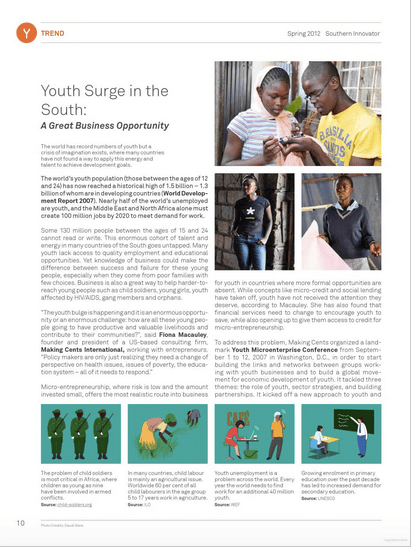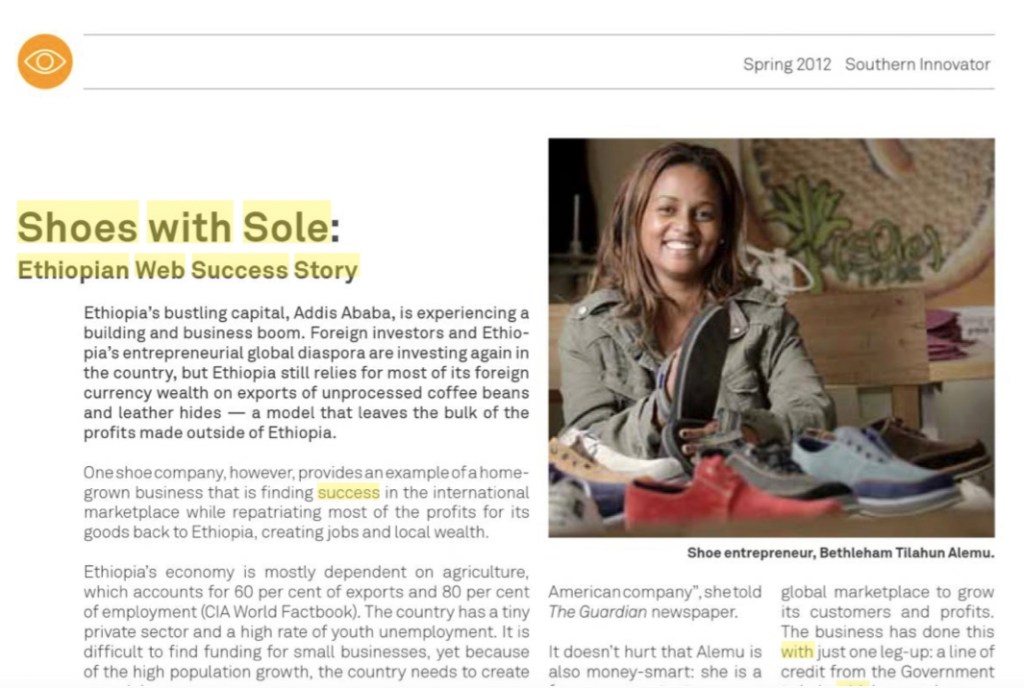
Tag: Southern Innovator magazine

  • Profile of African Innovators Continues to Rise

    Profile of African Innovators Continues to Rise

    By David South, Development Challenges, South-South Solutions

    SOUTH-SOUTH CASE STUDY

    A mix of developments is proving that African innovators no longer need to see themselves as lone operators working in isolation. Awareness of the continent’s talent has never been higher and is grabbing attention from the world’s media. In turn, more and more resources are being made available – from funding opportunities to get-togethers where innovators can meet like-minded people, to ego-boosting praise that helps raise profiles and attract investors.

    This summer saw the launch of a new publication called African Innovator Magazine (africaninnovatormagazine.com). It is a good example of how perceptions have switched to recognizing that the continent is awash with innovators who have a lot to say.

    Billing itself as “Technology insights for Africa’s decision makers,” African Innovator interviews business leaders on the continent about how they are driving innovation within their organizations.

    Launched at a dinner on July 31 in Johannesburg, South Africa (http://www.flickr.com/photos/innovationdinner/sets/72157630881776882/), the quarterly magazine – with its glossy production values, high-quality photographs and design – is a reflection of how far the information technology business has come in Africa. The first issue asks “What is Innovation?” and features a broad range of African technology innovators, from Nigerian tablet personal computer maker Saheed Adepoju (http://enciphergroup.com/about/) to one of the world’s best-known technology innovators, South African-born Elon Musk (http://elonmusk.com/).

    Publisher Abby Wakama told IT News Africa that the magazine would initially be distributed in South Africa, with plans to expand into Kenya and Nigeria.

    “Our aim is to grow the reader base and branch out into new regions,” Wakama said. “The vision is to be the premier voice of Africa’s larger ICT community, covering issues that impact on commerce, trade, industry and the lives of everybody who uses IT.

    “Readers do have a choice of publications that talk about ICT that cover technology and products. But there are very few that have an inside track into innovation in Africa. There are not many publications that discuss how technology is making an impact in the lives of Africans.”

    For innovators strapped for cash to take their ideas forward, there are several new Africa-based funding sources to turn to.

    In East Africa, the Rwanda Innovation Endowment Fund (RIEF) (http://www.mineduc.gov.rw/spip.php?article21) is a collaboration between the Government of Rwanda and the United Nations. The Fund aims to promote research and development (R&D) of “innovative market-oriented products and processes in priority areas of the economy” to increase the country’s wealth and economic competiveness.

    For Africans as a whole, there is The Innovation Prize for Africa (IPA) (http://innovationprizeforafrica.org), an initiative of the United Nations Economic Commission for Africa (ECA) and the African Innovation Foundation (AIF) (africaninnovation.org). The prize hopes to place African innovators and entrepreneurs at the heart of the development agenda. It will be awarded to innovators who develop new products, increase efficiency or find ways to do things better and save money in Africa.

    Africa Review, published by the Nation Media Group in Kenya, is “a digital news platform” providing “smart insights on African news and to examine important social and political trends in the continent.” It recently came up with a list of 20 East African “bold young innovators to watch”.

    The 20 were selected because all of them are working on mobile phone applications and are creating “life-changing mobile apps in health care, education, finance and agriculture.”

    They include:

    • Jamila Abass from Kenya, the founder and chief executive officer (CEO) for M-Farm (http://mfarm.co.ke/about), which is helping farmers get real-time retail prices for their products.
    • Tanzania’s Erric Mutta, founder and CEO of Problem Solved Ltd, set up the MiniShop mobile phone application for small businesses to make accounting and inventory control easier and more transparent – in turn making it easier to access credit.
    • Jessie Gakwandi Benimana runs Rwandan company Sail Ltd (http://sailltd.com/) and the Get-It application (http://www.youtube.com/watch?v=vU8SCfyzf9Q), which helps people to find restaurants in the capital Kigali.
    • Everyone knows Africans like to tell stories, and Victor Miclovich from Uganda is helping them to do this online. His StorySpaces (storyspaces.net) website “builds on the age-old African tradition of storytelling” for the digital age.
    • Tanzania’s Eric Lwambura is using technology to save lives during pregnancy. He is founder of Crystal Interactive Systems (CIS) (http://www.crystal-int.com/), which has developed a mobile phone-based application to assist doctors to detect problems during labour. It is designed for health centres that can’t afford more expensive and sophisticated equipment.
    • Kariuki Gathitu from Kenya who founded Zege Technologies (http://zegetech.com/home/), is working on innovative ways to transfer money. His latest development is M-Payer, helping small businesses manage their payments.

    Read more about the East African technology innovators here: http://www.africareview.com/Special+Reports/-/979182/1513900/-/xpmsurz/-/index.html

    Resources

    1) Southern Innovator: Browse the back issues of Southern Innovator magazine. Website: http://www.scribd.com/SouthernInnovator

    2) Innovative Africa: The New Face of Africa: Essays on the Rise of Africa’s Innovation Age by Will Mutua and Mbwana Ally, Publisher: Afrinnovator.  Website:http://book.afrinnovator.com/

    3) The Coming Prosperity by Philip Auerswald, Publisher: Oxford University Press.  Website: http://auerswald.org/

    Creative Commons License

    This work is licensed under a
    Creative Commons Attribution-Noncommercial-No Derivative Works 3.0 License.

    ORCID iD: https://orcid.org/0000-0001-5311-1052.

    © David South Consulting 2022

  • Better by Design in China

    Better by Design in China

    By David SouthDevelopment Challenges, South-South Solutions

    SOUTH-SOUTH CASE STUDY

    In recent decades, China has been known more for its inexpensive manufactured goods than as a producer of high quality products. But this is changing as the country seeks to move up the economic chain.

    China’s long-established design traditions were largely overlooked as the country made its breakneck push to become the world’s manufacturing powerhouse. But now Chinese manufacturers want to be known for high-quality designs and products rather than just for cheap-and-cheerful merchandise.

    China is a critical lesson for the rest of the global South, and offers much inspiration to any country trying to develop, modernize and eradicate poverty.

    The country is the main reason for the dramatic reductions in global extreme poverty rates, and it can be proud of using its average yearly economic growth rate of 10 per cent to lift 440 million Chinese out of poverty – the biggest reduction of poverty in history (The Economist). The strategy of exporting manufactured goods into Western markets at competitive prices has dominated the past 20 years.

    But China faces a dilemma as other nations in the global South are moving into this niche. It needs to quickly become a high-value nation, with unique products and designs generated in the country.

    Luckily, a renaissance in Chinese design in the last five years has been gradually grabbing the attention of the world’s creative community.

    Innovative Chinese designers are creating home furnishings and interiors that are being snapped up by European companies.

    The Italian kitchen utensil design company Alessi turned to eight Chinese architects – including Ma Yansong and Yung Ho Chang – to design a range of trays called (Un) Forbidden City. The architects’ designs were manufactured in Italy – a reversal of the pattern that has dominated for the past 20 years.

    The architects drew on Chinese traditions and 21st century technologies to design the trays. One was made using a 3D scanner which captured images used to make a mould.

    The drive to change and transform China’s global economic role was promoted in 2011’s Beijing International Design Week (http://www.bjdw.org/en/), with its theme of transforming “Made in China to Designed in China.”

    “When you have so much of a manufacturing base in one place, it’s natural that people start thinking about how to climb the value chain,” Philip Tinari, director of Beijing’s Ullens Centre for Contemporary Art (UCCA) (http://ucca.org.cn/) – a champion of new artists and designers – told howtospendit.com.

    “Chinese design has become something to rally around and, unlike art, enjoys great official support because it’s a way of improving China’s long-term economic position, as opposed to expressing thoughts about what’s been going on.”

    Other Chinese designers grabbing attention include Chen Xuan, who makes tables; chair-maker Gui Yang; Li Bowen, a maker of wicker chairs; and Ge Wei, a maker of jewellery boxes.

    Designer Huo Yijin makes contemporary tea trays, using heat-reactive lacquer coating to create dazzling effects.

    “Users can see the wonderful effect of water and temperature reacting on the tea trays when they drink Kungfu tea in the traditional way,” Huo explained.

    Jingdezhen, Jiangxi province – a city that has been making ceramics since the Ming Dynasty (1368–1644) – is now attracting craftspeople from around the world looking to tap into its expertise and skill. One attraction is Mr Yu’s Big Ware Factory. Its unparalleled ability to create giant-size pottery is a design niche with much potential.

    Many foreign creatives are being drawn to China for its can-do attitude and the ability to break with conventions stifling creativity in the West. The next five years could see the world’s design centre of gravity shift eastwards again.

    Published: November 2012

    Resources

    1) Ullens Centre for Contemporary Art (UCCA): The Ullens Center for Contemporary Art (UCCA) is a comprehensive, not-for-profit art center serving a global Beijing public. Website: http://ucca.org.cn/

    2) ChinaShijitanContemporaryArtCenter: A mixed-use art venue with experimental theatre, exhibition space, art gallery and production spaces. Website: http://www.ar-chiasmus.cn/project_6.html

    3) Pearl Lam Galleries: Pearl Lam Galleries lead a stable of International and Chinese artists who are multidisciplinary, refuting the hierarchy of art forms. The galleries do not follow the model of Western galleries; rather, they have evolved from the philosophy of Chinese Literati, which does not segregate between the different art disciplines. Website: http://pearllamgalleries.blogspot.co.uk/p/about.html

    4) School of Design of the China Central Academy of Fine Arts (CAFA): The Central Academy of Fine Arts, located in Beijing, the capital of China, is an academy where culture, history and art are flourishing, which enjoys the best art resources of the world. Website: http://www.cafa.edu.cn/aboutcafa/lan/?c=1101

    5) Beijing’s legendary 798 art district: “798” is located in the Dashanzi area, to the northeast of central Beijing. It is the site of state-owned factories including Factory 798, which originally produced electronics. Beginning in 2002, artists and cultural organizations began to divide, rent out, and re-make the factory spaces, gradually developing them into galleries, art centers, artists’ studios, design companies, restaurants, and bars. Website: http://www.798space.com/subpage_en.asp?classid=17

    https://davidsouthconsulting.org/2021/03/20/accessing-global-markets-via-design-solutions/

    https://davidsouthconsulting.org/2021/03/12/afro-coffee-blending-good-design-and-coffee/

    https://davidsouthconsulting.org/2021/02/20/baker-cookstoves-designing-for-the-african-customer/

    https://davidsouthconsulting.org/2021/08/29/brazilian-design-for-new-urban-middle-class-world/

    https://davidsouthconsulting.org/2022/10/04/the-brck-kenyan-developed-solution-to-boost-internet-access/

    https://davidsouthconsulting.org/2020/12/10/china-sets-sights-on-dominating-global-smartphone-market/

    https://davidsouthconsulting.org/2021/01/26/designed-in-china-to-rival-made-in-china/

    https://davidsouthconsulting.org/2021/06/11/indonesian-wooden-radio-succeeds-with-good-design/

    https://davidsouthconsulting.org/2022/10/04/popular-chinese-social-media-chase-new-markets/

    https://davidsouthconsulting.org/2021/10/04/putting-quality-and-design-at-the-centre-of-chinese-fashion/

    Creative Commons License

    This work is licensed under a
    Creative Commons Attribution-Noncommercial-No Derivative Works 3.0 License.

    ORCID iD: https://orcid.org/0000-0001-5311-1052.

    © David South Consulting 2023

  • Turning African Youth on to Technology

    Turning African Youth on to Technology

    By David SouthDevelopment Challenges, South-South Solutions

    SOUTH-SOUTH CASE STUDY

    An African NGO believes the Internet is the single biggest key to rapid development in Africa – and it is working to connect youth, women and rural populations to the web, and in turn, switch them on to the vast resources stored across the world’s Internet sites.

    After initial successes with a youth project and with farmers, Voices of Africa (VOA) (http://www.voicesofafrica.info) is now seeking to scale up its work to fan out across Africa – and take its services to the world’s largest refugee camp, the Dadaab Refugee Camp in Kenya. 

    The youth and technology empowerment NGO has developed a business model to deliver low-cost Internet access and e-resources to Africa’s slums and rural farmers.

    VOA argues that “the digital divide, defined by a lack of access to information for a specific population, symbolizes the largest difference between developed and developing countries: the opportunity to obtain and utilize information.”

    “The digital divide runs much deeper than hardware and software,” it says. “While equipment is necessary it is not sufficient. The real heart of the digital divide is that those without access to information resources often suffer needlessly while the solutions to their problems are floating in the air.”

    But why is the Internet so important?

    “The internet puts the choice of content at the fingertips of the user,” explains executive director Crystal Kigoni. “Traditional media is one way communications. Internet is bi-directional.

    “Our NGO is completely grassroots. We train the people who train the people. It is an each one, teach one philosophy and is highly effective. We also design our projects to be self-sustainable after one year of successful implementation.”

    The philosophy behind Voices of Africa – “Sustainable Development through Information Empowerment” – is to give people the information and resources to take better control of their lives.

    Access to the Internet in Africa is patchy and, for the poor, an expensive resource. The penetration of mobile phones in Africa has been spectacular in the past five years. But there are limits to the resources people can afford to access with their phones. Issues abound about data costs, mobile phone networks, and mobile phone capability.

    VOA targets youth and women in sub-Saharan Africa through online educational resources offered on their e-learning website (http://elearning.voicesofafrica.info/). The resources have been certified by Nazarene University (http://www.anu.ac.ke), a private university in Nairobi, Kenya.

    The e-learning resources include high quality training videos, presentations and screencasts (http://en.wikipedia.org/wiki/Screencast) – like a movie, it is a digital recording of changes on a computer screen and is used to teach software – to share on the web. The resources are also shared through compact discs (CDs) and iPods (http://en.wikipedia.org/wiki/IPod).

    Project coordinator Nick Kungu coordinates the staff working on the pilot Kenyan projects: a Rural Internet Kiosk; a Youth Empowerment Center; and KiberaNet, which launched in August 2011. VOA uses a part-time and volunteer staff of more than 20 Kenyans and four international ‘virtual’ volunteers.

    The group is also working with farmers in Kutus, central Kenya, to help them get a better price for their products and introduce sustainable agriculture practices. This is done through online courses so the farmers do not need to travel. It is hoped by doing this they can improve the supply of food for the country.

    The Youth Empowerment Center in Webuye constituency of the Western province of Kenya involves a partnership with the government of Kenya to teach computer basics, research and data collection, social media, ICT (information communication technology) for development, social business and community health.

    In rural areas, the need for information cannot be overestimated. In the remote countryside, there are few schools with adequate resources and almost no community libraries. The lifesaving knowledge the people require has to date been completely beyond their grasp. As one rural woman in the Western province of Kenya exclaimed to VOA after encountering the resources on the Internet, “It is like being brought from the darkness into the light.”

    Another project in development is SlumNet, which seeks to combine the Internet with low-cost devices like tablet computers and netbooks. Its pilot scheme, KiberaNet, launched this month in the Kibera slum of Nairobi, Kenya to test the business model. VOA hopes to then expand it to Uganda, Tanzania, Ghana, Nigeria and Sierra Leone. It is using a business model to bring low-cost Internet access to Africa’s slums that is fully funded by the local communities and the users.

    It has identified the key needs of youth in slums that need to be met: a way to access the vast resources available on the Internet; a way to generate income, undertake low-cost learning, and organise for social justice; ways to overcome social, economic and political isolation; a way to access affordable equipment and resources to improve their quality of life in the short-term.

    To make it a sustainable business model, the community takes a 60 percent stake in the incorporated entity. Voices of Africa will select six local civil society organisations to take another 10 percent stake in the business. VOA takes 10 percent and the remaining 30 percent will be open to outside investors.

    It involves setting up a closed intranet system and Internet access covering the entire Kibera slum, which has an estimated population of 2 million, a majority under the age of 30.

    KiberaNet hopes to act as a community hub for socialising, education and generating content. A key part is creating an atmosphere that is welcoming to novices. The business model is about delivering the bandwidth of Internet access and simultaneously generating a sustainable source of income to keep it going. Partners in the business include Promote Africa, Plexus Group and Future Optics Networks.

    VOA also has been blogging about its time in Kenya’s Dadaab Refugee Camp (http://www.unhcr.org/cgi-bin/texis/vtx/page?page=49e483a16) at their website, www.voicesofafrica.info, and has been developing plans to expand services to the camp, home to over 400,000 refugees from drought and famine in Somalia. The camp was only designed to hold 90,000 people. The chronic food insecurity has caused a massive humanitarian crisis in the Horn of Africa, leaving over 10 million people in need of help.

    “There are plenty of resources going in but it is aid business as usual,” claims Kigoni. “You see lots of waste in many areas, and a lack in others that would be extremely beneficial. Hence, why Voices of Africa has come up with the youth technology and empowerment plan that accompanies a general information and communications system, DadaabNet.”

    DadaabNet will be a youth-run community Internet service and education service. VOA plans to use a wireless intranet, internal communications systems and low-cost internet access in the refugee camp.

    The project is the first of its kind in Dadaab and a first in Kenya, claims VOA, allowing free educational content without needing to access the Internet

    The intranet will host free educational videos that can be accessed by mobile phones and computers. The topics covered in the videos include health, nutrition, sanitation and computer training and how to use technology for sustainable development.

    The curriculum is also approved by Nazerene University to certificate level.

    The system is supervised and would be able to offer resources to other NGOs seeking to provide services to the camp’s residents. The intention is to open up opportunities for education and employment youth who are currently unemployed.

    At present the youth in the camp, many of whom have not completed secondary school, get by ‘hustling’ for work, according to VOA. By being left to their own devices, there is a risk they will fall into negative behaviour like crime and drug use or be preyed upon by terrorist organisations operating in the area like al Shabaab, they maintain.

    “In our dreams, everyone everywhere in the world can have the opportunity to develop their minds. It is through this creativity that Africa will rise,” concludes Kigoni.

    Published: August 2011

    Resources

    1) The Impact of Mobile Phones on Profits from Livestock Activities by Roxana Barrantes. Website: http://www.mendeley.com/research/impact-mobile-phones-profits-livestock-activities-evidence-puno-peru-14/

    2) 2011 UNHCR Country Operations Profile – Kenya. Website: http://www.unhcr.org/cgi-bin/texis/vtx/page?page=49e483a16

    3) Southern Innovator magazine: New global magazine Southern Innovator’s first issue is out now and is about Mobile Phones and Information Technology in the global South. Website: http://www.scribd.com/doc/57980406/Southern-Innovator-Issue-1

    Creative Commons License

    This work is licensed under a
    Creative Commons Attribution-Noncommercial-No Derivative Works 3.0 License.

    ORCID iD: https://orcid.org/0000-0001-5311-1052.

    © David South Consulting 2023

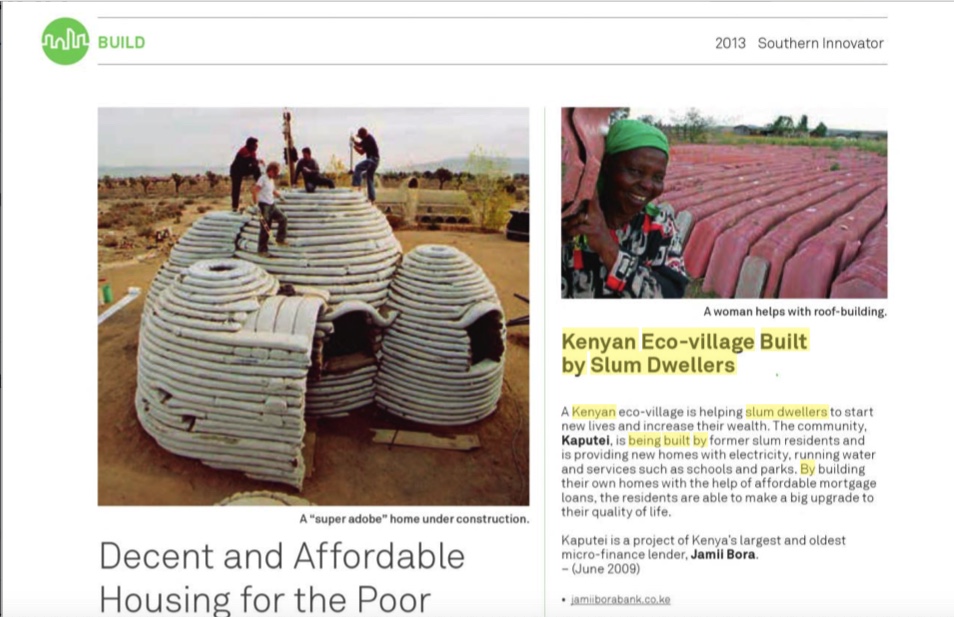
  • Kenyan Eco-Village Being Built by Slum-Dwellers

    Kenyan Eco-Village Being Built by Slum-Dwellers

    By David SouthDevelopment Challenges, South-South Solutions

    SOUTH-SOUTH CASE STUDY

    A Kenyan eco-village is helping slum dwellers to start new lives and increase their wealth. The community, Kaputei, is being built by former slum residents – some of whom used to beg to survive – and is providing new homes with electricity, running water and services like schools and parks. By building their own homes, with the help of affordable mortgage loans, the residents are able to make a big upgrade to their quality of life while acquiring real wealth.

    More than 900 million people – almost a sixth of the world’s population – now live in urban slums (UN). This number will double by 2030 as a result of rapid urbanization in developing countries. Already in developing countries 43 per cent of urban dwellers live in slums, and the figure leaps to 78 per cent in the least-developed countries. The UN estimates it will take US $18 billion a year to improve living conditions for these people – and most of it will have to come from the residents themselves.

    Kaputei is a project of Kenya’s largest and oldest micro-finance lender, Jamii Bora (www.jamiibora.org). Having enjoyed significant success in making loans to over 225,000 people – after starting out in 1999 with loans to just 50 beggars – it realized something on a larger scale was necessary to permanently transform the lives of poor Kenyans.

    Jamii Bora’s founder, Ingrid Munro, saw the whole atmosphere of the slums as the biggest impediment to long-term life changes. “As long as you are living in the slums, you will never climb out of poverty,” she told The Independent newspaper. “Families of course need economic opportunities to rise out of poverty, but what good are they if you are still living in hell?”

    Jamii Bora came up with the idea of building an entire community from scratch, and doing it in way that was affordable, ecological and sustainable, while building the wealth of the residents. Since 2007, the project has provided homes for 50 families; the target is to have homes for 2,000.

    One former beggar who has built her own home is Clarice Adhiambo. An early client of Jamii Bora, she started to learn how to save, reaching her first goal of saving 1,000 Kenyan shillings (US $12.81). With Jamii Bora’s encouragement, she plowed this money back into buying some fish and selling it in the markets. Over time, she was able to grow her efforts until she was a regular market trader, and was borrowing as much as US $1,900 to fund various slum businesses.

    Then came the Kaputei project. It has helped Adhiambo move from a 3 meter by 3 meter tin shack in the Nairobi slum of Soweto to her own home with running water: “So much water,” she told The Independent.

    The new home is 50 square metres with two bedrooms, a sitting room and a bathroom.

    Adhiambo pays US $36 a month for her mortgage — more than most people, because she wants to pay it off quickly. That compares to about US $20 a month in rent paid by many slum dwellers to live in squalor with poor services and quality of life.

    Kaputei is a clever community project. Unlike attempts to build housing for the poor in isolation, Kaputei is based on neighbourhoods of 250 families each, with common community centres, playgrounds, parks and church halls. There is a town centre, and zones for commercial and industrial enterprises. The project was approved by the Kenyan government in 2004 and has planning permission for 119 hectares. Trees are being planted to provide protection from wind, add beauty, and, in time, to be a source of income or firewood. A wetland is being used to recycle waste water and is being run in partnership with Kenyan universities.

    Each house costs US $1,875 to build. The homes are so cheap because the building materials are assembled in a factory on site, and the families help with the building.

    Three house models are available and the families – from the Kamba, Kikuyu, Luo and Maasai peoples – choose the one they like by viewing show homes on site. Each home has access to roads, water and sewage.

    It’s estimated the entire community of 2,000 families will cost US $3,750,000 for the homes, and another US $3,750,000 for infrastructure. Mortgages are offered at between 8.5 percent and 10 percent interest and are estimated to take 10 to 15 years to repay. The average mortgage is about US $32 a month.

    Published: June 2009

    Resources

    Builders Without Borders: Is an international network of ecological builders who advocate the use of straw, earth and other local, affordable materials in construction. Website: www.builderswithoutborders.org/

    World Hands Project: An NGO specialising in simple building techniques for the poor. Website:www.worldhandsproject.org

    CIDEM and Ecosur specialize in building low-cost community housing using eco-materials. They have projects around the world and are based in Cuba. Website: www.ecosur.org

    The Building and Social Housing Foundation: An independent research organization promoting sustainable development and innovation in housing through collaborative research and knowledge transfer. Website: www.bshf.org

    Slum TV: Based deep inside Nairobi’s largest slum, Mathare, they have been seeking out the stories of hope where international media only see violence and gloom. Website: www.slum-tv.org

    https://davidsouthconsulting.org/2022/10/06/africas-fast-growing-cities-a-new-frontier-of-opportunities/

    https://davidsouthconsulting.org/2022/05/23/debt-free-homes-for-the-poor/

    https://davidsouthconsulting.org/2022/02/17/digital-mapping-to-put-slums-on-the-map/

    https://davidsouthconsulting.org/2022/04/28/envisioning-better-slums/

    https://davidsouthconsulting.org/2022/11/16/favela-fashion-brings-women-work/

    https://davidsouthconsulting.org/2021/11/04/filipino-architect-wants-to-transform-slum-with-new-plan/

    https://davidsouthconsulting.org/2022/11/16/housing-innovation-in-souths-urban-areas/

    https://davidsouthconsulting.org/2022/10/25/indian-city-slum-areas-become-newly-desirable-places-to-live/

    https://davidsouthconsulting.org/2022/04/28/innovation-in-the-slums-can-bring-peace-and-prosperity/

    https://davidsouthconsulting.org/2022/10/31/mapping-beirut-brings-city-to-light/

    https://davidsouthconsulting.org/2021/10/03/a-new-house-kit-for-slum-dwellers-that-is-safe-and-easy-to-build/

    https://davidsouthconsulting.org/2022/11/19/securing-land-rights-for-the-poor-now-reaping-rewards/

    https://davidsouthconsulting.org/2022/11/17/tiny-homes-to-meet-global-housing-crisis/

    https://davidsouthconsulting.org/2022/11/18/toilet-malls-make-going-better/

    https://davidsouthconsulting.org/2022/10/17/the-water-free-south-african-bathing-solution/

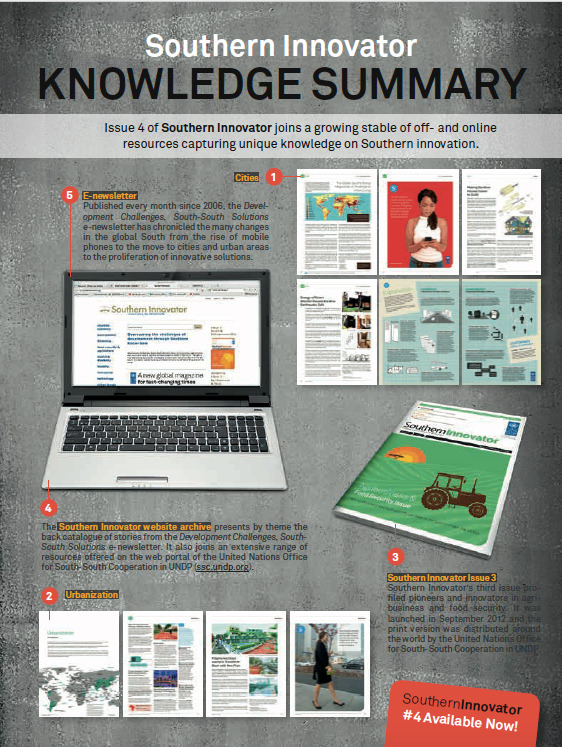
    https://davidsouthconsulting.org/2021/03/05/southern-innovator-issue-4/

    Creative Commons License

    This work is licensed under a
    Creative Commons Attribution-Noncommercial-No Derivative Works 3.0 License.

    2009: Development Challenges, South-South Solutions

    ORCID iD: https://orcid.org/0000-0001-5311-1052.

    © David South Consulting 2023