Tag: Southern Innovator magazine

  • Ugandan Project Pioneers Transparent Development

    Ugandan Project Pioneers Transparent Development

    By David SouthDevelopment Challenges, South-South Solutions

    SOUTH-SOUTH CASE STUDY

    A pioneering experiment in the community of Katine (www.guardian.co.uk/katine) in the East African nation of Uganda recently came to its official end. A unique three-year project to try and transform the development outcomes of this rural community, it pioneered a new model of communicating aid and development. Unusual transparency was used to show how things work – or don’t – in development. The budgets, the reports and the evaluations are all available on the website. Britain’s Guardian newspaper regularly covered the work, and two Ugandan journalists embedded in the community gave regular updates as well.

    A rich resource of web content was built up over the three years. People were able to post their comments and criticisms on the website for all to see. Members of the community logged onto the website as well and gave their on-the-ground views. Development workers had to explain what they were doing and why.

    Anthropologist Ben Jones wrote in The Guardian that Katine is “remarkable: for the first time, the complex reality of doing a development project has been brought to a wider audience.”

    Katine is a rural community of villages and home to 29,000 people. The Katine development project set out to focus on five aspects of deprivation: health, education, water and sanitation, livelihoods and governance.

    It was launched in 2007, when The Guardian urged its readers to donate to support the project. The British bank Barclays pledged to match the donations up to £1 million (US$1,619,229). The NGO Farm-Africa (http://www.farmafrica.org.uk/) provided expertise on agriculture and the project partnered with Amref (http://uk.amref.org/), a leading African health NGO.

    Journalists, academics, development experts and NGOs tracked progress on the web and shared this with the general public.

    The records show that the project spent a total of US $3.72 million between 2007 and 2010. Administration in various forms used US $968,166 while, US $501,935 was spent on health projects, US $650,866 on education and US $577,997 on water and sanitation.

    Accomplishments included a boost to safe water coverage from 42 percent to 69.6 percent, and the distribution of 7,000 malaria nets. A co-operative was set up to help sell surplus agricultural products from farmers and teach new skills to grow disease-resistant cassava. A culture of saving and investing was also introduced with the establishment of 150 village savings and loans associations. They charged a start up membership fee of 12 US cents. Villagers used small loans to start small businesses or to buy medicine. In one year, a total of £22, 482 (US $36,401) was banked.

    Along the three-year journey, tempers flared over the cost of a school’s classrooms, and people vented their feelings regularly on the project website.

    Beyond the donated inputs to the community, the issue of sustainability has taken more hard work. The community needed a better organizing structure and committees were established: village health teams, parent-teacher associations, water source committees, farmers’ groups, parent-teacher associations, and village savings associations.

    It wasn’t just a legacy of poverty the community had to contend with: residents also were overcoming the disruption and trauma of decades of violence and instability. The Lord’s Resistance Army had terrorised the population in 2003, for example.

    With the relationship with The Guardian ending, Amref will continue to work for another year to strengthen the community structures to lock in the sustainability of the achievements.

    This experience is an interesting one that could be copied across the South, with people sharing their recent experiences of development and how they overcame poverty.

    Published: November 2010

    https://davidsouthconsulting.org/2022/11/21/africa/

    https://davidsouthconsulting.org/2022/10/14/anti-bribery-website-in-india-inspires-others/

    https://davidsouthconsulting.org/2021/03/04/innovation-villages-tackling-mdgs/

    https://davidsouthconsulting.org/2021/04/08/making-the-world-a-better-place-for-southern-projects/

    https://davidsouthconsulting.org/2021/03/31/new-weapon-against-crime-in-the-south/

    https://davidsouthconsulting.org/2022/11/23/publications/

    https://davidsouthconsulting.org/2021/02/22/team-southern-innovator-phase-1-development-2010-2015/

    https://davidsouthconsulting.org/2021/09/16/ugandan-fish-sausages-transform-female-fortunes/

    https://davidsouthconsulting.org/2022/06/16/women-mastering-trade-rules/

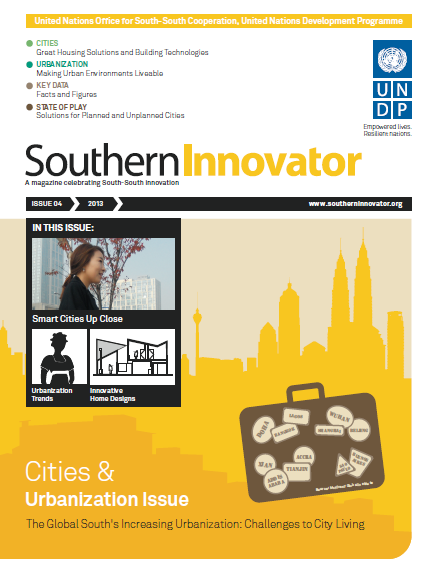
    Development Challenges, South-South Solutions was launched as an e-newsletter in 2006 by UNDP’s South-South Cooperation Unit (now the United Nations Office for South-South Cooperation) based in New York, USA. It led on profiling the rise of the global South as an economic powerhouse and was one of the first regular publications to champion the global South’s innovators, entrepreneurs, and pioneers. It tracked the key trends that are now so profoundly reshaping how development is seen and done. This includes the rapid take-up of mobile phones and information technology in the global South (as profiled in the first issue of magazine Southern Innovator), the move to becoming a majority urban world, a growing global innovator culture, and the plethora of solutions being developed in the global South to tackle its problems and improve living conditions and boost human development. The success of the e-newsletter led to the launch of the magazine Southern Innovator.  

    Follow @SouthSouth1

    Slideshare: http://www.slideshare.net/DavidSouth1/development-challengessouthsouthsolutionsnovember2010issue

    Southern Innovator Issue 1: https://books.google.co.uk/books?id=Q1O54YSE2BgC&dq=southern+innovator&source=gbs_navlinks_s

    Southern Innovator Issue 2: https://books.google.co.uk/books?id=Ty0N969dcssC&dq=southern+innovator&source=gbs_navlinks_s

    Southern Innovator Issue 3: https://books.google.co.uk/books?id=AQNt4YmhZagC&dq=southern+innovator&source=gbs_navlinks_s

    Southern Innovator Issue 4: https://books.google.co.uk/books?id=9T_n2tA7l4EC&dq=southern+innovator&source=gbs_navlinks_s

    Southern Innovator Issue 5: https://books.google.co.uk/books?id=6ILdAgAAQBAJ&dq=southern+innovator&source=gbs_navlinks_s

    https://davidsouthconsulting.org/2021/03/05/southern-innovator-issue-2/

    Creative Commons License
    This work is licensed under a
    Creative Commons Attribution-Noncommercial-No Derivative Works 3.0 License.

    ORCID iD: https://orcid.org/0000-0001-5311-1052.

    © David South Consulting 2023

  • African Manufacturing Pioneers Proving it is Possible to Thrive

    African Manufacturing Pioneers Proving it is Possible to Thrive

    By David SouthDevelopment Challenges, South-South Solutions

    SOUTH-SOUTH CASE STUDY

    Africa’s paradox is that it is home to the greatest share of the world’s unexploited resources, yet has some of the world’s lowest per capita incomes. History has shown that exploiting the continent’s resources alone for export markets does little to improve incomes and living conditions in Africa, which in turn does nothing to improve human development. The key to resolving this paradox is made-in-Africa jobs, in particular high-value jobs that make products.

    Africa still mostly makes its income from exporting raw commodities, from minerals to fuel to food. In the 1990s, Asian countries exported five times more manufactured goods, as share of GDP, than sub-Saharan Africa. Things changed in the 2000s. African manufactured output has roughly doubled over the last 10 years. And those goods are going more to the emerging economies than to the traditional powers (African Economic Outlook).

    African Economic Outlook points out that by 2009 “trade between African countries and emerging powers equalled that between Africa and its traditional partners.”

    “South-based manufacturing enhances the welfare of African consumers via prices and functionality,” the report says.

    “For instance, generic Indian pharmaceuticals are cheaper than brands from traditional partners.”

    Small and medium enterprises (SMEs) have been identified as a key part of Africa’s future prosperity and key to its ability to reduce poverty and achieve development objectives like the Millennium Development Goals (MDGs) (www.un.org/millenniumgoals).

    The sector is large but its economic power is inefficiently used. Telling the Wall Street Journal, Mthuli Ncube, chief economist at the African Development Bank Group, estimated one-quarter of Africa’s gross domestic product — about US $450 billion — comes from 65 million small and medium-sized enterprises.

    Manufacturing has been difficult to measure because so many businesses are just tiny cottage industries.

    Obstacles to growth include poor infrastructure, unreliable power supplies, unscaleable business models, low quality standards and poor quality branding and design.

    Access to funding is often weak and fragmented and many programmes run by international donors and banks targeting SMEs are uncoordinated and duplicate resources. The global economic crisis has not made these factors any easier.

    But things are changing in many areas. The booming technology, consumer goods and resource sectors offer hope for a manufacturing renaissance.

    There are examples from Africa defying the sceptics and showing it is possible to expand and export manufactured, finished goods that meet international standards.

    What they have in common is a sophisticated product offering and an ability to meet international export standards. They also have overcome obstacles that scare away more timid international rivals.

    Nigerian shoe and garment maker Fut Conceptus (www.futconceptus.com) has been taking raw Nigerian leather that was once just sent overseas for export, and instead is turning out high-quality shoes and bags made in Nigerian factories. These shoes – made in African, Spanish and Italian styles – meet international standards and are exported aroundAfrica. It has also established operations in Spain and the United Kingdom.

    Started in 2008, the company got off to a good start by seeking out the best expertise to train its staff. Shoe-making experts fromSpainwere brought in to do the training. The company also imported top-quality machinery fromItalyandSpainto make sure its operations were modern and efficient.

    These first, smart moves have meant the company is able to run an efficient and high-skilled operation inNigeriawhile also making its products to international standards. This is critical for a start-up business: the better the quality of the product in the beginning, the better the chance for accessing lucrative export markets. And the better and more efficient the manufacturing processes, the better chance a company will have meeting increasing demand and tight deadlines. It is one thing to make the best shoe in the world, but if you cannot deliver the quantity required for orders, then your reputation will be damaged.

    Fut Conceptus is able to produce 22,000 pairs of sandals and 10,000 pairs of safety boots a day, according to its website.

    Fut Conceptus Manufacturing Nigeria Ltd. also found a way to thrive in the country’s difficult and erratic conditions. To deal with the unreliable power supply, they run four electric generators. This costs them US $500 a day in fuel. This power problem scares off multinational companies, leaving the market open for Fut Conceptus. The company has been able to use this first-mover advantage to build its brand acrossWest Africa. It currently makes men’s moccasins, slippers, law enforcement footwear, safety footwear, and ladies’ sandals.

    Founder Olumide Wole-Madariola is proud of the achievement. “Nobody was ready for what we were doing… Nobody was ready for ‘Made inNigeria,’” he said.

    South African sauce maker Primolitos (www.primolitos.com) has become one of the few African companies able to meet international standards for food exports. It makes a vast range of products (http://www.primolitos.com/index.php?option=com_content&view=article&id=10&Itemid=12), from juices to sauces, spices, pickles, soups and baked goods.

    The company has been around for over a decade and sells 2,000 products. It has also set-up a sister division to specialise in liquid and powdered food sachets. The company also has a clear “Quality Policy”, championing collective decision-making between management and staff, delivering “quality and safe consumer products”, and a system to quickly respond to consumer complaints and recall substandard products. All ingredients for building trust in a business.

    It also has an ISO 20 0002 (www.iso.org/iso/home.html) accredited factory, complete with three testing labs, a training room, test kitchen, care centre for employees’ children, a wellness centre, laundry, high-tech water filtration and purification systems and the latest in hygiene and manufacturing processes. All of this a clear example of the commitment required to build a quality company that can export.

    Over at Good African Coffee, Ugandan entrepreneur Andrew Rugasira is pioneering new ways to process coffee inAfrica. He set upUganda’s first enterprise to make instant coffee two years ago. This is a radical departure from the old practice of exporting the coffee beans to Europe for processing into instant coffee, which would then be exported back toAfrica.

    “For decades, Africans have produced what they do not consume and consumed what they do not produce,” Rugasira told the Wall Street Journal.

    The company has developed unique distribution arrangements for its instant coffee. A recent deal included providing coffee for an American network of 12,000 churches.

    The company’s products are cleverly designed and packaged and are sold in distinct colour-coordinated packets. The company also passionately champions “trade not aid” as the long-term solution toAfrica’s economic growth (http://www.goodafrican.com/index.php/our-story/trade-not-aid.html).

    On the African islandof Madagascar, a company is trying to reverse the practice of exporting Africa’s cocoa beans for manufacturing into chocolate products. The Madecasse Chocolate LLC. (http://madecasse.com) is a collaboration between American entrepreneur Tim McCollum and Madagascan chocolatier Shahin Cassam Chenai. The company is making a range of chocolate and vanilla products for US supermarkets.

    “IfAfricacould sell the world chocolate…it wouldn’t solve all the continent’s problems, but it could make a big dent,” McCollum told the Wall Street Journal.

    Africais believed to produce 60 to 70 percent of the world’s cacao supply. Less than one percent is made inAfricaand most is made into chocolate outside the continent.

    Madecasse’s high-quality chocolate bars sell in the USfor US $6 each. Their market niche is to make “a single-origin chocolate, made entirely in Madagascar, which rivals the flavour of the best European chocolates”, according to its website. Flavours (http://store.madecasse.com) include pink pepper and citrus, cinnamon and sakay (a type of Madagascan hot pepper sauce), exotic pepper, sea salt and nibs, Arabica coffee, and baking chocolate. They also sell the world-famous Madagascan vanilla beans and extract. All are sold in colourful and well-designed packaging and sold on their website.

    Chenai is a self-taught chocolate maker and works with a local team to refine the Madécasse chocolate.

    “Connoisseurs knowMadagascarproduces some of the best cocoa in the world,” maintains Chenai. “My passion is to prove we can produce some of the best chocolate in the world.”

    Published: December 2011

    Resources

    1) SME Toolkit South Africa: A website packed with resources and support for anyone starting a small business in Africa. Website: http://southafrica.smetoolkit.org/sa/en

    2) African Guarantee Fund for Small and Medium-sized Enterprises: The AGF provides guarantees and technical assistance to financial institutions in Africa with the objective of generating enhanced growth in the SME sector and increasing employment opportunities in the economy, particularly for youth. Website: www.afdb.org/en/topics-and-sectors/initiatives-partnerships/african-guarantee-fund-for-small-and-medium-sized-enterprises/

    3) Small and Medium Enterprise Support, East Africa: A blog promoting events and support for SMEs in East Africa. Website: http://smeseastafrica.blogspot.com/

    4) Integrating Developing Countries’ SMEs into Global Value Chains: A paper from UNCTAD (2010). Website:http://www.unctad.org/en/docs/diaeed20095_en.pdf

    Creative Commons License

    This work is licensed under a
    Creative Commons Attribution-Noncommercial-No Derivative Works 3.0 License.

    ORCID iD: https://orcid.org/0000-0001-5311-1052.

    © David South Consulting 2023

  • Vietnamese Google Rival Challenging Global Giant

    Vietnamese Google Rival Challenging Global Giant

    By David South, Development Challenges, South-South Solutions

    New UNOSSC banner Dev Cha 2013

    SOUTH-SOUTH CASE STUDY 

    Information technologies are creating new business opportunities across the global South. As more and more people gain access to the Internet in one form or another, opportunities to offer them services also increase.

    A number of key trends show how the Internet’s profile is being reshaped by the growing number of users from the global South. One of those trends is language. English was the first language to dominate the Internet – but this is changing, according to the latest data.

    China has the largest number of Internet users in the world (China Internet Network Information Center) and the Chinese language is the second-most often used online, behind English and before Spanish and Japanese (http://www.internetworldstats.com/stats7.htm).

    While most English-language users turn to the giant Google search engine to look things up on the Internet, Google also has many rivals chasing its tail. In China, Baidu (baidu.com) offers searches in Mandarin using Chinese characters, making the Internet easier to navigate for Mandarin speakers. Elsewhere, Arabic language Internet users are being offered new services and urls using Arabic characters.

    In short, the Internet is becoming multilingual, customized and local, and creating new opportunities with it.

    One new business in Vietnam is challenging Google with its own locally tailored search engine. Called Coc Coc (http://coccoc.com/) – Knock Knock in English – it has already spent US $10 million to hire 300 staff at its Hanoi base, according to the Associated Press. Whether Coc Coc is successful or not in the long term, it is clear as a business it is already helping the local economy by hiring so many people and investing in Vietnam. Google currently does not have any staff in Vietnam because of its concerns about legal conflict with the government over censorship of content on the Internet, AP reports.

    Coc Coc believes it has developed a system that better understands the grammar, syntax and nuances of the Vietnamese language. Another advantage it believes it has over Google is its large presence on the ground in Vietnam. With a headquarters in Hanoi, it can quickly make marketing deals and agreements with content providers. To further its local advantage, Coc Coc has dispatched camera crews and photographers to film and photograph streets and log the details of shops, cafes and businesses – all to make search results more accurate and richer in detail.

    The headquarters is spread out over four floors of a downtown office block in Hanoi, and according to the Associated Press has a relaxed atmosphere similar to that found in many places in California’s technology start-up culture.

    Coc Coc is a joint Russian-Vietnamese venture and is hoping to ride the fast-growing Asian Internet market by offering a search tool that understands the nuances of the Vietnamese language online. By using algorithms (https://en.wikipedia.org/wiki/Algorithm) it promises to give a faster and better search experience to Vietnamese-language users. It also uses its knowledge of the local scene to  tailor results to users’ needs.

    The plan is to spend US $100 million during the next five years to lure 97 per cent of Vietnamese Internet users to make the switch from Google.

    “When I came here, I had some understanding why Vietnam was a good market to beat Google,” said Mikhail Kostin, the company’s chief search expert. “But after living here for one year, I understand the language and market much more deeply. I’m sure it’s right.”

    Having a local search engine tool can be a successful approach. The Yandex (http://www.yandex.com/) search engine in Russia beats Google in the Russian-speaking market. In South Korea, there is the Naver (naver.com) search engine.

    Google battled it out with the Chinese search engine Baidu in 2010 before leaving the country when Google refused to abide by government censorship guidelines. Baidu in the meantime has become the number one search engine in China and is planning to expand to other markets throughout Asia.

    “Google is a foreign company, and they are not here,” said one of the three founders of Coc Coc, Nguyen Duc Ngoc. “We can serve the interests of the local market better.”

    Vietnam has been experiencing rapid economic growth since the introduction of the Doi Moi (https://en.wikipedia.org/wiki/Doi_Moi) economic reforms two decades ago in 1986.  Vietnam is fast becoming an Internet success story, with a third of its population of 88 million (World Bank) (http://www.worldbank.org/en/country/vietnam) now online. Many are accessing the Internet through their mobile phones and electronic devices.

    Vietnam connected to the Internet in the 1990s and the infrastructure was built up in the mid-2000s. A national plan that kicked off in 2005 accelerated take-up of the Internet in the country as more and more people accessed the Internet through mobile phones, often at home, rather than just in public Internet centres. One study found 71 per cent of users in major cities were accessing the Internet at home (https://opennet.net/research/profiles/vietnam). One in three people in Vietnam now has access to the Internet. Significantly, the Internet has been an overwhelming success with youth in the main cities of Hanoi and Ho Chi Minh City, where 95 per cent of people in the 15-to-22 age group has Internet access.

    Optimists point to Vietnam’s large youth population, fast-growing economy and its modern Internet infrastructure as advantages that will boost its Internet economy. This is attracting entrepreneurs and investors from across Asia and around the world working in the field of online content, e-payments systems and other online services.

    With Vietnam’s Internet scene on fire, many people and companies are piling in to come up with the Next Big Thing online. Many have failed, but the same is true in every other country where new information technologies have been introduced. The nature of information technology innovation means ideas quickly rise or die depending on whether Internet users find the innovation useful or attractive. Despite great ideas, there are often far too many factors at play to guarantee any one person or company will have a success on their first try. As has happened elsewhere, ideas hatched by small start-ups, if good, are gobbled up by larger companies. Talented and skilled people usually find themselves being chased by other companies.

    Resources

    1) Techinasia: “Vietnam is Asia’s New Tech Manufacturing Hub”. Website: http://www.techinasia.com/vietnam-asias-tech-manufacturing-hub/

    2) Allo’ Expat Vietnam: A list of Vietnam’s Internet Service Providers (ISPs). Website: http://www.vietnam.alloexpat.com/vietnam_information/internet_service_providers_vietnam.php

    3) Telecommunications in Vietnam: A quick explanation from Wikipedia on the state of play in Vietnam. Website: http://en.wikipedia.org/wiki/Telecommunications_in_Vietnam

    4) Vietnam Women’s Innovation Day 2013: Theme: “Women’s Economic Empowerment”. Website: http://www.worldbank.org/en/news/press-release/2013/03/13/vietnam-womens-innovation-day-2013-launched-themed-womens-economic-empowerment-8221

    Creative Commons License

    This work is licensed under a
    Creative Commons Attribution-Noncommercial-No Derivative Works 3.0 License.

    ORCID iD: https://orcid.org/0000-0001-5311-1052.

    © David South Consulting 2022

  • Boosting Tourism in India with Surfing Culture

    Boosting Tourism in India with Surfing Culture

    By David SouthDevelopment Challenges, South-South Solutions

    SOUTH-SOUTH CASE STUDY

    Tourism has experienced decades of growth and diversification and is now considered one of the fastest-growing economic sectors in the world. According to the UNWTO – the United Nations World Tourism Organization – modern tourism is “a key driver for socio-economic progress.”

    The scale of global tourism means it rivals other sectors, such as oil exports, food products and automobiles in terms of economic clout. With such an important role to play in global commerce, it has become a top income source for developing countries in the global South.

    International tourist arrivals grew by 4 per cent in 2012, reaching a record 1.035 billion worldwide (UNWTO). Emerging economies led the growth in tourism, with Asia and the Pacific showing the strongest gains. Tourism outpaced growth in the wider world economy in 2012, contributing US $2.1 trillion to global GDP and supporting 101 million jobs (WTTC).

    “2012 saw continued economic volatility around the globe, particularly in the Eurozone. Yet international tourism managed to stay on course” said UNWTO Secretary-General Taleb Rifai. “The sector has shown its capacity to adjust to the changing market conditions and, although at a slightly more modest rate, is expected to continue expanding in 2013. Tourism is thus one of the pillars that should be supported by governments around the world as part of the solution to stimulating economic growth.”

    One country that has found tourism becoming a key contributor to its national income is India. The country’s travel and tourism industry is now three times larger than its automotive manufacturing industry, and generates more jobs than chemical manufacturing, communications and the mining sector combined (World Travel and Tourism Council).

    Indian Tourism Minister Subodh Kant Sahai called for the sector to create 25 million new jobs over the next five years and it is hoping to grow the market by 12 per cent by 2016 (The Economic Times).

    Travel and tourism now contributes 6.7 billion rupees (US $124 million) – or 6.4 per cent – of the country’s total GDP (gross domestic product). The sector supports 39 million jobs directly and indirectly.

    But competition for global tourist dollars is fierce. As more flight routes open up – Africa for example, is seeing new airlines and routes emerge every year – a person looking for somewhere to holiday has an ever-growing range of options to choose from. Will it be Africa this year, or shall we go to Asia?
    One way to attract tourists and gain an extra edge in the global travel marketplace is to show imagination and innovation. Being different and novel can be the clincher for a tourist, especially one who is widely travelled and is searching for new experiences.

    In Southern India, the state of Kerala is well known for its ayurvedic medicine (http://en.wikipedia.org/wiki/Ayurveda) and food tradition going back centuries, combined with its laid-back beach culture. It is a heady combination that successfully attracts many people, who come to relax and boost their health.
    Now, Kerala is offering a new dimension to this experience: surfing. Surfing is a water sport involving a person riding ocean waves (https://en.wikipedia.org/wiki/Surfing), usually on a long board. India has enormous and mostly untapped potential as a surfing destination, with its hot weather and 7,000 kilometres of coastline.

    Soul and Surf (http://soulandsurf.com) in Golden Beach, Varkala is within walking distance of the Varkala Cliff tourist area and an hour away from the closest major airport, Trivandrum International Airport.

    The founders of Soul and Surf, Ed and Sofie Templeton, were captivated by “surfing warm, empty waves, eating wonderful fresh, cheap seafood, practicing yoga and receiving ayurvedic treatments”, according to their website.

    “Enchanted by India’s magical, spiritual atmosphere, the warmth of the local people and the raw natural beauty of the area,” they set up a combined surfing and yoga retreat in 2010.

    They have become part of a growing surfing scene in Kerala, and an increasing awareness in the country that its long ocean coastline is perfect for water sports.

    As surfing grows in India, the owners wanted to create a business that supported the local area, particularly coastal fishing communities surrounding Varkala.

    They have also expanded to run a luxury surf and yoga retreat in Sri Lanka and guided trips to the Andaman Islands.

    Soul and Surf was inspired by the Surfing India Surf Ashram (surfingindia.net), a 12-hour trip up the coast from Surf and Soul in Karnataka.

    Their so-called “Surfing Swamis” have discovered the best places to surf in India and are spirited champions of the whole surfing lifestyle. A swami (http://en.wikipedia.org/wiki/Swami) is a Hindu male religious teacher.
    Surfing India promotes adventure sport in India and was started in 2004. At the time, surfing in India had a very low profile. Surfing India offers a sophisticated experience to travellers, including Wi-Fi Internet access, vegetarian food and all the equipment required.

    All the staff are volunteers and work for room and board. Profits are plowed back into keeping the surf ashram going and helping its activities, which include adventure tours, a surf camp, surf school, yoga retreat, bodyboarding, snorkelling and wakeboarding.

    The Surfing Swamis Foundation is a non-profit organization whose goal is to “teach surfing and environmental awareness to children, orphans, and handicapped persons of any age or gender.”

    It also sponsors the All India Surf Team for boys and girls across India.

    Published: April 2013

    Resources

    1) India Surf Festival: Taking place at the beginning of the year. Website: http://www.surfingindia.net/random-stuff/india-surf-festival-2013

    2) A guide to the best places to surf in India. Website:http://www.surfingindia.net/india-surf-spots

    3) Surfing Federation of India. Website:http://www.surfingfederationofindia.org/

    4) United Nations World Tourism Organization: The World Tourism Organization (UNWTO) is the United Nations agency responsible for the promotion of responsible, sustainable and universally accessible tourism. Website: unwto.org

    Southern Innovator logo

    London Edit

    31 July 2013

    https://davidsouthconsulting.org/2022/10/20/african-tourism-leads-the-world-and-brings-new-opportunities/

    https://davidsouthconsulting.org/2022/10/20/africas-tourism-sector-can-learn-from-asian-experience/

    https://davidsouthconsulting.org/2022/09/27/caribbean-island-st-kitts-goes-green-for-tourism/

    https://davidsouthconsulting.org/2022/11/20/ecotourism-to-heal-the-scars-of-the-past/

    https://davidsouthconsulting.org/2022/11/23/kenyan-safari-begins-minutes-from-airport/

    https://davidsouthconsulting.org/2022/10/10/a-solution-to-stop-garbage-destroying-tourism/

    Creative Commons License

    This work is licensed under a
    Creative Commons Attribution-Noncommercial-No Derivative Works 3.0 License.

    ORCID iD: https://orcid.org/0000-0001-5311-1052.

    © David South Consulting 2023