Tag: Southern Innovator magazine

  • Solar Sisters Doing it for Themselves: Tackling African Light Famine

    Solar Sisters Doing it for Themselves: Tackling African Light Famine

    By David SouthDevelopment Challenges, South-South Solutions

    SOUTH-SOUTH CASE STUDY

    A social enterprise is seeking to capture the power of the sun to bring light and economic opportunity to women in Africa. Using a direct-marketing distribution system, it sells solar lamps and lanterns to some of Africa’s remotest communities. Solar Sister (www.solarsister.org), launched in Uganda in 2010, is hoping to do for power generation what mobile phones have done for communication in Africa: make a technological leap to a model of grassroots power generation, rather than waiting for large-scale power schemes to eventually reach the poor and rural.

    More than 1.7 billion people around the world have no domestic electricity supply, of which more than 500 million live in sub-Saharan Africa (World Bank).

    Solar power is being creatively used in many countries to tackle energy poverty and give women, in particular, viable sources of income. In India, whole villages are already using solar energy and improving their standard of living. Various companies and projects are selling inexpensive solar appliances – from cooking stoves to lanterns and power generators – across the country.

    A billion Africans use just four percent of the world’s electricity (The Economist). Energy poverty is already harming further economic growth and development gains. With Africa’s population expected to double to 2 billion by 2050, the gap between people’s needs and the power available is stark: in Nigeria, out of 79 power stations, only 17 are working (The Economist).

    A report by the International Finance Corporation called the sub-Saharan solar market the largest in the world – a market of 65 million would-be customers, who could access off-grid lighting over the next five years (IFC). The report anticipated high growth rates of 40 to 50 percent for anyone entering the market, with less than one percent of the market currently being served.

    Being able to see at night unleashes a vast range of possibilities, such as being able to work or study later. But for the very poor, lighting is often the most expensive household expense.

    As Solar Sister founder Katherine Lucey points out, households “rely on kerosene lanterns and candles for light. They spend up to 40 percent of their family income on energy that is inefficient, insufficient and hazardous. Widespread use of kerosene has an adverse impact on local air quality as well as on global climate change.

    “Poor lighting, smoke and rudimentary lanterns are responsible for a large number of infections and burn injuries. Within the household, women are responsible for kerosene purchases and use – in order for new clean energy technology to be adopted at the household level, women have to ‘buy in’ to the technology.”

    And this is the challenge: to find an affordable – and sustainable – way to bring electricity and energy to people living in remote and rural areas. These are places that face stark options: to remain off-grid and energy poor, or to abandon their communities and join the many millions across the global South on the march to urban and semi-urban areas in search of income and opportunity.

    Lucey says that could be “a recipe for disaster”.

    “In a country like Uganda, with a population of 32 million people, it is not possible to have them all move to Kampala to access electricity,” she said. “It would overburden already stretched infrastructure and services and disrupt the social and economic structures of an entire population. In the end, it can challenge the stability of entire nations.”

    The Solar Sister direct-marketing model works like this: micro-investment capital of US $500 is invested in one Solar Sister Entrepreneur and she receives a ‘business in a bag’: a start-up kit of inventory, training and marketing resources. As her own boss, she has a strong incentive to succeed. She uses the money to purchase a consignment of lamps or lanterns, which she then sells, encouraging people to replace kerosene lamps with solar lamps: healthier, safer and better for the environment. She is encouraged to use her existing networks of family, friends and neighbours to reach rural and hard-to-reach customers.

    The Solar Sister, after succeeding in selling the first consignment of lamps, then receives training in marketing and inventory and business skills. She can then move on to be a team leader and recruit other Solar Sisters. She earns a commission from the lamp sales, which help to improve her ability to pay for healthcare, education and food for her family. She then repays the cash for the lamps and the cycle starts all over again with a new consignment.

    The model will sound familiar to many: it is what has built successful marketing machines like the famous all-women’s make-up and beauty products seller Avon (www.avon.com). Or the other famous direct marketing behemoth, Amway (www.amway.co.uk).

    The Solar Sister model is heavily dependent on the success of word-of-mouth to grow:

    “What we have found is that the women are the best distribution system for bringing new technology to rural households since they sell through their trusted networks of family, friends and neighbours,” Lucey said. “They use the lamps themselves, and then talk passionately about the benefits: the better light, the money they save by not having to buy kerosene, the amount of time their children are able to study, the cleaner air and safer environment for their kids.”

    According to Lucey, the business model “brings solar technology right to the women’s doorstep. The Solar Sister business model developed as a grass-roots solution to the gender-based technology gap. Women make up 70 percent of the rural poor, but are often left out ‘in the dark’ when it comes to technology solutions.”

    It is still early days for Solar Sister, which has been in operation for just over a year and now has 107 Solar Sister Entrepreneurs working in 10 teams reaching 34 communities in three countries – Uganda, Rwanda and Sudan. Lucey says the goal is to build a network of 1,500 female entrepreneurs in Africa over the next two years, benefiting over 1 million people.

    Apart from the business model and the new technology, there is a radical concept at the heart of Solar Sister: to replicate for electricity generation the distributed and rapid growth that has been seen with mobile phones. In just five years, the availability of mobile phones in Africa increased by 550 percent.

    “Distributed energy, such as solar, puts the investment in energy generation rather than transmission, and breaks the problem into smaller, achievable, components that do not have to wait for political processes for implementation,” explains Lucey. “It allows for the possibility that people can solve their own problems rather than wait for government or NGOs to come solve their energy problems for them. Distributed solar has the potential to leap-frog the 20th century grid-based solution, much like mobile phones have done in the telecom industry.”

    One of the solar lanterns for sale is manufactured by D.Light Design. Their newest lantern model is called Kiran (http://www.dlightdesign.com/products_kiran_global.php). It sells for US $10 and provides up to eight hours of light on a full battery, its manufacturers say. D.Light Design calls it the “$10 Kerosene Killer” because it believes it has the right mix of price and technology to trump the need to use kerosene lanterns. The lantern gives off a white light powerful enough so people can read, study or do domestic tasks. A solar panel sits on top of the lantern, which is shaped like a drinking thermos with a large carry handle on top.

    Other solar lamps/lanterns have been burdened by cost, ranging in price from US $15 to US $30: a prohibitive price for many poor people.

    The ubiquity of mobile phone payments in Africa has made it much easier to transfer funds back and forth between the entrepreneurs and Solar Sister. And since its launch, Solar Sister has learned how to change and adapt to local conditions.

    “These women are the experts in their local communities of what works and what doesn’t,” Lucey said. “Solar Sister Voila (http://www.solarsister.org/voila-uganda) decided to visit the roadside market stalls at night when shopkeepers were burning kerosene lamps for light. She got their instant attention with the high brightness of her solar powered lamps.

    “Solar Sister’s mission is to bring more and more women from the veils of smoke, darkness and anonymity to the forefront of a clean energy revolution.”

    Published: April 2011

    Resources

    1) D.light Design: Their lights use LEDs (light emitting diodes) (http://en.wikipedia.org/wiki/LED_lamp) and are four times brighter than a kerosene lantern according to D.Light Design. Website: www.dlightdesign.com

    2) Lighting Africa: Lighting Africa, a joint IFC and World Bank program, is helping develop commercial off-grid lighting markets in Sub-Saharan Africa as part of the World Bank Group’s wider efforts to improve access to energy. Lighting Africa is mobilizing the private sector to build sustainable markets to provide safe, affordable, and modern off-grid lighting to 2.5 million people in Africa by 2012 and to 250 million people by 2030. Website: www.lightingafrica.org

    3) Solar Lighting for the Base of the Pyramid – Overview of an Emerging Market, a report by the International Finance Corporation finding Africa will be the world’s largest market for solar portable lights by 2015. The report addresses market trends and statistics at a global level with more detailed analysis for the African market. Website: www.lightingafrica.org/market-intelligence/market-trends-assessment.html

    4) How We Made It Africa: A website detailing success stories on businesses investing in Africa and how people are making the most of opportunities on the continent. Website: www.howwemadeitinafrica.com

    5) Barefoot College: The College is training women to be solar engineers, developing both useful skills and a new income source. So far, Barefoot College itself has solar electrified some 350 villages across India and dozens more in sub-Saharan Africa and even war-torn Afghanistan. Website: www.barefootcollege.org

    6) Solar Power Answers is a one-stop-shop for everything to do with solar power. It has a design manual and guides to the complex world of solar power equipment. Website: www.solar-power-answers.co.uk/index.php

    7) Sun King solar lantern: The lantern provides 16 hours of light for a day’s charge. Website: www.greenlightplanet.com/ourusers.html

    8) ToughStuff has developed a modular range of affordable solar powered energy solutions to the three main power needs of poor consumers in the developing world – lighting, mobile phones and radios. Website: www.toughstuffonline.com

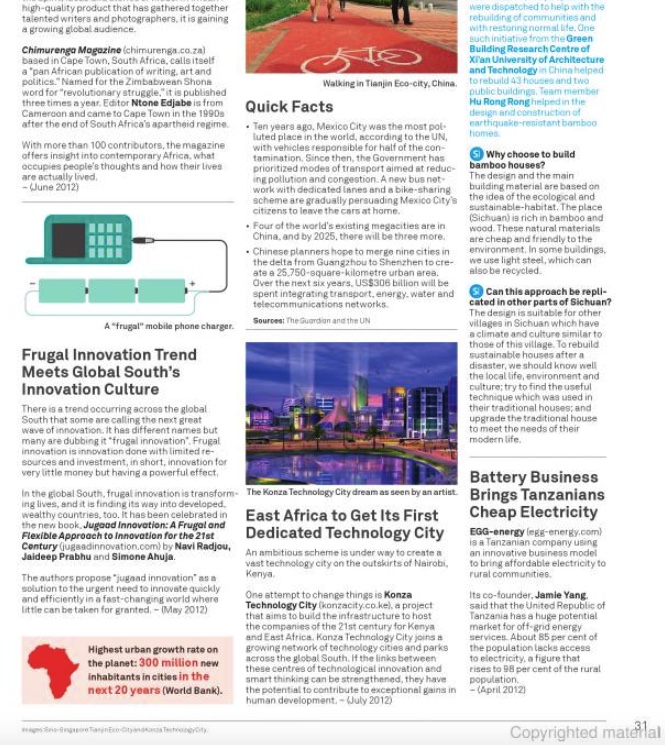
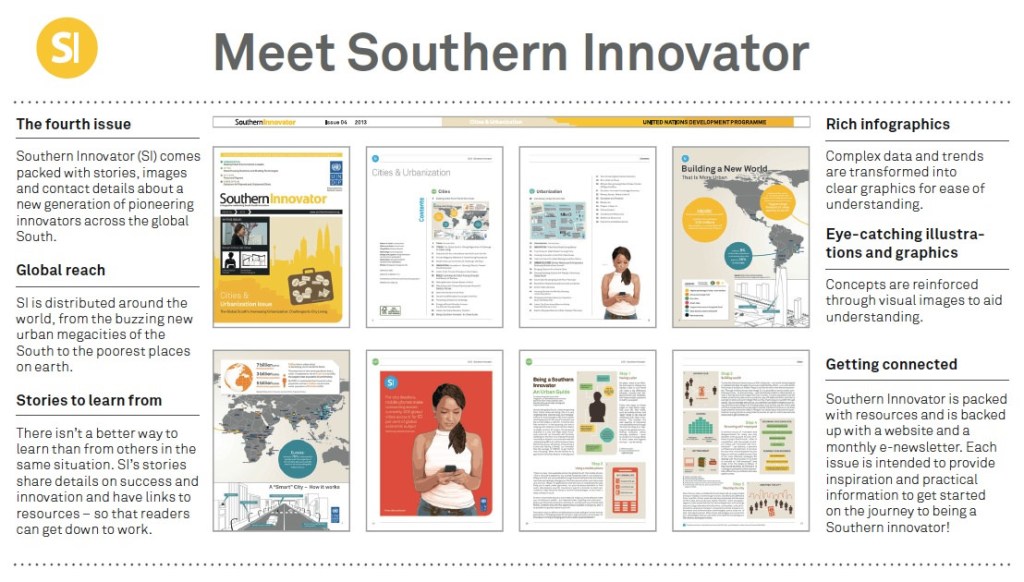
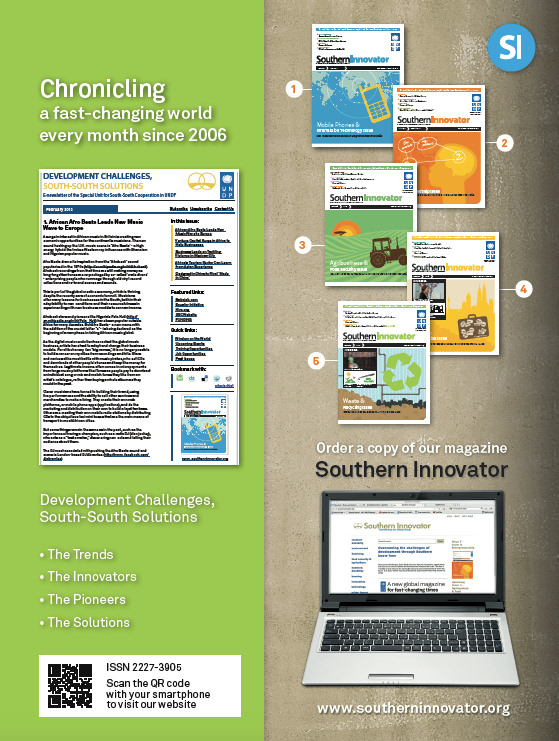
    Development Challenges, South-South Solutions was launched as an e-newsletter in 2006 by UNDP’s South-South Cooperation Unit (now the United Nations Office for South-South Cooperation) based in New York, USA. It led on profiling the rise of the global South as an economic powerhouse and was one of the first regular publications to champion the global South’s innovators, entrepreneurs, and pioneers. It tracked the key trends that are now so profoundly reshaping how development is seen and done. This includes the rapid take-up of mobile phones and information technology in the global South (as profiled in the first issue of magazine Southern Innovator), the move to becoming a majority urban world, a growing global innovator culture, and the plethora of solutions being developed in the global South to tackle its problems and improve living conditions and boost human development. The success of the e-newsletter led to the launch of the magazine Southern Innovator.  
    Creative Commons License

    This work is licensed under a
    Creative Commons Attribution-Noncommercial-No Derivative Works 3.0 License.

    ORCID iD: https://orcid.org/0000-0001-5311-1052.

    © David South Consulting 2023

  • Time-Tested Iranian Solutions to Cool and Refrigerate

    Time-Tested Iranian Solutions to Cool and Refrigerate

    By David SouthDevelopment Challenges, South-South Solutions

    SOUTH-SOUTH CASE STUDY

    Keeping food cool is critical for human health. No matter what the climate, a cool environment will prolong food preservation, stave off spoilage and lower the risk of food poisoning. This is crucial for the poor because it means they can reduce food waste and avoid illnesses caused by food poisoning. Diarrhea is a common problem when people do not have access to refrigeration for their food.

    Food security is also enhanced, as more can be stored and less thrown away as waste. Keeping food cool also means less need for preservation techniques, such as using salt, spices or smoke. Salt and smoke both can have adverse affects on human health. Salt increases sodium in the diet, which leads to high blood pressure, and smoke is a carcinogen which can lead to various forms of cancer.

    It is healthier to keep food in its natural state – and keep it cool.

    While the invention of the electric refrigerator was a major breakthrough, it requires a steady supply of electricity, which is expensive and difficult for many people.

    Various pre-electric refrigeration technologies have been developed over the centuries. Among them was a pioneering technology used in Persia (modern-day Iran) as far back as the 11th century (http://en.wikipedia.org/wiki/Avicenna). And now, it is being looked to once again today as a sustainable refrigeration solution that does not damage the environment.

    Iran’s solution involves creating a domed ice house made from earth bricks. Many ancient ice houses have been discovered on the edge of deserts, where ice was scarce and supplies remote. The solution was to create a dugout channel at the rear of a domed house and then flood the channel with water. When the temperature dropped at night in the desert, the water would freeze into ice.

    Rising early in the morning, the resident would break up the ice into blocks and store them inside the ice house. This was repeated night after night until there was enough ice in the house that it could last the summer months.

    The water was drawn from elaborate irrigation systems used for farming.

    The ice houses were cone and dome-shaped and included some with underground structures. To date, a project headed by Dr. Hemming Jorgensen has documented 129 centuries-old ice houses at the fringe areas of large deserts in Iran. Jorgensen, from the University of Copenhagen in Denmark, has documented the use of these structures on his “Ice Houses of Iran” website (http://www.hemmingjorgensen.com/).

    In 18th and 19th century England, ice houses were also common place in country estates to keep food cool in kitchens. Today, there are growing numbers of people around the world who are turning to technologies such as ice houses to find sustainable, non-electric, low-carbon alternatives to electric refrigeration.

    Another environmentally friendly cooling solution from Iran involves using wind catchers to circulate air during the hotter months. Called bagdir wind towers, or windcatchers (http://en.wikipedia.org/wiki/Windcatcher), they have been used in Yadz, Iran since the 19th century.

    Profiled in Green Building Magazine (http://www.greenbuildingpress.co.uk/product_details.php?category_id=10&item_id=235), the wind towers are made of stone, and channel wind down into a shaft to cool or heat the rooms below. It is an air circulation solution that does not take any energy – because it uses the wind – and is carbon neutral. In summer, the wind is drawn down into a stone chimney by low air pressure zones in the ventilation system. It is cooled, and then is circulated through the dwelling, rising as it warms up through the house. This is combined with a strategy of moving rooms depending on how hot or cool they are, adjusting clothing based on the temperature, or even placing water on the floor to cool the air.

    In Nigeria in West Africa, a cooler called the zeer (http://practicalaction.org/zeer-pots) has been developed. It works like this: two ceramic earthenware pots of different sizes are arranged one inside the other. The space between the pots is filled with wet sand and kept moist. The user then places drinks or vegetables inside and covers it with a damp cloth. As the water from the moist sand evaporates (http://en.wikipedia.org/wiki/Evaporation), the air inside the centre pot is cooled several degrees, enough to preserve some foods and drinks.

    Published: June 2013

    Resources

    1) ChotuKool fridge: The ChotuKool fridge is designed to stay cool for hours without electricity and to use half the power of conventional refrigerators. Priced at US $69, it is targeted at India’s poor. Website: (http://www.new.godrej.com/godrej/godrej/index.aspx?id=1)

    2) Ice house designs from the 18th and 19th century in the United Kingdom. Website: http://www.icehouses.co.uk/petworth.htm

    3) The High Desert Chronicles: “Sometimes you need to look back to move forward!”. Details use of contemporary ice houses in the desert for refrigeration. Website: http://www.highdesertchronicles.com/2012/10/ice-in-the-high-desert-without-electricity-or-refrigeration/

    4) History Magazine: The Impact of Refrigeration: The role played by refrigeration throughout human history. Website: http://www.history-magazine.com/refrig.html

    5) Methods of Alternative Refrigeration: Three solutions in detail. Website: http://www.provident-living-today.com/Alternative-Refrigeration.html

    Southern Innovator logo

    London Edit

    31 July 2013

    https://davidsouthconsulting.org/2022/10/05/cool-food-for-the-poor/

    https://davidsouthconsulting.org/2022/06/23/innovative-ways-to-collect-water-from-air/

    https://davidsouthconsulting.org/2022/10/24/iranian-savings-funds-to-tackle-loan-drought/

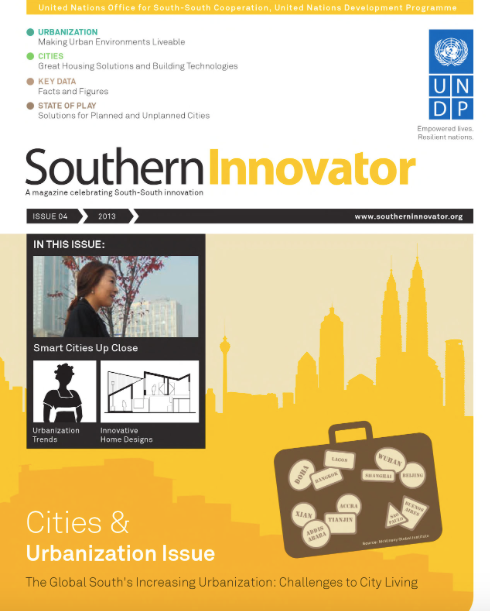
    https://davidsouthconsulting.org/2021/03/05/southern-innovator-issue-4/

    https://davidsouthconsulting.org/2021/03/05/southern-innovator-issue-5/

    https://davidsouthconsulting.org/2021/02/05/study-says-jetliner-air-quality-poses-health-risks-cupe-takes-on-airline-industry-with-findings-of-survey/

    https://davidsouthconsulting.org/2022/10/26/tackling-chinas-air-pollution-crisis-an-innovative-solution/

    Development Challenges, South-South Solutions was launched as an e-newsletter in 2006 by UNDP’s South-South Cooperation Unit (now the United Nations Office for South-South Cooperation) based in New York, USA. It led on profiling the rise of the global South as an economic powerhouse and was one of the first regular publications to champion the global South’s innovators, entrepreneurs, and pioneers. It tracked the key trends that are now so profoundly reshaping how development is seen and done. This includes the rapid take-up of mobile phones and information technology in the global South (as profiled in the first issue of magazine Southern Innovator), the move to becoming a majority urban world, a growing global innovator culture, and the plethora of solutions being developed in the global South to tackle its problems and improve living conditions and boost human development. The success of the e-newsletter led to the launch of the magazine Southern Innovator.  

    Creative Commons License

    This work is licensed under a
    Creative Commons Attribution-Noncommercial-No Derivative Works 3.0 License.

    ORCID iD: https://orcid.org/0000-0001-5311-1052.

    © David South Consulting 2023

  • Battery Business Brings Tanzanians Cheap Electricity

    Battery Business Brings Tanzanians Cheap Electricity

    By David SouthDevelopment Challenges, South-South Solutions

    SOUTH-SOUTH CASE STUDY

    Access to electricity is critical for making substantial development gains. With steady supplies of electricity, it is possible to read and study at night, to run modern appliances, to better use the latest information technologies and to work using time- and labour-saving devices. A home with electricity literally switches the light on modern life and gives a family huge advantages compared to those without electricity.

    But there are two potential obstacles to providing electricity for the poor: one is just getting access to a steady supply; the other is paying for it.

    In Africa, much of the population suffers from an electricity famine. The situation is worse than on any other continent: the proportion of people in Africa still without electricity is higher – and the rate of urban electrification is lower – than anywhere else. Four out of five rural residents in Africa live without electricity. The rate of rural electrification is also lower than on any other continent and the proportion of Africans who depend on inefficient traditional energy sources is higher than elsewhere (Desertec-Africa).

    EGG-energy (http://egg-energy.com) is a Tanzanian company using an innovative business model to bring affordable electricity to rural communities.

    Its co-founder, Jamie Yang, said Tanzania has a huge potential market for offgrid energy services. About 85 per cent of the population lacks access to electricity, a figure that rises to 98 per cent of the rural population.

    EGG-energy says it is “dedicated to helping low-income consumers in sub-Saharan Africa gain access to clean, affordable energy, using a unique strategy based around portable rechargeable batteries.” The company has eight full-time staff based in their Makumbusho office, 6 kilometres north of Dar es Salaam, the capital.

    It calls its system the “portable grid,” and it works like this: customers have a power system installed in their home that runs on brick-sized, re-chargeable batteries. The batteries are re-charged at a central charging station using power from the Tanzanian power grid, and sent to local distribution centres where customers can pick them up. Customers rent the batteries for a subscription fee, and they last about five nights in a home. When the battery is empty, the customer returns it, swaps for a fresh battery and pays a small swapping fee.

    It is a brilliant solution to the problem of getting power from the main Tanzanian power grid to people’s homes. According to EGG-energy, most Tanzanians live within 5 kilometres from a power grid line. Yet the majority of the population lack access to electricity.

    “After researching the energy situation in Tanzania and other countries with similar electricity access problems, it became clear that one of the primary problems was a lack of last-mile distribution,” explained Yang. “The only way to get power from the source into homes and businesses were power lines, and for the vast majority of rural Tanzanians, this was very much out of reach.

    We saw situations in which power lines would pass right over large populations that were still using kerosene for lighting. We also saw that distributed generation like solar was finding only very limited markets because there was no share or sell power from that source without an affordable way to distribute the electricity.”

    While EGG-energy is based in Tanzania, it hopes hope to expand across the developing world.

    In order to develop an effective distribution network, EGG-energy partners with local store owners and delivery businesses to help with distributing the batteries. The batteries are based on those used in the airline industry and are light enough to be held in one hand.

    Yang believes marketing is critical to the success of the technology.

    “Don’t underestimate the cost of sales, marketing, and distribution,” he said.

    “Many companies focus on the technology and in lowering the cost of the technology, while not paying enough attention to the gaps in the distribution channels.

    “We have a sales team that communicates what we do through a variety of methods, including door-to-door sales, road shows and village meetings. We also make contact with the local political leaders and offer referral awards to our existing customers. Potential customers come to our charging stations to purchase the system and to connect to EGG.”

    When a customer signs up with EGG-energy, a technician is dispatched to their home to make sure the electricity system is sound and effective. The company also sells energy-efficient lights, radios and mobile phone chargers to complement the electricity system. It’s a wise business model, since having a steady and reliable supply of electricity is a great motivator for customers to purchase other electric-powered appliances.

    “We have technicians that have received vocational training through the Tanzanian system and technicians that we train ourselves,” Yang said. “We have very standardized electricity installations that are easy to teach, and have more experienced technicians that we rely on for troubleshooting and support.”

    EGG-energy also makes the claim it can reduce a household’s energy expenses by 50 per cent as they make the switch from traditional batteries for radios and kerosene lamps for light.

    EGG-energy calls itself a “for-profit company with a social mission.” It sees the provision of affordable electricity and energy as a spur for small entrepreneurs to build their businesses, boost educational opportunities through longer study time, and help with connecting families with the outside world.

    It uses regular feedback with customers to make sure their service is actually cheaper than other options – a good habit for any business looking to build a lasting customer relationship.

    “One of the key deficiencies in the energy supply chain is customer support,” said Yang. “We have seen multiple solar installations given by NGOs to community organizations that are no longer functioning because the user doesn’t have someone reliable to call or hasn’t allotted a budget to maintain the system.

    “Customer support is a key component of last mile distribution, and something that EGG-energy is focusing on as an energy services company with a local, physical presence.”

    Published: April 2012

    Resources

    1) ANSOLE (the African Network for Solar Energy) is a research-oriented network of 200 scientists from 22 African and 10 non-African countries. It believes, according to Mammo Muchie, founding editor of the African Journal of Science, Technology, Innovation, and Development, “solar power will become the major renewable energy source on the continent only by organized research, training, design, and engineering.” Website: ansole.org

    2) The Kenya-based non-governmental organization (NGO) Access: energy is tackling the problem of 84 per cent of Kenyans – 32 million people – lacking access to electricity at home. It is doing this by teaching people how to make and assemble wind turbines out of scrap metal and car parts and other materials found within communities. Their turbine design is called the Night Heron Turbine. Website: http://access-collective.com/energy/

    4) TANESCO: Tanzania Electric Supply Company: Website: http://www.tanesco.co.tz

    https://davidsouthconsulting.org/2022/10/24/brazilian-solar-powered-wifi-for-poor-schools/

    https://davidsouthconsulting.org/2022/10/06/indian-solar-power-pack-powers-villages/

    https://davidsouthconsulting.org/2022/11/20/new-battery-back-up-technology-targeting-developing-countries-and-remote-regions/

    https://davidsouthconsulting.org/2022/10/02/powerful-solar-light-spurring-income-making-opportunities/

    https://davidsouthconsulting.org/2022/10/24/solar-power-bringing-light-and-opportunity-to-the-poor/

    https://davidsouthconsulting.org/2021/03/24/solar-powered-mobile-clinics-to-boost-rural-healthcare-in-africa/

    https://davidsouthconsulting.org/2021/03/30/solar-powered-village-kick-starts-development-goals/

    https://davidsouthconsulting.org/2022/10/06/solar-sisters-doing-it-for-themselves-tackling-african-light-famine/

    Development Challenges, South-South Solutions was launched as an e-newsletter in 2006 by UNDP’s South-South Cooperation Unit (now the United Nations Office for South-South Cooperation) based in New York, USA. It led on profiling the rise of the global South as an economic powerhouse and was one of the first regular publications to champion the global South’s innovators, entrepreneurs, and pioneers. It tracked the key trends that are now so profoundly reshaping how development is seen and done. This includes the rapid take-up of mobile phones and information technology in the global South (as profiled in the first issue of magazine Southern Innovator), the move to becoming a majority urban world, a growing global innovator culture, and the plethora of solutions being developed in the global South to tackle its problems and improve living conditions and boost human development. The success of the e-newsletter led to the launch of the magazine Southern Innovator.  

    https://davidsouthconsulting.org/2021/03/05/southern-innovator-issue-4/

    Creative Commons License

    This work is licensed under a
    Creative Commons Attribution-Noncommercial-No Derivative Works 3.0 License.

    ORCID iD: https://orcid.org/0000-0001-5311-1052.

    © David South Consulting 2023

  • Global South Urbanization Does Not Have to Harm Biodiversity

    Global South Urbanization Does Not Have to Harm Biodiversity

    By David SouthDevelopment Challenges, South-South Solutions

    SOUTH-SOUTH CASE STUDY

    How to balance fragile ecosystems with rapid urbanization will be the challenge for planners and governments across the global South in the coming years. The urbanization trend is clear: the world’s total urban area is expected to triple between 2000 and 2030, with urban populations set to double to around 4.9 billion in the same period (UNEP). This urban expansion will draw heavily on water and other natural resources and will consume prime agricultural land.

    Global urbanization will have significant implications for biodiversity and ecosystems if current trends continue, with knock-on effects for human health and development, according to a new assessment by the United Nations Convention on Biological Diversity (CBD).

    Cities and Biodiversity Outlook – the first global analysis of how projected patterns of urban land expansion will affect biodiversity and crucial ecosystems – argues that promoting low-carbon, resource-efficient urban development can counter urbanization’s adverse effects on biodiversity while improving quality of life.

    “The way our cities are designed, the way people live in them and the policy decisions of local authorities, will define, to a large extent, future global sustainability,” said Braulio Dias, Executive Secretary of the CBD.

    “The innovation lies not so much in developing new infrastructural technologies and approaches but to work with what we already have. The results often require fewer economic resources and are more sustainable,” he added.

    The report says urban expansion is occurring fast in areas close to biodiversity ‘hotspots’ and coastal zones. And rapidly urbanizing regions, such as large and mid-size settlements in sub-Saharan Africa, India and China, often lack resources to implement sustainable urban planning.

    But the study found that cities do not need to be in conflict with plant and animal species and ecosystems. They can, in fact, protect species, as is the case with Belgium, where 50 per cent of the country’s floral species are found in Brussels, or Poland, where 65 per cent of the country’s bird species occur in Warsaw.

    At the Alexander von Humboldt Research Institute in Bogota, Colombia (humboldt.org.co) researchers have been thinking about how to get this balance right and make sure the growing cities of the future are not ecological disasters.

    According to Juana Marino and Maria Angélica Mejia at the Institute’s Biological Resources Policy Program – which investigates “Biodiversity, Ecosystem Services and Urban-Regional Environments” – how cities grow and develop must change.

    They believe cities need to take into account the resources they require to function and the impact this has on biodiversity and ecosystems.

    “The more people who arrive in cities, the more they demand goods and services (in a massive way!): roads, housing, infrastructure, food, water – (creating) an impressive amount of waste, challenging traditional waste management and sanitation policies,” said Marino.

    In short, “Cities enhance consumption.”

    The Humboldt researchers believe common patterns can be seen across the global South, where ecosystems “surrounding urban areas are deforested and have significant levels of water and air pollution; they also become deeply transformed by informal settlements.”

    This process means cities “lose their ability to be resilient, they become highly vulnerable to global change and they decrease their production of ecosystem services to maintain human well-being in cities.”

    They argue that human settlements must be sustainably planned for, with ecological resilience and human well-being. If this is not done, areas suitable for agricultural production and biodiversity preservation will be harmed.

    While better planning is needed there also needs to be long-term thinking.

    But planning and managing are not the only things required: “it is a matter of design” if new “resilient” urban-rural landscapes are to be created.

    And what can be done? They believe better analysis is required and it needs to take on social and cultural knowledge, and take in the border regions around cities, the “suburban, peri-urban and other ‘transition’ landscapes should become main actors in these relationships, not mere by-products; (they are) compromise territories between a lack of definition and low governance.”

    These complex relationships with the border ecosystems of cities need to be communicated to the general public in simple, user-friendly ways so they can understand how important these areas are to the overall health of the city.

    In Latin America, the cities of Curitiba (Brazil) and Bogotá and Medellin (Colombia) have made great strides in managing and planning for biodiversity and ecosystem services, they say. But it is not just as simple as recording the number of native species and the percentage of protected areas in urban places. Links need to be created between “social, scientific and political” elements to create “socio-ecological indicators” that can be developed and turned into “easy-to-adopt mechanisms” for people to use.

    And they see innovation as the way to do this. Innovation is critical if cities and urban areas are to avoid widespread destruction of biodiversity as urbanization increases.

    “Innovation is not just an option – it is a ‘must’,” said Marino. “Not just the technical innovation already being carried on by infrastructure, transport and building sectors that are rapidly changing their patterns based on mitigation technologies.

    “Innovation is also needed in terms of biodiversity, biotechnology, information and knowledge production; appropriation, use and management. Knowledge turns into innovation when appropriated by social spheres; when it enters the social and political arenas.”

    Environmental governance can be strengthened “when promoting top-down and bottom-up innovations.”

    Published: December 2012

    Resources

    1) Environmental Public Awareness Handbook: Case Studies and Lessons Learned in Mongolia. Website: http://tinyurl.com/yhjyd7h

    2) Hyderabad Case Study: During the recent UN biodiversity talks in Hyderabad, the International Union for Conservation of Nature gave journalists the opportunity to see how biodiversity can thrive in the middle of a bustling metropolis. Website: http://www.rtcc.org/hyderabad-a-showcase-of-urban-biodiversity/

    3) UNEP: A Global Partnership on Cities and Biodiversity was launched by UNEP, the Secretariat of the Convention on Biological Diversity (CBD), UN-HABITAT, ICLEI, IUCN Countdown 2010, UNITAR, UNESCO and a Steering Group of Mayors from Curitiba, Montreal, Bonn, Nagoya and Johannesburg to bring together existing initiatives on cities and biodiversity. Website: http://www.unep.org/urban_environment/issues/biodiversity.asp

    4) Nature in the City: Nature in the City, a project of Earth Island Institute, is San Francisco’s first organization wholly dedicated to ecological conservation, restoration and stewardship of the Franciscan bioregion. Website: http://natureinthecity.org/urbanbiodiversity.php

    Development Challenges, South-South Solutions was launched as an e-newsletter in 2006 by UNDP’s South-South Cooperation Unit (now the United Nations Office for South-South Cooperation) based in New York, USA. It led on profiling the rise of the global South as an economic powerhouse and was one of the first regular publications to champion the global South’s innovators, entrepreneurs, and pioneers. It tracked the key trends that are now so profoundly reshaping how development is seen and done. This includes the rapid take-up of mobile phones and information technology in the global South (as profiled in the first issue of magazine Southern Innovator), the move to becoming a majority urban world, a growing global innovator culture, and the plethora of solutions being developed in the global South to tackle its problems and improve living conditions and boost human development. The success of the e-newsletter led to the launch of the magazine Southern Innovator.  

    Creative Commons License

    This work is licensed under a
    Creative Commons Attribution-Noncommercial-No Derivative Works 3.0 License.

    ORCID iD: https://orcid.org/0000-0001-5311-1052.

    © David South Consulting 2023