African youth need to play more according to a new landmark study published in the UK’s leading medical journal, The Lancet. The study tackles the high rates of illiteracy and educational under-achievement in Africa and finds that malnourishment and lack of stimulation are leaving millions unable to benefit from schooling. It found projects that encouraged learning through play led to children boosting their IQs and getting better reading skills. And it comes up with a very simple and low-cost solution – but excellent opportunity for entrepreneurs – toys and play.
“These are not high tech interventions,” said team leader for the study, Professor Sally McGregor of the Institute of Child Health of University College London. “Research over decades in Jamaica (and other countries) has shown that women with only primary school-level education and a few home made toys can be trained to make a significant difference in the education, intelligence and mental health of disadvantaged children. The Millennium Goal of universal primary education for all cannot be met unless these children’s poor development is tackled.”
The paper – Strategies to Avoid the Loss of Developmental Potential among Over 200 Million Children in the Developing World – is published in three parts in the journal.
Twenty projects around the world were evaluated for the benefits they produce for children under five who use toys. McGregor, who has set up several projects in Kenya, Tanzania and Uganda designing and constructing toys using whatever materials are available, was appalled by the widespread neglect of play throughout these countries. With play, the study found children read better, have better mental health and better self-esteem. In Africa it is ‘desperate, really desperate’ she says.
African primary school enrolments and literacy rates are among the lowest in the world, with over 42 million school children in sub-Saharan Africa not enrolled in school, and many children not able to afford to go or stay in primary school. Today a little more than half of African adults are literate and some 60 per cent of children go to school, according to UNESCO. The agency has forecasted the need for an additional 1.6 million teachers in Sub-Saharan African classrooms by 2015 – an increase of 68 percent.
The materials used to construct the toys do not need to be expensive or sophisticated. Toys can be constructed from banana trees, mud, corn on the cob, old plastic bottles, or cloth and straw dolls. It is key that the toys are safe for children under five and that anyone building such toys for sale must follow existing manuals.
McGregor continues: ‘One mother in a village was doing marvellous things with tiny scraps of material to make a doll. She received no recognition in the village for the work she was doing yet it was so important. It doesn’t take much – dolls or simple wooden blocks – they are so versatile. You see schools with nothing – it is unforgivable. The problem is how poor these people are – food just takes priority over toys – it is that stark.”
Locally produced toys are key to resolving this crisis for several reasons. Cost is the most important, with those most adversely affected also the least able to pay for toys and who are already living a precarious existence where basic survival takes precedence over play. Another factor is Africa being home to the countries who import the least number of toys: Somalia, Liberia, Togo, Rwanda and Chad. But the situation for African toymakers is often desperate as well, with many craft workers living at the economic margins. Several initiatives have emerged in the last couple of years to address this problem and ensure African toys are local and toymakers earn a living.
Initiatives like the African Toyshop based in Johannesburg, South Africa – a fair trade business – work to ensure African toymakers can make a living and get their wares to as wide a market as possible. The toymakers featured all use natural resources or recycled materials. Most work at the village level and produce toys that are culturally relevant to Africa. The organization COFTA – Cooperation For Fair Trade in Africa – is a network of Fair Trade producer Organizations in Africa involved and working with disadvantaged grassroots producers to eliminate poverty through fair trade. It is an excellent resource for grassroots organizations wanting to work with African toymakers.
Published: January 2007
Resources
The UK charity TALC – Teaching-aids At Low Cost – is planning to make available toy making manuals on a CD. Tel: (0) 1727 853869
Book: Africa on the Move: Toys from West Africa Stefan Eisenhofer, Karin Guggeis, Jacques Froidevaux Stuttgart, Germany: Arnoldsche, 2004. 216 pp., 195 color, 28 b/w illustrations. $75.00, cloth.
Development Challenges, South-South Solutions was launched as an e-newsletter in 2006 by UNDP’s South-South Cooperation Unit (now the United Nations Office for South-South Cooperation) based in New York, USA. It led on profiling the rise of the global South as an economic powerhouse and was one of the first regular publications to champion the global South’s innovators, entrepreneurs, and pioneers. It tracked the key trends that are now so profoundly reshaping how development is seen and done. This includes the rapid take-up of mobile phones and information technology in the global South (as profiled in the first issue of magazine Southern Innovator), the move to becoming a majority urban world, a growing global innovator culture, and the plethora of solutions being developed in the global South to tackle its problems and improve living conditions and boost human development. The success of the e-newsletter led to the launch of the magazine Southern Innovator.
The deluge of data gathered by the digital revolution underway in the global South continues to offer a significant economic opportunity. How this data is harvested will forge the successful Internet business models of the future.
As the Internet spreads its way further across the global South, many are forecasting this new surge in web users and the data they generate will radically reshape the way people engage with and use the Internet. Unlike previous generations of web users, most of these new users will be accessing the Internet primarily with mobile phones and other devices, rather than computers. Many will not be native English speakers.
Argentinian philosopher and digital publisher Octavio Kulesz says “the digital experiences undertaken in the South suggest that new technologies represent a great opportunity for developing countries … but on the condition that local entrepreneurs seek out original models adapted to the concrete needs of their communities.”
In a report for the International Alliance of Independent Publishers, Kulesz said we “must ask ourselves how useful it would be to reproduce the prototypes from the North in the South.”
According to the Cisco Visual Networking Index Forecast (2010-2015), by 2015, there will be 3 billion Internet users in the world: 40 percent of the global population. Internet Protocol (IP) traffic is growing fastest in Latin America, where it is forecast to grow by 50 percent from 2010 to 2015. Next are the Middle East and Africa.
There are already as many networked devices – tablets, mobile phones, connected appliances and smart machines – on the planet as people. By 2015 – the year of the Millennium Development Goals (http://www.un.org/millenniumgoals) – they’ll outnumber people by two to one.
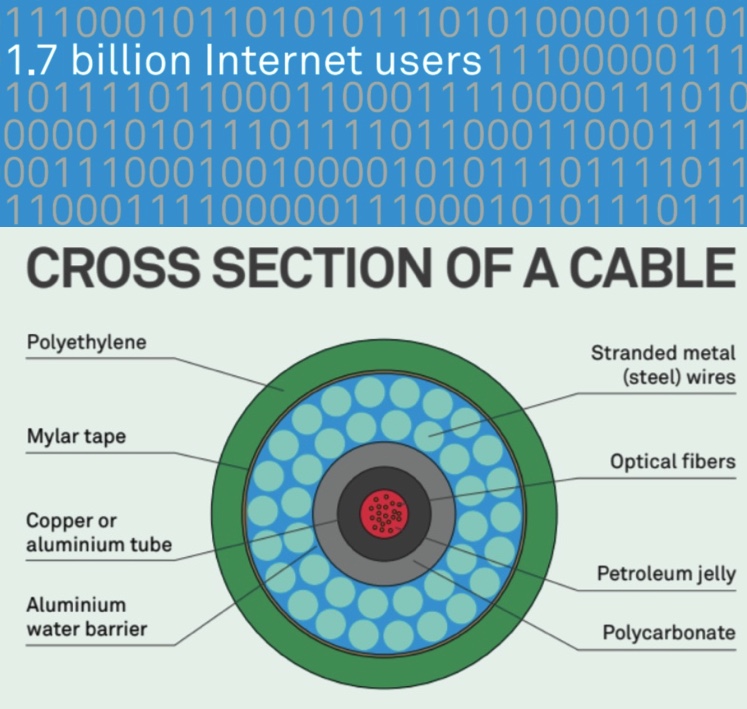
The potential of the Internet revolution is especially compelling in Africa, a continent neglected for so long in the global communications revolution. The 10,000 kilometre-long East African Submarine Cable System (EASSy), connecting sub-Saharan Africa with Europe and Asia, has joined other cables from the continent. Gradually, the infrastructure is coming in to place to connect Africa properly to the world.
The first batch of Internet users came from the United States, home of the Internet which grew out of the US military’s Arpanet system (http://en.wikipedia.org/wiki/ARPANET). This first wave of the Internet’s history was very much an American phenomenon. The priorities and content of the web were driven by the cultural and economic concerns of its American users. And the big brands of today’s web reflect this: Google, Facebook, eBay, Twitter, Yahoo, WordPress, to name a few.
As the web expanded across wealthy, developed nations in Europe, users mostly mimicked the priorities of the American approach, using the web to express themselves, be entertained, share files, access government services and sell and market products and services.
But the spread of the Internet across the global South is already showing itself to have a different character and set of priorities. One change is in the way people are accessing the web: through mobile phones and other devices, rather than through laptops and personal computers.
In the future, the trend is towards a global mobile world, in which the communications medium will favour video and audio over text, according to Fast Company magazine (http://www.fastcompany.com). Information is being shared across boundaries on a vast scale for the first time. People around the world are gaining access to data and information never available before, and all of it is nearly instantaneous.
Kulesz said countries of the South face a profound and difficult decision: follow the lead taken by the technology pioneers of the South, or try and replicate what was done in the North?
“Sooner or later, these countries will have to ask themselves what kind of digital publishing highways they must build,” his report said, “and they will be faced with two very different options: a) financing the installation of platforms designed in the North; b) investing according to the concrete needs, expectations and potentialities of local authors, readers and entrepreneurs. Whatever the decision of each country may be, the long-term impact will be immense.”
The costs of trying to replicate the technological infrastructure of the North makes little sense, when it is technologically possible to bypass this costly infrastructure with even newer work-arounds.
“Of course, it would be extraordinary to obtain 80 percent Internet penetration in Africa or make huge investments in infrastructure throughout the developing regions,” continues Kulesz, “but that may never happen. And in the event that it does occur some day, by then the industrialized countries will no doubt have made another technological leap, meaning that the disparity in infrastructure would still persist. So the most effective option is to start working right now, with what is available.”
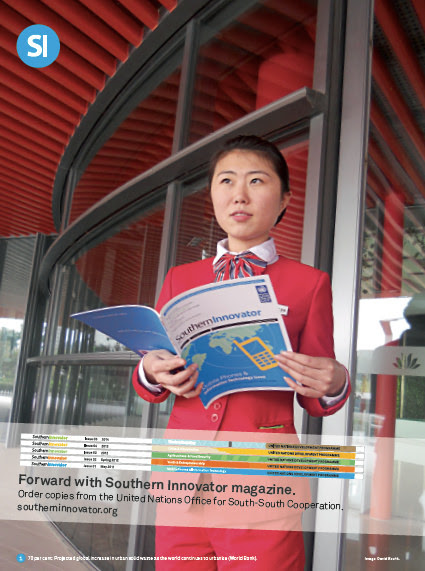
New global magazine Southern Innovator (http://www.scribd.com/doc/57980406/Southern-Innovator-Issue-1), published by UNDP’s Special Unit for South-South Cooperation, captures how this process is happening, as the people of the global South re-shape the Internet to be their own and to meet their needs.
2) Cisco Visual Networking Index Forecast (2010-2015): The annual Cisco VNI Forecast was developed to estimate global Internet Protocol traffic growth and trends. Widely used by service providers, regulators, and industry influencers alike, the Cisco VNI Forecast is based on in-depth analysis and modelling of traffic, usage and device data from independent analyst forecasts. Website:http://newsroom.cisco.com/press-release-content?type=webcontent&articleId=324003
3) Digital Publishing in Developing Countries: A report by the International Alliance of Independent Publishers. Website:http://alliance-lab.org/etude/archives/date/2010/01?lang=en
Development Challenges, South-South Solutions was launched as an e-newsletter in 2006 by UNDP’s South-South Cooperation Unit (now the United Nations Office for South-South Cooperation) based in New York, USA. It led on profiling the rise of the global South as an economic powerhouse and was one of the first regular publications to champion the global South’s innovators, entrepreneurs, and pioneers. It tracked the key trends that are now so profoundly reshaping how development is seen and done. This includes the rapid take-up of mobile phones and information technology in the global South (as profiled in the first issue of magazine Southern Innovator), the move to becoming a majority urban world, a growing global innovator culture, and the plethora of solutions being developed in the global South to tackle its problems and improve living conditions and boost human development. The success of the e-newsletter led to the launch of the magazine Southern Innovator.
The coming years will see a major new force dominating development: Big Data. The term refers to the vast quantities of digital data being generated as a result of the proliferation of mobile phones, the Internet and social media across the global South – a so-called ‘data deluge’ (UN Global Pulse). It is an historically unprecedented surge in data, much of it coming from some of the poorest places on the planet and being gathered in real time.
Big Data will have a profound impact on how the cities of the future develop, and will re-shape the way the challenges and problems of human development are handled.
Estimates by Cisco (cisco.com) foresee 10 billion mobile Internet-enabled devices around the world by 2016. With the world population topping 7.3 billion by then, that will work out to 1.4 devices per person.
Some estimates say 90 per cent of the digital data ever generated in the world has been produced in the past two years. It is also estimated that available digital data will increase by 40 per cent every year (UN Global Pulse). This digital transformation is being accompanied by another trend: the largest migration in human history from rural to semi-urban and urban areas.
This presents an unprecedented opportunity to make this rapid urbanization and social change smarter and more responsive to human needs, and to avoid the failures of the past, from over-crowding to crime, disease, pollution, unemployment and poverty. Some believe data collection can radically alter development by flagging up problems quickly, giving cities the chance to respond and correct negative trends before they get out of control. In short, to build in resilience by way of digital technology.
The latest region to see rapid industrialization and urbanization has been Asia – in particular China, a country that since the 1980s has simultaneously lifted the largest number of people in world history out of poverty and undertaken the biggest migration ever from rural to urban areas.
And now Africa is beginning to follow in Asia’s wake.
Unlike previous waves of industrialization and urbanization, Africa’s transformation is occurring in the age of the mobile phone, the Internet, personal computers and miniature electronic devices capable of more computing power than the computers used during the Apollo space programme (http://www.nasa.gov/audience/foreducators/diypodcast/rocket-evolution-index-diy.html). This changes the game significantly.
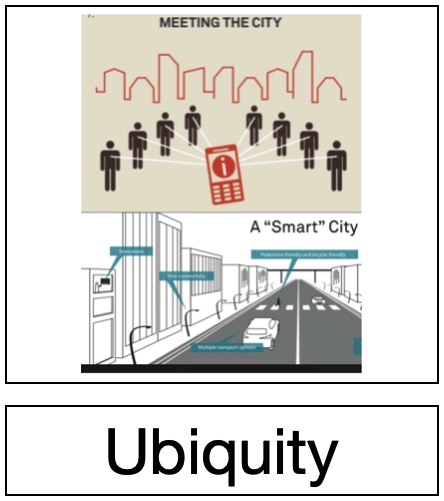
This 21st-century approach to urban growth is at its most sophisticated, and utopian, in so-called “smart cities.” These are built-from-scratch cities that use the “Internet of Things”, where everything, from lamp posts to garbage bins to roads are embedded with microchips and radio frequency transmitters (RFID chips) (http://en.wikipedia.org/wiki/Radio-frequency_identification) to communicate data in real time. By analyzing this data, cities can be responsive to human needs and mitigate problems – improving waste collection and traffic management, reducing crime and pollution. Services can be customized to residents’ needs and liberate them to spend more time on things that matter such as their own health, family, work and hobbies. Examples of these cities include Tianjin Eco-city (tianjinecocity.gov.sg) in China, Masdar (masdar.ae) in Abu Dhabi in the United Arab Emirates and Songdo International Business District (songdo.com) in the Republic of Korea.
These experimental smart cities are springing up in the East, and it will be the East – as well as Africa – that will see most of the action going forward. As the global management consulting firm McKinsey noted in its report Urban World: Mapping the Economic Power of Cities: “Over the next 15 years, the center of gravity of the urban world will move south and, even more decisively, east.”
Cities in the global South will be generating the new prosperity of the 21st century. And it is widely accepted that people living in cities have the potential to become very efficient economically while rapidly driving prosperity higher.
The McKinsey report says that “by 2025, developing-region cities of the City 600 (a list gathered by McKinsey) will be home to an estimated 235 million middle-class households earning more than (US) $20,000 a year at purchasing power parity (PPP).
“Emerging-market mega-and middleweight cities together – 423 of them are included in the City 600 – are likely to contribute more than 45 percent of global growth from 2007 to 2025 (http://www.mckinsey.com/insights/urbanization/urban_world).”
The world’s future prosperity is going to be found in the urban, the digitally connected, and the middle class.
Tracking all this digital change is the UN Global Pulse. UN Global Pulse (unglobalpulse.org) was started by Secretary-General Ban Ki-moon in 2009 with a mandate to study these changes and build expertise in applying Big Data to global development. UN Global Pulse functions as a network of innovation labs where research on Big Data for development is conceived and coordinated. It partners with experts from UN agencies, governments, academia, and the private sector to research, develop, and mainstream approaches for applying real-time digital data to 21st-century development challenges.
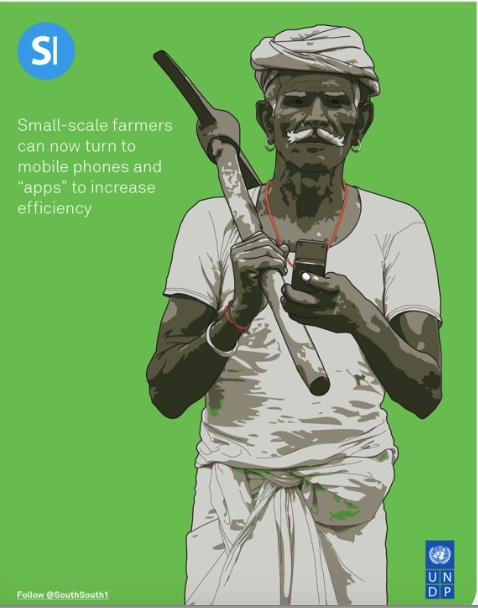
Unlike major technological trends of the past, this one is not restricted to the industrialized, developed world. Through the spread of mobile phone technology, billions of people are now using a device that constantly collects digital data, even in the poorest places on earth.
From an international development perspective, Big Data has five characteristics, according to UN Global Pulse: it is digitally generated, passively produced by people interacting with digital services, automatically collected, can be geographically or temporally traced and can be continuously analyzed in real time.
Sources of Big Data include chatter from social networks, web server logs, traffic flow sensors, satellite imagery, telemetry from vehicles and financial market data.
The key to using Big Data is combining datasets and then contrasting them in lots of different ways and doing it very quickly. The purpose? Better decision-making, based on an understanding of what is really happening on the ground.
This data exceeds the capability of existing database software. It is either too much, or comes in too quickly, or can’t be handled using current software technology. Tackling this problem is creating a whole new wave of opportunities for those working in information technology.
As technology and processing power continue to improve, the cost of wrestling with this data and putting it to use is coming down.
The data can be analyzed for patterns and hidden information that before would have been too difficult to gather. This approach has been used by big companies such as WalMart (walmart.com), but it has cost them a large amount of money and time.
Pioneers in Big Data include search engine Google, email and search provider Yahoo, online shopping service Amazon and social media service Facebook. Many supermarkets use Big Data to analyze the way customers behave when they are shopping, combining it with their social and geographical data.
But new developments in hardware, cloud architecture, and open-source software mean Big Data processing is more accessible, including for small start-ups, who can just rent the capacity required on a cloud-based service (http://en.wikipedia.org/wiki/Cloud_computing).
In the past, governments and planners had a ready excuse as to why they could not keep on top of ballooning urban populations and the chaos they brought. They could just throw up their hands and say “We do not know who these people are or what to do about them!”
This excuse does not work in the age of the mobile phone. It is now relatively easy to deploy the power of the networked computing inside mobile phones to map urban slums and identify the needs of the people there. Parse that data, and you have an accurate account of what is happening in the slum – all in real-time.
Making sense of all this information is creating its own new industries as innovators, entrepreneurs and companies step forward to chart this brave new world.
Historically, significant improvements in human development have occurred only after large-scale gathering of data and information on the actual living conditions of the population. For example, prototypes of today’s infographics (http://en.wikipedia.org/wiki/Infographic) – informative visual representations of complex data – were created during the great attempts at tackling poverty and disease in Europe in the 19th century. Today’s masters of this technique include the Swedish doctor, academic and statistician Hans Rosling (gapminder.org), whose dynamic infographics are renowned for changing people’s perceptions of global problems.
UN Global Pulse notes “much of the data used to track progress toward the Millennium Development Goals (MDGs) dates back to 2008 or earlier and doesn’t take into account the more recent economic crisis.
“While this may feed a perception that there is a scarcity of information about the wellbeing of populations, the opposite is in fact true. Thanks to the digital revolution, there is an ocean of data, being continuously generated in both developed and developing nations, that did not exist even a few years ago.”
UN Global Pulse believes Big Data can be used to protect social development gains when crises strike. Rather than undoing decades of good development work and human development achievements, Big Data can help to create agile responses to crisis as it happens.
UN Global Pulse believes the same data, tools and analytics used by business can be turned to help the public sector understand “where people are losing the fight against hunger, poverty and disease, and to plan or evaluate a response.”
Published: June 2014
Resources
1) Big Data: The Next Frontier for Innovation, Competition, and Productivity, Publisher: McKinsey Global Institute. Website: mckinsey.com
2) United Nations Global Pulse: Global Pulse is an innovation initiative launched by the Executive Office of the United Nations Secretary-General, in response to the need for more timely information to track and monitor the impacts of global and local socio-economic crises. The Global Pulse initiative is exploring how new, digital data sources and real-time analytics technologies can help policymakers understand human well-being and emerging vulnerabilities in real-time, in order to better protect populations from shocks. Website: http://www.unglobalpulse.org/
11) Hadoop: Is open source software for handling of large data sets across clusters of computers using simple programming models. Website: http://hadoop.apache.org/
12) Pivotal: Pivotal develops software applications for big data. A testimonial on the Pivotal website sums it up: “With the ability to load a day’s worth of data for a million meters in under fifty (50) seconds, we are able to keep up with the tremendous amount of data generated and start experimenting with many useful smart grid analytics.” Website: gopivotal.com
13) TotallyDot: A way to centralize all the social media people use into a single page. Website: totallydot.com
Development Challenges, South-South Solutions was launched as an e-newsletter in 2006 by UNDP’s South-South Cooperation Unit (now the United Nations Office for South-South Cooperation) based in New York, USA. It led on profiling the rise of the global South as an economic powerhouse and was one of the first regular publications to champion the global South’s innovators, entrepreneurs, and pioneers. It tracked the key trends that are now so profoundly reshaping how development is seen and done. This includes the rapid take-up of mobile phones and information technology in the global South (as profiled in the first issue of magazine Southern Innovator), the move to becoming a majority urban world, a growing global innovator culture, and the plethora of solutions being developed in the global South to tackle its problems and improve living conditions and boost human development. The success of the e-newsletter led to the launch of the magazine Southern Innovator.
The world’s rush to urban centres is the great challenge of the 21st century. In 2007, the world became a majority urban place. The consequences of this shift can be seen in the blight of urban poverty, with its slums and squalor, environmental degradation, and rising social tensions. But there are people working on keeping rural areas relevant and pleasant places to live. These rural advocates see a vibrant countryside as part of the solution to the world’s plethora of crises.
In India, a pioneering initiative is reviving impoverished rural villages. Drawing on self-organizing methods used in India since 1200 BC, the Model Village India (www.modelvillageindia.org.in) is based around India’s democratic system of Panchayats: a village assembly of people stemming back to pre-colonial times.
“Decentralizing is necessary if development is to reach the grassroots,” said the concept’s founder, Rangeswamy Elango, a head of the village of Kuthampakkam, 20 kilometres (12 miles) from the bustling city of Chennai, and one of the 12,600 Panchayats in the Indian state of Tamil Nadu.
While all villages have the ability to use the Panchayat system to improve their lives, few are making the most of this system. The model villages are about showing other villages the true power they have at their disposal. And that with a plan and determination, they can increase their income and improve their quality of life, attracting more money from government and other sources to do so.
The concept has now expanded to 30 model villages. At its core it is about being positive, eschewing griping about problems and instead getting down to work to solve them.
“We demonstrate the basic infrastructure, sustainable housing, food security,” said Elango. “If the government is not bothering, maybe through the local people’s efforts, we can try to demonstrate a variety of development models.”
As India’s economy has boomed, its small towns and villages have withered. Home to the majority of the country’s population, they are in crisis, with declining populations and high suicide rates. India’s urban slums are where people are going – they are growing 250 percent faster than the country’s population. India is a country in danger of neither having a viable rural economy, nor viable cities, but just vast tracts of slums.
Originally left out of the first draft of India’s constitution, Panchayats became legitimized in 1992. They are now elected in every one of the 260,000 villages in India. If they use them, the local Panchayats have extensive powers to transform the destiny of a village, with control of budgets, and decision-making power on how services are to be delivered. This ranges from the provision of clean water, to burying the dead and building roads. The trick is in getting people to realize the power they wield over their destiny and how it can transform their economic situation.
“The village-level local governments are constitutionally important bodies,” said Elango, “but the way it is implemented is not good. The system is unable to deliver the goods to the people.”
The model village approach has revived once-declining villages plagued with high unemployment, chronic alcohol abuse, and domestic violence. The residents are involved in the building of new and healthier homes, providing clean drinking water, waste facilities, education services – including an academy dedicated to teaching the skills and lessons leaned by the villagers to other villages – and even trying to break down the barriers between people because of India’s caste social hierarchy.
“Instead of having a big college, this is a practical people’s model,” Elango said. “It is not done by an academic but by a layman. The learning is spontaneous and emotional.”
Elango is driven by making his village a model that works, and in turn, becoming a magnet for others wishing to improve their lives and their villages.
Elango’s village was not able to support itself with its two crop harvests a year and the villagers resorted to illegal alcohol production instead to make a living. Despite being well connected by highway with nearby Chennai, the village was socially and economically dying.
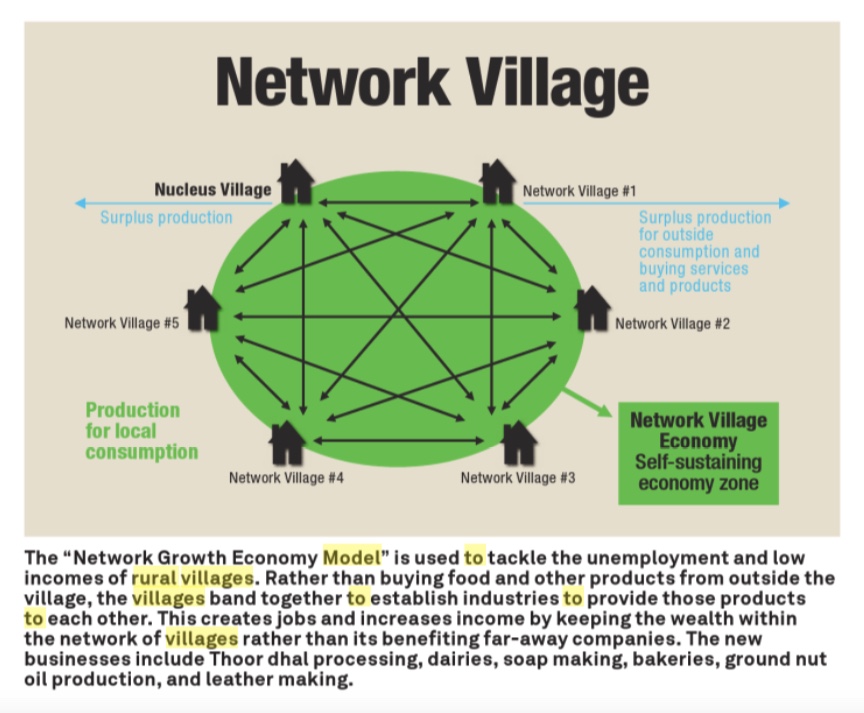
Like a spreading ink spot, the concept is to create a network of like-minded villages that act as self-reinforcing positive role models, spreading the prosperity and stability outwards. The “Network Growth Economy Model” is a direct challenge to the “special economic zones that benefit only capitalist owners,” said Elango.
Ambitious, Elango is hoping to draw in 2,000 villages over the next 10 years, until a tipping point is reached, and the model explodes across India.
A native of the village, Elango became saddened by the community’s decline, including widespread domestic violence against women. The booming city of Chennai’s prosperity had not rippled out to the village, and it was still lacking good infrastructure and sanitation. A trained chemical engineer, he was elected the President of the Kuthambakkam Panchayat in 1996, and set about using his engineer’s perspective to draft the village’s five-year plan from 1996 to 2001.
But the budget was tight. And he had to turn to innovative solutions: recycling building materials, conserving water and reducing electricity consumption. But the resourcefulness paid off, and the state of Tamil Nadu provided the money to upgrade roads, drains, build a community centre, child care facilities, 200 low cost toilets, and work sheds for the village’s industries. By the end of 2001, most basic needs were being met. He then turned to providing good quality housing for the villagers still living in thatch huts.
He has used the “Network Growth Economy Model” to tackle the unemployment and low incomes. It works like this: rather than buying food and other products from outside the village, the villages band together to establish industries to provide those products to each other. This creates jobs and increases income by keeping the wealth within the network of villages, rather than it benefiting far-away companies. The new businesses include Thoor dhal processing, dairies, soap making, bakeries, ground nut oil production, and leather making.
“India was strong when this model was in place – we had strong villages,” said Elango. “Globalization’s trickle down is not working for India.”
NextBillion.net: Hosted by the World Resources Institute, it identifies sustainable business models that address the needs of the world’s poorest citizens. Website:http://www.wri.org
CIDEM and Ecosur specialise in building low-cost community housing using eco-materials. They have projects around the world and are based in Cuba. Website:http://www.ecosur.org
Sponsored by BSHF. BSHF is now called World Habitat and it aims to seek out and share the best solutions to housing problems from around the world.
Development Challenges, South-South Solutions was launched as an e-newsletter in 2006 by UNDP’s South-South Cooperation Unit (now the United Nations Office for South-South Cooperation) based in New York, USA. It led on profiling the rise of the global South as an economic powerhouse and was one of the first regular publications to champion the global South’s innovators, entrepreneurs, and pioneers. It tracked the key trends that are now so profoundly reshaping how development is seen and done. This includes the rapid take-up of mobile phones and information technology in the global South (as profiled in the first issue of magazine Southern Innovator), the move to becoming a majority urban world, a growing global innovator culture, and the plethora of solutions being developed in the global South to tackle its problems and improve living conditions and boost human development. The success of the e-newsletter led to the launch of the magazine Southern Innovator.









 David South Consulting
You must be logged in to post a comment.