Categories
Archive Development Challenges, South-South Solutions Newsletters

Innovation: Cairo’s Green Technology Pioneers

By David SouthDevelopment Challenges, South-South Solutions

SOUTH-SOUTH CASE STUDY

One thing is ubiquitous to every country, community and society: garbage. It’s a social and environmental problem, but far from being mere waste, rubbish has its uses. This by-product of the goods and foods consumed can also be a source of fuel. As such it has many advantages, including providing free fuel to cash-strapped households, independence from unreliable municipal services and a way to dispose of waste.

An enterprising Egyptian man is showing his community how it is possible to lower the cost of gas and hot water while also avoiding the service disruptions common with municipal utilities. In the process, he is pioneering a local green innovation model that can be replicated elsewhere.

Biogas (http://en.wikipedia.org/wiki/Biogas) generators — which can transform organic household waste into fuel — have been very successful in India and China. It is estimated there are 20 million small-scale urban biogas digesters in China and 2 million in India.

Hanna Fathy’s roof in the Manshiyet Nasser neighbourhood, home to the Coptic Christian Zabaleen community of Cairo – the city’s traditional garbage collectors and recyclers – is now a utility system, providing biogas and hot water.

The area is made of narrow streets and makeshift houses. Residents live cheek-by-jowl in a neighbourhood that is home to tens of thousands of people.

The community was badly hit when the 300,000 pigs the Christian residents have kept for the past 30 years to eat Cairo’s vegetative waste — an effective garbage-disposal system — were slaughtered under government orders to prevent the spread of swine flu (H1N1) (http://en.wikipedia.org/wiki/Swine_influenza).

One woman told U.S. National Public Radio about the hard life in the neighbourhood: “I’m working all the time. My hands get dirty, there’s no water. The price of food is too high. The gas has gone up to seven pounds (US $1.28) a bottle, so it’s expensive to heat.

“Everything is so expensive, and I have to live like this?” she said.

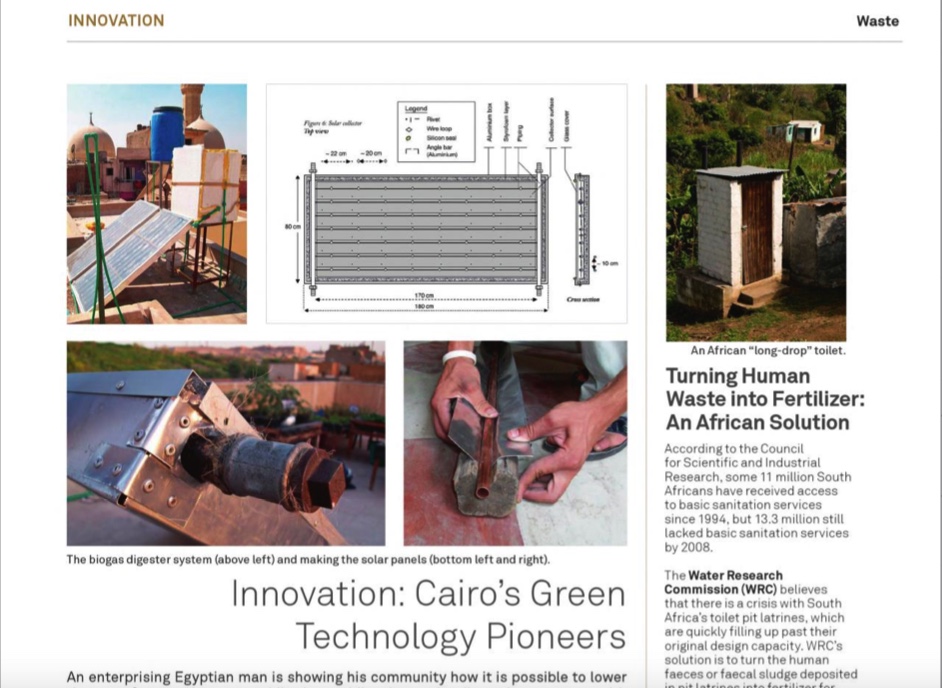
Fathy plops kitchen scraps, stale tea and tap water into a jug which he pours into a homemade biogas maker on the roof of his house. The stew of waste mixes with water and a small quantity of animal manure used to start the process, and overnight makes biogas, which is then used for cooking. The digester is able to provide an hour’s worth of cooking gas a day in winter months, and two hours in the summer, from around two kilograms of waste. The remaining waste by product becomes liquid organic fertilizer for the garden.

Fathy has been developing the biogas digester with the NGO Solar Cities (http://solarcities.blogspot.com), which provides designs, technical advice and support to Cairo citizens keen to embrace green technologies.

What is interesting is not only the technology but how that technology is being developed. The approach is to innovate and adapt the technology to local resources and skills. This increases the chances of take-up and buy-in.

The designs for the digesters and heaters have evolved through experimentation, brainstorming and availability of local materials.

Each biogas system costs about US $150 for materials, a cost that is being picked up right now by donations. Solar Cities believes there are only eight biogas digesters in Egypt so far, most built in 2009.

Solar Cities’ founder, Thomas Culhane, points out many urban dwellers do not believe they can generate biogas and associate it with rural systems that use animal manure. But the abundance of urban kitchen waste is in fact an excellent source material for biogas.

Culhane believes the biogas digesters are an excellent solution to two problems: the vast quantities of garbage piling up in Cairo, which has had its traditional disposal system disrupted by the slaughter of the pigs, and the city’s emissions of greenhouse gases that contribute to climate change.

Fathy has one goal: to be completely self-sufficient. He has been also prototyping a solar heater on his roof as well as the biogas digester. The solar water heater makes use of items that can be easily found: it recycles black garbage bags, has an aluminium frame and a glass cover. The whole thing rests on a Styrofoam block and uses copper tubes. The water is stored in a bright blue barrel.

Biogas, solar power and other forms of green energy face many obstacles if it is to expand further in Egypt. The average cost of each unit will need to come down to match the income of the users and compete with the government-subsidized energy sector.

Fathy has also found neighbours are skeptical and can’t believe biogas can be made this way.

Another man, Hussain Soliman, had both a solar water heater and biogas digester on the roof of his apartment building before the crumbling building collapsed.

The complete solar water heating system designed by Solar Cities can be assembled for under US $500. It uses two 200-litre recycled industrial shampoo barrels for the holding tank and back-up water supply. The solar panels need to be kept clean from dust every week, but other than that, Culhane insists the heaters require little maintenance.

Now in temporary government housing, Soliman is still enthusiastic about the technology and is re-building a solar heater and biogas digester for his new home.

“I’m planning to collect the organic waste from restaurants in the neighborhood to increase my gas output,” he told IPS News. “I’ll give the restaurants plastic bags and they can separate out the organics, and I’ll collect the bags at the end of each day.”

Published: January 2010

Resources

1) Practical Action has technical drawings and guidelines for making a small biogas digester. Website: http://practicalaction.org/practicalanswers/product_info.php?products_id=42

2)  The Anaerobic Digestion Community: Here is an excellent technical explanation of how a digester works, including a short film. Website: http://www.anaerobic-digestion.com/

3) China boasts a fast-growing biogas economy using farm waste. Here is a full summary of their experience. Website: http://www.i-sis.org.uk/BiogasChina.php.

https://davidsouthconsulting.org/2022/09/28/asian-factories-starting-to-go-green/

https://davidsouthconsulting.org/2022/09/27/caribbean-island-st-kitts-goes-green-for-tourism/

https://davidsouthconsulting.org/2021/01/25/creating-green-fashion-in-china/

https://davidsouthconsulting.org/2023/02/03/environmental-public-awareness-handbook-case-studies-and-lessons-learned-in-mongolia/

https://davidsouthconsulting.org/2021/02/01/ethiopia-and-djibouti-join-push-to-tap-geothermal-sources-for-green-energy/

https://davidsouthconsulting.org/2021/08/29/indian-business-model-makes-green-energy-affordable/

https://davidsouthconsulting.org/2021/10/22/innovations-in-green-economy-top-three-agenda/

https://davidsouthconsulting.org/2021/08/07/mongolian-green-book/

https://davidsouthconsulting.org/2022/04/14/prisons-with-green-solutions/

https://davidsouthconsulting.org/2021/02/04/us-450-million-pledged-for-green-economy-investments-at-kenyan-gssd-expo/

Development Challenges, South-South Solutions was launched as an e-newsletter in 2006 by UNDP’s South-South Cooperation Unit (now the United Nations Office for South-South Cooperation) based in New York, USA. It led on profiling the rise of the global South as an economic powerhouse and was one of the first regular publications to champion the global South’s innovators, entrepreneurs, and pioneers. It tracked the key trends that are now so profoundly reshaping how development is seen and done. This includes the rapid take-up of mobile phones and information technology in the global South (as profiled in the first issue of magazine Southern Innovator), the move to becoming a majority urban world, a growing global innovator culture, and the plethora of solutions being developed in the global South to tackle its problems and improve living conditions and boost human development. The success of the e-newsletter led to the launch of the magazine Southern Innovator. 

https://davidsouthconsulting.org/2022/11/01/southern-innovator-magazine-2010-2014/

Creative Commons License

This work is licensed under a
Creative Commons Attribution-Noncommercial-No Derivative Works 3.0 License.

ORCID iD: https://orcid.org/0000-0001-5311-1052.

© David South Consulting 2023

Categories
Archive

Clay Filters are Simple Solution for Clean Water

By David SouthDevelopment Challenges, South-South Solutions

SOUTH-SOUTH CASE STUDY

Access to clean water is critical to good health. It is a basic human need that when met, leads to the biggest improvements in health and well-being. Dirty water causes diarrhoea (http://en.wikipedia.org/wiki/Diarrhea), cholera and typhoid. Diseases caused by dirty drinking water kill almost 5,000 children a day around the world (WHO).

But millions have benefited from a simple solution using clay filters invented and pioneered in Central America, and now manufactured by 28 small factories in 23 countries – the largest in Ghana and Cambodia. Each factory makes up to several thousand filters a day. They offer an ingenious solution that also creates local jobs and skills.

Looking like 30 centimetre-high flowerpots, the filters designed by Guatemalan chemist Fernando Mazariegos blend local clay and plant husks to create a filter capable of killing 98 percent of the contaminants that cause diarrhoea. The husks are burnt away when the filters are fired in a kiln, creating tiny holes that filter out harmful organisms. A coating of colloidal silver (http://en.wikipedia.org/wiki/Colloidal_silver) is painted on the filters after they have been fired in the kiln.

“Each filter can support a family of six,” said Kaira Wagoner, Coordinator of Ceramic Water Filter Projects with the NGO Potters for Peace (www.pottersforpeace.org). Founded in Nicaragua but now US-based, Potters for Peace has popularized the filters and helps with all the training and support required to establish the workshops and market the filters.

The first filter-making workshop was set up in Managua, Nicaragua after Hurricane Mitch in 1999 (http://en.wikipedia.org/wiki/Hurricane_Mitch). That workshop has made and distributed 40,000 filters through the Red Cross and NGOs such as Medecins Sans Frontieres/Doctors Without Borders. Potters for Peace has now stopped running workshops and factories themselves, and provides others with the training and advice necessary to produce clay filters.

To work, the filters are placed in a plastic bucket, a spigot added, and a cover put on top to prevent contamination. The filters are capable of filtering four litres of water an hour.

The genius behind the filters is the fact they can be made by small, local workshops – making access to clean water available anywhere, and creating jobs. Just three to four people can produce up to 50 filters a day. According to tests by the Family Foundation of the Americas, a Guatemalan NGO, the filters halve the incidence of diarrhoea in households that use them.

“The cost of establishing a workshop varies largely,” said Wagoner, “depending on the factory’s location, desired production – from 50 per day to 1000 per day – and on the equipment already available in the potter’s workshop. Potters for Peace generally tries to work with potters who already have some of the needed equipment, such as a hammer mill and clay mixer.

“Filters are distributed hand in hand with health and sanitation information which highlights practices such as hand washing,” said Wagoner. “Since many individuals would otherwise boil their water, the filter significantly reduces the time many women would spend gathering firewood. This gives them time for other things such as school and income generating activities, and is better for the environment, especially in locations where problems with deforestation are significant.”

Experience has found marketing is key to the successful adoption of the filters by communities.

“It is very difficult to create a market in a region of poverty,” said Beverly Pillars, also from Potters for Peace, “and to gain acceptance of a new product that the community will want to purchase to keep a workshop sustainable. NGOs may distribute the ceramic water filters, but for the community to fully accept the idea of seeking out clean, safe drinking water on their own, we urge the local owners of the factory to be innovative in marketing.

“Our best approach has been to select partners in developing areas that have some experience such as a potter or brick maker, and help them to find methods that work in their communities to distribute as many of the ceramic water filters as possible, such as a distribution link through local health centres and small corner markets, adds in Yellow Pages, road signs.”

To get a workshop up and running, they need to have a machine to press the clay filters, a kiln to fire them, and a pyrometer (http://en.wikipedia.org/wiki/Pyrometer) to measure the temperature of the kiln. It usually takes between three and six weeks of training to become proficient at making the filters. Trainers help with acquiring the proper equipment, building the kiln, the clay filter formula, quality control procedures, and marketing techniques and materials.

“My advice to people wanting to start making filters is to look for local craftspeople to partner with,” said Pillars. “Look at local access to brick, clay and sawdust. Be prepared for hard and rewarding work to bring safe, clean drinking water to developing populations.

“Every location is a best location, because the demand for safe, clean drinking water worldwide is so great. The beauty of the ceramic water filter technology is that it uses very few resources: clay, sawdust or other burnout material available and bricks for a kiln. We have found these resources to be present worldwide.”

The filter has been cited by the United Nations’ Appropriate Technology Handbook, and is used by the International Red Cross and the Nobel Prize winning medical relief organization Doctors Without Borders. There are plans to start more filter factories in Cote d’Ivoire, Bolivia and Somaliland.

Published: December 2008

Resources

Development Challenges, South-South Solutions was launched as an e-newsletter in 2006 by UNDP’s South-South Cooperation Unit (now the United Nations Office for South-South Cooperation) based in New York, USA. It led on profiling the rise of the global South as an economic powerhouse and was one of the first regular publications to champion the global South’s innovators, entrepreneurs, and pioneers. It tracked the key trends that are now so profoundly reshaping how development is seen and done. This includes the rapid take-up of mobile phones and information technology in the global South (as profiled in the first issue of magazine Southern Innovator), the move to becoming a majority urban world, a growing global innovator culture, and the plethora of solutions being developed in the global South to tackle its problems and improve living conditions and boost human development. The success of the e-newsletter led to the launch of the magazine Southern Innovator. 

Creative Commons License

This work is licensed under a
Creative Commons Attribution-Noncommercial-No Derivative Works 3.0 License.

ORCID iD: https://orcid.org/0000-0001-5311-1052.

© David South Consulting 2022

Categories
Archive Blogroll Southern Innovator magazine Special Unit for South-South Cooperation United Nations Development Programme United Nations Office for South-South Cooperation

Southern Innovator Magazine | 2010 – 2014 

By David South

“I think you [David South] and the designer [Solveig Rolfsdottir] do great work and I enjoy Southern Innovator very much!” 

Ines Tofalo, Programme Specialist, United Nations Office for South-South Cooperation
Southern Innovator in Tianjin, China.
Issue 5 of Southern Innovator at the Global South-South Development Expo (GSSD Expo) 2014 held in Washington, D.C.
Volunteers in Nairobi, Kenya pose with Southern Innovator Issue 4 at the Global South-South Development Expo (GSSD Expo) in 2013.
Southern Innovator Editor and Writer David South in Australia.
Southern Innovator Graphic Designer and Illustrator Sólveig Rolfsdóttir in Iceland.

Some comments that have come in so far about SI’s first issue:

“What a tremendous magazine your team has produced! It’s a terrific tour de force of what is interesting, cutting edge and relevant in the global mobile/ICT space… Really looking forward to what you produce in issues #2 and #3. This is great, engaging, relevant and topical stuff.”, to “Looks great. Congratulations. It’s Brill’s Content for the 21st century!”

What they are saying about SI on Twitter: From @CapacityPlus Nice job RT @ActevisCGroup: RT @UNDP: Great looking informative @SouthSouth1 mag on South-South Innovation; @UNDP Great looking informative @SouthSouth1 mag on South-South Innovation; @JeannineLemaireGraphically beautiful & informative @UNDP Southern Innovator mag on South-South Innov. 

And on Pinterest:

Peggy Lee • 1 year ago 

“Beautiful, inspiring magazine from UNDP on South-South innovation. Heart is pumping adrenaline and admiration just reading it”

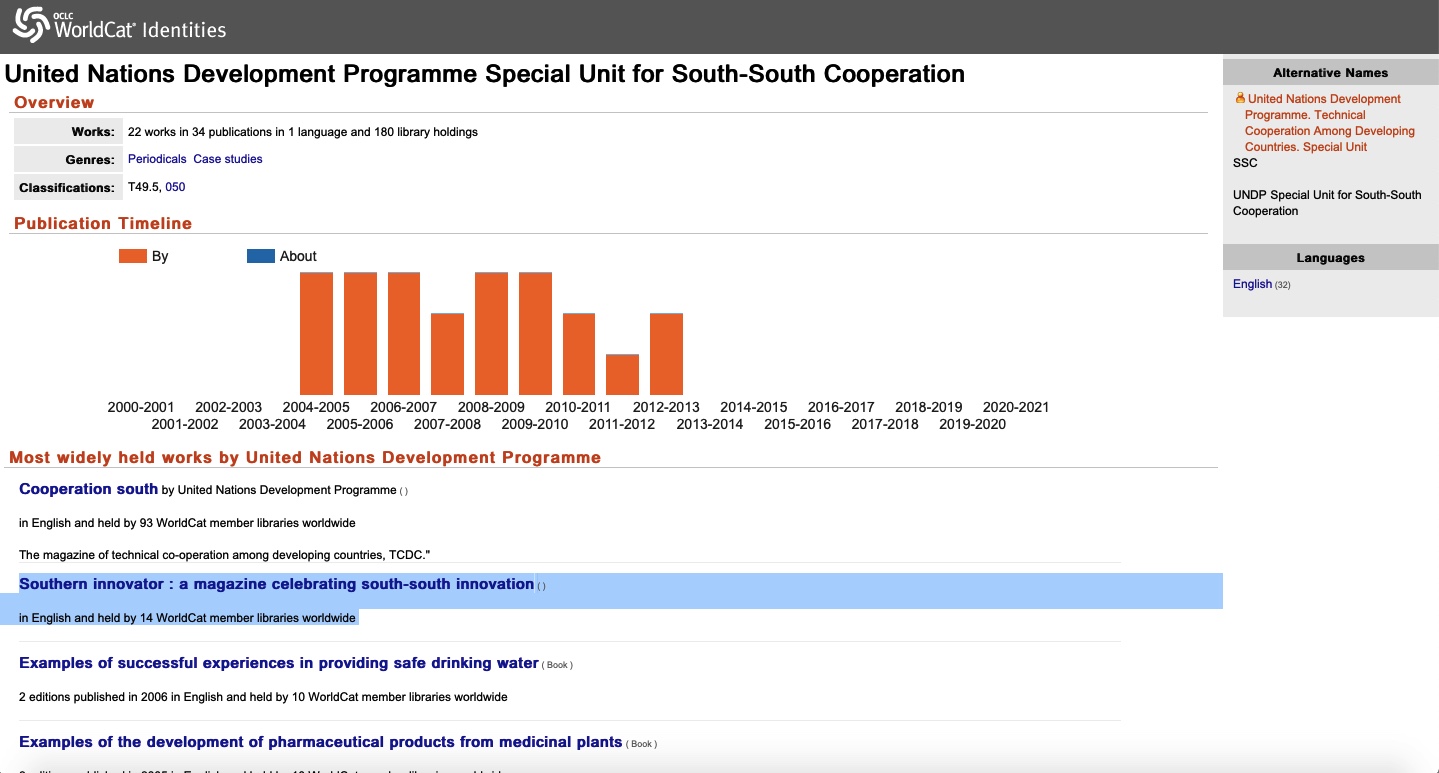
Southern Innovator Magazine can be found in libraries around the world.

Development Challenges, South-South Solutions was launched as an e-newsletter in 2006 by UNDP’s South-South Cooperation Unit (now the United Nations Office for South-South Cooperation) based in New York, USA. It led on profiling the rise of the global South as an economic powerhouse and was one of the first regular publications to champion the global South’s innovators, entrepreneurs, and pioneers. It tracked the key trends that are now so profoundly reshaping how development is seen and done. This includes the rapid take-up of mobile phones and information technology in the global South (as profiled in the first issue of magazine Southern Innovator), the move to becoming a majority urban world, a growing global innovator culture, and the plethora of solutions being developed in the global South to tackle its problems and improve living conditions and boost human development. The success of the e-newsletter led to the launch of the magazine Southern Innovator. 

https://davidsouthconsulting.org/southern-innovator-scale-up-fundraiser/

Creative Commons License

This work is licensed under a
Creative Commons Attribution-Noncommercial-No Derivative Works 3.0 License.

ORCID iD: https://orcid.org/0000-0001-5311-1052.

© David South Consulting 2022

Categories
Archive Southern Innovator magazine

Press Release 3 | Southern Innovator

Press Release for General Distribution

Southern Innovator’s Fifth Issue Profiles Innovators in Waste and Recycling

United Nations, New York, USA, 28 April 2014

• Fifth issue of Southern Innovator tackles ways to improve human development in a world with finite resources
• 60-page color magazine offers a snapshot of our fast-changing world

The fifth issue of Southern Innovator (SI) magazine is out now. It explores how innovation can tackle the challenges of improving human development on a planet with finite resources.

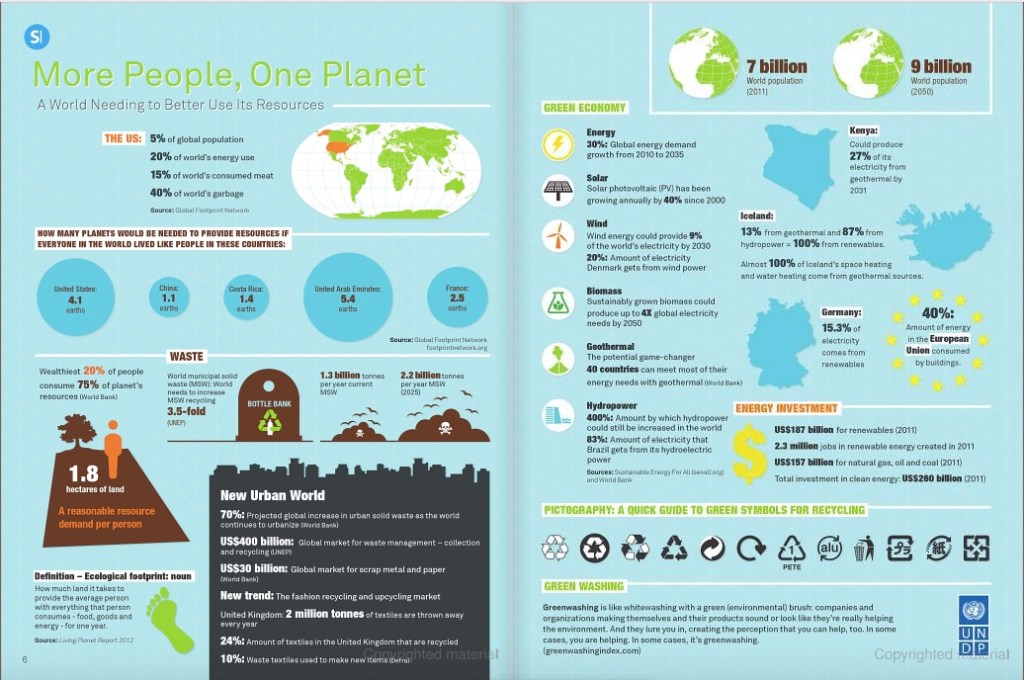
SI researchers identified innovative, low-polluting options to the world’s energy needs. They found that it is possible to alter the way that things are made to reduce or eliminate waste and toxic pollutants harming human health and damaging the environment. And not only that: they also discovered that there are sustainable incomes to be made from the economy of waste reduction and recycling – an opportunity that has yet to be fully realized. The innovations shared here demonstrate that raising living standards in the global South and responsible use of the world’s resources are not necessarily incompatible.

Some innovators are transforming attitudes towards fashion, proving that it does not have to be a wasteful industry. Others are turning commonly found waste – food waste, or human or animal excrement – into fuel for heating. The link between good design and the efficient use of resources is apparent in many of the innovators’ solutions. If a new, green economy is to work, then it must appeal to people’s aspirations and be something that they want in their lives and are willing to work to achieve.

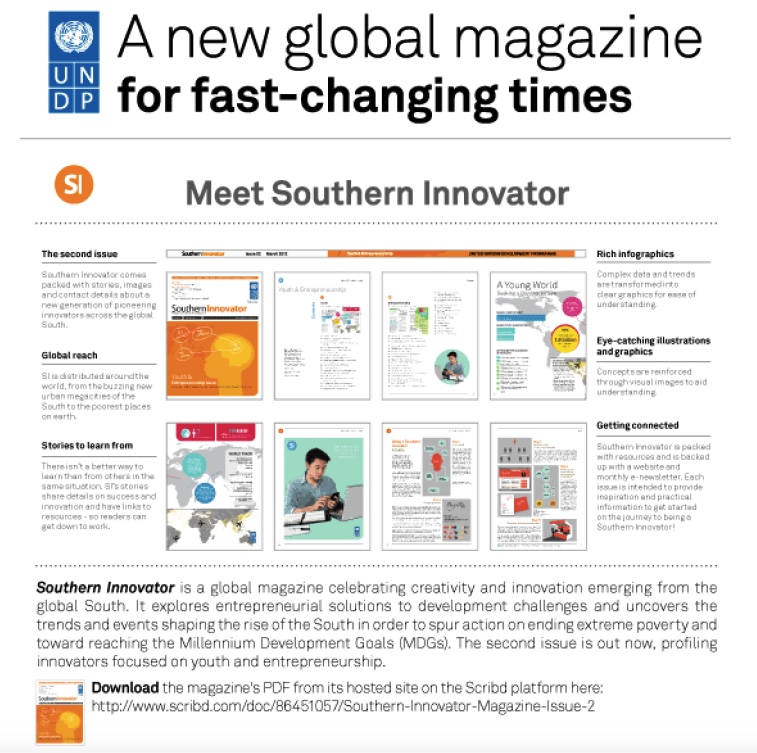
Southern Innovator (southerninnovator.org) champions a 21st-century global innovator culture. It is based on intensive research and produced by the United Nations Office for South-South Cooperation in (UNOSSC) in UNDP. UNOSSC also organizes the annual Global South-South Development Expo (southsouthexpo.org), a traveling celebration bringing together Southern innovators, with previous venues in New York, Washington, D.C., Geneva, Rome,Vienna, Nairobi and Doha.

We hope that you enjoy the magazine and find its content interesting and illuminating, a snapshot of a fast-changing world awash with innovators, creators and doers making their world a better place.

For information on sponsoring issues of the magazine, either through helping to fund its print run, or through an insert relating to an issue’s theme with pertinent content for our readers, contact Cosmas Gitta at cosmas.gitta@undp.org.

Online archives: southerninnovator.org; http://www.scribd.com/SouthernInnovator. Follow us @SouthSouth1

Press Release 2

Press Release 1

United Nations General Assembly: Sixty-ninth session, Item 24 (b) of the provisional agenda, Operational activities for development: South-South cooperation for development, 17 July 2014.
The research informing Southern Innovator Magazine played a part in the formulation of the UN’s post-2015 development agenda, including the Sustainable Development Goals (SDGs).

https://davidsouthconsulting.org/southern-innovator-scale-up-fundraiser/

ORCID iD: https://orcid.org/0000-0001-5311-1052.

© David South Consulting 2022