Categories
Archive Development Challenges, South-South Solutions Newsletters Southern Innovator magazine

Indian Toilet Pioneer Champions Good Ideas

By David SouthDevelopment Challenges, South-South Solutions

SOUTH-SOUTH CASE STUDY

Access to adequate sanitation and toilet facilities is critical to making development gains. Yet this simple fact of life often gets overlooked, especially in fast-growing cities where populations are on the rise or in transit. Out of an estimated 2.6 billion people in the world without toilets, two-thirds are in southern and eastern Asia (World Toilet Organization).

It is easy to take toilet technology for granted in developed countries, but in the fast-growing urban world of the global South, increasing access will be the dividing line between a future of good human health and dignity, or misery and poor health. The biggest gains in human health always come about once people have access to clean water and sanitation. Yet this proven fact gets lost in many places for a wide variety of reasons.

One country currently failing to meet the needs of its population is India. According to the McKinsey Global Institute, by 2030, 70 percent of India’s jobs will be created in its cities, and 590 million Indians will be city-dwellers. An enormous infrastructure task lies ahead for India: a city the size of Chicago needs to be built every year. But so far this challenge is not being met, leaving the country with the largest number of urban slum dwellers anywhere in the world. Housing is just not keeping up with populations’ needs.

As K.T. Ravindran, a professor of urban development, told the New York Times: “We require radical rethinking about urban development. It is not that there are no ideas. It is that there is no implementation of those ideas.”

It is this ability to act that makes the Sulabh International Social Service Organization stand out. The Indian non-governmental organization (NGO) sees itself as a movement and is a passionate advocate for toilets and toilet innovation for the poor and underserved.

Sulabh was founded in 1970 by Dr. Bindeshwar Pathak, who saw the vast task ahead. “I thought the challenges to provide toilet facilities have been overcome in rich countries; it has still to be met in developing countries like India,” he said.

So far, Sulabh has brought together 50,000 volunteers across the country to build toilets and sanitation facilities.

The organization’s success flows from understanding that it needs to do more than supply the ‘hardware’ of the toilets; it also needs to address the ‘software’: ideas and innovation and concepts.

The organization has directly built 1.2 million household toilets – but the government of India has built a further 54 million toilets based on the designs made by Sulabh. It’s an example of a good idea multiplying its impact when picked up by others.

While 10 million Indians use a Sulabh-built sanitation facility each day, according to the group’s website, an estimated 300 million are using a toilet based on Sulabh’s designs.

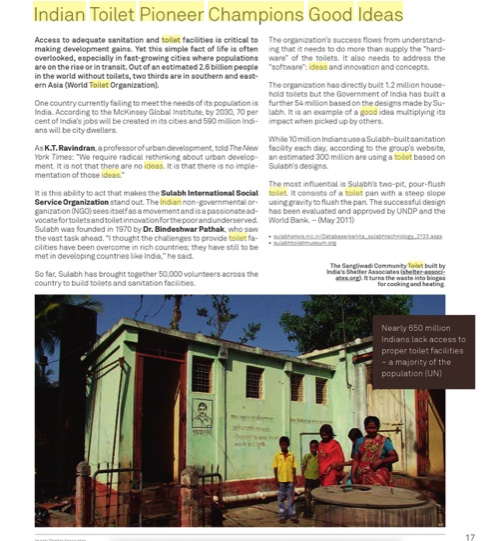
Most influential is Sulabh’s two-pit, pour-flush toilet (www.sulabhenvis.nic.in/Sulabhtechnology.htm). It consists of a toilet pan with a steep slope using gravity to flush the pan. Water is poured in to the pan to flush the toilet and the waste goes into either one of two pits. As one pit fills up with waste, waste is diverted to the second pit. After around 18 months, the first, filled pit’s waste becomes a safe, organic fertiliser suitable for agriculture and the fertiliser’s value covers the cost of emptying the pit. The successful design has been evaluated and approved by UNDP and the World Bank.

Sulabh has also been designing ways to get power and energy from toilets, building 200 biogas plants that turn the gas generated from the human excrement deposited in the toilets into a source of energy. Biogas (http://en.wikipedia.org/wiki/Biogas) is a clean-burning gas that can be made from animal, plant and human waste with the right technology and is a green solution to the need for gas to cook and run electricity generators.

Pride of place for the NGO is its vast toilet and bath complex at the holy shrine of Shri Sai Baba in Shirdi, Maharashtra (http://en.wikipedia.org/wiki/Maharashtra). Millions flock to the shrine every year, but it lacked proper sanitation facilities. To solve this problem Sulabh’s local branch has built a vast complex occupying two acres. The brightly coloured and palace-like facility has 120 toilets, 108 bathing cubicles, six dressing rooms, and urinals and can serve 30,000 people a day. There are telephones and 5,000 lockers for tourists to keep possessions safe.

There are also three biogas plants connected to the facility, generating electricity and hot water for bathing used by the toilet and bath complex. This solves the puzzle of how to fund the utilities. Water discharged from the facility is used to irrigate the surrounding green spaces.

Sulabh has also built a museum dedicated to toilets and toilet technology (http://www.sulabhtoiletmuseum.org). The museum places the toilet as a critical part of human civilisation and shows how it fits in with the cultural context of India. Toilets and toilet designs from around the world and throughout history are gathered together and make a fascinating journey through this essential human need.

Published: May 2011

Resources

1) World Toilet Organization: World Toilet Organization (WTO) is a global non- profit organization committed to improving toilet and sanitation conditions worldwide. Website: http://www.worldtoilet.org

2) World Toilet Day: On November 19 every year, this event draws attention to the lack of access for 2.6 billion people. Website: http://www.worldtoilet.org

3) Dirt: The Filthy Reality of Everyday Life: An exhibit by the prestigious Wellcome Collection on the human relationship with dirt and hygiene in history. Website:http://www.wellcomecollection.org/whats-on/exhibitions/dirt.aspx

4) World Toilet College: Established in 2005, the World Toilet College (WTC) started as a social enterprise, with the belief that there is need for an independent world body to ensure the best practices and standards in Toilet Design, Cleanliness, and Sanitation Technologies are adopted and disseminated through training. Website:http://worldtoilet.org/ourwork3.asp

Development Challenges, South-South Solutions was launched as an e-newsletter in 2006 by UNDP’s South-South Cooperation Unit (now the United Nations Office for South-South Cooperation) based in New York, USA. It led on profiling the rise of the global South as an economic powerhouse and was one of the first regular publications to champion the global South’s innovators, entrepreneurs, and pioneers. It tracked the key trends that are now so profoundly reshaping how development is seen and done. This includes the rapid take-up of mobile phones and information technology in the global South (as profiled in the first issue of magazine Southern Innovator), the move to becoming a majority urban world, a growing global innovator culture, and the plethora of solutions being developed in the global South to tackle its problems and improve living conditions and boost human development. The success of the e-newsletter led to the launch of the magazine Southern Innovator. 

Creative Commons License

This work is licensed under a
Creative Commons Attribution-Noncommercial-No Derivative Works 3.0 License.

ORCID iD: https://orcid.org/0000-0001-5311-1052.

© David South Consulting 2023

Categories
Archive Development Challenges, South-South Solutions Newsletters

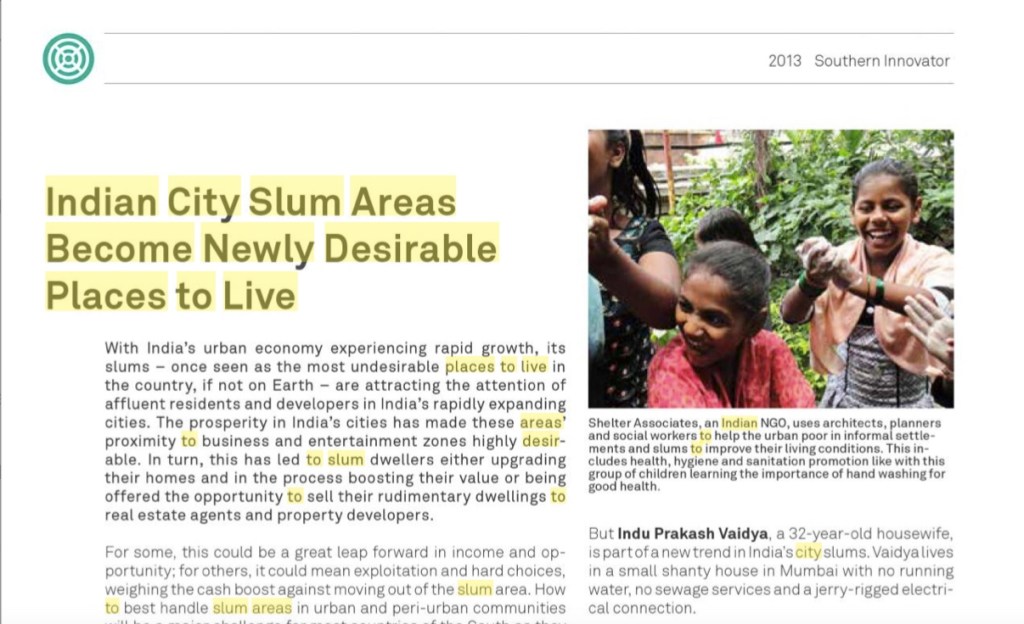
Indian City Slum Areas Become Newly Desirable Places to Live

By David SouthDevelopment Challenges, South-South Solutions

SOUTH-SOUTH CASE STUDY

With India’s urban economy experiencing rapid growth, its slums – once seen as the most undesirable places to live in the country, if not on Earth – are attracting the attention of affluent residents and developers inIndia’s rapidly expanding cities. The prosperity inIndia’s cities has made these areas’ proximity to business and entertainment zones highly desirable. In turn, this has led to slum dwellers either upgrading their homes and in the process boosting their value, or being offered the opportunity to sell their rudimentary dwellings to real estate agents and property developers.

For some, this could be a great leap forward in income and opportunity; for others, it could mean exploitation and hard choices, weighing up the cash boost against moving out of the slum area.

How to best handle slum areas in urban and peri-urban communities will be a major challenge for most countries in the South as they continue to urbanize.

India’s phenomenal economic growth rate – forecast to be 7.9 percent this year by the Asian Development Bank, after averaging 7.7 percent per year over the past decade – has been the force behind an expanding middle class population, now estimated at 50 million people (McKinsey). Forecasts see it swelling from 5 percent ofIndia’s population to 40 percent by 2025.

With 30 percent of the population living in urban areas and cities contributing 60 percent of the country’s GDP and 90 percent of government revenues (Wall Street Journal), city-dwellers’ fate is critical to the functioning of the economy.

According to the 2001 Indian census, slums make up 25 percent of all housing and 26 percent of urban households lack access to sanitation facilities.

But Indu Prakash Vaidya, a 32-year-old housewife, is part of new trend inIndia’s city slums. Vaidya lives in a small shanty house in Mumbai with no running water, no sewage services and a jerry-rigged electrical connection.

Vaidya’s home is a just a single room for the five people in her family. They sleep on the cement floor and the ‘kitchen’ is a two-burner gas stove. The dwelling is so poorly constructed that they have to move around inside the room when it rains outside to avoid getting soaked.

But her humble home has been valued at US $24,000 by people looking to buy it.

According to real estate agent Hari Ram, the average price of a 91 square metre shanty home in Mumbai is now US $46,000.

“Shanties as small as 120 square feet… are as expensive as US $93,000,” Dinesh Prabhu, a construction company owner, told NDTV television.

Sixty percent of Mumbai’s 21 million people live in slums. And many are now finding themselves the subject of a property boom. This has led to the bizarre spectacle of luxury high-rise buildings sprouting up in a sea of slum housing. The slums are attracting the attention of those with money because many busy city workers face long commutes and are desperate for homes closer to work and entertainment areas.

The value of living close to the action is summed up by one slum dweller:

“People would kill to be in a place like this,” said slum dweller Sundar. “There are four local train stations close by. And the bus stop is a stone’s throw away.”

Some say this real estate boom offers enormous potential for the poor.

“All I can say is, given the current real-estate rates, those slums are invaluable,” said Sharad Mahajan of the Pune-based nonprofit organization Mashal (http://mashalindia.org).  Mashal focuses on the problem of urban shelter and also implements housing projects. It has been working in the Dharavi slum area with theMaharashtra government on its redevelopment. The slum is well-known for its representation in the film Slumdog Millionaire, and the area is next to the Bandra-Kurla Complex business district of Mumbai. Mashal has been mapping the area, home to 60,000 families, to make sure the redevelopment is fair to the families living there.

Land tenure is an issue however. Many slum dwellers do not have official title to the land they live on. Over time, they have become semi-official places to live as governments have hooked many up to electricity and drinking water. Issues of corruption and exploitation are also other problems that need addressing if this real estate windfall is to actually benefit slum dwellers.

Typical slum dwellers are day labourers and poor migrants. But others are people who good easily afford to live somewhere else but don’t want the long commutes to work.

“It is simpler and less expensive to live here,” said Sankaralingam, a plastic merchant, who estimates his annual income at around US $9,300: an amount that could get him a home somewhere nicer.

For Indu Prakash Vaidya, the dilemma – to sell or not to sell – makes for some painful choices. While her current home is prone to flooding during the rainy season, she feels she would have nowhere else to go if she sold the home.

Yet the pressure to sell is great and elemental.

“I have three children, and their education and well-being need to be taken care of. Financial constraints can push me to sell this shanty in the future, then where will I live? I will have nowhere to go,” she told NDTV. 

Published: December 2011

Resources

1) New documentary Urbanized gives a passionate over-view of the challenges facing the rapidly urbanizing world around us. Website: http://urbanizedfilm.com/

Development Challenges, South-South Solutions was launched as an e-newsletter in 2006 by UNDP’s South-South Cooperation Unit (now the United Nations Office for South-South Cooperation) based in New York, USA. It led on profiling the rise of the global South as an economic powerhouse and was one of the first regular publications to champion the global South’s innovators, entrepreneurs, and pioneers. It tracked the key trends that are now so profoundly reshaping how development is seen and done. This includes the rapid take-up of mobile phones and information technology in the global South (as profiled in the first issue of magazine Southern Innovator), the move to becoming a majority urban world, a growing global innovator culture, and the plethora of solutions being developed in the global South to tackle its problems and improve living conditions and boost human development. The success of the e-newsletter led to the launch of the magazine Southern Innovator. 

Creative Commons License

This work is licensed under a
Creative Commons Attribution-Noncommercial-No Derivative Works 3.0 License.

ORCID iD: https://orcid.org/0000-0001-5311-1052.

© David South Consulting 2023

Categories
Archive Development Challenges, South-South Solutions Newsletters

Business Leads on Tackling Violence in Mexican City

By David SouthDevelopment Challenges, South-South Solutions

SOUTH-SOUTH CASE STUDY

The damaging affects of crime and violence can ruin a city. They act as a drag on efforts to increase wealth and improve living conditions, and a city that gets a bad reputation, especially in the age of the Internet, will lose investment opportunities.

The North American nation of Mexico has been struggling against drug and gang-related violence that has left an estimated 47,000 people dead over the past five years. It is a casualty rate worthy of a war.

In Monterrey, the capital of Nuevo Leon state (http://en.wikipedia.org/wiki/Nuevo_Le%C3%B3n), an innovative initiative has brought together local businesses to tackle the root causes of violence and crime. The initiative – called Red SumaRSE, which means ‘joining a network’ – was born from anger and disgust at the situation in the city. And it was ignited by a prominent member of the business community expressing this frustration on the social media outlet Twitter (twitter.com).

The chief executive of the Cemex cement company had had enough one day. Lorenzo Zambrano tweeted a blunt message to other companies in the city: “He who leaves Monterrey is a coward.” It was to be a rallying cry for the campaign to take back the city from the violent gangs.

Monterrey is embroiled in violent drug-related gang crime. Just one incident shows how bad the situation had become. In August 2011 members of the Zetas drug gang torched a casino over a dispute over non-payment of extortion money, killing 52 people.

Law enforcement measures can often only go so far to curb violence in a community. Little impact can be made without addressing the underlying economic causes of much of the violence – poor employment opportunities, drug turf wars between rival gangs, economic instability and more.

“Violence is an expression of social inequality,” Zambrano told The New York Times.

Tragedies like the casino fire provoked the city’s business community to take action. Private companies in the city have stepped up to design and fund a recruitment campaign for the police force and are paying part of the cost for government-backed community redevelopment plans.

Corporate philanthropy in Mexico has a history of being very limited. Apart from distribution of gifts at holiday time,there was little else. But this is changing, with Red SumaRSE showing the way.

“In the last five or 10 years there has been progress both in terms of the quantity of the money and the quality,” Michael Layton, director of the Philanthropy and Civil Society Project at the Autonomous Technological Institute of Mexico, told The New York Times. “But I don’t think Mexico has caught up to Brazil and other countries where the business sector has taken corporate philanthropy to heart.”

The Red SumaRSE alliance of Monterrey’s companies is directing support to non-governmental organizations working on community development. Examples include telephone company Axtel and the tortilla maker Gruma (gruma.com/vEsp) taking charge of 20 other companies to invest in schools, building up infrastructure and reversing drop-out rates.

The Oxxo company (oxxo.com/index.php), Mexico and Latin America’s largest chain store, has started to work at improving conditions in the neighbourhood immediately behind its headquarters. The company is working on building parks, increasing job opportunities and finding ways to prevent teenagers from joining gangs in the first place.

Cemex has also opened a new community centre in a violent neighbourhood where shootings were a regular occurrence. It was based on some Latin American knowledge sharing: inspired by the case of the Colombian city of Medellin, where libraries were strategically located in violent slum areas.

And there is more good work in the pipeline. The business community has drawn up a list of 70 neighbourhoods in the city needing re-development.

Red SumaRSE has not been without its critics. They have attacked the focus on security, education and victims while ignoring corruption, which many believe is the source of many of the city’s problems.

Published: February 2012

Resources

1) Medellin: Walking between slums and dreamworlds of neoliberalism: More on the complexities of the situation in this Colombian city.Website: http://www.a0n.com/medellin/dreamworlds.htm

Development Challenges, South-South Solutions was launched as an e-newsletter in 2006 by UNDP’s South-South Cooperation Unit (now the United Nations Office for South-South Cooperation) based in New York, USA. It led on profiling the rise of the global South as an economic powerhouse and was one of the first regular publications to champion the global South’s innovators, entrepreneurs, and pioneers. It tracked the key trends that are now so profoundly reshaping how development is seen and done. This includes the rapid take-up of mobile phones and information technology in the global South (as profiled in the first issue of magazine Southern Innovator), the move to becoming a majority urban world, a growing global innovator culture, and the plethora of solutions being developed in the global South to tackle its problems and improve living conditions and boost human development. The success of the e-newsletter led to the launch of the magazine Southern Innovator. 

Creative Commons License

This work is licensed under a
Creative Commons Attribution-Noncommercial-No Derivative Works 3.0 License.

ORCID iD: https://orcid.org/0000-0001-5311-1052.

© David South Consulting 2023

Categories
Archive Development Challenges, South-South Solutions Newsletters Southern Innovator magazine

More Futuristic African Cities in the Works

By David SouthDevelopment Challenges, South-South Solutions

SOUTH-SOUTH CASE STUDY

It has been well documented that China is undergoing the largest migration in human history from rural areas to cities. But this urbanization trend is occurring across the global South, including in Africa, as well. According to the UN, more than half the world’s population already lives in cities, and 70 per cent will live in urban areas by 2050. Most of the world’s population growth is concentrated in urban areas in the global South.

These emerging urban areas represent vast opportunities for innovators. Innovators will be needed to build them, and in turn they will provide modern facilities for innovators to operate in and engage with the global economy. And they will connect innovators to 21st-century information technology.

But while the government in China engages in significant planning and preparation to facilitate movements to urban areas – often building entire cities from scratch (http://www.time.com/time/photogallery/0,29307,1975397,00.html) – that has not been the case in Africa. People in Africa are on the move because they are seeking out opportunities, but much of this movement has been poorly planned and not well thought out.

But now more and more African governments are grappling with how to call time on chaotic and haphazard development and build sustainable, planned cities that will significantly improve human development and quality of life.

Across Africa, a host of ambitious new cities and urban developments are in the works.

Kenya’s Konza Technology City (konzacity.co.ke) is planned as a new centre 60 kilometres from the capital, Nairobi. Calling itself a “world-class technology hub and a major economic driver for the nation”, it offers a high-tech vision full of ultra-modern buildings and houses in order to spur the future growth of Kenya’s technology industry.

It is hoped Konza will create 100,000 jobs by 2030. There will be a central business district, a university campus for 1,500 students, a residential community, and parks and wildlife in green corridors.

The groundbreaking ceremony occurred on January 2013 but the Kenyan Ministry of Lands and Housing has halted operations to allow for greater community engagement, according to Urban Africa. A dispute had erupted with the current landowners who wanted to be better consulted about the development and had accused the government of locking them out of the physical planning process.

Tatu City, Kenya (tatucity.com) bills itself as “by Kenyans, for Kenyans”. It is being built by Rendeavour (rendeavour.com), the urban development division of Moscow-based Renaissance Group (rengroup.com), one of the largest urban developers of land in Africa. It joins Konza Technology City as a flagship project for the government’s Vision 2030, hoping to turn Kenya into a middle-income country and a role model for other countries in East Africa.

Tatu City is 15 kilometres from Nairobi. It will take up 1,035 hectares and will be completed in 10 phases. Construction began in May 2012 and is scheduled to be completed by 2022.

It is selling safety and a “beautiful urban environment” just a short journey away from Nairobi’s existing Central Business District. Tatu City wants to be “a model of the African city of the future” as a “dynamic mixed-use, mixed-income environment that will be home to an estimated 70,000 residents and 30,000 day visitors”.

Just 25 minutes from Jomo Kenyatta International Airport, it promises to be one of “the most modern, well-planned urban developments in East Africa”.

In Ghana, a number of innovative projects in development reflect the country’s impressive economic growth and information technology achievements in the past decade.

Two cities are being designed by Rendeavour. One, Appolonia, is being built in the Greater Accra area while the second, King City, is being built on the west coast of the country where there is an oil and gas boom underway.

Both will have houses, retail and commercial centres, schools, healthcare facilities and other social services.

“Our objective is to provide the basic infrastructure, planning and necessary management framework in creating satellite cities that reverses the current trend of unplanned development and urban congestion in most of Africa’s growing cities,” Tim Beighton of Rendeavour told CNN.

These projects are in an advanced stage, with all plans completed and approved by the government, according to their websites.

Appolonia City of Light near Accra (appolonia.com.gh) – due to break ground in the third quarter of 2013 – capitalizes on Accra’s status as one of Africa’s fastest-growing urban areas. The Appolonia development will be a “planned, sustainable, mixed-use and mixed-income city” to build a “work-live-play” community for 88,000 people living in 22,000 homes.

It will be built 30 kilometres northeast of Accra’s central business district and will have retail, commercial and industrial space combined with tourism, social and recreation facilities.

King City in Takoradi (kingcity.com.gh) calls itself “Western Ghana’s new holistic city”. It will offer homes, shops, offices, industries and public places. The plan includes building 25,000 new homes and, importantly, over 30 per cent of the city will be allocated for green space. It will take up 1,000 hectares on the outskirts of Sekondi-Takoradi.

Elsewhere in Accra, the Hope (Home Office People Environment) City (http://www.rlgghana.com/index.php/2013-02-07-11-25-04.html) is a much more ambitious concept. It is one of a cluster of projects in Africa focused on building the infrastructure for a 21st century, high-tech future. Costing US $10 billion, it will be built outside Accra and is focused on boosting Ghana’s already established reputation in the field of information and communications technology. It will be home to 25,000 people and create jobs for 50,000. There will be six towers including a 75-storey, 270 metre building that hopes to be the highest in Africa.

It is being financed by RLG Communications, a mix of investors and a stock-buying scheme.

There will be an assembly plant for high-tech products, business offices an information technology university, a hospital and restaurants, theaters and sports centres.

The design is hyper-modern and tries to create a vertical office environment that is dense and reduces the amount of time it takes to get around and circulate between businesses in the complex.

Eko Atlantic on Victoria Island in Lagos, Nigeria (ekoatlantic.com) is a coastal residential and business development that calls itself “The New Gateway to Africa”. To ease pressure in an already crowded city, it is being built on 10 square kilometres of reclaimed land from the Atlantic Ocean. It will be able to house 250,000 people and give work to 150,000.

The story began in 2003 when the Lagos State government was looking for a solution to protect the Bar Beach area of the city from coastal erosion. Land is being reclaimed from the sea and it will make up an area the equivalent of Manhattan in New York City. Just like Manhattan, it is hoped Eko Atlantic will become the new financial centre for West Africa by the year 2020.

Kilamba, or Nova Cidade de Kilamba (https://www.facebook.com/media/set/?set=a.231897596836631.80284.228497773843280), 30 kilometres outside Luanda, Angola is being built by the China International Trust and Investment Corporation (http://www.citic.com/wps/portal). It is on a vast scale and is designed to be home to 500,000 people with apartment blocks and commercial spaces. It has cost so far US $3.5 billion and is part of a government pledge to provide a million new homes within four years. Kilamba has come in for criticism for not being affordable enough for ordinary Angolans and for having much of the site unoccupied. With the apartments too expensive for ordinary Angolans, the government has decided to take action and ordered the prices to be reduced and made more affordable, according to Angola Press .

La Cite du Fleuve in the Democratic Republic of Congo (lacitedufleuve.com) is  a more conventional luxury housing development built on two islands in the capital, Kinshasa. Kinshasa, despite its problems and the turmoil from an ongoing civil war, is one of the continent’s fastest-growing cities. Developed by Hawkwood Properties, La Cite du Fleuve will need to reclaim 375 hectares of sandbanks and swamps to be able to build a collection of riverside villas, offices and shopping centres. It is is planned to take 10 years to complete.

And finally, Kigali, the capital of Rwanda, wants to transform itself into the “center of urban excellence in Africa”.

The 2020 Kigali Conceptual Master Plan (http://www.kigalicity.gov.rw/spip.php?article494) hopes to create a regional hub for business, trade and tourism, by building a mix of commercial and shopping districts with glass skyscrapers and modern hotels, parks and entertainment facilities.

Critics, however, believe these new cities and modern developments are tackling the problems of urban development by bypassing most of the population. They argue they are just developments for those with money who can buy their way out of the chaos and lack of planning of current African cities.

“They are essentially designed for people with money,” Vanessa Watson, professor of city planning at the University of Cape Town, told CNN. She believes most of the plans are unsustainable “urban fantasies” detached from the reality of African poverty and informal living.

But while it is easy to criticize these ambitious projects, they reflect not only optimism for the continent’s future but also a clear recognition the continent will not be able to get wealthier without modern cities and infrastructure in keeping with a 21st-century economy.

Published: August 2013

Resources

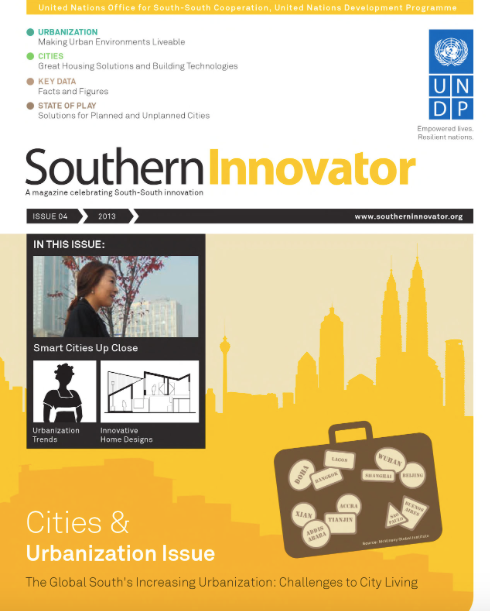
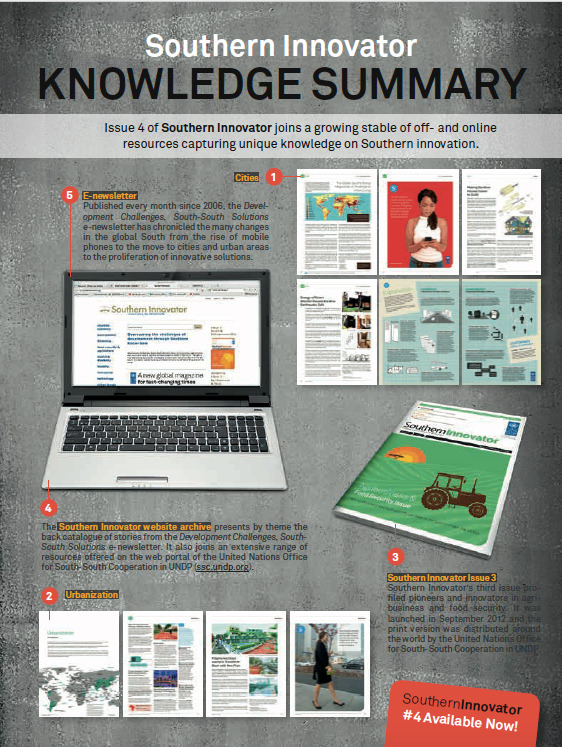
1) Southern Innovator Issue 4: Cities and Urbanization: SI’s fourth issue goes to the many new cities under construction to build the new 21st century world emerging in the global South. Website: http://www.scribd.com/doc/133622315/Southern-Innovator-Magazine-Issue-4-Cities-and-Urbanization

2) Urban Africa: Urban Africa is a digital entry point for knowledge sharing, interactive exchange and information dissemination on urbanization in Africa. Website: http://urbanafrica.net/

3) Arrival City: A third of humanity is on the move. History’s largest migration is creating new urban spaces that are this century’s focal points of conflict and change — unseen districts of rapid transformation and febrile activity that will reshape our cities and reconfigure our economies. Website: http://arrivalcity.net/

4) Global Urbanist: The Global Urbanist is an online magazine reviewing urban affairs and urban development issues in cities throughout the developed and developing world. Website: globalurbanist.com

5) Africa Renewal: The Africa Renewal information programme, produced by the Africa Section of the United Nations Department of Public Information, provides up-to-date information and analysis of the major economic and development challenges facing Africa today. Website: http://www.un.org/africarenewal/

Citations

Cited in Beyond Gated Communities by Samer Bagaeen and Ola Uduku (2015).

https://davidsouthconsulting.org/2022/02/09/african-megacity-makeovers-tackle-rising-populations/

https://davidsouthconsulting.org/2022/10/19/chinese-building-solution-for-rapidly-urbanizing-global-south/

https://davidsouthconsulting.org/2022/05/23/debt-free-homes-for-the-poor/

https://davidsouthconsulting.org/2022/10/17/east-africa-to-get-its-first-dedicated-technology-city/

https://davidsouthconsulting.org/2022/03/20/global-south-eco-cities-show-how-the-future-can-be/

https://davidsouthconsulting.org/2021/11/12/global-souths-rising-megacities-challenge-idea-of-urban-living/

https://davidsouthconsulting.org/2022/03/29/model-city-to-test-the-new-urbanism-concept-in-india/

https://davidsouthconsulting.org/2017/11/08/smart-cities-up-close-2013/

https://davidsouthconsulting.org/2022/09/26/3d-home-printing-landmark-10-houses-in-a-day/

https://davidsouthconsulting.org/2022/11/17/tiny-homes-to-meet-global-housing-crisis/

Development Challenges, South-South Solutions was launched as an e-newsletter in 2006 by UNDP’s South-South Cooperation Unit (now the United Nations Office for South-South Cooperation) based in New York, USA. It led on profiling the rise of the global South as an economic powerhouse and was one of the first regular publications to champion the global South’s innovators, entrepreneurs, and pioneers. It tracked the key trends that are now so profoundly reshaping how development is seen and done. This includes the rapid take-up of mobile phones and information technology in the global South (as profiled in the first issue of magazine Southern Innovator), the move to becoming a majority urban world, a growing global innovator culture, and the plethora of solutions being developed in the global South to tackle its problems and improve living conditions and boost human development. The success of the e-newsletter led to the launch of the magazine Southern Innovator. 

https://davidsouthconsulting.org/2021/03/05/southern-innovator-issue-4/

Creative Commons License

This work is licensed under a
Creative Commons Attribution-Noncommercial-No Derivative Works 3.0 License.

ORCID iD: https://orcid.org/0000-0001-5311-1052.

© David South Consulting 2022