Categories
Archive Development Challenges, South-South Solutions Newsletters

2014: Development Challenges, South-South Solutions

By David SouthDevelopment Challenges, South-South Solutions

SOUTH-SOUTH CASE STUDY 

ISSN 2227-3905

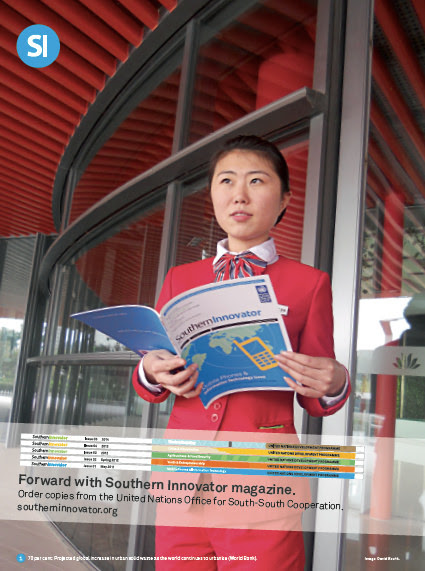
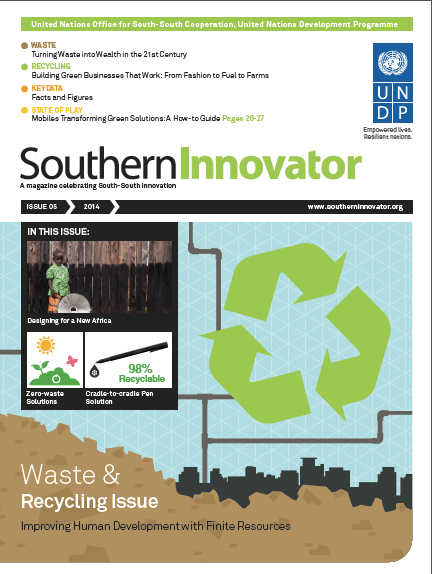
The fifth issue of Southern Innovator has launched online and in print. Order copies now for distribution. Email: southerninnovator@yahoo.co.uk.

Issue six will be on science, technology and innovation. This issue will be different from previous issues and will be including supplements and inserts to boost the impact of the magazine. Southern Innovator is seeking sponsors to fund this and also to help us expand the print run (currently 5,000 copies for global distribution).

July

3D Home Printing Landmark: 10 Houses in a Day Development Challenges: The global South is experiencing urban growth on a scale unprecedented in human history, far outstripping the great urbanization wave that swept across Europe and North America during the 19th and 20th centuries.

Old Boats Become New Furniture in Senegal Development Challenges: Every country has its fair share of waste and the remnants of past economic activity. Old cars nobody wants, discarded tins of food, old plastic bags, spare copper wire, cast-off clothing – all can have a new life in the right hands.

Innovative Solutions Celebrated in Ashden Awards Development Challenges: The world’s population is heading towards 9.6 billion by 2050 (UN). Combined with a growing middle class and rising living standards across the global South, that means ever-greater demand on the world’s finite resources. This raises a crucial question: Where will the energy to power rising living standards come from, and how much damage will be done to the planet’s environment by pollution created generating it (https://www.un.org/en/development/desa/news/population/un-report-world-population-projected-to-reach-9-6-billion-by-2050.html)?

Innovative Ways to Collect Water from Air Development Challenges: World water resources are being depleted quickly as populations grow, urbanize and demand better living standards. Many scientists believe we are reaching peak water – the point at which fresh water is consumed faster than it is replenished.

June

Caribbean Island St. Kitts Goes Green for Tourism Development Challenges: Going green may sound like the right thing to do but it can also be associated with being a costly burden and boring. But, as one island nation is proving, being green is a great selling point for attracting tourists and investors – especially in a world where many places are grappling with pollution and resource depletion.

Big Data Can Transform the Global South’s Growing Cities Development Challenges: The coming years will see a major new force dominating development: Big Data. The term refers to the vast quantities of digital data being generated as a result of the proliferation of mobile phones, the Internet and social media across the global South – a so-called ‘data deluge’ (UN Global Pulse). It is an historically unprecedented surge in data, much of it coming from some of the poorest places on the planet and being gathered in real time.

Indian Business Model Makes Green Energy Affordable Development Challenges: The technology already exists to provide renewable energy and electricity to all the world’s poor. The trick is finding a way to pay for it and to make it sustainable. Many innovators are experimenting with business models to reach the so-called Bottom of the Pyramid (BOP) cohort, and the 1.2 billion poorest people in the world who do not have access to electricity (World Bank) (http://tinyurl.com/n9p3f5x). A further 2.8 billion have to rely on wood or other biomass materials to cook and heat their homes.

South-South Trade Helping Countries During Economic Crisis Development Challenges: Weathering the global economic crisis is testing the stability of countries across the global South. But many countries are finding South-South trade and catering to their domestic middle classes can lift incomes and maintain growth rates despite the global turmoil.

May

3D Printing Gives Boy a New Arm in Sudan Development Challenges: 3D printing is rapidly going mainstream and is now starting to make a big impact in health care. One innovative solution is using the technology to manufacture artificial arms for amputees harmed by war in Africa.

African Hotel Boom Bringing in New Investment and Creating Jobs Development Challenges: Africa is experiencing a boom not seen for decades. The IMF forecasts economic growth in sub-Saharan Africa of 6 per cent in 2014, compared to global growth of 3.6 per cent.

China’s Outsourced Airliner Development Model Development Challenges: Many emerging-market countries in the global South have built up substantial foreign currency reserves. Much of this has been a response to past foreign currency crises, particularly the Asian Crisis in the late 1990s (http://en.wikipedia.org/wiki/1997_Asian_financial_crisis).

Brazilian Design for New Urban, Middle-Class World Development Challenges: Countries across the global South are experiencing rapid urbanization as people move to cities for better economic opportunities — and this massive social change is creating new business opportunities. Those who recognize how fundamentally people’s lifestyles are changing will be those who will benefit from this big shift in populations.

April

Cheap Paper Microscope to Boost Fight Against Diseases Development Challenges: To tackle diseases in the developing world, the most important first step is diagnosis. Without effective diagnosis, it is difficult to go to the next steps of either treatment or cure. While much attention is given to the high costs involved in treating and curing ailments, screening for diagnosis is also expensive, especially if it involves lots of people. Anything that can reduce the cost of diagnosis will free up resources to expand the number of people who can be checked, and help eradicate contagious diseases.

Asian Factories Starting to go Green Development Challenges: Media headlines have recently highlighted the growing air pollution crisis in Asia’s expanding cities. This is caused by a mix of factors – the growing number of vehicles, coal-powered factories, people burning dirty fuels to heat their homes, and poor enforcement of standards – and has severe consequences for human health. If it’s not tackled, more and more countries will see large rises in respiratory problems, cancers and early deaths from pollution-caused illnesses (http://www.nrdc.org/air/).

Reality Television Teaches Business Skills in Sudan Development Challenges: Learning how to thrive in a market economy does not necessarily come naturally. But for young people who have grown up under a different economic system or known nothing but economic chaos, learning business skills can give them the tools to get on in life.

Popular Chinese Social Media Chase New Markets Development Challenges: China has a vast and growing market for the Internet and mobile devices. Over the past decade that market has been largely confined to China –  most businesses have had enough domestic demand and opportunities inside the country to keep them busy.

The BRCK: Kenyan-Developed Solution to Boost Internet Access Development Challenges: Using the Internet in Africa has its challenges, as anyone who has worked there knows. Issues can include weak Wi-Fi signals, slow Internet service providers, electricity outages and power surges that can damage or destroy sensitive electronic devices.

March

Women Empowered by Fair Trade Manufacturer Development Challenges: There is sometimes a great deal of negativity surrounding the issue of manufacturing in Africa. Some claim the risks of doing business are too high or that the workers are not motivated enough. But one garment manufacturer is out to prove the skeptics wrong. It pays decent wages and gives its mostly female workforce a stake in the business in a bid to drive motivation and make it worthwhile to work hard.

Global South Trade Boosted with Increasing China-Africa Trade in 2013 Development Challenges: It was announced in January 2014 that China has surpassed the United States to become the world’s number one trading nation, as measured by the total value of exports and imports. This new economic behemoth also continued to grow its trade relationships with Africa.

India 2.0: Can the Country Make the Move to the Next Level? Development Challenges: With the global economic crisis threatening to cause turmoil in the emerging markets of the global South, it is becoming clear that what worked for the past two decades may not work for the next two.

“Pocket-Friendly” Solution to Help Farmers Go Organic Development Challenges: Interest in organic food and farming is high, and organics have become a growing global industry. The worldwide market for organic food grew by more than 25 per cent between 2008 and 2011, to US $63 billion, according to pro-organic group the Soil Association. That is an impressive accomplishment given the backdrop of the global economic crisis, and evidence that people value quality food, even in tough times.

Cheap Farming Kit Hopes to Help More Become Farmers Development Challenges: Food security is key to economic growth and human development. A secure and affordable food supply means people can meet their nutrition needs and direct their resources to improving other aspects of their lives, such as housing, clothing, health services or education.

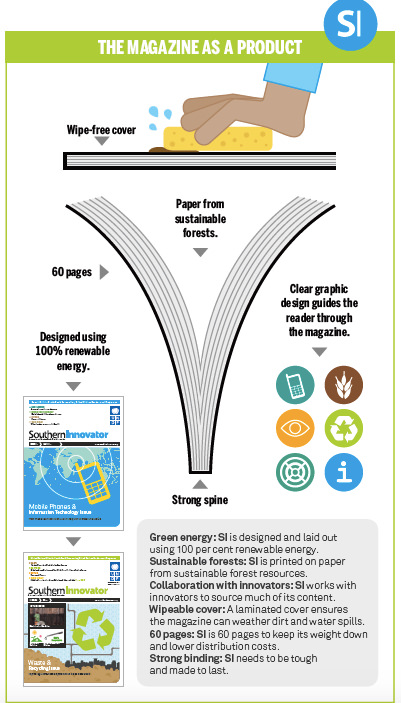
While Southern Innovator’s digital presence has been key to its success and global reach, the hard copy of the magazine was designed with special features. The magazine needed to be robust and able to stand a fair bit of abuse and hard wear. It needed to be easy to read in low light conditions. And it needed to look sharp and eye-catching to reach as wide an audience as possible.

Back Issues

Development Challenges, South-South Solutions Newsletter | 2011-2014

Development Challenges, South-South Solutions Newsletter | 2007-2010

2013

2012

2011

2010

2009

2008

2007

ISSN Portal.
South-South cooperation for development, SSC/17/3, High-level Committee on South-South Cooperation, 12 April 2012.

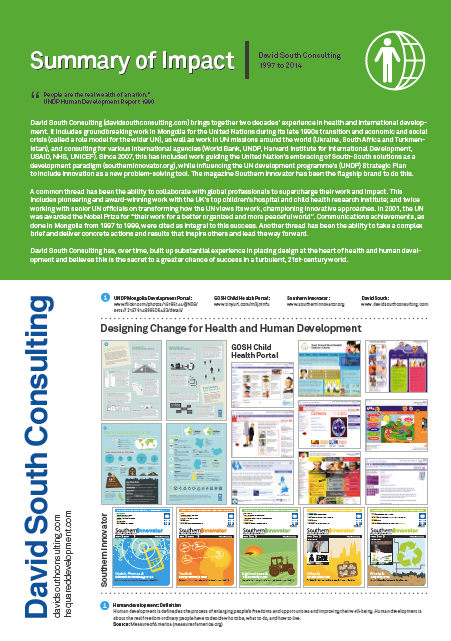
Development Challenges, South-South Solutions was launched as an e-newsletter in 2006 by UNDP’s South-South Cooperation Unit (now the United Nations Office for South-South Cooperation) based in New York, USA. It led on profiling the rise of the global South as an economic powerhouse and was one of the first regular publications to champion the global South’s innovators, entrepreneurs, and pioneers. It tracked the key trends that are now so profoundly reshaping how development is seen and done. This includes the rapid take-up of mobile phones and information technology in the global South (as profiled in the first issue of magazine Southern Innovator), the move to becoming a majority urban world, a growing global innovator culture, and the plethora of solutions being developed in the global South to tackle its problems and improve living conditions and boost human development. The success of the e-newsletter led to the launch of the magazine Southern Innovator.

Creative Commons License

This work is licensed under a
Creative Commons Attribution-Noncommercial-No Derivative Works 3.0 License.

ORCID iD: https://orcid.org/0000-0001-5311-1052.

© David South Consulting 2022

Categories
Archive Blogroll Southern Innovator magazine United Nations Development Programme United Nations Office for South-South Cooperation

Southern Innovator Issue 5

Launched in May 2011, the new global magazine Southern Innovator (ISSN 2222-9280) is about the people across the global South shaping our new world, eradicating poverty and working towards the achievement of the Millennium Development Goals (MDGs). 

Team | Southern Innovator Phase 1 Development (2010 – 2015)

They are the innovators.

Follow the magazine on Twitter @SouthSouth1. 

Southern Innovator Issue 1

Southern Innovator Issue 2

Southern Innovator Issue 3

Southern Innovator Issue 4

Southern Innovator Issue 5

If you would like hard copies of the magazine for distribution, then please contact the United Nations Office for South-South Cooperation (UNOSSC)(https://www.unsouthsouth.org/2014/12/25/southern-innovator-magazine/).

Citations

Recasting ‘truisms’ of low carbon technology cooperation through innovation systems: insights from the developing world by Alexandra Mallet, Innovation and Development, Volume 5, 2015 – Issue 2: Low-Carbon Innovation and Development

https://davidsouthconsulting.org/2021/07/30/disrupted-whatever-happened-to-southern-innovator-issue-6/

https://davidsouthconsulting.org/2021/07/30/issue-6-will-launch-in-autumn-2014-get-on-board-28-july-2014/

https://davidsouthconsulting.org/2021/12/20/press-release-1-southern-innovator/

https://davidsouthconsulting.org/2021/12/20/press-release-2-southern-innovator/

https://davidsouthconsulting.org/2021/12/20/press-release-3-southern-innovator/

https://davidsouthconsulting.org/2021/03/05/southern-innovator-issue-1/

https://davidsouthconsulting.org/2021/03/05/southern-innovator-issue-2/

https://davidsouthconsulting.org/2021/03/05/southern-innovator-issue-3/

https://davidsouthconsulting.org/2021/03/05/southern-innovator-issue-4/

https://davidsouthconsulting.org/southern-innovator-scale-up-fundraiser/

ORCID iD: https://orcid.org/0000-0001-5311-1052.

© David South Consulting 2023

Categories
Archive Blogroll Development Challenges, South-South Solutions Newsletters Southern Innovator magazine

Baker Cookstoves – Designing for the African Customer

By David SouthDevelopment Challenges, South-South Solutions

SOUTH-SOUTH CASE STUDY

An innovative social enterprise is using design to create an energy-efficient cookstove for Kenya. By turning to an experienced Swedish architecture and design firm, the people behind the Baker cookstove wanted to make sure the stove’s design was as efficient as possible and relevant to the customers’ needs, while also making sure it is visually appealing and something a person would proudly want in their home.

The Baker cookstove (bakerproduct.com) has been designed to be a high-quality and desirable product that also accomplishes the goal of saving money for the user. This unique product is being developed and made at the company’s factory in Nairobi, Kenya.

Baker’s owner is Top Third Ventures Global (topthirdventures.com), a social-impact company registered in Kenya and founded in 2011 by American Lucas Belenky and Björn Hammar, a Swedish/Finnish entrepreneur. Their goal is to make sure that everyone in the developing world has access to an affordable, high-quality efficient cookstove.

While cooking is a daily necessity for billions of people, it is also costly and polluting. By switching to energy-efficient cookstoves, families can reduce the cost of cooking daily meals and, if the stove is designed right, cut the amount of pollution generated. One of the great obstacles to the take-up of energy-efficient cookstoves to date has been the absence of sustainable business models to sell and distribute them.

The Baker cookstove, designed as an aspirational product and backed up with a seven-year guarantee, hopes to change this dynamic. If things go to plan, the company hopes to significantly scale up its production based on customers wanting to have a Baker cookstove proudly on display in their home.

The Baker cookstove is the product of a deliberate attempt to use design and a well-thought-out production life cycle to create an item that is eye-catching, effective, and manufactured consistently to a high standard.

Designed by Claesson Koivisto Rune (http://www.ckr.se/), a Swedish architecture and design firm, the Baker cookstove is a sleek, round, modern stove and comes in eye-catching colors such as orange. It could easily fit in with other kitchen products in a high-end design shop. And that is the point: they want people to want the Baker cookstove.

Quality is key, and engineering and design teams constantly monitor the product and make adjustments to the cookstove as they receive feedback from customers.

The Baker cookstove is benefiting from new financing being made available through carbon credits, which its founders believe will bring big changes to the energy-efficient cookstove market over the next 10 years.

Baker’s chief executive, Lucas Belenky, told Southern Innovator magazine – this newsletter’s sister publication – about the thinking behind the Baker cookstove.

SI: What role does design play in the Baker cookstove social enterprise? At what stage did Top Third Ventures start to think through the production life cycle for the Baker cookstove? What did you feel was missing in the other cookstove models currently available on the market?

The Baker cookstove is the cornerstone of the social enterprise. Top Third Ventures is at its core a product company. There are different aspects to the business model to make it work (i.e. carbon credits and big data) but everything depends on the success of the Baker product. We started thinking through the production life cycle from the day the company was founded in late 2011. The Baker is designed for usability, aspirational value, and performance, prioritized in that order. The most important thing is that the Baker is easy to use and does not require its users to change their daily routines or cooking habits. Cooking cultures vary greatly across the developing world so it is important to understand exactly who your customer is and focus on meeting their requirements. When you have a product that is easy to use it needs to be desirable as well. Beyond the service provided, the product should make the customer feel good about themselves. Finally, the Baker cooks the same food with half the fuel and much less smoke.

The priorities seem reversed for other cookstove models on the market. Efficiency comes first, then the aesthetic design, and cultural conformity is last. Hyper-efficient cookstoves are great for health and the environment on paper but the benefits are not realized because widespread adoption isn’t achieved. Most products are imposed through a top-down approach instead of starting with the customer and designing the stove around them.

SI: Why did you choose to have the Baker cookstove designed by Claesson Koivisto Rune, a Swedish architecture and design firm? What were some of the challenges encountered when designing the product and the production life cycle? What advice do you have for other social enterprises looking to offer an appealing product to low-income households?

We wanted the Baker cookstove to be an aspirational product that you use as much because of the performance (less fuel and less smoke) as because it is beautiful. Claesson Koivisto Rune believed in our vision at a very early stage and I doubt we could have gotten where we are today without them. Challenges around the design mainly involve keeping the costs down. Our customers do not have a lot of disposable income so balancing affordability with performance and world-class design is tough.

For other entrepreneurs selling to low-income households my advice is identify your customer, listen to them, and never stop listening. This is obvious to most businesses but for social enterprises sometimes the grant organizations or other dispersers of donor funding become the customer without you noticing.

Finally, often just because the consumer is in a developing country, enterprises neglect aesthetic appeal and branding. Do not do this. Your consumer behaves for the most part like their counterpart in the developed world. They want products that look nice and make them feel good.

SI: What role is information technology playing in the Baker cookstove’s development? How do mobile phones help with reaching customers in Africa? How does offering software products such as Top3Tracker help Baker cookstoves?

Information technology has a huge impact in decentralized areas because it enables cheap flow of information. For Top Third Ventures it allows us to track our sales in real-time, communicate with current and future customers instantly, and gain valuable insights about how to improve the sales pitch and marketing strategy. The Baker cookstoves also depends on carbon finance, which requires a dialogue with current customers to ensure the usage of the cookstove is accurately measured. Information technology such as our Top3 Tracker significantly reduces the cost of accessing carbon finance.

SI: It is said an innovator is somebody who disrupts existing products and ways of doing things. How is Top Third Ventures innovating and disrupting the current approach to energy-efficient cookstove distribution?

We hope to change the way products for low-income households are designed, marketed, and sold. Top Third Ventures’ Baker cookstove embodies our conviction that these products should be customer-centric, have aspirational value, and conform to local cultures. The success of our product will show that consumers in the developing world want the same thing as their counterparts in developed countries.

Top Third is a partner of the Global Alliance for Clean Cookstoves (cleancookstoves.org).

Published: December 2013

Resources

1) Baker cookstove: The website details how the cookstove was developed. Website: bakerproduct.com

2) Top Third Ventures: The company designs, manufactures, and sells its own unique efficient cookstoves made to fit the local cultures and traditions of their customers, supported by a strong brand and world-class customer communication. In addition, Top Third Ventures works with existing manufacturers and distributors to secure carbon financing for their activities through their programmatic CDM activity and electronic data management system. Website: topthirdventures.com

3) Global Alliance for Clean Cookstoves: The Global Alliance for Clean Cookstoves calls for 100 million homes to adopt clean and efficient stoves and fuels by 2020. Website: cleancookstoves.org

Like our content? Help contribute to the costs of keeping it online. 

Scan code with your phone and help us out.

This work is licensed under a Creative Commons Attribution 4.0 International License.

ORCID iD: https://orcid.org/0000-0001-5311-1052.

© David South Consulting 2021