Categories
Archive Development Challenges, South-South Solutions Newsletters

Innovation: Cairo’s Green Technology Pioneers

By David SouthDevelopment Challenges, South-South Solutions

SOUTH-SOUTH CASE STUDY

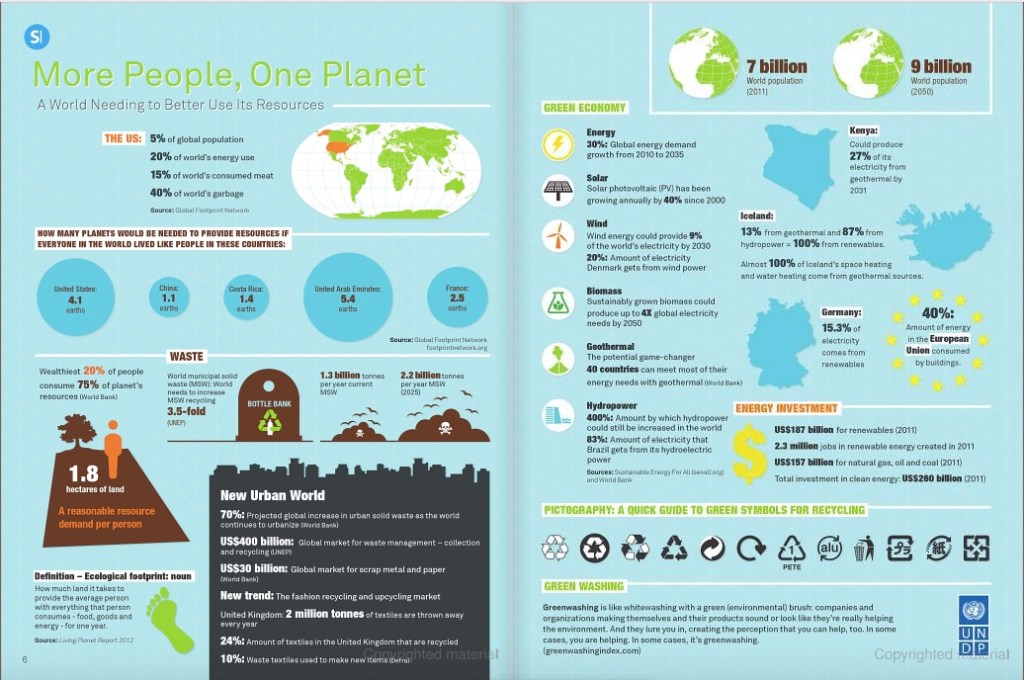
One thing is ubiquitous to every country, community and society: garbage. It’s a social and environmental problem, but far from being mere waste, rubbish has its uses. This by-product of the goods and foods consumed can also be a source of fuel. As such it has many advantages, including providing free fuel to cash-strapped households, independence from unreliable municipal services and a way to dispose of waste.

An enterprising Egyptian man is showing his community how it is possible to lower the cost of gas and hot water while also avoiding the service disruptions common with municipal utilities. In the process, he is pioneering a local green innovation model that can be replicated elsewhere.

Biogas (http://en.wikipedia.org/wiki/Biogas) generators — which can transform organic household waste into fuel — have been very successful in India and China. It is estimated there are 20 million small-scale urban biogas digesters in China and 2 million in India.

Hanna Fathy’s roof in the Manshiyet Nasser neighbourhood, home to the Coptic Christian Zabaleen community of Cairo – the city’s traditional garbage collectors and recyclers – is now a utility system, providing biogas and hot water.

The area is made of narrow streets and makeshift houses. Residents live cheek-by-jowl in a neighbourhood that is home to tens of thousands of people.

The community was badly hit when the 300,000 pigs the Christian residents have kept for the past 30 years to eat Cairo’s vegetative waste — an effective garbage-disposal system — were slaughtered under government orders to prevent the spread of swine flu (H1N1) (http://en.wikipedia.org/wiki/Swine_influenza).

One woman told U.S. National Public Radio about the hard life in the neighbourhood: “I’m working all the time. My hands get dirty, there’s no water. The price of food is too high. The gas has gone up to seven pounds (US $1.28) a bottle, so it’s expensive to heat.

“Everything is so expensive, and I have to live like this?” she said.

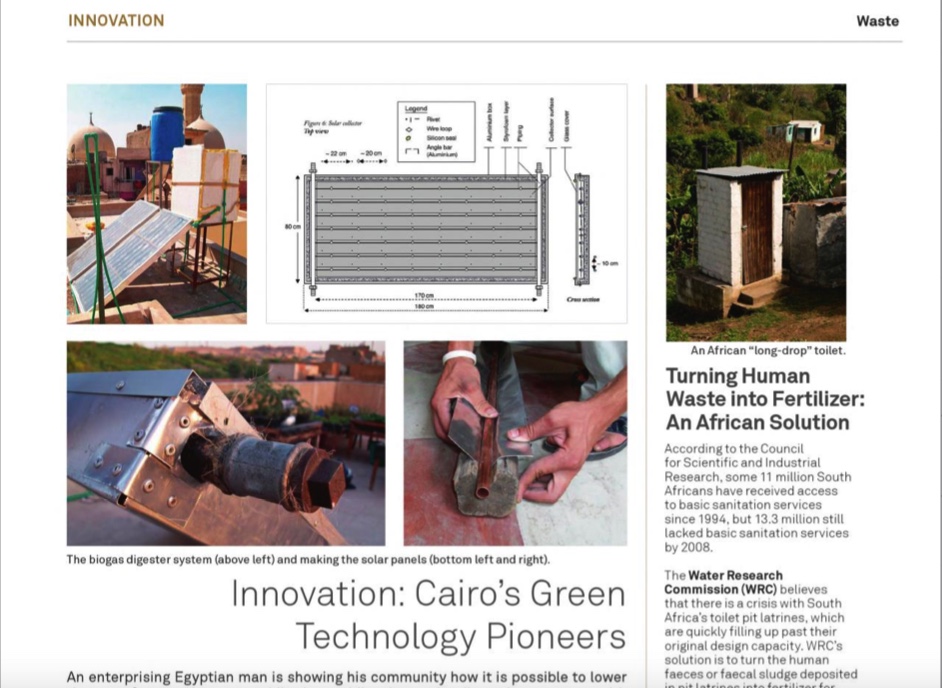
Fathy plops kitchen scraps, stale tea and tap water into a jug which he pours into a homemade biogas maker on the roof of his house. The stew of waste mixes with water and a small quantity of animal manure used to start the process, and overnight makes biogas, which is then used for cooking. The digester is able to provide an hour’s worth of cooking gas a day in winter months, and two hours in the summer, from around two kilograms of waste. The remaining waste by product becomes liquid organic fertilizer for the garden.

Fathy has been developing the biogas digester with the NGO Solar Cities (http://solarcities.blogspot.com), which provides designs, technical advice and support to Cairo citizens keen to embrace green technologies.

What is interesting is not only the technology but how that technology is being developed. The approach is to innovate and adapt the technology to local resources and skills. This increases the chances of take-up and buy-in.

The designs for the digesters and heaters have evolved through experimentation, brainstorming and availability of local materials.

Each biogas system costs about US $150 for materials, a cost that is being picked up right now by donations. Solar Cities believes there are only eight biogas digesters in Egypt so far, most built in 2009.

Solar Cities’ founder, Thomas Culhane, points out many urban dwellers do not believe they can generate biogas and associate it with rural systems that use animal manure. But the abundance of urban kitchen waste is in fact an excellent source material for biogas.

Culhane believes the biogas digesters are an excellent solution to two problems: the vast quantities of garbage piling up in Cairo, which has had its traditional disposal system disrupted by the slaughter of the pigs, and the city’s emissions of greenhouse gases that contribute to climate change.

Fathy has one goal: to be completely self-sufficient. He has been also prototyping a solar heater on his roof as well as the biogas digester. The solar water heater makes use of items that can be easily found: it recycles black garbage bags, has an aluminium frame and a glass cover. The whole thing rests on a Styrofoam block and uses copper tubes. The water is stored in a bright blue barrel.

Biogas, solar power and other forms of green energy face many obstacles if it is to expand further in Egypt. The average cost of each unit will need to come down to match the income of the users and compete with the government-subsidized energy sector.

Fathy has also found neighbours are skeptical and can’t believe biogas can be made this way.

Another man, Hussain Soliman, had both a solar water heater and biogas digester on the roof of his apartment building before the crumbling building collapsed.

The complete solar water heating system designed by Solar Cities can be assembled for under US $500. It uses two 200-litre recycled industrial shampoo barrels for the holding tank and back-up water supply. The solar panels need to be kept clean from dust every week, but other than that, Culhane insists the heaters require little maintenance.

Now in temporary government housing, Soliman is still enthusiastic about the technology and is re-building a solar heater and biogas digester for his new home.

“I’m planning to collect the organic waste from restaurants in the neighborhood to increase my gas output,” he told IPS News. “I’ll give the restaurants plastic bags and they can separate out the organics, and I’ll collect the bags at the end of each day.”

Published: January 2010

Resources

1) Practical Action has technical drawings and guidelines for making a small biogas digester. Website: http://practicalaction.org/practicalanswers/product_info.php?products_id=42

2)  The Anaerobic Digestion Community: Here is an excellent technical explanation of how a digester works, including a short film. Website: http://www.anaerobic-digestion.com/

3) China boasts a fast-growing biogas economy using farm waste. Here is a full summary of their experience. Website: http://www.i-sis.org.uk/BiogasChina.php.

https://davidsouthconsulting.org/2022/09/28/asian-factories-starting-to-go-green/

https://davidsouthconsulting.org/2022/09/27/caribbean-island-st-kitts-goes-green-for-tourism/

https://davidsouthconsulting.org/2021/01/25/creating-green-fashion-in-china/

https://davidsouthconsulting.org/2023/02/03/environmental-public-awareness-handbook-case-studies-and-lessons-learned-in-mongolia/

https://davidsouthconsulting.org/2021/02/01/ethiopia-and-djibouti-join-push-to-tap-geothermal-sources-for-green-energy/

https://davidsouthconsulting.org/2021/08/29/indian-business-model-makes-green-energy-affordable/

https://davidsouthconsulting.org/2021/10/22/innovations-in-green-economy-top-three-agenda/

https://davidsouthconsulting.org/2021/08/07/mongolian-green-book/

https://davidsouthconsulting.org/2022/04/14/prisons-with-green-solutions/

https://davidsouthconsulting.org/2021/02/04/us-450-million-pledged-for-green-economy-investments-at-kenyan-gssd-expo/

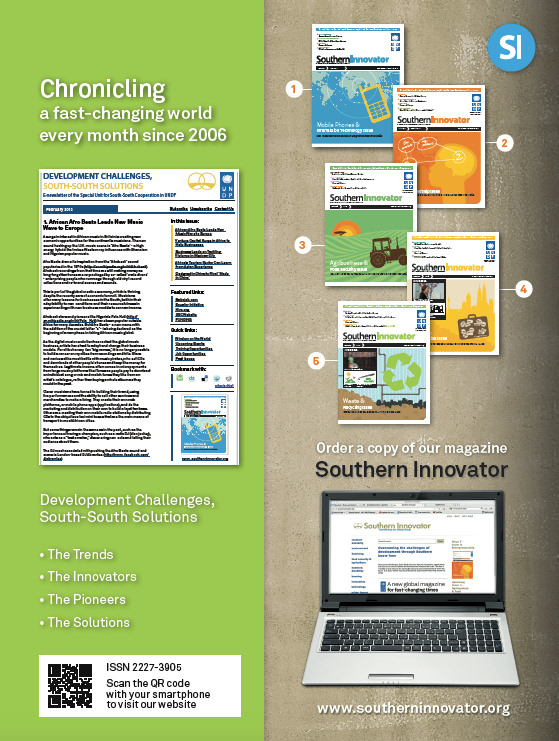
Development Challenges, South-South Solutions was launched as an e-newsletter in 2006 by UNDP’s South-South Cooperation Unit (now the United Nations Office for South-South Cooperation) based in New York, USA. It led on profiling the rise of the global South as an economic powerhouse and was one of the first regular publications to champion the global South’s innovators, entrepreneurs, and pioneers. It tracked the key trends that are now so profoundly reshaping how development is seen and done. This includes the rapid take-up of mobile phones and information technology in the global South (as profiled in the first issue of magazine Southern Innovator), the move to becoming a majority urban world, a growing global innovator culture, and the plethora of solutions being developed in the global South to tackle its problems and improve living conditions and boost human development. The success of the e-newsletter led to the launch of the magazine Southern Innovator. 

https://davidsouthconsulting.org/2022/11/01/southern-innovator-magazine-2010-2014/

Creative Commons License

This work is licensed under a
Creative Commons Attribution-Noncommercial-No Derivative Works 3.0 License.

ORCID iD: https://orcid.org/0000-0001-5311-1052.

© David South Consulting 2023

Categories
Archive Blogroll Southern Innovator magazine Special Unit for South-South Cooperation United Nations Development Programme United Nations Office for South-South Cooperation

Southern Innovator Magazine | 2010 – 2014 

By David South

“I think you [David South] and the designer [Solveig Rolfsdottir] do great work and I enjoy Southern Innovator very much!” 

Ines Tofalo, Programme Specialist, United Nations Office for South-South Cooperation
Southern Innovator in Tianjin, China.
Issue 5 of Southern Innovator at the Global South-South Development Expo (GSSD Expo) 2014 held in Washington, D.C.
Volunteers in Nairobi, Kenya pose with Southern Innovator Issue 4 at the Global South-South Development Expo (GSSD Expo) in 2013.
Southern Innovator Editor and Writer David South in Australia.
Southern Innovator Graphic Designer and Illustrator Sólveig Rolfsdóttir in Iceland.

Some comments that have come in so far about SI’s first issue:

“What a tremendous magazine your team has produced! It’s a terrific tour de force of what is interesting, cutting edge and relevant in the global mobile/ICT space… Really looking forward to what you produce in issues #2 and #3. This is great, engaging, relevant and topical stuff.”, to “Looks great. Congratulations. It’s Brill’s Content for the 21st century!”

What they are saying about SI on Twitter: From @CapacityPlus Nice job RT @ActevisCGroup: RT @UNDP: Great looking informative @SouthSouth1 mag on South-South Innovation; @UNDP Great looking informative @SouthSouth1 mag on South-South Innovation; @JeannineLemaireGraphically beautiful & informative @UNDP Southern Innovator mag on South-South Innov. 

And on Pinterest:

Peggy Lee • 1 year ago 

“Beautiful, inspiring magazine from UNDP on South-South innovation. Heart is pumping adrenaline and admiration just reading it”

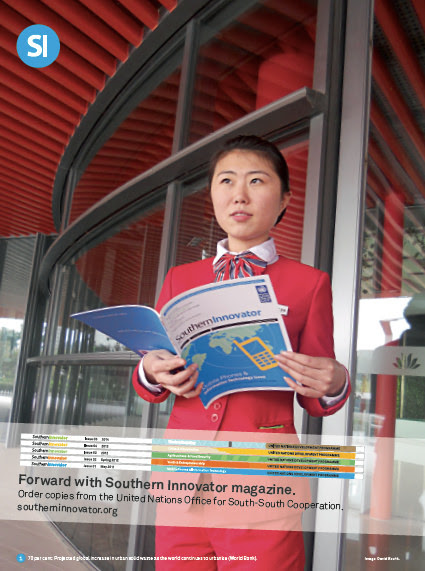
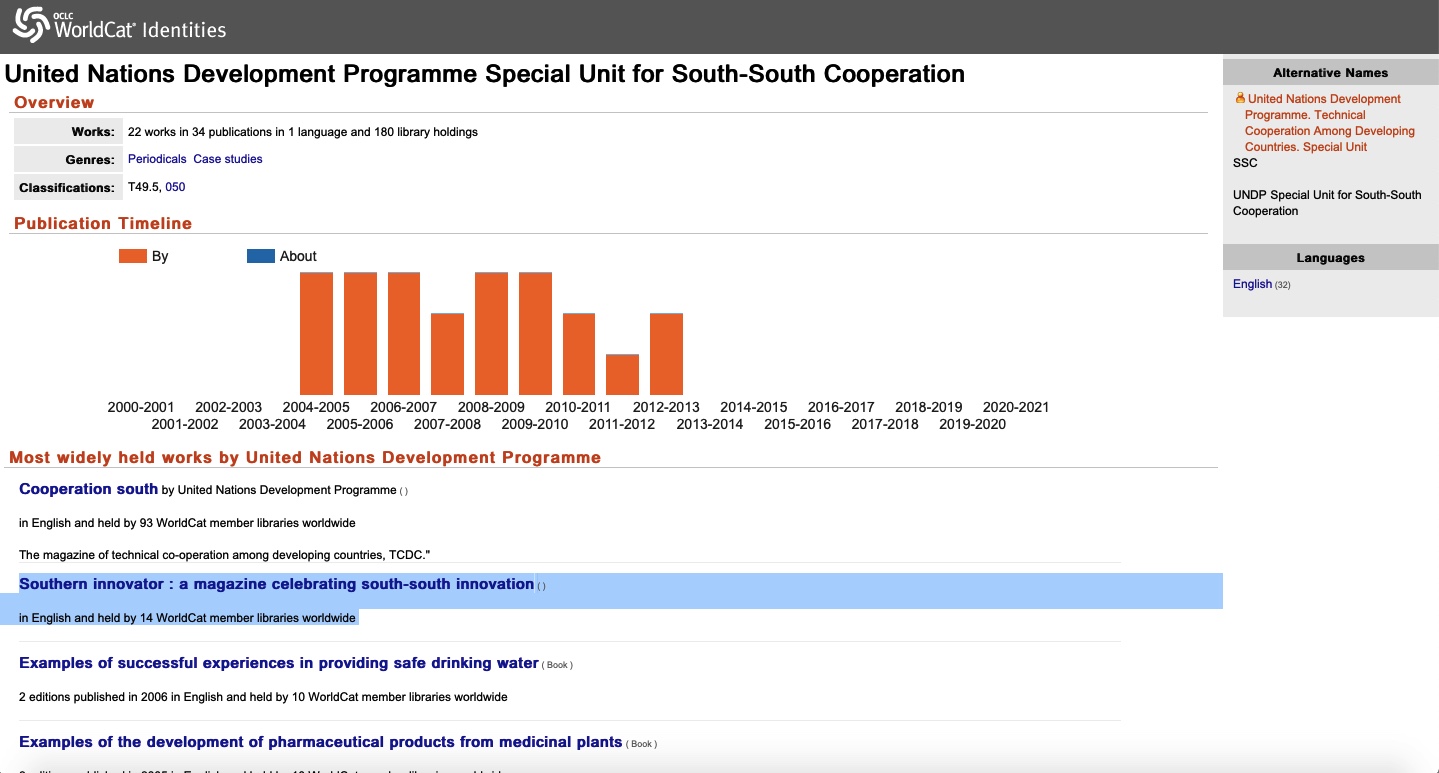
Southern Innovator Magazine can be found in libraries around the world.

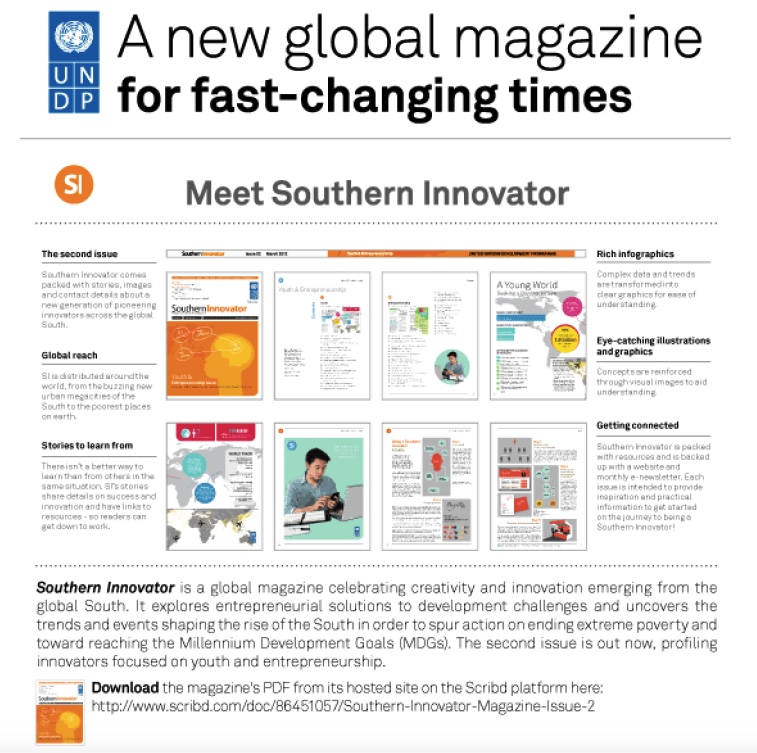
Development Challenges, South-South Solutions was launched as an e-newsletter in 2006 by UNDP’s South-South Cooperation Unit (now the United Nations Office for South-South Cooperation) based in New York, USA. It led on profiling the rise of the global South as an economic powerhouse and was one of the first regular publications to champion the global South’s innovators, entrepreneurs, and pioneers. It tracked the key trends that are now so profoundly reshaping how development is seen and done. This includes the rapid take-up of mobile phones and information technology in the global South (as profiled in the first issue of magazine Southern Innovator), the move to becoming a majority urban world, a growing global innovator culture, and the plethora of solutions being developed in the global South to tackle its problems and improve living conditions and boost human development. The success of the e-newsletter led to the launch of the magazine Southern Innovator. 

https://davidsouthconsulting.org/southern-innovator-scale-up-fundraiser/

Creative Commons License

This work is licensed under a
Creative Commons Attribution-Noncommercial-No Derivative Works 3.0 License.

ORCID iD: https://orcid.org/0000-0001-5311-1052.

© David South Consulting 2022

Categories
Archive Development Challenges, South-South Solutions Newsletters Southern Innovator magazine

A Solution to Stop Garbage Destroying Tourism

By David SouthDevelopment Challenges, South-South Solutions

SOUTH-SOUTH CASE STUDY

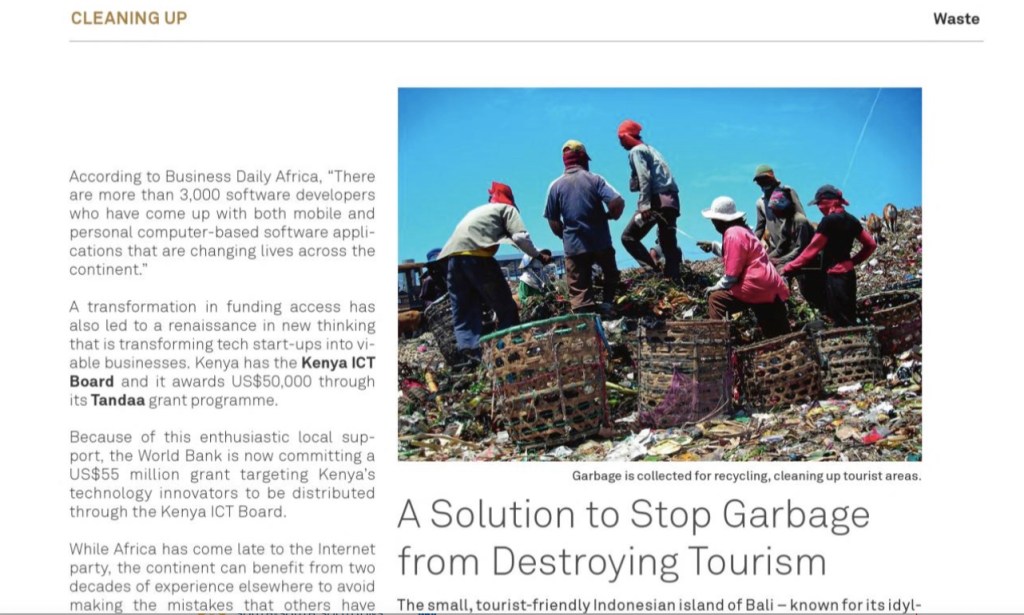
Tourism is an essential source of income for countries across the South. But many put that livelihood in jeopardy when they lose control of garbage collection. A popular tourist spot can represent a ‘paradise’ to visitors, but when it becomes too popular and local garbage collection systems collapse under the burden, ‘paradise’ can soon turn to an environmental hell.

The small, tourist-friendly Indonesian island of Bali (http://en.wikipedia.org/wiki/Bali) – known for its idyllic pleasures of spas, surf and serenity – is being overwhelmed by garbage. A survey of tourists found two-thirds would not return to the island because of the problem.

Tourism took off on the island in the 1970s. The economic benefits are clear: the island went from being economically marginal to ranking second only to the country’s capital, Jakarta, in wealth creation. The island received more than 2.38 million tourists in 2009, up 14.5 percent compared with 2008, according to Ida Komang Wisnu, head of the provincial statistics office. But tourism produces on average five kilograms of waste a day per tourist – 10 times what the average Indonesian produces (Bali Fokus).

In the past, the traditional way of serving food in Indonesia was to wrap it in, or serve it on, a palm leaf: a biodegradable approach. But with the huge expansion in use of plastics and non-biodegradable packaging, the waste disposal problem is out of control.

In Indonesia, government garbage disposal services tend to collect between 30 and 40 percent of solid waste, most of this from high income communities. The majority poor population are left to fend for themselves when it comes to waste disposal.

A solution by Yuyun Ismawati, an environmental engineer and consultant, has since 1996 focused on helping poor communities find ways to safely dispose of waste. In 2000, she started her own NGO – Bali Fokus (http://balifokus.asia/balifokus/) – and opened a waste management facility in the Bali village of Temesi. The recycling plant employs 40 people from the village, who sort garbage into recyclables, compost and residual waste. Income from the recycled waste and compost goes to helping local farmers.

She then expanded her concept to include households around Bali and elsewhere in Indonesia. She concentrated on housewives and targeted reducing the amount of household waste going to dump sites. A core team trains housewives in daily habits that separate waste and compost organic matter like vegetable and fruit scraps. Bali Fokus claims it has been able to reduce waste created by 50 percent in 500 homes. Some of the women sell their compost in local markets; recyclables are turned into sellable items.

From 2001 to 2003, Ismawati turned this approach into a replicable template called SANIMAS. By 2008, the SANIMAS template was being used in hundreds of communities across Indonesia.

Her solution to the deluge of tourist waste can be seen in the luxury Jimbaran Bay area of Bali. Traditionally, the area’s hotels would sell their waste to pig farmers. While the pigs feasted on the fancy scraps, the rest of the waste was put in plastic bags and thrown away in mangrove forests.

“I told hotels: Your job is to sell rooms, not to sell garbage,” Ismawati recalls. “We have to protect Bali or else tourists won’t want to come here anymore.”

Ismawati cleverly turned the relationship around: rather than a pig farmer paying for scraps, she convinced one of them there was money to be made recycling and sorting garbage. For this, the hotels would pay the farmer.

A network of 25 hotels now pays to have their garbage taken away and sorted by hand: an important source of full-time jobs.

The workers sort through paper, plastics, glass, aluminium, food scraps and vegetables. Each week, 140 trucks deliver waste to the facility. Only 10 leave with waste that has to go to a dump site.

Food leftovers are bought by local pig farmers and grass clippings and other organic matter is composted (http://www.recyclenow.com/home_composting/), and eventually makes its way back to the hotels and is distributed in the flower beds.

This system has created 400 jobs where the pig farmer once only employed 10 people.

“If you want a hi-tech solution in a developing country you will wait and wait and wait until you get the money, or big donors to fund it,” Ismawati told the Telegraph newspaper. “And even then it may not work.”

A graphic example of this is a donated waste recycling machine given by the local government. It can’t be used because the electricity to power it costs too much. Human labour is a cheaper option.

Bali Fokus’ successful approach has now been replicated in six other sites on the nearby island of Java. And the government of Indonesia has promised to help create 15 more each year.

In 2009 Ismawati won the Goldman Award (http://www.goldmanprize.org/), which honors grassroots environmental heroes from the six inhabited continental regions: Africa, Asia, Europe, Islands and Island Nations, North America, and South and Central America.

She is also working on using decentralized grassroots approaches to bringing sewage disposal and clean water to communities.

Published: March 2010

Resources

https://davidsouthconsulting.org/2022/11/19/african-culture-as-big-business/

https://davidsouthconsulting.org/2022/10/20/african-tourism-leads-the-world-and-brings-new-opportunities/

https://davidsouthconsulting.org/2022/10/20/africas-tourism-sector-can-learn-from-asian-experience/

https://davidsouthconsulting.org/2022/11/18/bolivia-grabs-world-media-attention-with-salt-hotel/

https://davidsouthconsulting.org/2022/02/07/boosting-tourism-in-india-with-surfing-culture/

https://davidsouthconsulting.org/2022/09/27/caribbean-island-st-kitts-goes-green-for-tourism/

https://davidsouthconsulting.org/2022/11/20/ecotourism-to-heal-the-scars-of-the-past/

https://davidsouthconsulting.org/2022/11/21/from-warriors-to-tour-guides/

https://davidsouthconsulting.org/2022/11/11/havanas-restaurant-boom-augers-in-new-age-of-entrepreneurs/

https://davidsouthconsulting.org/2022/11/15/indonesia-best-for-entrepreneurs/

https://davidsouthconsulting.org/2022/11/01/indonesian-food-company-helps-itself-by-making-farmers-more-efficient/

https://davidsouthconsulting.org/2022/11/15/indonesian-middle-class-recycle-wealth-back-into-domestic-economy/

https://davidsouthconsulting.org/2021/06/11/indonesian-wooden-radio-succeeds-with-good-design/

https://davidsouthconsulting.org/2022/11/23/kenyan-safari-begins-minutes-from-airport/

https://davidsouthconsulting.org/2022/10/26/south-gets-reading-bug-with-more-festivals/

https://davidsouthconsulting.org/2021/03/05/southern-innovator-issue-2/

https://davidsouthconsulting.org/2021/03/05/southern-innovator-issue-5/

https://davidsouthconsulting.org/2022/11/18/tourist-passion-for-quirky-holidays-helps-south/

Development Challenges, South-South Solutions was launched as an e-newsletter in 2006 by UNDP’s South-South Cooperation Unit (now the United Nations Office for South-South Cooperation) based in New York, USA. It led on profiling the rise of the global South as an economic powerhouse and was one of the first regular publications to champion the global South’s innovators, entrepreneurs, and pioneers. It tracked the key trends that are now so profoundly reshaping how development is seen and done. This includes the rapid take-up of mobile phones and information technology in the global South (as profiled in the first issue of magazine Southern Innovator), the move to becoming a majority urban world, a growing global innovator culture, and the plethora of solutions being developed in the global South to tackle its problems and improve living conditions and boost human development. The success of the e-newsletter led to the launch of the magazine Southern Innovator.  

Creative Commons License

This work is licensed under a
Creative Commons Attribution-Noncommercial-No Derivative Works 3.0 License.

ORCID iD: https://orcid.org/0000-0001-5311-1052.

© David South Consulting 2023

Categories
Archive

Indian Solar Power Pack Powers Villages

By David SouthDevelopment Challenges, South-South Solutions

SOUTH-SOUTH CASE STUDY

Developments in India are showing the way forward for low-cost solar power for the poor. The Duron Solar Home Power System (http://www.duronenergy.com/product_info/) is now enabling the rural poor to generate and store solar electricity. It is powerful enough to charge gadgets and appliances and run LED lights. It allows people to do their household chores into the dark hours and to study or earn extra income.

As the company says, it “allows ample light for cooking, for children to study at night, and for shop owners to stay open later to earn more money.”

The system removes the need for polluting and dangerous kerosene lamps, which are used by an estimated one million families for lighting in India.

Kerosene lamps are a major contributor to indoor air pollution, which itself claims the lives of 1.5 million people each year. Kerosene lamps have also caused countless deaths by suffocation, burns and fatal fires.

The United Nations Environment Program says kerosene fumes are responsible for around 64 percent of deaths for children under the age of five in developing countries.

More than 1.7 billion people around the world have no domestic electricity supply, of whom more than 500 million live in sub-Saharan Africa (World Bank). Some 400 million people in India do not have access to electricity, according to the World Bank, and 600,000 villages lack an electrical supply. Prime Minister Manmohan Singh has pledged “power for all” by 2012. Without electricity, many development goals remain dreams that will never be achieved.

Being able to see at night unleashes a vast range of possibilities, but for the very poor lighting is often the most expensive household expense, soaking up 10 to 15 percent of income.

According to Greenpeace (http://www.greenpeace.org/international/), India could generate 10 percent of its electricity from solar power by 2030.

The Duron package comes with a five watt solar panel, a cell phone charger connection, three LED (http://en.wikipedia.org/wiki/LED_lamp) lights, and an AC grid charger. After a day of charging, the Duron can power three hours of bright lighting or 10 hours of dim lighting.

The Duron system sells for about 5,999 rupees, or around US $130, and the typical user to date has been small businesses and schools.

Duron is selling several thousand units a month and the company is currently scaling up its sales efforts.

Duron’s approach is to provide a market solution to the huge problem of providing electricity to India’s rural poor.

The company was launched in 2008 with the goal of providing electricity to those without around the world. It was developed out of the Idea Lab (http://www.idealab.com/), a Pasadena, Californian incubator of technology companies.

Extensive field research was conducted across India to determine what was the best solution and what were the needs of rural dwellers. Duron moved its headquarters to Bangalore, India in 2009 to be closer to its customers and expand sales. The company operates in the Indian states of Uttar Pradesh and Karnataka.

By August 2009, more than 2,100 people had light because of the Duron system. The company calculates this translated into 172,500 hours of light.

One customer, Anil Singh, lives with his family in the unelectrified village of Narainpur. His family used kerosene lamps and was paying US $4 a day for unreliable lighting. But after seeing his neighbour, Santosh Singh, with bright, powerful lights at his home, he was curious as to why. When he found out about Duron’s system, he installed a system to light his front porch and two rooms in his house. His family now enjoys two-and-half hours of reliable light in the evening to do things.

“The Duron has made my life so much easier,” said Anil. “It’s a much cheaper (lighting) option compared to kerosene lamps, and I now have a reliable source of power on a daily basis,” he told the company’s website.

Another innovative start-up with offices in India and Africa, is the d.light company, which also has a new, highly-efficient solar-powered product available. The Kiran LED lamp (http://www.dlightdesign.com/products_kiran_global.php) stays lit for eight hours on a full battery and is four times brighter than a kerosene lamp. It illuminates 360 degrees and produces an even, bright white light.

Published: February 2010

Resources

1) Lighting Africa: this website run by the World Bank is a virtual business community and has forums, market intelligence, access to grants, network and partnership opportunities. Website: http://lightingafrica.org/index.cfm?Page=Home

2) D.light Design is dedicated to bringing modern lighting and power to more than 1.6 billion people globally currently living without electricity. They aim to be the number one player in off-grid lighting and power solutions worldwide. Website: http://www.dlightdesign.com/

3) Solar Power Answers is a one-stop-shop for everything to do with solar power. It has a design manual and guides to the complex world of solar power equipment. Website: http://www.solar-power-answers.co.uk/index.php

4) Sun King solar lantern: The lantern provides 16 hours of light for a day’s charge. Website: http://www.greenlightplanet.com/ourusers.html

Development Challenges, South-South Solutions was launched as an e-newsletter in 2006 by UNDP’s South-South Cooperation Unit (now the United Nations Office for South-South Cooperation) based in New York, USA. It led on profiling the rise of the global South as an economic powerhouse and was one of the first regular publications to champion the global South’s innovators, entrepreneurs, and pioneers. It tracked the key trends that are now so profoundly reshaping how development is seen and done. This includes the rapid take-up of mobile phones and information technology in the global South (as profiled in the first issue of magazine Southern Innovator), the move to becoming a majority urban world, a growing global innovator culture, and the plethora of solutions being developed in the global South to tackle its problems and improve living conditions and boost human development. The success of the e-newsletter led to the launch of the magazine Southern Innovator.  

Creative Commons License

This work is licensed under a
Creative Commons Attribution-Noncommercial-No Derivative Works 3.0 License.

ORCID iD: https://orcid.org/0000-0001-5311-1052.

© David South Consulting 2022