Categories
Archive Development Challenges, South-South Solutions Newsletters

A New African Beer Helps Smallholder Farmers

By David SouthDevelopment Challenges, South-South Solutions

SOUTH-SOUTH CASE STUDY

Africa’s growth in the past decade has held steady despite the trauma of the global economic crisis and the tumult of the “Arab Spring” in several countries of North Africa. African economies are growing because of a number of resilient trends. These include growing regional trade links, greater investment in infrastructure and the remarkable rise of China to become Africa’s number one trade partner, pushing the United States to second place (Technology + Policy). This has given birth to a growing consumer marketplace and consumer class – some 300 million people earning about US $200 a month (Africa Rising).

The continent as a whole now stands as the 10th largest economy in the world.

How will Africans spend this new money in their pockets (or more than likely, on their mobile phones)? They could go for the big, famous global brands that they see advertised in magazines or on television. Or they could also spend it on local products and services that seem just as enticing and life-improving. Creating local African products and services with strong brands will have an important knock-on effect of creating new wealth and jobs within Africa.

One new product being introduced to the West African country of Ghana’s thirsty beer drinkers is the Eagle beer brand. But this is not just any beer made from the traditional ingredients of water, hops, malted barley and yeast (http://en.wikipedia.org/wiki/Beer) – it is brewed from the root vegetable cassava.

A staple of many African diets, cassava (http://en.wikipedia.org/wiki/Cassava) is a starchy, tuberous root vegetable and a common crop across the continent.

It is believed that 70 per cent of Ghana’s farms are just 3 hectares in size or smaller. They grow many things, but cassava is the most common crop.

Cassava soon spoils once it has been harvested and needs to be consumed quickly. Currently, too much of it goes to waste. In Ghana, according to The Guardian, there is an annual surplus of some 40 per cent of cassava produced.

The Accra Brewery Limited (ABL) (http://www.sabmiller.com/index.asp?pageid=1156) decided to find a way to put the cassava from smallholder farms to good use and stop the waste. The brewery had observed the success of parent company SABMiller (http://www.sabmiller.com/index.asp?pageid=27) elsewhere in Africa, in turning cassava and the grain sorghum from smallholder farmers into beer. Farmers had directly benefited from the purchase of their surplus product.

Eagle brand cassava beer is creating opportunities for business, consumers and smallholder farmers in Ghana. According to The Guardian, the company hopes to source cassava from 1,500 smallholders.

By having a guaranteed purchase from the brewery on a regular basis, farmers are able to move beyond subsistence agriculture and turn themselves into functioning businesses.

The spare income from selling the cassava also can be used to improve a farmer’s household access to healthcare and education.

The Accra Brewery provides advice on agricultural techniques and growing a diverse range of crops, to ensure farmers are not dependent on a monocrop harvest. It also offers advice on business and developing commercial relationships.

The Eagle brand cassava beer will be sold at a 30 per cent discount to low-income drinkers in order to lure them away from illicit and informal alcohol drinks of dubious quality.

Professor Ethan Kapstein of business school INSEAD found that ABL and its water business Voltic (GH) Ltd. was a creator and supporter of high-quality jobs in Ghana and supported 17,600 jobs throughout the Ghanaian economy.

Adjoba Kyiamah (http://www.sabmiller.com/index.asp?pageid=1766&blogid=172), corporate and legal affairs director at Accra Brewery, told The Guardian she believes Eagle brand beer will help create even more jobs, boost government revenues and expand consumer choice.

This is an innovative first, as cassava beer had never been made before in Ghana on a commercial scale. This had not been possible in the past because of the challenge of collecting fresh cassava from farms widely spread out over a large territory. As well as spoiling quickly, Cassava is heavy, being mostly made up of water, and is difficult to transport over large distances.

“Part of our strategy across Africa is to make high quality beer which is affordable for low-income consumers while simultaneously creating opportunities for smallholder farmers in our markets. The launch of Eagle in Ghana ticks both these boxes,” said Mark Bowman, Managing Director of SABMiller Africa.

“Eagle is aimed at attracting low-income consumers away from illicit alcohol. This is a virtuous circle: smallholder cassava farmers have a guaranteed market for their crop, which is then used to make consistently high quality, affordable beer for consumers; and the government realises increased revenues as people trade up into formal, taxable alcohol consumption.”

ABL is using a mobile processing unit developed by DADTCO (Dutch Agricultural Development and Trading Company) Cassava Processing Ghana Ltd. It is designed to process the cassava on site, preserving the integrity of the starch.

Eagle is sold in 375 millilitre bottles at a price 70 per cent lower than that charged for other lager beers. The use of local ingredients, and a reduced excise tax awarded to the brand because is it is boosting local agriculture, allows for the lower price.

Production of cassava beer got its start first in Mozambique, with the launch of the Impala brand (http://www.sabmiller.com/index.asp?pageid=149&newsid=1748), the first commercial-scale cassava-based clear beer, in October 2011.

Published: April 2013

Resources

1) Southern Innovator Magazine Issue 3: Agribusiness and Food Security. Packed with information, insights and business models to turn smallholder farmers into agribusinesses. Website: http://www.scribd.com/doc/106055665/Southern-Innovator-Magazine-Issue-3-Agribusiness-and-Food-Security

2) Cassava can become Africa’s new cash crop: Cassava is abundant in sub-Saharan Africa, and could be an ideal crop to improve food security for millions of people. Website: http://www.guardian.co.uk/global-development-professionals-network/2013/mar/28/cassava-food-security-sub-saharan-africa

3) Cassava recipes from the BBC. Website: http://www.bbc.co.uk/food/cassava

Southern Innovator logo

London Edit

31 July 2013

Development Challenges, South-South Solutions was launched as an e-newsletter in 2006 by UNDP’s South-South Cooperation Unit (now the United Nations Office for South-South Cooperation) based in New York, USA. It led on profiling the rise of the global South as an economic powerhouse and was one of the first regular publications to champion the global South’s innovators, entrepreneurs, and pioneers. It tracked the key trends that are now so profoundly reshaping how development is seen and done. This includes the rapid take-up of mobile phones and information technology in the global South (as profiled in the first issue of magazine Southern Innovator), the move to becoming a majority urban world, a growing global innovator culture, and the plethora of solutions being developed in the global South to tackle its problems and improve living conditions and boost human development. The success of the e-newsletter led to the launch of the magazine Southern Innovator. 

Creative Commons License

This work is licensed under a
Creative Commons Attribution-Noncommercial-No Derivative Works 3.0 License.

ORCID iD: https://orcid.org/0000-0001-5311-1052.

© David South Consulting 2022

Categories
Archive Development Challenges, South-South Solutions Newsletters Southern Innovator magazine

New Appetite for Nutritious Traditional Vegetables

By David SouthDevelopment Challenges, South-South Solutions

SOUTH-SOUTH CASE STUDY

Throughout the history of farming, around 7,000 species of plants have been domesticated. Yet everyday diets only draw on 30 percent of these plants and even this number has been going down as more people consume mass-market foods (FAO).

One consequence has been poor nutrition resulting from the reduction in consumption of high-vitamin foods, leading to stunted mental and physical development across the global South.

Once-rich culinary traditions have wilted and left many people not knowing what to do with formerly common vegetables and fruits, even if they can actually find them in markets.

Between 94,000 and 144,000 plant species — a quarter to a half of the world’s total — could die out in the coming years, according to an estimate by Scientific American (2002). Among them are vital food crops, threatened by a world in which climate change is causing more weather turbulence and diseases and viruses can spread rapidly and destroy crops.

This scale of plant loss risks leaving the world’s food security dependent on fewer – and more vulnerable – domesticated species.

Despite being rich in vitamins, minerals and trace elements, African leafy vegetables have been overlooked in preference for cabbage, tomatoes, carrots, and other imported produce. But with rising food prices at local markets, people are looking again at these neglected African vegetables. In East Africa, this includes indigenous plants like amaranth (http://en.wikipedia.org/wiki/Amaranth), African eggplant, Ethiopian mustard, cowpea, jute mallow and spider plant.

Like tomatoes and potatoes, some of these vegetables are members of the nightshade family — but unlike those imports, they are indigenous to Africa. According to Patrick Maundu of Bioversity International (http://www.bioversityinternational.org/), African nightshades provide good levels of protein, iron, vitamin A, iodine, zinc, and selenium at seven times the amounts derived from cabbage. The high levels of vitamins and micronutrients, he says, are especially important to people at risk of malnutrition and disease, particularly HIV/AIDS.

As the cost for basic foodstuffs have shot up during the global economic crisis, growing food has become an increasingly lucrative source of income. Estimates of the number of people doing this across Africa range from hundreds of thousands to millions.

In the bid to reduce the over-dependence on imported foods, urban farming is coming to the rescue and becoming an effective survival tactic in Africa’s fast-growing cities. Thousands of urban workers in Kenya’s capital, Nairobi, are supplementing their wages by investing in farms growing food.

Eunice Wangari, a nurse in Kenya, supplements her US $350/month salary with money earned from growing food. “For too long our country has been flooded with imported food and westernized foods,” Wangari told The Guardian newspaper. “This is our time to fight back – and grow our own.”

In Kenya, this type of agriculture usually involves an urbanite taking a stake in farmland outside the city. Relatives then do the farming. Mobile phones play a key role in this approach. The urban dweller can keep in touch with the farm by phone and receive updates on progress. They use their knowledge of urban food tastes to then adjust the crops and increase profits.

An accountant, James Memusi in Nairobi, is growing mushrooms in a spare bedroom in his home and then selling them to hotels and supermarkets, according to The Guardian. Miringo Kinyanjui is selling unrefined maize and wheat. Loved for its nutritional qualities, the flour is also flavoured with amarathan, a common green vegetable in Kenya.It is a clever way to make the most of the fact that many urban dwellers have some access to land in the countryside.

Pride is also returning to the topic of food, as people re-discover traditional foods and vegetables and fruits.

In Liberia, president Ellen Johnson-Sirleaf has launched a “Back to the Soil” campaign to get urban dwellers to farm and help the country lose its dependence on foreign food imports.

Liberia is trying to reduce the importing of rice and tomatoes.

In Zambia, the embracing of traditional foods has been fuelled by recipes used by a chain of popular restaurants. This appetite has driven demand for dried pumpkins, ‘black jack’ leaves and fresh okra.

The success of this revival of traditional foods has attracted big multinationals as well. Unilever Kenya ran a campaign in 2008 called ‘taste our culture,’ promoting African herbs and spices.

Published: November 2009

Resources

1) The Global Trees Campaign, a partnership between Fauna & Flora International, Botanic Gardens Conservation International and many other organisations around the world, aims to save threatened tree species through provision of information, conservation action and support for sustainable use. Website: http://www.globaltrees.org

2) World Vegetable Center: The World Vegetable Center is the world’s leading international non-profit research and development institute committed to alleviating poverty and malnutrition in developing countries through vegetable research and development. Website: http://www.avrdc.org/

3) Sylva Professional Catering and College: A well-known Zambian food entrepreneur who runs a range of businesses, including restaurants, a cooking school and a guest house. Website: http://sadcbiz.com/countries/zambia/categories/index.htm

4) Marketing African Leafy Vegetables: Challenges and Opportunities in the Kenyan Context By Kennedy M. Shiundu and Ruth. K. Oniang. Website: http://www.ajfand.net/Issue15/PDFs/8%20Shiundu-IPGR2_8.pdf

Development Challenges, South-South Solutions was launched as an e-newsletter in 2006 by UNDP’s South-South Cooperation Unit (now the United Nations Office for South-South Cooperation) based in New York, USA. It led on profiling the rise of the global South as an economic powerhouse and was one of the first regular publications to champion the global South’s innovators, entrepreneurs, and pioneers. It tracked the key trends that are now so profoundly reshaping how development is seen and done. This includes the rapid take-up of mobile phones and information technology in the global South (as profiled in the first issue of magazine Southern Innovator), the move to becoming a majority urban world, a growing global innovator culture, and the plethora of solutions being developed in the global South to tackle its problems and improve living conditions and boost human development. The success of the e-newsletter led to the launch of the magazine Southern Innovator. 

Creative Commons License

This work is licensed under a
Creative Commons Attribution-Noncommercial-No Derivative Works 3.0 License.

ORCID iD: https://orcid.org/0000-0001-5311-1052.

© David South Consulting 2023

Categories
Archive Development Challenges, South-South Solutions Newsletters Southern Innovator magazine

Woman Wants African Farming to be Cool

By David SouthDevelopment Challenges, South-South Solutions

SOUTH-SOUTH CASE STUDY

Can farming be cool? Especially on a continent where it has long been associated with hardship and poverty, can agriculture be attractive to a young generation looking for big opportunities? A young woman in Nigeria thinks so and is on a mission to show farming is a great way to get ahead in modern Africa. And she hopes more people attracted to farming will boost the continent’s food security and reduce costly imports.

Cynthia Mosunmola Umoru’s company, Honeysuckle PTL Ventures (http://www.tootoo.com/d-c3015227-Honeysuckles_Ptl_Ventures/), is based in Lagos , the business capital of Nigeria. The West African country has become dependent on food imports, despite many attempts to modernise its agricultural sector.

The country’s heavy dependence on oil exports for its income has led to poor investment in its domestic economy. Over 80 percent of Nigeria’s university graduates struggle to find work. And it is these two problems – food security and high unemployment among the country’s young, educated and ambitious – that Umoru wants to change.

Leading by example, Umoru has set up a successful and modern agribusiness focusing on high-quality food products using modern packaging and fast delivery. She produces meat products, from seafood like shrimps and prawns to snails, beef, chicken, and birds. Her niche is to deliver the product however the customer wishes: fresh, frozen or processed. Her business has its own farms and ponds but also has developed a sophisticated network with other farmers, providing them with standard contracts and benefits. This extra capacity means she can meet the demand and handle large volume orders.

She is proudly self-taught. “I didn’t have a mentor in farming! Though I have other mentors,” Umoru told the Guardian Life Magazine. “My knowledge of agribusiness has been largely from personal education and research. The Internet has served greatly as my resource bank.”

Umoru was initially on the path to study medicine, but had that dream upset by riots in the late 1990s. She then moved on to study zoology at Lagos State University. In her final year, she became interested in agribusiness. Her company was officially registered in 2004, but she had already begun at university providing meat products to fast-food outlets in Lagos.

“It took five years to gain relevance,” she said. “My involvement in the agribusiness sector is really impacting people, particularly young people like me, who I always hear say ‘If you are involved with farming then it is probably not as bad as it seems’. Farming, before now in Nigeria, was termed business of low-lives and with the barrier to entry being so high for young people to actively participate.”

“I have successfully, in my little way, impressed on my generation that farming could be glamorous and cool enough for us to trade places with the business executive in the large conglomerate and also the bank’s middle management cadre, which is the initial attraction for most young graduate(s) in Nigeria.”

She is not shy talking about how rough it was in the beginning: “As a young entrepreneur, in my very early days, I lost a lot of the seed capital I got from financial mentors to poor and bad business decisions I took because there was no one to talk to.”

Overall in sub-Saharan Africa, the long-term prospects for agriculture are good. The Food and Agricultural Organization (FAO) found in a 2009 paper that “the sub-Saharan agricultural sector — 80 percent of which consists of smallholder farmers — grew more than 3.5 percent in 2008, well above the 2 percent rate of population growth.”

Sub-Saharan Africa’s population is predicted to grow from 770 million in 2005 to 1.5 to 2 billion in 2050 (FAO). Despite rapid migration from the countryside to cities and the growth in urban population, the absolute number of rural people is also likely to continue to increase.

Agriculture is the motor for rural development, poverty and hunger reduction in sub-Saharan Africa. The FAO paper said that agricultural growth in sub-Saharan Africa is likely to be led by domestic and intra-African demand for food commodities due to urbanization and the growing population.

African farming has been able to benefit from rising global food prices and demand. The policy environment has also become more favourable, according to the FAO. The paper found “There is a particular need for programmes and policies to increase the capacity of smallholder farmers to enter dynamic sectors of national, regional and international markets.”

African farming can see serious productivity gains if it changes and it takes on new techniques. At the moment only 3 percent of the region’s food crops are produced using irrigation, compared to more than 20 percent globally.

The irony is that Nigeria has already hatched one of the world’s most successful food companies, Olam (www.olamonline.com). A global food supply company in ‘agri-products’ that got its start in Nigeria, it shows Umoru is on to something – a Southern brand can grow and go global, and overcome the difficulties of cross-border trade in Africa.

Olam currently supplies well-known global food brands including Cadbury (chocolate), Nestle, Lavazza (coffee), Mars (chocolate), Tchibo and Planters (peanuts).

With some 218 million people in Africa — around 30 percent of the total population — estimated to be suffering from chronic hunger and malnutrition, a thriving local food sector would bring many gains.

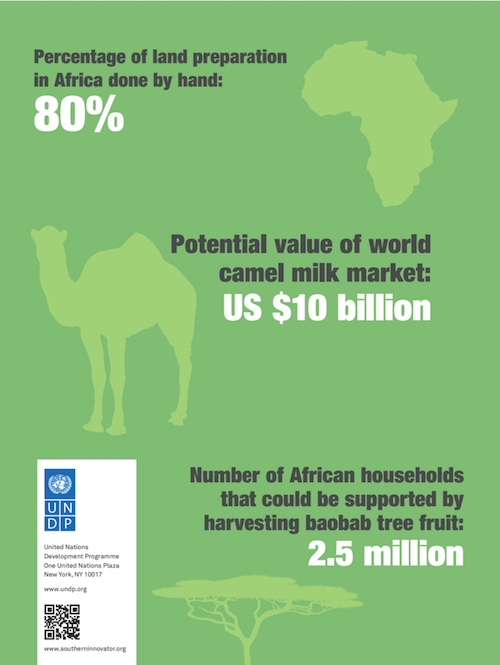
Turning to more sophisticated business models offers solutions to chronic problems. With 80 percent of Africa’s farms less than two hectares in size – and there are 33 million of them – cereal yields have grown little and are still around 1.2 tonnes per hectare in the region, compared to an average of some 3 tonnes per hectare in the developing world as a whole. Fertilizer consumption was only 13 kg per hectare in sub-Saharan Africa in 2002, compared to 73 kg in the Middle East and North Africa and 190 kg in East Asia and the Pacific. The FAO has estimated that the potential additional land area available for cultivation in sub-Saharan Africa amounts to more than 700 million hectares – a boon to the continent’s and the world’s food needs in coming years if handled well.

And the demand is there: Between 2001 and 2007, annual increases in the global consumption of agricultural commodities were larger than during the 1980s and 1990s. The quantity of agri-products harvested in the world is 5.2 billion metric tonnes a year.

“I have been able to reach out to so many people across the nation, preaching the agribusiness development and adoption gospel,” said Umoru. “I have also worked closely with other youth agencies to empower many more young people to aspire in Nigeria.”

One such agency is the Harambe Nigeria Endeavour. Harambe Nigeria (http://www.hendeavor.org/content/bgroups/nigeria.php) is a programme designed to stimulate growth in the agricultural sector and open up opportunities for youth to become leaders and entrepreneurs in this area. And this means future young entrepreneurs going into the agricultural sector will not feel as alone as Umoru once did.

As Obinna Ukwuani, creative director of Harambe Nigeria says: “We wish to rectify the tarnished image of agriculture in Nigeria, making it a viable investment for Nigerian youth from all walks of life.”

Published: May 2010

Resources

1) World Vegetable Center: The World Vegetable Center is the world’s leading international non-profit research and development institute committed to alleviating poverty and malnutrition in developing countries through vegetable research and development. Website: http://www.avrdc.org

2) Marketing African Leafy Vegetables: Challenges and Opportunities in the Kenyan Context by Kennedy M. Shiundu and Ruth. K. Oniang. Website: http://www.ajfand.net/Issue15/PDFs/8%20Shiundu-IPGR2_8.pdf

3) 2050: Africa’s Food Challenge: Prospects good, resources abundant, policy must improve: A discussion paper from the Food and Agricultural Organization (FAO). Website: http://www.fao.org/wsfs/forum2050/wsfs-background-documents/issues-briefs/en/

4) African Alliance for Capital Expansion: A management consultancy focused on private sector development and agribusiness in West Africa. Website: http://www.africanace.com/v3

5) Branding Strategy Insider: This blog provides advice and case studies on how to build trust for your brand. Website: www.brandingstrategyinsider.com

6) Growing Inclusive Markets, a web portal from UNDP packed with case studies, heat maps and strategies on how to use markets to help the poor. Website: www.growinginclusivemarkets.org

7) Starting a SME (small, medium enterprise): This website is packed with advice and tips for starting a small business and how to grow it with limited resources. Website: http://www.smallbusiness.co.uk

8) World Business Fair: The World Business Fair is an international trade platform for global entrepreneurs and professionals. Website: http://www.worldbusinessfair.com

Development Challenges, South-South Solutions was launched as an e-newsletter in 2006 by UNDP’s South-South Cooperation Unit (now the United Nations Office for South-South Cooperation) based in New York, USA. It led on profiling the rise of the global South as an economic powerhouse and was one of the first regular publications to champion the global South’s innovators, entrepreneurs, and pioneers. It tracked the key trends that are now so profoundly reshaping how development is seen and done. This includes the rapid take-up of mobile phones and information technology in the global South (as profiled in the first issue of magazine Southern Innovator), the move to becoming a majority urban world, a growing global innovator culture, and the plethora of solutions being developed in the global South to tackle its problems and improve living conditions and boost human development. The success of the e-newsletter led to the launch of the magazine Southern Innovator. 

Creative Commons License

This work is licensed under a
Creative Commons Attribution-Noncommercial-No Derivative Works 3.0 License.

ORCID iD: https://orcid.org/0000-0001-5311-1052.

© David South Consulting 2023

Categories
Archive Development Challenges, South-South Solutions Newsletters

West African Chocolate Success Story

By David SouthDevelopment Challenges, South-South Solutions

SOUTH-SOUTH CASE STUDY

A Ghanaian chocolate company has become a big success in the United Kingdom and shown how it is possible to develop and market a high-quality product grown in West Africa. While the chocolate bars are manufactured in the Netherlands, the cooperative that owns the company initiated the push into producing a mass-market chocolate brand – and shares in the profits.

The Divine chocolate brand is available in shops and supermarkets across Britain and is the product of the Kuapa Kokoo (http://www.kuapakokoo.com/) cocoa farmers cooperative. The Divine brand was launched in the U.K. in 1998 as the first Fairtrade (http://www.fairtrade.org.uk) chocolate bar aimed at the mass market. Previously, most Fairtrade chocolate was made for high-end customers.

Apart from the chocolate bars, the co-op also sells its cocoa butter to The Body Shop (http://www.thebodyshop.co.uk/_en/_gb/index.aspx), a chain of natural beauty retailers.

In 1997, at the co-op’s annual general meeting, members decided to create a mass-market chocolate bar of their own. Ambitiously, they did not want to just be a small, niche-market chocolate bar. They wanted to take on the big brands. They set up The Day Chocolate Company in 1998 and received support from a collection of international charities, aid agencies and businesses.

The Chocolate Company is structured to have two members of the co-op on its board of directors, with one out of four yearly board meetings held in Ghana. As shareholders, the farmers also receive a share of the profits of chocolate sales. Britain’s chocolate market is worth £4 billion a year (US $6 billion) and the country has hundreds of chocolate brands, making competition for customers fierce. The Divine range of chocolate has been designed to match U.K. market tastes.

Ghana has an excellent reputation for the quality of its cocoa beans and has been growing cocoa since it was first brought to the country from Equatorial Guinea in 1878 by Tetteh Quarshie (http://www.ghanaweb.com/GhanaHomePage/people/pop-up.php?ID=128).

Kuapa Kokoo’s success story has its origins in responding to the structural adjustment programmes (http://en.wikipedia.org/wiki/Structural_adjustment) which started liberalizing Ghana’s cocoa market in 1993.

The lock the government had on selling cocoa to the Cocoa Marketing Company had been lifted. Now the opportunity was there for others to sell to the Marketing Company and some farmers decided to form a cooperative, Kuapa Kokoo – “the best of the best”. They wanted to get a better price for the cocoa and to improve working conditions and lives of the pickers.

The cooperative does all the processing of the cocoa and delivers it to market. One of the great advantages for the farmers is the honest weighing of the beans – something previous buying agents would cheat doing. By creating a more efficient and fair process, greater savings are made on the price paid for the beans and this is passed on to the co-op’s members.

The farmers are also trained to do tasks like weighing and bagging the cocoa, removing the need for outside help. Every year the farmers receive cash bonuses based on the co-op’s profits and any efficiencies made.

With this success, Kuapa Kokoo grew and now has more than 40,000 members spread over 1,300 villages.

The co-op offers various services to the farmers including a credit union to help with finances. There are also 33 Research and Development Officers employed by the co-op to oversee training and election.

The number of women farmers has grown over the years, from 13 percent to 30 percent.

Extra income-generating skills are encouraged for the women farmers as well. One project is to make soap from the potash produced from burnt cocoa husks. Women have also been given machines to crack palm kernels for cooking oil.

Comfort Kumeah, a 62-year-old co-op farmer, lives in the village of Mim in the Ashanti region. A former teacher for 39 years, she inherited 20 acres of land from her husband’s family.

“Each farmer has a passbook to record weight and payment. In the whole of Ghana, only Kuapa Kokoo … is certified Fairtrade,” she told the Sunday Times.

“I was voted chair of the farmers’ trust and national secretary for the union; once a year I attend a conference to vote on how the Fairtrade premium is spent. Last year we bought a palm-nut crusher and we sell the red oil on the market.”

“Before, I was always cheated. Purchasing clerks would come and weigh the beans and you never knew if their scales were correct, as no one checked them. Some embezzled the money instead of paying it to the farmers.”

“Owning this company has given cocoa farmers a voice for the first time.”

Kuapa Kokoo sells around 1,000 tonnes of cocoa every year to the European Fairtrade market (http://www.etfam.com/index2.php). This has many advantages for sellers if they meet certain conditions. These conditions include health and safety requirements and democratic decision making. If they are met, the producers receive a guaranteed price for their goods and long-term trading contracts. This means a stable price despite market fluctuations. With a stable price, it is easier to plan and save money.

Ghanaian cocoa has a good international reputation and trades at a higher price because of this. Cocoa once made up 66 percent of Ghana’s foreign exchange, but is now down to 35-40 percent as the economy has diversified into areas like information technology.

Cocoa is usually grown on small family farms in Ghana. Farmers also grow crops like plantain to provide food for the family. Around 1.6 million people are involved in growing cocoa and its business in Ghana. Cocoa trees grow to 15 metres in height and take three to four years to start producing a crop. An entire year’s worth of a tree’s crop can make three large chocolate bars.

A tree can produce two crops a year. Each cocoa pod produces around 40 seeds.

“A cocoa farmer’s life is hard,” admits Comfort. “In the lean season, we have no income. Also, cocoa is controlled by climate. Drought followed by too much rain causes fungus and rot, and then every farmer is poor.”

“I have saved money for my children’s education but my own needs are few: clothes, soap and toothpaste. Generally, you know, women are strong. Last year more women than men were voted onto the Kuapa Kokoo national executive and now hold some of the most senior positions.”

Learn more about cocoa trading and Africa’s role here (content provided by commodity.com): Cocoa’s Future as Commodity: What If Africa Can’t Keep Up the Supply? – Where’s Cocoa From and How Much Does It Contribute to the World’s Economy?

Cocoa has many health benefits. From the British Journal of Clinical Pharmacology: The neuroprotective effects of cocoa flavanol and its influence on cognitive performance

“In summary, the flavonoids contained in cocoa and chocolate appear able to improve various types of cognitive and visual tasks, possibly as the result of more efficient perfusion of blood to different neural tissues, clearly both forebrain and more posterior cortex and possibly also influence retinal blood flow and visual function.”

Published: April 2010

Resources

1) Divine’s online shop. Website: www.divinechocolateshop.com

2) An online shop with various Fairtrade chocolate brands for sale. Website: http://www.simplyfair.co.uk/acatalog/Chocolate.html?icid=J158-11634392-071H&gclid=CMOlycDN8KACFUkrDgodjXDsEg

3) How to make chocolate bars from the bean to bar. Website: http://www.wikihow.com/Make-Chocolate

4) Home Chocolate Factory: A website selling the moulds and other accessories for making chocolate products in small factories or at home. Website: http://www.homechocolatefactory.com/

https://davidsouthconsulting.org/2022/10/17/connoisseur-chocolate-from-the-south-gets-a-higher-price/

https://davidsouthconsulting.org/2022/11/01/indonesian-food-company-helps-itself-by-making-farmers-more-efficient/

Development Challenges, South-South Solutions was launched as an e-newsletter in 2006 by UNDP’s South-South Cooperation Unit (now the United Nations Office for South-South Cooperation) based in New York, USA. It led on profiling the rise of the global South as an economic powerhouse and was one of the first regular publications to champion the global South’s innovators, entrepreneurs, and pioneers. It tracked the key trends that are now so profoundly reshaping how development is seen and done. This includes the rapid take-up of mobile phones and information technology in the global South (as profiled in the first issue of magazine Southern Innovator), the move to becoming a majority urban world, a growing global innovator culture, and the plethora of solutions being developed in the global South to tackle its problems and improve living conditions and boost human development. The success of the e-newsletter led to the launch of the magazine Southern Innovator. 

https://davidsouthconsulting.org/2021/03/05/southern-innovator-issue-3/

Creative Commons License

This work is licensed under a
Creative Commons Attribution-Noncommercial-No Derivative Works 3.0 License.

ORCID iD: https://orcid.org/0000-0001-5311-1052.

© David South Consulting 2023