Categories
Archive Development Challenges, South-South Solutions Newsletters

Indonesia Best for Entrepreneurs

By David SouthDevelopment Challenges, South-South Solutions

SOUTH-SOUTH CASE STUDY

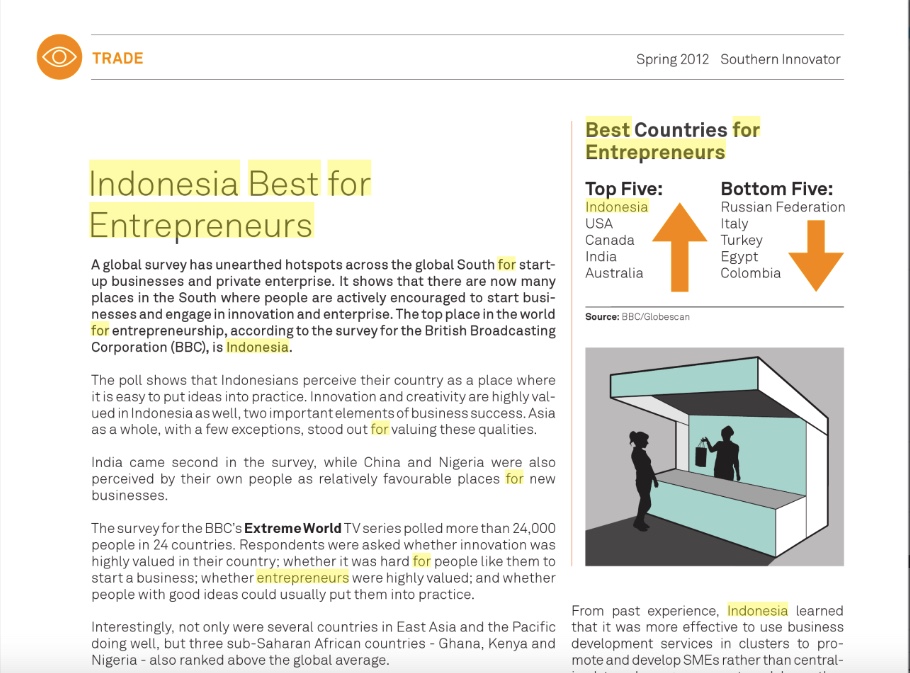
A global survey has unearthed hotspots across the global South for start-up businesses and private enterprise. It shows there are now many places in the South where people are actively encouraged to start businesses and engage in innovation and enterprise. The top place in the world for entrepreneurship, according to the survey for the British Broadcasting Corporation (BBC), is Indonesia.

The poll shows that Indonesians perceive their country as a place where it is easy to put ideas into practice. Innovation and creativity are highly valued in Indonesia as well, two important elements of business success. Asia as a whole, with a few exceptions, stood out for valuing these qualities.

India came second in the survey, while China and Nigeria were also perceived by their own people as relatively favourable places for new businesses.

The survey for the BBC’s Extreme World TV series polled more than 24,000 people across 24 countries (http://www.globescan.com/news_archives/bbc2011_entrepreneur/backgrounder.html). Respondents were asked whether innovation was highly valued in their country; whether it was hard for people like them to start a business; whether entrepreneurs were highly valued; and whether people with good ideas could usually put them into practice.

Interestingly, not only were several countries in East Asia and the Pacific doing well, but three sub-Saharan African countries – Nigeria, Kenya and Ghana – ranked above the global average.

The survey found work still needed to be done in Latin America. While Mexico and Peru scored highly, Brazil and Colombia ranked below average.

So, what are the things that make Indonesia so positive for entrepreneurs and private business? And what do they do – or not do – for small business start-ups?

According to Bali International Consulting Group, the Indonesian economy is highly dependent on small and medium-sized enterprises: they make up 99.95 percent of the total number of enterprises, and provide most of the country’s jobs. Authorities have identified a problem with the sector, however: productivity per worker is very low compared to large enterprises. Poor productivity matters because it means people are working very hard for low return and this affects the overall standard of living in the country and its human development.

The Indonesian government has set about boosting productivity in the sector, adopting a ‘clustering’ approach in partnership with non-governmental organizations (NGOs). Like-minded businesses tend to cluster together across the archipelago of islands that makes up the nation. By targeting these places with resources and support, it can use those resources more efficiently. The country has a dedicated ministry for small and medium enterprises (http://www.depkop.go.id) and a wide range of businesses and services targeting them. From dedicated trading and office facilities (http://www.smescoindonesia.com) to an online marketplace to display, trade and sell SME products (http://www.smescotrade.com), extensive resources are applied to give SMEs a boost and a competitive edge in the global marketplace.

From past experience, Indonesia learned it was more effective to use business development services in clusters to promote and develop SMEs, rather than centralised, top-down government models or other approaches.

As Bali International Consulting Group notes, “The government has introduced many models for promoting SMEs, including business incubators, business consulting clinics and technology centers. However, those sponsoring programs have not been productive and could not sustain themselves for a long time. The government then turned to supporting BDS (Business Development Services) providers to serve a certain cluster in a selected area.”

Developed countries like the United States significantly grew their wealth by allowing entrepreneurs and small and medium-sized enterprises to flourish. The USA’s highly innovative and globe-straddling high tech and information technology businesses would not have been so successful without entrepreneurs. Think of Bill Gates, one of the founders of Microsoft, or Steve Jobs, one of the pioneers behind the Apple computer brand.

China – the country that has seen the largest lifting of people out of poverty in our time – is awash with entrepreneurs. So successful at providing manufacturing services to foreign companies, China is fast on track to become the wealthiest country in the world. The International Monetary Fund recently issued a report predicting China would be number one within five years.

Entrepreneurs play a key role in any country’s economic strategy. The more they are encouraged to flourish – and build wealth and their businesses – the better a country can do. Large human development gains can come about when entrepreneurs are matched with a fair and transparent tax system, balancing between social and economic needs.

China is the source of one of the most successful aids to small business growth in the global South. Hong Kong-based Alibaba (http://www.alibaba.com) is an online trading and selling marketplace aimed at small businesses and start-ups. Packed with support, advice and inspiration, it makes it possible for people anywhere in the world to get trading and selling.

To help small businesses trade with each other, New Delhi, India-based Go4World Business.com (http://indonesia.go4worldbusiness.com) has for the past 12 years helped exporters and importers to explore new markets and increase their international business in a simple, cost effective manner.

The Internet has not only radically transformed how to trade and sell, it has also opened up many ways for small and medium-sized businesses to raise funds and borrow money. Examples include Zopa (www.zopa.com) – “Where people meet to lend and borrow money”; social lenders like Kiva (www.kiva.org)w, whose mission is to connect people, through lending, for the sake of alleviating poverty; and Betterplace (www.betterplace.org), an online marketplace for projects to raise funds. It is free to use, and it passes on 100 percent of the money raised on the platform to the projects. For those with a creative business idea, Kickstarter (http://www.kickstarter.com) is a funding platform for artists, designers, filmmakers, musicians, journalists, inventors, and explorers.

Published: June 2011

Resources

1) Small business guide: An online resource packed with advice and resources on starting a small business. Website: http://www.smallbusiness.co.uk/

2) The red dot logo stands for belonging to the best in design and business. The red dot is an internationally recognized quality label for excellent design that is aimed at all those who would like to improve their business activities with the help of design. Website: http://www.red-dot.de

3) Dutch Designers in Development: The Dutch NGO works with producers to develop skills and adapt producers’ products to present and future demands in Europe. By following this approach, Southern producers can reduce the risk of making products nobody wants, or that lack originality in the marketplace and thus won’t sell. Website: http://www.ddid.nl/english/index.html

4) SME toolkits abound: Here are two from Africa: SME Toolkit Kenya Website: http://kenya.smetoolkit.org/kenya/en and SME Toolkit South Africa: Website: http://southafrica.smetoolkit.org/sa/en

5) African Alliance for Capital Expansion: A management consultancy focused on private sector development and agribusiness in West Africa. Website: http://www.africanace.com/v3

6) World Business Fair: The World Business Fair is an international trade platform for global entrepreneurs and professionals. Website: http://www.worldbusinessfair.com

7) Small businesses looking to develop their brand can find plenty of free advice and resources here. Website: www.brandingstrategyinsider.com

8) Brandchannel: The world’s only online exchange about branding, packed with resources, debates and contacts to help businesses intelligently build their brand. Website: www.brandchannel.com

9) ZanaAfrica (ZanaA) is a non-profit whose mission is to craft tools from within Africa to slay the giants of poverty. The tools are in the nexus of health, education, and environment with a particular focus on gender and technology. These tools address root causes of poverty, and are primarily market-based solutions with a national and replicable scope to provide leveraged, lasting solutions with significant multiplier effects. Website: http://www.zanaa.org/

10) Small Business in Indonesia by Peter Van Diermen. Explores how critical families are to business success in Indonesia. Website: http://books.google.com/books/about/Small_business_in_Indonesia.html?id=WSu1AAAAIAAJ

11) SME Toolkit Indonesia: The SME Toolkit Indonesia offers a wide range of how-to articles, business forms, free business software, online training, self-assessment exercises, quizzes, and resources to help entrepreneurs, business owners, and managers in emerging markets and developing countries start, finance, formalize, and grow their businesses. Website: http://indonesia.smetoolkit.org/indonesia/en

12) The 3rd Indonesia International Conference on Innovation, Entrepreneurship, and Small Business 2011: From July 25 to 28, is aimed at challenging researchers, Indonesians in particular, to study and create local knowledge on Innovation, Entrepreneurship, and Small Business. Website: http://www.ciel-sbm-itb.com/iicies2011

Development Challenges, South-South Solutions was launched as an e-newsletter in 2006 by UNDP’s South-South Cooperation Unit (now the United Nations Office for South-South Cooperation) based in New York, USA. It led on profiling the rise of the global South as an economic powerhouse and was one of the first regular publications to champion the global South’s innovators, entrepreneurs, and pioneers. It tracked the key trends that are now so profoundly reshaping how development is seen and done. This includes the rapid take-up of mobile phones and information technology in the global South (as profiled in the first issue of magazine Southern Innovator), the move to becoming a majority urban world, a growing global innovator culture, and the plethora of solutions being developed in the global South to tackle its problems and improve living conditions and boost human development. The success of the e-newsletter led to the launch of the magazine Southern Innovator. 

Creative Commons License

This work is licensed under a
Creative Commons Attribution-Noncommercial-No Derivative Works 3.0 License.

ORCID iD: https://orcid.org/0000-0001-5311-1052.

© David South Consulting 2023

Categories
Archive Development Challenges, South-South Solutions Newsletters Southern Innovator magazine

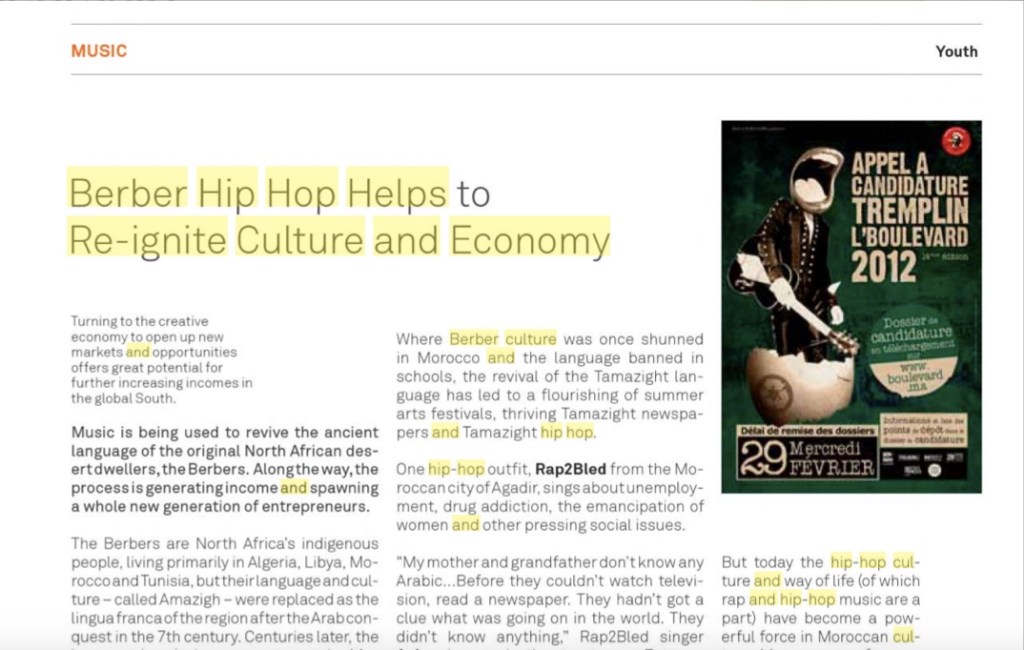
Berber Hip Hop Helps Re-ignite Culture and Economy

By David SouthDevelopment Challenges, South-South Solutions

SOUTH-SOUTH CASE STUDY

Music is being used to revive the ancient language of the original North African desert dwellers, the Berbers (http://en.wikipedia.org/wiki/Berber_people). And in the process, it is spawning a whole new generation of entrepreneurs and generating income. 

The Berbers are North Africa’s indigenous people, primarily living in Morocco, Algeria, Libya, and Tunisia, but their language and culture – called Amazigh – were replaced as the lingua franca of the region after the Arab conquest in the 7th century. But all these years later, the language is enjoying resurgence under Morocco’s king, Mohammed VI, who is helping to promote the language through television programming and a new law making teaching of the language compulsory in schools by 2010.

Amazigh people – the name means “free humans” or “free men” – total more than 50 million. Their group languages, called Tamazight, are spoken by several million people across North Africa, with the largest number in Morocco.

For young Moroccans, promoting the language is more interesting when hip hop (http://en.wikipedia.org/wiki/Hip_hop_music) is thrown into the mix. 

Where once Berber culture was shunned in Morocco and the language banned in schools, the revival of the Tamazight language has led to a flourishing of summer arts festivals, thriving Tamazight newspapers _ and Tamazight hip hop.

One hip-hop outfit, Rap2Bled from the Moroccan city of Agadir, stick to social issues, singing about unemployment, drug addiction and the emancipation of women.

“My mother and grandfather don’t know any Arabic…Before they couldn’t watch television, read a newspaper. They hadn’t got a clue what was going on in the world. They didn’t know anything,” Rap2Bled singer Aziz, who goes by the street name Fatman, told to Radio Netherlands Worldwide.

“But now there is a TV channel in our local dialect and a newspaper. But our aim is to put the language on the map by fusing it with hip hop. More than 60 per cent of young Moroccans only listen to rap and western music. So we thought why not fuse Berber with that and make it really accessible?”

Just 10 years ago, rap and hip hop were virtually unknown in Morocco, with only a small group of hip hop aficionados listening to big American stars like Dr Dre, Tupac Shakur and Notorious BIG.

But today hip hop culture and way of life (of which rap and hip hop music are a part) have become a powerful force in Moroccan culture. Moroccan rap focuses on local issues like unemployment and injustice and is ubiquitous on radio and TV.

The Casa Crew, from Casablanca, has become so successful since their beginnings in 2003 that their fan base stretches to Spain and Algeria.

“First of all, to designate rap simply as mere ‘music’ deprives it of its real impact,” Caprice from the Casa Crew (http://casa-crew-00.skyrock.com/), told the Arab Media News, Menassat. 

“Rap is a life style, and mainly a culture of convictions. The fact that rap is spreading in countries like Morocco is an excellent sign. On the one hand, it’s proof that the youth are starting to react, to think they have the right to express themselves in any way they see fit, without anyone judging them or denying them of that right. On the other hand, the development of rap means that the space for artistic freedom is growing particularly when considering that a majority of Arab rappers are dealing with subjects that we were forbidden to speak about a few years ago.”

The Amazigh revival industry centres around large music festivals. Timitar Festival in Agadir (http://www.moroccofestivals.co.uk/timitar.html) gets crowds surpassing 500,000, with more than 40 artists. Morocco’s biggest festival helps Amazigh artists meet world musicians and learn how to reach music fans outside of Morocco.

Another pioneer of Morocco’s music industry is Mohamed ‘Momo’ Merhari, a young music entrepreneur and winner of the British Council’s International Young Music Entrepreneur of the Year award in 2008 (http://www.creativeconomy.org.uk/).

Momo is a music consultant and co-founder of the “Boulevard des Jeunes Musiciens” (http://www.boulevard.ma/), the largest contemporary music festival in North Africa, featuring 50 bands over four days, and reaching a live audience of 130,000 people. The annual event showcases new talent from the worlds of hip hop, rock and jazz fusion from all over the region.

In January, Morocco’s culture minister Touriya Jabrane promised to introduce a range of measures to financially support Moroccan musicians, composers and the industry as whole.

Published: March 2009

Resources

https://davidsouthconsulting.org/2022/10/02/african-afro-beats-leads-new-music-wave-to-europe/

https://davidsouthconsulting.org/2022/11/17/cashing-in-on-music-in-brazil/

https://davidsouthconsulting.org/2022/12/18/disabled-congolese-musicians-become-world-hit/

https://davidsouthconsulting.org/2021/11/09/mauritanian-music-shop-shares-songs-and-friendship/

https://davidsouthconsulting.org/2020/12/17/mongolias-musical-entrepreneurs-led-way-out-of-crisis-2018/

https://davidsouthconsulting.org/2023/02/07/mongolian-rock-and-pop-book-mongolia-sings-its-own-song/

https://davidsouthconsulting.org/2021/11/09/ring-tones-and-mobile-phone-downloads-are-generating-income-for-local-musicians-in-africa/

https://davidsouthconsulting.org/2021/11/09/taxis-promote-african-music-beats/

https://davidsouthconsulting.org/2020/11/24/too-black/

Development Challenges, South-South Solutions was launched as an e-newsletter in 2006 by UNDP’s South-South Cooperation Unit (now the United Nations Office for South-South Cooperation) based in New York, USA. It led on profiling the rise of the global South as an economic powerhouse and was one of the first regular publications to champion the global South’s innovators, entrepreneurs, and pioneers. It tracked the key trends that are now so profoundly reshaping how development is seen and done. This includes the rapid take-up of mobile phones and information technology in the global South (as profiled in the first issue of magazine Southern Innovator), the move to becoming a majority urban world, a growing global innovator culture, and the plethora of solutions being developed in the global South to tackle its problems and improve living conditions and boost human development. The success of the e-newsletter led to the launch of the magazine Southern Innovator. 

Creative Commons License

This work is licensed under a
Creative Commons Attribution-Noncommercial-No Derivative Works 3.0 License.

ORCID iD: https://orcid.org/0000-0001-5311-1052.

© David South Consulting 2023
Categories
Archive Blogroll Southern Innovator magazine Special Unit for South-South Cooperation United Nations Development Programme United Nations Office for South-South Cooperation

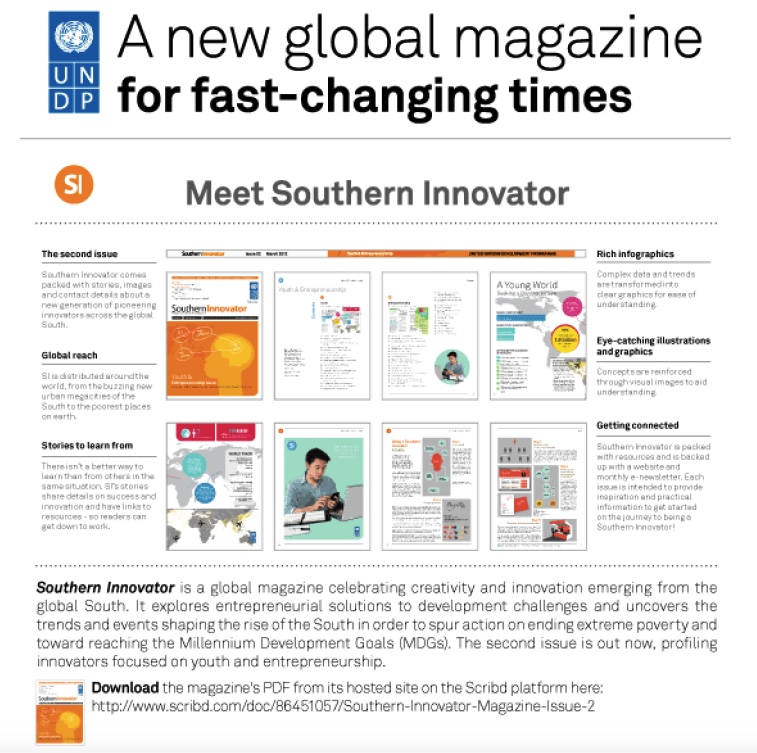
Southern Innovator Magazine | 2010 – 2014 

By David South

“I think you [David South] and the designer [Solveig Rolfsdottir] do great work and I enjoy Southern Innovator very much!” 

Ines Tofalo, Programme Specialist, United Nations Office for South-South Cooperation
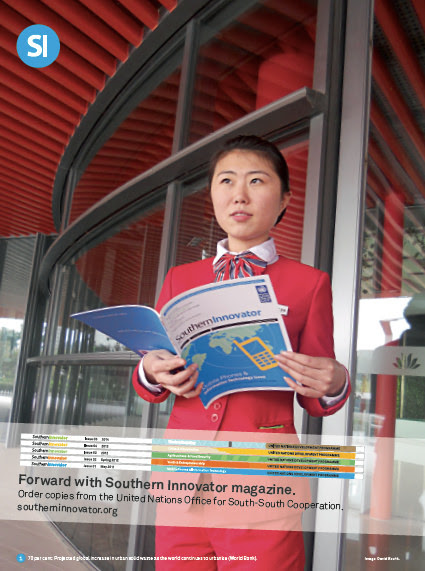
Southern Innovator in Tianjin, China.
Issue 5 of Southern Innovator at the Global South-South Development Expo (GSSD Expo) 2014 held in Washington, D.C.
Volunteers in Nairobi, Kenya pose with Southern Innovator Issue 4 at the Global South-South Development Expo (GSSD Expo) in 2013.
Southern Innovator Editor and Writer David South in Australia.
Southern Innovator Graphic Designer and Illustrator Sólveig Rolfsdóttir in Iceland.

Some comments that have come in so far about SI’s first issue:

“What a tremendous magazine your team has produced! It’s a terrific tour de force of what is interesting, cutting edge and relevant in the global mobile/ICT space… Really looking forward to what you produce in issues #2 and #3. This is great, engaging, relevant and topical stuff.”, to “Looks great. Congratulations. It’s Brill’s Content for the 21st century!”

What they are saying about SI on Twitter: From @CapacityPlus Nice job RT @ActevisCGroup: RT @UNDP: Great looking informative @SouthSouth1 mag on South-South Innovation; @UNDP Great looking informative @SouthSouth1 mag on South-South Innovation; @JeannineLemaireGraphically beautiful & informative @UNDP Southern Innovator mag on South-South Innov. 

And on Pinterest:

Peggy Lee • 1 year ago 

“Beautiful, inspiring magazine from UNDP on South-South innovation. Heart is pumping adrenaline and admiration just reading it”

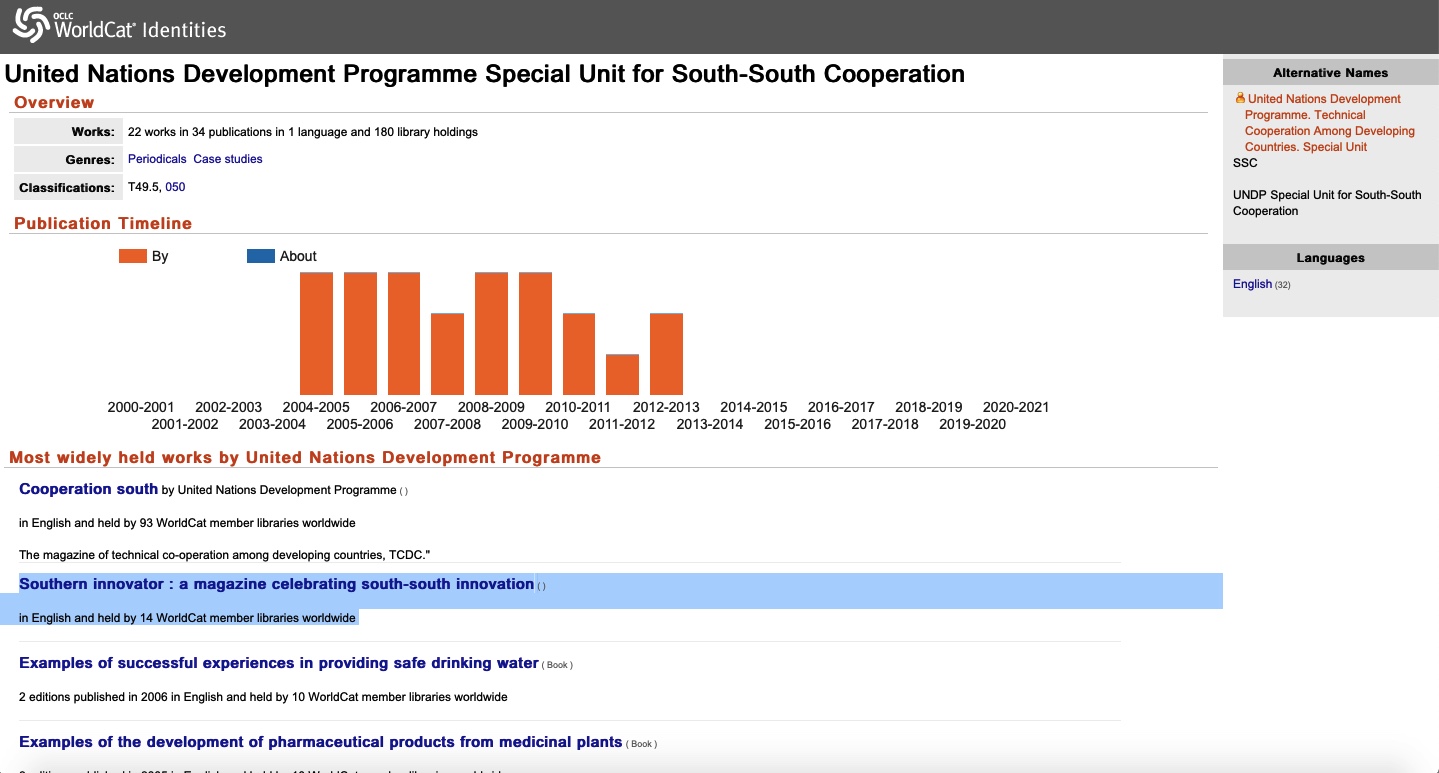
Southern Innovator Magazine can be found in libraries around the world.

Development Challenges, South-South Solutions was launched as an e-newsletter in 2006 by UNDP’s South-South Cooperation Unit (now the United Nations Office for South-South Cooperation) based in New York, USA. It led on profiling the rise of the global South as an economic powerhouse and was one of the first regular publications to champion the global South’s innovators, entrepreneurs, and pioneers. It tracked the key trends that are now so profoundly reshaping how development is seen and done. This includes the rapid take-up of mobile phones and information technology in the global South (as profiled in the first issue of magazine Southern Innovator), the move to becoming a majority urban world, a growing global innovator culture, and the plethora of solutions being developed in the global South to tackle its problems and improve living conditions and boost human development. The success of the e-newsletter led to the launch of the magazine Southern Innovator. 

https://davidsouthconsulting.org/southern-innovator-scale-up-fundraiser/

Creative Commons License

This work is licensed under a
Creative Commons Attribution-Noncommercial-No Derivative Works 3.0 License.

ORCID iD: https://orcid.org/0000-0001-5311-1052.

© David South Consulting 2022