Categories
Archive Development Challenges, South-South Solutions Newsletters

Southern Drinks Challenge Corporate Dominance

By David SouthDevelopment Challenges, South-South Solutions

SOUTH-SOUTH CASE STUDY

Across the global South, its thirsty people have long been a target market for Northern drinks companies. The ubiquity of the American soft drink Coca Cola, or even its rival Pepsi Cola, is testimony to that. Even the most remote village on the impoverished island of Haiti can offer an ice-cold Coke.

But the marketing power of these companies has a down side: it has pushed aside local drink brands based on traditional formulations. But in some countries, local brands are fighting back.

In India, the Cow Protection Department of the Rashtriya Swayamsevak (called RSS) based in Hardwar (www.hardwar.com), one of the four holy cities on the River Ganges, has produced a soft drink made from recycled cow urine. They call it ‘gau jal’ (Sanskrit for ‘cow water’) and it is set for a launch at the end of 2009.

The urine is highly processed to make the drink. “Don’t worry, it won’t smell like urine and will be tasty too,” Om Prakash told the Daily Mail. “Its unique selling point will be that it’s going to be very healthy. It won’t be like carbonated drinks and will be devoid of any toxins.”

The price will be less than American brands such as Coca Cola.

“We’re going to give them good competition as our drink is good for mankind,” he continued. “We may also think of exporting it.”

The drink contains not only cow urine but a blend of medicinal and ayurvedic herbs. Ayurveda is the 5,000-year-old ancient Indian health system.

The RSS was founded in 1925 and claims to have eight million members.

Cows are sacred to India’s Hindu population and killing them is illegal in many parts of India.Finding ways to make a living from cows’ waste products is common. Cow dung (manure) is already used as a fertilizer in villages. It is claimed the new soda pop will help with cancer, obesity and liver disease.

Another drink that has been consumed for its health-giving properties is Mongolian mare’s (female horse) milk. Studies by female scientists from Mongolia, South Korea and China for UNDP in the late 1990s found the milk was packed with vitamins and minerals and effective in treating liver diseases, cancer, intestine inflammations and tuberculosis.

Mongolians have used mare’s milk for centuries in their traditional diet. The drink, called airag in Mongolian, is consumed especially during traditional holidays.

There are eight times as many horses in Mongolia as the human population, which numbers 2.7 million, so the potential for this drink is enormous. The Food and Biotechnology Institute of the Mongolian University of Science and Technology (www.must.edu.mn/beta_new/) in association with the Swiss International Development Agency (www.sdc.admin.ch), has been developing technology to process mare’s milk, and make value-added products with it to create rural jobs. Under the project, eight kinds of beauty products have been manufactured so far using mare’s milk.

Published: July 2009

Resources

Just Food is a web portal packed with the latest news on the global food industry and packed with events and special briefings to fill entrepreneurs in on the difficult issues and constantly shifting market demands. Website: www.just-food.com

Brandchannel: The world’s only online exchange about branding, packed with resources, debates and contacts to help businesses intelligently build their brand. Website: www.brandchannel.com

Small businesses looking to develop their brand can find plenty of free advice and resources here. Website: www.brandingstrategyinsider.com

Growing Inclusive Markets, a new web portal from UNDP packed with case studies, heat maps and strategies on how to use markets to help the poor. Website: www.growinginclusivemarkets.org

Asia-Pacific Traditional Medicine and Herbal Technology Network: an excellent first stop for any entrepreneur, where they can find out standards and regulations and connect with education and training opportunities. Website: www.apctt-tm.net

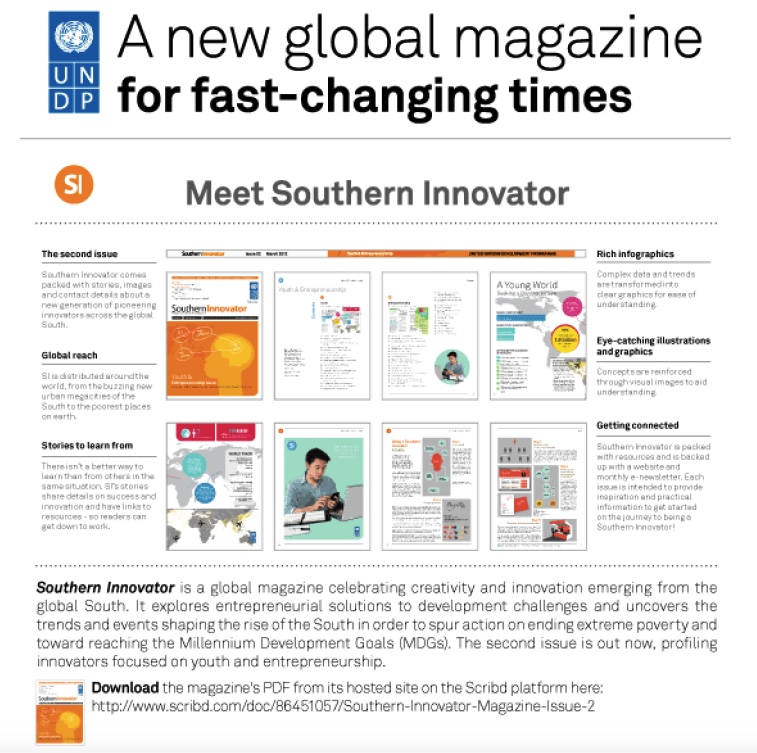
Development Challenges, South-South Solutions was launched as an e-newsletter in 2006 by UNDP’s South-South Cooperation Unit (now the United Nations Office for South-South Cooperation) based in New York, USA. It led on profiling the rise of the global South as an economic powerhouse and was one of the first regular publications to champion the global South’s innovators, entrepreneurs, and pioneers. It tracked the key trends that are now so profoundly reshaping how development is seen and done. This includes the rapid take-up of mobile phones and information technology in the global South (as profiled in the first issue of magazine Southern Innovator), the move to becoming a majority urban world, a growing global innovator culture, and the plethora of solutions being developed in the global South to tackle its problems and improve living conditions and boost human development. The success of the e-newsletter led to the launch of the magazine Southern Innovator.

Southern Innovator’s online archive portal was launched in New York City, U.S.A. (home to the UN’s headquarters) in 2011 (southerninnovator.org).
Creative Commons License

This work is licensed under a
Creative Commons Attribution-Noncommercial-No Derivative Works 3.0 License.

ORCID iD: https://orcid.org/0000-0001-5311-1052.

© David South Consulting 2024

Categories
Archive Development Challenges, South-South Solutions Newsletters

Tourist Passion for Quirky Holidays Helps South

By David SouthDevelopment Challenges, South-South Solutions

SOUTH-SOUTH CASE STUDY

Conventional thinking holds that any country with a poor or non-existent reputation in the international media will not attract tourists. But this conventional thinking is wrong: The hottest tourist trend for 2009 is directly benefiting the South’s more out-of-the-way and under-appreciated countries. So says a travel expert who specializes in overlooked travel destinations.

Prior to the economic downturn, tourism accounted for more than 10 percent of global GDP and 8 percent of total employment worldwide. It grew by 6 percent in 2007, according to the UN World Tourism Organization. Tourism in the Asia-Pacific region grew by 10 percent and Africa by 8 percent.

But it has since declined by 8 percent between January and April of 2009 compared to the same period in 2008. Destinations worldwide recorded a total of 247 million international tourist arrivals in those four months, down from 269 million in 2008 (UNWTO World Tourism Barometer).

This means competition is heating up for tourists. Well-travelled tourists are now looking for out-of-the-way places and places far off the beaten track. They want to be unique and have a tale to tell when they get home.

Tony Wheeler, author of the book Bad Lands: A Tourist on the Axis of Evil and co-founder of the Lonely Planet travel guides, said “Lots of tourists want to be the first through the door.”

During the Fitur Travel Fair in Madrid in January 2009, Myanmar (formerly Burma) appeared for the first time. Europe’s biggest travel fair also saw Zimbabwe, the Palestinian territories and Iran chasing travellers to come and see the sights.

Wheeler told Britain’s Daily Telegraph newspaper that, ironically, the more negative reports in the media a country gets, the more this new breed of tourist want to visit and find out the truth.

And his travel experiences have taught him, for example, the Burmese people do not believe in isolation and boycotts, as he wrote in the Guardian.

“Over the three decades since my first visit, tourism has grown from 20,000 tourists a year to more than 100,000.”
“Cutting the country off from the rest of the world isn’t going to help. We recently received a letter from one of our Burma authors saying the psychological damage of being isolated can be as bad as the economic damage.”

North Korea – which was labelled part of the “axis of evil” by President George W. Bush – saw its foreign tourist numbers rise to 4,500 in 2008 from just 600 in 2001.

Ross Kennedy of Africa Albida Tourism, which operates safari lodges in Zimbabwe, said bad headlines hurt but presenting an alternative view can reverse apprehension and lure tourists to come.

The lodges saw a 4 percent rise in visitors in 2008 in spite of chaotic elections in Zimbabwe that drew negative press.

“You certainly can’t write off an entire destination because of the choices or behaviour of a few individuals,” Kennedy told the Telegraph.

Tourism is now generally recognized to be one of the largest industries in the world, if not the largest. It has grown rapidly and almost continuously over the past 20 years, and is now one of the world’s most significant sources of employment and of Gross Domestic Product (GDP). Tourism particularly benefits the economies of developing countries, where most of the sector’s new tourism jobs and businesses are being created.

Tourism, because it is a labor-intensive industry, is seen as a great way both to reduce poverty and to meet all the Millennium Development Goals. It favours small-scale businesses, it is decentralized and can diversify regional economies, it is relatively non-polluting and can contribute to the conservation and promotion of natural and cultural heritage, and most importantly it can act as a catalyst for kick-starting other sectors of the economy.

In Iran, the Laleh Kandovan International Rocky Hotel, located in the province of East Azerbaijan in the north-west of the country, has been luring in tourists with the villages’ cave homes. Located in the village of Kandovan, where residents speak a Turkish dialect, the homes look like craggy sandcastles with holes in them; around 700 people live in the hollowed out rocks.

Prior to the hotel opening, it was only possible to visit for a day and the locals, who make their money harvesting fruit and walnuts, were suspicious of outsiders.

Kandovan means “Land of the Unknown Carvers”. An added attraction to visiting Kandovan is the mystery surrounding the houses. No one knows how long people have been there or when the homes were carved out of the rock. Others claim it is the biblical land of Nod, where Cain was left to wander after murdering his brother Abel.

The hotel occupies a hillside of caves and has a large restaurant and rooms that blend traditional décor like Persian rugs with modernist touches like recessed lighting. The rooms offer under-floor heating and some even have whirlpool baths. The hotel currently has 10 rooms, but plans to expand to 30.

Published: July 2009

Resources

United Nations World Tourism Organization (UNWTO). Website: www.unwto.org

Magic Carpet Travel: It specializes in trips to Iran and bookings for the Laleh Kandovan International Rocky Hotel. Website: www.magic-carpet-travel.com

African Travel and Tourism Association: ATTA creates the platform for buyers across Europe to meet suppliers of African tourism products at networking events, trade shows and through its links with the media. Website: www.atta.co.uk

Planeta: One of the first ecotourism resources to go online (since 1994) and still offers plenty of information for those wanting to start a business. Website: www.planeta.com

Off The Beaten Track Travel Magazine: Off The Beaten Track is a site for the traveller who avoids the beaten path of mass tourism. Website: www.off-the-beaten-track.net

World Tourism Cities: Developing Tourism Off the Beaten Track, edited by Robert Maitland and Peter Newman, Publisher: Routledge. Website: www.amazon.com

https://davidsouthconsulting.org/2022/10/20/african-tourism-leads-the-world-and-brings-new-opportunities/

https://davidsouthconsulting.org/2022/10/20/africas-tourism-sector-can-learn-from-asian-experience/

https://davidsouthconsulting.org/2022/02/07/boosting-tourism-in-india-with-surfing-culture/

https://davidsouthconsulting.org/2022/09/27/caribbean-island-st-kitts-goes-green-for-tourism/

https://davidsouthconsulting.org/2022/11/20/ecotourism-to-heal-the-scars-of-the-past/

https://davidsouthconsulting.org/2022/11/23/kenyan-safari-begins-minutes-from-airport/

https://davidsouthconsulting.org/2022/10/10/a-solution-to-stop-garbage-destroying-tourism/

https://davidsouthconsulting.org/2021/03/05/southern-innovator-issue-2/

Development Challenges, South-South Solutions was launched as an e-newsletter in 2006 by UNDP’s South-South Cooperation Unit (now the United Nations Office for South-South Cooperation) based in New York, USA. It led on profiling the rise of the global South as an economic powerhouse and was one of the first regular publications to champion the global South’s innovators, entrepreneurs, and pioneers. It tracked the key trends that are now so profoundly reshaping how development is seen and done. This includes the rapid take-up of mobile phones and information technology in the global South (as profiled in the first issue of magazine Southern Innovator), the move to becoming a majority urban world, a growing global innovator culture, and the plethora of solutions being developed in the global South to tackle its problems and improve living conditions and boost human development. The success of the e-newsletter led to the launch of the magazine Southern Innovator. 

Creative Commons License

This work is licensed under a
Creative Commons Attribution-Noncommercial-No Derivative Works 3.0 License.

ORCID iD: https://orcid.org/0000-0001-5311-1052.

© David South Consulting 2023

Categories
Archive Development Challenges, South-South Solutions Newsletters

Cashing in on Music in Brazil

By David SouthDevelopment Challenges, South-South Solutions

SOUTH-SOUTH CASE STUDY

Brazilian musicians have found a way to prosper and exploit the realities of music distribution in the modern age. The biggest problem for most artists – both beginners and those who are more established – is how to earn an income from their work. In the digital age, it is next to impossible to stop people freely copying your work and passing it on.

The impact of digital technology on the global music business has been earth-shattering. It’s estimated 95 percent of music digital downloads are unauthorized, with no payment to artists and producersWhile the legal digital music business grew for the sixth consecutive year in 2008, with a 25 percent increase in global sales to a trade value of US$3.7 billion, this only makes up 20 percent of total music sales (IFPI) (http://www.ifpi.org/). Even legal digital services like Apple’s iTunes have suffered (http://www.apple.com/downloads/).

An economic solution to this conundrum is critical for the growth of creative economies in the South.

The traditional music industry model from the analogue age – where copies of music are tightly controlled and royalties and profits funnel back to recording companies – has come unstuck in the digital age. With digital recordings, it is easy to copy high quality music and distribute it for free through the Internet, by audio music players like the iPod or on discs.

Many are saying a corner has been turned: free distribution is the new future and illegal copying is the new normal. The model for music making has been turned on its head: from high investment and high returns, it is now low investment and low returns. And this model chimes very well with the world most Southern musicians live in. The chances for most of emulating the champagne and jets lifestyle of the Rolling Stones or Beyonce is beyond their reality. But they can build a slower and more sustainable income with the new digital model.

A music phenomenon in Brazil’s poorer neighbourhoods, tecnobrega (brega means cheesy or corny) is a mix of electronic beats from the 1980s, mixed with found snippets of strange sounds or sound bites, combined in a so-called ‘mash-up’ (http://en.wikipedia.org/wiki/Mashups). It makes for an easy-to-dance-to mix.

“Tecnobrega is a regional music, the music that people here in (the state of) Para most enjoy,” DJ Edilson told the BBC. “The secrets are the beats which drive people crazy.”

With music becoming easier and cheaper to record to a high standard, and distribution of music less and less a money-making opportunity, musicians have turned to economic models revolving around live performance to make the bulk of their income.

“What is going on is that people, sometimes in very poor areas, are appropriating electronic instruments like computers and synthesizers to create their own music,” said Ronaldo Lemos, a professor at the respected Getulio Vargas Foundation (http://www.fgv..br/ ) and project lead for the Creative Commons Brazil (http://creativecommons.org/international/br/).

“So this is a phenomenon that is going on not only in the tecnobrega scene but with many scenes around the world like Kuduro in Angola, Kwaito in South Africa, Bubblin’ in Suriname.”

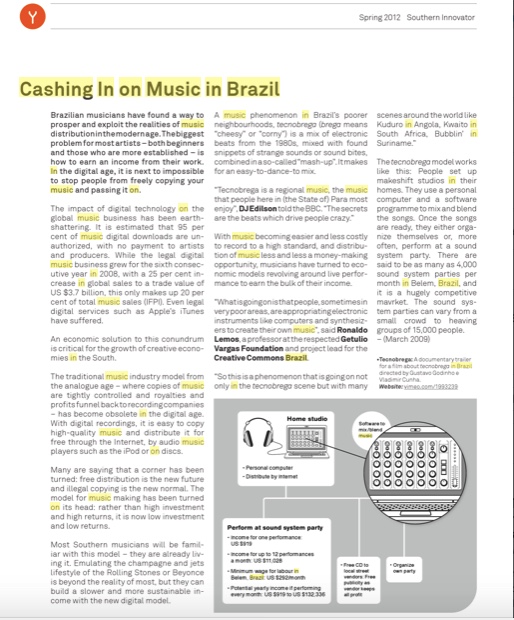
The tecnobrega model works like this: People set up makeshift studios in their homes. They use a personal computer and a software programme to mix and blend the songs. Once the songs are ready, they either organize themselves, or more often, perform at a sound system party. There are said to be as many as 4,000 sound system parties per month in Belem (http://en.wikipedia.org/wiki/Bel%C3%A9m) and it is a hugely competitive market. The sound system parties can vary from a small crowd to heaving groups of 10 to 15,000 people. 

The money for performing at these parties is good. A musician performing just once can make 2,200 realis (US $919), and can do this 12 times a month. This is a good income compared to the minimum wage in Belem: 700 realis (US $292). It is estimated it generates US $1.5 million a month in Belem.

In Brazil, where many do not have broadband Internet and thus can’t download music, fans buy pirated and cheap compact discs (CDs) in markets. Local musicians make their own CDs and give them free to local street vendors. While they make no money off the CDs that are then sold by the vendors, they do drum up publicity and profile. And they then use this to draw large paying crowds to their live gigs.

In just a few years, tecnobrega has become a multi-million dollar music business in Brazil. Once an artist has gained experience performing live at the parties, they can develop the skills to organize their own events, and boost their income accordingly.

One singer who has successfully exploited the opportunities raised by the tecnobrega phenomenon is Gaby Amarantos (http://www.youtube.com/watch?v=ZKjH__ghQa4 ). She now regularly appears on TV. 

“We have found a new way to work,” she told the BBC. “It is a new format and a new market model because we produce the music ourselves and the cost to make one song is very cheap.”

“What happens is that the musicians skip the intermediaries,” said Ronaldo Lemos.

“So the musicians do not make money from the CDs that are sold by the street vendors, they actually make money by playing live at the so-called sound system parties – the aparelhagem parties as we tecnobrega say here in Brazil – and also by selling CDs after they play live.

“No-one expects to make money from the CDs – they use it as a way to advertise the music and to advertise themselves as artists, and then their expectation is that they get invited to play at the sound system parties and clubs.

“The more their music gets distributed, the more they will make money in return.”

The furious pace of innovation in the tecnobrega scene is all about generating more revenue and more income. New styles emerge to cater to new tastes: cyber tecnobrega, brega melody, electro melody. And this passion for innovation has kept the tecnobrega entrepreneurs ahead of the traditional music business in how it uses digital technologies.

Lemos calls tecnobrega a “globoperipheral music”: it transcends rich and poor divisions and geographical boundaries.

Other examples include Argentina’s Cumbia Villera, or Brazil’s Funk Carioca.

“The number one lesson would be innovation – if you want to survive in the music industry right now you have to innovate,” said Lemos.

Published: March 2009

Resources

  • Good Copy, Bad Copy: A Danish documentary film by director Andreas Johnsen about the global explosion in movie- and music-making because of the digital revolution. Website: http://www.goodcopybadcopy.net/
  • A documentary trailer for a film about tecnobrega in Brazil directed by Gustavo Godinho e Vladimir Cunha. Website:http://www.vimeo.com/1993239

Development Challenges, South-South Solutions was launched as an e-newsletter in 2006 by UNDP’s South-South Cooperation Unit (now the United Nations Office for South-South Cooperation) based in New York, USA. It led on profiling the rise of the global South as an economic powerhouse and was one of the first regular publications to champion the global South’s innovators, entrepreneurs, and pioneers. It tracked the key trends that are now so profoundly reshaping how development is seen and done. This includes the rapid take-up of mobile phones and information technology in the global South (as profiled in the first issue of magazine Southern Innovator), the move to becoming a majority urban world, a growing global innovator culture, and the plethora of solutions being developed in the global South to tackle its problems and improve living conditions and boost human development. The success of the e-newsletter led to the launch of the magazine Southern Innovator. 

Creative Commons License

This work is licensed under a
Creative Commons Attribution-Noncommercial-No Derivative Works 3.0 License.

ORCID iD: https://orcid.org/0000-0001-5311-1052.

© David South Consulting 2023

Categories
Archive Development Challenges, South-South Solutions Newsletters Southern Innovator magazine

Favela Fashion Brings Women Work

By David SouthDevelopment Challenges, South-South Solutions

SOUTH-SOUTH CASE STUDY

A highly successful cooperative of women in Brazil has shown that it is possible for outsiders to make it in the fast-paced world of fashion. Despite being based in one of Rio de Janerio’s slums, or favelas (http://en.wikipedia.org/wiki/Favela), the women have developed a reputation for high-quality merchandise and even put on fashion shows.

Fashion earns big money around the world: The global clothing industry is estimated to be worth more than US $900 billion a year. But fashion also has a reputation for relying on sweat shops, poor pay and poor working conditions. The poor are the most at risk of exploitation in the industry – upwards of 90 percent of sweatshop workers are women (www.feminist.org).

Yet the COOPA-ROCA cooperative (www.coopa-roca.org.br/en/index_en.html) – or Rocinha Seamstress and Craftwork Co-operative Ltd – has pioneered a way to involve poor women in the business, build their skills while creating high-quality products, and be flexible enough to make time for their families’ needs. It particularly helps single mothers.

The cooperative was founded by Maria Teresa Leal in Rocinha – the largest favela in Rio, home to over 180,000 people. After visiting her housekeeper’s home in the favela, Leal was impressed by the sewing skills of the women but found they weren’t making any money from their work. She decided to found the cooperative in 1981 and start making quilts and pillows. By the early 1990s, the cooperative had attracted the attention of Rio’s fashion scene. And in 1994, it jumped into making clothes for the fashion catwalks. Fashion designers in turn taught the women advanced production skills and about fashion trends.

Today, the coop has established a hard-won reputation for quality and sells its clothes to the wealthy elite of Rio. Its success has led to contracts with major clothing stores, including Europe’s C&A.

“Creativity is an important tool for transforming people and raising their consciousness,” Leal told Vital Voice. “My great passion is beauty. Beauty has the capacity to inspire, to touch individuals in a more subtle way. For this reason, I like to make beautiful things with the artisans of COOPA-ROCA.”

Leal realized that most small businesses helping the poor fail despite their best intentions. They often make the same mistakes: they fail to produce high quality goods, they fail to do market research and understand who they are selling to, they fail to develop the skills of their workers, and most importantly, they fail to see that they have to compete in a global economy with lots of other enterprises. How many people have seen crafts and knickknacks for sale that nobody really wants?

Slum dwellers are on the increase across the South. As the world becomes a more urban place – and 70 million people move every year to the world’s cities (UN) – the growing population of poor women and households presents a dilemma: how to provide meaningful work so they do not fall risk to exploitation? Without work opportunities, women can feel pressured to turn to prostitution, or even be trafficked by gangs for work or sex. And women in slums experience greater levels of unemployment than those who live elsewhere (UNHABITAT).

Women now make up the majority of the world’s poor: 70 percent of the world’s poor are women, as are a majority of the 1.5 billion living on less than US $1 a day (UNESCO).

Established in 1981 from a recycling project for local children, COOPA-ROCA started with finding ways to use thrown away scraps of cloth to make clothing. It eventually evolved into a cooperative. It focused on improving traditional Brazilian decorative craftwork skills like drawstring appliqué, crochet, knot work and patchwork.

“COOPA-ROCA works with traditional handicraft techniques that are widely used by women around the world,” explains Leal. “As COOPA-ROCA works with fashion, and fashion is always linked with media, the COOPA-ROCA artisans inspire other women who recognize in themselves the potential to do the kind of work that COOPA-ROCA does.”

For its first five years, COOPA-ROCA concentrated on building the organization and the skills of the artisans. Once a production structure was in place, quality control workshops were set up to increase the quality of the products so they could compete better in the marketplace.

“Many social projects believe that money is the only resource required to begin their work. The COOPA-ROCA case proves that social organizations must use a more entrepreneurial vision to understand the concept of resources.”

The cooperative’s mission statement is to “provide conditions for its members, female residents of Rocinha, to work from home and thereby contribute to their family budget, without having to neglect their childcare and domestic duties.”

By doing this to a high standard, the profile and reputation of traditional crafts has been raised.

The COOPA-ROCA hopes the work shows others how they can increase income in poor communities. The cooperative has 150 members and has partners in the wider fashion and decorative design markets.

The women equally share responsibility for production, administration and publicity. While they work at home, they come to the office to drop off the completed pieces and pick up more fabric.

The success of the cooperative has led to donations of funds to build a new headquarters designed by architect Joao Mauricio Pegorim.

Despite the cooperative’s success, it is still not easy to work with partners. “There are many negative preconceptions about Rocinha and the people who live there, both within and outside of Brazil. COOPA-ROCA is consistently rejected when it applies for loans,” Leal said. “Furthermore, the cooperative’s commercial partners usually do not enter the favela themselves, and I must serve as a bridge between the two worlds.”

But Leal is still ambitious for bigger things: “I envision COOPA-ROCA expanding to include 400 women artisans, producing for commercial partners, selling their own brand in Brazil and abroad, and carrying out fashion and design projects in the new headquarters in Rocinha.”

Published: March 2010

Resources

1) The online service CafePress is a specially designed one-stop shop that lets entrepreneurs upload their designs, and then sell them via their online payment and worldwide shipping service. Website:http://www.cafepress.com/cp/info/sell/

2) Tips on how to start your own t-shirt business. Website: http://www.pioneerthinking.com/dy_tshirt.html And how to do it online: Website:http://www.ehow.com/how_2135779_start-network-online-tshirt-company.html

3) Once inspired to get into the global fashion business, check out this business website for all the latest news, jobs and events. Website:http://us.fashionmag.com/news/index.php

4) iFashion: This web portal run from South Africa has all the latest business news on fashion in Africa and profiles of up-and-coming designers. Website:http://www.ifashion.co.za/index.php?option=com_frontpage&Itemid=1

5) Kiva: Kiva’s mission is to connect people, through lending, for the sake of alleviating poverty. Website:http://www.kiva.org/

6) Betterplace: Is another great way to solicit funds for NGOs or businesses in the developing world. Website: http://www.betterplace.org

7) Viva Favela: The first Internet portal in Brazil. Viva Favela has a team made up of journalists and “community correspondents” – favela residents qualified to act as reporters and photographers. Website:http://www.vivafavela.com.br/publique/cgi/cgilua.exe/sys/start.htm?infoid=40489&sid=74

8) Women in Poverty: A New Global Underclass by Mayra Buvinic (1998). Website: http://www.onlinewomeninpolitics.org/beijing12/womeninpoverty.pdf

Development Challenges, South-South Solutions was launched as an e-newsletter in 2006 by UNDP’s South-South Cooperation Unit (now the United Nations Office for South-South Cooperation) based in New York, USA. It led on profiling the rise of the global South as an economic powerhouse and was one of the first regular publications to champion the global South’s innovators, entrepreneurs, and pioneers. It tracked the key trends that are now so profoundly reshaping how development is seen and done. This includes the rapid take-up of mobile phones and information technology in the global South (as profiled in the first issue of magazine Southern Innovator), the move to becoming a majority urban world, a growing global innovator culture, and the plethora of solutions being developed in the global South to tackle its problems and improve living conditions and boost human development. The success of the e-newsletter led to the launch of the magazine Southern Innovator. 

Creative Commons License

This work is licensed under a
Creative Commons Attribution-Noncommercial-No Derivative Works 3.0 License.

ORCID iD: https://orcid.org/0000-0001-5311-1052.

© David South Consulting 2023