In an effort to diversify its power supply and meet growing electricity demand, Kenya is looking to increase its use of geothermal energy sources (http://en.wikipedia.org/wiki/Geothermal_electricity). Tapping the abundant heat and steam that lurks underground to drive electric power plants offers a sustainable and long-term source of low-cost energy.
Kenya currently gets most of its electricity from hydroelectric projects. This is great until there is a drought, which there now is. With water resources low, the country has had to turn to fossil fuels to power electricity generators. This means relying on imported diesel, which is both expensive and polluting. It is also not generating enough electricity to keep up with demand.
Electricity blackouts have become common in the country and this is harming economic development. This is a particularly damaging setback in a country that has, in the last five years, gained a deserved reputation for its technological advances in mobile phone applications and Internet services – all needing reliable supplies of electricity.
Kenya is Africa’s largest geothermal producer and has geothermal resources concentrated near a giant volcanic crater in the Great Rift Valley with 14 fields reaching from Lake Magadi to Lake Turkana. There are also low temperature fields in Homa Hills and Massa Mukwe (http://www.gdc.co.ke/index.php?option=com_content&view=article&id=191&Itemid=163).
Kenya is expecting its gross domestic product (GDP) to grow by 10 per cent from 2012 onwards. The country hopes to become a middle income country by 2030.
Around 1,400 steam wells will be drilled by companies to meet these goals.
There are also many spin-off opportunities from tapping geothermal heat sources. These include using the steam heat for greenhouses growing plants, for cooling and heating buildings, and for drying and pasteurising foods.
Kenya is currently building a 52-megawatt (MW) geothermal project with funding from the United States government. It is also receiving US$149 million funding from the African Development Bank Group (AfDB) to build the Menengai Geothermal Development Project. This plant will be able to generate 400 megawatts of renewable electricity from the Menengai geothermal sources in the steam field located 180 kilometres northwest of the capital, Nairobi (http://www.gdc.co.ke/index.php?option=com_content&view=category&layout=blog&id=49&Itemid=137).
Speaking at a press conference this month, Gabriel Negatu, AfDB’s Regional Director, said he sees geothermal technology as an important driver of Kenya’s green growth ambition.
“Geothermal generation yields energy that is clean, affordable, reliable and scalable,” he said.
The Geothermal Development Company (GDC) (gdc.co.ke) is a state-owned company in Kenya and recently declared it had tapped steam with a well in the Menengai steam field. GDC started surface exploration in 2009 and has been using two drilling rigs to look for geothermal steam.
The Menengai Geothermal Development Project is slated to be completed by 2016 and will boost the country’s geothermal capability by 20 per cent. It is estimated to be able to power the electricity needs of 500,000 Kenyan households and power the needs of 300,000 small businesses.
Geothermal as a source of energy and electricity can help a country make big development gains. The best example is the Northern European island nation of Iceland. According to Orkustofnun (nea.is/geothermal), Iceland’s National Energy Authority, the country is a successful example of how a small, poor nation (Iceland was one of Europe’s poorest countries in the 20th century), shook off its dependence on burning peat and importing coal for its energy use. By 2007, Iceland was listed in the global Human Development Report as the country with the highest level of human development in the world. And one aspect of this success was the country’s ability to tap its renewable energy resources. Around 84 per cent of the country’s primary energy use comes from renewable resources, and 66 per cent of this is geothermal.
It is estimated Kenya could generate 7,000 megawatts of geothermal power and the Kenyan government is looking to increase the nation’s geothermal capacity from the current 198 MW to 1,700 MW by 2020 and 5,530 MW by 2031.
Harnessing the power of design to improve products and the way they are manufactured is a critical component of successful economic development. And the high export value of designing and making “computer equipment, office equipment, telecommunication equipment, electric circuit equipment, and valves and transistors” was flagged up as a priority for developing nations back in 2005 at a meeting looking for “New and Dynamic Sectors of World Trade” (UNCTAD).
One country taking up this challenge is China. It now boasts twice as many Internet users as the United States, and is the main global maker of computers and consumer electronics, from toys to games consoles to digital everything.
China is also on course to become the world’s largest market for Internet commerce and computing.
The centre of gravity is very much moving China’s way: One study of 769 firms investing in 2,203 Chinese companies by Stanford University in California, found “the same firms that were successful in Silicon Valley … have transplanted their expertise to China,” according to Marguerite Gong Hancock in The New York Times.
But the country wants to move from ‘Made in China’ to ‘Designed in China’. This is critical because the majority of the profits to be made are actually in the designing, patenting and marketing of products. Manufacturing, as has been shown in the recent media controversy over the products made by Apple (apple.com), is not the main profit centre.
Apple employs 43,000 people in the United States and 20,000 overseas. But through its network of sub-contractors, the number employed overseas in Asia, Europe and elsewhere is around 700,000 (The New York Times). This includes around 200,000 assembly jobs in China. These workers can make US $17 a day or less.
Apple makes hundreds of dollars in profit for each of its iPhones. Apple can do this because it is the designer of the phones and holds the copyright, and it is the branded company that has built up its reputation and developed a highly sophisticated marketing and distribution network around the world. Through clever use of design, Apple created products that look distinctive in the marketplace. And those are the factors that determine the ability to make this profit. As has been noted, it isn’t just cheap wages that keep Apple’s profits high.
Getting consumers to desire and buy your products is a challenge for any company. Design plays a major part in understanding the unique demands of countries and markets, and what people find appealing or repellent.
A product that has both a successful design and is produced efficiently will generate a good profit.
The classic example from the past is Japan. Devastated during World War II, Japan set about re-building its manufacturing prowess from scratch. It brought in American innovators to introduce new concepts in manufacturing.
Japan’s openness to the new ways enabled it to re-fashion its manufacturing industries to exporting to the developed Western nations, in particular the United States. At first, quality control was an issue and Japan was mocked for making cheap quality trinkets, toys, automobiles and motorcycles. But it quickly changed from this to a reputation for making quality, affordable products and moving quickly into the burgeoning micro-electronics and consumer products markets. It also was a pioneer in computer gaming and entertainment.
The recent achievements in supercomputing in China are pointing to where things can go. China has developed the Sunway Bluelight MPP supercomputer (http://en.wikipedia.org/wiki/ShenWei). It is able to do a quadrillion calculations per second: making the Sunway Bluelight one of the 20 fastest supercomputers in the world. It was built with a Chinese-made microprocessor, and importantly, uses lower amounts of power than other supercomputers.
The clever bit is the ratio of computing power to wattage used. Energy-efficient computing is critical if computers are to make the jump to the next level in processing power.
All these trends coming together hint at big changes in the coming years.
In the past two decades, the electronics sector has enabled a number of developing countries to improve trade performance, in particular East and Southeast Asian nations.
Improving education is critical to the growth strategy. Improving education, like encouraging the pursuit of engineering as a profession, as China has done – it now has more than half a million estimated graduates, the most in the world – means new skills and ideas are coming to the industry (engineeringinchina.net).
But this is not enough. New ideas are essentially a creative process and this needs connections to business and the ability to experiment and play with ideas. Start-up incubators have proven a successful way to do this.
Thailand is a good example: Around US $4.5 billion was invested in the country’s electronics industry between 1986 and 2001. This created 300,000 jobs. The sector became so important it made up a third of the country’s exports.
Realizing that much of the work was assembly manufacturing, the government set up the Thailand IC Design Incubator (http://www.nectec.or.th/rd/electronics/be204-45/be204-45.php) to work on hard disk drive development and move up the value chain.
“In 1978, I saw workers stringing together computer memories with sewing needles,” Patrick J. McGovern explained to The New York Times. McGovern is the founder of the International Data Group, which invests in Chinese enterprises.
“Now innovation is accelerating, and in the future, patents on smartphones and tablets will be originated by the Chinese people.”
In the past, China was not able to make significant progress on this development for two main reasons. The first is copyright piracy and theft of intellectual property rights. During China’s economic rise, this theft was rampant and the country developed a reputation for being home to a vast marketplace of knock-offs of major Western brands. And the second reason was the heavy hand of the government, which scared off many entrepreneurs.
But China is re-structuring its industries to focus on innovation. In 2011, China surpassed South Korea and Europe in total patents and was in a neck and neck race with Japan and the United States. As fuel for the innovation rocket,venture capital is critical. And China is now the world’s second largest venture capital market, with the total jumping from US $2.2 billion in 2005 to US $7.6 billion in 2011.
It is this journey up the manufacturing ‘value chain’ that many countries look to with admiration and jealousy. And the secret to being able to move up this value chain is design – savvy product design combined with savvy design of manufacturing methods to continually drive down costs and drive up quality. How long until China has its own Apple and not just an Apple knock-off (http://www.bbc.co.uk/news/technology-14503724)?
Published: February 2012
Resources
1) Red Dot: The red dot logo stands for belonging to the best in design and business. The red dot is an internationally recognised quality label for excellent design that is aimed at all those who would like to improve their business activities with the help of design.Website: http://www.red-dot.de
2) Dutch Design in Development: DDiD is the agency for eco design, sustainable production and fair trade. They work with Dutch importers and designers and connect them to local producers in developing countries and emerging markets. Together products are made that are both profitable and socially and environmentally sustainable. Website: http://www.ddid.nl/english/index.html
3) C3: C3 offers product design and product engineering services in Shanghai, China. Their strong point is managing innovative design processes from scratch (market research) until production: a one shop service: Website: chinacreativecompany.com
4) Dahua: Zhejiang Dahua Technology Co., Ltd. is a partially state-owned publicly traded company based in Hangzhou which sells video surveillance products and services. Leading video surveillance product and solution provider in IP camera, NVR, HD cctv camera, Analog, PTZ and other vertical solutions. Website: https://www.dahuasecurity.com/uk
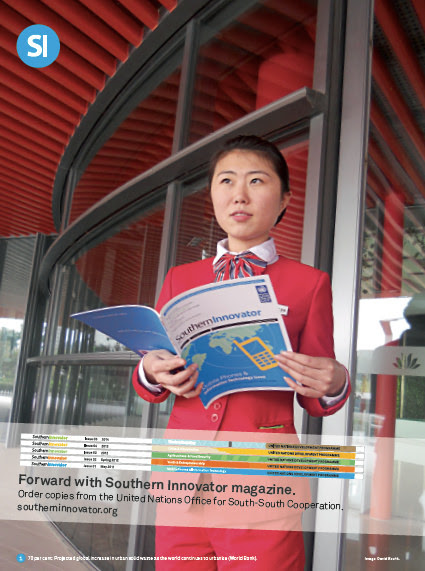
Development Challenges, South-South Solutions was launched as an e-newsletter in 2006 by UNDP’s South-South Cooperation Unit (now the United Nations Office for South-South Cooperation) based in New York, USA. It led on profiling the rise of the global South as an economic powerhouse and was one of the first regular publications to champion the global South’s innovators, entrepreneurs, and pioneers. It tracked the key trends that are now so profoundly reshaping how development is seen and done. This includes the rapid take-up of mobile phones and information technology in the global South (as profiled in the first issue of magazine Southern Innovator), the move to becoming a majority urban world, a growing global innovator culture, and the plethora of solutions being developed in the global South to tackle its problems and improve living conditions and boost human development. The success of the e-newsletter led to the launch of the magazine Southern Innovator.
China is the world’s largest manufacturer (Euromonitor) and the largest clothing maker, producing a quarter of all textiles and clothing. It is a global fashion production hub, and many major global clothing brands have their products made there – whether they admit it or not.
Although most people probably do not give it a second thought, the fashion and clothing industries can be highly polluting and exploitive. The use of toxic fertilizers to boost cotton yields leaves behind a legacy of contaminated soil and water tables. Dyes used to colour clothing also can be toxic and pollute water. For people working in this industry – many of whom are women – conditions can vary widely and include low pay and high stress.
According to the Ethical Fashion Forum, “it is difficult for companies sourcing from China to be sure of fair working practices. There have been many reports of low wages, long hours, and unfair working conditions in factories in China.”
But one innovative fashion brand is out to transform the way the garment business works in China and to develop a template that could be used in other places such as Africa.
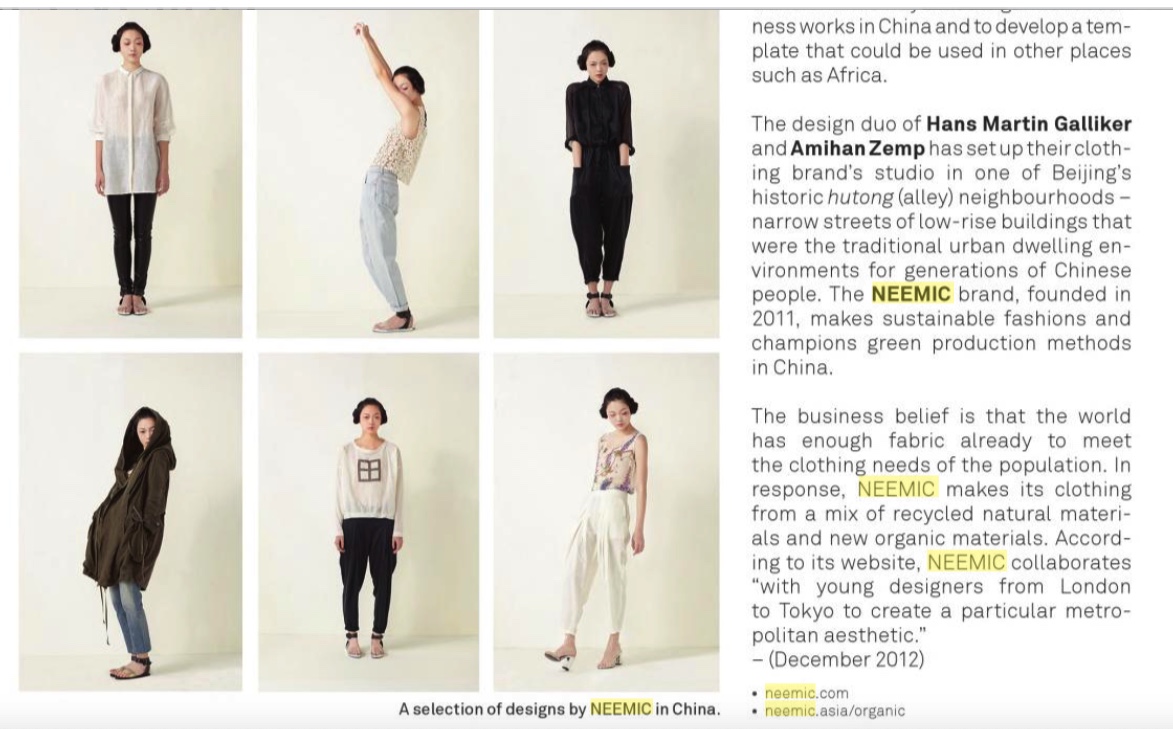
The design duo of Hans Martin Galliker and Amihan Zemp has set up their clothing brand’s studio in one of Beijing’s historic hutong (alley) neighbourhoods – narrow streets of low-rise buildings that were the traditional urban dwelling environments for generations of Chinese people. The NEEMIC (neemic.com) brand, founded in 2011, makes sustainable fashions and champions green production methods in China.
The business’s belief is that the world has enough fabric already to meet the clothing needs of the population. In response, NEEMIC makes its clothing from a mix of recycled natural materials and new organic materials. According to its website, NEEMIC collaborates “with young designers from London to Tokyo to create a particular metropolitan aesthetic.”
“We use the finest natural fabrics for a perfectly comfortable feel,” Galliker said. “We pick the finest natural materials from leftovers of the industry, recycle used clothes, and strive to order new fabrics only from certified organic producers.”
Hans Martin Galliker began as a farming apprentice in his native Switzerland, and brings a practical bent to his approach to fashion. He draws on his knowledge of farming and agriculture to create a unique eco-conscious fashion product in China.
Galliker got his start in fashion working for a brand in Shenzhen, southern China. He worked with the organic farms there, and this inspired him to explore sustainability in fashion design and ways of introducing the principles of fair trade to the fashion and textile industries in China.
Galliker is passionate about taking a different attitude to fashion: “There are many fashion brands and many of them are … meaningless,” he told the China Daily newspaper. “They do fashion which looks more or less … the same, which has no creativity and does a lot of harm to the environment.
“Growing cotton is highly chemicals and labour-intensive, which degrades the soil and pays people very low salaries. And the dyeing and colouring processes pollute rivers and people receive low salaries but have to work long hours. The whole textile industry is really bad for the environment.”
NEEMIC has completed three collections of clothing since it was founded in 2011.
“We started selling some of our designs at a boutique in Beijing that focuses on upcycling fashion. People like it and want to buy more,” said Galliker.
And to counter any negative perceptions that organic cotton clothing can only ever be unfashionable, Galliker is out to prove it is possible to create stylish organic clothing.
On top of building the brand, Galliker also works to educate the industry and change ways. He is also setting up a branch in China of the Hong Kong Organic Textile Association (http://neemic.asia/organic), which encourages fashion designers to jointly buy organic materials. He also publishes a website on sustainable agricultural practices in China, with details on current policies on organic farming.
“It is very normal for Chinese farmers to use many fertilizers, but the environment is going bad and consumers do not like this kind of farming,” Galliker points out. “For farmers, it’s not meaningful to produce only to make money to live a decent life. It should be more than that.”
The NEEMIC operation is lean: the Beijing studio does all the designing of the clothes, programming of the multilingual websites and runs the online shopping and payment sites.
For now, the goal is to not only increase the use of organically grown materials but also to introduce the fair trade concept into China.
“In two years we want to do fair trade production,” Galliker said.
And he has Africa in his sights with his green fashion template.
“In the long term we will have many successful projects here or non-profit companies … a lot of creative force and investment so that we can help rural regions in Africa to do sustainable agriculture projects.”
Published: December 2012
Resources
1) Ethical Fashion Forum: The Ethical Fashion Forum is the industry body dedicated to a sustainable future for fashion. A not for profit organisation, EFF aims to make it easy for fashion professionals to integrate sustainability at the heart of what they do. Website: http://www.ethicalfashionforum.com/
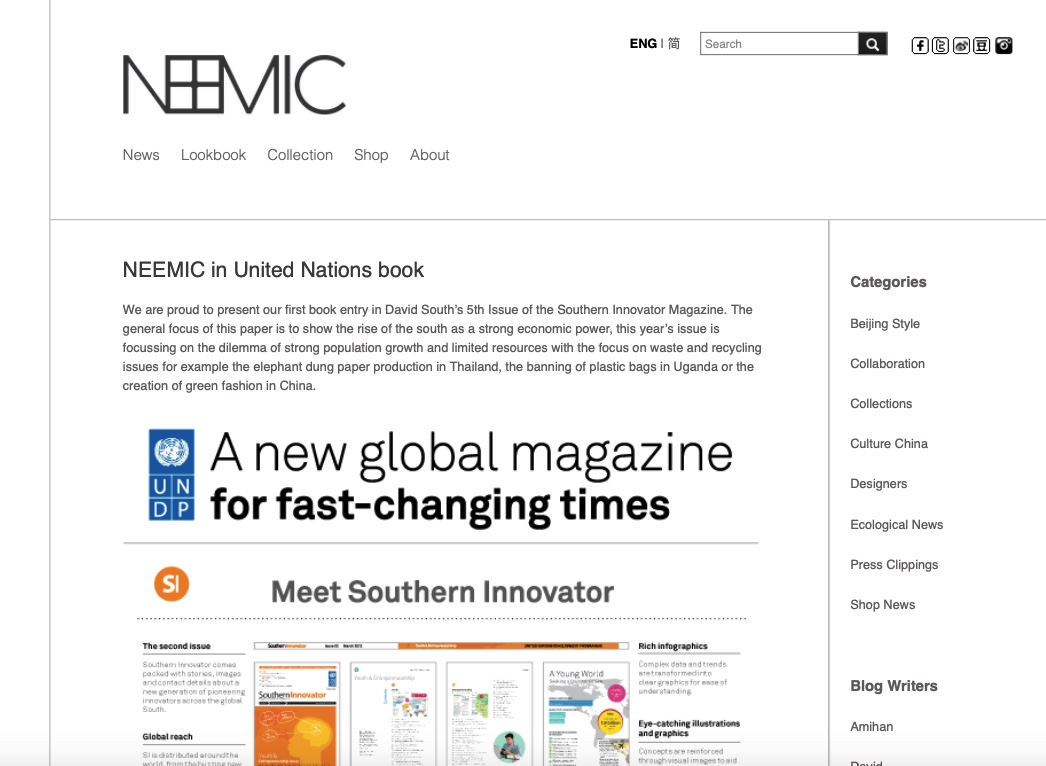
“We are proud to present our first book entry in David South’s 5th Issue of the Southern Innovator Magazine. The general focus of this paper is to show the rise of the south as a strong economic power, this year’s issue is focussing on the dilemma of strong population growth and limited resources with the focus on waste and recycling issues for example the elephant dung paper production in Thailand, the banning of plastic bags in Uganda or the creation of green fashion in China.” https://neemic.asia/ecological-news/neemic-southern-innovator-book
Development Challenges, South-South Solutions was launched as an e-newsletter in 2006 by UNDP’s South-South Cooperation Unit (now the United Nations Office for South-South Cooperation) based in New York, USA. It led on profiling the rise of the global South as an economic powerhouse and was one of the first regular publications to champion the global South’s innovators, entrepreneurs, and pioneers. It tracked the key trends that are now so profoundly reshaping how development is seen and done. This includes the rapid take-up of mobile phones and information technology in the global South (as profiled in the first issue of magazine Southern Innovator), the move to becoming a majority urban world, a growing global innovator culture, and the plethora of solutions being developed in the global South to tackle its problems and improve living conditions and boost human development. The success of the e-newsletter led to the launch of the magazine Southern Innovator.
Many initiatives seek to bring inexpensive access to the internet to rural and remote regions around the world. One of the most successful ways to rapidly expand access is to offer wireless internet so that anyone can use a laptop computer, a PC or a mobile phone to quickly access the Net. Access to wireless internet is being rolled out in cities around the world with so-called ‘hot spots’, but the thornier issue of improving access in rural or remote regions could get better, thanks to a Venezuelan team.
The rapid expansion of mobile phones has done much to reduce the digital divide in Africa, for example, where the number has grown from just 15 million in 2000 to more than 160 million by the end of 2006, according to the International Telecommunications Union. This rapid growth has paid off: Morocco, Senegal, Ghana, Gabon and Cote d’Ivoire are in the top ten gainers of the Digital Opportunity Index, 2004-2006 (http://www.itu.int). The proliferation of Wi-Fi-enabled mobile phones combined with the spread of inexpensive wireless access has the potential to close the digital divide between rural and urban areas.
The issue of inequality in access to the internet has stark consequences for global economic development. Already, according to the World Information Society Report 2007, “Europe has achieved the largest overall gain in digital opportunity over the last two years, followed by the Americas… Asia and Africa have witnessed smaller gains in digital opportunity. The implications for the digital divide are clear: digital opportunity is becoming more sharply divided by region, not less.”
As the Digital Divide campaign learned, it is more important to keep in mind “Internet kiosks or rental of cell phones and other devices hold great promise for the poor. But shared use is a complement to a strategy that involves giving each person their own wireless device. Eventually, the price of such devices will be low enough so that everyone can have their own device.”
A Venezuelan team led by Ermanno Pietrosemoli, president of the Latin American networking association Escuela Latinoamericana de Redes, has broken the world record for unamplified broadcasting of a Wi-Fi (wireless internet) signal. The signal was broadcast in June from two mountains 282 kilometres apart in the Venezuelan Andes. Importantly, they did this using equipment costing only just over US $360, while producing a signal strong enough to send video messages. The former record was 220 kilometres set in 2005.
The consequence of this achievement for entrepreneurs is important: It means inexpensive wireless signals can now reach further into remote and rural regions for a small investment.
“We we’re able to transmit voice and video with both,” said Professor Pietrosemoli. “280 kilometres is pushing the envelope, but the same technique can be used at distances of some 150 kilometres by people with some basic training provided there is uninterrupted line of sight between the end points. This usually means shooting from hills or using them as repeater points. For distances up to 80 kilometres, towers can be used to provide connectivity even in flat land”
Pietrosemoli is willing to train people in the techniques he has developed for transmitting wireless over large distances (https://wireless.ictp.it or www.eslareed.org.ve).
The advantages of this approach include cost and simplicity. The more commercial WiMax technology costs more and is usually installed by large companies. Pietrosemoli’s technique is for people who lack those technical and financial advantages.
“I have been installing wireless networks for some 20 years,” he continued, “and reckon that wireless is the only viable alternative to ameliorate the digital divide in developing countries. For rural areas, the challenge is to use as little repeater sites as possible, as each repeater adds costs, delay and powering issues.”
Pietrosemoli said the only other obstacle to setting these networks up is the availability of unlicensed radio frequency spectrum in the 2,4 and 5 Ghz bands. The International Telecommunications Union has recommended that countries make these free for the use of data networks, but some countries are still blocking this.
The Wireless Geographic Logging Engine: This is a website with maps tracking the presence of Wi-Fi access around the globe. So far it maps over 10 million separate Wi-Fi networks. Entrepreneurs only have to log into the website to start searching for wireless networks near them.
Southern Innovator Issue 1: Mobile Phones & Information Technology.











 David South Consulting
You must be logged in to post a comment.