Tag: South-South Solutions

  • Vietnamese Google Rival Challenging Global Giant

    Vietnamese Google Rival Challenging Global Giant

    By David South, Development Challenges, South-South Solutions

    New UNOSSC banner Dev Cha 2013

    SOUTH-SOUTH CASE STUDY 

    Information technologies are creating new business opportunities across the global South. As more and more people gain access to the Internet in one form or another, opportunities to offer them services also increase.

    A number of key trends show how the Internet’s profile is being reshaped by the growing number of users from the global South. One of those trends is language. English was the first language to dominate the Internet – but this is changing, according to the latest data.

    China has the largest number of Internet users in the world (China Internet Network Information Center) and the Chinese language is the second-most often used online, behind English and before Spanish and Japanese (http://www.internetworldstats.com/stats7.htm).

    While most English-language users turn to the giant Google search engine to look things up on the Internet, Google also has many rivals chasing its tail. In China, Baidu (baidu.com) offers searches in Mandarin using Chinese characters, making the Internet easier to navigate for Mandarin speakers. Elsewhere, Arabic language Internet users are being offered new services and urls using Arabic characters.

    In short, the Internet is becoming multilingual, customized and local, and creating new opportunities with it.

    One new business in Vietnam is challenging Google with its own locally tailored search engine. Called Coc Coc (http://coccoc.com/) – Knock Knock in English – it has already spent US $10 million to hire 300 staff at its Hanoi base, according to the Associated Press. Whether Coc Coc is successful or not in the long term, it is clear as a business it is already helping the local economy by hiring so many people and investing in Vietnam. Google currently does not have any staff in Vietnam because of its concerns about legal conflict with the government over censorship of content on the Internet, AP reports.

    Coc Coc believes it has developed a system that better understands the grammar, syntax and nuances of the Vietnamese language. Another advantage it believes it has over Google is its large presence on the ground in Vietnam. With a headquarters in Hanoi, it can quickly make marketing deals and agreements with content providers. To further its local advantage, Coc Coc has dispatched camera crews and photographers to film and photograph streets and log the details of shops, cafes and businesses – all to make search results more accurate and richer in detail.

    The headquarters is spread out over four floors of a downtown office block in Hanoi, and according to the Associated Press has a relaxed atmosphere similar to that found in many places in California’s technology start-up culture.

    Coc Coc is a joint Russian-Vietnamese venture and is hoping to ride the fast-growing Asian Internet market by offering a search tool that understands the nuances of the Vietnamese language online. By using algorithms (https://en.wikipedia.org/wiki/Algorithm) it promises to give a faster and better search experience to Vietnamese-language users. It also uses its knowledge of the local scene to  tailor results to users’ needs.

    The plan is to spend US $100 million during the next five years to lure 97 per cent of Vietnamese Internet users to make the switch from Google.

    “When I came here, I had some understanding why Vietnam was a good market to beat Google,” said Mikhail Kostin, the company’s chief search expert. “But after living here for one year, I understand the language and market much more deeply. I’m sure it’s right.”

    Having a local search engine tool can be a successful approach. The Yandex (http://www.yandex.com/) search engine in Russia beats Google in the Russian-speaking market. In South Korea, there is the Naver (naver.com) search engine.

    Google battled it out with the Chinese search engine Baidu in 2010 before leaving the country when Google refused to abide by government censorship guidelines. Baidu in the meantime has become the number one search engine in China and is planning to expand to other markets throughout Asia.

    “Google is a foreign company, and they are not here,” said one of the three founders of Coc Coc, Nguyen Duc Ngoc. “We can serve the interests of the local market better.”

    Vietnam has been experiencing rapid economic growth since the introduction of the Doi Moi (https://en.wikipedia.org/wiki/Doi_Moi) economic reforms two decades ago in 1986.  Vietnam is fast becoming an Internet success story, with a third of its population of 88 million (World Bank) (http://www.worldbank.org/en/country/vietnam) now online. Many are accessing the Internet through their mobile phones and electronic devices.

    Vietnam connected to the Internet in the 1990s and the infrastructure was built up in the mid-2000s. A national plan that kicked off in 2005 accelerated take-up of the Internet in the country as more and more people accessed the Internet through mobile phones, often at home, rather than just in public Internet centres. One study found 71 per cent of users in major cities were accessing the Internet at home (https://opennet.net/research/profiles/vietnam). One in three people in Vietnam now has access to the Internet. Significantly, the Internet has been an overwhelming success with youth in the main cities of Hanoi and Ho Chi Minh City, where 95 per cent of people in the 15-to-22 age group has Internet access.

    Optimists point to Vietnam’s large youth population, fast-growing economy and its modern Internet infrastructure as advantages that will boost its Internet economy. This is attracting entrepreneurs and investors from across Asia and around the world working in the field of online content, e-payments systems and other online services.

    With Vietnam’s Internet scene on fire, many people and companies are piling in to come up with the Next Big Thing online. Many have failed, but the same is true in every other country where new information technologies have been introduced. The nature of information technology innovation means ideas quickly rise or die depending on whether Internet users find the innovation useful or attractive. Despite great ideas, there are often far too many factors at play to guarantee any one person or company will have a success on their first try. As has happened elsewhere, ideas hatched by small start-ups, if good, are gobbled up by larger companies. Talented and skilled people usually find themselves being chased by other companies.

    Resources

    1) Techinasia: “Vietnam is Asia’s New Tech Manufacturing Hub”. Website: http://www.techinasia.com/vietnam-asias-tech-manufacturing-hub/

    2) Allo’ Expat Vietnam: A list of Vietnam’s Internet Service Providers (ISPs). Website: http://www.vietnam.alloexpat.com/vietnam_information/internet_service_providers_vietnam.php

    3) Telecommunications in Vietnam: A quick explanation from Wikipedia on the state of play in Vietnam. Website: http://en.wikipedia.org/wiki/Telecommunications_in_Vietnam

    4) Vietnam Women’s Innovation Day 2013: Theme: “Women’s Economic Empowerment”. Website: http://www.worldbank.org/en/news/press-release/2013/03/13/vietnam-womens-innovation-day-2013-launched-themed-womens-economic-empowerment-8221

    Creative Commons License

    This work is licensed under a
    Creative Commons Attribution-Noncommercial-No Derivative Works 3.0 License.

    ORCID iD: https://orcid.org/0000-0001-5311-1052.

    © David South Consulting 2022
  • Boosting Tourism in India with Surfing Culture

    Boosting Tourism in India with Surfing Culture

    By David SouthDevelopment Challenges, South-South Solutions

    SOUTH-SOUTH CASE STUDY

    Tourism has experienced decades of growth and diversification and is now considered one of the fastest-growing economic sectors in the world. According to the UNWTO – the United Nations World Tourism Organization – modern tourism is “a key driver for socio-economic progress.”

    The scale of global tourism means it rivals other sectors, such as oil exports, food products and automobiles in terms of economic clout. With such an important role to play in global commerce, it has become a top income source for developing countries in the global South.

    International tourist arrivals grew by 4 per cent in 2012, reaching a record 1.035 billion worldwide (UNWTO). Emerging economies led the growth in tourism, with Asia and the Pacific showing the strongest gains. Tourism outpaced growth in the wider world economy in 2012, contributing US $2.1 trillion to global GDP and supporting 101 million jobs (WTTC).

    “2012 saw continued economic volatility around the globe, particularly in the Eurozone. Yet international tourism managed to stay on course” said UNWTO Secretary-General Taleb Rifai. “The sector has shown its capacity to adjust to the changing market conditions and, although at a slightly more modest rate, is expected to continue expanding in 2013. Tourism is thus one of the pillars that should be supported by governments around the world as part of the solution to stimulating economic growth.”

    One country that has found tourism becoming a key contributor to its national income is India. The country’s travel and tourism industry is now three times larger than its automotive manufacturing industry, and generates more jobs than chemical manufacturing, communications and the mining sector combined (World Travel and Tourism Council).

    Indian Tourism Minister Subodh Kant Sahai called for the sector to create 25 million new jobs over the next five years and it is hoping to grow the market by 12 per cent by 2016 (The Economic Times).

    Travel and tourism now contributes 6.7 billion rupees (US $124 million) – or 6.4 per cent – of the country’s total GDP (gross domestic product). The sector supports 39 million jobs directly and indirectly.

    But competition for global tourist dollars is fierce. As more flight routes open up – Africa for example, is seeing new airlines and routes emerge every year – a person looking for somewhere to holiday has an ever-growing range of options to choose from. Will it be Africa this year, or shall we go to Asia?
    One way to attract tourists and gain an extra edge in the global travel marketplace is to show imagination and innovation. Being different and novel can be the clincher for a tourist, especially one who is widely travelled and is searching for new experiences.

    In Southern India, the state of Kerala is well known for its ayurvedic medicine (http://en.wikipedia.org/wiki/Ayurveda) and food tradition going back centuries, combined with its laid-back beach culture. It is a heady combination that successfully attracts many people, who come to relax and boost their health.
    Now, Kerala is offering a new dimension to this experience: surfing. Surfing is a water sport involving a person riding ocean waves (https://en.wikipedia.org/wiki/Surfing), usually on a long board. India has enormous and mostly untapped potential as a surfing destination, with its hot weather and 7,000 kilometres of coastline.

    Soul and Surf (http://soulandsurf.com) in Golden Beach, Varkala is within walking distance of the Varkala Cliff tourist area and an hour away from the closest major airport, Trivandrum International Airport.

    The founders of Soul and Surf, Ed and Sofie Templeton, were captivated by “surfing warm, empty waves, eating wonderful fresh, cheap seafood, practicing yoga and receiving ayurvedic treatments”, according to their website.

    “Enchanted by India’s magical, spiritual atmosphere, the warmth of the local people and the raw natural beauty of the area,” they set up a combined surfing and yoga retreat in 2010.

    They have become part of a growing surfing scene in Kerala, and an increasing awareness in the country that its long ocean coastline is perfect for water sports.

    As surfing grows in India, the owners wanted to create a business that supported the local area, particularly coastal fishing communities surrounding Varkala.

    They have also expanded to run a luxury surf and yoga retreat in Sri Lanka and guided trips to the Andaman Islands.

    Soul and Surf was inspired by the Surfing India Surf Ashram (surfingindia.net), a 12-hour trip up the coast from Surf and Soul in Karnataka.

    Their so-called “Surfing Swamis” have discovered the best places to surf in India and are spirited champions of the whole surfing lifestyle. A swami (http://en.wikipedia.org/wiki/Swami) is a Hindu male religious teacher.
    Surfing India promotes adventure sport in India and was started in 2004. At the time, surfing in India had a very low profile. Surfing India offers a sophisticated experience to travellers, including Wi-Fi Internet access, vegetarian food and all the equipment required.

    All the staff are volunteers and work for room and board. Profits are plowed back into keeping the surf ashram going and helping its activities, which include adventure tours, a surf camp, surf school, yoga retreat, bodyboarding, snorkelling and wakeboarding.

    The Surfing Swamis Foundation is a non-profit organization whose goal is to “teach surfing and environmental awareness to children, orphans, and handicapped persons of any age or gender.”

    It also sponsors the All India Surf Team for boys and girls across India.

    Published: April 2013

    Resources

    1) India Surf Festival: Taking place at the beginning of the year. Website: http://www.surfingindia.net/random-stuff/india-surf-festival-2013

    2) A guide to the best places to surf in India. Website:http://www.surfingindia.net/india-surf-spots

    3) Surfing Federation of India. Website:http://www.surfingfederationofindia.org/

    4) United Nations World Tourism Organization: The World Tourism Organization (UNWTO) is the United Nations agency responsible for the promotion of responsible, sustainable and universally accessible tourism. Website: unwto.org

    Southern Innovator logo

    London Edit

    31 July 2013

    https://davidsouthconsulting.org/2022/10/20/african-tourism-leads-the-world-and-brings-new-opportunities/

    https://davidsouthconsulting.org/2022/10/20/africas-tourism-sector-can-learn-from-asian-experience/

    https://davidsouthconsulting.org/2022/09/27/caribbean-island-st-kitts-goes-green-for-tourism/

    https://davidsouthconsulting.org/2022/11/20/ecotourism-to-heal-the-scars-of-the-past/

    https://davidsouthconsulting.org/2022/11/23/kenyan-safari-begins-minutes-from-airport/

    https://davidsouthconsulting.org/2022/10/10/a-solution-to-stop-garbage-destroying-tourism/

    Creative Commons License

    This work is licensed under a
    Creative Commons Attribution-Noncommercial-No Derivative Works 3.0 License.

    ORCID iD: https://orcid.org/0000-0001-5311-1052.

    © David South Consulting 2023

  • Mongolian Enterprises Target Healthy Urban Lifestyles

    Mongolian Enterprises Target Healthy Urban Lifestyles

    By David SouthDevelopment Challenges, South-South Solutions

    SOUTH-SOUTH CASE STUDY

    In the Northeast Asian nation of Mongolia – landlocked between Russia and China – the traditional diet is based on the nomadic ways of its herders. Rich in meat and milk products, it is a diet that has evolved from the need to survive in a harsh climate doing hard physical labour – winter temperatures can drop below minus 50 degrees Celsius.

    Social changes brought about by Mongolia’s economic journey since embracing free markets and democracy in the early 1990s have led to a growing urban population. The capital, Ulaanbaatar, has seen its population balloon for a variety of reasons – from collapsing rural economies to environmental disasters to the need to find work and opportunities – and is estimated to be over a million, out of a national population of just 2.6 million (World Bank).

    Mongolia is experiencing serious food security problems due to factors including economic inflation and weather-related disasters, and is also confronting problems common to many countries in the age of globalization. According to the World Diabetes Foundation, 10 percent of the population is at risk of the disease, which it calls a lurking catastrophe.

    As the paper “Lessons from a small country about the global obesity crisis” by Kelly D. Brownell and Derek Yach notes: “Globalization changes many features of modern life, including diets. As trade changes, diets can become more secure (hunger becomes less of a problem), but the cheapening of calories, the reliance on imported food, and the influence of food marketing drive up consumption and drive down nutrient density. Obesity, diabetes, and other chronic diseases are not far behind.”

    In response to these problems, increasing awareness of healthy lifestyles has led to some new business ventures in Ulaanbaatar. This past summer, saw the opening of an organic vegetarian restaurant and shop: the Organic Café Shop, reports Green Traveler Guides.

    Started by business partner-sisters  Bayarmaa Jarantai and Enkhmaa Jarantai with nephew Lkhagvasuren, the modest four-table restaurant and shop is a mini-revolution for a country as meat-loving as Mongolia. It serves up organic vegetarian meals and sells certified organic products. The spark of inspiration came when Bayarmaa read three books on the macrobiotic diet translated into Mongolian. The macrobiotic diet (http://en.wikipedia.org/wiki/Macrobiotic_diet) avoids highly processed foods and uses grains, beans and vegetables as its staples.

    The cafe’s menu includes: vegetable salads (shredded cabbage, bell peppers, carrots and seasoning), stir-fried vegetables with tofu and asparagus soup, 10-grain soup, eggplant, and Mongolian vegetarian fried vegetables. Prices range between 2,500 Mongolian tugrug and 4,500 tugrug (US $1.75 and US $3.00).

    The vegetables are sourced locally from Mongolian farmers and gardeners and are chemical-free. While not officially certified as organic, they are effectively that.

    The shop sells certified organic products from China. The products include rice, grains, sugars and jams. (Made-in-Mongolia organic produce is a business opportunity waiting to happen: so far there are no certified organic packaged-product producers in the country).

    The sisters import the products from Lohao City (http://www.lohaocity.com/eshow.asp) organic food market in Beijing, China.

    But despite the Organic Café Shop’s good intentions, it is not immune to the country’s food security issues: Bayarmaa admits to being puzzled about how she will be able to continue to source the fresh vegetables she needs during the harsh winter months. Ulaanbaatar is the coldest national capital in the world and fresh produce has to be imported at considerable expense.

    Another enterprise promoting healthy living in Ulaanbaatar is the Ananda Café and Meditation Centre (http://www.anandacenter.org/), a vegetarian restaurant and yoga (http://en.wikipedia.org/wiki/Yoga) centre. Yoga is the traditional physical and mental discipline from ancient India used to keep physically fit. It is a form of exercise that appeals to a wide age range and can be done pretty well anywhere.

    The Ananda Centre offers courses in yoga and meditation, vegetarian cooking classes and nature retreats.

    Published: November 2010

    Resources

    Creative Commons License

    This work is licensed under a
    Creative Commons Attribution-Noncommercial-No Derivative Works 3.0 License.

    ORCID iD: https://orcid.org/0000-0001-5311-1052.

    © David South Consulting 2023

  • Press Release 3 | Southern Innovator

    Press Release 3 | Southern Innovator

    Press Release for General Distribution

    Southern Innovator’s Fifth Issue Profiles Innovators in Waste and Recycling

    United Nations, New York, USA, 28 April 2014

    • Fifth issue of Southern Innovator tackles ways to improve human development in a world with finite resources
    • 60-page color magazine offers a snapshot of our fast-changing world

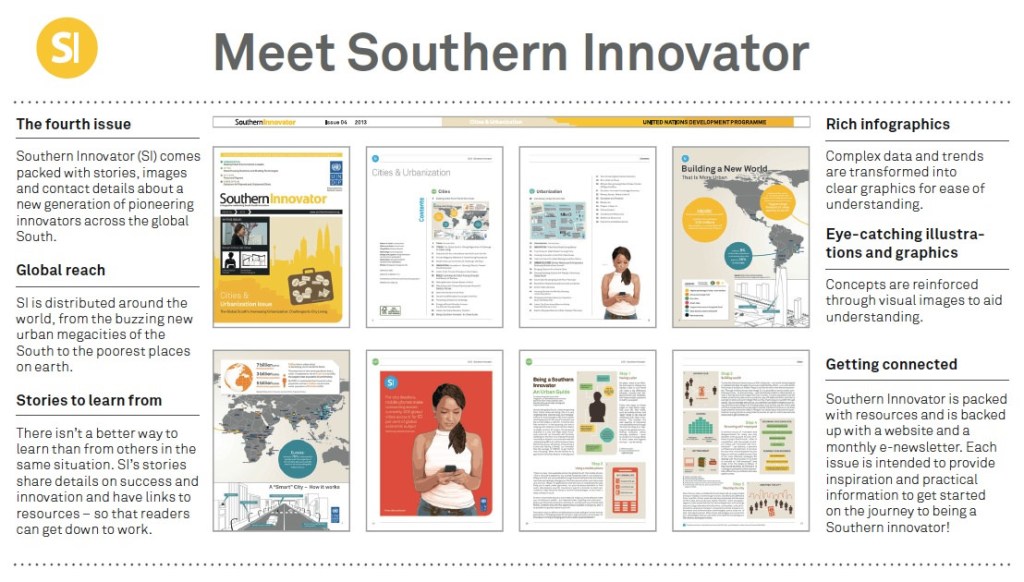
    The fifth issue of Southern Innovator (SI) magazine is out now. It explores how innovation can tackle the challenges of improving human development on a planet with finite resources.

    SI researchers identified innovative, low-polluting options to the world’s energy needs. They found that it is possible to alter the way that things are made to reduce or eliminate waste and toxic pollutants harming human health and damaging the environment. And not only that: they also discovered that there are sustainable incomes to be made from the economy of waste reduction and recycling – an opportunity that has yet to be fully realized. The innovations shared here demonstrate that raising living standards in the global South and responsible use of the world’s resources are not necessarily incompatible.

    Some innovators are transforming attitudes towards fashion, proving that it does not have to be a wasteful industry. Others are turning commonly found waste – food waste, or human or animal excrement – into fuel for heating. The link between good design and the efficient use of resources is apparent in many of the innovators’ solutions. If a new, green economy is to work, then it must appeal to people’s aspirations and be something that they want in their lives and are willing to work to achieve.

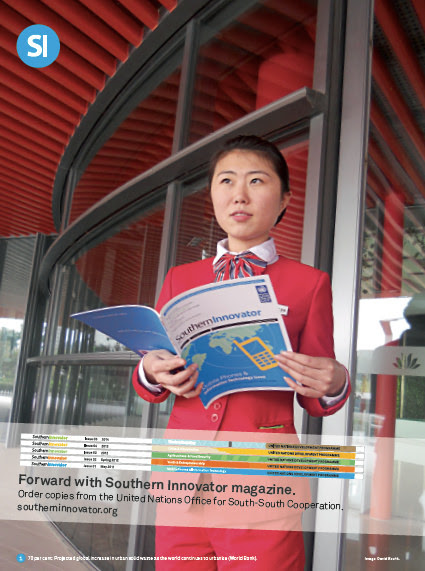
    Southern Innovator (southerninnovator.org) champions a 21st-century global innovator culture. It is based on intensive research and produced by the United Nations Office for South-South Cooperation in (UNOSSC) in UNDP. UNOSSC also organizes the annual Global South-South Development Expo (southsouthexpo.org), a traveling celebration bringing together Southern innovators, with previous venues in New York, Washington, D.C., Geneva, Rome,Vienna, Nairobi and Doha.

    We hope that you enjoy the magazine and find its content interesting and illuminating, a snapshot of a fast-changing world awash with innovators, creators and doers making their world a better place.

    For information on sponsoring issues of the magazine, either through helping to fund its print run, or through an insert relating to an issue’s theme with pertinent content for our readers, contact Cosmas Gitta at cosmas.gitta@undp.org.

    Online archives: southerninnovator.org; http://www.scribd.com/SouthernInnovator. Follow us @SouthSouth1

    Press Release 2

    Press Release 1

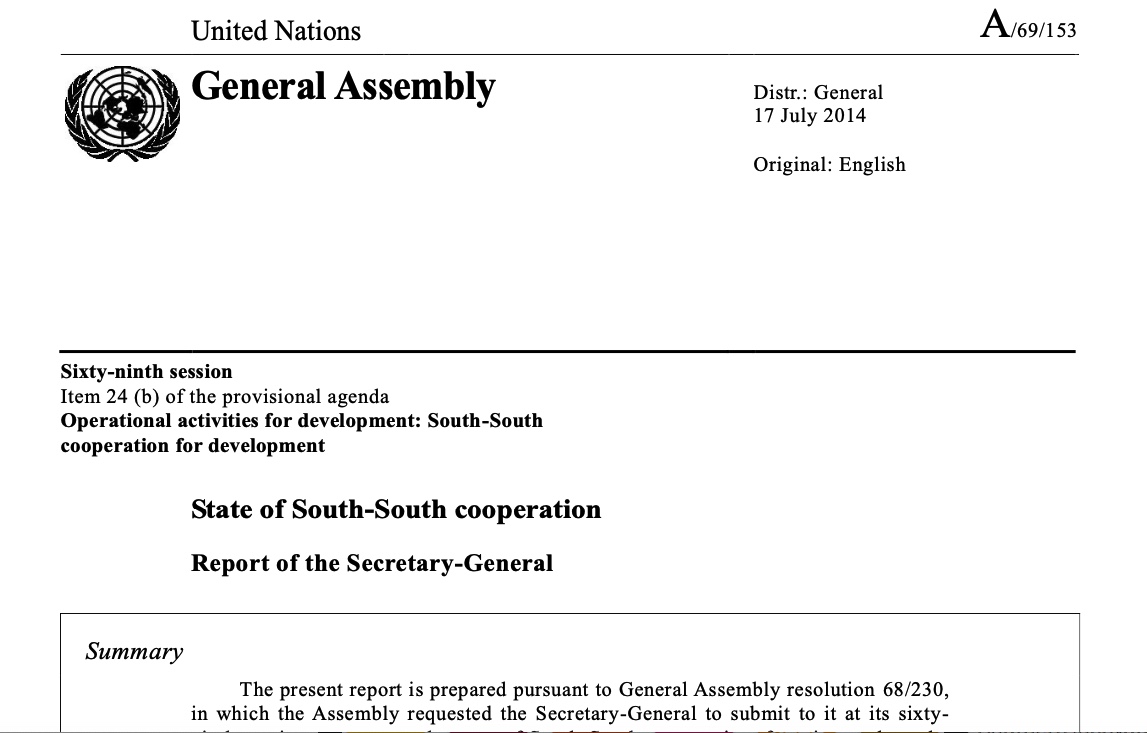
    United Nations General Assembly: Sixty-ninth session, Item 24 (b) of the provisional agenda, Operational activities for development: South-South cooperation for development, 17 July 2014.
    The research informing Southern Innovator Magazine played a part in the formulation of the UN’s post-2015 development agenda, including the Sustainable Development Goals (SDGs).

    https://davidsouthconsulting.org/southern-innovator-scale-up-fundraiser/

    ORCID iD: https://orcid.org/0000-0001-5311-1052.

    © David South Consulting 2022