Tag: South-South Solutions

  • Urban Youth: A Great Source of Untapped Growth

    Urban Youth: A Great Source of Untapped Growth

    By David SouthDevelopment Challenges, South-South Solutions

    SOUTH-SOUTH CASE STUDY

    The world’s growing urbanization means that a whole generation of youth will have a dramatically different life than their parents. The world’s 3.3 billion urbanites now outnumber rural residents for the first time (UNFPA’s State of the World Population 2007 Report). And the vast majority live in slums or periurban areas, places of sprawl, where public services are poor and housing conditions unhealthy. Most young people working in the urban informal sector live in slum areas: for example, 75 per cent in Benin in Africa, and 90 per cent in Burkina Faso, the Central African Republic, Chad and Ethiopia. Most of this work is just bare survival work: according to the International Labour Organization, approximately 85 per cent of all new employment falls into this category.

    Getting youth into quality work and earning more than enough simply to survive is critical to building a healthy society. Young people are bombarded every day with good and bad influences, and as UNFPA found in its Youth Supplement: Growing Up Urban, “the interactions with the urban environment can have an intense impact on the socialization of young people, exposing them to a multitude of influences as they develop, experiment, question, and assume roles in their societies.”

    It is predicted that over the next 10 years, 1.2 billion youths will enter the working-age population (UNFPA). But youth unemployment is a huge problem around the world. Unemployed young people make up almost half (43.7 per cent) of the world’s total unemployed (UNFPA). Young people aged 15 to 19 are more than three times as likely to be unemployed as adults. Young people are the future, a resource no society can afford to waste. If their innate energy and enthusiasm is tapped, countries can see significant economic growth.

    There are youth entrepreneurs who are defying the gloom and coming up with great business ideas. Five finalists for BBC Swahili’s regional entrepreneur competition – Faidika na BBC (Prosper with the BBC) – offer inspiration for youth across the South. Finalists from Burundi, Kenya, Rwanda, Tanzania and Uganda were selected for their bright schemes.

    The overall winner was 24-year-old Burundian student Ashura Kisesa for a plan to build commercial public toilets in the cities and towns of East and Central Africa. Ashura, who entered but failed to reach the Faidika na BBC finals last year, has 12 brothers and sisters and is studying for a degree in agronomy at Burundi University.

    “I am very happy to win the top prize in this competition,” she told the BBC. “The lack of public toilets throughout East and Central Africa is a major problem that needs to be addressed and I hope to make a difference with my business idea. My whole family wanted me to win and they really supported me which makes me especially proud. I cannot wait to get started with my business.”

    On June 26 in Kampala, Uganda, Kisesa was awarded US $5,000 to put towards her business.

    Kenyan national winner, 22-year-old Witness Omoga from Kakamega, wants to make identity cards for schools. Right now he works as a volunteer at his uncle’s photo studio, and hopes to get into Makerere University to pursue a degree in computer science. “I am very excited,” he said to the BBC. “I have never been number one in my life, but now I have emerged first in this competition.”

    The Rwandan winner is a pioneer in the growing field of biomass energy production. A 17-year-old student from Kigali, Rangira Aime Frederick, impressed the panel of judges with his idea to turn domestic waste into energy. The national winner for Tanzania is a private tutor from Dar es Salaam, Apolinary Joseph Laksh. A business education tutor, 23-year-old Apolinary’s idea is to produce charcoal from recycled materials to offer people in rural areas sustainable and affordable cooking fuel.

    Ugandan finalist, 23-year-old Dereick Kajukano, is in his last year at Kampala International University doing a degree in business administration. Dereick’s business idea is to make bags out of plastic trash. He was inspired by last year’s Faidika na BBC winner, David Ssegawa from Uganda: “When I heard him defend his proposal on air, I said to myself, why don’t I do it as well. That’s when it all started, and here I am.”

    Published: July 2008

    Resources

    • 2008 Global Youth Enterprise Conference: Designed as a participatory learning event, this conference aims to support youth enterprise and entrepreneurship programs and policies achieve greater effectiveness around the world.
      Website: www.youthenterpriseconference.org
    • KickStart is a South African project aimed at inculcating a culture of entrepreneurship among young people between the ages of 18 and 35, by promoting business awareness through training, providing grants as start-up capital and providing mentorship and assistance during the setting up phase of the business.
      Website: http://www.sabkickstart.co.za/
    • iDISC – the infoDev Incubator Support Center – is a virtual networking and knowledge-sharing platform for incubators and technology parks leveraging ICT to facilitate entrepreneurship and new business creation in developing countries.
      Website: http://www.idisc.net/en/Index.html
    • Climate Capital Network: this company offers strategic advice, intelligence and assistance with fundraising for low-carbon solutions around the world. They have 2,000 investors looking for projects to invest in.
      Website: http://www.climatecapital.net/
    • Global Entrepreneurship Week: the website for this event in November has many opportunities for youth entrepreneurs to connect with each other through social networking websites.
      Website: http://unleashingideas.org/welcome
    Follow @SouthSouth1

    Google Books: https://books.google.co.uk/books?id=waeXBgAAQBAJ&dq=Development+Challenges+February+2008&source=gbs_navlinks_s

    Slideshare: http://www.slideshare.net/DavidSouth1/development-challengessouthsouthsolutionsfebruary2008issue

    Southern Innovator Issue 1: https://books.google.co.uk/books?id=Q1O54YSE2BgC&dq=southern+innovator&source=gbs_navlinks_s

    Southern Innovator Issue 2: https://books.google.co.uk/books?id=Ty0N969dcssC&dq=southern+innovator&source=gbs_navlinks_s

    Southern Innovator Issue 3: https://books.google.co.uk/books?id=AQNt4YmhZagC&dq=southern+innovator&source=gbs_navlinks_s

    Southern Innovator Issue 4: https://books.google.co.uk/books?id=9T_n2tA7l4EC&dq=southern+innovator&source=gbs_navlinks_s

    Southern Innovator Issue 5: https://books.google.co.uk/books?id=6ILdAgAAQBAJ&dq=southern+innovator&source=gbs_navlinks_s

    Creative Commons License

    This work is licensed under a
    Creative Commons Attribution-Noncommercial-No Derivative Works 3.0 License.

    ORCID iD: https://orcid.org/0000-0001-5311-1052.

    © David South Consulting 2023
  • African Youth Want to do Business in Fast-growing Economy

    African Youth Want to do Business in Fast-growing Economy

    By David SouthDevelopment Challenges, South-South Solutions

    SOUTH-SOUTH CASE STUDY

    Africa’s growing economy is meeting head-on an optimistic young population keen to start businesses. At least that is what a new poll of African youth says, finding that one in five Africans between the ages of 15 and 24 without a current business wants to start one in the next 12 months.

    The Gallup surveys (www.gallup.com) of 27 African countries and areas also found young women were just as keen as young men to start a business.

    Throughout the decade of the 2000s, Africa experienced an average economic growth rate of 5.4 percent (World Bank) – a big gain from the poor growth rates of the 1980s and early 1990s.

    The turnaround in Africa’s economic growth prospects was the product of a number of trends and factors. One has been better policies and easier trade. Other factors include rising tourism, a growing service sector, rising commodity prices, greater demand for African exports in emerging economies and rapidly improving communications: the surge in mobile phone usage during the last five years has surprised many. Africans are also avid spenders on goods and services, spending US $860 billion on them in 2008, more than India’s US $635 billion or Russia’s US $821 billion (Economic Report on Africa 2011).

    The African Development Bank predicts Africa’s growth rate for 2011 will decline to 3.7 percent from 2010’s 4.9 percent, largely as a result of turmoil in North Africa. East Africa is projected to grow the fastest this year at 6.7 percent, with West Africa close behind at 5.9 percent.

    Africa as a continent collectively had a gross domestic product in 2009 of US $1.6 trillion: equal to Brazil’s or Russia’s. The continent is considered among the fastest-expanding economic regions in the world (McKinsey & Company).

    In fact, while economic prospects are grim in many developed countries, Africa joined Asia as the only continents to grow during this recession.

    But major problems still confront the continent, among them youth unemployment. Those between 15 and 24 make up more than 60 percent of the continent’s population and are 45 percent of the total labor force (African Economic Outlook). Sub-Saharan Africa is experiencing a youth explosion, with the proportion of youth there to rise to 75 percent of the population by 2015. Demographers forecast this rising youth trend will not stop for the next 20 years.

    Getting these youth actively engaged in the economy and society is a major challenge for the continent. Already, 133 million African youth are illiterate. They have few skills and are marginalised from more productive sectors of the economy.

    Even those with an education find their skills often don’t match the needs of the labor market. In sub-Saharan Africa, youth unemployment is believed to be 20 percent.

    So even with better economic prospects and growing economies and incomes, youth unemployment looms large.

    The Economic Report on Africa 2011 (www.uneca.org/era2011/) finds the “persistent high youth unemployment rate is a cause of concern and a potential source of political instability.” Job creation is still not adequate: “The growth rates are still below the levels needed to make a significant impact on unemployment and poverty reduction.”

    While Africa will experience higher growth in 2011, for youth it is looking like a “jobless recovery,” according to the report. Overseas investors are mostly throwing their money at the resource sector, which doesn’t create many jobs in the economy.

    But for young Africans looking to start a business, the opportunities are there in sectors such as retailing, telecommunications, banking, infrastructure-related industries, resource-related businesses, and all along the agricultural value chain.

    The booming communications industry has added 316 million new subscribers since 2000, for example. And all those people now connected need new services.

    And once a business is up and running, it is possible to make higher profits in Africa than on other continents, according to the UN. Africa leads the emerging market economies for returns for businesses. This is because competition isn’t as intense and there is still plenty of built-up consumer demand that needs to be met.

    All of this means young people willing to start a business and put in the hard work, will have a better chance of reaping the rewards.

    Published: July 2011

    Resources

    1) iHub Nairobi: iHub Nairobi’s Innovation Hub for the technology community is an open space for the technologists, investors, tech companies and hackers in the area. This space is a tech community facility with a focus on young entrepreneurs, web and mobile phone programmers, designers and researchers. It is part open community workspace (co-working), part vector for investors and VCs and part incubator. Website: http://ihub.co.ke/pages/home.php

    2) The Other Side of Innovation: Solving the Execution Challenge by Vijay Govindarajan, Chris Trimble: On how businesses need to follow through with execution if they really want to innovate. Website: http://hbr.org/product/baynote/an/13219-HBK-ENG?referral=00505&cm_sp=baynote-_-featured_products-_-13219-HBK-ENG

    3) “The Globe: Cracking the Next Growth Market: Africa” by Mutsa Chironga et al, Harvard Business Review. Website: http://hbr.org/2011/05/the-globe-cracking-the-next-growth-market-africa/ar/1

    4) 2011 Global Youth Economic Opportunities Conference: This 5th anniversary conference will provide a learning platform for the world’s leading funders, practitioners, technical assistance providers, policy makers, and academics working to increase and improve economic opportunities for young people. Join 400 professionals from over 60 countries to share lessons learned, promising practices, and innovative ideas through technical workshops, engaging plenary sessions, and interactive networking. The result? Higher-impact programming, breakthrough solutions, and proven approaches. This year’s theme, Breakthroughs, reflects the focus on the innovative ideas, proven practices, and visionary insights that are taking this emerging field to new heights. Website: http://www.youtheconomicopportunities.org/

    5) Dutch Design in Development: DDiD is the agency for fair design, sustainable production and fair trade. They work with Dutch importers and designers and connect them to local producers in developing countries and emerging markets. Together products are made that are both profitable and socially and environmentally sustainable. Website: http://www.ddid.nl/english/index.html

    6) Francophone Africa Hackathon: Taking place on 24 September 2011, a ‘hackathon’ to develop mobile phone applications will take place for Francophone Africans. Website: http://www.mobilehackaf.com/

    By 2012, Southern Innovator had completed its global reader impact study.

    Follow @SouthSouth1

    Google Books: https://books.google.co.uk/books?id=waeXBgAAQBAJ&dq=Development+Challenges+February+2008&source=gbs_navlinks_s

    Slideshare: http://www.slideshare.net/DavidSouth1/development-challengessouthsouthsolutionsfebruary2008issue

    Southern Innovator Issue 1: https://books.google.co.uk/books?id=Q1O54YSE2BgC&dq=southern+innovator&source=gbs_navlinks_s

    Southern Innovator Issue 2: https://books.google.co.uk/books?id=Ty0N969dcssC&dq=southern+innovator&source=gbs_navlinks_s

    Southern Innovator Issue 3: https://books.google.co.uk/books?id=AQNt4YmhZagC&dq=southern+innovator&source=gbs_navlinks_s

    Southern Innovator Issue 4: https://books.google.co.uk/books?id=9T_n2tA7l4EC&dq=southern+innovator&source=gbs_navlinks_s

    Southern Innovator Issue 5: https://books.google.co.uk/books?id=6ILdAgAAQBAJ&dq=southern+innovator&source=gbs_navlinks_s

    Creative Commons License

    This work is licensed under a
    Creative Commons Attribution-Noncommercial-No Derivative Works 3.0 License.

    ORCID iD: https://orcid.org/0000-0001-5311-1052.

    © David South Consulting 2023

  • Youth Surge in the South: A Great Business Opportunity

    Youth Surge in the South: A Great Business Opportunity

    By David SouthDevelopment Challenges, South-South Solutions

    SOUTH-SOUTH CASE STUDY

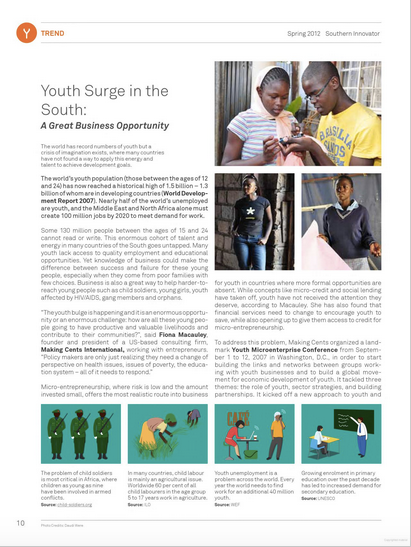
    The world’s youth population (those between the ages of 12 and 24) has now reached a historical high of 1.5 billion – 1.3 billion of whom are in developing countries (World Development Report 2007). Nearly half of the world’s unemployed are youth, and the Middle East and North Africa alone must create 100 million jobs by 2020 to meet demand for work.

    Some 130 million people between the ages of 15 and 24 cannot read or write. This enormous cohort of talent and energy in many countries of the South goes untapped. Many youths lack access to quality employment and education opportunities. Yet knowledge of business could make the difference between success and failure for these young people, especially when they come from poor families with few choices. Business is also a great way to help harder-to-reach young people such as child soldiers, young girls, youth affected by HIV/AIDS, gang members, and orphans.

    “The youth bulge is happening and it is an enormous opportunity or an enormous challenge: how are all these young people going to have productive and valuable livelihoods and contribute to their communities?,” said Fiona Macauley, founder and president of US-based consulting firm working with entrepreneurs, Making Cents International. “Policy makers are only just realizing they need a change of perspective on health issues, issues of poverty, the education system – all of it needs to respond.”

    Micro-entrepreneurship, where risk is low and the amount invested small, offers the most realistic route into business for youth in countries where more formal opportunities are absent. While concepts like micro-credit and social lending have taken off, youth have not received the attention they deserve, according to Macauley. She has also found financial services need to change to encourage youth to save, while also opening up to give them access to credit for micro-entrepreneurship.

    To address this problem, Making Cents is organizing a Youth Microenterprise Conference on September 1-12, 2007 in Washington D.C. in order to start building the links and networks between groups working with youth businesses, and to build a global movement for youth economic development. It will tackle three themes: the role of youth, sector strategies, and building partnerships.

    “It is important that entrepreneurship is mainstreamed into the school system,” continues Macauley. ”That youth are getting good skills the private sector are looking for: how to budget, costing and pricing, developing entrepreneurial mind sets, problem solving, leading groups, researching, how to be problem solvers. If we can get this into the high school and the elementary school level, imagine how different the workforce would be?”

    Other initiatives that are focusing on youth entrepreneurship:

    South African Breweries Limited has been providing seed capital to youth businesses run by 18 to 35 year olds through its KickStart program. Successful youth enterprises to come out of the program have included Golden Sunset Fresh Produce, started by 27-year-old Alwyn Jepha to help pay for his law school studies. Starting on a small scale producing vegetables and fruit, the business has grown substantially, making in a month what it once made in a year. The KickStart grant enabled Jepha to buy irrigation equipment and to scale up his operations. At Zanopt, Khetla Leqola has been producing afro-centric optical frame styles, meeting a market need not being met by the global brands. KickStart enabled Leqola to buy the equipment required to produce the frames and run his office.

    The Barbados Youth Business Trust has an excellent web portal for youth, with practical tips on starting a youth business and good examples of young people actually doing it. At 29, youth entrepreneur Ailene Harrison-Malcolm found herself unemployed. She had long noticed the lack of clothing for full-bodied women in Barbados, and decided to open her own store, Full Elegance Boutique in 2002. She was able to tap into a mentoring scheme run by the government’s Youth Entrepreneurship Scheme toget a loan. It is this kind of joined up support that youth need.

    Published: May 2007

    Resources

    • World Development Report 2007: Development and the Next Generation
    • World Bank’s Youthink! Website for youth: Click here
    • The Entrepreneurial League System: Professor Thomas S. Lyons and Gregg A. Lichtenstein have a established an entrepreneurial mentor scheme based on the baseball farm team concept targeting poor communities. Read more about this at Collaborative Strategies.
    • Students in Free Enterprise (SIFE): A non-profit organization in 40 countries, it organizes students on university campuses to develop community outreach projects that achieve their five goals: market economics, success skills, entrepreneurship, financial literacy, and business ethics.
    • Young Americas Business Trust; Latin America: Acts as a ‘catalyst for young entrepreneur development in the Americas through business skills training, partnerships, leadership and technology.’
    • Youth Business International (UK): An international organization providing disadvantaged youth with business mentoring and funds. They helped 2,000 youth in 2006.
    • UN Youth Employment Gateway: Click here

    Follow @SouthSouth1

    Google Books: https://books.google.co.uk/books?id=waeXBgAAQBAJ&dq=Development+Challenges+February+2008&source=gbs_navlinks_s

    Slideshare: http://www.slideshare.net/DavidSouth1/development-challengessouthsouthsolutionsfebruary2008issue

    Southern Innovator Issue 1: https://books.google.co.uk/books?id=Q1O54YSE2BgC&dq=southern+innovator&source=gbs_navlinks_s

    Southern Innovator Issue 2: https://books.google.co.uk/books?id=Ty0N969dcssC&dq=southern+innovator&source=gbs_navlinks_s

    Southern Innovator Issue 3: https://books.google.co.uk/books?id=AQNt4YmhZagC&dq=southern+innovator&source=gbs_navlinks_s

    Southern Innovator Issue 4: https://books.google.co.uk/books?id=9T_n2tA7l4EC&dq=southern+innovator&source=gbs_navlinks_s

    Southern Innovator Issue 5: https://books.google.co.uk/books?id=6ILdAgAAQBAJ&dq=southern+innovator&source=gbs_navlinks_s

    Creative Commons License

    This work is licensed under a
    Creative Commons Attribution-Noncommercial-No Derivative Works 3.0 License.

    ORCID iD: https://orcid.org/0000-0001-5311-1052.

    © David South Consulting 2023

  • Prisons With Green Solutions

    Prisons With Green Solutions

    By David SouthDevelopment Challenges, South-South Solutions

    SOUTH-SOUTH CASE STUDY

    An ingenious solution is helping Rwanda reduce the cost of running its bursting prisons, while improving conditions for the prisoners and helping protect the environment.

    The country’s prison population soared to a peak of 120,000 suspects awaiting trial for their role in the 1994 genocide, in which 800,000 Tutsis and moderate Hutus were killed. The traditional court system, gacaca, is being used for national reconciliation, but the process is slow and costly for a country where 90 per cent of the population exist on subsistence agriculture, and where food production has dropped below 70 per cent of the levels needed for self-sufficiency (USAID).

    But thanks to enormous, bee-hive shaped human manure digesters, a steady supply of biogas is on tap for cooking and lighting at prisons – the first country in Africa to do this. Five of the country’s largest prisons – two at Gitarama and one each in Butare, Kigali and Cyangugu – now have biogas plants producing 50 per cent of the gas needed to cook for prisoners. It has also saved half of each prison’s US $44,000 a year firewood costs. The money saved is being ploughed back into renovations to the prisons to improve conditions, and to provide more services like healthcare.

    Biogas is produced from the fermentation of household or agricultural waste or animal or human feces, and has become a viable alternative when traditional gas sources become more expensive. The waste is placed in a 150 cubic meter beehive-shaped digester and fermented until a gas is produced. According to lead engineer on the project, Ainea Kimaro, 100 cubic meters of waste is turned into 50 cubic meters of fuel by bacteria devouring the manure in just four weeks.

    The digesters are a project of the Kigali Institute of Sciences, Technology and Management ‘s Center for Innovations and Technology Transfer.

    “Biogas kills two birds with one stone,” Kimaro told the BBC. It gets rid of all the human waste and helps cover the enormous costs of feeding so many prisoners. Prior to the digesters, the quantity of human waste was a real problem: it was flooding down hillsides and leaking into rivers and lakes.

    A school, the Lycee de Kigali , also has a digester. “The methane gas is used to cook for 400 students and for operating Bunsen burners in the school laboratories”, Kimaro said.

    Many would think this a smelly affair, but in fact the whole process isn’t that pungent. Most of the digester is underground and the gas produced burns a clean, blue smokeless flame. It is much cleaner than the smoke from firewood. The remaining sludgy residue is used as an odourless compost for soil. This is used in the prison gardens to grow maize, mangos, bananas and tomatoes – all of which ends up back on the prisoner’s plates, improving the quality of their nutrition.

    “The firewood savings are excellent – they really make a difference for us,” a Cyangugu prison warden said, adding that the odour-free compost had done wonders for the prison gardens. “Look at all these bananas! This fertiliser really is the best,” he said to the BBC.

    In Uganda, human urine and feces are being mixed with banana peels, algae, water hyacinth and poultry droppings to make biogas. In Uganda’s rural Mukono district, biogas is used for cooking, lighting pressure lamps and to power engines. The slurry left over is then used to fertilise the soil. For Ugandans, most of whom are rural dwellers, electricity is rare and petrol to run generators and refrigeration units is expensive.

    “It keeps the environment free of organic wastes, is convenient, time-saving and reduces smoke-related illnesses often associated with the use of firewood,” said Patrick Nalere, country director of the Heifer Project International, an American NGO which shares livestock and knowledge to reduce poverty. “If the majority of Ugandans adopted biogas, we would preserve our biodiversity. People should exploit decomposing raw materials, which are free. Therefore, no monthly power tariffs.”

    Published: February 2008

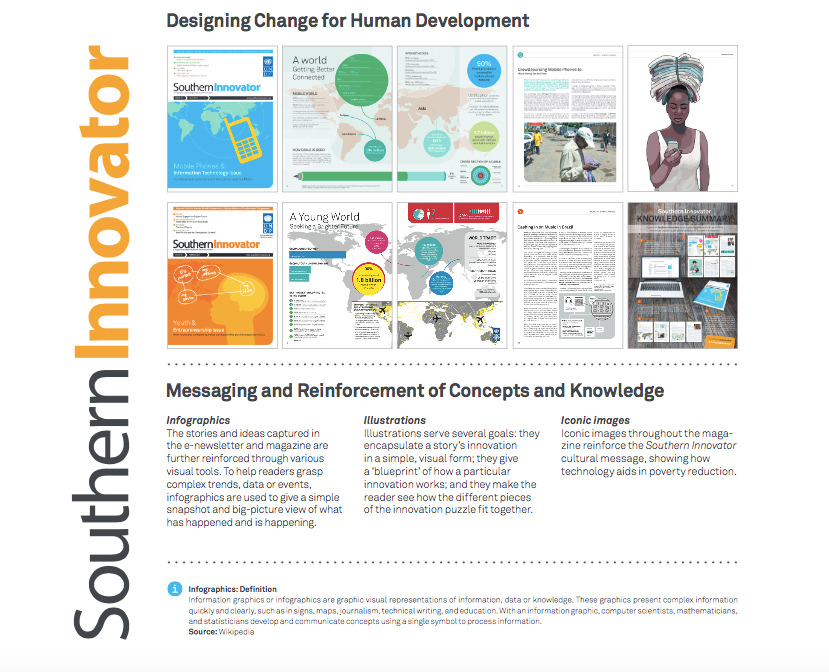
    Development Challenges, South-South Solutions was launched as an e-newsletter in 2006 by UNDP’s South-South Cooperation Unit (now the United Nations Office for South-South Cooperation) based in New York, USA. It led on profiling the rise of the global South as an economic powerhouse and was one of the first regular publications to champion the global South’s innovators, entrepreneurs, and pioneers. It tracked the key trends that are now so profoundly reshaping how development is seen and done. This includes the rapid take-up of mobile phones and information technology in the global South (as profiled in the first issue of magazine Southern Innovator), the move to becoming a majority urban world, a growing global innovator culture, and the plethora of solutions being developed in the global South to tackle its problems and improve living conditions and boost human development. The success of the e-newsletter led to the launch of the magazine Southern Innovator.  

    Follow @SouthSouth1

    Google Books: https://books.google.co.uk/books?id=waeXBgAAQBAJ&dq=Development+Challenges+February+2008&source=gbs_navlinks_s

    Slideshare: http://www.slideshare.net/DavidSouth1/development-challengessouthsouthsolutionsfebruary2008issue

    Southern Innovator Issue 1: https://books.google.co.uk/books?id=Q1O54YSE2BgC&dq=southern+innovator&source=gbs_navlinks_s

    Southern Innovator Issue 2: https://books.google.co.uk/books?id=Ty0N969dcssC&dq=southern+innovator&source=gbs_navlinks_s

    Southern Innovator Issue 3: https://books.google.co.uk/books?id=AQNt4YmhZagC&dq=southern+innovator&source=gbs_navlinks_s

    Southern Innovator Issue 4: https://books.google.co.uk/books?id=9T_n2tA7l4EC&dq=southern+innovator&source=gbs_navlinks_s

    Southern Innovator Issue 5: https://books.google.co.uk/books?id=6ILdAgAAQBAJ&dq=southern+innovator&source=gbs_navlinks_s

    Creative Commons License
    This work is licensed under a
    Creative Commons Attribution-Noncommercial-No Derivative Works 3.0 License.

    ORCID iD: https://orcid.org/0000-0001-5311-1052.

    © David South Consulting 2023