Tag: South-South Solutions

  • Bringing the Invention and Innovation Mindset to Young Kenyans

    Bringing the Invention and Innovation Mindset to Young Kenyans

    By David SouthDevelopment Challenges, South-South Solutions

    SOUTH-SOUTH CASE STUDY

    A highly innovative new way to teach the basics of electronics, computing and technological innovation is being pioneered in the slums of Nairobi, Kenya. Driven by the desire to counter perceptions of apathy among young people, NGO Kuweni Serious is running a training course for girls aged over 8 years in some of the poorest parts of the city to turn on a new generation to the power of technology to make change.

    “Technology is pivotal in our work, as Kuweni Serious is a primarily online platform that seeks to create offline action,” according to Kuweni Serious’ Rachel Gichengo. “It’s positive in that you can reach a lot of people with solid messages that are in bite-size pieces that are easy to disseminate and consume. Everyone can pass on the information with a simple click – it’s an easier way to begin socio-political discussion among people who would otherwise not be drawn into these kinds of discussions because they’re not presented in a way that appeals to them. The typical profile of a KS volunteer is someone in their 20s, middle-class, has some experience volunteering, has never been to a slum despite living in Nairobi, but wants more for their country.”

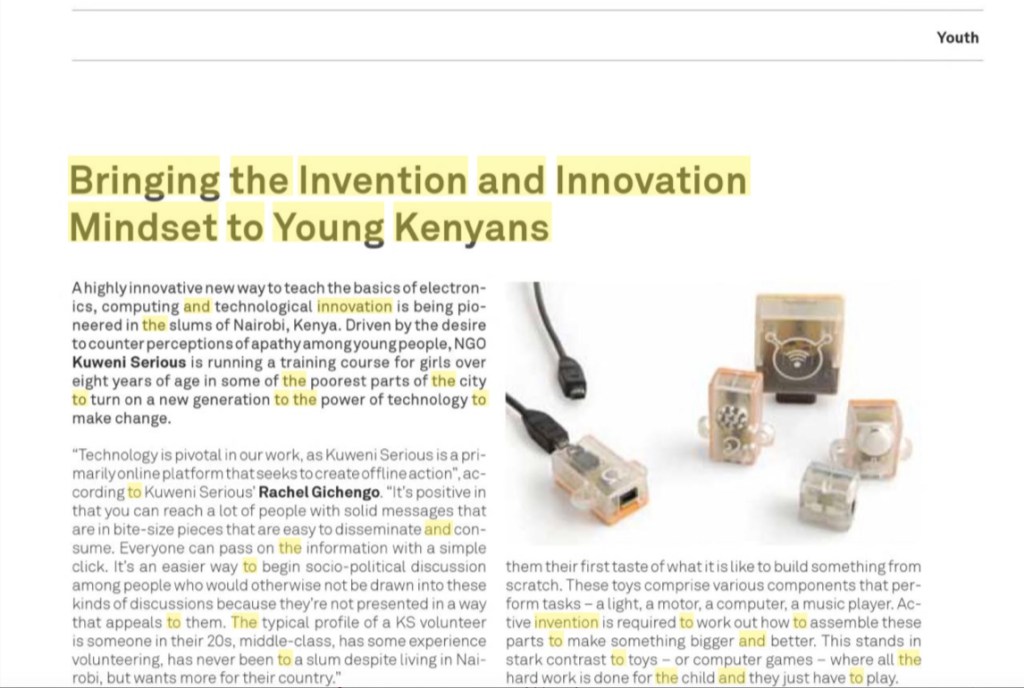
    The course uses a clever, hands-on approach to teaching. Instructors use a new generation of learning toys that help young people understand how technology works and gives them the first taste of what it is like to build something from scratch. These toys comprise various components that perform tasks – a light, a motor, a computer, a music player. Active invention is required to work out how to assemble these parts to make something bigger and better. This stands in stark contrast to toys – or computer games – where all the hard work is done for the child and they just have to play.

    “We chose tech training because it’s a traditionally under-represented area when it comes to reaching this particular group (underprivileged girls), yet such an important set of skills to be taught in this day and age,” confirms Gichengo. “We want to expand these girls’ thinking – to get them interested in the possibilities of careers in science and tech, rather than perpetuate the idea that all they’ll ever do, based on their circumstances, is tailoring or dance. We hoped to open our girls’ worlds a bit, as well as link them to our Kuweni Serious community of volunteers.”

    Called PicoCrickets (www.picocricket.com), and manufactured by the Canadian Playful Invention Company (PICO), the toys were developed from research and ideas at the Lifelong Kindergarten group (http://llk.media.mit.edu/) at the MIT (Massachusetts Institute of Technology) Media Lab (www.media.mit.edu).

    “Pico Crickets are cool,” continues Gichengo. “They’re a fun way to learn to build things, to learn the connection between hardware and software, to begin to understand what computers can do. They make learning easy, and they make science seem accessible to a group that tends to see it as too hard for them. The kits were paid for by a grant from the Girl Effect (www.girleffect.org).”

    The MIT lab conducted intensive research into creative learning environments for children. One of the first fruits of this research was Lego Mindstorms (http://mindstorms.lego.com), kits that allow children to make and program their own robots.

    Inspired by this work, the PicoCricket places more emphasises on artistic expression. The company created the PicoCricket Kit (www.picocricket.com/whatisit.html) as a way to integrate art and technology to “spark creative thinking in girls and boys 8 years and older,” according to its website.

    A typical kit includes a central PicoCricket that a child then plugs in to various motors, sensors, lights and other devices to make something that can spin, light up or play music. It is intended to give free rein to both technological innovation and artistic expression.

    Kenya experienced violent rioting during the 2007 and 2008 elections. The shock of the events produced a number of initiatives to counter the violence and the social and economic disruption it has caused. One of the most well-known innovations, Ushahidi (www.ushahidi.com), a crisis-mapping platform, has been deployed around the world and led to many other new innovations.

    Kuweni Serious (www.kuweniserious.org) is also a result of this crisis. The NGO sets out to counter the stereotype of Kenya’s youth as a “hedonistic generation of brand-obsessed youth, moving from party to party in the night and congregating on Facebook during the day.”

    Kuweni Serious believes young people in Kenya were shocked into action when violence broke out during the elections. Prices jumped for everything – from fuel to food – and water and power started to be rationed. It was a wake-up call to youth: it was getting harder and harder to ignore what was happening in the country.

    Kuweni Serious was founded by Kenyan youth and asked the question “how do Kenya’s youth feel about all the chaos around us?” It seeks to rally young people to their motto: “Fighting the evil forces of apathy.”

    Their 125/100 program set out to train 125 girls on a 100-day course. It ended with a graduation ceremony on July 2, 2011.

    The program, run by volunteers from the University of Nairobi, has taught basic computer skills, got the children working on Google Maps and making – and inventing – using the PicoCrickets.

    The girls on the course came from Baba Dogo and Kibera, Nairobi’s largest slum.

    The technology training program lasted between three and six hours a week for 12 weeks. The inventions made by the children included merry go rounds, a lamp stand and fan and miniature automobiles. Participants even got to grips with Google Maps and learned how to use mobile phones in citizen journalism. At the end of the course, all the children received a certificate reinforcing their sense of accomplishment and achievement.

    “We hope to continue doing similar projects, scaling up 125/100, and working on developing a corps of everyday change makers among young, educated, middle class Kenyans,” according to Gichengo. “We’re also preparing for the 2012 elections, so we need to have more conversations about what a new election means, given the outcome of our previous one.”

    Another initiative seeking to improve life chances for Kenyan girls is ZanaAfrica (www.zanaa.org). It focuses on educational opportunities for girls, consulting them to find out what would increase their chances of graduation from school. Because of this back-and-forth dialogue with the girls, they have come up with various strategic programs, one example being providing girls with sanitary pads for menstruation (http://en.wikipedia.org/wiki/Menstruation) every month so that they do not skip classes and lose vital class time. ZanaAfrica was born around tackling the issue of lost school days for girls because of poor provision of sanitary pads in Kenya: an estimated 868,000 adolescent girls were missing 3.5 million school days a month, according to ZanaAfrica.  Sanitary pads in Kenya cost twice most people’s daily wage. Just to provide pads to all the school girls in Kenya, they estimated, would cost US $13 million a year, increasing by 5 percent every year.

    Another disadvantage for these girls is finding the right support environment and strong, positive role models. ZanaAfrica’s solution is Empowerment Clubs (www.zanaa.org/empowernet-clubs), places where small groups of 15 to 20 students meet with field officers and tackle difficult topics not discussed at home or in school: drugs, relationships, self-confidence, health and disease. There are already 1,000 students in the Kibera area in these Empowerment Clubs. This approach has also been combined with something called EmpowerNet Clubs: these clubs take place in the schools and combine blogging and tweeting (www.twitter.com) with the discussions on life issues. Already in five schools, the clubs include a field officer and 20 girls meeting once a week.

    ZanaAfrica was started in 2007 by social entrepreneur and Harvard University graduate Megan White, who has been living and working in Kenya since 2001. ZanaAfrica identifies poverty-eradicating, African-led innovations and then tries to build them up and find ways to replicate them and make them sustainable. They look for innovations in the areas of health, education and the environment.

    “Kenyans are definitely early adopters, and are rushing to take advantage of new technologies,” confirms Gichengo. “The Kenyan success stories have been a huge inspiration, largely because they developed localized solutions that could then be exported to the world, rather than the other way around, which tends to be the case. There’s always value in looking further afield to see what else is being done around the world, but the iHub and Ushahidi (and the Kenya ICT Board, Safaricom, etc.) have gone a long, long way in inspiring local innovation.”

    Published: July 2011

    Resources

    1) Make Magazine: “MAKE Magazine brings the do-it-yourself mindset to all the technology in your life. MAKE is loaded with exciting projects that help you make the most of your technology at home and away from home. We celebrate your right to tweak, hack, and bend any technology to your own will.” Website: http://makezine.com/

    2) Lego Mindstorms robot-making kits. Website:http://mindstorms.lego.com/en-us/Default.aspx

    3) Southern Innovator Issue 1: New global magazine celebrating innovation across the global South. Website:http://www.scribd.com/doc/57980406/Southern-Innovator-Issue-1

    4) iHub Nairobi: iHub Nairobi’s Innovation Hub for the technology community is an open space for the technologists, investors, tech companies and hackers in the area. This space is a tech community facility with a focus on young entrepreneurs, web and mobile phone programmers, designers and researchers. It is part open community workspace (co-working), part vector for investors and VCs and part incubator. Website:http://ihub.co.ke/pages/home.php

    5) Maker Faire Africa 2011: MFA 2011 continues to cultivate new and existing maker communities across Africa. As was the case in Accra (‘09) and Nairobi (’10), MFA 2011 will present and spotlight the vibrant and endlessly creative individuals that have come to represent the spirit of ‘making’ throughout the continent. These innovators, artists and tinkerers will be exhibiting a fusion of the informal and formal; ideas, inventions, hacks and designs both low-tech & high-tech.  From cuisine to machines, come see their re-imagining of products, exploration of novel materials, and original solutions for some of the continent’s most important challenges and opportunities. Maker Faire Africa 2011 will be a celebratory showcase of unhindered experimentation and curiosity. Website:http://makerfaireafrica.com/2011/06/09/maker-faire-africa-2011-cairo/

    6) Social enterprise (http://en.wikipedia.org/wiki/Social_enterprise): Learn more about the vibrant world of social enterprise and connect with others. Website: http://www.socialenterpriselive.com/

    Development Challenges, South-South Solutions was launched as an e-newsletter in 2006 by UNDP’s South-South Cooperation Unit (now the United Nations Office for South-South Cooperation) based in New York, USA. It led on profiling the rise of the global South as an economic powerhouse and was one of the first regular publications to champion the global South’s innovators, entrepreneurs, and pioneers. It tracked the key trends that are now so profoundly reshaping how development is seen and done. This includes the rapid take-up of mobile phones and information technology in the global South (as profiled in the first issue of magazine Southern Innovator), the move to becoming a majority urban world, a growing global innovator culture, and the plethora of solutions being developed in the global South to tackle its problems and improve living conditions and boost human development. The success of the e-newsletter led to the launch of the magazine Southern Innovator.  

    Creative Commons License

    This work is licensed under a
    Creative Commons Attribution-Noncommercial-No Derivative Works 3.0 License.

    ORCID iD: https://orcid.org/0000-0001-5311-1052.

    © David South Consulting 2023

  • Fashion Closes Gap Between Catwalk and Crafts

    Fashion Closes Gap Between Catwalk and Crafts

    By David SouthDevelopment Challenges, South-South Solutions

    SOUTH-SOUTH CASE STUDY

    The notion of doing right with fashion has been getting a make-over in the past few years. In the West, non-sweatshop clothing and crafts from developing countries have long been confined to a small niche in the marketplace. They were seen at best as garments for the eccentric or unconventional, and at worst as a poor substitute for clothing and accessories peddled by the major manufacturers. Organic or ethically produced products were often stigmatized as unfashionable and frumpy.

    In Paris, the Ethical Fashion Show, now in its fourth year, showcases fashion that respects people and the environment while still being glamorous, luxurious and trendy. It has attracted designers from around the world, including Mongolia, Thailand, China, Peru and Bolivia. The show demands that all participants adhere to International Labour Organization conventions – including banning forced and child labour – respect the environment, create local employment and work with craftspeople to ensure skills are retained and the fashion reflects the diversity of the world’s cultures.

    As an example of the high growth in ethical fashion in the past year, the UK chain of clothing and food retailers Marks and Spencer has become the world’s biggest buyer of Fairtrade cotton.

    “I have only been in the business for the past 12 months, but at first it was hard to find producers,” said Tamzin Berry, owner of the British company Ethical Catwalk. “But now it has really taken off. Celebrities have helped to raise the profile. One line we carry, Red Mother, Madonna’s backing dancers wear it. I have found everybody in the business to be very approachable, genuinely caring and ethical people.”

    Style is the big consideration now, said Berry. “More of the trendy labels have taken up the challenge and it seems to be going the same way as the organic food. “

    “The fashion industry has one of the worst reputations of any industry,” Dr. Katie Beverley of the University of Leeds’ Nonwovens Research Group told The Guardian newspaper. “But the drive for ethical and environmental considerations in design has never been stronger.”

    In Mozambique, catwalk fashions are helping poor people and saving fast-depleting forests. A project by the International Trade Centre (a joint initiative between UNCTAD and the WTO (www.intracen.org)) in the forests of Sofala Province – stretching from Angola to southern Tanzania, Mozambique, and northern South Africa – targets this home of rare hardwoods. Local craftspeople in the town of Dondo were producing crafts for a tourist market that didn’t exist and a local market that couldn’t afford them. But by bringing on board the social entrepreneur Allan Schwarz – an expert in working with forest communities and an Ashoka fellow (www.ashoka.org) – they were able to create bracelets of high enough quality to sell in fashion magazines and be a hit at the Ethical Fashion Show in Paris. On average, workers wages have increased 14 times topping at US $300/month in a country where average income per year is US $250.

    Published: March 2007

    Resources

    • Potential designers and exhibitors can contact the Ethical Fashion Show by sending collection photos and a brief explanation on how the fashions contribute to the ethical fashion movement, to 4, rue Trousseau 75011 Paris. Email: unilove@wanadoo.fr
    • Ethical Catwalk: One of the UK’s leading suppliers of ethical fashion and accessories. They only use organic and Fairtrade products.
    • People Tree: A five-year-old online shopping site created in partnership with producers from the poorest communities around the world.
    • Allan Schwarz bracelets: www.allanschwarz.com
    • Cebra: Fair Trade Crafts from Africa: An online shopping site that sources handcrafted fair trade fashions and products from Africa.
    • Fair Indigo: A fair trade fashion company based in Madison, Wisconsin, USA.

    Development Challenges, South-South Solutions was launched as an e-newsletter in 2006 by UNDP’s South-South Cooperation Unit (now the United Nations Office for South-South Cooperation) based in New York, USA. It led on profiling the rise of the global South as an economic powerhouse and was one of the first regular publications to champion the global South’s innovators, entrepreneurs, and pioneers. It tracked the key trends that are now so profoundly reshaping how development is seen and done. This includes the rapid take-up of mobile phones and information technology in the global South (as profiled in the first issue of magazine Southern Innovator), the move to becoming a majority urban world, a growing global innovator culture, and the plethora of solutions being developed in the global South to tackle its problems and improve living conditions and boost human development. The success of the e-newsletter led to the launch of the magazine Southern Innovator.  

    Creative Commons License

    This work is licensed under a
    Creative Commons Attribution-Noncommercial-No Derivative Works 3.0 License.

    ORCID iD: https://orcid.org/0000-0001-5311-1052.

    © David South Consulting 2022

  • A New Mobile Phone Aimed at the Poor

    A New Mobile Phone Aimed at the Poor

    By David SouthDevelopment Challenges, South-South Solutions

    SOUTH-SOUTH CASE STUDY

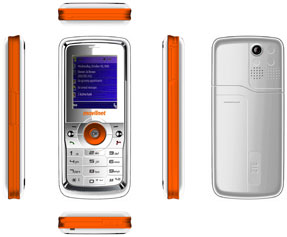
    A low-cost Venezuelan mobile phone aimed at the South’s poor is proving that South-South technological cooperation works. Packed with features and costing no more than US $15 – making it one of the cheapest mobile handsets in the world – the phone is aimed at the fast-growing mobile market across the global South.

    The South is a dynamic market and has seen quick acceptance of mobile phones. The number of mobile phone users in the world passed 4 billion in 2008, and the fastest growth was in the South (ITU). The development of inexpensive handsets means the phones will be able to reach even more poor people. And packing these phones with the latest in multimedia capability means the poor will be able to make a technological leap.

    The Venezuelan phone is being championed as the world’s cheapest mobile phone. It is a bold effort to create an affordable mobile phone packed with features: a camera, WAP internet access (wireless application protocol), FM radio, and MP3 and MP4 players for music and videos.

    The phone uses inexpensive parts from China and is assembled in Venezuela. A quarter of the cost of manufacturing the phone is subsidized by the government. Venezuela often uses the profits from its oil industry to subsidize social goals.

    The phone was launched on Mother’s Day by Venezuela’s president Hugo Chavez with a call to his mother. Chavez boasted to the Guardian newspaper: “This telephone will be the biggest seller not only in Venezuela but the world.”

    With his usual bravado, he said that “whoever doesn’t have Vergatario is nothing” – a statement that has become the marketing slogan for the phone on its website.

    The phone already has a waiting list of 10,000 people. The phones are assembled in western Venezuela by Vetelca, a joint state (85 percent) and Chinese (15 percent) company. Vetelca hope to make 600,000 phones in 2009, and to sell more than 2 million in 2011. Exports will first target the Caribbean and then the world.

    The desire to spark technological innovation at home is also alive in the Southern African country of Mozambique, which is making the bold move to start manufacturing computers for schools in the country. Like other African countries, Mozambique is connecting schools with computers and the internet. By manufacturing the laptop computers within the country, Mozambiquans are increasing the program’s economic benefit to the country, and building advanced technical skills.

    Most Southern African countries rely on importing computers, and Rwanda, South Africa and Ethiopia are getting their school computers from the OLPC (One Laptop Per Child) (www.laptop.org) initiative from the United States.

    The Mozambique laptops are call Magalhael (www.portatilmagalhaes.com) and are made in partnership with the Mozambican Ministry of Science and Technology (www.mct.gov.mz/portal/page?_pageid=615,1&_dad=portal&_schema=PORTAL) and Portugal Telecom (www.telecom.pt/InternetResource/PTSite/PT). They come with a 60 gigabyte (GB) hard drive and 2 GB of RAM (memory) and are entirely built in Mozambique.

    Read these stories on ICT4D from Development Challenges, South-South Solutions:

    Published: June 2009

    Resources

    • Google Android: Android is a software for mobile phones that allows people to create useful applications (apps) for the phones. Website: http://code.google.com/android/and www.android.com
    • Kabissa: Space for Change in Africa: An online African web community promoting and supporting the transition to Web 2.0 services in Africa. Offers lots of opportunities to meet people throughout Africa and learn more.Website: www.kabissa.org
    • Business Fights Poverty: Business Fights Poverty is the free-to-join, fast-growing, international network for professionals passionate about fighting world poverty through good business.Website:http://businessfightspoverty.ning.com/
    • BOP Source is a platform for companies and individuals at the BOP to directly communicate, ultimately fostering close working relationships, and for NGOs and companies to dialogue and form mutually valuable public-private partnerships that serve the BOP. Website:http://bopsource.ning.com/
    • Venezuelan Phone. Website: www.vergatorio.com

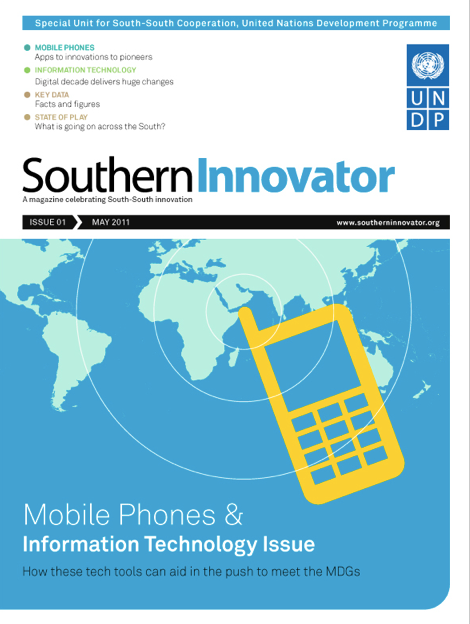
    Like this story? Please check out our first issue of Southern Innovator on mobile phones and information technology.

    Development Challenges, South-South Solutions was launched as an e-newsletter in 2006 by UNDP’s South-South Cooperation Unit (now the United Nations Office for South-South Cooperation) based in New York, USA. It led on profiling the rise of the global South as an economic powerhouse and was one of the first regular publications to champion the global South’s innovators, entrepreneurs, and pioneers. It tracked the key trends that are now so profoundly reshaping how development is seen and done. This includes the rapid take-up of mobile phones and information technology in the global South (as profiled in the first issue of magazine Southern Innovator), the move to becoming a majority urban world, a growing global innovator culture, and the plethora of solutions being developed in the global South to tackle its problems and improve living conditions and boost human development. The success of the e-newsletter led to the launch of the magazine Southern Innovator.  

    Creative Commons License

    This work is licensed under a
    Creative Commons Attribution-Noncommercial-No Derivative Works 3.0 License.

    ORCID iD: https://orcid.org/0000-0001-5311-1052.

    © David South Consulting 2023

  • Grassroots Entrepreneurs Now Have Many Ways to Fund their Enterprises

    Grassroots Entrepreneurs Now Have Many Ways to Fund their Enterprises

    By David SouthDevelopment Challenges, South-South Solutions

    SOUTH-SOUTH CASE STUDY


    In the past, African entrepreneurs were extremely limited in the options for funding their plans. They had to rely on often ineffective national banks or local networks based on political, tribal or family connections to secure funding for enterprises. That has now changed, and there is an explosion in new thinking on business start-ups and how best to help grassroots entrepreneurs.

    Concepts such as socially responsible investing, social enterprises and fair trade have opened up new frontiers for business development. All focus on the so-called triple bottom line: people, planet, profit. Economist Milton Friedman’s refrain that the only social responsibility of business was to increase profits, is being proven wrong. Some even go as far as to say social enterprise is the model for the 21st century.

    “There’s lots of money to be made here,” said James Baderman of What If, an innovation company in the UK that employs 300 people and devotes 10 percent of its profits to helping social enterprises develop and grow. “There are huge opportunities; just look at the double-digit growth in fair trade and organic goods over the past decade. Consumers are increasingly making choices based on the ethical nature of products.”

    Many in the social enterprise movement believe breaking the cycle of poverty and economic stagnation requires more than charity; it requires the creation of sustainable businesses that will pay local taxes and employ local people. They have also adopted and adapted the techniques used by multinational companies to improve the desirability of their products. A key part of these new socially responsible businesses is branding and marketing.

    In Kenya, the UK’s Traidcraft (www.traidcraft.co.uk) – an organization that fights poverty through a wide range of trade-related activities combining a development charity with a trading company – is working with the Kenya Organic Agriculture Network to develop markets for Kenyan herbs, spices and related products in local and international markets. These include gums, resins (e.g. frankincense), herbs such as coriander, oregano, garlic and lemon grass; spices such as paprika, chillies, rosemary, lemon balm, and essential oils such as pepper tree oil, sinoni oil, and megalocapus oil – all grown in marginalised, arid areas.In another development focused on Kenya – but applicable across Africa – is being led by the UK-based Mark Leonard Trust (http://markleonard.net/). Called the Mainstreaming African Crafts project, it seeks to boost demand for Kenyan craft products in the UK market. It will build demand by focusing on growth areas (such as baskets, jewellery, leather), emphasizing the distinctiveness of African craft products and support product development in line with identified market trends. The aim is to launch a branded Kenyan product range at an international trade fair in 2008.

    Along with improving the branding and marketing of social enterprises and fair trade businesses, funding options are becoming more varied. One new source of funding for budding social entrepreneurs is the William James Foundation’s 4th Annual Socially Responsible Business Plan Competition. It awards winners who develop business plans that blend people, planet and profit together with over US $40,000 in cash and expert advice to make sure it is spent well. Past winners have included business ventures as varied as an Afghan company that sends SMS text messages on security alerts, to others making hand-made organic clothing and portable vaccine packs for remote areas.

    “We’re at a tipping point wherein the entrepreneur who builds in long-term values of sustainability is the one who will be successful,” said Ian Fisk, executive director of the William James Foundation and a long-time sustainable business activist through Net Impact (http://www.netimpact.org/index.cfm). “Most of what people think of as environmental and social activism in business is simply long-term thinking about energy costs and human resources. There are thousands of good ideas out there. The foundation wants to find those that are attached to solid business plans and help them succeed.”

    The success of this approach has also attracted the attention of multinational companies like the oil company Shell. At the Shell Foundation (www.shellfoundation.org), they look at all the enterprises they support from a hardnosed, business perspective. Rather than seeing a producer who needs to produce, they look first at the market and the consumer, and then work backwards to get the producer to make the appropriate products that will sell. “No micro-enterprise is sustainable unless there is a viable route to market,” said Sharna Jarvis, Programme Manager for the Shell Foundation. “The problem with the standard model for micro-finance is that it begins with the producer, not the consumer. It is all about what someone wants to make – there is not enough emphasis on whether anyone will buy it.”

    A new internet search engine has also been launched that is seeking a new way to create a steady flow of funds to nonprofit enterprises working to reduce poverty. Called GoodSearch (www.GoodSearch.com), it plows 50 percent of its advertising revenue (about a penny a search) back into nonprofits selected by its users. Powered by the well-known portal Yahoo!, if for example 1,000 supporters just searched twice a day, it would raise US $7,300 a year for an organization.

    Published: February 2007

    Resources

    • The Fairtrade Foundation (FTF) helps farmers and other producers to earn a decent living and obtain good healthcare and education. Fair Trade Resource Network: http://fairtraderesource.org/about.html
    • Unltd (pronounced Unlimited), a charity supporting social entrepreneurs: www.unltd.org.ukExcellent resource to link with branded social enterprises and all the resources required to get started: www.socialenterprise.org.uk
    • Equitrade helps businesses in poor countries to develop finished or part-finished products to sell in rich countries: www.equitrade.org
    • The 4th Annual Socially Responsible Business Plan Competition is open to for-profit business (or business ideas) with at least one member who is a current student or has graduated within the past five years.
    • For more information contact: www.williamjamesfoundation.org or email ian.fisk@williamjamesfoundation.org.

    https://davidsouthconsulting.org/2021/02/04/cuban-entrepreneurs-embracing-changes-to-economy/

    https://davidsouthconsulting.org/2022/10/09/entrepreneurs-use-mobiles-and-it-to-tackle-indian-traffic-gridlock/

    https://davidsouthconsulting.org/2022/10/20/ghana-oil-rich-city-sparks-entrepreneurs-and-debate/

    https://davidsouthconsulting.org/2022/11/11/havanas-restaurant-boom-augers-in-new-age-of-entrepreneurs/

    https://davidsouthconsulting.org/2022/11/15/indonesia-best-for-entrepreneurs/

    https://davidsouthconsulting.org/2020/12/20/mobile-phones-engineering-souths-next-generation-of-entrepreneurs/

    https://davidsouthconsulting.org/2020/12/17/mongolias-musical-entrepreneurs-led-way-out-of-crisis-2018/

    https://davidsouthconsulting.org/2021/02/11/turning-street-children-into-entrepreneurs/

    Development Challenges, South-South Solutions was launched as an e-newsletter in 2006 by UNDP’s South-South Cooperation Unit (now the United Nations Office for South-South Cooperation) based in New York, USA. It led on profiling the rise of the global South as an economic powerhouse and was one of the first regular publications to champion the global South’s innovators, entrepreneurs, and pioneers. It tracked the key trends that are now so profoundly reshaping how development is seen and done. This includes the rapid take-up of mobile phones and information technology in the global South (as profiled in the first issue of magazine Southern Innovator), the move to becoming a majority urban world, a growing global innovator culture, and the plethora of solutions being developed in the global South to tackle its problems and improve living conditions and boost human development. The success of the e-newsletter led to the launch of the magazine Southern Innovator.  

    https://davidsouthconsulting.org/2021/03/05/southern-innovator-issue-2/

    Creative Commons License

    This work is licensed under a
    Creative Commons Attribution-Noncommercial-No Derivative Works 3.0 License.

    ORCID iD: https://orcid.org/0000-0001-5311-1052.

    © David South Consulting 2023