Tag: South-South Solutions

  • Protecting Threatened Fruits and Nuts in Central Asia

    Protecting Threatened Fruits and Nuts in Central Asia

    By David SouthDevelopment Challenges, South-South Solutions

    SOUTH-SOUTH CASE STUDY

    Between 94,000 and 144,000 plant species — a quarter to a half of the world’s total — could die out in the coming years, according to an estimate by Scientific American (2002).  Among them are vital food crops, threatened by a world in which climate change is causing more weather turbulence and diseases and viruses can spread rapidly and destroy crops.

    This scale of plant loss risks leaving the world’s food security dependent on fewer – and more vulnerable – domesticated species. The hunt is on for hardy plant species that can survive these ups and downs while protecting the world’s food security for this and the next generation.

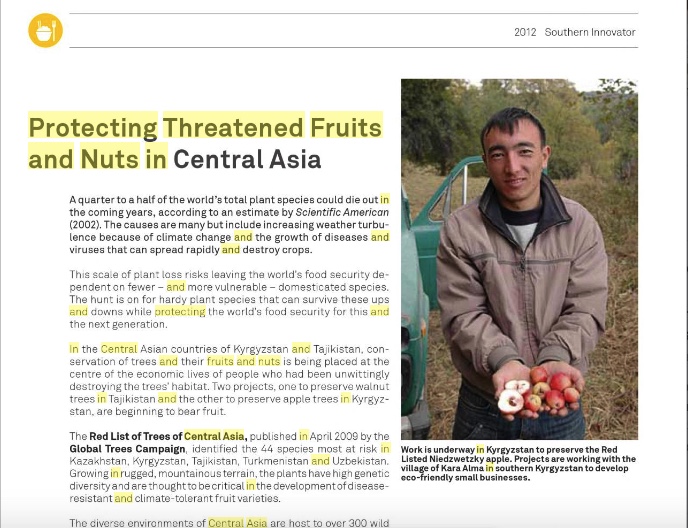
    In the Central Asian nations of Kyrgyzstan and Tajikistan, conservation of trees and their fruits and nuts are being placed at the centre of the economic lives of people who had been unwittingly destroying the trees’ habitat. Two projects, one to preserve walnut trees in Tajikistan, and the other to preserve apple trees in Kyrgyzstan, are beginning to bear fruit.

    The Red List of Trees of Central Asia published in April 2009 by the Global Trees Campaign (http://www.globaltrees.org/rl_centralasia.htm), identified the 44 species most at risk in Kyrgyzstan, Kazakhstan, Uzbekistan, Turkmenistan and Tajikistan. Growing in rugged, mountainous terrain, the plants have high genetic diversity and are thought to be critical in the development of disease-resistant and climate-tolerant fruit varieties.

    The diverse environments of Central Asia are host to over 300 wild fruit and nut species that are ancestors to the fruits and nuts we eat today, including wild apple, plum, pears, pistachios, cherry, apricot, and walnut.

    Many face extinction as local people — driven by the need for fire wood, or to earn an income — cut down this precious resource. The Red List estimates that over 90 percent of the trees in the fruit and nut forests across Central Asia have been destroyed in the past 50 years.

    The importance of these fruits and nuts can’t be over-emphasized: all the common varieties of apricot come from one living ancestor, the species Armeniaca vulgaris, now very rare in Central Asia. Central Asia’s Malus sieversii (http://en.wikipedia.org/wiki/Malus_sieversii) gave birth to today’s domestic apples. It spread its way around the world along the ancient Silk Road (http://en.wikipedia.org/wiki/Silk_Road). The name of Kazakhstan’s former capital city is Almaty (http://en.wikipedia.org/wiki/Almaty), which literally means ‘Grandfather of Apples’.

    Scientists have found genetic diversity and disease resistance greater in wild plant species that have not been domesticated, like Malus sieversii. Malus sieversii is highly resistant to Fire Blight (http://en.wikipedia.org/wiki/Fire_blight), a nasty disease that turns the fruits black (USDA).

    To stop this free-for-all in which resources are plundered to extinction and trees wiped out to be used for firewood, deals are being struck to guarantee local communities’ rights to exploit the trees as a resource, while also obligating them to preserve them.

    In Tajikistan, the walnut trade is a critical source of income for some villages, with most of the crop exported to Turkey. The country shares with Kyrgyzstan the world’s largest natural-growth walnut forest. But the use of short-term land leases discouraged long-term management, while local people were lacking any other sources of income and over-exploited the trees.

    Jilly McNaughton of British NGO Fauna and Flora International (www.fauna-flora.org), said the current situation “is not good, with use of the forest by local people both heavy and inadequately controlled.” “Collection of firewood and grazing are perhaps the biggest concerns,” she said. “There is very little natural regeneration of wild trees due to grazing and hay making in the forest. “As the walnut is valued as an income generating crop, other trees are cut for firewood and timber, meaning parts of the forest have become a park-like landscape with scattered large walnut trees.”

    Fauna and Flora International, which specializes in species preservation, is encouraging local people to work towards long-term leases and diversify their sources of income. The strategy includes encouraging other ways to make a living, including raising chickens, making clothes and bee keeping.

    As one villager said: “We have bought honey buckets and bees. Next year we will get a lot of honey – it will be a great income. We got a job.”

    The Red List of Trees found the causes of species’ destruction are multiple: over-exploitation, human development, pests and diseases, overgrazing, desertification and fires. Since the break up of the Soviet Union, funds have been short to help reverse these threats.

    The most threatened apple species in the Red List is the Niedzwetzky apple (Malus niedzwetzkyana) (www.globaltrees.org/kyrgyzstan_apple.htm).

    In Kyrgyzstan, work to preserve the Niedzwetsky apple is directly involving the community. Projects are working with the village of Kara Alma in southern Kyrgyzstan and government forest services to encourage eco-friendly small businesses to earn incomes and protect the forests.

    They have catalogued all 111 trees that still survive, and have set up a community-run nursery to grow more. The ambition is to expand this approach across the region, both preserving these great resources and bringing hope and employment to the people.

    Published: July 2009

    Resources

    • The Global Trees Campaign, a partnership between Fauna & Flora International, Botanic Gardens Conservation International and many other organisations around the world, aims to save threatened tree species through provision of information, conservation action and support for sustainable use. Website: www.globaltrees.org
    • The Red List of Trees of Central Asia: Has evaluated 96 of the region’s tree species, identifying 44 as globally threatened with extinction. Website: www.globaltrees.org/news_RLCA.htm
    • Association of Cities of Kyrgyz Republic. Website: www.citykr.kg/en/index.php
    • Planeta: One of the first ecotourism resources to go online (since 1994) and still offers plenty of information for those wanting to start a business. Website: www.planeta.com
    • Environmental Public Awareness Handbook: A thorough account with case studies of a successful two-year project in Mongolia to combine environmental protection with livelihoods. Website: http://tiny.cc/oZ9sA

    Development Challenges, South-South Solutions was launched as an e-newsletter in 2006 by UNDP’s South-South Cooperation Unit (now the United Nations Office for South-South Cooperation) based in New York, USA. It led on profiling the rise of the global South as an economic powerhouse and was one of the first regular publications to champion the global South’s innovators, entrepreneurs, and pioneers. It tracked the key trends that are now so profoundly reshaping how development is seen and done. This includes the rapid take-up of mobile phones and information technology in the global South (as profiled in the first issue of magazine Southern Innovator), the move to becoming a majority urban world, a growing global innovator culture, and the plethora of solutions being developed in the global South to tackle its problems and improve living conditions and boost human development. The success of the e-newsletter led to the launch of the magazine Southern Innovator. 

    Creative Commons License

    This work is licensed under a
    Creative Commons Attribution-Noncommercial-No Derivative Works 3.0 License.

    ORCID iD: https://orcid.org/0000-0001-5311-1052.

    © David South Consulting 2023

  • Preserving Beekeeping Livelihoods in Morocco

    Preserving Beekeeping Livelihoods in Morocco

    By David SouthDevelopment Challenges, South-South Solutions

    SOUTH-SOUTH CASE STUDY

    The clever combining of tourism and long-standing beekeeping skills has revived a local craft and is also helping to preserve the ecology of Morocco.

    Beekeeping, or apiculture (http://en.wikipedia.org/wiki/Beekeeping), has two clear benefits. Bee products, including honey, beeswax, propolis, pollen and royal jelly can be a valuable source of income. The other benefit is the critical role bees play in the ecology by pollinating flowers and plants as they go about their daily business.

    Bees are at risk around the world, as reports of the dying-off of bees from colony collapse disorder (http://en.wikipedia.org/wiki/Colony_collapse_disorder) raise concerns about the impact on the earth’s ecology and plant life should bees disappear.

    North Africa and the Middle East are considered the cradle of beekeeping, with records showing beekeeping going back to 2400 BC in Egypt. According to “A review of beekeeping in Arab countries” by Moustafa H. Hussein, “The total number of honey bee colonies in Arab countries is approximately 42 million, the total number of beekeepers is 321,700”.

    In the paper “The Future of Bees and Honey Production in Arab Countries” by Moustafa A. EL-Shehawy, Egypt has the largest number of bee colonies in Arab countries (48 per cent), with Algeria in second place and Morocco with 9 per cent of the bee colonies.

    Support for beekeeping comes from the Arab Beekeepers Union (http://abu.saudibi.com/index.php?page_id=115), which was established in 1994 with the aim to improve “the beekeeping profession all over the Arab World”, according to its website, and the Arab Apicultural Congress, first launched in 1996.

    Beekeeping has significant potential for further development, many argue, and can be a great source of income and sustainable livelihoods for communities with a long history of beekeeping.

    In Morocco, one solution to preserve beekeeping as a skill and source of income is to turn beekeeping into a tourist destination and event, which has the dual aim of boosting a local food product and reviving a traditional craft and skill.

    The Berber heartland of the Agadir region is an area with a reputation for beauty, filled with waterfalls and mountains – and plentiful flowers, which attract bees. As a result, the area is home to the proud local specialty of honey, as well as for its argan nuts and oil, almonds, palm, juniper and olive production.

    Now a “Honey Road” route for tourists, combined with community honey festivals, is helping preserve local skills and give a boost to this long-standing economic activity.

    Beekeeping is a centuries old skill for the Berber people of North Africa. Berbers (http://en.wikipedia.org/wiki/Berber_people) are spread out across North Africa and were traditionally nomadic herders. Most now live in Morocco and Algeria, but Berbers can also be found in Tunisia, Libya, Mauritania, Mali and Niger.

    Starting at the beginning of May, a honey festival takes place in the Moroccan village of Imouzzer des Ida Outanane (http://en.wikipedia.org/wiki/Imouzzer_Ida_Ou_Tanane), 60 kilometres from Agadir.

    The honey festival brings together the region’s beekeepers. Tourists can sample honey and prizes are offered based on the quality of the product. It is part of the “Honey Road” route that tourists are encouraged to journey along.
    The villagers share responsibility for the care of the bees. Demonstrations take place showing the basics of honey production and the keeping of queen bees.

    A few kilometres away on the Honey Road is the village of Izourki Oufella, which produces honey perfumed with thyme and lavender.

    The Honey Road runs a triangular pattern south and west of Marrakech between Argana, Oued Tinkert, Asif Tamraght, Agadir and Imouzzer. Argana is reputed to have the “largest and oldest collective beehive in the world” (http://www.morocco.com/blog/tantalizing-tastes-of-the-honey-festival).

    Abdelhakim Sabri, owner of Auberge Zolado (aubergezolado.com) – a hilltop hotel with a restaurant and spa – is located in Agadir on the Honey Road.

    Sabri works to preserve local culture. “Rural beekeepers struggle, so we’re introducing visitors to apiculturists like Ahmed – and Morocco’s finest honey,” he told High Life magazine.

    Ahmed is a Berber beekeeper. He builds cylindrical hives for the bees by rolling sheets of woven reed and then caking them in earth. When the earth has dried, the bees quickly make it their home.

    The region’s honey is prized for its distinctive flavour, infused with the aroma of herbs such as thyme, or flowers such as lavender, orange blossom or cactus. A mixture is made of honey, argan oil and almonds and is usually given to couples on their honeymoon.

    “Different flowers bloom during different periods, so honey changes through the year,” said Sabri.

    It sounds like the Honey Road is worth regular visits to sample the honey as it changes with the seasons!

    Published: April 2013

    Resources

    1) A documentary on the Honey Route from Morocco’s travel promotion agency. Website: http://www.visitmorocco.com/index.php/eng/content/view/full/3975

    2) Apinews: Latest apiculture news. Website: http://www.apinews.com/en/

    3) Saudi Beekeeping Industry: An association to coordinate efforts to promote and support apiculture. Website: http://www.saudibi.com/?page_id=115
    4) Laboratory of Apiculture and Social Insects (LASI): The Laboratory of Apiculture and Social Insects (LASI) at the University of Sussex is the largest research group in the UK studying honey bees and other social insects. Website: http://www.sussex.ac.uk/lasi/

    5) Apimondia 2013: This year’s International Apicultural Congress will take place in Kiev, Ukraine from 29 September to 4 October 2013. Website: http://apimondia2013.org.ua/en/

    6) International Bee Research Association: Founded in 1949, the International Bee Research Association (IBRA) is a not for profit organisation. It collects, collates and disseminates information on all species of bees.  It is a publishing house, producing a varied and extensive selection of bee publications. Website: http://www.ibra.org.uk/

    Southern Innovator logo

    London Edit

    31 July 2013

    Development Challenges, South-South Solutions was launched as an e-newsletter in 2006 by UNDP’s South-South Cooperation Unit (now the United Nations Office for South-South Cooperation) based in New York, USA. It led on profiling the rise of the global South as an economic powerhouse and was one of the first regular publications to champion the global South’s innovators, entrepreneurs, and pioneers. It tracked the key trends that are now so profoundly reshaping how development is seen and done. This includes the rapid take-up of mobile phones and information technology in the global South (as profiled in the first issue of magazine Southern Innovator), the move to becoming a majority urban world, a growing global innovator culture, and the plethora of solutions being developed in the global South to tackle its problems and improve living conditions and boost human development. The success of the e-newsletter led to the launch of the magazine Southern Innovator. 

    Creative Commons License

    This work is licensed under a
    Creative Commons Attribution-Noncommercial-No Derivative Works 3.0 License.

    ORCID iD: https://orcid.org/0000-0001-5311-1052.

    © David South Consulting 2022

  • Social Networking Websites: A Way Out of Poverty

    Social Networking Websites: A Way Out of Poverty

    By David SouthDevelopment Challenges, South-South Solutions

    SOUTH-SOUTH CASE STUDY

    Social networking websites also known as, Web 2.0 – the name given to the new wave of internet businesses and websites such as YouTube and MySpace that are transforming the way people interact with the Web – has been dubbed the social web for its power to bring people together. The label has been derided as a marketing gimmick by some, but many argue there are a number of characteristics to Web 2.0 that make it something different and a valuable tool for entrepreneurs seeking ways out of poverty.

    The new Web 2.0 applications offer many free software tools stored online, from accounting and business related tools, to new multimedia ways to communicate for free. Unlike Web 1.0 sites, which offered information to passive users, Web 2.0 sites allow interaction and comment. These qualities have meant Web 2.0 can be used to build communities and social and business networks. By being able to store vast quantities of information online, it becomes faster to work and reduces the painful delays brought on by slow connections.

    All these new tools are making it easier and easier for entrepreneurs to work from home, in internet centres, or anywhere there is a wireless connection, and is slashing the costs of managing a business. All the applications are online so there is no need to be hidebound by one operating system or hardware capability. The number of internet centres has increased significantly all over Asia and Africa, bringing the power of Web 2.0 to millions more people.

    Linking mobile phones and the internet is also remarkable. It is becoming more and more possible in Africa to send messages to weblogs via text messaging, to post photos and videos, or to stay connected with a community, advocacy or business group via messaging to its website.

    “Web 2.0 is a pre-occupation of ours that can be beneficial in fighting poverty,” said Tobias Eigan, founder and co-executive director of Kabissa.org, a web portal dedicated to promoting Web 2.0 in Africa. “It is really relevant for Africa. It makes the internet a read and write function, it is more user-friendly – that dynamic is going to make a big difference. It is so much easier to upload content with Web 2.0. It will build the capacity of local institutions and society and that will improve the lives of people – it will be much easier to fight poverty with this connectivity.”

    Two other champions of the Web 2.0 way out of poverty are Waleed al-Shobakky, science and technology reporter for alJazeera.net, and Jack Imsdahl, a consultant and technology commentator. While they admit subsistence farmers and the illiterate will not directly benefit, those who are students or are working in proximity to computers will definitely benefit. They point out how rapidly mobile phones have been taken up by the poor and that this is being driven by the new services they offer.

    There are still profound obstacles to more rapid take-up, however. Internet connection speeds will have to get better and more will need to be invested in this area. Web 2.0 tools will also need to be adapted to local languages if they hope to get past those who speak major web languages like English.

    Entrepreneurs in the global South can now easily sign up to a vast array of e-newsletters that are sent to email accounts and keep on top of trends and innovations in their field. The relative anonymity of these email lists mean subscribers are less likely to be judged on their physical circumstances.

    Published: March 2007

    Resources

    Afriville is a Web 2.0 service and an African Caribbean social network started by two Nigerian web entrepreneurs in their twenties, Folabi Ogunkoya and Lawrence Bassey-Oden.

    Afriville is a community website along the lines of the famous MySpace. Users are free to message and post profiles. The difference is that the user is able to choose how closed or open the networks are. The site features a state of the art music management system which allows African and Caribbean artists to get straight in touch with their fans.

    “We have created a solid app(lication) with features that will give the big players a run for their money,” said Ogunkoya.

    African entrepreneurs have already stepped in with other Web 2.0 offerings. These include: Mooziko.com (an African YouTube), Afribian.com (news sharing), Afriqueka.com (social networking), Yesnomayb (online dating).

    Both Yahoo! And Google offer extensive free online tools for entrepreneurs and businesses that integrate seamlessly with their email services.

    Kabissa: Space for Change in Africa: An online African web community promoting and supporting the transition to Web 2.0 services in Africa. Offers lots of opportunities to meet people throughout Africa and learn more.

    Alexa: Here can be found a detailed break down by country in Africa of web use and site popularity and trends.

    Digital Divide Network: A website linking together initiatives and offering opportunities to debate current issues and problems.

    Global Voices: An initiative from the Reuters news agency to aggregate the global conversation online from countries outside the US and Western Europe.

    Free Web 2.0 tools for entrepreneurs:

    Wikis: Here is a detailed article on wikis – collaborative websites that allow authorised users to rapidly and easily change the content of pages – and a detailed list of free or low-cost wiki services.

    >> Blogging (an online diary):

    Blogger.com – A free, easy-to-use, online service owned by Google.

    BlogPlanet.net – Blog from your mobile phone, free.

    Blogsome.com – An easy-to-use, free service with good support for photos.

    Movable Type – An open-source, free, easy to use, online publishing system popular with bloggers.

    WordPress – Another easy, free, and popular online publishing system popular with bloggers.

    >> Aggregators (these are programmes that gather links and resources off the web):

    AmphetaDesk – One of the first news aggregators to really catch on, it’s still popular.

    Bloglines – Allows bloggers and webmasters to search, subscribe to, publish, and share RSS news feeds online.

    Del.icio.us – Aggregate content from your favorite Web sites and share them with others.

    Feed Demon – The news you want delivered to your desktop.

    Technorati – A real-time search engine that keeps track of what is happening in the world of blogs.

    Techsoup.org is an excellent resource for all the latest developments in Web 2.0 and how to access free or low-cost resources. Being based in the US, it gets the inside scoop on cutting edge developments in Silicon Valley.

    Development Challenges, South-South Solutions was launched as an e-newsletter in 2006 by UNDP’s South-South Cooperation Unit (now the United Nations Office for South-South Cooperation) based in New York, USA. It led on profiling the rise of the global South as an economic powerhouse and was one of the first regular publications to champion the global South’s innovators, entrepreneurs, and pioneers. It tracked the key trends that are now so profoundly reshaping how development is seen and done. This includes the rapid take-up of mobile phones and information technology in the global South (as profiled in the first issue of magazine Southern Innovator), the move to becoming a majority urban world, a growing global innovator culture, and the plethora of solutions being developed in the global South to tackle its problems and improve living conditions and boost human development. The success of the e-newsletter led to the launch of the magazine Southern Innovator. 
    Creative Commons License

    This work is licensed under a
    Creative Commons Attribution-Noncommercial-No Derivative Works 3.0 License.

    ORCID iD: https://orcid.org/0000-0001-5311-1052.

    © David South Consulting 2023

  • Africa’s Tourism Sector Can Learn from Asian Experience

    Africa’s Tourism Sector Can Learn from Asian Experience

    By David SouthDevelopment Challenges, South-South Solutions

    SOUTH-SOUTH CASE STUDY

    Africa continues to be seen as new territory for global tourism, yet it still is not even close to meeting its potential,according to a report by a South African think tank. In fact, many resorts and tourist areas are failing to fill up with visitors. This contrasts with the booming world tourism industry, which broke records in arrivals in 2011 (UNWTO).

    Apart from South Africa, much of sub-Saharan Africa is the worst performing region for tourism in the world. Africa received 5.2 per cent of the world’s tourism – 40 million visitors – in 2010. Yet the continent as a whole has 15 per cent of the world’s population: a hint at the potential being missed.

    Okavango Delta in Botswana (botswana-places.co.za/okavango.html), reports Canada’s Globe and Mail newspaper,has nearly empty luxury lodges and resorts and is offering heavy discounts to lure tourists in.

    But the report believes there are two countries African nations can look to for lessons on how to tighten up their tourism offerings: Vietnam and Cambodia. It points out both these countries share similar challenges, including colonial legacies, war and conflict, poor quality skills and weak infrastructure. Both countries dramatically reversed their failures in a decade and now have booming tourism sectors creating jobs and bringing in wealth.

    Africa suffers from negative publicity generated by media reporting about terrorist attacks on tourists across the continent and kidnappings by criminal gangs and pirates in East Africa. The so-called ‘Arab Spring’ upheavals in North Africa are also having an impact. The continent’s many infrastructure problems also limit its potential. These include unreliable power supplies, out-of-date airports, inadequate involvement of local populations in the benefits of tourism and the tourist economy, and poor awareness of attractions apart from the clichéd African “safari”.

    The report is urging a re-think by all of Africa’s nations of their tourism strategies and the structure of their tourism sectors. In order for the tourism industry to grow and to thrive, greater focus is required and greater investment needed to ensure the facilities, attractions and experience matches what tourists would expect. And the report believes this matters a great deal because in tourism lies the solution to many of the continent’s high unemployment problems.

    Tourism is one of the world’s largest industries and a great generator of wealth and jobs. But while it provides 5 per cent of the world’s gross domestic product (GDP), it only provides 2 per cent of Africa’s GDP.

    Tourism in Africa is also heavily skewed to just a handful of countries. The bulk of tourists visit just four countries: Egypt, Morocco, Tunisia and South Africa.

    “This desultory record belies the natural advantages Africa has over other regions that have performed much better,in particular the continent’s extraordinary diversity – of wildlife, environment and people,” according to the report produced by the Brenthurst Foundation (thebrenthurstfoundation.org), a think-tank in Johannesburg.

    The paper is called ‘Unlocking Africa’s Tourism Potential: Lessons from Vietnam and Cambodia’ (http://www.thebrenthurstfoundation.org/a_sndmsg/news_view.asp?I=121182&PG=288)

    The Brenthurst Foundation researches new ideas and “innovative actions for strengthening Africa’s economic performance”.

    Cambodia’s tourism industry grew by 17 per cent in 2010 and became the country’s second largest earner of foreign income. In Vietnam, tourism has grown by 11 per cent every year since 1995 and makes up 12 per cent of the country’s GDP.

    The report isolated four key lessons that African tourism authorities should follow:

    1) Help the private sector to expand what it offers to tourists, and make it more sophisticated, including ecotourism and maritime tourism.

    2) Undertake aggressive international marketing campaigns (South Africa is a good example) and push hard their well-known tourism offerings, making them global icons. Also develop tourism hubs.

    3) The tourism sector needs to professionalize by investing in skills training in tourism and hospitality.

    4) Identify potential tourist markets and smooth the journey for them by streamlining obstacles like visas. They should also make a list of health and safety concerns tourists will have and address them. The report believes this strategy would go a long way to tackle the continent’s high unemployment levels.

    “No continent stands to benefit more from the 21st century tourism boom than Africa,” the report claims.

    Published: February 2012

    Resources

    1) World Tourism Organization: UNWTO is the United Nations agency responsible for the promotion of responsible,sustainable and universally accessible tourism.Website: http://unwto.org

    2) Vietnam Tourism: The national tourism administration of Vietnam. Website: http://www.vietnamtourism.com

    3) Tourism Cambodia: The official website for the tourism authority of Cambodia.Website: http://www.tourismcambodia.com

    4) Tourism and Poverty Reduction: Pathways to Prosperity by Jonathan Mitchell and Caroline Ashley, Publisher:Earthscan.Website: http://www.earthscan.co.uk/?TabId=92842&v=497073

    Development Challenges, South-South Solutions was launched as an e-newsletter in 2006 by UNDP’s South-South Cooperation Unit (now the United Nations Office for South-South Cooperation) based in New York, USA. It led on profiling the rise of the global South as an economic powerhouse and was one of the first regular publications to champion the global South’s innovators, entrepreneurs, and pioneers. It tracked the key trends that are now so profoundly reshaping how development is seen and done. This includes the rapid take-up of mobile phones and information technology in the global South (as profiled in the first issue of magazine Southern Innovator), the move to becoming a majority urban world, a growing global innovator culture, and the plethora of solutions being developed in the global South to tackle its problems and improve living conditions and boost human development. The success of the e-newsletter led to the launch of the magazine Southern Innovator. 
    Creative Commons License

    This work is licensed under a
    Creative Commons Attribution-Noncommercial-No Derivative Works 3.0 License.

    ORCID iD: https://orcid.org/0000-0001-5311-1052.

    © David South Consulting 2023