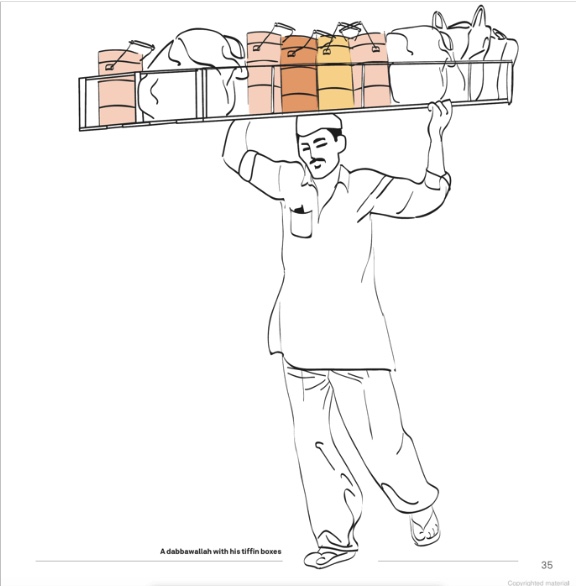
Tag: South-South Solutions Newsletter

  • Dabbawallahs Use Web and Text to Make Lunch on Time

    Dabbawallahs Use Web and Text to Make Lunch on Time

    By David SouthDevelopment Challenges, South-South Solutions

    SOUTH-SOUTH CASE STUDY

    The developing world’s rapidly growing cities are bringing with them whole new ways of living and working. One rapidly expanding category of citizen is the office worker. A symbol of growing prosperity, the office worker also tends to be a time-poor person who often must commute large distances between home and workplace.

    These long commutes mean that many workers have lost the old ability to go home for lunch. This has led to an expanding new field of business: catering to all these office workers’ appetites.

    Every morning Mumbai’s legendary dabbawallahs (it means “box-carrier” or “lunchpail man”) fan out across the city to collect freshly prepared lunches from people’s homes and restaurants. They then efficiently use the transport network to quickly deliver lunches to the customers’ workplaces. Once just for the elite, the dabbawallah lunch has become the norm for Mumbai’s middle class office workers. Lunches are packed into small, metal tiffin boxes, ingeniously organized so each component of the meal is sealed in its own section and kept warm.

    With a plethora of religious and cultural practices, Indians are particular about what they eat. In Mumbai there are 200,000 office workers receiving cooked lunches every day delivered straight to their desks. This is done by an army of 5,000 dabbawallahs. While their delivery accuracy was already impressive – only six deliveries in a million go astray – they realized they had to adapt to the city’s rapid changes. In addition to their network using trains, hand-carts and bicycles to get the lunches to desks, they have turned to the internet and mobile phone SMS text messaging to take orders.

    It is a 125-year old industry that has grown at the rate of five to ten per cent a year and all are paid the same no matter what their function in the business.

    With foreign direct investment into developing countries surging – according to the United Nations Conference on Trade and Development (UNCTAD), it rose by 12 per cent from 2005 to 2006 – the number of office workers is on the rise too.

    The trend is especially pronounced in India, which is on track to overtake the United Kingdom as the world’s fifth largest economy by 2010, according to investment bankers Goldman Sachs.

    India’s cities are booming. Mumbai is one of the top five global megacities as well as the world’s most crowded metropolis. The dabbawallahs are an excellent example of how a business can move with the times.

    A key component in India’s new-found success has been a willingness to do things better and become more efficient; the key to this is often information technology. The new technology for the dabbawllahs has been built for them by software engineer Manish Tripathi – he has even been adopted as an honorary tiffinwallah.

    “When people move to Mumbai for work, and need a lunchbox carrier, who do they ask?” he said. “They ask their friends, or their neighbour. Now, they just need to go to the website and they can find out how to get in touch with us. They can also get in touch with us via SMS.”

    The move online has been a great success said Tripathi: “We get 10 to 15 enquiries more a day via SMS and the website.”

    Raghunath Medge from the dabbawallahs cooperative said they are also making money by selling advertising on table mats. They have also turned to being a health service: they distribute health advice, beginning with this year’s World AIDS Day. An “AIDS kit”, comprising a car calendar and fliers on testing and counselling tied neatly with a red ribbon, was distributed ahead of World AIDS Day December 1.

    “The kit was attached to empty lunch boxes and delivered to about 100,000 clients’ homes,” said Raghunath Megde,

    Targeting hungry office workers is a goldmine for others too: in Saigon, Vietnam, the Ben Thann restaurant capitalised on its proximity to an area with a fast-growing office worker population to increase its profits. “Since our restaurant began serving lunch for office workers our business has increased by 60 per cent. This increase in number of guests enjoying the new menu was the main reason for Ben Thanh’s decision to introduce a buffet lunch,” said Nguyen Thi Thu Thao, deputy manager of Ben Thanh Restaurant.

    In the past, the dabbawallahs were visited by Prince Charles and British entrepreneur multimillionaire Richard Branson, to study their working methods. It looks like this next round of innovation will equally grab the world’s attention.

    Published: December 2007

    Resources 

    • The New York Times has an excellent slideshow of the dabbawallahs at work: Click here to view 
    • The official website of the dabbawallahs: http://www.mydabbawala.com/

    “I think you [David South] and the designer [Solveig Rolfsdottir] do great work and I enjoy Southern Innovator very much!” 

    Ines Tofalo, Programme Specialist, United Nations Office for South-South Cooperation
    Creative Commons License

    This work is licensed under a
    Creative Commons Attribution-Noncommercial-No Derivative Works 3.0 License.

    ORCID iD: https://orcid.org/0000-0001-5311-1052.

    © David South Consulting 2023

  • Bolivian Film School’s Film Scene Paying Off

    Bolivian Film School’s Film Scene Paying Off

    By David SouthDevelopment Challenges, South-South Solutions

    SOUTH-SOUTH CASE STUDY

    A film school in Bolivia shows how a creative hub can become the start of something much bigger. The school is inspiring a new generation of young people to get into filmmaking. And one of its lecturers is already experiencing global success acting in an award-winning new Spanish film.

    Bolivia’s economy has grown over the last decade, and the country is beginning to shed its long-standing reputation for grinding poverty and political instability. Public spending has risen, and more money has been put into programmes to reduce poverty. More students are entering higher education and the country recognizes an urgent need for greater awareness and understanding of modern technology.

    Film and media production have been targeted as an important way to advance Bolivia’s social and economic development.

    Veteran Bolivian filmmaker Jorge Sanjines (http://en.wikipedia.org/wiki/Jorge_Sanjin%C3%A9s) has been one of the most passionate exponents of using film to spread the stories and wisdom of Bolivia’s indigenous people. He believes their stories understand the need to balance the demands of humanity with preservation of the environment. Film, to him, is a way to liberate Bolivian society and address its pervasive problems of poverty, hunger and marginalization.

    This chimes with rising global awareness of the importance of the creative economy in future development. No longer seen as a frippery, the creative economy is the “interface between creativity, culture, economics and technology in a contemporary world dominated by images, sounds, texts and symbols” (UNCTAD). It is seen as a way for emerging economies to leapfrog into high-growth areas in the world economy.

    It’s a formula that has worked well in many other places. A successful art gallery fosters a scene and draws in audiences, buyers and new businesses. Soon, a creative economy comes alive and that means serious money. Both New York and London have shown how this can work. By 2005, New York City’s creative economy employed over 230,899 people in 24,481 businesses (Americans for the Arts).

    Creative economies tend to create excitement and pride in the country; creative businesses like advertising and design make it much easier to sell products and connect with customers. It is hard to imagine the Apple computer brand (http://www.apple.com/) being as successful as it is without intelligent and engaging design.

    Regeneration – of poor neighbourhoods, districts, even whole countries – is both a challenge and a key to transforming lives. There is a strong track record of turning to artists and creative people to re-imagine neighbourhoods or a country’s culture, restoring pride and vitality to places beaten down by life’s hardships.

    In the Bolivian city of El Alto (http://en.wikipedia.org/wiki/El_Alto,_La_Paz), the Cine Alto film school at the Municipal Arts School of El Alto (http://cinealto.blogspot.com/2009/01/nueva-carrera-de-artes-cinematogrficas.html), offers students a free education in filmmaking. Lecturer and actor Juan Carlos Aduviri is one of the high-profile successes to come from the school since it opened in 2006.

    A graduate of the school and a lecturer on screenwriting, he got a big career boost by acting in a major new, award-winning film and is nominated as Best Newcomer by Spain’s top film awards, the Goyas (http://www.academiadecine.com/home/index.php). The nomination is for his role in the Spanish film Even the Rain (http://www.tambienlalluvia.com/) – set in the Bolivian city of Cochabamba, where protests a decade ago broke out over privatisation of water services. It stars well-known Mexican actor Gael Garcia Bernal, who plays a filmmaker set on making a movie about the Spanish conquest of the Americas. While making the film, the so-called “water wars” break out and the actor played by Aduviri must balance his film role with being a protest leader.

    The protests against water privatisation in Cochabamba led to the election of Evo Morales (http://en.wikipedia.org/wiki/Evo_Morales) as Bolivia’s president in December 2005.

    Cine Alto is one of four film schools in Bolivia but the only one that does not charge students tuition. Cash is tight for the school, which is a simple place and runs on thin resources. The classrooms have bare walls and broken windows, but the school is serious about transforming the lives of young people. The curriculum emphasises a strong theoretical foundation in combination with technical and practical training.

    “Conditions in Bolivia to make a film are challenging and in El Alto, it’s even more difficult,” Aduviri told the BBC.

    “Life is hard here in El Alto, and this film school is trying to rescue this talent, and support these young people.”

    A member of Bolivia’s indigenous people, the Aymara (http://en.wikipedia.org/wiki/Aymara_people), Aduviri grew up in El Alto, a city known for its strong pride and resilience. It is home to almost a million people, most of whom are Aymara.

    He studied screenwriting and turned to teaching at the school after graduating. He is passionate about filmmaking as an alternative to negative influences in the community: he wanted the film school “to give a voice to all the talent that we’re losing to alcohol, drugs, prostitution, homelessness and gangs.”

    One student, Edson Chambiborque, told the BBC: “”He has taught us to value the little that we have in this school, and never drop our heads despite all the difficulties we may have.”

    Aduviri comes from a poor family but now makes a good salary by Bolivian standards: US $200 a month. (The average monthly wage in Bolivia is around US $90). He still lives with his mother in a poor neighbourhood. His father, a miner, died of lung disease.

    He wants to become a director and screenwriter and dreams of his film career taking him to the Cannes Film Festival in France (http://www.festival-cannes.com/).

    He will continue acting to raise the money to be able to finance his own films. With the money he has made from appearing in the Spanish film, he has bought a computer with film editing software and a television. He has a goal to watch two movies a day on his new television and keep learning.

    Appearing in the film has catapulted his career to the next level: the phone is always ringing and the world’s media keep asking for interviews. It has come with trips to Europe to promote the film and receive awards. He also won the best actor award from the Festival de Cinema Europeen des Arcs (http://www.lesarcs-filmfest.com/2010/programme/). An impressive journey for somebody from a poor family.

    When he saw his first movie he was inspired by the magic of filmmaking. He told the BBC: “It was showing Rambo. And that day I realised what I wanted to do. When I left the cinema, I said: I want to make films.”

    Bolivian film has had to fight for attention with other Central and South American countries. Brazil, Argentina and Chile all have experienced global success. The country has a rich – but little-known – film history, with significant Bolivian filmmakers including Pedro Sambarino, Jorge Ruiz, Oscar Soria, Jorge Sanjines, Antonio Eguino, Paolo Agazzi, Rodrigo Bellott, Juan Carlos Valdivia, Adriana Montenegro, Marcos Loayza.

    Bolivia is looking to the digital age to rectify its relative anonymity, and Cine Alto may be ground zero for a Bolivian film new wave.

    Published: March 2011

    Resources

    1) European film festival in Bolivia, with screenings across the country. Website: http://www.cineeuropeobolivia.org/

    2) Cine Alto on Facebook: Website: http://es-la.facebook.com/cine.alto

    3) Global Creative Economy Convergence Summit 2009: The summit is about the successful and emerging creative technologies and initiatives that are driving economic growth locally, nationally and internationally. Website: http://www.gcecs2009.com/

    4) AltoTV: A non-profit television documentary-making project that has made small films on El Alto. Website:http://www.altotvgerman.blogspot.com/

    5) The Public University of El Alto: Website:http://www.enlaupea.com/

    6) Creative Economy Report 2008. An economic and statistical assessment of creative industries world-wide as well as an overview of how developing countries can benefit from trade in creative products and services, produced by UNCTAD and the Special Unit for South-South Cooperation in UNDP. Website: http://www.unctad.org/en/docs/ditc20082cer_en.pdf

    7) A course on Bolivian filmmaking taught by award-winning filmmaker Ismael Saavedera. Website:http://www.sit.edu/studyabroad/sss_blv.cfm

    Creative Commons License

    This work is licensed under a
    Creative Commons Attribution-Noncommercial-No Derivative Works 3.0 License.

    ORCID iD: https://orcid.org/0000-0001-5311-1052.

    © David South Consulting 2022

  • African Manufacturing Pioneers Proving it is Possible to Thrive

    African Manufacturing Pioneers Proving it is Possible to Thrive

    By David SouthDevelopment Challenges, South-South Solutions

    SOUTH-SOUTH CASE STUDY

    Africa’s paradox is that it is home to the greatest share of the world’s unexploited resources, yet has some of the world’s lowest per capita incomes. History has shown that exploiting the continent’s resources alone for export markets does little to improve incomes and living conditions in Africa, which in turn does nothing to improve human development. The key to resolving this paradox is made-in-Africa jobs, in particular high-value jobs that make products.

    Africa still mostly makes its income from exporting raw commodities, from minerals to fuel to food. In the 1990s, Asian countries exported five times more manufactured goods, as share of GDP, than sub-Saharan Africa. Things changed in the 2000s. African manufactured output has roughly doubled over the last 10 years. And those goods are going more to the emerging economies than to the traditional powers (African Economic Outlook).

    African Economic Outlook points out that by 2009 “trade between African countries and emerging powers equalled that between Africa and its traditional partners.”

    “South-based manufacturing enhances the welfare of African consumers via prices and functionality,” the report says.

    “For instance, generic Indian pharmaceuticals are cheaper than brands from traditional partners.”

    Small and medium enterprises (SMEs) have been identified as a key part of Africa’s future prosperity and key to its ability to reduce poverty and achieve development objectives like the Millennium Development Goals (MDGs) (www.un.org/millenniumgoals).

    The sector is large but its economic power is inefficiently used. Telling the Wall Street Journal, Mthuli Ncube, chief economist at the African Development Bank Group, estimated one-quarter of Africa’s gross domestic product — about US $450 billion — comes from 65 million small and medium-sized enterprises.

    Manufacturing has been difficult to measure because so many businesses are just tiny cottage industries.

    Obstacles to growth include poor infrastructure, unreliable power supplies, unscaleable business models, low quality standards and poor quality branding and design.

    Access to funding is often weak and fragmented and many programmes run by international donors and banks targeting SMEs are uncoordinated and duplicate resources. The global economic crisis has not made these factors any easier.

    But things are changing in many areas. The booming technology, consumer goods and resource sectors offer hope for a manufacturing renaissance.

    There are examples from Africa defying the sceptics and showing it is possible to expand and export manufactured, finished goods that meet international standards.

    What they have in common is a sophisticated product offering and an ability to meet international export standards. They also have overcome obstacles that scare away more timid international rivals.

    Nigerian shoe and garment maker Fut Conceptus (www.futconceptus.com) has been taking raw Nigerian leather that was once just sent overseas for export, and instead is turning out high-quality shoes and bags made in Nigerian factories. These shoes – made in African, Spanish and Italian styles – meet international standards and are exported aroundAfrica. It has also established operations in Spain and the United Kingdom.

    Started in 2008, the company got off to a good start by seeking out the best expertise to train its staff. Shoe-making experts fromSpainwere brought in to do the training. The company also imported top-quality machinery fromItalyandSpainto make sure its operations were modern and efficient.

    These first, smart moves have meant the company is able to run an efficient and high-skilled operation inNigeriawhile also making its products to international standards. This is critical for a start-up business: the better the quality of the product in the beginning, the better the chance for accessing lucrative export markets. And the better and more efficient the manufacturing processes, the better chance a company will have meeting increasing demand and tight deadlines. It is one thing to make the best shoe in the world, but if you cannot deliver the quantity required for orders, then your reputation will be damaged.

    Fut Conceptus is able to produce 22,000 pairs of sandals and 10,000 pairs of safety boots a day, according to its website.

    Fut Conceptus Manufacturing Nigeria Ltd. also found a way to thrive in the country’s difficult and erratic conditions. To deal with the unreliable power supply, they run four electric generators. This costs them US $500 a day in fuel. This power problem scares off multinational companies, leaving the market open for Fut Conceptus. The company has been able to use this first-mover advantage to build its brand acrossWest Africa. It currently makes men’s moccasins, slippers, law enforcement footwear, safety footwear, and ladies’ sandals.

    Founder Olumide Wole-Madariola is proud of the achievement. “Nobody was ready for what we were doing… Nobody was ready for ‘Made inNigeria,’” he said.

    South African sauce maker Primolitos (www.primolitos.com) has become one of the few African companies able to meet international standards for food exports. It makes a vast range of products (http://www.primolitos.com/index.php?option=com_content&view=article&id=10&Itemid=12), from juices to sauces, spices, pickles, soups and baked goods.

    The company has been around for over a decade and sells 2,000 products. It has also set-up a sister division to specialise in liquid and powdered food sachets. The company also has a clear “Quality Policy”, championing collective decision-making between management and staff, delivering “quality and safe consumer products”, and a system to quickly respond to consumer complaints and recall substandard products. All ingredients for building trust in a business.

    It also has an ISO 20 0002 (www.iso.org/iso/home.html) accredited factory, complete with three testing labs, a training room, test kitchen, care centre for employees’ children, a wellness centre, laundry, high-tech water filtration and purification systems and the latest in hygiene and manufacturing processes. All of this a clear example of the commitment required to build a quality company that can export.

    Over at Good African Coffee, Ugandan entrepreneur Andrew Rugasira is pioneering new ways to process coffee inAfrica. He set upUganda’s first enterprise to make instant coffee two years ago. This is a radical departure from the old practice of exporting the coffee beans to Europe for processing into instant coffee, which would then be exported back toAfrica.

    “For decades, Africans have produced what they do not consume and consumed what they do not produce,” Rugasira told the Wall Street Journal.

    The company has developed unique distribution arrangements for its instant coffee. A recent deal included providing coffee for an American network of 12,000 churches.

    The company’s products are cleverly designed and packaged and are sold in distinct colour-coordinated packets. The company also passionately champions “trade not aid” as the long-term solution toAfrica’s economic growth (http://www.goodafrican.com/index.php/our-story/trade-not-aid.html).

    On the African islandof Madagascar, a company is trying to reverse the practice of exporting Africa’s cocoa beans for manufacturing into chocolate products. The Madecasse Chocolate LLC. (http://madecasse.com) is a collaboration between American entrepreneur Tim McCollum and Madagascan chocolatier Shahin Cassam Chenai. The company is making a range of chocolate and vanilla products for US supermarkets.

    “IfAfricacould sell the world chocolate…it wouldn’t solve all the continent’s problems, but it could make a big dent,” McCollum told the Wall Street Journal.

    Africais believed to produce 60 to 70 percent of the world’s cacao supply. Less than one percent is made inAfricaand most is made into chocolate outside the continent.

    Madecasse’s high-quality chocolate bars sell in the USfor US $6 each. Their market niche is to make “a single-origin chocolate, made entirely in Madagascar, which rivals the flavour of the best European chocolates”, according to its website. Flavours (http://store.madecasse.com) include pink pepper and citrus, cinnamon and sakay (a type of Madagascan hot pepper sauce), exotic pepper, sea salt and nibs, Arabica coffee, and baking chocolate. They also sell the world-famous Madagascan vanilla beans and extract. All are sold in colourful and well-designed packaging and sold on their website.

    Chenai is a self-taught chocolate maker and works with a local team to refine the Madécasse chocolate.

    “Connoisseurs knowMadagascarproduces some of the best cocoa in the world,” maintains Chenai. “My passion is to prove we can produce some of the best chocolate in the world.”

    Published: December 2011

    Resources

    1) SME Toolkit South Africa: A website packed with resources and support for anyone starting a small business in Africa. Website: http://southafrica.smetoolkit.org/sa/en

    2) African Guarantee Fund for Small and Medium-sized Enterprises: The AGF provides guarantees and technical assistance to financial institutions in Africa with the objective of generating enhanced growth in the SME sector and increasing employment opportunities in the economy, particularly for youth. Website: www.afdb.org/en/topics-and-sectors/initiatives-partnerships/african-guarantee-fund-for-small-and-medium-sized-enterprises/

    3) Small and Medium Enterprise Support, East Africa: A blog promoting events and support for SMEs in East Africa. Website: http://smeseastafrica.blogspot.com/

    4) Integrating Developing Countries’ SMEs into Global Value Chains: A paper from UNCTAD (2010). Website:http://www.unctad.org/en/docs/diaeed20095_en.pdf

    Creative Commons License

    This work is licensed under a
    Creative Commons Attribution-Noncommercial-No Derivative Works 3.0 License.

    ORCID iD: https://orcid.org/0000-0001-5311-1052.

    © David South Consulting 2023
  • Press Release 2 | Southern Innovator

    Press Release 2 | Southern Innovator

    Press Release for General Distribution

    Fourth Issue of UNDP Magazine Southern Innovator Launches at Expo

    United Nations, Nairobi, Kenya, 31 October 2013

    • Fourth issue of Southern Innovator launched at Global South-South Development Expo 2013 in Nairobi, Kenya
    • 60-page color magazine gives snapshot of fast-changing world

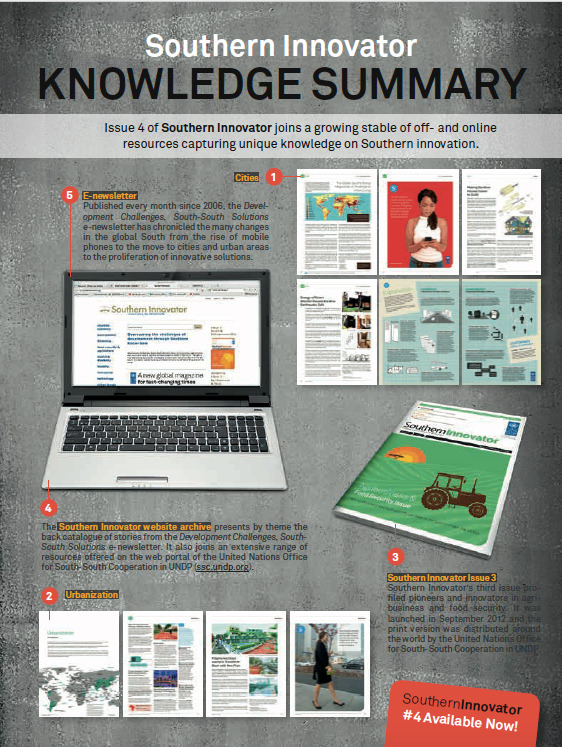
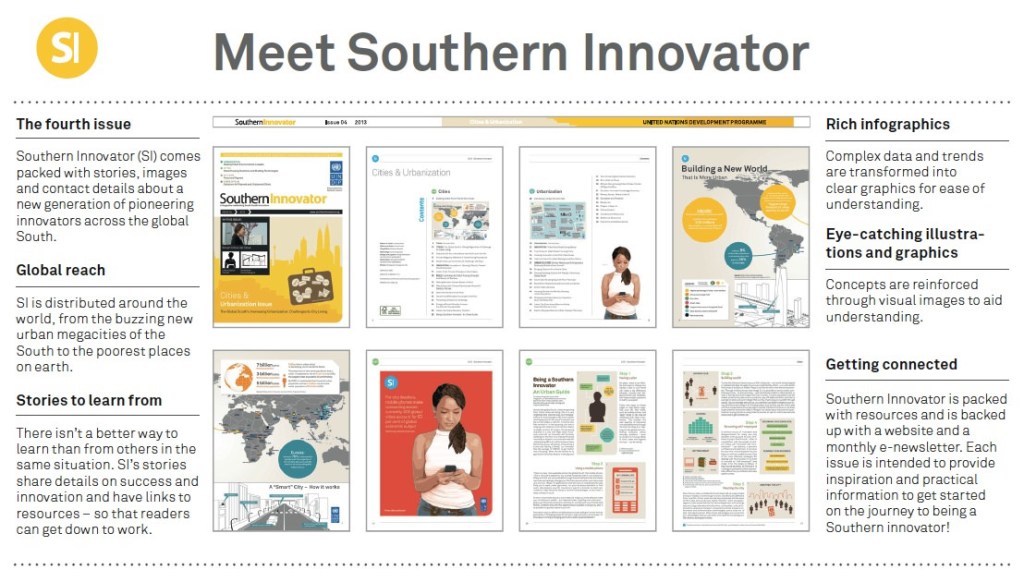
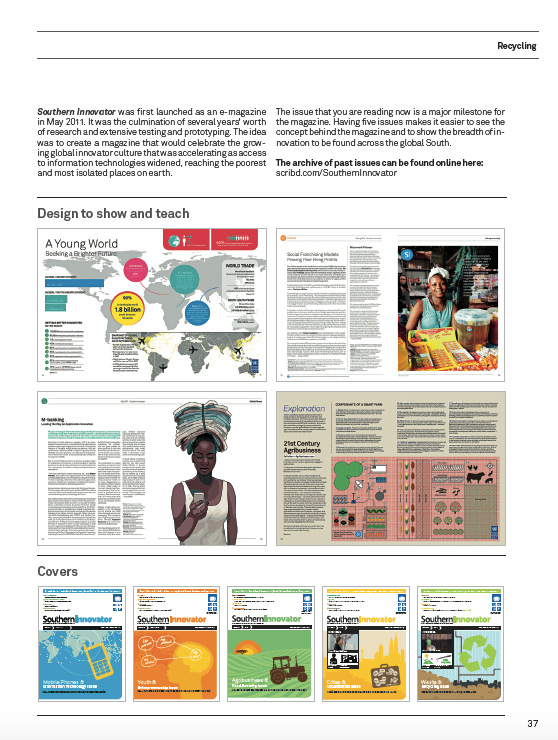
    The fourth issue of Southern Innovator magazine has launched at the Global South-South Development Expo 2013 in Nairobi, Kenya. Southern Innovator Issue 4 visits the new cities being built to tackle the challenges of a rapidly urbanizing 21st-century world. The magazine also highlights some of the solutions being devised to the challenges people face as the world becomes a majority urban place.

    Some innovators are building new cities from scratch, applying the latest thinking and hard-wiring in cutting-edge information technologies and innovative environmental measures to create ‘smart’ cities and eco-cities. Architects are designing and refining homes that are beautiful and functional, easy to build, affordable and conserve energy. Social entrepreneurs are innovating ways to create liveable and socially inclusive urban areas, often in places where planning has been scant and where incomes are very low. All those featured in the magazine were chosen for their focus on improving human development and their ingenuity and fresh thinking.

    Southern Innovator champions a 21st-century global innovator culture. The magazine profiles and celebrates the innovators across the global South finding new ways to tackle poverty, create wealth and improve human development and achieve the Millennium Development Goals (MDGs). In its first issue in September 2011, Southern Innovator featured the people who are re-shaping new information technologies – from mobile phone apps to Internet technologies. Many of the innovators profiled in that first issue came from Kenya.

    SI (southerninnovator.org) is based on intensive research and produced by the United Nations Office for South-South Cooperation in UNDP (UNOSSC) (formerly the Special Unit for South-South Cooperation in UNDP). UNOSSC organizes an annual Global South-South Development Expo (southsouthexpo.org), a roaming celebration and gathering of Southern innovators previously held in New York, Washington, D.C., Geneva, Rome and Vienna. This year’s Expo is being held in Nairobi, Kenya (28 October to 1 November 2013) and is hosted by the UN Environment Programme (unep.org).

    SI is being distributed through the United Nations’ network and partners and reaches some of the world’s poorest and remotest places, as well as the vibrant but stressed growing global megacities. It is hoped the magazine will inspire budding innovators with its mix of stories, essential information, facts and figures, images and graphics.

    We hope you enjoy the magazine and find its content interesting and illuminating: a snapshot of a fast-changing world awash, as we found out, with
    innovators, creators and do-ers making their world a better place. It is possible to sponsor issues of the magazine, either through helping to fund its print run, or through sponsored inserts covering that issue’s theme with relevant content for our readers.

    For more information on Southern Innovator, contact Cosmas Gitta at
    cosmas.gitta@undp.org.

    Press Release 1

    Press Release 3

    Online archives: southerninnovator.orghttp://www.scribd.com/SouthernInnovator. Follow @SouthSouth1

    United Nations General Assembly: Sixty-ninth session, Item 24 (b) of the provisional agenda, Operational activities for development: South-South cooperation for development, 17 July 2014.
    The research informing Southern Innovator Magazine played a part in the formulation of the UN’s post-2015 development agenda, including the Sustainable Development Goals (SDGs).

    https://davidsouthconsulting.org/southern-innovator-scale-up-fundraiser/

    ORCID iD: https://orcid.org/0000-0001-5311-1052.

    © David South Consulting 2022