Categories
Archive

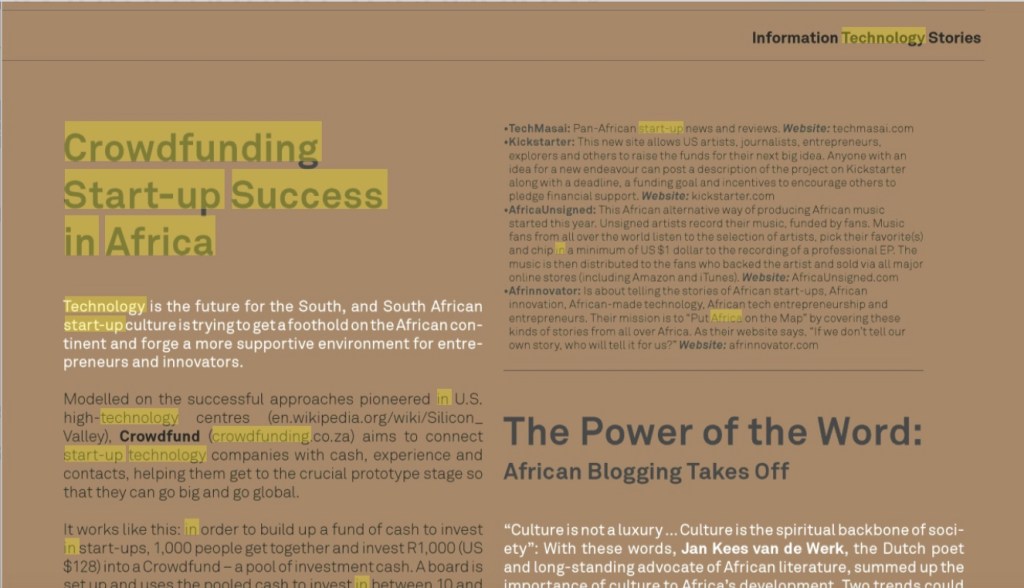
Crowdfunding Technology Start-up Success in Africa

By David SouthDevelopment Challenges, South-South Solutions

SOUTH-SOUTH CASE STUDY

Technology is the future for the South, and South African start-up culture is trying to get a foothold on the African continent and forge a more supportive environment for entrepreneurs and innovators.

Modelled on the successful approaches pioneered in U.S. high-technology centres like California’s Silicon Valley (http://en.wikipedia.org/wiki/Silicon_Valley) , Crowdfund (http://www.crowdfunding.co.za) aims to connect start-up technology companies with cash, experience and contacts, helping them get to the crucial prototype stage so that they can go big and go global.

It works like this: in order to build up a fund of cash to invest in start-ups, 1,000 people get together and invest R1,000 (US $128) into a Crowdfund – a pool of investment cash. A board is set up and uses the pooled cash to invest in between 10 and 20 of the best start-up ideas submitted. The ideas are funded and developed into working prototypes in return for a stake in the business. Once the working prototype is up and running, traditional venture capitalists are approached for further funding and usually Crowdfund will then cash in its equity.

The concept of crowdfunding allows groups of people to use the internet to pool their money together to help support a person or a cause (http://en.wikipedia.org/wiki/Crowd_funding) . There are now many variations on the concept, with online services providing crowdfunding for artists, designers, film-makers, causes, scientists and technology pioneers.

As a model for raising funds for small businesses, the concept has a long history in poor communities across the South. Often, it can be a group of poor women pooling their resources to help each other start small businesses. Technology in the form of the internet and mobile phones has helped the concept jump to the next level, and expanded the pool of people who can support a crowdfunded idea around the world.

It is an answer to the need for so-called “angel funding” (http://en.wikipedia.org/wiki/Angel_investor) : somebody with lots of cash who is willing to help a start-up entrepreneur. Crowdfund’s founders felt South Africa lacked enough angel funders to meet the needs of the country’s technology start-ups. This can be a big problem in countries where there is no history or culture of angel funding and searching far and wide for the “next big idea.”

In April of this year, Crowdfund was able to raise R1 million (over US $128,000) from 229 investors.

Venture capitalists (http://en.wikipedia.org/wiki/Venture_capital) – people or investment groups looking for high-growth start-ups to invest in – usually prefer to put their money into proven ideas for big, fast returns. They often lack interest in smaller ideas that may grow more slowly. It is a classic dilemma: how can an entrepreneur know if their idea will work if nobody will give them the cash to prove it?

This is a critical problem in the information age. As broadband technology spreads across Africa, the opportunities for online businesses will just grow and grow. But few will be able to benefit and African start-ups will not stand a chance against global competition if funding is not available to nurture new businesses.

Crowdfund assesses ideas and identifies skill shortfalls. The cash is used to help with the skills shortage, provide office space, bandwidth, hosting and mentorship. The funded team will also have access to legal, marketing and management experts to get through the development stage and avoid costly mistakes. The development process in stage one takes three months. The Crowdfund Board will then search for potential investors to take the start-up to stage two and a working prototype.

By this stage negotiations will take place to set the start-up off on the path to global success. They are helped with the tricky negotiation process with investors.

Apart from the start-up cash, the powerful idea behind Crowdfund is the network of support and advice that comes with it. Two of the board members are South Africans based in San Francisco, USA, and can make that crucial connection with the buzzing U.S. technology scene. Investors are asked to mentor the start-up concepts, meaning start-ups are accessing normally costly business advice.

Crowdfund tries to get a response back to potential start-ups within 48 hours (http://digitalgarage.co.za/2010/04/12/filtering-the-applications-for-funding/) , so, if you have a great idea, get submitting!

Published: June 2010

Resources

  • TechMasai: Pan-African start-up news and reviews. Website: www.techmasai.com
  • Kickstarter: This new site allows US artists, journalists, entrepreneurs, explorers and others to raise the funds for their next big idea. Anyone with an idea for a new endeavour can post a description of their project on Kickstarter along with a deadline, a funding goal and incentives to encourage others to pledge financial support. Website: http://www.kickstarter.com/
  • AfricaUnsigned: This African alternative way of producing African music started this year. Unsigned artists record their music, funded by fans. Music fans from all over the world listen to the selection of artists, pick their favorite(s) and chip in a minimum of $1 dollar to the recording of a professional EP. The music is then distributed to the fans who backed the artist and sold on all major online stores (incl. Amazon & iTunes). Website: www.AfricaUnsigned.com
  • Afrinnovator: Is about telling the stories of African start-ups, African innovation, African made technology, African tech entrepreneurship and entrepreneurs. Their mission is to ‘Put Africa on the Map’ by covering these kinds of stories from all over Africa. As their website says, “if we don’t tell our own story, who will tell it for us?” Website: http://afrinnovator.com

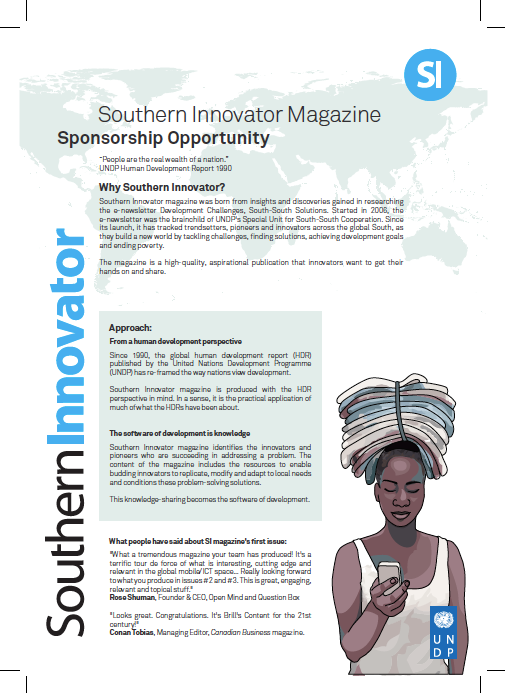
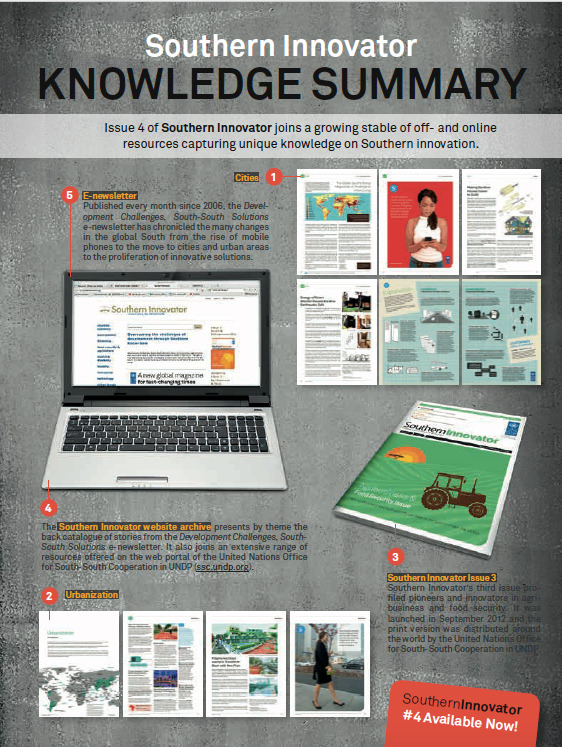
Development Challenges, South-South Solutions was launched as an e-newsletter in 2006 by UNDP’s South-South Cooperation Unit (now the United Nations Office for South-South Cooperation) based in New York, USA. It led on profiling the rise of the global South as an economic powerhouse and was one of the first regular publications to champion the global South’s innovators, entrepreneurs, and pioneers. It tracked the key trends that are now so profoundly reshaping how development is seen and done. This includes the rapid take-up of mobile phones and information technology in the global South (as profiled in the first issue of magazine Southern Innovator), the move to becoming a majority urban world, a growing global innovator culture, and the plethora of solutions being developed in the global South to tackle its problems and improve living conditions and boost human development. The success of the e-newsletter led to the launch of the magazine Southern Innovator. 

Creative Commons License

This work is licensed under a
Creative Commons Attribution-Noncommercial-No Derivative Works 3.0 License.

ORCID iD: https://orcid.org/0000-0001-5311-1052.

© David South Consulting 2022

Categories
Archive

Combating Counterfeit Drugs

By David SouthDevelopment Challenges, South-South Solutions

SOUTH-SOUTH CASE STUDY

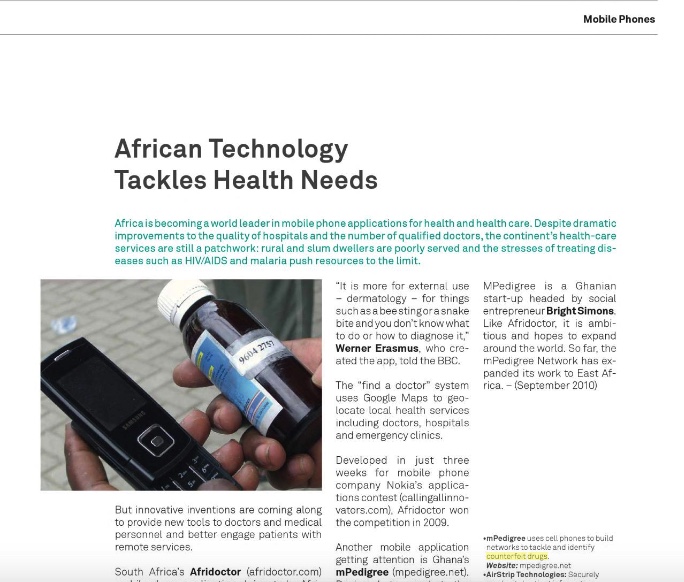
Access to good quality drugs is a serious problem across the South. The International Narcotics Control Board estimates that up to 15 per cent of all drugs sold around the world are fake or counterfeit, and in parts of Africa and Asia this figure jumps to 50 per cent. The US Food and Drug Administration estimates counterfeit drugs make up 10 per cent of the global medicine market. The US Centre for Medicines in the Public Interest predicts counterfeit drug sales will reach US $75 billion globally in 2010, an increase of more than 90 per cent from 2005.

Fake drugs are a major cause of unnecessary death and destroy public confidence in medicines and health services. While counterfeit drugs have been on the rise, there is little co-ordinated or effective action to counter this menace afflicted on the sick.

But in Ghana, a solution has emerged that shows a way to guarantee that quality drugs get to the sick who need them. CareShop Ghana uses the franchise model – where licenses are sold to approved vendors who adhere to strict guidelines – to ensure that the quality, accessibility and affordability of essential medicines in and around Accra is guaranteed. CareShop has made deals with close to 300 franchisee pharmacies – often modest operations – who sell over-the-counter drugs.

In Ghana, preventable and curable illnesses like malaria and diarrhoeal diseases are among the leading causes of death. Their treatment pushes many people to financial despair; they can ill afford the extra burden of worrying about counterfeit drugs and the harm they do. Like many countries in the South, Ghana’s public healthcare system is unable to meet these needs and so most people turn to the private sector for help.

An estimated 65 per cent of people turn to licensed pharmacies. But many of these operate haphazard businesses, dispensing expired or counterfeit drugs.

The Ghana Social Marketing Foundation Enterprises Limited (GSMFEL) founded CareShop in 2002, hoping to battle common infectious diseases in poor areas by making sure good drugs get through to the sick.

GSMFEL makes a small profit as the franchisor by selling high-quality drugs to the franchisees. The key to CareShop’s success is imposing standardization on franchisees, so they have to stick to common diagnosis, quality and pricing. They make more money when they adhere to these rules than when they break them. To ensure there is no tampering with the drugs, they are delivered straight to the vendor’s doorsteps, and it is all backed up with health and business training support and branded materials.

The tide can be turned around on fake drugs: in 2002, the WHO reported that 70 per cent of drugs in Nigeria were fake or substandard: by 2004 that figure had fallen to 48 per cent.

Stimulating private sector solutions to African healthcare problems is now receiving an additional boost from a new fund established by the World Bank’s private sector arm, the International Finance Corporation. Launched in 2007, it offers cash and loans totalling US $500 million to commercial healthcare projects in Africa. According to its own statistics, 60 per cent of health expenditure in sub-Saharan Africa is privately funded, and the market, excluding South Africa, is worth US $19 billion.

Published: May 2008

Resources

  • SafeMedicines.org is a website offering the latest reports on fake medicines and is a good place to report incidences.
    Website: http://safemedicines.org/in_the_news/
  • A paper on the global threat of counterfeit drugs: Click here.

Development Challenges, South-South Solutions was launched as an e-newsletter in 2006 by UNDP’s South-South Cooperation Unit (now the United Nations Office for South-South Cooperation) based in New York, USA. It led on profiling the rise of the global South as an economic powerhouse and was one of the first regular publications to champion the global South’s innovators, entrepreneurs, and pioneers. It tracked the key trends that are now so profoundly reshaping how development is seen and done. This includes the rapid take-up of mobile phones and information technology in the global South (as profiled in the first issue of magazine Southern Innovator), the move to becoming a majority urban world, a growing global innovator culture, and the plethora of solutions being developed in the global South to tackle its problems and improve living conditions and boost human development. The success of the e-newsletter led to the launch of the magazine Southern Innovator.  

Creative Commons License

This work is licensed under a
Creative Commons Attribution-Noncommercial-No Derivative Works 3.0 License.

ORCID iD: https://orcid.org/0000-0001-5311-1052.

© David South Consulting 2022

Categories
Archive Development Challenges, South-South Solutions Newsletters Southern Innovator magazine

Solar Solution to Lack of Electricity in Africa

By David SouthDevelopment Challenges, South-South Solutions

SOUTH-SOUTH CASE STUDY

Electricity is critical to improving human development and living standards. Yet, for many in the global South, electricity is either non-existent or its provision is patchy, erratic, unreliable or expensive.

Just as Africa has been able to jump a generation ahead when it comes to communications through the mass adoption of mobile phones – a much cheaper option than trying to provide telephone wires and cables across the continent – so it could also bypass the burdensome costs of providing electricity mains to everyone by turning to smaller electricity generation technologies such as solar power. This is called “off-grid” electricity.

The UN has set the goal of universal access to modern energy services by 2030. A report issued in April 2010 by United Nations Secretary-General Ban Ki-moon’s Advisory Group on Energy and Climate Change (AGECC) calls for expanding energy access to more than 2 billion people (http://www.unido.org/fileadmin/user_media/Publications/download/AGECCsummaryreport.pdf).

The report found that a lack of access to modern energy services represents a significant barrier to development. Some 1.6 billion people still lack access to electricity.

A reliable, affordable energy supply, the report says, is the key to economic growth and the achievement of the anti-poverty targets contained in the Millennium Development Goals.

When a person has electricity and the lighting it powers, it is possible to do business and study late into the night. Electric lighting also makes streets and living areas safer. Electricity can power a plethora of labour-saving and life-enhancing consumer goods: televisions, refrigerators, vacuum cleaners, air conditioners and fans, washing machines, clothes dryers, computers. And electricity recharges that most essential item, the mobile phone, on which millions rely to do their daily business.

After witnessing the struggle African health clinics have to access electricity, a Nairobi, Kenya-based company has developed a simple solution to ensure a steady supply of solar electricity. One Degree Solar’s (http://onedegreesolar.com/) founder, Gaurav Manchanda, developed and sells the BrightBox solar-charging system for lights, mobile phones, tablet computers and radios.

He first gained experience working in the West African nation of Liberia with the Clinton Health Access Initiative (http://www.clintonfoundation.org/main/our-work/by-initiative/clinton-health-access-initiative/about.html). Working at the country’s Ministry of Health, he found most health clinics operated without electricity.

He identified solar power as the only viable energy source. Trying to deliver fuel to power generators by the road network had two impediments: the diesel fuel was expensive and the road conditions were poor.

After seeing that large solar-power systems required significant maintenance and upkeep, he started to explore the possibility of low-cost, and simple-to-use solar electricity products that would be useful to community healthcare workers.

This became the beginning of One Degree Solar and its mission.

The company’s main product is the BrightBox, a cleverly designed solar charger. A bright orange box with a folding, aluminum handle at the top for easy carrying, it switches on and off simply with a bright red button. It has a waterproof solar panel. The BrightBox has USB (universal service bus) (http://en.wikipedia.org/wiki/Universal_Serial_Bus) ports so that mobile phones and radios can be plugged in. It is also possible to plug in four lights at once with the four outports on the side of the box.

It meets the standards set by the Lighting Africa initiative (http://lightingafrica.org/specs/one-degree-brightbox-2-.html) of the International Finance Corporation and the World Bank.

One Degree Solar claim it is possible to set up a BrightBox in 10 minutes. When the indicator light has turned green, the box is fully charged and capable of providing 40 hours of light.

A full charge can power two light bulbs for 20 hours. Manchanda told How We Made It In Africa (http://www.howwemadeitinafrica.com/) that he has sold 4,000 units of the BrightBox since its launch in October 2012.

According to The Nation, the BrightBox is currently retailing in Kenya for Kenyan shillings 7,000 (US $82).

One Degree Solar’s product range is sold to local resellers and distributors. The products are designed to be repaired using locally sourced parts and can be fixed by local electricians.

Most of the sales so far have been in Kenya but the firm has also sold units to other countries.

Testimonials on the BrightBox website tell of the transformation to people’s lives the clean energy source makes: “BrightBox has helped us in so many ways! We used to spend 800 Shillings (US $9.50) a month for two paraffin lanterns. The fumes smelled and always made us feel sick.”

Manchanda is a strong believer in Africa’s potential and its future and dismisses those who are negative about the continent.

“That was not a holistic assessment, but rather, an unnecessary and damaging generalization,” he told How We Made It In Africa. “Fortunately, most news outlets in Africa are now available online and offer a wider range of perspectives. The middle class is booming in certain countries. We have seen the success of mobile phones in enabling people to access other services. I think hope and progress come with innovation. Technology access has helped create entirely new markets and reach populations that otherwise could have taken decades to service with traditional approaches.

“India was in a similar space 15 years ago before the Internet boom, and today parts of Nairobi (Kenya) are just like Delhi (India): people have a cell phone or two, there are large shopping malls, a booming middle class, and new construction everywhere.”

Published: June 2013

Resources

Global Off-Grid Lighting Association: Global Off-Grid Lighting Association (GOGLA) has been established to act as the industry advocate with a focus on small and medium enterprises. It is a neutral, independent, not-for-profit association created to promote lighting solutions that benefit society and businesses in developing and emerging markets. GOGLA will support industry in the market penetration of clean, quality alternative lighting systems. Website: http://globaloff-gridlightingassociation.org/

Solar Sister: Solar Sister eradicates energy poverty by empowering women with economic opportunity. Website: http://www.solarsister.org/

Solarpod: Sunbird Solar/Thousand Suns manufactures, sources and distributes the portable solar generator range. Website: http://www.thousandsuns.com/

4) Little Sun: An attractive, high-quality solar-powered lamp in the shape of a hand-sized sun developed by artist Olafur Eliasson and engineer Frederik Ottesen. Website: http://www.littlesun.com/

Southern Innovator logo

London Edit

31 July 2013

Development Challenges, South-South Solutions was launched as an e-newsletter in 2006 by UNDP’s South-South Cooperation Unit (now the United Nations Office for South-South Cooperation) based in New York, USA. It led on profiling the rise of the global South as an economic powerhouse and was one of the first regular publications to champion the global South’s innovators, entrepreneurs, and pioneers. It tracked the key trends that are now so profoundly reshaping how development is seen and done. This includes the rapid take-up of mobile phones and information technology in the global South (as profiled in the first issue of magazine Southern Innovator), the move to becoming a majority urban world, a growing global innovator culture, and the plethora of solutions being developed in the global South to tackle its problems and improve living conditions and boost human development. The success of the e-newsletter led to the launch of the magazine Southern Innovator.

Creative Commons License

This work is licensed under a
Creative Commons Attribution-Noncommercial-No Derivative Works 3.0 License.

ORCID iD: https://orcid.org/0000-0001-5311-1052.

© David South Consulting 2023

Categories
Archive Development Challenges, South-South Solutions Newsletters

Poorest Countries Being Harmed by Euro Currency Crisis

By David SouthDevelopment Challenges, South-South Solutions

SOUTH-SOUTH CASE STUDY

The ongoing economic crisis in Europe is forecast to harm the economies of the world’s poorest countries if it continues, according to a study by the United Kingdom’s Overseas Development Institute (ODI) (odi.org.uk).

As an example, Kenya’s shilling currency has weakened and increased the cost of imports, leading to a surge in inflation, while the number of European tourists has declined, according to Business Daily.

Raging since 2009 (http://www.bbc.co.uk/news/business-13856580), the eurozone crisis has seen several European countries struggling to pay debts built up during the boom years, and this has threatened the currency compact among countries that use the euro single currency (http://www.ecb.europa.eu/euro/html/index.en.html). Several countries have introduced harsh austerity measures to try and rein in the debts and stabilize economies while keeping countries within the eurozone.

This has had the consequence of dramatically raising unemployment levels, reducing consumption of goods and services and increasing poverty rates in many European countries. Some governments have responded by reducing the amount of legal labour migration allowed into their countries.

The study estimates that the euro crisis could amount to a loss of US $238 billion for poorer countries from 2012 to 2013 as aid, trade, investment and remittance payments sent home to relatives and friends are damaged by the crisis.

This would particularly harm export-dependent, emerging-market countries. The study found demand was weakening for products from low and low-to-middle income countries. This would in turn harm growth in these countries. Growth in the past decade has helped many countries lift millions of people out of poverty and enabled the growth of new middle classes, who in turn use their rising incomes to purchase consumer goods and invest.

The crisis will cause developing countries’ currencies to drop in value if they are pegged to the euro, and for countries to be economically harmed because of austerity policies in European countries, said the study’s author, Dr. Isabella Massa.

“The EU remains the largest single export market for poorer countries, although it is the emerging BRIC economies which are their main source of imports.”

The European Union (EU) (http://europa.eu/index_en.htm) is the biggest market in the world and the largest importer of goods from developing countries. The ODI report found a 1 per cent drop in global export demand has the knock-on affect of reducing growth in poor countries by 0.5 per cent. The countries most at risk from the crisis are Mozambique, Kenya, Niger, Cameroon, Cape Verde and Paraguay.

For example, 17 per cent of Ivory Coast’s exports go to the EU. Mozambique sends 14 per cent of its exports to the EU and Nigeria sends 10 per cent.

Tajikistan in Central Asia was the most highly dependent economy on remittance payments from its workers living outside the country to prop up its GDP (gross domestic product). Remittance payments from Tajik citizens outside the country made up 40 per cent of GDP.

Liberia and the Democratic Republic of Congo were both heavily dependent on foreign direct investment (FDI) from Europe in 2010.

Many countries have also grown used to strong demand for their resources in recent years as China has rapidly developed and urbanized, sucking in more and more resources from around the world, including sub-Saharan Africa.

“Poor countries are vulnerable to the euro crisis not only because of their exposure (due to dependence on trade flows, remittances, private capital flows and aid) but also because of their weaker resilience compared to 2007, before the onset of the global financial crisis,” said Massa.

“The ability of developing countries to respond to the shock waves emanating from the euro area crisis is likely to be constrained if international finance dries up and global conditions deteriorate sharply.

“The escalation of the euro crisis and the fact that growth rates in emerging BRIC economies, which have been the engine of the global recovery after the 2008-9 financial crisis, are now slowing down make the current situation really worrying for developing countries.”

Despite the gloom, there are many positive and powerful antidotes to this economic crisis, including rising South-South trade and innovation, which shows it is possible to reduce dependency on wealthy-developed countries alone for economic prosperity.

Published: September 2013

Resources

1) UNRISD: United Nations Research Institute for Social Development: The United Nations Research Institute for Social Development (UNRISD) is an autonomous research institute within the UN system that undertakes multidisciplinary research and policy analysis on the social dimensions of contemporary development issues. Website: unrisd.org/

2) The Global Urbanist: News and analysis of cities around the world: planning, governance, economy, communities, environment, international. Website: globalurbanist.com

3) OECD: The global economic crisis is entering a new phase amid signs of a return to positive growth in many countries. But unemployment is likely to remain high and much still needs to be done to underpin a durable recovery. This website will track the recovery. Website: http://www.oecd.org/general/tacklingthecrisisastrategicresponse.htm

4) African Union: This vision of a new,  forward looking, dynamic and integrated Africa will be fully realized through relentless struggle on several fronts and as a long-term endeavor. The African Union has shifted focus from supporting liberation movements in the erstwhile African territories under colonialism and apartheid, as envisaged by the OAU since 1963 and the Constitutive Act, to an organization spear-heading Africa’s development and integration. Website: http://www.au.int/en/

5) Youth-Inclusive Financial Services (YFS-Link) Program website: The first space for financial services providers (FSPs) and youth-service organizations (YSOs) to gather, learn and share about youth-inclusive financial services. Website: http://www.makingcents.com/ourWork/yfsLink.php

6) Triple Crisis Blog: Global Perspectives on Finance, Development and Environment: Website: http://triplecrisis.com/

7) African Economic Outlook: A unique online tool that puts rigorous economic data, information and research on Africa at your fingertips. A few clicks gives access to comprehensive analyses of African economies, placed in their social and political contexts. This is the only place where African countries are examined through a common analytical framework, allowing you to compare economic prospects at the regional, sub-regional and country levels. Website: africaneconomicoutlook.org/en

Creative Commons License

This work is licensed under a
Creative Commons Attribution-Noncommercial-No Derivative Works 3.0 License.

ORCID iD: https://orcid.org/0000-0001-5311-1052.

© David South Consulting 2023