Tag: South-South Case Study

  • Brazil Preserves Family Farms and Keeps Food Local and Healthy 

    Brazil Preserves Family Farms and Keeps Food Local and Healthy 

    By David SouthDevelopment Challenges, South-South Solutions

    (Havana, Cuba), November 2008

    SOUTH-SOUTH CASE STUDY

    Today’s global food crisis sparked by a toxic mix of events – high oil and commodity prices, food scarcity, growing populations, and environmental catastrophes – has woken many up to the urgent need to secure food supplies and help those who grow the world’s food. More and more countries are turning to local and small farms – or family farms – to offer food security when times get rough.

    Right now there are more than 862 million undernourished people around the world (FAO), and U.N. Secretary- General Ban Ki-moon has called for food production to increase 50 percent by 2030 just to meet rising demand. Three-quarters of the world’s poorest people living on less than US $1 a day live in rural areas in developing countries and 85 percent of the world’s farms are of less than two hectares in size.

    There has long been a tension between those who believe in very large farms, agribusiness and mono-crops (http://en.wikipedia.org/wiki/Mono-cropping), and those who believe in having a large number of smaller farms with a wide variety of crops and animals.

    Family farming has been seen as doomed for a long time. In the 19th century, figures like philosopher Karl Marx believed they would be split into capitalist farms and proletarian labour. Most modern economists regard family farming as an archaic way to grow food, destined to give way to agribusiness. Most family farms refute this, saying family farmers have been able to operate with success in both developed and developing countries.

    And small farms have endured. The livelihoods of more than 2 billion people depend on the 450 million smallholder farms across the world. With their families, they account for a third of the world’s population.

    Family farms are critical to weathering economic crises and ensuring a steady and secure food supply. The International Fund for Agricultural Development (IFAD) (www.ifad.org) called earlier this year for small family farms to be put at the heart of the global response to high food prices and to improve food security. And in Brazil, this call is being answered by a bold initiative to create what they call a “social technology”, combining a house building programme with diverse family farms.

    Brazil is currently buying up unused land and distributing it to people making land claims, including Brazil’s Landless Workers Movement (http://www.mstbrazil.org). When they receive land, family farmers often find there is no house on the land, or just a very basic dwelling.

    This is where the Brazilian farmer’s cooperative Cooperhaf: Cooperativa de Habitacao dos Agricultores Familiares (http://www.cooperhaf.org.br/), steps in. It has put together what it calls a “social technology” combining housing and farm diversification to support family farmers.

    “We see the house as the core issue,” said Adriana Paola Paredes Penafiel, a projects adviser with the Cooperhaf. “The farmers can improve their productivity but the starting point is the house.

    “Family farming is very important for the country – 70 percent of food for Brazilians comes from family farming,” said Penafiel. “The government wants to keep people in rural areas.”

    Started in 2001 by a federation of farmers unions, the Cooperhaf works in 14 Brazilian states with family farmers.

    “Family farmers had to organize themselves to deal with housing,” said Penafiel. “The cooperative was formed to mediate between farmers and the government. The farmers have a right in the law to a house.

    “We promote diversification to make farmers less vulnerable: if they lose a crop in macro farming, they lose everything. We encourage diversification and self-consumption to guarantee the family has food everyday. We help to set up a garden.”

    The concept is simple: a good quality home acts as an anchor to the family farm, making them more productive as farmers. The farmers receive up to 6,000 reals (US $2,290) for a house, and can choose designs from a portfolio of options from the Cooperhaf.

    As in other countries, the Cooperhaf and other coops encourage markets and certification programmes to promote family farmed food and raise awareness. Penafiel says promoting the fact that the food is family farmed is critical: to the consumer it is healthier, fresher and contains fewer chemicals than imported produce.

    “We sell a livelihood not a product. If you get to know the product, you are more conscious of what you eat.”

    In the US, there are almost 2 million farms, 80 percent of which are small farms, a large percentage family-owned. More and more of these farmers are now selling their products directly to the public.

    In the UK, family farms are on course to provide 10 percent of the country’s food and drink and be worth £15 billion a year.

    “If we forget them, we actually may get a situation where, while meeting the world’s immediate supply targets, we wind up with an even greater imbalance in the global supply system and greater food insecurity,” said IFAD President Lennart Båge.

    “Most agri business is for export,” said Penafiel. “If we don’t have food in the country, food for poor communities would not be available. This enables farmers to be more autonomous, not having to buy fertilizers and equipment and take on too much debt. That approach is not sustainable as we saw with the so-called Green Revolution.”

    Published: December 2008

    https://davidsouthconsulting.org/2020/12/14/african-farming-wisdom-now-scientifically-proven/

    https://davidsouthconsulting.org/2022/11/16/brazils-agricultural-success-teaches-south-how-to-grow/

    https://davidsouthconsulting.org/2022/10/10/cheap-farming-kit-hopes-to-help-more-become-farmers/

    https://davidsouthconsulting.org/2022/11/18/farmers-weather-fertilizer-crisis-by-going-organic/

    https://davidsouthconsulting.org/2022/11/01/indonesian-food-company-helps-itself-by-making-farmers-more-efficient/

    https://davidsouthconsulting.org/2022/11/23/kenyan-farmer-uses-internet-to-boost-potato-farm/

    https://davidsouthconsulting.org/2021/11/09/pocket-friendly-solution-to-help-farmers-go-organic/

    https://davidsouthconsulting.org/2021/09/16/small-fish-farming-opportunity-can-wipe-out-malnutrition/

    https://davidsouthconsulting.org/2022/11/11/urban-farming-to-tackle-global-food-crisis/

    https://davidsouthconsulting.org/2022/10/18/woman-wants-african-farming-to-be-cool/

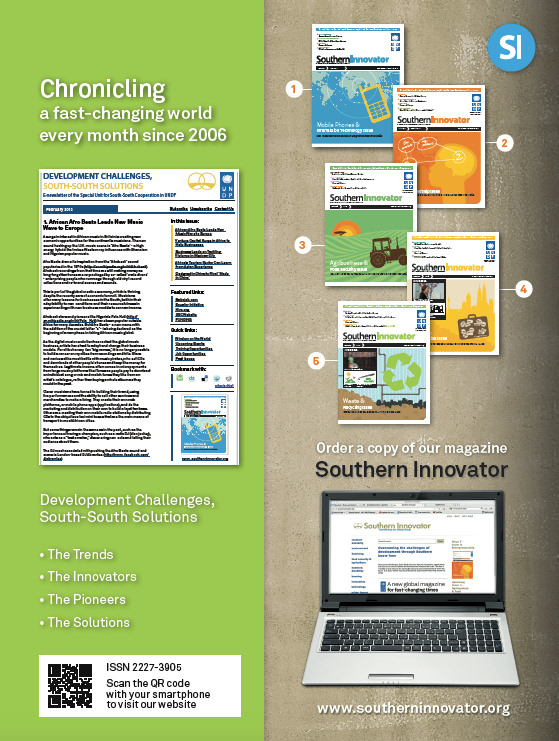
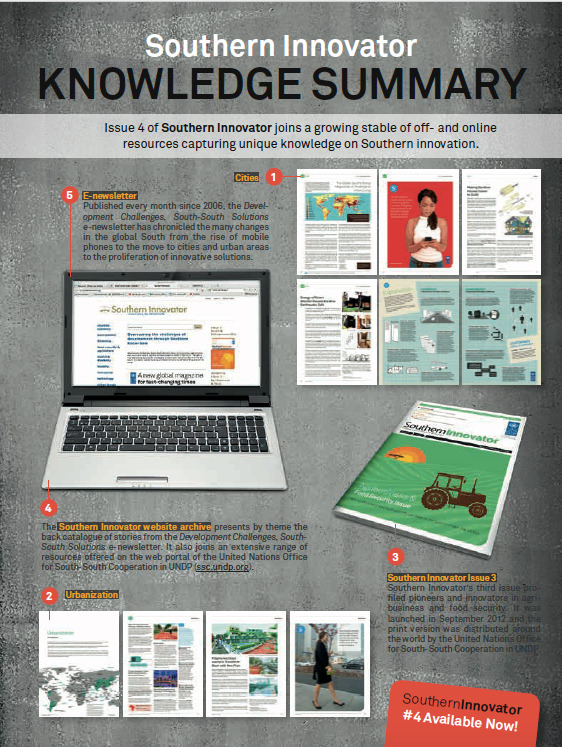
    Development Challenges, South-South Solutions was launched as an e-newsletter in 2006 by UNDP’s South-South Cooperation Unit (now the United Nations Office for South-South Cooperation) based in New York, USA. It led on profiling the rise of the global South as an economic powerhouse and was one of the first regular publications to champion the global South’s innovators, entrepreneurs, and pioneers. It tracked the key trends that are now so profoundly reshaping how development is seen and done. This includes the rapid take-up of mobile phones and information technology in the global South (as profiled in the first issue of magazine Southern Innovator), the move to becoming a majority urban world, a growing global innovator culture, and the plethora of solutions being developed in the global South to tackle its problems and improve living conditions and boost human development. The success of the e-newsletter led to the launch of the magazine Southern Innovator.  

    Follow @SouthSouth1

    Google Books: https://books.google.co.uk/books?id=YtEgTdyZioUC&dq=development+challenges+december+2008&source=gbs_navlinks_s

    Slideshare: http://www.slideshare.net/DavidSouth1/development-challengessouthsouthsolutionsdecember2008issue

    Southern Innovator Issue 1: https://books.google.co.uk/books?id=Q1O54YSE2BgC&dq=southern+innovator&source=gbs_navlinks_s

    Southern Innovator Issue 2: https://books.google.co.uk/books?id=Ty0N969dcssC&dq=southern+innovator&source=gbs_navlinks_s

    Southern Innovator Issue 3: https://books.google.co.uk/books?id=AQNt4YmhZagC&dq=southern+innovator&source=gbs_navlinks_s

    Southern Innovator Issue 4: https://books.google.co.uk/books?id=9T_n2tA7l4EC&dq=southern+innovator&source=gbs_navlinks_s

    Southern Innovator Issue 5: https://books.google.co.uk/books?id=6ILdAgAAQBAJ&dq=southern+innovator&source=gbs_navlinks_s

    https://davidsouthconsulting.org/2021/03/05/southern-innovator-issue-3/

    Creative Commons License
    This work is licensed under a
    Creative Commons Attribution-Noncommercial-No Derivative Works 3.0 License.

    ORCID iD: https://orcid.org/0000-0001-5311-1052.

    © David South Consulting 2023

  • African Fuel Pioneer Uses Crisis to Innovate

    African Fuel Pioneer Uses Crisis to Innovate

    By David SouthDevelopment Challenges, South-South Solutions

    SOUTH-SOUTH CASE STUDY

    Crisis, as the old saying goes, is also a window of opportunity. And there is one African entrepreneur who knows this better than most. Daniel Mugenga has been on a journey of innovation that has led him to become a pioneer in the emerging new field of algae technologies. The story of how he got there is a testament to the power of using business to both solve problems and make profits.

    Kenyan entrepreneur Daniel Mugenga has found a solution to the problem of high fuel costs for the transport sector in his country. He has been making money from turning waste cooking oil and inedible vegetable oil into biodiesel (http://en.wikipedia.org/wiki/Biodiesel). He then discovered that he could boost his production of biodiesel by using marine algae as a source for oil.

    According to the body that represents the algae fuel industry, Oilgae (oilgae.com), algae are “plant-like organisms that are usually photosynthetic and aquatic, but do not have true roots, stems, leaves, vascular tissue and have simple reproductive structures. They are distributed worldwide in the sea, in freshwater and in wastewater. Most are microscopic, but some are quite large, e.g. some marine seaweeds that can exceed 50 m in length.”

    The U.S. Department of Energy has been investigating algae as a fuel source since 1978, and it is being investigated as a potentially transformative fuel source around the world. His business, Pure Fuels Ltd. (http://www.purefuels.co.ke/), is currently seeking venture capital funding for expansion and innovation. Pure Fuels is “a commercial producer of biodiesel and also manufactures biodiesel processors, which we sell to budding entrepreneurs,” says Mugenga.

    The Pure Fuels website educates readers on biodiesel as well as offering opportunities for investors and news updates. Pure Fuels was registered as a business in Kenya in 2010.

    The business was born out of crisis: in 2008 there were frequent fuel shortages in Kenya and prices were volatile. That was bad news for Daniel Mugenga’s job, working for a transport company with a fleet of trucks. Rising or volatile fuel prices can destroy businesses in areas like trucking, where the biggest expense is fuel.

    Mugenga began to do research into fuel alternatives in the crisis and came upon biodiesel. He then set about training in how to produce biodiesel. A period of testing, trials and research ensued between 2008 and 2010, which enabled Pure Fuels to build confidence they had something that was high  quality. The company started producing 120,000 litres of biodiesel in 2010 and increased production to 360,000 litres in 2011 and 700,000 so far in 2012. In 2011, Pure Fuels had revenue of US $230,000 from selling biodiesel.

    “We started off using jatropha oil, but when its price went up it was no longer profitable,” Mugenga told the VC4Africa website blog. “Having invested in the machinery, we switched to the next quickest alternative which is used cooking oil. We source it from several of the tourist hotels along the Kenyan coast.”

    Turning to cooking oil for biodiesel at first was a good idea. The company was able to get enough waste cooking oil from Kenya hotels and tourist resorts to meet demand. But as demand rose, the thorny problem of Kenya’s tourism business being seasonal arose.

    “For about five months of the year, many hotels in Mombasa temporarily shut down or operate at lower capacity. Of course this is affecting the amount of waste cooking oil,” Mugenga said. This is where algae (http://en.wikipedia.org/wiki/Algae) comes in.

    Pure Fuels found a biotechnologist in Kenya to help develop a solution using algae as a source for fuel. While the company is keeping details of its innovation secret, it is currently hunting for investors to help increase the quantity of biodiesel it can make – and in turn, revenues.

    Investor funds would be used to import non-edible vegetable oil and also to continue the company’s work on extracting oil from marine algae.

    Pure Fuels make a bold statement on algae fuel development: it “may actually be Kenya’s next cash crop.”

    Pure Fuels sells several products: there is the biodiesel itself, as well as a processing machine called the GXP-200, which can turn customers into biodiesel manufacturers themselves. The company also builds large, industrial-scale processors that can produce between 1,000 litres and 5,000 litres a day.

    Pure Fuels currently sells fuel to truck, bus and tuk-tuk companies, and also operates biofuel stations.

    The firm has patented its biodiesel and makes all its fuel go through seven quality checks for purity. An in-house laboratory ensures adherence to international standards, and the company is certified by the Kenya Bureau of Standards (http://www.kebs.org/).

    Mugenga is a passionate advocate of biodiesel’s advantages: he believes it is cheaper, and better for engines and for the environment. He admits it does have a disadvantage: it gels below 13 degrees Celsius and must be mixed 50-50 with conventional diesel to stay fluid.

    Pure Fuels encourages others to use biofuels for business, throwing in a home training kit with the biodiesel processors it manufactures and sells, complete with DVDs, manuals and a business plan. The GXP-200 biodiesel processor was developed after years of experience, and Pure Fuels hopes it will be bought by people who then set up businesses – especially youth, women and the disabled. As a further incentive, Pure Fuels promises to buy the biodiesel produced. The GXP-200 was recently awarded “Most Innovative Product 2012” at a small and medium business entrepreneurs event in Nairobi.

    In Israel, there are a number of pioneers working on further developing algae as a biofuel source too. Isaac Berzin of Seambiotic (seambiotic.com) sees algae as a good source for biofuel because it does not compete with food crops like other biofuel sources (sugar, potatoes, corn etc.). Algae is among a group of so-called second-generation biofuels that includes jatropha, wood and castor plants.

    The disadvantage of plant-based fuel sources is they need arable land and water. This seriously holds back their ability to meet the world’s demand for fuel since they would just take up too much land and water. Algae takes up less space and produces a higher yield per acre than conventional crops.

    Seambiotic makes marine microalgae using the CO2 from electric power plant flue gas. It pioneered making large quantities of fuel algae in the United States, creating the first gallons of bio-diesel and bio-ethanol from marine microalgae.

    Seambiotic is also working on a US $10 million commercial microalgae farm in China, partnering with China Guodian (http://www.cgdc.com.cn/), one of the country’s largest power companies. Another Israeli company in this field is UniVerve (http://www.univervebiofuel.com/). Its CEO, Ohad Zuckerman, runs the10-person company in Tel Aviv, Israel. It is developing a new biofuel from a special strain of algae that can grow quickly in a wider range of temperatures.

    Published: July 2012

    Resources

    1) A website with all the details on biodiesel and how to make it. Website: http://www.biodiesel.org/

    2) How to make your own biodiesel. Website: http://journeytoforever.org/biodiesel_make.html

    3) Oilgae is the global information support resource for the algae fuels industry. Website: http://www.oilgae.com/

    4) Algae as a superfood and cancer-fighter: Chlorella. Website: http://en.wikipedia.org/wiki/Chlorella

    Creative Commons License

    This work is licensed under a
    Creative Commons Attribution-Noncommercial-No Derivative Works 3.0 License.

    ORCID iD: https://orcid.org/0000-0001-5311-1052.

    © David South Consulting 2023

  • Poorest Countries Being Harmed by Euro Currency Crisis

    Poorest Countries Being Harmed by Euro Currency Crisis

    By David SouthDevelopment Challenges, South-South Solutions

    SOUTH-SOUTH CASE STUDY

    The ongoing economic crisis in Europe is forecast to harm the economies of the world’s poorest countries if it continues, according to a study by the United Kingdom’s Overseas Development Institute (ODI) (odi.org.uk).

    As an example, Kenya’s shilling currency has weakened and increased the cost of imports, leading to a surge in inflation, while the number of European tourists has declined, according to Business Daily.

    Raging since 2009 (http://www.bbc.co.uk/news/business-13856580), the eurozone crisis has seen several European countries struggling to pay debts built up during the boom years, and this has threatened the currency compact among countries that use the euro single currency (http://www.ecb.europa.eu/euro/html/index.en.html). Several countries have introduced harsh austerity measures to try and rein in the debts and stabilize economies while keeping countries within the eurozone.

    This has had the consequence of dramatically raising unemployment levels, reducing consumption of goods and services and increasing poverty rates in many European countries. Some governments have responded by reducing the amount of legal labour migration allowed into their countries.

    The study estimates that the euro crisis could amount to a loss of US $238 billion for poorer countries from 2012 to 2013 as aid, trade, investment and remittance payments sent home to relatives and friends are damaged by the crisis.

    This would particularly harm export-dependent, emerging-market countries. The study found demand was weakening for products from low and low-to-middle income countries. This would in turn harm growth in these countries. Growth in the past decade has helped many countries lift millions of people out of poverty and enabled the growth of new middle classes, who in turn use their rising incomes to purchase consumer goods and invest.

    The crisis will cause developing countries’ currencies to drop in value if they are pegged to the euro, and for countries to be economically harmed because of austerity policies in European countries, said the study’s author, Dr. Isabella Massa.

    “The EU remains the largest single export market for poorer countries, although it is the emerging BRIC economies which are their main source of imports.”

    The European Union (EU) (http://europa.eu/index_en.htm) is the biggest market in the world and the largest importer of goods from developing countries. The ODI report found a 1 per cent drop in global export demand has the knock-on affect of reducing growth in poor countries by 0.5 per cent. The countries most at risk from the crisis are Mozambique, Kenya, Niger, Cameroon, Cape Verde and Paraguay.

    For example, 17 per cent of Ivory Coast’s exports go to the EU. Mozambique sends 14 per cent of its exports to the EU and Nigeria sends 10 per cent.

    Tajikistan in Central Asia was the most highly dependent economy on remittance payments from its workers living outside the country to prop up its GDP (gross domestic product). Remittance payments from Tajik citizens outside the country made up 40 per cent of GDP.

    Liberia and the Democratic Republic of Congo were both heavily dependent on foreign direct investment (FDI) from Europe in 2010.

    Many countries have also grown used to strong demand for their resources in recent years as China has rapidly developed and urbanized, sucking in more and more resources from around the world, including sub-Saharan Africa.

    “Poor countries are vulnerable to the euro crisis not only because of their exposure (due to dependence on trade flows, remittances, private capital flows and aid) but also because of their weaker resilience compared to 2007, before the onset of the global financial crisis,” said Massa.

    “The ability of developing countries to respond to the shock waves emanating from the euro area crisis is likely to be constrained if international finance dries up and global conditions deteriorate sharply.

    “The escalation of the euro crisis and the fact that growth rates in emerging BRIC economies, which have been the engine of the global recovery after the 2008-9 financial crisis, are now slowing down make the current situation really worrying for developing countries.”

    Despite the gloom, there are many positive and powerful antidotes to this economic crisis, including rising South-South trade and innovation, which shows it is possible to reduce dependency on wealthy-developed countries alone for economic prosperity.

    Published: September 2013

    Resources

    1) UNRISD: United Nations Research Institute for Social Development: The United Nations Research Institute for Social Development (UNRISD) is an autonomous research institute within the UN system that undertakes multidisciplinary research and policy analysis on the social dimensions of contemporary development issues. Website: unrisd.org/

    2) The Global Urbanist: News and analysis of cities around the world: planning, governance, economy, communities, environment, international. Website: globalurbanist.com

    3) OECD: The global economic crisis is entering a new phase amid signs of a return to positive growth in many countries. But unemployment is likely to remain high and much still needs to be done to underpin a durable recovery. This website will track the recovery. Website: http://www.oecd.org/general/tacklingthecrisisastrategicresponse.htm

    4) African Union: This vision of a new,  forward looking, dynamic and integrated Africa will be fully realized through relentless struggle on several fronts and as a long-term endeavor. The African Union has shifted focus from supporting liberation movements in the erstwhile African territories under colonialism and apartheid, as envisaged by the OAU since 1963 and the Constitutive Act, to an organization spear-heading Africa’s development and integration. Website: http://www.au.int/en/

    5) Youth-Inclusive Financial Services (YFS-Link) Program website: The first space for financial services providers (FSPs) and youth-service organizations (YSOs) to gather, learn and share about youth-inclusive financial services. Website: http://www.makingcents.com/ourWork/yfsLink.php

    6) Triple Crisis Blog: Global Perspectives on Finance, Development and Environment: Website: http://triplecrisis.com/

    7) African Economic Outlook: A unique online tool that puts rigorous economic data, information and research on Africa at your fingertips. A few clicks gives access to comprehensive analyses of African economies, placed in their social and political contexts. This is the only place where African countries are examined through a common analytical framework, allowing you to compare economic prospects at the regional, sub-regional and country levels. Website: africaneconomicoutlook.org/en

    Creative Commons License

    This work is licensed under a
    Creative Commons Attribution-Noncommercial-No Derivative Works 3.0 License.

    ORCID iD: https://orcid.org/0000-0001-5311-1052.

    © David South Consulting 2023


  • New Swimwear for Plus-size Women in Brazil

    New Swimwear for Plus-size Women in Brazil

    By David SouthDevelopment Challenges, South-South Solutions

    SOUTH-SOUTH CASE STUDY

    Brazil is well known for its stylish swimwear, with styles usually targeted at young women and those with more conventional, media-friendly body shapes. But now a company is making visiting the beach more comfortable and empowering for plus-size women.

    Prior to the arrival of plus-size swimwear, women turned to over-sized t-shirts and baggy shorts to hit the beach. Now, Brazilian companies are pioneering fashionable and sexy swimwear for women of all sizes.

    Brazil has a well-known beach culture – a culture celebrated over the years in popular pop tunes like ‘The Girl From Ipanema’ (http://en.wikipedia.org/wiki/The_Girl_from_Ipanema). The country has successfully turned its alluring beach culture into lucrative businesses,including fashion enterprises that have become global brands. The global hit brand of beach flip flops Havaianas (havaianas.com) is a good example.

    Lehona (lehona.com.br) makes ‘Moda Praia’ – plus-size – swimwear for women. The swimsuits are specially designed to flatter larger body shapes and give women the confidence to go back to the beach. It is seeking to end the discrimination inherent in beach culture that favours the “thin, the rich and the chic.”

    Body shapes have been changing in Brazil – as they have been across the world and the global South. While one cause is the global obesity crisis -ballooning as diets change with rising prosperity – there is also another, more positive cause: greater access to nutrition and increasing consumption of milk and meat tends to lead to larger body shapes. This has happened across the world and in many countries irrespective of the racial and ethnic background of the people. Norwegians in Northern Europe were once some of the shortest people in Europe and suffered from poverty and malnutrition. But, as food security increased and nutrition improved, they have over time become the second tallest people in Europe behind the Netherlands (The Changing Body: Health, Nutrition,and Human Development in the Western World since 1700).

    For Brazil, malnutrition was widespread until recently. Records show 10 per cent of the country’s rural northeast in the 1970s was considered underweight.

    The Brazilian statistics institute has found the past decade’s economic boom has had another consequence as well as lifting many millions out of poverty. It has found 48 per cent of adult women and 50 per cent of adult men are now overweight. This compares with 1985, when 29 per cent of women and 18 per cent of men were overweight.

    Diets have changed in the intervening years. Rice, beans and vegetables are now in competition with potato chips, processed meats and sugary soft drinks.

    And apart from nutrition and diet changes because of increasing incomes,there is also a cultural change. While the wealthy are more used to lifestyles with plenty of exercise, newly prosperous people do not necessarily have the fitness habit. One study found just 10 per cent of Brazilian teens and adults exercise regularly.

    The Lehona brand has become a quick hit and receives many telephone calls and emails from would-be customers, its owners claim.

    The Brazilian cultural expectation for women’s beachwear is skimpy, showing more rather than less. This prejudices women who do not have slim body shapes or who are not under 30.

    Started in 2010 by clothing designer Clarice Rebelatto and run by her son Luiz Rebelatto, Lehona was started out of personal need.

    “Honestly, the problem went way beyond just bikinis. In Brazil, it used to be that if you were even a little chunky, finding any kind of clothes in the right size was a real problem,” said Clarice Rebelatto, a size 10, to The Associated Press.

    “And I thought, ‘I’m actually not even that big compared to a lot of women out there, so if I have problems, what are they doing?’”

    The approach to the swimsuits is counter to many other brands targeting plus-size women. They are bold and emphasize the shape rather than try to cover it up and hide it.

    The brand sells itself through specialty stores for large and tall women in Brazil. A bikini sells for around 130 reais (US $66).

    “Some brands, they don’t want their image to be associated with chunky women= Only the thin, the rich and the chic,” Luiz Rebelatto told The Associated Press.

    “We’re working from the principle that bigger women are just like everyone else: They don’t want to look like old ladies, wearing these very modest, very covering swimsuits in just black.”

    The plus-size market has even been taken up by conventional Brazilian swimwear manufacturer Acqua Rosa (http://www.acquarosanet.com.br/site/). It released its plus-size line in 2008 and claims sales now account for 70 per cent of their total sales.

    One woman frequenting Copacabana beach copacabana.info) in Rio de Janeiro is Elisangela Inez Soares. She is happy and confident with the new swim suits.

    “It used to be bikinis were only in tiny sizes that only skinny girls could fit into. But not everyone is built like a model,” concludes Soares.

    Published: May 2012

    Resources

    1) Start a Fashion Business: A website packed with step-by-step advice on starting a fashion business. Website: startafashionbusiness.co.uk/

    2) A website compiled by an American fashion expert on how to run a fashion business for profit. Website: http://fashionforprofit.com/about-us/

    3) The catalogue for the Lehona swimsuit line. Website: http://www.lehona.com.br/pdf/lehona_moda_praia_plus_size.pdf

    4) Miss Brazil Plus-Size Beauty Contest: Website: http://www.youtube.com/watch?v=LHLflIgXqgM

    “I think you [David South] and the designer [Solveig Rolfsdottir] do great work and I enjoy Southern Innovator very much!” Ines Tofalo, Programme Specialist, United Nations Office for South-South Cooperation

    Creative Commons License

    This work is licensed under a
    Creative Commons Attribution-Noncommercial-No Derivative Works 3.0 License.

    ORCID iD: https://orcid.org/0000-0001-5311-1052.

    © David South Consulting 2022