Categories
Archive Development Challenges, South-South Solutions Newsletters

Successful Fuel-Efficient Cookers Show the Way

By David SouthDevelopment Challenges, South-South Solutions

SOUTH-SOUTH CASE STUDY

A Kenyan entrepreneur has cooked up a fuel-efficient stove and oven that uses less of a precious national resource: wood from trees.

Most African households using fuel-burning stoves either cannot afford clean-burning fuels like natural gas or electric stoves, or do not have access to them. They are stuck having to burn wood or other materials like animal dung – collectively called biomass – on open fires.

As well as using up wood and contributing to deforestation, there is another downside to these stoves. The use of polluting fuel-burning stoves by half the world’s population – including 80 percent of rural households – is a documented contributor to a host of health problems. Poor households not only have to contend with the ill health effects of dirty water and poor sanitation, the fumes from burning dung, wood, coal or crop leftovers lead to the global deaths of more than 1.6 million people a year from breathing toxic indoor air (WHO).

Two solutions in Kenya are helping people to cook more efficiently (meaning less time wasted on gathering material to burn, and less fuel used) and reducing cooking time by using heat more effectively.

Invented by Dr Maxwell Kinyanjui, the Kinyanjui Jiko is a fuel-efficient charcoal oven that comes in small, medium and large industrial sizes. Made entirely in Kenya, the ovens are custom designed for a variety of environments, from domestic household use and on-the-go safari models to high-capacity models for micro-enterprises and large institutions. Cooks can use the ovens to bake, toast, steam or boil. And they are 40 percent cheaper than cooking with electricity and between 15 and 20 percent cheaper than gas.

Kinyanjui’s Musaki Enterprises Ltd. (www.reskqu.blogspot.com/2009/01/arboretum-project.html) has developed a reputation for pioneering work in developing fuel-efficient stoves and ovens. Its most popular success to date has been the Kenya Ceramic Jiko (jiko is Swahili for cooker), or KCJ, a cheap, simple and effective stove. The company was set up in 1992, but has been involved in international aid-funded research and development efforts since the 1980s.

“My dad was on a very good team of highly motivated individuals in the early 80s who developed the stove through pragmatism, logic and good old-fashioned ingenuity,” said his son, Teddy Kinyanjui. “He then set up the independent Musaki Enterprises.”

The KCJ uses a ceramic liner placed inside a metal container. The metal is usually recycled, often taken from 55 gallon steel drums. The ceramic liner stops the heat energy from simply escaping into the environment and helps to focus the heat on cooking. Simply adding the ceramic liner reduces the stove’s fuel consumption by between 25 and 40 percent. The charcoal or wood sits in the ceramic basin and the burnt ash falls through holes in the bottom of the liner.

The stove design was a result of international and Kenyan cooperation, and has become popular in many African countries, including Uganda, Rwanda, Ethiopia, Malawi, Niger, Senegal and Sudan. It is used in 50 percent of urban homes in Kenya and 16 percent of rural homes.

Musaki Enterprises say the KCJ stoves on average save between 1 and 1.5 tons of CO2 per stove per year compared to other models. In supermarkets, the KCJs retail for around US $5 and the Kinyanjui Jiko ovens start at around US $100.

The deployment of the KCJ stoves has helped in slowing the deforestation of the country, but has not been able to bring it to a halt because of population growth and poor re-forestation efforts, says Teddy Kinyanjui.

“The lack of forward planning in tree planting is making firewood and charcoal harder and harder to obtain,” he said. “Fossil fuels are unavailable or unaffordable. Tree planting must begin now on a huge scale for people to continue cooking.”

Teddy won’t reveal how profitable the KCJ stoves have been, but says, “I wouldn’t have gone to school if they didn’t sell well.”

“Well, more and more people keep buying the damn things as fast as we can make them, so I think our customers like them,” he said. “They really all seem to like that the stoves cook really well for really cheap and are very high quality.”

Published: June 2009

Resources

https://davidsouthconsulting.org/2021/02/20/baker-cookstoves-designing-for-the-african-customer/

https://davidsouthconsulting.org/2022/02/14/cleaner-stoves-to-reduce-global-warming/

https://davidsouthconsulting.org/2022/02/11/cooking-bag-helps-poor-households-save-time-money/

https://davidsouthconsulting.org/2022/02/15/innovative-stoves-to-help-the-poor/

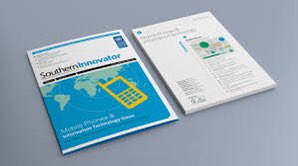
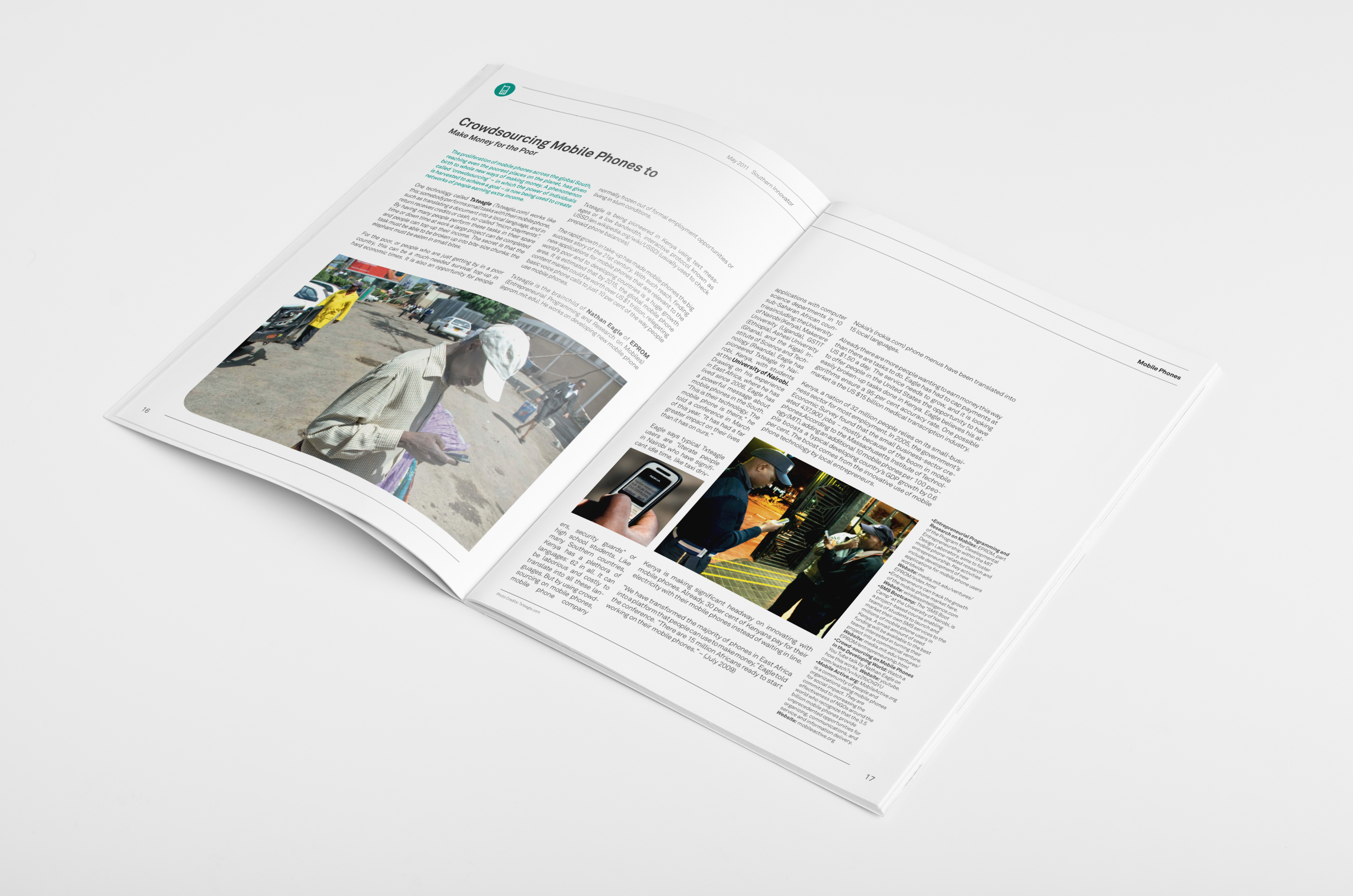
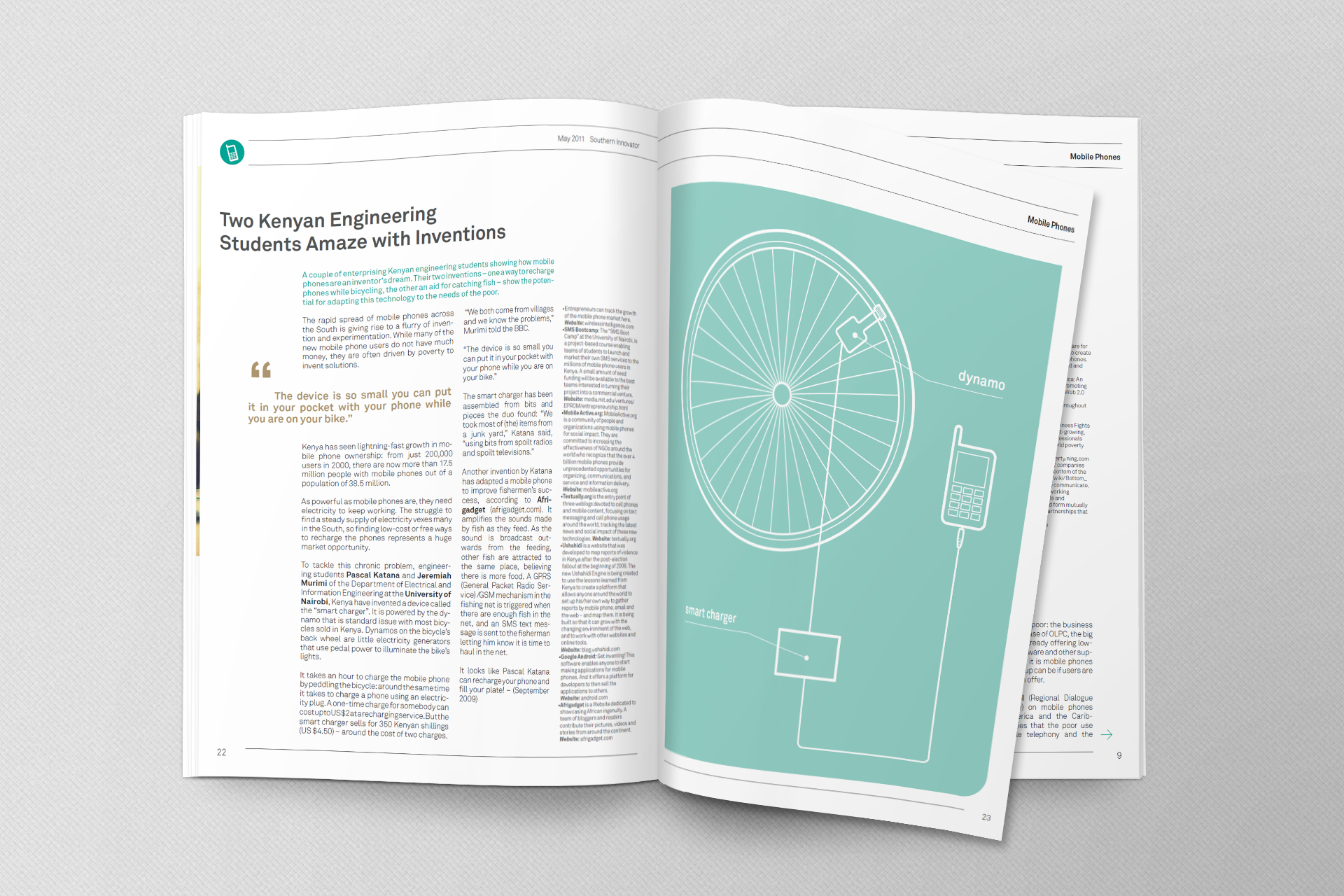
Development Challenges, South-South Solutions was launched as an e-newsletter in 2006 by UNDP’s South-South Cooperation Unit (now the United Nations Office for South-South Cooperation) based in New York, USA. It led on profiling the rise of the global South as an economic powerhouse and was one of the first regular publications to champion the global South’s innovators, entrepreneurs, and pioneers. It tracked the key trends that are now so profoundly reshaping how development is seen and done. This includes the rapid take-up of mobile phones and information technology in the global South (as profiled in the first issue of magazine Southern Innovator), the move to becoming a majority urban world, a growing global innovator culture, and the plethora of solutions being developed in the global South to tackle its problems and improve living conditions and boost human development. The success of the e-newsletter led to the launch of the magazine Southern Innovator. 

https://davidsouthconsulting.org/2021/03/05/southern-innovator-issue-5/

Creative Commons License

This work is licensed under a
Creative Commons Attribution-Noncommercial-No Derivative Works 3.0 License.

ORCID iD: https://orcid.org/0000-0001-5311-1052.

© David South Consulting 2022

Categories
Archive Development Challenges, South-South Solutions Newsletters

Maker Faire and the R & D Rise in the South

By David SouthDevelopment Challenges, South-South Solutions

SOUTH-SOUTH CASE STUDY

The majority of the world’s research and development (R & D) in science and technology is now shifting to the global South. Powerhouses like China boast vast numbers of published papers in peer-reviewed journals and hefty cash inputs into research and development.

China increased its R & D spending in 2009 to US $25.7 billion, a 25.6 percent increase over 2008, according to Du Zhanyuan, vice minister of the Ministry of Science and Technology. China is rapidly closing the science funding gap with Japan: in 2009 it allotted US $37.1 billion for R & D.

The times have never been better for those with new ideas in the global South.

And it’s not just big companies that are involved. There is R & D going on at ground level as well. African inventors, innovators and creatives met in Nairobi, Kenya in August as part of the Maker Faire Africa 2010 (http://makerfaireafrica.com). This is research and development on a shoestring, and done in a very practical, problem-solving way. While Africa’s inventors and innovators lack the big budgets of other economies, they are not short on ideas and drive.

The Maker Faire Africa is a family-friendly gathering where the inventors can showcase their work and connect with others. It is a mix of workshops, tips on business skills, awards and a party.

The global economy thrives on innovation and so-called ‘creative destruction’ – as economist Joseph Schumpeter called it (http://en.wikipedia.org/wiki/Creative_destruction) – that takes place as out-of-date technologies and ways of doing are surpassed by better ideas and more efficient methods. The power to innovate is the deciding factor for sustained economic growth.

The philosophy behind Maker Faire Africa 2010 – the brainchild of ‘venture catalyst’ and entrepreneur Emeka Okafor (http://timbuktuchronicles.blogspot.com) – is to prove that innovation doesn’t just happen with computers.

As its website says, “The aim of a Maker Faire-like event is to create a space on the continent where Afrigadget-type innovations (http://www.afrigadget.com), inventions and initiatives can be sought, identified, brought to life, supported, amplified, propagated, etc.”

Maker Faire Africa is working with research organizations like Ghana’s Ashesi University (http://www.ashesi.edu.gh/index.html) and Kwame Nkrumah University of Science and Technology (http://www.knust.edu.gh/pages) “to sharpen focus on locally-generated, bottom-up prototypes of technologies that solve immediate challenges to development.”

In the end, the goal of engaging all this creative and inventive energy is to spur Africans towards building “a manufacturing base that supplies innovative products in response to market needs.”

This initiative stands out in several ways: it is truly inspiring, it gets to the core of how wealth is created, and helps build communities of innovators and inventors to tackle the problems facing Africa – and humanity.

“We have a broader variety of makers this time around,” says Emeka Okafor of the 2010 Maker Faire. He notes makers are bringing more complex systems to the Faire, rather than just single devices. And that they “have more makers who are actually from the region.”

“Maker Faire Africa is essentially a platform whereby innovators, inventers, creative types, across all disciplines, share ideas, showcase their products, interact with attendees and other makers,” he continues. They “begin the process of building what we think is an essential community of what I like to term the productive class. That is essentially where we see ourselves playing a key role. A productive class whose foundation is laid upon building problem-solving systems.”

Okafor believes Africa just doesn’t “have enough wealth creation as we should.”

“We have things backwards. … One of the essential steps is that you had productive systems that allowed those countries (Asia and Europe) to create wealth. And they had to draw those resources from within.

“We see Maker Fair Africa celebrating resources that we already have, with knowledge from within and outside.

“In many ways the Makers as we see them, epitomise the very sense of problem-solving that as a society acquires more of it, it begins to deal with its challenges very differently. And not look elsewhere in terms of dealing with its challenges. We want to make our Makers sexy, we want to make inventors sexy, innovators celebrities.”

Some of the inspiring inventors from this year’s Faire include Norbert Okec from Uganda. His prototype for a solar powered street lighting system comes straight from his frustration with the traffic lights of Kampala, Uganda. Many don’t work and so he has developed a prototype solar-powered traffic light using a mix of recycled local parts and some LEDs (http://en.wikipedia.org/wiki/Light-emitting_diode) brought by a friend from China.

He hopes to produce an e-book on his invention to share with other inventors. He was joined by fellow inventors working on a dashboard for managing wireless networks, how to recycle plastic parts, solar-power torches, water and sanitation products, junk art, community cookers, sculptures, eye glasses, bicycles, and an automatic lighting system for homes.

Okafor is a passionate advocate of the Maker philosophy and how it changes the game: “…building is equivalent to making and making is a joyful thing, it is an interesting thing. It is a very satisfactory thing. It is not work. Most of the individuals around here have the biggest smiles on their faces. They don’t see what they are doing as work.

“The fact they are sitting next to other people like them if anything is one of the biggest take-aways for them. Because for some of them they were toiling away on their own. Now they see others like them. And they realise they aren’t crazy.

“When you build a community and the community begins to get stronger and sustain itself, all the other things come naturally: businesses get formed, partnerships happen: and then everything else people look for first…actually begins to happen.”

And Africa’s future prosperity is what is at stake at the Faire: “There is a market for the products. And we believe as more individuals – Africans and otherwise – come into contact with what is on display, they will come to see their own societies differently. ”

Published: September 2010

Resources

  • Flickr photo gallery: A clickable archive of the Maker Faire inventors and their inventions. Website: http://www.flickr.com/groups/makerfaireafrica/pool/
  • Afrigadget: ‘Solving everyday problems with African ingenuity’: This blog never ceases to amaze and fascinate. Website: http://www.afrigadget.com/
  • Afrobotics: A competition for African engineering students to develop robots. Website: http://www.afrobotics.com/
  • International Development Design Summit: The Summit is an intense, hands-on design experience that brings together people from all over the world and all walks of life to create technologies and enterprises that improve the lives of people living in poverty. Website: http://iddsummit.org/
  • Butterflyworks: A social design studio using design to make social change. They use media, social branding and experiential learning to share knowledge, trigger creativity and build sustainable businesses. Website: http://www.butterflyworks.org
  • AshokaTECH: AshokaTECH is a blog about technology and invention within the realm of social entrepreneurship. It aims to find, support, and celebrate social innovators whose technologies offer fresh, effective approaches to advancing social change. Website: http://tech.ashoka.org/

Development Challenges, South-South Solutions was launched as an e-newsletter in 2006 by UNDP’s South-South Cooperation Unit (now the United Nations Office for South-South Cooperation) based in New York, USA. It led on profiling the rise of the global South as an economic powerhouse and was one of the first regular publications to champion the global South’s innovators, entrepreneurs, and pioneers. It tracked the key trends that are now so profoundly reshaping how development is seen and done. This includes the rapid take-up of mobile phones and information technology in the global South (as profiled in the first issue of magazine Southern Innovator), the move to becoming a majority urban world, a growing global innovator culture, and the plethora of solutions being developed in the global South to tackle its problems and improve living conditions and boost human development. The success of the e-newsletter led to the launch of the magazine Southern Innovator. 

Creative Commons License

This work is licensed under a
Creative Commons Attribution-Noncommercial-No Derivative Works 3.0 License.

ORCID iD: https://orcid.org/0000-0001-5311-1052.

© David South Consulting 2022

Categories
Archive Blogroll Southern Innovator magazine Special Unit for South-South Cooperation United Nations Development Programme United Nations Office for South-South Cooperation

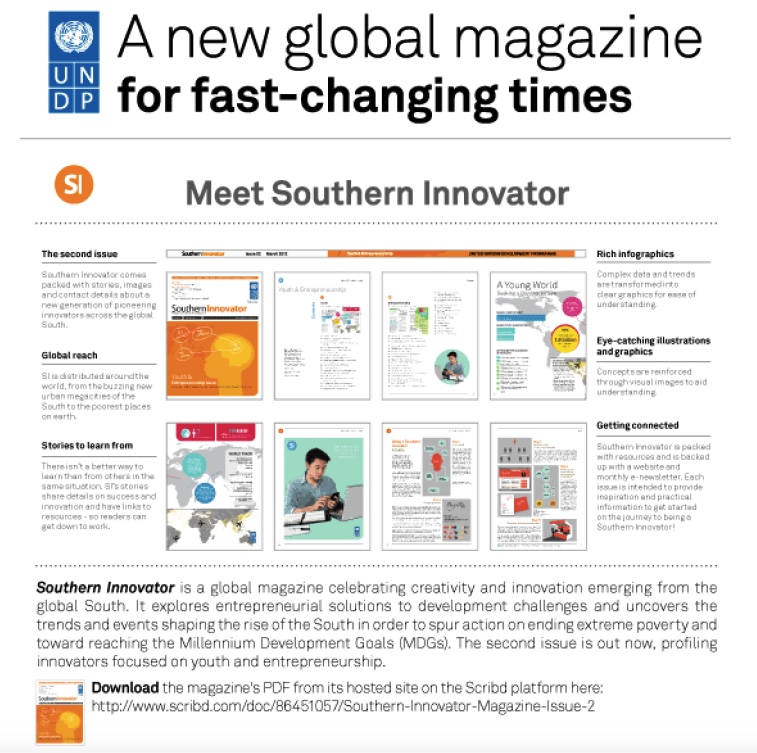
Southern Innovator Magazine | 2010 – 2014 

By David South

“I think you [David South] and the designer [Solveig Rolfsdottir] do great work and I enjoy Southern Innovator very much!” 

Ines Tofalo, Programme Specialist, United Nations Office for South-South Cooperation
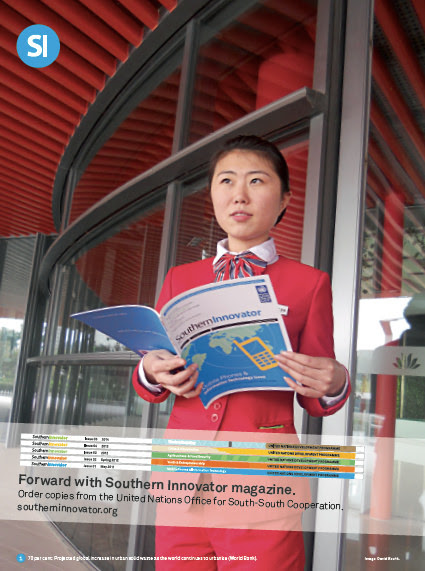
Southern Innovator in Tianjin, China.
Issue 5 of Southern Innovator at the Global South-South Development Expo (GSSD Expo) 2014 held in Washington, D.C.
Volunteers in Nairobi, Kenya pose with Southern Innovator Issue 4 at the Global South-South Development Expo (GSSD Expo) in 2013.
Southern Innovator Editor and Writer David South in Australia.
Southern Innovator Graphic Designer and Illustrator Sólveig Rolfsdóttir in Iceland.

Some comments that have come in so far about SI’s first issue:

“What a tremendous magazine your team has produced! It’s a terrific tour de force of what is interesting, cutting edge and relevant in the global mobile/ICT space… Really looking forward to what you produce in issues #2 and #3. This is great, engaging, relevant and topical stuff.”, to “Looks great. Congratulations. It’s Brill’s Content for the 21st century!”

What they are saying about SI on Twitter: From @CapacityPlus Nice job RT @ActevisCGroup: RT @UNDP: Great looking informative @SouthSouth1 mag on South-South Innovation; @UNDP Great looking informative @SouthSouth1 mag on South-South Innovation; @JeannineLemaireGraphically beautiful & informative @UNDP Southern Innovator mag on South-South Innov. 

And on Pinterest:

Peggy Lee • 1 year ago 

“Beautiful, inspiring magazine from UNDP on South-South innovation. Heart is pumping adrenaline and admiration just reading it”

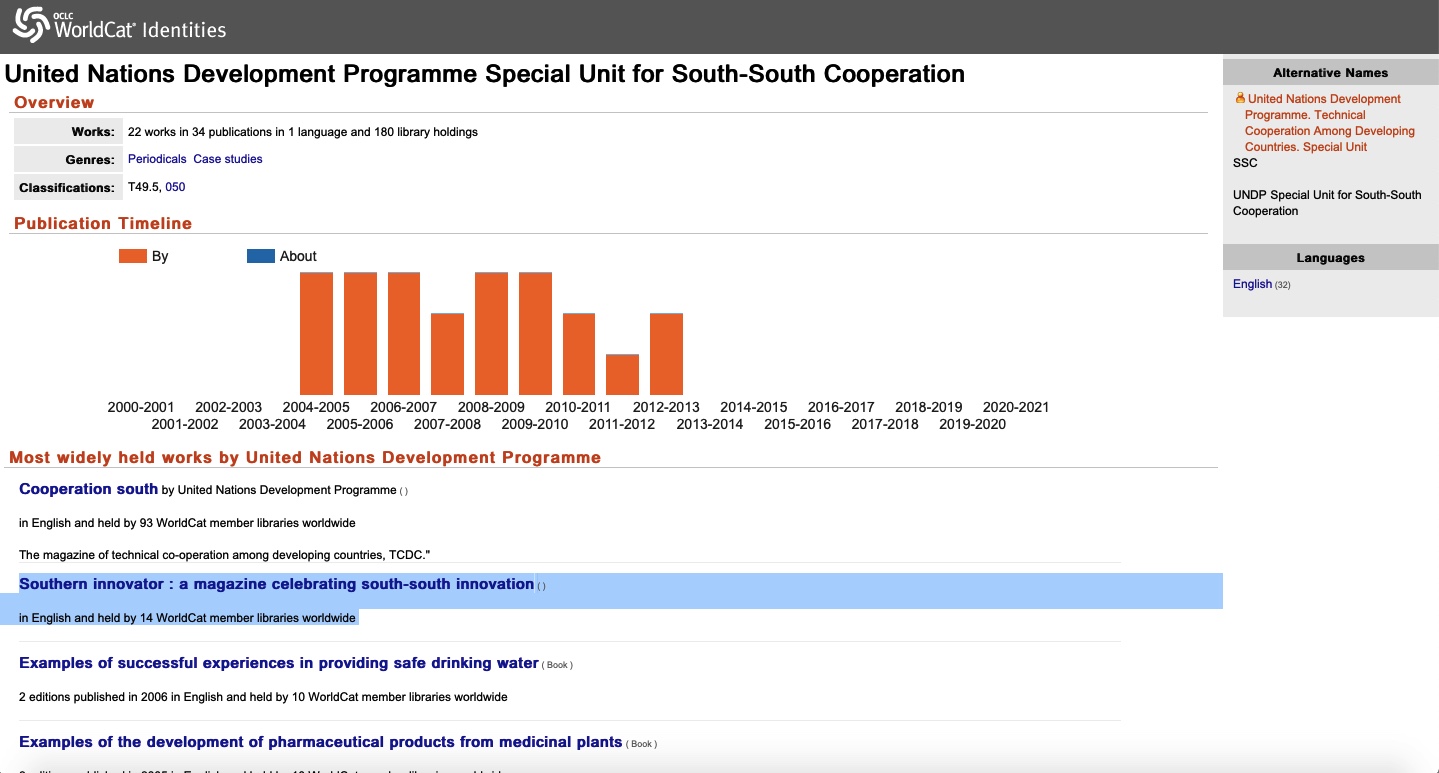
Southern Innovator Magazine can be found in libraries around the world.

Development Challenges, South-South Solutions was launched as an e-newsletter in 2006 by UNDP’s South-South Cooperation Unit (now the United Nations Office for South-South Cooperation) based in New York, USA. It led on profiling the rise of the global South as an economic powerhouse and was one of the first regular publications to champion the global South’s innovators, entrepreneurs, and pioneers. It tracked the key trends that are now so profoundly reshaping how development is seen and done. This includes the rapid take-up of mobile phones and information technology in the global South (as profiled in the first issue of magazine Southern Innovator), the move to becoming a majority urban world, a growing global innovator culture, and the plethora of solutions being developed in the global South to tackle its problems and improve living conditions and boost human development. The success of the e-newsletter led to the launch of the magazine Southern Innovator. 

https://davidsouthconsulting.org/southern-innovator-scale-up-fundraiser/

Creative Commons License

This work is licensed under a
Creative Commons Attribution-Noncommercial-No Derivative Works 3.0 License.

ORCID iD: https://orcid.org/0000-0001-5311-1052.

© David South Consulting 2022

Categories
Archive Development Challenges, South-South Solutions Newsletters Southern Innovator magazine

Making Bamboo Houses Easier to Build

By David SouthDevelopment Challenges, South-South Solutions

SOUTH-SOUTH CASE STUDY

More than 1 billion people around the world lack decent shelter. Of these, the majority live in urban areas, usually in slums and informal settlements (UN-HABITAT). Latin America has a serious shortage of adequate housing: in Colombia, 43 percent of the population needs decent housing; in Brazil, 45 percent; Peru, 53 percent.

The challenge is to provide good quality homes without significantly harming the environment – and with constrained budgets. Bamboo – cheap, strong, quickly renewable and beautiful to look at (http://en.wikipedia.org/wiki/Bamboo) – is an ideal solution to replace traditional wood lumber. In Bolivia, pioneering work is underway to improve the quality of homes and buildings made with bamboo.

Bamboo is the fastest growing woody plant in the world, sometimes growing over 1 metre a day. Bolivia (http://en.wikipedia.org/wiki/Bolivia) has about 17 identified bamboo species, of which five have a significant economic value. Around the world, there are 1,000 species of bamboo. They grow in a wide variety of climates, from cold mountains to hot tropical regions.

Once called the “poor man’s timber” – a temporary building material to replace once there is more money – bamboo is now getting the respect it deserves. Bamboo for housing has a long history in Latin America, stretching back 4,500 years to ancient civilizations. In Asia, it has long been a traditional construction material. But most of the existing bamboo dwellings in Latin America are 50 to 100 years old.

The most popular species of bamboo used in South America is Guadua, which is known for being large, straight and attractive.

“In Bolivia, there is no other building material more competitive in costs,” said Jose Luis Reque Campero, coordinator of the Bolbambu Programme of the Architectural Research Institute, Universidad Mayor de San Simon, Bolivia (http://www.umss.edu.bo/).

“Bamboo is the material that requires less energy, followed by wood and concrete, with steel in last place, needing energy necessary for its production 50 times greater than that required by bamboo.”

Campero also says bamboo is much less expensive than traditional building materials.

“But the biggest advantage is certainly the possibility of planting bamboo, and then reaping houses,” he said.

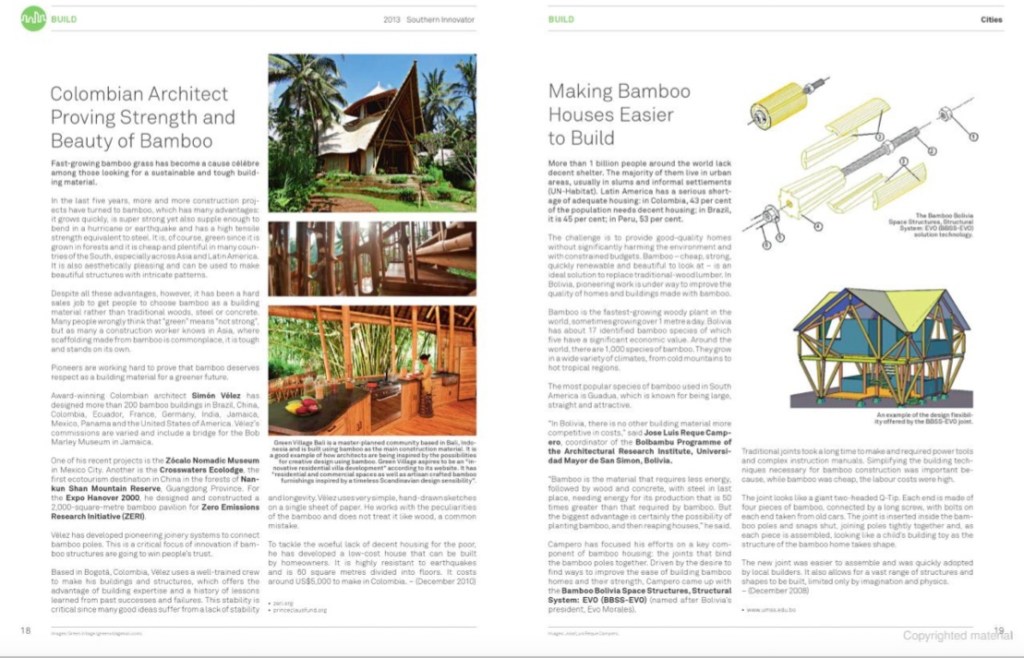
Campero has focused his efforts on a key component of bamboo housing: the joints that bind the bamboo poles together. Driven by the desire to find ways to improve the ease of building bamboo homes and their strength, Campero came up with the Bamboo Bolivia Space Structures, Structural System: EVO (BBSS-EVO) (named after Bolivia’s president, Evo Morales – http://en.wikipedia.org/wiki/Evo_Morales).

Traditional joints took a long time to make and required power tools and complex instruction manuals. Simplifying the building techniques necessary for bamboo construction was important because, while bamboo was cheap, the labour costs were high.

The joint looks like a giant two-headed Q-Tip. Each end is made of four pieces of bamboo, connected by a long screw with bolts on each end taken from old cars. The joint is inserted inside the bamboo poles and snaps shut, joining poles tightly together and, as each piece is assembled, looking like a child’s building toy as the structure of the bamboo home takes shape.

The new joint was easier to assemble and was quickly adopted by local builders. It also allows for a vast range of structures and shapes to be built, limited only by imagination and physics.

Devising joints made from bamboo has the advantage of avoiding the weight and cost of bringing in concrete, especially to remote areas.

“The manufacturing process is fully in the workshop and indoors,” said Campero, “which in addition to allowing a degree of quality control in production, improves working conditions for staff and protects the material.”

The whole building process adheres to “the principles of the famous phrase: ‘do-it-yourself’.”

The Evo joint allows for flexibility and easy assembly and disassembly, enabling the builder to move around parts of the structure and not be wedded to the original structural plan. This has the advantage of customizing the building to its physical location.

Working in the tropical forests of Cochabamba (http://en.wikipedia.org/wiki/Cochabamba), Campero has been testing his designs with the local people, who were looking to improve the tourist infrastructure in the resort town of Cristal Mayu.

Costa Rica in Central America – ironically a country without indigenous bamboo plants – has used its National Bamboo Project of Costa Rica (http://www.unesco.org/most/centram1.htm) to prove it is possible to both cultivate bamboo and use it to provide housing for the poor, confirming the wisdom of millions of people: bamboo is economical, convenient, safe and looks great.

Campero has received a great deal of interest in his innovations and is looking for funding partners in 2009 to take his work further.

He has this advice for other builders and designers: “Stick to developing local technologies, use what you have and innovate, use native materials and the local environment for the development of elements, components and construction systems. Don’t rely on advanced technology tools for manufacture, and stay in harmony with the human need for creativity.”

Published: December 2008

Resources

  • UNEP, the UN’s Environment Programme, has produced a report on bamboo biodiversity and how it can be preserved. Website: http://www.unep-wcmc.org
  • The Asian Development Bank is using its Markets for Poor programme to link bamboo products to marketplaces, helping poor communities. Website:http://www.markets4poor.org/
  • The United Nations Human Settlements Programme, UN-HABITAT, is the United Nations agency for human settlements. It is mandated by the UN General Assembly to promote socially and environmentally sustainable towns and cities with the goal of providing adequate shelter for all. Website: www.unhabitat.org

https://davidsouthconsulting.org/2022/10/26/bamboo-becomes-transport-option-for-the-south/

https://davidsouthconsulting.org/2022/10/26/colombian-architect-proving-strength-and-beauty-of-bamboo/

https://davidsouthconsulting.org/2021/11/11/decent-and-affordable-housing-for-the-poor/

https://davidsouthconsulting.org/housing/

https://davidsouthconsulting.org/2022/11/16/housing-innovation-in-souths-urban-areas/

https://davidsouthconsulting.org/2021/11/11/housing-solution-for-worlds-growing-urban-population/

https://davidsouthconsulting.org/2021/02/12/rebuilding-after-chinese-earthquake-beautiful-bamboo-homes/

https://davidsouthconsulting.org/2022/11/17/tiny-homes-to-meet-global-housing-crisis/

Development Challenges, South-South Solutions was launched as an e-newsletter in 2006 by UNDP’s South-South Cooperation Unit (now the United Nations Office for South-South Cooperation) based in New York, USA. It led on profiling the rise of the global South as an economic powerhouse and was one of the first regular publications to champion the global South’s innovators, entrepreneurs, and pioneers. It tracked the key trends that are now so profoundly reshaping how development is seen and done. This includes the rapid take-up of mobile phones and information technology in the global South (as profiled in the first issue of magazine Southern Innovator), the move to becoming a majority urban world, a growing global innovator culture, and the plethora of solutions being developed in the global South to tackle its problems and improve living conditions and boost human development. The success of the e-newsletter led to the launch of the magazine Southern Innovator. 

Creative Commons License

This work is licensed under a
Creative Commons Attribution-Noncommercial-No Derivative Works 3.0 License.

ORCID iD: https://orcid.org/0000-0001-5311-1052.

© David South Consulting 2023