Tag: South-South Case Study

  • African Digital Laser Breakthrough Promises Future Innovation

    African Digital Laser Breakthrough Promises Future Innovation

    By David SouthDevelopment Challenges, South-South Solutions

    SOUTH-SOUTH CASE STUDY

    For decades many African countries have experienced low investment in research and development (R&D) and scientific innovation. One of the few nations to benefit from a sophisticated university network and research and development sector was South Africa. It still ranks top on the continent for funding R&D and its high number of scientific journals.

    And it seems this support has paid off in a recent innovation. The world’s first digital laser designed and built in Africa has been developed by a team of physicists at the University of KwaZulu–Natal in South Africa (http://www.ukzn.ac.za/), as reported in the MIT Technology Review (http://www.technologyreview.com/).

    This innovation joins a positive trend in Africa, where support to science, technology and R&D is rising – albeit from a very low base. In 2010 UNESCO – the United Nations Educational, Scientific and Cultural Organization – found Africa was reversing decades of neglect in research and development. African countries were increasing investment in science and technology after realizing it will accelerate their connection with the global economy and help create better-quality jobs to tackle poverty. The UNESCO Science Report found Burkina Faso, Kenya, Nigeria and South Africa had adopted laws to support biotechnology research, for example.

    Since 2005, six new science academies have been established in Mauritius, Morocco, Mozambique, Sudan, Tanzania and Zimbabwe. This compares to nine established between 1902 and 2004.

    The proportion of GDP (gross domestic product) devoted to R&D averages 0.3 per cent in Africa, according to UNESCO.

    South Africa continues to lead in R&D spending, raising its investment from 0.73 per cent of GDP in 2001 to 0.94 per cent in 2006. The country is home to 46 per cent of Africa’s scientific publications compared to 11.4 per cent in Nigeria and 6.6 per cent in Kenya (UNESCO).

    Experts say the digital laser developed in South Africa is a breakthrough that will open up ever-further innovations and business opportunities.

    So, what is a digital laser and what is the innovation? A laser is short form for Light Amplification by Stimulated Emission of Radiation. It is a device that produces a concentrated light source. Unlike conventional light sources that emit a diffused, multispectral light, lasers allow for a monochromatic light beam to be concentrated on a small area. This can be used to cut an object precisely, or beamed over long distances without losing its strength.

    Lasers can create immense light, heat and power at close range and are regularly used in surgery and medical diagnosis.

    Conventional lasers require external devices to alter and bend the laser light beam. The digital laser allows the shape of the beam to be digitally altered internally at the touch of a computer keyboard and gives greater immediate control. This means a plethora of new shapes can be formed with the laser beam, and this can have many practical applications.

    The digital laser augers in a new age of creativity with lasers and more spontaneity in how they are used. Rather than having to place a lens or mirror at the front of the casing to shape the laser beam, this innovation makes it possible to create any shape desired digitally by a computer. The research team has been able to create various complex shapes for the laser beams in experiments. One mooted use is to apply laser beams to manipulate microscopic objects – similar to the tractor beams seen in science fiction films such as “Star Trek”.

    Few of us spend much time thinking about lasers, yet they are ubiquitous in the modern world and are found in many electronic products (https://en.wikipedia.org/wiki/List_of_laser_applications). They play a critical part in the modern world’s economy. Some common applications for lasers include laser light shows at music concerts, bar code readers at the grocery store, or laser pointers used during public presentations. Dentists also use them to speed the hardening of fillings.

    Not to exploit lasers as a technology in the modern world is equivalent to bypassing the silicon micro-chip that sits inside personal computers, electronic devices and mobile phones.

    Published: May 2013

    Resources

    1) Digital laser: The research paper submitted by the team explaining the innovation. Website: http://arxiv.org/abs/1301.4760

    2) 3D Laser Hologram Kit: Now you can make your own holograms at home with the help of this innovative kit. Website: http://www.scientificsonline.com/hologram-kit.html

    3) Hands-On Science Kits and Demos. Website: http://ice.chem.wisc.edu/Catalog/SciKits.html

    4) Home kit for making a Laser Theatre. Website: http://www.scientificsonline.com/laser-theater.html

    5) Little Bits: littleBits is an open source library of electronic modules that snap together with magnets for prototyping, learning and fun. Website: http://littlebits.cc/

    6) Consolidated Plan of Action for Africa’s Science and Technology adopted by African Minsters of Science and Technology in 2005. Website: http://www.nepad.org/humancapitaldevelopment/news/1581/advancing-science-and-technology-africa

    Southern Innovator logo

    London Edit

    31 July 2013

    Like science and technology stories from the global South? Here are some more from the archive:

    China Sets Sights on Dominating Global Smartphone Market

    China Pushing Frontiers of Medical Research

    China Looking to Lead on Robot Innovation

    Follow @SouthSouth1

    Slideshare: http://www.slideshare.net/DavidSouth1/development-challengessouthsouthsolutionsnovember2010issue

    Southern Innovator Issue 1: https://books.google.co.uk/books?id=Q1O54YSE2BgC&dq=southern+innovator&source=gbs_navlinks_s

    Southern Innovator Issue 2: https://books.google.co.uk/books?id=Ty0N969dcssC&dq=southern+innovator&source=gbs_navlinks_s

    Southern Innovator Issue 3: https://books.google.co.uk/books?id=AQNt4YmhZagC&dq=southern+innovator&source=gbs_navlinks_s

    Southern Innovator Issue 4: https://books.google.co.uk/books?id=9T_n2tA7l4EC&dq=southern+innovator&source=gbs_navlinks_s

    Southern Innovator Issue 5: https://books.google.co.uk/books?id=6ILdAgAAQBAJ&dq=southern+innovator&source=gbs_navlinks_s

    Creative Commons License

    This work is licensed under a
    Creative Commons Attribution-Noncommercial-No Derivative Works 3.0 License.

    ORCID iD: https://orcid.org/0000-0001-5311-1052.

    © David South Consulting 2023

  • Egyptian Youth Turns Plastic Waste into Fuel

    Egyptian Youth Turns Plastic Waste into Fuel

    By David SouthDevelopment Challenges, South-South Solutions

    SOUTH-SOUTH CASE STUDY

    The challenge of finding alternate fuel sources is capturing the imagination of innovators across the global South. As the world’s population increases – it recently reached 7 billion (UN) – and the number of people seeking a better life grows in turn, the energy demands on the planet are pushing up competition for existing conventional fuel sources.

    The modern lifestyle that many aspire to requires energy, whether it’s using electronic products which consume large quantities of electricity, driving personal vehicles or living in homes that are artificially heated and cooled.

    This energy hunger has opened up a whole new market demand that needs to be met. The scale of this market is enormous, but the solutions are ultimately limited only by people’s imaginations. An award-winning Egyptian teenage scientist is capturing attention for the imaginative solution of turning waste plastic into biofuel, sparking interest in the creation of a whole new source of wealth for her country.

    Sixteen-year-old Azza Abdel Hamid Faiad (http://tinyurl.com/dysemjg) has found a new way to take waste plastic and break it down into fuel. She has discovered aluminosilicate minerals (http://en.wikipedia.org/wiki/Aluminosilicate) – which contain aluminium, silicon and oxygen and are found in clays – can break down the polymers that make up plastic (http://en.wikipedia.org/wiki/Polymer) to produce the gases methane, propane and ethane, all of which can be turned into ethanol (http://en.wikipedia.org/wiki/Ethanol), which is useful as a biofuel.

    According to Inhabitat (inhabitat.com), a website dedicated to “green design, innovation, and the future of clean technology,” her solution could turn the country’s annual consumption of 1 million tonnes of plastic into a year’s supply of biofuel worth US $78 million.

    Clever innovators are sitting on a goldmine if they can come up with renewable energy solutions. The U.S. Army alone is looking to spend US $7 billion on renewable energy sources and is accepting bids from the private sector to meet its needs (http://www.forbes.com/sites/toddwoody/2012/08/08/u-s-army-opens-bids-to-buy-7-billionin-renewable-energy/). The army is looking to sign contracts stretching up to 30 years for buying electricity generated by solar, wind, geothermal and biomass projects.

    The options are numerous for renewable energy – from solar power to wind power to algae as a source of biofuels (http://en.wikipedia.org/wiki/Biofuel). The challenge is to find a fuel source that is plentiful, renewable, and crucially, doesn’t harm other needs.

    Using biofuel as a replacement for conventional petroleum-based fuels like gasoline and diesel appears to be an attractive solution, but it can lead to other problems. Some people are using used cooking oils to convert into biodiesels, but sometimes there is not enough used cooking oil to meet demand. In short, a constant supply source is required to meet ever-increasing energy demand.

    A famous example of where the use of renewable plant-based fuel sources can go wrong is the case of corn. The widespread use of corn as a source for biofuels – rather than for animal feed or human food – has led to accusations this is contributing to the global food crisis. The current drought in the United States is damaging corn crops and only making this problem more acute. The U.S. is the world’s largest producer of corn (US Department of Agriculture) and much of it is used as livestock feed around the world.

    Faiad’s solution is appealing because the fuel does not come from biomass – derived from plant matter – but turns waste plastic into the raw material for biofuel.

    Plastic waste is a common byproduct of modern life. Plastic is used extensively in packaging, bottles, bags and electronic products. It fills up landfill sites and is a blight on the landscape in many countries. It is also a product made from petrochemicals (http://en.wikipedia.org/wiki/Plastic), the very source of conventional fuel used by most of the world’s vehicles.

    Breaking down waste plastic from bottles, packaging and other products into what is called ‘biofuel feedstock’ – the substance necessary to start the creation of biofuel – requires a means to turn the plastic into fuel.

    According to Green Prophet (greenprophet.com), Faiad believes her technological breakthrough “can provide an economically efficient method for production of hydrocarbon fuel namely: cracked naphtha (http://en.wikipedia.org/wiki/Petroleum_naphtha) of about 40,000 tons per year and hydrocarbon gases of about 138,000 tons per year equivalent to US $78 million.”

    This could be a big economic boost to Egypt’s economy, simultaneously reducing dependence on petroleum-based fuels and creating a new source of income. Egypt’s economy has been hit hard since the start of the Arab Spring (http://en.wikipedia.org/wiki/Arab_Spring). The number of tourists fell 33 per cent in 2011 and revenue dropped by US $3.7 billion from 2010 (Egyptian Tourism Minister). In 2009 about 12.5 million tourists visited Egypt, bringing revenue of US $10.8 billion. The tourism sector is one of the country’s top sources of foreign revenue, accounting for more than 11 per cent of GDP, and offers jobs in a country beset by high unemployment – for Egypt, tourism makes up 11 per cent of its GDP (gross domestic product) (Reuters).

    Faiad’s innovation has not gone unnoticed. She received the European Fusion Development Agreement award (http://www.efda.org/) at the 2011 23rd European Union Contest for Young Scientists (http://ec.europa.eu/research/youngscientists/index_en.cfm). She is also receiving interest from the Egyptian Petroleum Research Institute (http://www.epri.sci.eg/), according to Inhabitat.

    Ambitious Faiad is also seeking to take ownership of her innovation by getting a patent from the Egyptian Patent Office (http://www.egypo.gov.eg/english/default.htm).

    Published: August 2012

    Resources

    1) Biofuel: A website with a good overview of biofuel options and directions on how to make biofuel. Website: http://biofuel.org.uk/

    2) Biogasmax: Biogas Highway – waste to energy concept, 18-19 September in Gothenburg, Sweden. Participate in an intensive two-day programme with complete focus on biogas at the Water and Wastewater Fair. Meet with exhibiting Swedish biogas companies and companies within the water and wastewater sectors. Participate at the “International biogas business opportunities” seminar and learn more about biogas concepts and strategies. Website: http://www.biogasmax.eu/

    3) New Techniques Create Butanol, A Superior Biofuel: A story from Science Daily about new techniques to produce a biofuel superior to ethanol. Website: http://www.sciencedaily.com/releases/2008/01/080123153142.htm

    4) Biofuels Digest: The Digest covers producer news, research, policy, policymakers, conferences, fleets and financial news. Website: http://www.biofuelsdigest.com/bdigest/

    Follow @SouthSouth1

    Slideshare: http://www.slideshare.net/DavidSouth1/development-challengessouthsouthsolutionsnovember2010issue

    Southern Innovator Issue 1: https://books.google.co.uk/books?id=Q1O54YSE2BgC&dq=southern+innovator&source=gbs_navlinks_s

    Southern Innovator Issue 2: https://books.google.co.uk/books?id=Ty0N969dcssC&dq=southern+innovator&source=gbs_navlinks_s

    Southern Innovator Issue 3: https://books.google.co.uk/books?id=AQNt4YmhZagC&dq=southern+innovator&source=gbs_navlinks_s

    Southern Innovator Issue 4: https://books.google.co.uk/books?id=9T_n2tA7l4EC&dq=southern+innovator&source=gbs_navlinks_s

    Southern Innovator Issue 5: https://books.google.co.uk/books?id=6ILdAgAAQBAJ&dq=southern+innovator&source=gbs_navlinks_s

    Creative Commons License

    This work is licensed under a
    Creative Commons Attribution-Noncommercial-No Derivative Works 3.0 License.

    ORCID iD: https://orcid.org/0000-0001-5311-1052.

    © David South Consulting 2023

  • Press Release 2 | Southern Innovator

    Press Release 2 | Southern Innovator

    Press Release for General Distribution

    Fourth Issue of UNDP Magazine Southern Innovator Launches at Expo

    United Nations, Nairobi, Kenya, 31 October 2013

    • Fourth issue of Southern Innovator launched at Global South-South Development Expo 2013 in Nairobi, Kenya
    • 60-page color magazine gives snapshot of fast-changing world

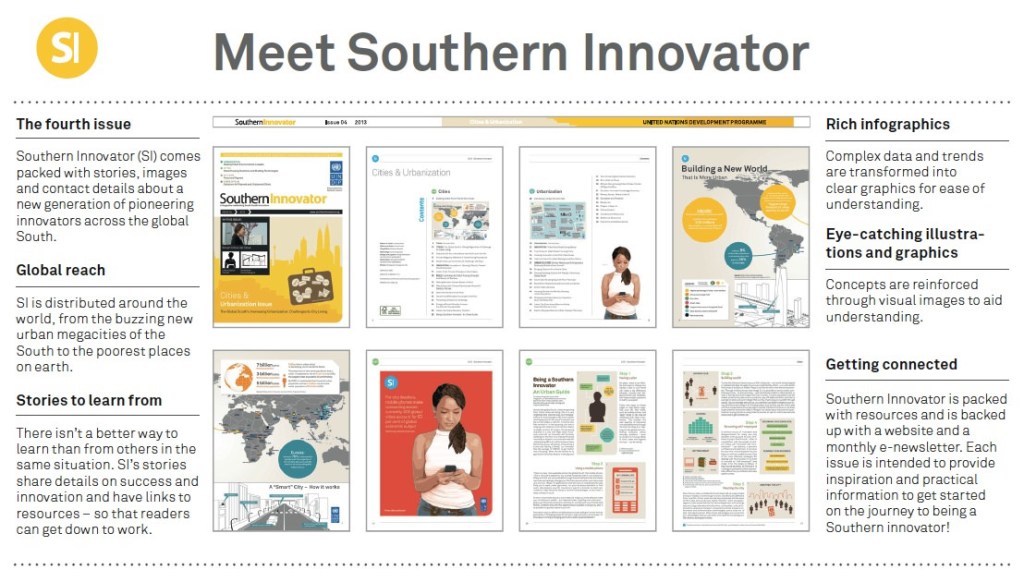
    The fourth issue of Southern Innovator magazine has launched at the Global South-South Development Expo 2013 in Nairobi, Kenya. Southern Innovator Issue 4 visits the new cities being built to tackle the challenges of a rapidly urbanizing 21st-century world. The magazine also highlights some of the solutions being devised to the challenges people face as the world becomes a majority urban place.

    Some innovators are building new cities from scratch, applying the latest thinking and hard-wiring in cutting-edge information technologies and innovative environmental measures to create ‘smart’ cities and eco-cities. Architects are designing and refining homes that are beautiful and functional, easy to build, affordable and conserve energy. Social entrepreneurs are innovating ways to create liveable and socially inclusive urban areas, often in places where planning has been scant and where incomes are very low. All those featured in the magazine were chosen for their focus on improving human development and their ingenuity and fresh thinking.

    Southern Innovator champions a 21st-century global innovator culture. The magazine profiles and celebrates the innovators across the global South finding new ways to tackle poverty, create wealth and improve human development and achieve the Millennium Development Goals (MDGs). In its first issue in September 2011, Southern Innovator featured the people who are re-shaping new information technologies – from mobile phone apps to Internet technologies. Many of the innovators profiled in that first issue came from Kenya.

    SI (southerninnovator.org) is based on intensive research and produced by the United Nations Office for South-South Cooperation in UNDP (UNOSSC) (formerly the Special Unit for South-South Cooperation in UNDP). UNOSSC organizes an annual Global South-South Development Expo (southsouthexpo.org), a roaming celebration and gathering of Southern innovators previously held in New York, Washington, D.C., Geneva, Rome and Vienna. This year’s Expo is being held in Nairobi, Kenya (28 October to 1 November 2013) and is hosted by the UN Environment Programme (unep.org).

    SI is being distributed through the United Nations’ network and partners and reaches some of the world’s poorest and remotest places, as well as the vibrant but stressed growing global megacities. It is hoped the magazine will inspire budding innovators with its mix of stories, essential information, facts and figures, images and graphics.

    We hope you enjoy the magazine and find its content interesting and illuminating: a snapshot of a fast-changing world awash, as we found out, with
    innovators, creators and do-ers making their world a better place. It is possible to sponsor issues of the magazine, either through helping to fund its print run, or through sponsored inserts covering that issue’s theme with relevant content for our readers.

    For more information on Southern Innovator, contact Cosmas Gitta at
    cosmas.gitta@undp.org.

    Press Release 1

    Press Release 3

    Online archives: southerninnovator.orghttp://www.scribd.com/SouthernInnovator. Follow @SouthSouth1

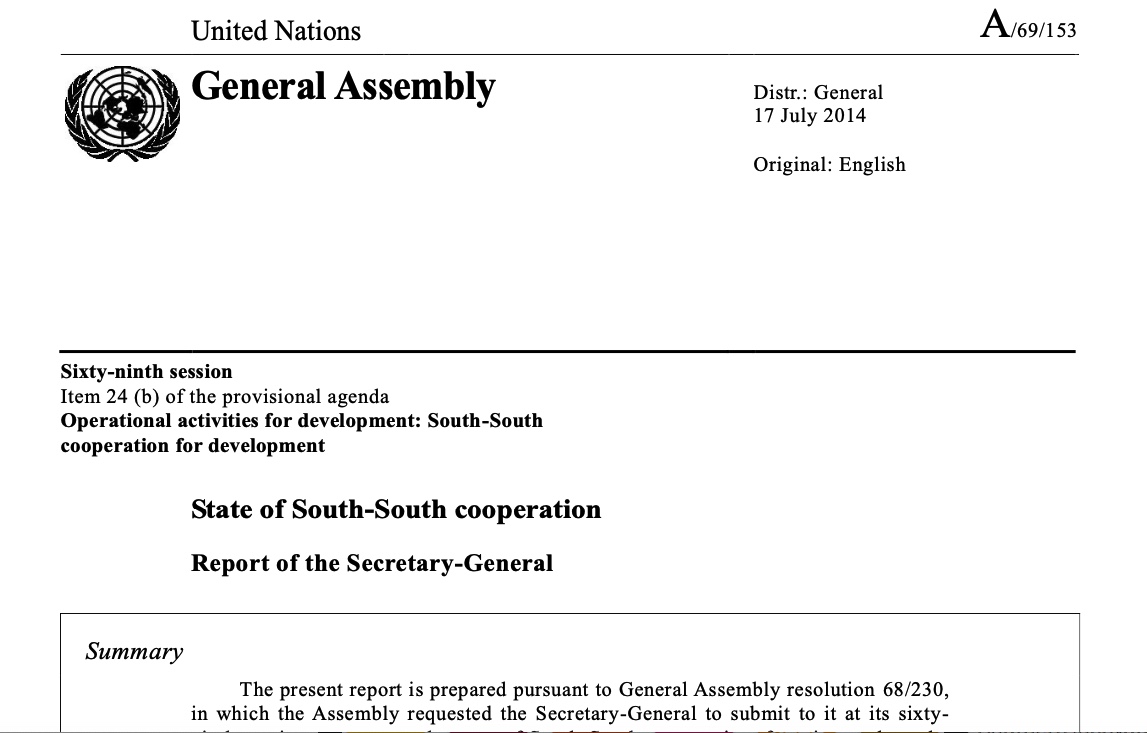
    United Nations General Assembly: Sixty-ninth session, Item 24 (b) of the provisional agenda, Operational activities for development: South-South cooperation for development, 17 July 2014.
    The research informing Southern Innovator Magazine played a part in the formulation of the UN’s post-2015 development agenda, including the Sustainable Development Goals (SDGs).

    https://davidsouthconsulting.org/southern-innovator-scale-up-fundraiser/

    ORCID iD: https://orcid.org/0000-0001-5311-1052.

    © David South Consulting 2022

  • Turning African Youth on to Technology

    Turning African Youth on to Technology

    By David SouthDevelopment Challenges, South-South Solutions

    SOUTH-SOUTH CASE STUDY

    An African NGO believes the Internet is the single biggest key to rapid development in Africa – and it is working to connect youth, women and rural populations to the web, and in turn, switch them on to the vast resources stored across the world’s Internet sites.

    After initial successes with a youth project and with farmers, Voices of Africa (VOA) (http://www.voicesofafrica.info) is now seeking to scale up its work to fan out across Africa – and take its services to the world’s largest refugee camp, the Dadaab Refugee Camp in Kenya. 

    The youth and technology empowerment NGO has developed a business model to deliver low-cost Internet access and e-resources to Africa’s slums and rural farmers.

    VOA argues that “the digital divide, defined by a lack of access to information for a specific population, symbolizes the largest difference between developed and developing countries: the opportunity to obtain and utilize information.”

    “The digital divide runs much deeper than hardware and software,” it says. “While equipment is necessary it is not sufficient. The real heart of the digital divide is that those without access to information resources often suffer needlessly while the solutions to their problems are floating in the air.”

    But why is the Internet so important?

    “The internet puts the choice of content at the fingertips of the user,” explains executive director Crystal Kigoni. “Traditional media is one way communications. Internet is bi-directional.

    “Our NGO is completely grassroots. We train the people who train the people. It is an each one, teach one philosophy and is highly effective. We also design our projects to be self-sustainable after one year of successful implementation.”

    The philosophy behind Voices of Africa – “Sustainable Development through Information Empowerment” – is to give people the information and resources to take better control of their lives.

    Access to the Internet in Africa is patchy and, for the poor, an expensive resource. The penetration of mobile phones in Africa has been spectacular in the past five years. But there are limits to the resources people can afford to access with their phones. Issues abound about data costs, mobile phone networks, and mobile phone capability.

    VOA targets youth and women in sub-Saharan Africa through online educational resources offered on their e-learning website (http://elearning.voicesofafrica.info/). The resources have been certified by Nazarene University (http://www.anu.ac.ke), a private university in Nairobi, Kenya.

    The e-learning resources include high quality training videos, presentations and screencasts (http://en.wikipedia.org/wiki/Screencast) – like a movie, it is a digital recording of changes on a computer screen and is used to teach software – to share on the web. The resources are also shared through compact discs (CDs) and iPods (http://en.wikipedia.org/wiki/IPod).

    Project coordinator Nick Kungu coordinates the staff working on the pilot Kenyan projects: a Rural Internet Kiosk; a Youth Empowerment Center; and KiberaNet, which launched in August 2011. VOA uses a part-time and volunteer staff of more than 20 Kenyans and four international ‘virtual’ volunteers.

    The group is also working with farmers in Kutus, central Kenya, to help them get a better price for their products and introduce sustainable agriculture practices. This is done through online courses so the farmers do not need to travel. It is hoped by doing this they can improve the supply of food for the country.

    The Youth Empowerment Center in Webuye constituency of the Western province of Kenya involves a partnership with the government of Kenya to teach computer basics, research and data collection, social media, ICT (information communication technology) for development, social business and community health.

    In rural areas, the need for information cannot be overestimated. In the remote countryside, there are few schools with adequate resources and almost no community libraries. The lifesaving knowledge the people require has to date been completely beyond their grasp. As one rural woman in the Western province of Kenya exclaimed to VOA after encountering the resources on the Internet, “It is like being brought from the darkness into the light.”

    Another project in development is SlumNet, which seeks to combine the Internet with low-cost devices like tablet computers and netbooks. Its pilot scheme, KiberaNet, launched this month in the Kibera slum of Nairobi, Kenya to test the business model. VOA hopes to then expand it to Uganda, Tanzania, Ghana, Nigeria and Sierra Leone. It is using a business model to bring low-cost Internet access to Africa’s slums that is fully funded by the local communities and the users.

    It has identified the key needs of youth in slums that need to be met: a way to access the vast resources available on the Internet; a way to generate income, undertake low-cost learning, and organise for social justice; ways to overcome social, economic and political isolation; a way to access affordable equipment and resources to improve their quality of life in the short-term.

    To make it a sustainable business model, the community takes a 60 percent stake in the incorporated entity. Voices of Africa will select six local civil society organisations to take another 10 percent stake in the business. VOA takes 10 percent and the remaining 30 percent will be open to outside investors.

    It involves setting up a closed intranet system and Internet access covering the entire Kibera slum, which has an estimated population of 2 million, a majority under the age of 30.

    KiberaNet hopes to act as a community hub for socialising, education and generating content. A key part is creating an atmosphere that is welcoming to novices. The business model is about delivering the bandwidth of Internet access and simultaneously generating a sustainable source of income to keep it going. Partners in the business include Promote Africa, Plexus Group and Future Optics Networks.

    VOA also has been blogging about its time in Kenya’s Dadaab Refugee Camp (http://www.unhcr.org/cgi-bin/texis/vtx/page?page=49e483a16) at their website, www.voicesofafrica.info, and has been developing plans to expand services to the camp, home to over 400,000 refugees from drought and famine in Somalia. The camp was only designed to hold 90,000 people. The chronic food insecurity has caused a massive humanitarian crisis in the Horn of Africa, leaving over 10 million people in need of help.

    “There are plenty of resources going in but it is aid business as usual,” claims Kigoni. “You see lots of waste in many areas, and a lack in others that would be extremely beneficial. Hence, why Voices of Africa has come up with the youth technology and empowerment plan that accompanies a general information and communications system, DadaabNet.”

    DadaabNet will be a youth-run community Internet service and education service. VOA plans to use a wireless intranet, internal communications systems and low-cost internet access in the refugee camp.

    The project is the first of its kind in Dadaab and a first in Kenya, claims VOA, allowing free educational content without needing to access the Internet

    The intranet will host free educational videos that can be accessed by mobile phones and computers. The topics covered in the videos include health, nutrition, sanitation and computer training and how to use technology for sustainable development.

    The curriculum is also approved by Nazerene University to certificate level.

    The system is supervised and would be able to offer resources to other NGOs seeking to provide services to the camp’s residents. The intention is to open up opportunities for education and employment youth who are currently unemployed.

    At present the youth in the camp, many of whom have not completed secondary school, get by ‘hustling’ for work, according to VOA. By being left to their own devices, there is a risk they will fall into negative behaviour like crime and drug use or be preyed upon by terrorist organisations operating in the area like al Shabaab, they maintain.

    “In our dreams, everyone everywhere in the world can have the opportunity to develop their minds. It is through this creativity that Africa will rise,” concludes Kigoni.

    Published: August 2011

    Resources

    1) The Impact of Mobile Phones on Profits from Livestock Activities by Roxana Barrantes. Website: http://www.mendeley.com/research/impact-mobile-phones-profits-livestock-activities-evidence-puno-peru-14/

    2) 2011 UNHCR Country Operations Profile – Kenya. Website: http://www.unhcr.org/cgi-bin/texis/vtx/page?page=49e483a16

    3) Southern Innovator magazine: New global magazine Southern Innovator’s first issue is out now and is about Mobile Phones and Information Technology in the global South. Website: http://www.scribd.com/doc/57980406/Southern-Innovator-Issue-1

    Creative Commons License

    This work is licensed under a
    Creative Commons Attribution-Noncommercial-No Derivative Works 3.0 License.

    ORCID iD: https://orcid.org/0000-0001-5311-1052.

    © David South Consulting 2023