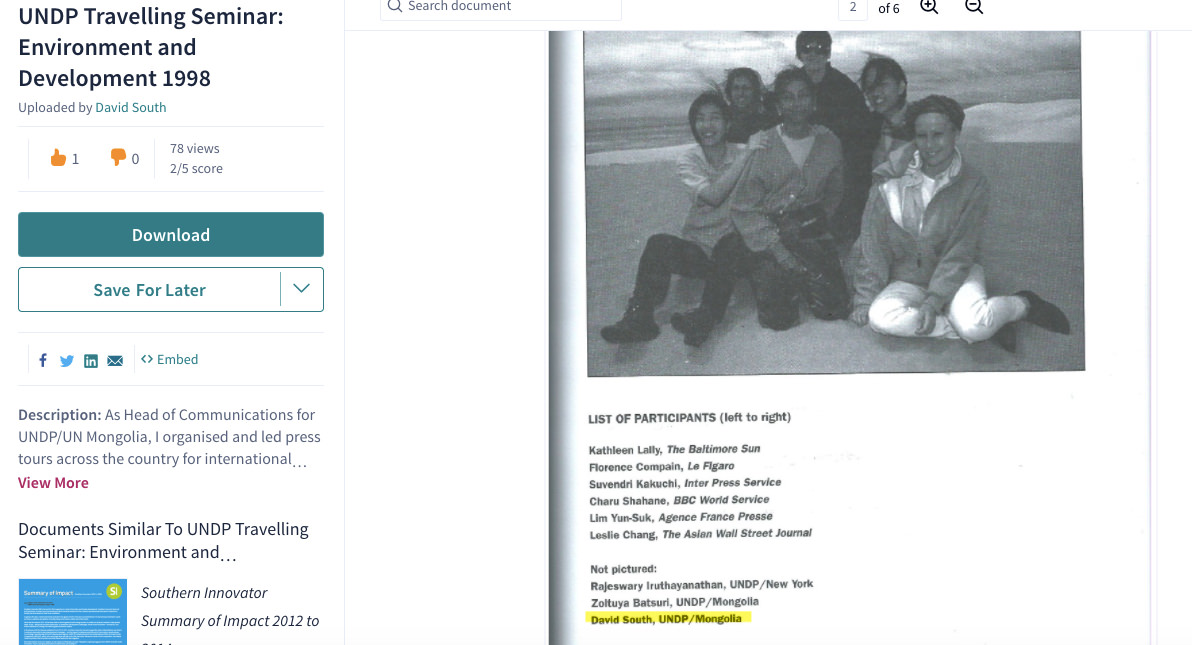
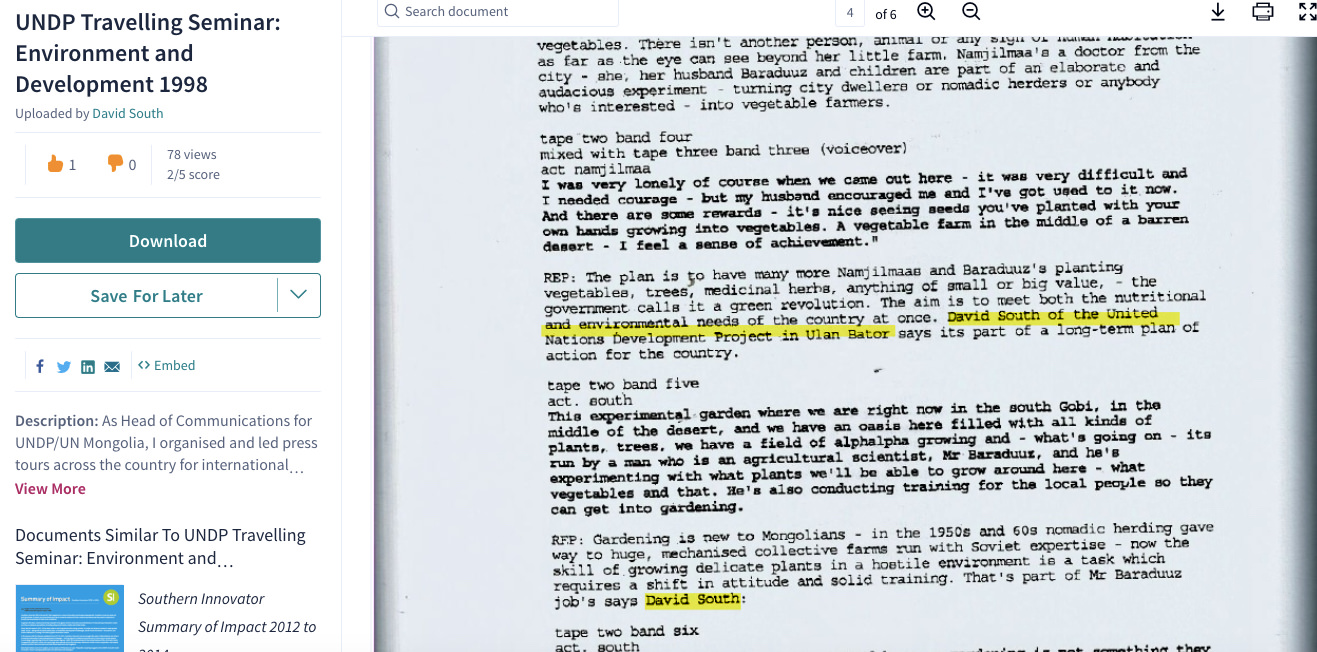
The media tour of Mongolia included the following journalists: Kathleen Lally (The Baltimore Sun), Florence Compain (Le Figaro), Suvendrini Kakuchi (Inter Press Service), Charu Shahane (BBC World Service), Lim Yun-Suk (Agency France Presse), Leslie Chang (The Asian Wall Street Journal).An Interoffice Memorandum from Djibril Diallo, Director, Division of Public Affairs, UNDP, to Mr. Nay Htun, Assistant Administrator and Director, Regional Bureau for Asia and the Pacific.An interview with the BBC World Service while visiting gardens in the Gobi Desert, 1998. I led media tours of Mongolia while serving as the UN/UNDP Mongolia Communications Coordinator from 1997-1999.
The UNDP Mongolia Communications Office would reach out to journalists to help tell the story of Mongolia’s late 1990s transition to free markets and democracy.
The BBC’s Charu Shahane joined other journalists on a UNDP Mongolia media tour in 1998.
UNDP Mongolia staff photo 1997. I served for two years as the UNDP Mongolia Head of Communications (1997-1999).
“Mongolia is not an easy country to live in and David [South] showed a keen ability to adapt in difficult circumstances. He was sensitive to the local habits and cultures and was highly respected by his Mongolian colleagues. … David’s journalism background served him well in his position as Director of the Communications Unit. … A major accomplishment … was the establishment of the UNDP web site. He had the artistic flare, solid writing talent and organizational skills that made this a success. … we greatly appreciated the talents and contributions of David South to the work of UNDP in Mongolia.” Douglas Gardner, UN Resident Coordinator and UNDP Resident Representative Mongolia
For many years it was a given that the world’s problem was not a lack of food, but that it was unfairly shared. But as the switch to biofuels gathers pace, farmland is being diverted away from growing food for people, to food for fuel. On top of this, growing prosperity in many countries in the South has boosted demand for better quality food, including grain-devouring meat diets – it takes 10 kilograms of grain to get one kilogram of meat from a cow. The crisis has deeply alarmed the UN’s World Food Programme and the World Bank. In the economic battle for food, the poor are the most vulnerable.
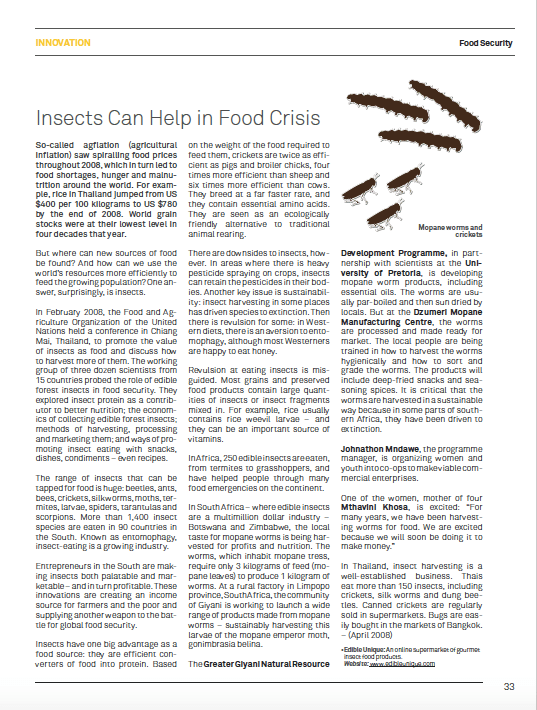
So-called agflation (agricultural inflation) has seen spiraling food prices, which in turn are causing food shortages, hunger and malnutrition around the world. For example, rice in Thailand has jumped from US $400 per 100 kilograms in January, to US $760. World grain stocks are at their lowest level in four decades.
But where can new sources of food be found? And what would be a more efficient use of the world’s resources to feed the growing population? One answer, surprisingly, is insects.
In February this year the UN’s Food and Agriculture Organization held a conference in Chiang Mai, Thailand to devour the dietary value of insects as food and discuss how to harvest more of them. The working group of three dozen scientists from 15 countries probed the role of edible forest insects in food security. They explored insect protein as a contributor to better nutrition, the economics of collecting edible forest insects, methods of harvesting, processing and marketing edible forest insects, and ways of promoting insect eating with snacks, dishes, condiments — even recipes.
The range of insects that can be tapped for food is huge: beetles, ants, bees, crickets, silk worms, moths, termites, larvae, spiders, tarantulas and scorpions. More than 1,400 insect species are eaten in 90 countries in the South. Known as entomophagy, insect eating is a growing industry. Entrepreneurs in the South are making insects both palatable and marketable – and in turn profitable. These innovations are adding another income source for farmers and the poor, and supplying another weapon to the battle for global food security.
Insects have one big advantage as a food source: they are efficient converters of food into protein. Based on the weight of the food required to feed them, crickets are twice as efficient as pigs and broiler chicks, four times more efficient than sheep and six times more efficient than cows. They breed at a far faster rate, and they contain essential amino acids. They are seen as an ecologically friendly alternative to traditional animal rearing.
There are downsides to insects, however. In areas where there is heavy pesticide spraying on crops, insects can retain the pesticides in their bodies. Another key issue is sustainability: insect harvesting in some places has driven species to extinction. Then there is revulsion for some: in Western diets, there is an aversion to entomophagy, although most Westerners are happy to eat honey.
Revulsion at eating of insects is misguided. Most grains and preserved food products contain large quantities of insects or insect fragments mixed in. For example, rice usually contains rice weevil larvae – and they can be an important source of vitamins.
In Africa, 250 edible insects are eaten, from termites to grasshoppers, and have helped people through many food emergencies on the continent.
In South Africa — where edible insects are a multimillion dollar industry — Botswana and Zimbabwe, the local taste for mopane worms is being harvested for profits and nutrition. The worms, which inhabit mopane tress, require only three kilograms of feed (mopane leaves) to produce one kilogram of worms. At a rural factory in Limpopo province, South Africa, the community of Giyani is working to launch a wide range of products made from mopane worms – sustainably harvesting this larvae of the mopane emperor moth, gonimbrasia belina.
The Greater Giyani Natural Resources Development Programme in partnership with scientists at the University of Pretoria, is developing mopane worm products, including essential oils. The worms are usually par-boiled and then sun dried by locals. But at the Dzumeri Mopane Manufacturing Centre, the worms are processed and made ready for market. The local people are being trained in how to harvest the worms hygienically, and how to sort and grade the worms. The products will include deep-fried snacks and seasoning spices. It is critical the worms are harvested in a sustainable way, because in some parts of southern Africa, they have been driven to extinction.
Johnathon Mndawe, the programme manager, is organizing women and youth into co-ops to make viable commercial enterprises. “We expect the product to hit supermarket shelves in 2009,” said Morewane Mampuru, coordinator for the Centre for Scientific and Industrial Research, another partner.
One of the women, mother of four Mthavini Khosa, is excited: “For many years, we have been harvesting worms for food. We are excited because we will soon be doing it to make money.”
In Thailand, insect harvesting is a well-established business. Thais eat more than 150 insects, including crickets, silk worms and dung beetles. Canned crickets are regularly sold in supermarkets. Bugs are easily bought in the markets of Bangkok.
Online vendor Thailand Unique, based in Udon Thani, sells and markets a wide range of edible insects. They include edible scorpions, preserved giant water bugs, roasted grasshoppers, edible big crickets, bamboo worms, crushed giant bug paste, and introducing this year, Bug Snackz and Scorpion Thai Green Curry. There is even a ‘Bug Sample Pack’, containing a mix of seven edible insects and arachnids, all slow roasted for easy snacking.
Another important centre for insect harvesting is Latin America. In Venezuala, the Pemon Indians eat fire ants during the rainy season.
In Colombia, so-called “fatass ant” or “hormiga culona” is eaten like popcorn in movie theatres. Some believe it is a defence against cancer, or a natural aphrodisiac. Eating the ants or culona, has been happening right back to the ancient Guane Indians.
In Santander province, farmers are exporting the ants for sale, some being dipped in Belgian chocolate and sold as a luxury food in London’s Harrods and Fortnum and Mason department stores. The abundant ant population brings in US $11 a pound (kilogram conversion) for the farmers, a doubling in price since 2000.
Farmers in the artist colony of Barichara harvest the ants – though concerns have been raised that they have been over-harvesting the population. Restaurants in the area offer ant-based spreads for bread and an ant-flavored lamb sauce.
“It’s an age-old dilemma for the farmer — should I kill it or eat it?” said Andres Santamaria to CBS News, who was given a $40,000 grant from Santander’s government to develop an environmentally sustainable, export-oriented programme for breeding the ants.
In Tijuana, Mexico, ancient Aztec, pre-Colombian insect meals are on offer at this restaurant, joining a global trend. Cien Anios (“100 Years”), specialises in pre-Colombian, Aztec insect recipes. It is proof there is money in preparing insects for food. Typical dishes include garlicky ant eggs and cactus worms in butter.
Published: April 2008
Resources
A network for insect collectors: Website: www.insect.net
Sunrise Land Shrimp: A do-it-yourself guide to raising and harvesting insects for food, with important information on health and hygiene: Website: www.slshrimp.com
Edible Unique: An online supermarket of gourmet insect food products. Website:www.edibleunique.com
Tijuana‘s Cien Años was the original inspiration for this story. As one of the first stories to draw attention to the insects-for-food market, it contributed to a growing awareness of this exciting food source. I had a delicious all-insect meal there in 2002.
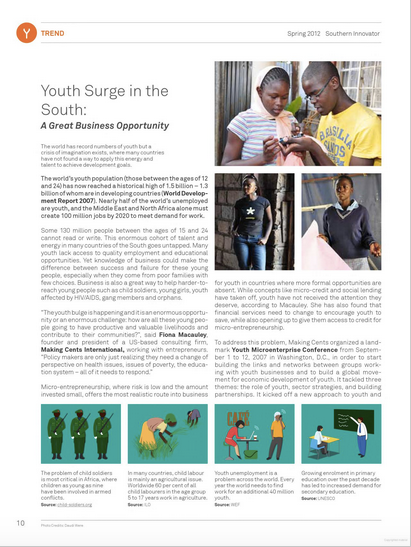
The world’s growing urbanization means that a whole generation of youth will have a dramatically different life than their parents. The world’s 3.3 billion urbanites now outnumber rural residents for the first time (UNFPA’s State of the World Population 2007 Report). And the vast majority live in slums or periurban areas, places of sprawl, where public services are poor and housing conditions unhealthy. Most young people working in the urban informal sector live in slum areas: for example, 75 per cent in Benin in Africa, and 90 per cent in Burkina Faso, the Central African Republic, Chad and Ethiopia. Most of this work is just bare survival work: according to the International Labour Organization, approximately 85 per cent of all new employment falls into this category.
Getting youth into quality work and earning more than enough simply to survive is critical to building a healthy society. Young people are bombarded every day with good and bad influences, and as UNFPA found in its Youth Supplement: Growing Up Urban, “the interactions with the urban environment can have an intense impact on the socialization of young people, exposing them to a multitude of influences as they develop, experiment, question, and assume roles in their societies.”
It is predicted that over the next 10 years, 1.2 billion youths will enter the working-age population (UNFPA). But youth unemployment is a huge problem around the world. Unemployed young people make up almost half (43.7 per cent) of the world’s total unemployed (UNFPA). Young people aged 15 to 19 are more than three times as likely to be unemployed as adults. Young people are the future, a resource no society can afford to waste. If their innate energy and enthusiasm is tapped, countries can see significant economic growth.
There are youth entrepreneurs who are defying the gloom and coming up with great business ideas. Five finalists for BBC Swahili’s regional entrepreneur competition – Faidika na BBC (Prosper with the BBC) – offer inspiration for youth across the South. Finalists from Burundi, Kenya, Rwanda, Tanzania and Uganda were selected for their bright schemes.
The overall winner was 24-year-old Burundian student Ashura Kisesa for a plan to build commercial public toilets in the cities and towns of East and Central Africa. Ashura, who entered but failed to reach the Faidika na BBC finals last year, has 12 brothers and sisters and is studying for a degree in agronomy at Burundi University.
“I am very happy to win the top prize in this competition,” she told the BBC. “The lack of public toilets throughout East and Central Africa is a major problem that needs to be addressed and I hope to make a difference with my business idea. My whole family wanted me to win and they really supported me which makes me especially proud. I cannot wait to get started with my business.”
On June 26 in Kampala, Uganda, Kisesa was awarded US $5,000 to put towards her business.
Kenyan national winner, 22-year-old Witness Omoga from Kakamega, wants to make identity cards for schools. Right now he works as a volunteer at his uncle’s photo studio, and hopes to get into Makerere University to pursue a degree in computer science. “I am very excited,” he said to the BBC. “I have never been number one in my life, but now I have emerged first in this competition.”
The Rwandan winner is a pioneer in the growing field of biomass energy production. A 17-year-old student from Kigali, Rangira Aime Frederick, impressed the panel of judges with his idea to turn domestic waste into energy. The national winner for Tanzania is a private tutor from Dar es Salaam, Apolinary Joseph Laksh. A business education tutor, 23-year-old Apolinary’s idea is to produce charcoal from recycled materials to offer people in rural areas sustainable and affordable cooking fuel.
Ugandan finalist, 23-year-old Dereick Kajukano, is in his last year at Kampala International University doing a degree in business administration. Dereick’s business idea is to make bags out of plastic trash. He was inspired by last year’s Faidika na BBC winner, David Ssegawa from Uganda: “When I heard him defend his proposal on air, I said to myself, why don’t I do it as well. That’s when it all started, and here I am.”
Published: July 2008
Resources
2008 Global Youth Enterprise Conference: Designed as a participatory learning event, this conference aims to support youth enterprise and entrepreneurship programs and policies achieve greater effectiveness around the world. Website:www.youthenterpriseconference.org
KickStart is a South African project aimed at inculcating a culture of entrepreneurship among young people between the ages of 18 and 35, by promoting business awareness through training, providing grants as start-up capital and providing mentorship and assistance during the setting up phase of the business. Website:http://www.sabkickstart.co.za/
iDISC – the infoDev Incubator Support Center – is a virtual networking and knowledge-sharing platform for incubators and technology parks leveraging ICT to facilitate entrepreneurship and new business creation in developing countries. Website: http://www.idisc.net/en/Index.html
Climate Capital Network: this company offers strategic advice, intelligence and assistance with fundraising for low-carbon solutions around the world. They have 2,000 investors looking for projects to invest in. Website:http://www.climatecapital.net/
Global Entrepreneurship Week: the website for this event in November has many opportunities for youth entrepreneurs to connect with each other through social networking websites. Website:http://unleashingideas.org/welcome
Africa’s growing economy is meeting head-on an optimistic young population keen to start businesses. At least that is what a new poll of African youth says, finding that one in five Africans between the ages of 15 and 24 without a current business wants to start one in the next 12 months.
The Gallup surveys (www.gallup.com) of 27 African countries and areas also found young women were just as keen as young men to start a business.
Throughout the decade of the 2000s, Africa experienced an average economic growth rate of 5.4 percent (World Bank) – a big gain from the poor growth rates of the 1980s and early 1990s.
The turnaround in Africa’s economic growth prospects was the product of a number of trends and factors. One has been better policies and easier trade. Other factors include rising tourism, a growing service sector, rising commodity prices, greater demand for African exports in emerging economies and rapidly improving communications: the surge in mobile phone usage during the last five years has surprised many. Africans are also avid spenders on goods and services, spending US $860 billion on them in 2008, more than India’s US $635 billion or Russia’s US $821 billion (Economic Report on Africa 2011).
The African Development Bank predicts Africa’s growth rate for 2011 will decline to 3.7 percent from 2010’s 4.9 percent, largely as a result of turmoil in North Africa. East Africa is projected to grow the fastest this year at 6.7 percent, with West Africa close behind at 5.9 percent.
Africa as a continent collectively had a gross domestic product in 2009 of US $1.6 trillion: equal to Brazil’s or Russia’s. The continent is considered among the fastest-expanding economic regions in the world (McKinsey & Company).
In fact, while economic prospects are grim in many developed countries, Africa joined Asia as the only continents to grow during this recession.
But major problems still confront the continent, among them youth unemployment. Those between 15 and 24 make up more than 60 percent of the continent’s population and are 45 percent of the total labor force (African Economic Outlook). Sub-Saharan Africa is experiencing a youth explosion, with the proportion of youth there to rise to 75 percent of the population by 2015. Demographers forecast this rising youth trend will not stop for the next 20 years.
Getting these youth actively engaged in the economy and society is a major challenge for the continent. Already, 133 million African youth are illiterate. They have few skills and are marginalised from more productive sectors of the economy.
Even those with an education find their skills often don’t match the needs of the labor market. In sub-Saharan Africa, youth unemployment is believed to be 20 percent.
So even with better economic prospects and growing economies and incomes, youth unemployment looms large.
The Economic Report on Africa 2011 (www.uneca.org/era2011/) finds the “persistent high youth unemployment rate is a cause of concern and a potential source of political instability.” Job creation is still not adequate: “The growth rates are still below the levels needed to make a significant impact on unemployment and poverty reduction.”
While Africa will experience higher growth in 2011, for youth it is looking like a “jobless recovery,” according to the report. Overseas investors are mostly throwing their money at the resource sector, which doesn’t create many jobs in the economy.
But for young Africans looking to start a business, the opportunities are there in sectors such as retailing, telecommunications, banking, infrastructure-related industries, resource-related businesses, and all along the agricultural value chain.
The booming communications industry has added 316 million new subscribers since 2000, for example. And all those people now connected need new services.
And once a business is up and running, it is possible to make higher profits in Africa than on other continents, according to the UN. Africa leads the emerging market economies for returns for businesses. This is because competition isn’t as intense and there is still plenty of built-up consumer demand that needs to be met.
All of this means young people willing to start a business and put in the hard work, will have a better chance of reaping the rewards.
Published: July 2011
Resources
1) iHub Nairobi: iHub Nairobi’s Innovation Hub for the technology community is an open space for the technologists, investors, tech companies and hackers in the area. This space is a tech community facility with a focus on young entrepreneurs, web and mobile phone programmers, designers and researchers. It is part open community workspace (co-working), part vector for investors and VCs and part incubator. Website:http://ihub.co.ke/pages/home.php
4) 2011 Global Youth Economic Opportunities Conference: This 5th anniversary conference will provide a learning platform for the world’s leading funders, practitioners, technical assistance providers, policy makers, and academics working to increase and improve economic opportunities for young people. Join 400 professionals from over 60 countries to share lessons learned, promising practices, and innovative ideas through technical workshops, engaging plenary sessions, and interactive networking. The result? Higher-impact programming, breakthrough solutions, and proven approaches. This year’s theme, Breakthroughs, reflects the focus on the innovative ideas, proven practices, and visionary insights that are taking this emerging field to new heights. Website:http://www.youtheconomicopportunities.org/
5) Dutch Design in Development: DDiD is the agency for fair design, sustainable production and fair trade. They work with Dutch importers and designers and connect them to local producers in developing countries and emerging markets. Together products are made that are both profitable and socially and environmentally sustainable. Website:http://www.ddid.nl/english/index.html
6) Francophone Africa Hackathon: Taking place on 24 September 2011, a ‘hackathon’ to develop mobile phone applications will take place for Francophone Africans. Website:http://www.mobilehackaf.com/
By 2012, Southern Innovator had completed its global reader impact study.







 David South Consulting
You must be logged in to post a comment.