Categories
Archive Development Challenges, South-South Solutions Newsletters Southern Innovator magazine

Indian Toilet Pioneer Champions Good Ideas

By David SouthDevelopment Challenges, South-South Solutions

SOUTH-SOUTH CASE STUDY

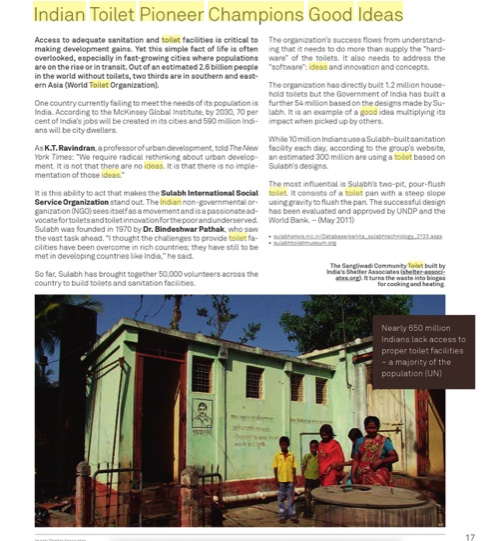
Access to adequate sanitation and toilet facilities is critical to making development gains. Yet this simple fact of life often gets overlooked, especially in fast-growing cities where populations are on the rise or in transit. Out of an estimated 2.6 billion people in the world without toilets, two-thirds are in southern and eastern Asia (World Toilet Organization).

It is easy to take toilet technology for granted in developed countries, but in the fast-growing urban world of the global South, increasing access will be the dividing line between a future of good human health and dignity, or misery and poor health. The biggest gains in human health always come about once people have access to clean water and sanitation. Yet this proven fact gets lost in many places for a wide variety of reasons.

One country currently failing to meet the needs of its population is India. According to the McKinsey Global Institute, by 2030, 70 percent of India’s jobs will be created in its cities, and 590 million Indians will be city-dwellers. An enormous infrastructure task lies ahead for India: a city the size of Chicago needs to be built every year. But so far this challenge is not being met, leaving the country with the largest number of urban slum dwellers anywhere in the world. Housing is just not keeping up with populations’ needs.

As K.T. Ravindran, a professor of urban development, told the New York Times: “We require radical rethinking about urban development. It is not that there are no ideas. It is that there is no implementation of those ideas.”

It is this ability to act that makes the Sulabh International Social Service Organization stand out. The Indian non-governmental organization (NGO) sees itself as a movement and is a passionate advocate for toilets and toilet innovation for the poor and underserved.

Sulabh was founded in 1970 by Dr. Bindeshwar Pathak, who saw the vast task ahead. “I thought the challenges to provide toilet facilities have been overcome in rich countries; it has still to be met in developing countries like India,” he said.

So far, Sulabh has brought together 50,000 volunteers across the country to build toilets and sanitation facilities.

The organization’s success flows from understanding that it needs to do more than supply the ‘hardware’ of the toilets; it also needs to address the ‘software’: ideas and innovation and concepts.

The organization has directly built 1.2 million household toilets – but the government of India has built a further 54 million toilets based on the designs made by Sulabh. It’s an example of a good idea multiplying its impact when picked up by others.

While 10 million Indians use a Sulabh-built sanitation facility each day, according to the group’s website, an estimated 300 million are using a toilet based on Sulabh’s designs.

Most influential is Sulabh’s two-pit, pour-flush toilet (www.sulabhenvis.nic.in/Sulabhtechnology.htm). It consists of a toilet pan with a steep slope using gravity to flush the pan. Water is poured in to the pan to flush the toilet and the waste goes into either one of two pits. As one pit fills up with waste, waste is diverted to the second pit. After around 18 months, the first, filled pit’s waste becomes a safe, organic fertiliser suitable for agriculture and the fertiliser’s value covers the cost of emptying the pit. The successful design has been evaluated and approved by UNDP and the World Bank.

Sulabh has also been designing ways to get power and energy from toilets, building 200 biogas plants that turn the gas generated from the human excrement deposited in the toilets into a source of energy. Biogas (http://en.wikipedia.org/wiki/Biogas) is a clean-burning gas that can be made from animal, plant and human waste with the right technology and is a green solution to the need for gas to cook and run electricity generators.

Pride of place for the NGO is its vast toilet and bath complex at the holy shrine of Shri Sai Baba in Shirdi, Maharashtra (http://en.wikipedia.org/wiki/Maharashtra). Millions flock to the shrine every year, but it lacked proper sanitation facilities. To solve this problem Sulabh’s local branch has built a vast complex occupying two acres. The brightly coloured and palace-like facility has 120 toilets, 108 bathing cubicles, six dressing rooms, and urinals and can serve 30,000 people a day. There are telephones and 5,000 lockers for tourists to keep possessions safe.

There are also three biogas plants connected to the facility, generating electricity and hot water for bathing used by the toilet and bath complex. This solves the puzzle of how to fund the utilities. Water discharged from the facility is used to irrigate the surrounding green spaces.

Sulabh has also built a museum dedicated to toilets and toilet technology (http://www.sulabhtoiletmuseum.org). The museum places the toilet as a critical part of human civilisation and shows how it fits in with the cultural context of India. Toilets and toilet designs from around the world and throughout history are gathered together and make a fascinating journey through this essential human need.

Published: May 2011

Resources

1) World Toilet Organization: World Toilet Organization (WTO) is a global non- profit organization committed to improving toilet and sanitation conditions worldwide. Website: http://www.worldtoilet.org

2) World Toilet Day: On November 19 every year, this event draws attention to the lack of access for 2.6 billion people. Website: http://www.worldtoilet.org

3) Dirt: The Filthy Reality of Everyday Life: An exhibit by the prestigious Wellcome Collection on the human relationship with dirt and hygiene in history. Website:http://www.wellcomecollection.org/whats-on/exhibitions/dirt.aspx

4) World Toilet College: Established in 2005, the World Toilet College (WTC) started as a social enterprise, with the belief that there is need for an independent world body to ensure the best practices and standards in Toilet Design, Cleanliness, and Sanitation Technologies are adopted and disseminated through training. Website:http://worldtoilet.org/ourwork3.asp

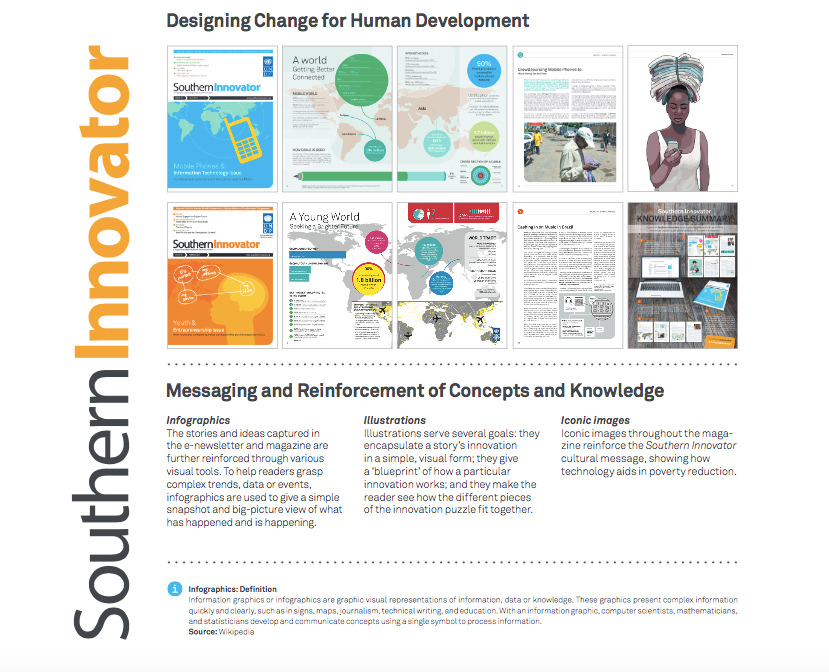
Development Challenges, South-South Solutions was launched as an e-newsletter in 2006 by UNDP’s South-South Cooperation Unit (now the United Nations Office for South-South Cooperation) based in New York, USA. It led on profiling the rise of the global South as an economic powerhouse and was one of the first regular publications to champion the global South’s innovators, entrepreneurs, and pioneers. It tracked the key trends that are now so profoundly reshaping how development is seen and done. This includes the rapid take-up of mobile phones and information technology in the global South (as profiled in the first issue of magazine Southern Innovator), the move to becoming a majority urban world, a growing global innovator culture, and the plethora of solutions being developed in the global South to tackle its problems and improve living conditions and boost human development. The success of the e-newsletter led to the launch of the magazine Southern Innovator. 

Creative Commons License

This work is licensed under a
Creative Commons Attribution-Noncommercial-No Derivative Works 3.0 License.

ORCID iD: https://orcid.org/0000-0001-5311-1052.

© David South Consulting 2023

Categories
Archive Development Challenges, South-South Solutions Newsletters Southern Innovator magazine

Solar Solution to Lack of Electricity in Africa

By David SouthDevelopment Challenges, South-South Solutions

SOUTH-SOUTH CASE STUDY

Electricity is critical to improving human development and living standards. Yet, for many in the global South, electricity is either non-existent or its provision is patchy, erratic, unreliable or expensive.

Just as Africa has been able to jump a generation ahead when it comes to communications through the mass adoption of mobile phones – a much cheaper option than trying to provide telephone wires and cables across the continent – so it could also bypass the burdensome costs of providing electricity mains to everyone by turning to smaller electricity generation technologies such as solar power. This is called “off-grid” electricity.

The UN has set the goal of universal access to modern energy services by 2030. A report issued in April 2010 by United Nations Secretary-General Ban Ki-moon’s Advisory Group on Energy and Climate Change (AGECC) calls for expanding energy access to more than 2 billion people (http://www.unido.org/fileadmin/user_media/Publications/download/AGECCsummaryreport.pdf).

The report found that a lack of access to modern energy services represents a significant barrier to development. Some 1.6 billion people still lack access to electricity.

A reliable, affordable energy supply, the report says, is the key to economic growth and the achievement of the anti-poverty targets contained in the Millennium Development Goals.

When a person has electricity and the lighting it powers, it is possible to do business and study late into the night. Electric lighting also makes streets and living areas safer. Electricity can power a plethora of labour-saving and life-enhancing consumer goods: televisions, refrigerators, vacuum cleaners, air conditioners and fans, washing machines, clothes dryers, computers. And electricity recharges that most essential item, the mobile phone, on which millions rely to do their daily business.

After witnessing the struggle African health clinics have to access electricity, a Nairobi, Kenya-based company has developed a simple solution to ensure a steady supply of solar electricity. One Degree Solar’s (http://onedegreesolar.com/) founder, Gaurav Manchanda, developed and sells the BrightBox solar-charging system for lights, mobile phones, tablet computers and radios.

He first gained experience working in the West African nation of Liberia with the Clinton Health Access Initiative (http://www.clintonfoundation.org/main/our-work/by-initiative/clinton-health-access-initiative/about.html). Working at the country’s Ministry of Health, he found most health clinics operated without electricity.

He identified solar power as the only viable energy source. Trying to deliver fuel to power generators by the road network had two impediments: the diesel fuel was expensive and the road conditions were poor.

After seeing that large solar-power systems required significant maintenance and upkeep, he started to explore the possibility of low-cost, and simple-to-use solar electricity products that would be useful to community healthcare workers.

This became the beginning of One Degree Solar and its mission.

The company’s main product is the BrightBox, a cleverly designed solar charger. A bright orange box with a folding, aluminum handle at the top for easy carrying, it switches on and off simply with a bright red button. It has a waterproof solar panel. The BrightBox has USB (universal service bus) (http://en.wikipedia.org/wiki/Universal_Serial_Bus) ports so that mobile phones and radios can be plugged in. It is also possible to plug in four lights at once with the four outports on the side of the box.

It meets the standards set by the Lighting Africa initiative (http://lightingafrica.org/specs/one-degree-brightbox-2-.html) of the International Finance Corporation and the World Bank.

One Degree Solar claim it is possible to set up a BrightBox in 10 minutes. When the indicator light has turned green, the box is fully charged and capable of providing 40 hours of light.

A full charge can power two light bulbs for 20 hours. Manchanda told How We Made It In Africa (http://www.howwemadeitinafrica.com/) that he has sold 4,000 units of the BrightBox since its launch in October 2012.

According to The Nation, the BrightBox is currently retailing in Kenya for Kenyan shillings 7,000 (US $82).

One Degree Solar’s product range is sold to local resellers and distributors. The products are designed to be repaired using locally sourced parts and can be fixed by local electricians.

Most of the sales so far have been in Kenya but the firm has also sold units to other countries.

Testimonials on the BrightBox website tell of the transformation to people’s lives the clean energy source makes: “BrightBox has helped us in so many ways! We used to spend 800 Shillings (US $9.50) a month for two paraffin lanterns. The fumes smelled and always made us feel sick.”

Manchanda is a strong believer in Africa’s potential and its future and dismisses those who are negative about the continent.

“That was not a holistic assessment, but rather, an unnecessary and damaging generalization,” he told How We Made It In Africa. “Fortunately, most news outlets in Africa are now available online and offer a wider range of perspectives. The middle class is booming in certain countries. We have seen the success of mobile phones in enabling people to access other services. I think hope and progress come with innovation. Technology access has helped create entirely new markets and reach populations that otherwise could have taken decades to service with traditional approaches.

“India was in a similar space 15 years ago before the Internet boom, and today parts of Nairobi (Kenya) are just like Delhi (India): people have a cell phone or two, there are large shopping malls, a booming middle class, and new construction everywhere.”

Published: June 2013

Resources

Global Off-Grid Lighting Association: Global Off-Grid Lighting Association (GOGLA) has been established to act as the industry advocate with a focus on small and medium enterprises. It is a neutral, independent, not-for-profit association created to promote lighting solutions that benefit society and businesses in developing and emerging markets. GOGLA will support industry in the market penetration of clean, quality alternative lighting systems. Website: http://globaloff-gridlightingassociation.org/

Solar Sister: Solar Sister eradicates energy poverty by empowering women with economic opportunity. Website: http://www.solarsister.org/

Solarpod: Sunbird Solar/Thousand Suns manufactures, sources and distributes the portable solar generator range. Website: http://www.thousandsuns.com/

4) Little Sun: An attractive, high-quality solar-powered lamp in the shape of a hand-sized sun developed by artist Olafur Eliasson and engineer Frederik Ottesen. Website: http://www.littlesun.com/

Southern Innovator logo

London Edit

31 July 2013

Development Challenges, South-South Solutions was launched as an e-newsletter in 2006 by UNDP’s South-South Cooperation Unit (now the United Nations Office for South-South Cooperation) based in New York, USA. It led on profiling the rise of the global South as an economic powerhouse and was one of the first regular publications to champion the global South’s innovators, entrepreneurs, and pioneers. It tracked the key trends that are now so profoundly reshaping how development is seen and done. This includes the rapid take-up of mobile phones and information technology in the global South (as profiled in the first issue of magazine Southern Innovator), the move to becoming a majority urban world, a growing global innovator culture, and the plethora of solutions being developed in the global South to tackle its problems and improve living conditions and boost human development. The success of the e-newsletter led to the launch of the magazine Southern Innovator.

Creative Commons License

This work is licensed under a
Creative Commons Attribution-Noncommercial-No Derivative Works 3.0 License.

ORCID iD: https://orcid.org/0000-0001-5311-1052.

© David South Consulting 2023
Categories
Archive

New Swimwear for Plus-size Women in Brazil

By David SouthDevelopment Challenges, South-South Solutions

SOUTH-SOUTH CASE STUDY

Brazil is well known for its stylish swimwear, with styles usually targeted at young women and those with more conventional, media-friendly body shapes. But now a company is making visiting the beach more comfortable and empowering for plus-size women.

Prior to the arrival of plus-size swimwear, women turned to over-sized t-shirts and baggy shorts to hit the beach. Now, Brazilian companies are pioneering fashionable and sexy swimwear for women of all sizes.

Brazil has a well-known beach culture – a culture celebrated over the years in popular pop tunes like ‘The Girl From Ipanema’ (http://en.wikipedia.org/wiki/The_Girl_from_Ipanema). The country has successfully turned its alluring beach culture into lucrative businesses,including fashion enterprises that have become global brands. The global hit brand of beach flip flops Havaianas (havaianas.com) is a good example.

Lehona (lehona.com.br) makes ‘Moda Praia’ – plus-size – swimwear for women. The swimsuits are specially designed to flatter larger body shapes and give women the confidence to go back to the beach. It is seeking to end the discrimination inherent in beach culture that favours the “thin, the rich and the chic.”

Body shapes have been changing in Brazil – as they have been across the world and the global South. While one cause is the global obesity crisis -ballooning as diets change with rising prosperity – there is also another, more positive cause: greater access to nutrition and increasing consumption of milk and meat tends to lead to larger body shapes. This has happened across the world and in many countries irrespective of the racial and ethnic background of the people. Norwegians in Northern Europe were once some of the shortest people in Europe and suffered from poverty and malnutrition. But, as food security increased and nutrition improved, they have over time become the second tallest people in Europe behind the Netherlands (The Changing Body: Health, Nutrition,and Human Development in the Western World since 1700).

For Brazil, malnutrition was widespread until recently. Records show 10 per cent of the country’s rural northeast in the 1970s was considered underweight.

The Brazilian statistics institute has found the past decade’s economic boom has had another consequence as well as lifting many millions out of poverty. It has found 48 per cent of adult women and 50 per cent of adult men are now overweight. This compares with 1985, when 29 per cent of women and 18 per cent of men were overweight.

Diets have changed in the intervening years. Rice, beans and vegetables are now in competition with potato chips, processed meats and sugary soft drinks.

And apart from nutrition and diet changes because of increasing incomes,there is also a cultural change. While the wealthy are more used to lifestyles with plenty of exercise, newly prosperous people do not necessarily have the fitness habit. One study found just 10 per cent of Brazilian teens and adults exercise regularly.

The Lehona brand has become a quick hit and receives many telephone calls and emails from would-be customers, its owners claim.

The Brazilian cultural expectation for women’s beachwear is skimpy, showing more rather than less. This prejudices women who do not have slim body shapes or who are not under 30.

Started in 2010 by clothing designer Clarice Rebelatto and run by her son Luiz Rebelatto, Lehona was started out of personal need.

“Honestly, the problem went way beyond just bikinis. In Brazil, it used to be that if you were even a little chunky, finding any kind of clothes in the right size was a real problem,” said Clarice Rebelatto, a size 10, to The Associated Press.

“And I thought, ‘I’m actually not even that big compared to a lot of women out there, so if I have problems, what are they doing?’”

The approach to the swimsuits is counter to many other brands targeting plus-size women. They are bold and emphasize the shape rather than try to cover it up and hide it.

The brand sells itself through specialty stores for large and tall women in Brazil. A bikini sells for around 130 reais (US $66).

“Some brands, they don’t want their image to be associated with chunky women= Only the thin, the rich and the chic,” Luiz Rebelatto told The Associated Press.

“We’re working from the principle that bigger women are just like everyone else: They don’t want to look like old ladies, wearing these very modest, very covering swimsuits in just black.”

The plus-size market has even been taken up by conventional Brazilian swimwear manufacturer Acqua Rosa (http://www.acquarosanet.com.br/site/). It released its plus-size line in 2008 and claims sales now account for 70 per cent of their total sales.

One woman frequenting Copacabana beach copacabana.info) in Rio de Janeiro is Elisangela Inez Soares. She is happy and confident with the new swim suits.

“It used to be bikinis were only in tiny sizes that only skinny girls could fit into. But not everyone is built like a model,” concludes Soares.

Published: May 2012

Resources

1) Start a Fashion Business: A website packed with step-by-step advice on starting a fashion business. Website: startafashionbusiness.co.uk/

2) A website compiled by an American fashion expert on how to run a fashion business for profit. Website: http://fashionforprofit.com/about-us/

3) The catalogue for the Lehona swimsuit line. Website: http://www.lehona.com.br/pdf/lehona_moda_praia_plus_size.pdf

4) Miss Brazil Plus-Size Beauty Contest: Website: http://www.youtube.com/watch?v=LHLflIgXqgM

“I think you [David South] and the designer [Solveig Rolfsdottir] do great work and I enjoy Southern Innovator very much!” Ines Tofalo, Programme Specialist, United Nations Office for South-South Cooperation

Creative Commons License

This work is licensed under a
Creative Commons Attribution-Noncommercial-No Derivative Works 3.0 License.

ORCID iD: https://orcid.org/0000-0001-5311-1052.

© David South Consulting 2022

Categories
Archive Development Challenges, South-South Solutions Newsletters Southern Innovator magazine

African Youth Want to do Business in Fast-growing Economy

By David SouthDevelopment Challenges, South-South Solutions

SOUTH-SOUTH CASE STUDY

Africa’s growing economy is meeting head-on an optimistic young population keen to start businesses. At least that is what a new poll of African youth says, finding that one in five Africans between the ages of 15 and 24 without a current business wants to start one in the next 12 months.

The Gallup surveys (www.gallup.com) of 27 African countries and areas also found young women were just as keen as young men to start a business.

Throughout the decade of the 2000s, Africa experienced an average economic growth rate of 5.4 percent (World Bank) – a big gain from the poor growth rates of the 1980s and early 1990s.

The turnaround in Africa’s economic growth prospects was the product of a number of trends and factors. One has been better policies and easier trade. Other factors include rising tourism, a growing service sector, rising commodity prices, greater demand for African exports in emerging economies and rapidly improving communications: the surge in mobile phone usage during the last five years has surprised many. Africans are also avid spenders on goods and services, spending US $860 billion on them in 2008, more than India’s US $635 billion or Russia’s US $821 billion (Economic Report on Africa 2011).

The African Development Bank predicts Africa’s growth rate for 2011 will decline to 3.7 percent from 2010’s 4.9 percent, largely as a result of turmoil in North Africa. East Africa is projected to grow the fastest this year at 6.7 percent, with West Africa close behind at 5.9 percent.

Africa as a continent collectively had a gross domestic product in 2009 of US $1.6 trillion: equal to Brazil’s or Russia’s. The continent is considered among the fastest-expanding economic regions in the world (McKinsey & Company).

In fact, while economic prospects are grim in many developed countries, Africa joined Asia as the only continents to grow during this recession.

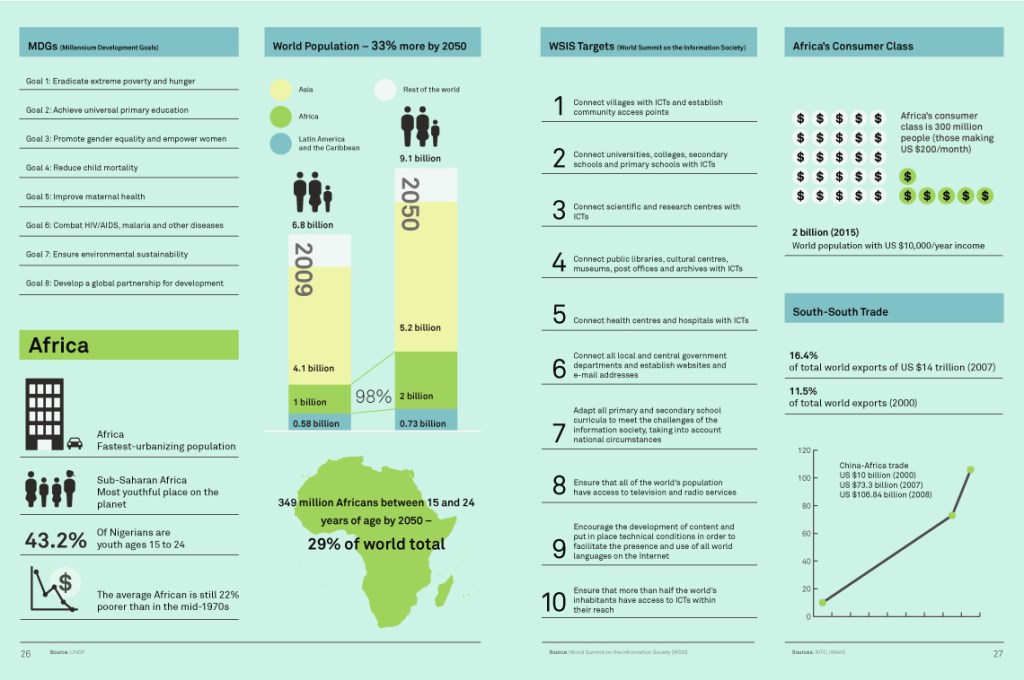
But major problems still confront the continent, among them youth unemployment. Those between 15 and 24 make up more than 60 percent of the continent’s population and are 45 percent of the total labor force (African Economic Outlook). Sub-Saharan Africa is experiencing a youth explosion, with the proportion of youth there to rise to 75 percent of the population by 2015. Demographers forecast this rising youth trend will not stop for the next 20 years.

Getting these youth actively engaged in the economy and society is a major challenge for the continent. Already, 133 million African youth are illiterate. They have few skills and are marginalised from more productive sectors of the economy.

Even those with an education find their skills often don’t match the needs of the labor market. In sub-Saharan Africa, youth unemployment is believed to be 20 percent.

So even with better economic prospects and growing economies and incomes, youth unemployment looms large.

The Economic Report on Africa 2011 (www.uneca.org/era2011/) finds the “persistent high youth unemployment rate is a cause of concern and a potential source of political instability.” Job creation is still not adequate: “The growth rates are still below the levels needed to make a significant impact on unemployment and poverty reduction.”

While Africa will experience higher growth in 2011, for youth it is looking like a “jobless recovery,” according to the report. Overseas investors are mostly throwing their money at the resource sector, which doesn’t create many jobs in the economy.

But for young Africans looking to start a business, the opportunities are there in sectors such as retailing, telecommunications, banking, infrastructure-related industries, resource-related businesses, and all along the agricultural value chain.

The booming communications industry has added 316 million new subscribers since 2000, for example. And all those people now connected need new services.

And once a business is up and running, it is possible to make higher profits in Africa than on other continents, according to the UN. Africa leads the emerging market economies for returns for businesses. This is because competition isn’t as intense and there is still plenty of built-up consumer demand that needs to be met.

All of this means young people willing to start a business and put in the hard work, will have a better chance of reaping the rewards.

Published: July 2011

Resources

1) iHub Nairobi: iHub Nairobi’s Innovation Hub for the technology community is an open space for the technologists, investors, tech companies and hackers in the area. This space is a tech community facility with a focus on young entrepreneurs, web and mobile phone programmers, designers and researchers. It is part open community workspace (co-working), part vector for investors and VCs and part incubator. Website: http://ihub.co.ke/pages/home.php

2) The Other Side of Innovation: Solving the Execution Challenge by Vijay Govindarajan, Chris Trimble: On how businesses need to follow through with execution if they really want to innovate. Website: http://hbr.org/product/baynote/an/13219-HBK-ENG?referral=00505&cm_sp=baynote-_-featured_products-_-13219-HBK-ENG

3) “The Globe: Cracking the Next Growth Market: Africa” by Mutsa Chironga et al, Harvard Business Review. Website: http://hbr.org/2011/05/the-globe-cracking-the-next-growth-market-africa/ar/1

4) 2011 Global Youth Economic Opportunities Conference: This 5th anniversary conference will provide a learning platform for the world’s leading funders, practitioners, technical assistance providers, policy makers, and academics working to increase and improve economic opportunities for young people. Join 400 professionals from over 60 countries to share lessons learned, promising practices, and innovative ideas through technical workshops, engaging plenary sessions, and interactive networking. The result? Higher-impact programming, breakthrough solutions, and proven approaches. This year’s theme, Breakthroughs, reflects the focus on the innovative ideas, proven practices, and visionary insights that are taking this emerging field to new heights. Website: http://www.youtheconomicopportunities.org/

5) Dutch Design in Development: DDiD is the agency for fair design, sustainable production and fair trade. They work with Dutch importers and designers and connect them to local producers in developing countries and emerging markets. Together products are made that are both profitable and socially and environmentally sustainable. Website: http://www.ddid.nl/english/index.html

6) Francophone Africa Hackathon: Taking place on 24 September 2011, a ‘hackathon’ to develop mobile phone applications will take place for Francophone Africans. Website: http://www.mobilehackaf.com/

By 2012, Southern Innovator had completed its global reader impact study.

Follow @SouthSouth1

Google Books: https://books.google.co.uk/books?id=waeXBgAAQBAJ&dq=Development+Challenges+February+2008&source=gbs_navlinks_s

Slideshare: http://www.slideshare.net/DavidSouth1/development-challengessouthsouthsolutionsfebruary2008issue

Southern Innovator Issue 1: https://books.google.co.uk/books?id=Q1O54YSE2BgC&dq=southern+innovator&source=gbs_navlinks_s

Southern Innovator Issue 2: https://books.google.co.uk/books?id=Ty0N969dcssC&dq=southern+innovator&source=gbs_navlinks_s

Southern Innovator Issue 3: https://books.google.co.uk/books?id=AQNt4YmhZagC&dq=southern+innovator&source=gbs_navlinks_s

Southern Innovator Issue 4: https://books.google.co.uk/books?id=9T_n2tA7l4EC&dq=southern+innovator&source=gbs_navlinks_s

Southern Innovator Issue 5: https://books.google.co.uk/books?id=6ILdAgAAQBAJ&dq=southern+innovator&source=gbs_navlinks_s

Creative Commons License

This work is licensed under a
Creative Commons Attribution-Noncommercial-No Derivative Works 3.0 License.

ORCID iD: https://orcid.org/0000-0001-5311-1052.

© David South Consulting 2023