Categories
Archive Development Challenges, South-South Solutions Newsletters Southern Innovator magazine

Local Animation: A Way Out of Poverty

By David SouthDevelopment Challenges, South-South Solutions

SOUTH-SOUTH CASE STUDY

One of the more remarkable creative developments since 2000 has been the explosion in animation production in the developing world, in particular Asia. Once seen as frivolous or unnecessary, animation is now acknowledged as a high-growth area and a critical component in the emerging economies being shaped by information technology.

The demand for more animation is being fuelled by several trends. Lucrative outsourcing contracts with major global film studios like Walt Disney and Warner Brothers get much of the attention. But even more importantly for small entrepreneurs, the rapid growth of information technology and mobile phones is fuelling demand for animation with a local flavour, which is an excellent way to make applications more attractive to users. As computers and animation software become cheaper, it is easier for entrepreneurs to compete with the bigger studios. It all started with the popularity of Japanese anime animation, which kicked the door open in the West, sparking an appetite for fresh, new styles unseen before.

The animation leaders in Asia are Japan, Republic of Korea, Philippines and Taiwan Province of China, with India rising quickly. As animation production is very lucrative and a labor-intensive business (labor takes up 70 to 80 percent of business costs), other Asian countries such as India, China, Vietnam, Malaysia and Singapore have recently started their own industries.

The National Association of Software and Service Companies (NASSCOM) has forecast the Indian animation sector to gross overall turnover of US $950 million in 2009, while its gaming industry will reach US $300 million in 2009 (from US $30 million in 2005). The global industry is huge: it is estimated that games will gross US $11 billion and animation US $35 billion by 2009. In the Philippines, growth has been 25 per cent a year since 2005 (National Statistics Office), and the government has been heavily promoting animation as a viable career and business opportunity. China was able to make US $604 million in 2005. The AWN’s Animation Industry Database lists 48 studios operating in the Philippines alone. Others benefiting are Thailand, Taiwan Province of China and Republic of Korea. And even in Africa, there have been attempts to get things going.

Ambitiously, China hopes to raise its home-made share of the animation pie from 10 per cent and to increase its overall animation programming from 5,000 hours/year to 16, 7000/year. In 2004, the Chinese government set up four animation schools: Communication University of China, Beijing Film Academy, China Academy of Art, and Tianjin Sorun Digital Media School. More than 200 animated films were produced in 2004.

Indian animation feature productions have exploded in the past few years. In 2005, animated feature Jai Hanuman started the current boom. Its quality marked a departure from past Indian productions and heralded in a new era. Importantly, it out-grossed any Disney film in India, and proved films featuring local topics could be commercially successful. It is a difficult market with 14 official languages and 1,400 dialects. At present, the huge Indian market has little locally produced animation to feed its needs. But by 2007, 71 Indian animation films were announced to be in production.

Productions in development draw heavily on India’s culture and love of gods. They include Epiphany Films’ The Dream Blanket, a Tibetan fairy tale, and Graphiti studios’ Action Hero BC, a teenager who fights evil.

The world’s animation producers scour India for talent to outsource. Global films with some Indian production in them include Finding Nemo, The Lion King and The Adventures of Tenali Raman. Toonz Animation Studio based at the Technopark in Kerala, was called by Animation Magazine one of the top ten studios in the world.

In Africa, South Africa has by far the most dynamic and sophisticated animation sector. Ten years after the birth of democracy, hundreds of production companies and several 2D animation houses were established. In turn, South Africa advertises itself as a cheaper place to produce animation.

The highly successful South African 3D animated series Magic Cellar by Morula Pictures – the first of its kind based on African culture – was successfully sold to the US Home Box Office channel this year. Based on 20 folk tales, the stories were collected through interviews with elders in African villages. Mfundi Vundla, 58, who owns Johannesburg’s Morula Pictures, South Africa’s largest black-led studio, said his productions are meant to counter the perception of “Africans as unsophisticated, superstitious idiots who visited witch doctors to solve problems.” It employs 60 people and dozens of actors.

In 2004, UNESCO’s Africa Animated! was launched, with East Africa’s first animation project. The participants undertook animation, drawing techniques, scriptwriting for animation and storyboarding. The project was launched to assemble resources and expertise for the production of culturally relevant children’s animated cartoons and programmes in Africa. It sought to create a high-quality “African branded” training and production model, in order to make African animation competitive for regional organizations to produce animated TV series, Public Service Announcements (PSA) and short films.

The Nairobi office is seeking to establish a Regional Training and Production Centre for Animation in Kenya in 2008.

Moustapha Alassane of Niger and one of Africa’s film pioneers, said: “The good thing about animation is that you can do it on a shoe-string budget. With the computer, animation is getting easier and anyone can do it now. I want to encourage young Africans to use new technologies for animation.”

Published: December 2007

Resources

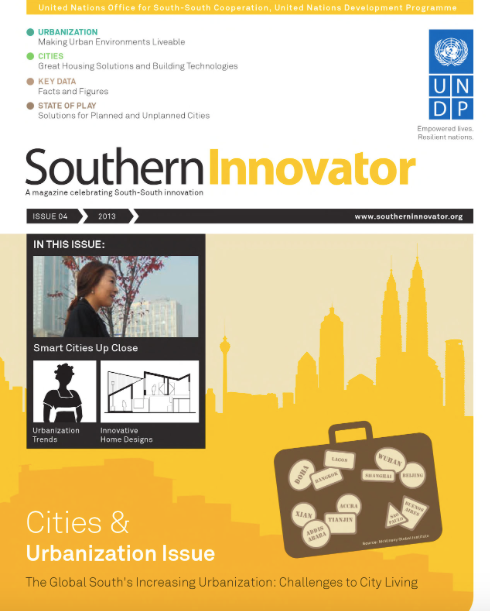
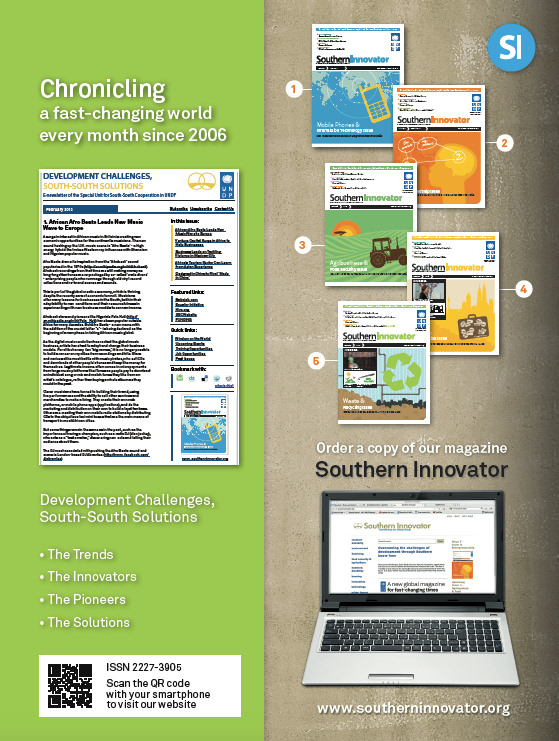
Development Challenges, South-South Solutions was launched as an e-newsletter in 2006 by UNDP’s South-South Cooperation Unit (now the United Nations Office for South-South Cooperation) based in New York, USA. It led on profiling the rise of the global South as an economic powerhouse and was one of the first regular publications to champion the global South’s innovators, entrepreneurs, and pioneers. It tracked the key trends that are now so profoundly reshaping how development is seen and done. This includes the rapid take-up of mobile phones and information technology in the global South (as profiled in the first issue of magazine Southern Innovator), the move to becoming a majority urban world, a growing global innovator culture, and the plethora of solutions being developed in the global South to tackle its problems and improve living conditions and boost human development. The success of the e-newsletter led to the launch of the magazine Southern Innovator. 

Creative Commons License

This work is licensed under a
Creative Commons Attribution-Noncommercial-No Derivative Works 3.0 License.

ORCID iD: https://orcid.org/0000-0001-5311-1052.

© David South Consulting 2023

Categories
Archive data Development Challenges, South-South Solutions Newsletters digital ID

African Entrepreneur Wants to Bring Order to Urban Chaos

By David SouthDevelopment Challenges, South-South Solutions

SOUTH-SOUTH CASE STUDY

All over the global South, urban and semi-urban areas are growing at a furious pace. Great swathes of mega-regions – places where large cities blend seamlessly into smaller towns and villages creating a giant economic hub – are becoming key economic and opportunity drivers in developing countries. One of the downsides of this rapid growth and economic vitality is the chaos and confusion brought by frenetic change. Into this busy landscape steps the fast-moving new world of everywhere computing, where computers exchange information with almost everything in the environment. A Ghanaian information technology pioneer and entrepreneur is changing perceptions about Africa by using the new technology of Semacodes – and proving a semblance of order can arise from the chaos and bustle of the street.

Semacode – a smart 2D barcode – was developed by Canadian Simon Woodside and is a tool to make everywhere computing a possibility. It works by embedding a web address into a 2D barcode called a tag which can be affixed to buildings, street lamps, and other landmarks. If one would like to know more information regarding the area they are in, all they need to do is find the nearest Semacode and use their internet-enabled camera phone to scan and read the code. A camera phone containing the Semacode’s Software Development Kit (SDK) detects and decodes the tag and sends the user the web address using the phone’s built-in browser. The user quickly learns what businesses and services are in the area and what the current street name is.

With code developed in Ghana called Semafox, one can create Semacodes for objects and contexts using a web browser – (http://sohne.net/semafox/). It is now being adapted by Ghanaian entrepreneur Guido Sohne to solve the common African problem of chaotic cityscapes brought about by rapid change, high turnover of businesses and changing street names. This handy tool has the power to revolutionise how people communicate and do business in the South, and a rival technology using a similar concept – QR code – is already widespread in Japan. Semacode also has its own user-contributed community website, Semapedia, to produce semacodes for any object or building.

*~~~~~~~~~~~~~~~~~~~~~*

Sohne is a computer code developer working for CoreNett – a Ghanaian electronic transaction processing company – and has been working on developing the code underlying the semacodes, and also piloting its application on the streets of Accra, the capital. Sohne (a former Kofi Annan ICT Centre for Excellence developer-in-residence), is an excellent example of how an IT innovator in the South is linking up early in a new technology’s development to help develop and evolve it.“It is rare to find African-created technology being used today in Western cyberspace,” concludes Sohne. It “is indeed a step forward for African technology as well as an indication of the benefits of collaborative development based on liberal software licensing such as open source software.”

Published: June 2007

Resources

  • You can download the Semacode reader software, here. This includes software for mobile phones and computer servers.
  • The latest stories and updates on Semacode can be found here.
  • A thorough explanation of rival technology QR Codes and their impact in Japan and how they work, can be found here. At present, QR Codes are used in a variety of ways, from linking to content and advertising in magazines and newspapers, to food product labels, public transportation signage, and as a way to communicate between people on the street.

https://davidsouthconsulting.org/2020/12/04/big-data-can-transform-the-global-souths-growing-cities/

https://davidsouthconsulting.org/2020/12/11/cyber-cities-an-oasis-of-prosperity-in-the-south/

https://davidsouthconsulting.org/2020/12/04/data-surge-across-global-south-promises-to-re-shape-the-internet/

https://davidsouthconsulting.org/2022/02/17/digital-mapping-to-put-slums-on-the-map/

https://davidsouthconsulting.org/2022/10/09/entrepreneurs-use-mobiles-and-it-to-tackle-indian-traffic-gridlock/

https://davidsouthconsulting.org/2022/09/27/india-2-0-can-the-country-make-the-move-to-the-next-level/

https://davidsouthconsulting.org/2021/03/04/indian-id-project-is-foundation-for-future-economic-progress/

https://davidsouthconsulting.org/2021/03/31/new-weapon-against-crime-in-the-south/

https://davidsouthconsulting.org/2021/02/18/what-is-the-un-doing-with-your-data/

Creative Commons License

This work is licensed under a
Creative Commons Attribution-Noncommercial-No Derivative Works 3.0 License.

ORCID iD: https://orcid.org/0000-0001-5311-1052.

© David South Consulting 2023

Categories
Archive data Development Challenges, South-South Solutions Newsletters Southern Innovator magazine

Enormous Potential for Nigerian Software Industry

By David SouthDevelopment Challenges, South-South Solutions

SOUTH-SOUTH CASE STUDY

Nigeria has an unfortunate global reputation as the home of 419 scams (http://en..wikipedia.org/wiki/Advance-fee_fraud). A typical 419 scam involves sending emails to people around the world in order to extort money from them. Online scams may show an unexpected technical sophistication for a country associated with poverty, but are a sign that some of Nigeria’s plentiful talents are being turned to illegal activities rather than building legitimate businesses.

Many argue that Nigeria is missing its potential to become an African legal software powerhouse. The Institute of Software Practitioners of Nigeria said the country’s annual consumption of software reached US $900 million in 2006, making it possibly Africa’s biggest market.

“Nigeria stands a good chance of dominating both the local and West African diaspora in a thriving global software market,” it argues.

Production of computer software is a major income earner for countries like the United States and India.

Many argue that Nigeria has enormous potential, if it can address some common problems: an absence of software quality assurance, poor investment in software development, poor product standards and a lack of proper documentation. In short: if Nigeria’s software industry takes on board global best practice, then it is sitting on a goldmine of legitimate business opportunities.

Chris Uwaje, president of the Institute of Software Practitioners of Nigeria (ISPON), told Business Day that the country’s software technology, if well retooled and strategically positioned for global competitiveness, could earn about US $10 billion annually from foreign software exchange.

He argued that developing the software industry would have many benefits for the population as a whole.

“Software has … become and will remain one of the fastest growing industries with power to enrich, and sustain national economies,” Uwaje said.

Some estimates put the world software industry and associated markets at US $1,300 billion, with 90 percent of the world’s software exports coming from the United States and Europe. Outside the U.S., U.K., Germany and Japan, the new and emerging countries within the software industry are India and China, and to a lesser extent Singapore and Malaysia.

According to market researcher DataMonitor, the worldwide software industry grew by 6.5 percent between 2007 and 2008.

DataMonitor forecasts that in 2013, the global software market alone will have a value of US $ 457 billion, an increase of 50.5 percent since 2008 (Datamonitor’s Software: Global Industry Guide).

Africa has a high proportion of entrepreneurs because people have next to no social supports to fall back on and need to do business to survive. Nigeria’s large youth population – 43.2 percent of the total – could be the driver of this new economy if used right.

Nigeria mostly imports software solutions despite having an extensive capacity in software development. If developed well, software could surpass oil as a revenue generator for the country.

According to A Profile of Nigeria’s Software Industry by H. Abimbola Soriyan and Richard Heeks, “A typical software company (in Nigeria) had between 11 and 50 customers (the average was 36 though a few firms involved with package installation had several thousand). There was a strong concentration among these customers. Almost all were private sector … There was a surprising lack of government/public sector organizations as customers (reflected above in the limited number of firms found in Abuja).”

Jimson Olufuye, president of the Information Technology Association of Nigeria (ITAN), believes that more needs to be done to support the software developers. And while on paper there is strong support for this sector in information technology policy, “In addition, we need to establish more IT parks with appropriate policies on infrastructure, human resources, incentives and business plan.”

Wahab Sarumi, chief executive officer of Wadof Software Consulting, explains the problem: “Indigenous software developers are an endangered species, abandoned by the government, neglected by its own people and bullied by the poachers from India, to whom Nigerian businesses rush to buy software applications to solve local business problems.”

Already, Nigerian software firms are offering existing off-the-shelf software that they custom package with local services. This recognizes software made in advanced countries isn’t entirely right for developing countries: and this is where business opportunities await for software developers.

But the key to success, at the end of the day, is to be the best solution on offer for the right price. James Agada, managing director of ExpertEdge Limited, believes people buy the best software for the task and don’t care where it comes from.

“If you want to sell software, the buyer does not buy the software alone, he buys the software, buys capacity to support the software, buys your capacity to improve on the software, he buys what he assumes is your mastery of the domain the software … the software must be able to compete favourably with its competitors.”

Published: February 2010

Resources

1) West Africa Trade Hub: A great resource for doing business in West Africa . Website:http://www.watradehub.com/index.php?option=com_content&task=view&id=1439

2) Rogue Economics: A website accompanying the book by Loretta Napoleoni on the illegal economic activities unleashed after the fall of communism. Website: http://www.lorettanapoleoni.com/

3) Towards an African E-Index: SMS e-Access and Usage Across 14 African Countries: A report from 2006 showing how small and medium African businesses increase income with ICTs. Website:http://mobileactive.org/research/towards-african-e-index-sms-e-access-and-usage-across-14-african-countries

4) Changing Dynamics of Global Computer Software and Services Industry: Implications for Developing Countries: A report from UNCTAD on how computer software can become the most internationally dispersed high-tech industry. Website:http://www.unctad.org/templates/webflyer.asp?docid=1913&intitemid=2529&lang=1

5) A Profile of Nigeria’s Software Industry by H. Abimbola Soriyan and Richard Heeks, Paper No 21, 2004, Development Informatics: Working Paper Series. Website: http://tinyurl.com/yh25dpa

6) Institute of Software Practitioners of Nigeria: A great contact point for finding legitimate software developers in Nigeria. Website: http://www.ispon.org/

7) Tech Soup: A great place to meet legitimate software developers and learn more. Website:http://home.techsoup.org/pages/default.aspx

https://davidsouthconsulting.org/2022/10/26/africa-to-get-own-internet-domain/

https://davidsouthconsulting.org/2021/03/20/computer-gold-farming-turning-virtual-reality-into-real-profits/

https://davidsouthconsulting.org/2020/12/11/cyber-cities-an-oasis-of-prosperity-in-the-south/

https://davidsouthconsulting.org/2020/12/04/data-surge-across-global-south-promises-to-re-shape-the-internet/

https://davidsouthconsulting.org/2020/12/11/false-data-makes-border-screening-corruptible/

https://davidsouthconsulting.org/2022/06/10/illiterate-get-internet-at-touch-of-a-button/

https://davidsouthconsulting.org/2022/10/04/popular-chinese-social-media-chase-new-markets/

Development Challenges, South-South Solutions was launched as an e-newsletter in 2006 by UNDP’s South-South Cooperation Unit (now the United Nations Office for South-South Cooperation) based in New York, USA. It led on profiling the rise of the global South as an economic powerhouse and was one of the first regular publications to champion the global South’s innovators, entrepreneurs, and pioneers. It tracked the key trends that are now so profoundly reshaping how development is seen and done. This includes the rapid take-up of mobile phones and information technology in the global South (as profiled in the first issue of magazine Southern Innovator), the move to becoming a majority urban world, a growing global innovator culture, and the plethora of solutions being developed in the global South to tackle its problems and improve living conditions and boost human development. The success of the e-newsletter led to the launch of the magazine Southern Innovator.  
Other stories from Development Challenges, South-South Solutions:

African Digital Laser Breakthrough Promises Future Innovation 

China Looking to Lead on Robot Innovation

Digital Mapping to put Slums on the Map

New Weapon Against Crime in the South

Follow @SouthSouth1

Google Books: https://books.google.co.uk/books?id=I_hcAwAAQBAJ&dq=development+challenges+october+2013&source=gbs_navlinks_s

Slideshare: http://www.slideshare.net/DavidSouth1/development-challenges-october-2013-issue

Southern Innovator Issue 1: https://books.google.co.uk/books?id=Q1O54YSE2BgC&dq=southern+innovator&source=gbs_navlinks_s

Southern Innovator Issue 2: https://books.google.co.uk/books?id=Ty0N969dcssC&dq=southern+innovator&source=gbs_navlinks_s

Southern Innovator Issue 3: https://books.google.co.uk/books?id=AQNt4YmhZagC&dq=southern+innovator&source=gbs_navlinks_s

Southern Innovator Issue 4: https://books.google.co.uk/books?id=9T_n2tA7l4EC&dq=southern+innovator&source=gbs_navlinks_s

Southern Innovator Issue 5: https://books.google.co.uk/books?id=6ILdAgAAQBAJ&dq=southern+innovator&source=gbs_navlinks_s

https://davidsouthconsulting.org/2021/03/05/southern-innovator-issue-1/

https://davidsouthconsulting.org/2021/03/05/southern-innovator-issue-2/

Creative Commons License

This work is licensed under a
Creative Commons Attribution-Noncommercial-No Derivative Works 3.0 License.

ORCID iD: https://orcid.org/0000-0001-5311-1052.

© David South Consulting 2023

Categories
Archive Blogroll Development Challenges, South-South Solutions Newsletters Southern Innovator magazine

Mongolia Looks to Become Asian IT Leader

By David SouthDevelopment Challenges, South-South Solutions

SOUTH-SOUTH CASE STUDY

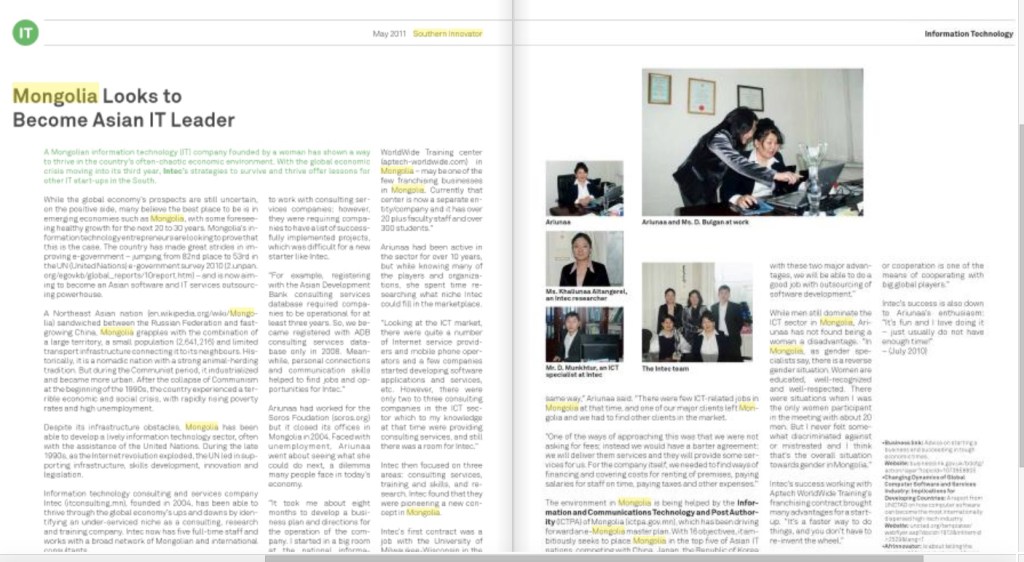
A Mongolian information technology company founded by a woman has shown a way to thrive in the country’s often-chaotic economic environment. With the global economic crisis moving into its third year, Intec’s strategies to survive and thrive offer lessons for other IT start-ups in the South.

While the global economy’s prospects are still uncertain, on the positive side, many believe the best place to be is in emerging economies like Mongolia, with some foreseeing healthy growth for the next 20 to 30 years. Mongolia’s information technology entrepreneurs are looking to prove this is the case. The country has made great strides in improving e-government – jumping from 82nd place to 53rd in the UN e-government survey 2010 (http://www2.unpan.org/egovkb/global_reports/10report.htm) – and is now aiming to become an Asian software and IT services outsourcing powerhouse.

A Northeast Asian nation (http://en.wikipedia.org/wiki/Mongolia) sandwiched between Russia and fast-growing China, Mongolia grapples with the combination of a large territory, a small population (2,641,216) and limited transport infrastructure connecting it to its neighbours. Historically, it is a nomadic nation with a strong animal herding tradition. But during the Communist period, it industrialized and became more urban. After the collapse of Communism at the beginning of the 1990s, the country experienced a terrible economic and social crisis, with rapidly rising poverty rates and high unemployment.

Despite its infrastructure obstacles, Mongolia has been able to develop a lively information technology sector, often with the assistance of the United Nations. During the late 1990s, as the internet revolution exploded, the UN led on supporting infrastructure, skills development, innovation and legislation.

Information technology consulting and services company Intec (www.itconsulting.mn) , founded in 2004, has been able to thrive through the global economy’s ups and downs by identifying an under-serviced niche as a consulting, research and training company. Intec now has five full-time staff and works with a broad network of Mongolian and international consultants.

As is often the case with new businesses, Intec initially found that many doors were closed to start-up enterprises.

“The major challenges which I faced were to make people understand about the consulting services,” said Intec’s founder, Lkhagvasuren Ariunaa. “The consulting services concept was new to Mongolia and Mongolians at that time and not many organizations were willing to work with consulting services. The international and donor organizations were keen to work with consulting services companies; however, they were requiring companies to have a list of successfully implemented projects, which was difficult for a new starter like Intec.

“For example, registering with the Asian Development Bank consulting services database required companies to be operational for at least three years. So, we got registered with ADB consulting services database only in 2008. Meanwhile, personal connections and communication skills helped to find jobs and opportunities for Intec.”

Ariunaa had worked for the Soros Foundation (http://www.soros.org/) but it closed its offices in Mongolia in 2004. Faced with unemployment, Ariunaa went about seeing what she could do next: a dilemma many people face in today’s economy.

“It took me about eight months to develop a business plan and directions of operation of the company. I started in a big room at the national information technology park building with one table, chair and computer.

“It has been quite challenging years for bringing a company to the market and finding niches for us. We have franchised the Indian Aptech WorldWide Training center (http://www.aptech-worldwide.com) in Mongolia – may be one of the few franchising businesses in Mongolia. Currently that center is now a separate entity/company and it has over 20 plus faculty staff and over 300 students.”

Ariunaa had been active in the sector for over 10 years, but while knowing many of the players and organizations, she spent time researching what niche Intec could fill in the marketplace.

“Looking at the ICT market, there were quite a number of internet service providers, mobile phone operators, a few companies started developing software applications, and services etc. However, there were only two to three consulting companies in the ICT sector which to my knowledge at that time were providing consulting services, and still there was a room for Intec.”

Intec then focused on three areas: consulting services, training and skills, and research. Intec found they were pioneering a new concept in Mongolia.

Intec’s first contract was a job with the University of Milwaukee-Wisconsin in the United States to organize a three week course for American students to learn about the digital divide in Mongolia. But the global economic crisis hit Mongolia hard in 2009.

“It was challenging to survive and continue working the same way,” Ariunaa said. “There were few ICT-related jobs in Mongolia at that time, and one of our major clients left Mongolia and we had to find other clients in the market.

“One of the ways of approaching this was that we were not asking for fees, instead we would have a barter agreement – we will deliver them services and they will provide some services for us. For the company itself, we needed to find ways of financing and covering costs for renting of premises, paying salaries for staff on time, paying taxes and other expenses.”

The environment in Mongolia is being helped by the Information and Communications Technology and Post Authority (ICTPA) of Mongolia (http://www.ictpa.gov.mn) , which has been driving forward an e-Mongolia master plan. With 16 objectives, it ambitiously seeks to place Mongolia in the top five of Asian IT nations, competing with South Korea, Singapore, Japan and China.

Ariunaa believes Mongolia has many competitive advantages. “Mongolia is known for a high-literacy rate and math-oriented training and education, and ICT specialists are targeting to become a software outsourcing country for other countries. Another advantage of Mongolians is that they can easily learn other languages: we are fluent in Russian, English, Japanese, Korean, German and we believe that with these two major advantages, we will be able to do a good job with outsourcing of software development.”

While men still dominate the ICT sector in Mongolia, Ariunaa has not found being a woman a disadvantage. “In Mongolia, as gender specialists say, there is a reverse gender situation. Women are educated, well-recognized and well-respected. There were situations, when I was the only women participant in the meeting with about 20 men. But I never felt somewhat discriminated or mis-treated and I think that’s the overall situation towards gender in Mongolia.”

Intec’s success working with Aptech WorldWide Training’s franchising contract brought many advantages for a start-up. “It’s a faster way to do things, and you don’t have to re-invent the wheel.”

As a Mongolian company, Intec has found it best to play to its local strengths. “National companies have knowledge, expertise and experience of local situations, know players and understand about legal, regulatory matters. … partnership or cooperation are one of the means of cooperating with big global players.”

Intec’s success is also down to Ariunaa’s enthusiasm: “It’s fun and I love doing it – just usually do not have enough time!”

Published: July 2010

Resources

1)  Advice on starting a business and succeeding in tough economic times. Website:http://www.businesslink.gov.uk/bdotg/action/layer?topicId=1073858805

2) Changing Dynamics of Global Computer Software and Services Industry: Implications for Developing Countries: A report from UNCTAD on how computer software can become the most internationally dispersed high-tech industry. Website:http://www.unctad.org/templates/webflyer.asp?docid=1913&intitemid=2529&lang=1

3) Afrinnovator: Is about telling the stories of African start-ups, African innovation, African made technology, African tech entrepreneurship and entrepreneurs. Their mission is to ‘Put Africa on the Map’ by covering these kinds of stories from all over Africa. As their website says, “if we don’t tell our own story, who will tell it for us?” Website:http://afrinnovator.com

4) TechMasai: Pan-African start-up news and reviews. Website: www.techmasai.com

5) Ger Magazine Project: Mongolia’s first online magazine pioneered communicating on the web. Website: http://en.wikipedia.org/wiki/Ger_magazine

Development Challenges, South-South Solutions was launched as an e-newsletter in 2006 by UNDP’s South-South Cooperation Unit (now the United Nations Office for South-South Cooperation) based in New York, USA. It led on profiling the rise of the global South as an economic powerhouse and was one of the first regular publications to champion the global South’s innovators, entrepreneurs, and pioneers. It tracked the key trends that are now so profoundly reshaping how development is seen and done. This includes the rapid take-up of mobile phones and information technology in the global South (as profiled in the first issue of magazine Southern Innovator), the move to becoming a majority urban world, a growing global innovator culture, and the plethora of solutions being developed in the global South to tackle its problems and improve living conditions and boost human development. The success of the e-newsletter led to the launch of the magazine Southern Innovator. 
Creative Commons License

This work is licensed under a
Creative Commons Attribution-Noncommercial-No Derivative Works 3.0 License.

Launched in 1997 in a major crisis, the UN Mongolia Development Portal (www.un-mongolia.mn) became the country’s largest online bilingual publisher and an award-winning pioneer of web content. It proved Mongolia had the potential to innovate in digital.
Story featured in the UN E-Government Knowledgebase and E-Government Survey in Media.
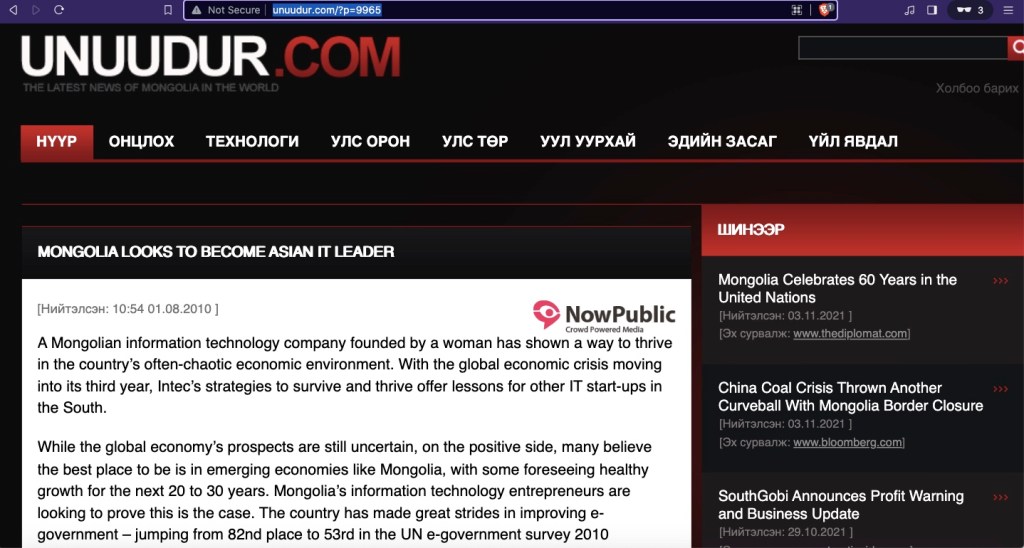
Posted in 2010 on the Unuudur.com (“The latest news of Mongolia in the world”) website.
Creative Commons License

This work is licensed under a
Creative Commons Attribution-Noncommercial-No Derivative Works 3.0 License.

ORCID iD: https://orcid.org/0000-0001-5311-1052.

© David South Consulting 2023