Categories
Archive Blogroll Development Challenges, South-South Solutions Newsletters Southern Innovator magazine

The Power of the Word: African Blogging and Books

By David SouthDevelopment Challenges, South-South Solutions

SOUTH-SOUTH CASE STUDY

“Culture is not a luxury … Culture is the spiritual backbone of society”: with these words Jan Kees van de Werk, the Dutch poet and long-standing advocate of African literature, summed up the importance of culture to Africa’s development. Two trends could significantly alter the prospects for African writers in 2007: the new wave of African bloggers and websites that are now emerging, and the increasing awareness of African literature. More traditional writing is now being joined in 2007 by a surge in African blogging. As internet access has increased, and awareness of free blogging websites like WordPress has also shot up, Africans are jumping online to express themselves (see also Development Challenges, March issue).

African literature is gaining an ever-greater audience through high-profile prize-winning. From veteran Nigerian writer and UNFPA Goodwill Ambassador Chinua Achebe winning this year’s Man Booker International Prize, to best-selling French language authors like Ivorian Ahmadou Kourouma (Allah is not Obliged) and Albert Memmi, winner of the French Academy’s Grand Prix de la Francophonie. They are joined by many others gaining international acclaim, including Uganda’s Monica Arac de Nyeko – winner of the prestigious Caine Prize for African Writing – Nigeria’s Chris Abani (Graceland), Cameroon’s Calixthe Beyala (Lost Honor), Congolese writer Daiel Biyaoula (Alley Without Exit) and Mauritius’s Carl de Souza. The Salon International du Livre et de la Presse de Geneva has established the Ahmadou Kourouma Prize, and the new Book Show for African Literature, Press and Culture is scheduled for 2008.

Increasingly, the creative industries are gaining respect as a key part of a vibrant economy. The power of a successful author or musician to generate awareness and excitement about a country and its products, has gained the respect of many governments. And they are also learning to respect the wealth that can be generated. For example, in Britain the creative industries earn almost as much as the powerful financial sector (Work Foundation). The World Bank’s private sector arm, the International Finance Corporation, has singled out Africa’s creative sector for its future investment.

Blogger Titilayo Soremi in Abuja, Nigeria, is typical of the new wave. A business development officer for an NGO, her blog is a vivid snapshot of life in her country. Obed Sarpongin Accra, Ghana is a budding poet and does not shy away from thorny issues. In his current blog, he tackles domestic politics and writes about the on-again, off-again electricity supply. The secretive Kenyan banker known by the name Bankelele is a lover of new ideas judging by his blog. The content is a mix of financial tip-offs and upcoming business investment opportunities in the region, all stirred up with some rather frank thoughts on politics. He has also gone the extra mile and acquired sponsors for his blog (that banking experience is not going to waste).

The Internet age has also given birth to a new phenomenon: the so-called ”long tail” This is best explained by Kelvin Smith in his paper ‘African Publishers and Writers in British and International Markets’: “What now emerges is that more than half the revenue of Amazon is in the ‘bottom’ two million books on the list.

“So, the ‘Long Tail’ principle goes, we are now looking at a technology that can service the needs not of dozens of markets of millions, but millions of markets of dozens. This has great significance for the small publisher, whether that publisher is in a large publishing nation or in a country where publishing is a smaller scale activity.”

It looks as if getting creative is not only fun, it can be the next goldmine for Africa’s entrepreneurs.

Published: August 2007

Resources

Creative Commons License

This work is licensed under a
Creative Commons Attribution-Noncommercial-No Derivative Works 3.0 License.

Update: There is no better proof of concept than impact.

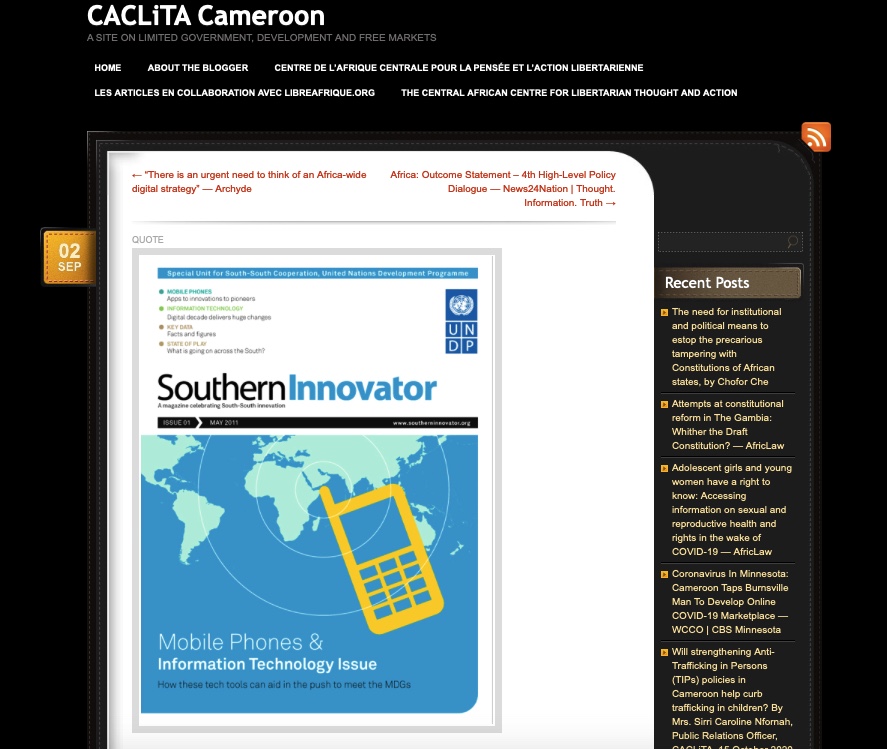
One of the many African blogs and websites to share content from UN e-newsletter Development Challenges, South-South Solutions (2006-2014) and Southern Innovator Magazine (2011-2014).

“Great economic and business reporting! Very helpful for us.” Africa Renewal, Africa Section United Nations Department of Public Information

The story Nollywood: Booming Nigerian Film Industry, from UNDP e-newsletter Development Challenges, South-South Solutions, cited in Innovation Africa: Emerging Hubs of Excellence edited by Olugbenga Adesida, Geci Karuri-Sebina, Joao Resende-Santos (Emerald Group Publishing, 2016).

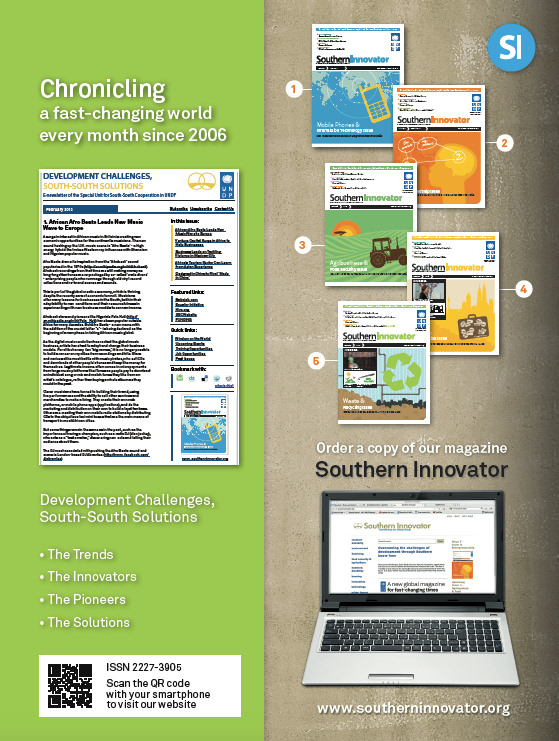
Southern Innovator was published from 2011 to 2015 by the United Nations.

Team | Southern Innovator Phase 1 Development (2010 – 2015)

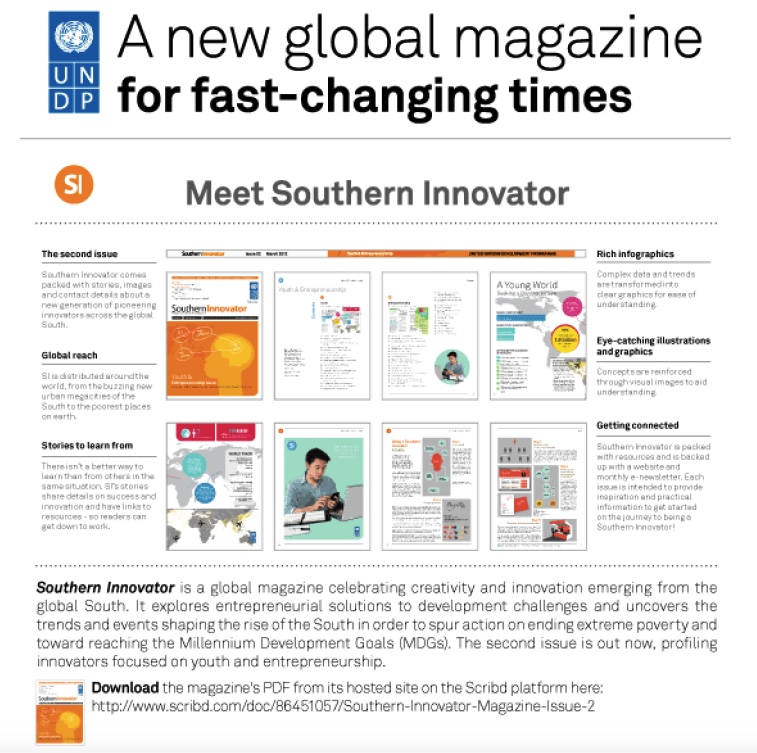
Development Challenges, South-South Solutions was launched as an e-newsletter in 2006 by UNDP’s South-South Cooperation Unit (now the United Nations Office for South-South Cooperation) based in New York, USA. It led on profiling the rise of the global South as an economic powerhouse and was one of the first regular publications to champion the global South’s innovators, entrepreneurs, and pioneers. It tracked the key trends that are now so profoundly reshaping how development is seen and done. This includes the rapid take-up of mobile phones and information technology in the global South (as profiled in the first issue of magazine Southern Innovator), the move to becoming a majority urban world, a growing global innovator culture, and the plethora of solutions being developed in the global South to tackle its problems and improve living conditions and boost human development. The success of the e-newsletter led to the launch of the magazine Southern Innovator.  

Follow @SouthSouth1

Google Books: https://books.google.co.uk/books?id=uXWUyfb4MacC&dq=development+challenges+september+2009&source=gbs_navlinks_s

Slideshare: http://www.slideshare.net/DavidSouth1/development-challengessouthsouthsolutionsseptember2009issue

Southern Innovator Issue 1: https://books.google.co.uk/books?id=Q1O54YSE2BgC&dq=southern+innovator&source=gbs_navlinks_s

Southern Innovator Issue 2: https://books.google.co.uk/books?id=Ty0N969dcssC&dq=southern+innovator&source=gbs_navlinks_s

Southern Innovator Issue 3: https://books.google.co.uk/books?id=AQNt4YmhZagC&dq=southern+innovator&source=gbs_navlinks_s

Southern Innovator Issue 4: https://books.google.co.uk/books?id=9T_n2tA7l4EC&dq=southern+innovator&source=gbs_navlinks_s

Southern Innovator Issue 5: https://books.google.co.uk/books?id=6ILdAgAAQBAJ&dq=southern+innovator&source=gbs_navlinks_s

ORCID iD: https://orcid.org/0000-0001-5311-1052.

© David South Consulting 2023

Categories
Archive Blogroll Development Challenges, South-South Solutions Newsletters

Cheap Paper Microscope to Boost Fight Against Diseases

By David SouthDevelopment Challenges, South-South Solutions

SOUTH-SOUTH CASE STUDY

To tackle diseases in the developing world, the most important first step is diagnosis. Without effective diagnosis, it is difficult to go to the next steps of either treatment or cure. While much attention is given to the high costs involved in treating and curing ailments, screening for diagnosis is also expensive, especially if it involves lots of people. Anything that can reduce the cost of diagnosis will free up resources to expand the number of people who can be checked, and help eradicate contagious diseases.

One innovation is an inexpensive microscope that could allow diagnosing diseases such as malaria to be done on a much larger scale. Called the Foldscope (foldscope.com), it is made from paper, comes in a variety of bright colors and resembles the cardboard, three-dimensional cut-and-keep models regularly found in children’s books and magazines.

Foldscope’s designs are developed on a computer and then printed. Foldscopes are made from thick paper, glue, a switch, a battery and a light-emitting diode (LED) (http://en.wikipedia.org/wiki/Light-emitting_diode).

Inspired by the ancient Japanese paper-folding craft of Origami (http://en.wikipedia.org/wiki/Origami), Foldscope’s makers at the Prakash Lab at Stanford University (http://www.stanford.edu/~manup/) are trying to create “scientific tools that can scale up to match problems in global health and science education”, according to their website.

The Foldscope can be put together in less than 10 minutes (http://www.youtube.com/watch?v=rphTSmb-Ux4) using a pair of scissors, packing tape and tweezers.

Once assembled, a user places a standard glass microscope slide in the Foldscope, turns on the LED light and uses their thumbs to guide the lens to view the slide.

Each Foldscope can magnify up to 2000 times with a sub-micron resolution of 800 nm. The battery can last up to 50 hours on a single button-cell battery and requires no further external power. Its makers claim it can survive being stepped on or dropped from a three-storey building.
It can perform a wide variety of microscopy techniques.

Its makers hope to manufacture billions of Foldscopes a year by exploiting the cheapness of the material and the simplicity of construction.

A beta test called “Ten Thousand Microscopes” will enlist 10,000 people to test the Foldscope in the field. Participants will contribute to helping write a field manual for the Foldscope prior to mass manufacturing. The Foldscope costs just US $0.50 to make for the basic model and US $1 for a higher-magnification version.

Field tests are taking place in the United States, Uganda and India.

Foldscope is designed to be used where more sophisticated lab analysis is not possible or affordable. It can also be an educational tool to give students experience in hands-on microscopy, or build awareness in the general population of how infectious diseases are spread by unseen lifeforms.

Foldscope’s makers hope their creation will help diagnose common but devastating diseases including Plasmodium falciparum (malaria), Trypanosome cruzi (Chagas disease), Giradia lamblia (giardiasis), Leishmania donovani (leishmaniasis), Dirofilaria immitis (filariasis), Human Sickle Cell (sickle-cell anaemia), E. Coli and Bacillus and Pine strobilus.

The quantity of people that need to be checked for diseases is vast and means, in countries where incomes and resources are low, it just isn’t possible to undertake diagnostic services using conventional methods.

“There is definitely a huge gap between where we are and where we want to be,” Stanford School of Medicine Assistant Professor for Bioengineering Manu Prakash explained on the university’s website.

“When you do get it (malaria), there is this simple-minded thing ‘forget diagnostics, let’s just get that tablet’ – and that’s what happens in most of the world. But the problem is there is many different strains, there are many different medications, you could potentially make the problem even worse by not realizing that you have malaria. And at the same time, the people who get a severe case – they are not detected at all.

“What is that one thing that you could almost distribute for free that starts to match the specificity of what detection requires? For malaria, the standard is to be able to image, and sit on a microscope and essentially go through slides.

“What we found as a challenge, if you truly want to scale, you should be really testing more than a billion people every year: that’s a billion tests a year. Any platform that you can imagine needs to scale to those numbers to make an impact.

“One of these things that have been shown over and over again – if you can put (in place) an infrastructure to fight malaria that is scalable and sustainable, then you get retraction of malaria in different regions.”

Published: April 2014

Resources

1) World Health Organization: Facts on malaria from the WHO. Website: http://www.who.int/topics/malaria/en/

2) WHO: Ten Facts on Malaria: About 3.4 billion people – half of the world’s population – are at risk of malaria. In 2012, there were about 207 million malaria cases (with an uncertainty range of 135 million to 287 million) and an estimated 627,000 malaria deaths (with an uncertainty range of 473,000 to 789,000). Website: http://www.who.int/features/factfiles/malaria/en/

3) Instructables: How to build a US $10 stand to turn a smartphone into a digital microsope. Website: http://www.instructables.com/id/10-Smartphone-to-digital-microscope-conversion/

4) Microscope adapter app for smartphones:  iPhone, Android, Blackberry or any Smartphone, with an attachment and an app, can be turned into a microscope. Website: http://internetmedicine.com/iphone-microscope/

5) Stanford University: Stanford University, located between San Francisco and San Jose in the heart of California’s Silicon Valley, is one of the world’s leading teaching and research universities. Website: stanford.edu

6) MaRS: Located in Toronto, Canada, MaRS is where science, technology and social entrepreneurs get the help they need. Where all kinds of people meet to spark new ideas. And where a global reputation for innovation is being earned, one success story at a time. Website: marsdd.com

7) Universal smartphone to microscope and telescope adapter/mount: The SkyLight is a universal smartphone-to-microscope adapter. Website: http://www.amazon.com/Universal-Smart-Microscope-Telescope-Adapter/dp/B00GF3Q3CK

Development Challenges, South-South Solutions was launched as an e-newsletter in 2006 by UNDP’s South-South Cooperation Unit (now the United Nations Office for South-South Cooperation) based in New York, USA. It led on profiling the rise of the global South as an economic powerhouse and was one of the first regular publications to champion the global South’s innovators, entrepreneurs, and pioneers. It tracked the key trends that are now so profoundly reshaping how development is seen and done. This includes the rapid take-up of mobile phones and information technology in the global South (as profiled in the first issue of magazine Southern Innovator), the move to becoming a majority urban world, a growing global innovator culture, and the plethora of solutions being developed in the global South to tackle its problems and improve living conditions and boost human development. The success of the e-newsletter led to the launch of the magazine Southern Innovator.

Creative Commons License

This work is licensed under a
Creative Commons Attribution-Noncommercial-No Derivative Works 3.0 License.

ORCID iD: https://orcid.org/0000-0001-5311-1052.

© David South Consulting 2022

Categories
Archive Blogroll Development Challenges, South-South Solutions Newsletters Southern Innovator magazine

Mobile Phones Bring the Next Wave of New Ideas from the South

By David SouthDevelopment Challenges, South-South Solutions

SOUTH-SOUTH CASE STUDY

Informa Telecoms and Media estimates mobile networks now cover 90 per cent of the world’s population – 40 per cent of whom are covered but not connected.

The rapid growth in take-up has made mobile phones the big success story of the 21st century. With such reach, finding new applications for mobile phones that are relevant to the world’s poor and to developing countries is a huge growth area. It is estimated that by 2015, the global mobile phone content market could be worth over US $1 trillion: relegating basic voice phone calls to just 10 per cent of how people use mobile phones.

Leonard Waverman of the London Business School has estimated that an extra 10 mobile phones per 100 people in a typical developing country, leads to an extra half a percentage point of growth in GDP per person.

The experience of the US $100 laptops from the One Laptop Per Child Project (OLPC) offers an important lesson on making technology work for the poor: the business model has to come first. In the case of OLPC, the big computer manufacturers are already offering low-cost laptops with extensive software and other support: and out-selling OLPC. And it is mobile phones that are proving how fast take-up can be if users are willing to pay for the service on offer.

A new report by the DIRSI (Regional Dialogue on the Information Society) on mobile phones and poverty in Latin America and the Caribbean, unearths the strategies the poor use to access and use mobile telephony, and the main barriers to increasing usage. It also looks at how mobile phones have improved the lives of the poor.

The poor use them to strengthen social ties, increase personal security, and improve business and employment opportunities. Few share their phones and most own them. The only exceptions are Colombia and Peru, where the incentive is to share ownership. Most importantly, the study found that mobile phones are not a luxury good, but the most cost-effective solution to many problems.

Some 250 million Indians today have mobile phones. Many of them are people who make just US $2 or US $3 a day. More and more are getting access to computers and the internet, even in villages.

India’s Mapunity is pioneering ways to reduce the stress and anguish of the daily commute to work – something that seriously erodes people’s quality of life and affects their health. Owner Madhav Pai is using SMS technology to improve transportation in Bangalore by providing the Bangalore Traffic System’s information on bus routes, locations and congestion – all in real time – to mobile phones. The service is free for subscribers to Airtel, and at a small cost for others.

The service works by collecting information on cell phone signal density to build up a map of congestion at different intersections in the city. Tracking congestion has had two benefits: it not only shows where the trouble spots are, it has also enabled mobile phone companies to know where to place extra relay towers to boost capacity and reduce network overload.

This technology effectively turns the mobile phone into a GPS (global positioning system) mapper, with real-time updates.

The company is incubated at the N S Raghavan Centre for Entrepreneurial Learning at the Indian Institute of Management, Bangalore.

In Nairobi, Kenya computer science graduate Billy Odero’s MoSoko uses an SMS text bulletin board system for buying and selling via mobile phones. He got the idea when he had to move out of his university dormitory and needed to sell things to the other students. He was also interested in finding an apartment to share with other newly graduated students somewhere downtown. Tired of sifting through irrelevant ads on bulletin boards, Billy developed an SMS bulletin board system to help connect buyers and sellers in Nairobi. Sellers text into the MoSoko SMS gateway with information regarding the type of item they would like to sell (a bicycle, TV, couch), their location, and the asking price for the item. This information is stored in a database and can be easily accessed via SMS by potential buyers.

More ingenuity can be found in Fultola, Bangladesh. A modest internet café with just four workstations it may be, but remarkably all four can access the internet: through just one mobile phone. This is all possible because of something called an EDGE-enabled (Enhanced Data Rates for GSM Evolution) mobile phone. One of the computers acts as a web server, while the other three workstations are connected to a small device no larger than a cigarette packet. All of this is wireless and possible because of the EDGE-enabled Motorola clamshell mobile phone using a USB cable connection to the server. The project is being supported by the Ndiyo ProjectGrameen Phone and Grameen Telecom.

People use the internet centre to keep in touch with relatives, check market prices, and seek job opportunities or access government websites. The project was co-ordinated by a team working for the GSM Association, the global confederation of mobile phone operators. The aim was to explore the extent to which mobile networks could provide Internet connectivity in developing countries, and to demonstrate the extent to which mobile telephony can increase access to online resources.

In Ghana, mPedigree uses mobiles to fight counterfeit drugs. The plague of counterfeit medicines in Africa kill thousands, and it is estimated between 10 and 25 per cent of all drugs sold in the developing world are fakes (BASCAP – Business Action to Stop Counterfeiting and Piracy). And in Africa, this may be over 50 per cent (USFDA).

mPedigree founder Ashifi Gogo started his company to use mobile phones to protect people against counterfeit drugs and vaccines. “Buying medicine here is like Russian roulette,” said Gogo. “I don’t want people to have to choose between a drug that’s safe and more expensive and a drug that’s cheap and not genuine. Those choices shouldn’t be there.”

Ghanaian Gogo (also a graduate of Dartmouth’s Thayer School of Engineering), lets consumers send an SMS to mPedigree to verify if a drug is legitimate while they are thinking about buying it in the drug store or the street market. The consumer types in the serial number found on the drug’s packet to a short code (a five-digit number similar to the ones used to top-up mobile phone credits). The consumer then receives an SMS response verifying the drug’s authenticity.

To publicise the service, mPedigree advertises in parallel with existing drug promotion campaigns by legitimate pharmaceutical companies. It is also getting publicity help from the local mobile phone provider, Mobile Content in Ghana.

Gogo hopes to expand the service to Nigeria and Mozambique – and eventually the rest of Africa.

Gogo is really enjoying the whole experience of setting up this business: “It’s fun!” he said. “It just feels so good doing this work.”

Published: December 2007

Resources

  • IdeaMamaClub: This online invention and business start-up incubator connects inventors and social entrepreneurs with investors, creative support and global business networks.
  • Stockholm Challenge Awards 2008: An initiative of the Global Knowledge Partnership (GKP), it has four categories and looks for innovative projects in ICT.
  • Terranet: A Swedish company, it has developed a way to make calls between a network of cellphones in a geographically close area, free. A powerful development for entrepreneurs in the South looking for free calls. They are piloting this technology in Ecuador.
  • SME Toolkit: A free online resource aimed at the South to help entrepreneurs and small businesses access business information, tools, and training services to be able to implement sustainable business practices.
  • Entrepreneurial Programming and Research on Mobiles: EPROM, part of the Program for Developmental Entrepreneurship within the MIT Design Laboratory, aims to foster mobile phone-related research and entrepreneurship. Key activities include: development of new applications for mobile phone users worldwide.

https://davidsouthconsulting.org/2022/10/09/a-new-mobile-phone-aimed-at-the-poor/

https://davidsouthconsulting.org/2020/04/30/crowdsourcing-mobile-phones-to-make-the-poor-money/

https://davidsouthconsulting.org/2020/05/01/diy-solution-charges-mobile-phones-with-batteries/

https://davidsouthconsulting.org/2022/10/09/entrepreneurs-use-mobiles-and-it-to-tackle-indian-traffic-gridlock/

https://davidsouthconsulting.org/2022/06/15/indian-mobile-phone-application-innovators-empower-citizens/

https://davidsouthconsulting.org/2022/11/01/innovative-mobile-phone-applications-storm-south/

https://davidsouthconsulting.org/2022/10/27/kenyan-mobile-phone-innovations/

https://davidsouthconsulting.org/2022/10/10/mobile-applications-market-opportunities-for-south/

https://davidsouthconsulting.org/2022/03/08/mobile-phone-microscopes-to-revolutionize-health-diagnostics/

https://davidsouthconsulting.org/2022/04/06/mobile-phone-peacekeeping/

https://davidsouthconsulting.org/2020/12/12/mobile-phone-shopping-to-create-efficient-markets-across-borders/

https://davidsouthconsulting.org/2020/12/20/mobile-phones-engineering-souths-next-generation-of-entrepreneurs/

https://davidsouthconsulting.org/2020/12/12/mobile-phones-new-market-tools-for-the-poor/

https://davidsouthconsulting.org/2022/10/31/new-kenyan-services-to-innovate-mobile-health-and-farming/

https://davidsouthconsulting.org/2021/11/09/ring-tones-and-mobile-phone-downloads-are-generating-income-for-local-musicians-in-africa/

https://davidsouthconsulting.org/2021/03/24/solar-powered-mobile-clinics-to-boost-rural-healthcare-in-africa/

David South Consulting first launched in Toronto, Canada in 1991. In 2010 it had a brand re-launch, with a new logo and website developed in Reykjavik, Iceland using 100% renewable energy.

Development Challenges, South-South Solutions was launched as an e-newsletter in 2006 by UNDP’s South-South Cooperation Unit (now the United Nations Office for South-South Cooperation) based in New York, USA. It led on profiling the rise of the global South as an economic powerhouse and was one of the first regular publications to champion the global South’s innovators, entrepreneurs, and pioneers. It tracked the key trends that are now so profoundly reshaping how development is seen and done. This includes the rapid take-up of mobile phones and information technology in the global South (as profiled in the first issue of magazine Southern Innovator), the move to becoming a majority urban world, a growing global innovator culture, and the plethora of solutions being developed in the global South to tackle its problems and improve living conditions and boost human development. The success of the e-newsletter led to the launch of the magazine Southern Innovator.  

https://davidsouthconsulting.org/2021/03/05/southern-innovator-issue-1/

Creative Commons License

This work is licensed under a
Creative Commons Attribution-Noncommercial-No Derivative Works 3.0 License.

ORCID iD: https://orcid.org/0000-0001-5311-1052.

© David South Consulting 2023
Categories
Archive Blogroll data Development Challenges, South-South Solutions Newsletters digital ID Southern Innovator magazine

China Sets Sights on Dominating Global Smartphone Market

By David SouthDevelopment Challenges, South-South Solutions

SOUTH-SOUTH CASE STUDY

The rise of smartphones – mobile phones capable of Internet access and able to run ‘apps’ or applications – is the latest wave of the global connectivity revolution. Mobile phones rapidly made their way around the world to become almost ubiquitous – the most successful take-up of a piece of communications technology in history – and now smartphones are set to do the same. The number of mobile phone subscriptions in the world surpassed 6 billion in 2012 (out of a population of 7 billion) and, according to the International Telecommunications Union (ITU), the number of mobile phones will exceed the world’s population by 2014.

Over the last five years, with the increasing popularity of smartphones, the focus of the mobile industry has shifted from voice and messaging to apps and data services.

Smartphones are complex pieces of technology and any country that can develop the capability to make them and innovate is set to make a lot of money.

The high export value potential of designing and making “computer equipment, office equipment, telecommunication equipment, electric circuit equipment, and valves and transistors” was flagged up as a priority for developing nations back in 2005 at a UN meeting looking for “New and Dynamic Sectors of World Trade” (UNCTAD).

At present, smartphones have a long way to go to surpass old-style mobile phones: by the end of 2016, according to Portio Research (portioresearch.com), the number of non-smartphones in the Asia-Pacific region alone will still be bigger than the entire worldwide number of all smartphones. Even so, it’s predicted that by 2016, there will be 555 million active smartphones in China alone, as well as half a billion smartphones in Europe by the end of 2014. By 2013, North America’s smartphones will make up 50 per cent of all mobile phones. All in all, a lucrative market.

The main factor holding back the rise of smartphones is price. Smartphones tend to cost more than a basic mobile phone. But as China gets more heavily involved in the smartphone marketplace with its own smartphone and mobile phone brands, low income consumers will find themselves with a wider choice of affordable and powerful smartphones, each one a mini-computer.

Out of the 10 largest global manufacturers of smartphones, four are Chinese: Lenovo, Yulong, Huawei and ZTE (Gartner).

Huawei (http://www.huawei.com/en/), the world’s biggest smartphone seller (according to research firm Canalys) (canalys.com), has started to move some of its design team to London in the United Kingdom, to better tailor its products for foreign markets. It has revenues each year of US $35 billion.

China’s mobile phone market is vast, accounting for a third of all smartphones sold in the world. Getting a foothold in this marketplace places a company in a very strong position to build the expertise and capital to push into the wider global marketplace. And that is what Chinese brands are starting to do. So far, Chinese exports of branded smartphones make up a fifth of those sold around the world (Canalys).

The big global competitors to date have been South Korea’s Samsung (samsung.com) and the American Apple brand (apple.com). Other large competitors are Canada’s troubled Blackberry and Finland’s Nokia.

To compete with them, popular and successful Chinese brands include Xiaomi (xiaomi.cn), which sells more mobile phones in China than does the American Apple brand, and ZTE (http://wwwen.zte.com.cn/en/).

For years, many of the top global brands have had their phones and the components manufactured in China. This meant Chinese manufacturers were assembling the phones but not benefiting from the high value that can be extracted from being the owner of the brand name and the originator of the innovation and holder of the copyrights and trademarks.

But now China’s Lenovo brand (http://www.lenovo.com/uk/en/), for example, has successfully pulled past U.S. electronics maker Hewlett-Packard (www.hp.com) to become the largest seller of personal computers in the world. It is also selling more mobile phones and tablet computers than personal computers.

Lenovo Chief Executive Yang Yuanqing espouses a two-part strategy to defend market share at home in China while going hard at overseas markets. Lenovo started with so-called emerging markets in Russia, India and Indonesia.

“We have very aggressive plans to explore overseas markets,” Lenovo’s mobile phone division head Liu Jun told China Daily. “We hope the overseas market will contribute more than half of Lenovo’s total smartphone revenue in the long run.”

Xiaomi founder Lei Jun is considered part of a new generation of dynamic Chinese technology leaders. His casual clothing and charismatic public presentations have had some equate him to the late Apple founder Steve Jobs. But Jun is not happy with selling smartphones and instead sees the company’s future in software and that the phones are just a tool to access the software. Xiaomi hopes to make even more money from selling games, running online marketplaces and offering social media.

The Chinese-made smartphone brand Coolpad (http://coolpadamericas.com/) – made by Yulong Computer Telecommunication Scientific Co. – is the third best-selling in the Chinese marketplace, surpassing Huawei and Apple and has global annual revenue of US $1.8 billion, according to Forbes magazine. Sino Market Research found 10.2 per cent of China’s smartphone users own a Coolpad, behind Korean brand Samsung and China’s Lenovo.

Coolpad has succeeded by investing heavily in research and development (R&D) and innovation to make the phones cheap but also powerful.

Innovations include technology that lets users have more than one phone number for the same phone by being able to connect to two different network technologies. The phones also include security and privacy protections that make them popular with businesspeople and government officials.

The Coolpad brand has also been frenetic in launching different models of the phones to appeal to its customers. In 2012, it launched 48 different models, selling for between US $50 and US $500.

Coolpad was launched in 2012 in the US as part of the company’s global expansion plans.

China has placed innovation at the core of its economic development policies. China increased its R&D spending in 2009 to US $25.7 billion, a 25.6 per cent rise over 2008, according to Du Zhanyuan, vice minister of the Ministry of Science and Technology. In 2011, China surpassed South Korea and Europe in total patents filed and was in a neck-and-neck race with Japan and the United States.

China now boasts twice as many Internet users as the United States, and is the main global maker of computers and consumer electronics, from toys to games consoles to digital everything.

China is also on course to become the world’s largest market for Internet commerce and computing.

The drive to change and transform China’s global economic role was promoted in 2011’s Beijing International Design Week (http://www.bjdw.org/en/), with its theme of transforming “Made in China to Designed in China.”

Published: September 2013

Resources

1) iHub Nairobi: iHub – Nairobi’s Innovation Hub for the technology community is an open space for the technologists, investors, tech companies and hackers in the area. This space is a tech community facility with a focus on young entrepreneurs, web and mobile phone programmers, designers and researchers. Website: http://www.ihub.co.ke/

2) Venture Capital for Africa: Venture Capital for Africa (www.vc4africa.biz) is the continent’s leading founder’s network, the largest and fastest growing community of  entrepreneurs and investors building promising companies in Africa. Website: https://vc4africa.biz/

Red Dot: The red dot logo stands for belonging to the best in design and business. The red dot is an internationally recognized quality label for excellent design that is aimed at all those who would like to improve their business activities with the help of design. Website: http://www.red-dot.de

C3: C3 offers product design and product engineering services in Shanghai, China. Their strong point is managing innovative design processes from scratch (market research) until production: a one shop service: Website: chinacreativecompany.com

North Korea Tech: North Korea Tech is dedicated to covering and collecting information regarding the state of information technology and related industry in North Korea. You can expect to find articles related to Internet connectivity in the country (yes, it does exist), North Korea’s use of technology, and the country’s centrally-controlled and heavily-censored mass media. Website: http://www.northkoreatech.org/

ISSN 2227-3905

Google Snippit December 2020.

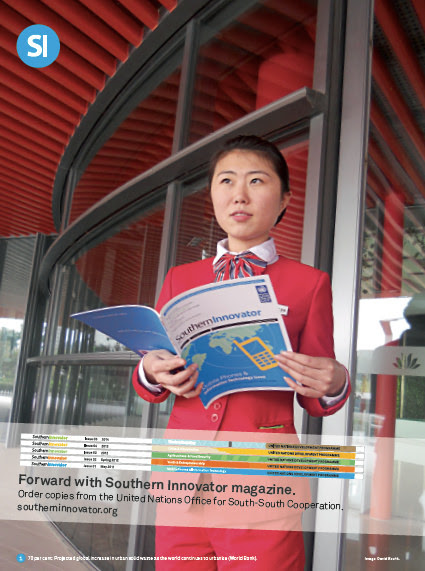
Note on story: Very few outside of China in 2013 were talking about this topic, let alone the increasing market share of smartphone manufacturer Huawei. This was one of many stories to result from a research trip to China. For the keen-eyed, try and spot the Huawei logo in the accompanying photo taken in Tianjin.

https://davidsouthconsulting.org/2020/04/30/crowdsourcing-mobile-phones-to-make-the-poor-money/

https://davidsouthconsulting.org/2020/05/01/diy-solution-charges-mobile-phones-with-batteries/

https://davidsouthconsulting.org/2022/10/09/entrepreneurs-use-mobiles-and-it-to-tackle-indian-traffic-gridlock/

https://davidsouthconsulting.org/2022/06/15/indian-mobile-phone-application-innovators-empower-citizens/

https://davidsouthconsulting.org/2022/11/01/innovative-mobile-phone-applications-storm-south/

https://davidsouthconsulting.org/2020/12/20/kenya-reaches-mobile-phone-banking-landmark/

https://davidsouthconsulting.org/2022/10/27/kenyan-mobile-phone-innovations/

https://davidsouthconsulting.org/2022/10/10/mobile-applications-market-opportunities-for-south/

https://davidsouthconsulting.org/2022/03/08/mobile-phone-microscopes-to-revolutionize-health-diagnostics/

https://davidsouthconsulting.org/2022/04/06/mobile-phone-peacekeeping/

https://davidsouthconsulting.org/2020/12/12/mobile-phone-shopping-to-create-efficient-markets-across-borders/

https://davidsouthconsulting.org/2020/12/20/mobile-phones-bring-the-next-wave-of-new-ideas-from-the-south/

https://davidsouthconsulting.org/2020/12/20/mobile-phones-engineering-souths-next-generation-of-entrepreneurs/

https://davidsouthconsulting.org/2020/12/12/mobile-phones-new-market-tools-for-the-poor/

https://davidsouthconsulting.org/2022/10/09/a-new-mobile-phone-aimed-at-the-poor/

https://davidsouthconsulting.org/2021/11/09/ring-tones-and-mobile-phone-downloads-are-generating-income-for-local-musicians-in-africa/

Development Challenges, South-South Solutions was launched as an e-newsletter in 2006 by UNDP’s South-South Cooperation Unit (now the United Nations Office for South-South Cooperation) based in New York, USA. It led on profiling the rise of the global South as an economic powerhouse and was one of the first regular publications to champion the global South’s innovators, entrepreneurs, and pioneers. It tracked the key trends that are now so profoundly reshaping how development is seen and done. This includes the rapid take-up of mobile phones and information technology in the global South (as profiled in the first issue of magazine Southern Innovator), the move to becoming a majority urban world, a growing global innovator culture, and the plethora of solutions being developed in the global South to tackle its problems and improve living conditions and boost human development. The success of the e-newsletter led to the launch of the magazine Southern Innovator.  

Follow @SouthSouth1

Google Books: https://books.google.co.uk/books?id=uXWUyfb4MacC&dq=development+challenges+september+2009&source=gbs_navlinks_s

Slideshare: http://www.slideshare.net/DavidSouth1/development-challengessouthsouthsolutionsseptember2009issue

Southern Innovator Issue 1: https://books.google.co.uk/books?id=Q1O54YSE2BgC&dq=southern+innovator&source=gbs_navlinks_s

Southern Innovator Issue 2: https://books.google.co.uk/books?id=Ty0N969dcssC&dq=southern+innovator&source=gbs_navlinks_s

Southern Innovator Issue 3: https://books.google.co.uk/books?id=AQNt4YmhZagC&dq=southern+innovator&source=gbs_navlinks_s

Southern Innovator Issue 4: https://books.google.co.uk/books?id=9T_n2tA7l4EC&dq=southern+innovator&source=gbs_navlinks_s

Southern Innovator Issue 5: https://books.google.co.uk/books?id=6ILdAgAAQBAJ&dq=southern+innovator&source=gbs_navlinks_s

This work is licensed under a Creative Commons Attribution 4.0 International License.

https://davidsouthconsulting.org/2021/03/05/southern-innovator-issue-1/

Creative Commons License

This work is licensed under a
Creative Commons Attribution-Noncommercial-No Derivative Works 3.0 License.

ORCID iD: https://orcid.org/0000-0001-5311-1052.

© David South Consulting 2023