Categories
Archive Development Challenges, South-South Solutions Newsletters Southern Innovator magazine

New Cities Offering Solutions for Growing Urban Populations

By David SouthDevelopment Challenges, South-South Solutions

SOUTH-SOUTH CASE STUDY

Across the global South, new cities are being dreamed up by architects, city planners and governments, or are already under construction. Two new urban areas being built offer lessons for others in the global South. They both deploy intelligent solutions to the combined demands of urbanization, growing populations and rising expectations.

An eco city in China and a smart city in the Republic of Korea are tackling today’s – and tomorrow’s – challenges.

A joint initiative between China and Singapore, the Sino-Singapore Tianjin Eco-City project (tianjinecocity.gov.sg) – located on reclaimed land some 45 kilometres from the booming Chinese city of Tianjin and 150 kilometres from Beijing – is an attempt to create a replicable model for other cities in China and the global South. Already well underway, with the first phase of construction nearly complete, the Eco-City’s hallmarks include encouraging walking, reducing reliance on private vehicles and aiming to generate 20 per cent of the city’s energy from renewable sources. It is run from the Chinese end by Tianjin TEDA Investment Holding Co., Ltd and in Singapore by the Keppel Group.

It is located 10 kilometres from the Tianjin Economic Technological Development Area (TEDA), a fast-growing high-tech business hub in its own right.

Called an “integrated work, live, play and learn environment,” it is a mix of public and private housing based on the highly successful model developed in Singapore.

The concept of an “eco city” was first raised by Richard Register in his 1987 book Ecocity Berkeley: Building Cities for a Healthy Future. It was to be a place that minimizes inputs of energy, water, and food and outputs of waste heat, air pollution, carbon dioxide, methane and water pollution. Like smart cities, eco cities are taking shape in various forms around the world. Some are applying the concept and principles of an eco city to an existing place, while others are being built from scratch.

The Tianjin Eco-City is a mix of elements designed to make it sustainable in the long-term. It includes an “EcoValley” running through the development as its centrepiece green space to encourage walking and cycling between the major centres of the city. It has the usual urban services – from schools to shops and restaurants – but also, critically, a growing range of business parks to support employment.

Unlike green initiatives in wealthy, developed countries, it is hoped the Tianjin Eco-City will prove a more relevant model for the global South. It has factored in the need to make an eco city pay its way and generate new business and innovations. It is trying to address the pressing urgency of China’s growing population and rapid urbanization, while balancing people’s expectations of rising living standards. As in other countries in the global South, people aspire to a higher standard of living and this needs to be taken into consideration when planning eco cities.

Ho Tong Yen, Chief Executive Officer of Sino-Singapore Tianjin Eco-City, says its aim is “sustainable development packaged in a way that is uniquely Asian.”

He says the project is intended to be “practical, replicable and scalable.”

“Practical at its core is building something that the market can support, something that is affordable given the economic development of the region,” he said. “The idea is that this model must be one that is replicable and scalable in other parts of China. Now, strictly speaking, there is no reason it needs to be just for China – it really might be replicable in other developing countries as well. Our starting point, however, is to find a model that might work for China.

“I think it is still a work in progress – a bold experiment – and it is a long-term experiment. The idea is to create an eco city that can support a population of 350,000 over a 10 to 15 year horizon.

“In some ways it is a city that does not look all that much different from other Chinese cities. But if you look at the subtleties – the building orientation, the renewable energy, the transit oriented developments, the walkability concepts – these are all the elements we built into this project.

“An eco city is not necessarily a science-fiction-like concept; it is something that is very real, very do-able. It looks a lot like a normal city – it is not a special city in a glass dome.”

The explosion in information technologies in the past decade has re-shaped the way cities can be planned, run and developed. The connectivity brought about by now-ubiquitous electronic devices such as mobile phones and the ever-expanding information networks connected by fibre optic cables is giving rise to so-called “smart cities.” These urban areas draw on information technologies to use resources more efficiently and reduce waste, while – it is hoped – better serving the needs of residents. Real-time information can be gleaned to monitor energy use, or traffic congestion, or crime, while constant online connectivity enables the efficient delivery of a multitude of services to residents.

Smart cities vary in their scope and ambition. Some are existing urban areas given a modern upgrade, while others, such as the Songdo International Business District (IBD) (songdoibd.com) smart city in the Republic of Korea, are planned and built from scratch.

Built on 1,500 acres (607 hectares) of reclaimed land from the Yellow Sea in Incheon, Songdo International Business District is being built by Gale International and POSCO E&C of Korea. It is considered one of the largest public/private real estate ventures in the world. Due to be completed in 2017, it will be home to 65,000 people (22,000 currently live there), while 300,000 people will commute in daily to work. Fifteen years in the making and costing over US $35 billion, it is called a “synergistic city” because it contains all the elements necessary for people to live a high-quality life.

Currently 50 percent complete, Songdo IBD is considered one of Asia’s largest green developments and a world leader in meeting LEED (Leadership in Energy and Environmental Design) (https://new.usgbc.org/leed) standards for green buildings. For example, it has the first LEED-certified hotel in Korea, the Sheraton Incheon. These high green standards have led to the United Nations Green Climate Fund Secretariat establishing its headquarters in Songdo, with a slated opening in 2013.

Songdo is “smart” because information technology connects all its systems – residences, buildings, offices, schools, hospitals, hospitality and retail outlets. This includes more than 10,000 Cisco TelePresence units (http://www.cisco.com/en/US/products/ps7060/index.html)– menu-driven video screens – being installed in the residences to connect them to all the services available in Songdo.

It also benefits from proximity to Incheon International Airport – consistently voted one of the best in the world – giving residents quick access to other Asian cities such as Shanghai, Tokyo and Hong Kong. This connection between urban development and a highly connected airport is being called an “aerotropolis.”

Songdo smart city is just one part of a massive regional development plan, using reclaimed land from the sea and marshlands. The residential and business developments are all being linked to IncheonInternationalAirport, which is being positioned as a transport hub and gateway to Northeast Asia – it boasts of being a three-and-a-half hour flight to one-third of the world’s population. The idea is to create a thriving international business hub that is a short flight away from Asia’s booming and fast-growing economic centres.

“The beauty is you are doing everything from scratch – you are using newer building technology, newer systems,” said Scott Summers, Vice President of Foreign Investment for developers Gale International Korea LLC.

“You are not going into a city and ripping up old things and then put in new systems. You have a greater opportunity to install this technology, the backbone (information technology from Cisco), to allow these services and connectivity to work properly because you are laying wires in buildings from the get-go rather than going in afterwards.”

Summers believes it is the high-tech component of Songdo that will set it apart from other cities in the future. Songdo is being built with a combination of innovative sustainable development technologies and the latest in information technologies provided by Cisco.

“That is one of the reasons we are pushing this technology, because it is how a city operates that is important,” Summers said.

“The operation of a city, to do it well, is going to improve the success of it. (To) embed into the development of the city some of the technologies of sustainable development – to put in the pneumatic waste system, grey water system, the co-generation – all of those things are much easier to do on raw land.”

Sojeong Sylvia Sohn, owner of Songdo’s Kyu, a Korean fusion cuisine restaurant, was attracted to Songdo and is banking on its future growth.

Sohn said Seoul’s “existing commercial area was just saturated.”

“Songdo International City in Incheon is the future for the region and early business tenants are coming here for investment purposes. It has uncluttered streets and modern buildings, being an international city – this makes it attractive.”

Published: December 2012
Resources

1) Eco Cities World Summit: The International Ecocity Conference Series brings together the key innovators, decision makers, technologists, businesses and organizations shaping the conversation around ecological and sustainable city, town and village design, planning and development. Website: http://www.ecocityworldsummit.org/

2) Richard Florida: The Creative Class Group is a boutique advisory services firm composed of leading next-generation researchers, academics, and strategists. Website:http://www.creativeclass.com/richard_florida

3) Global Urbanist: The Global Urbanist is an online magazine reviewing urban affairs and urban development issues in cities throughout the developed and developing world. Website: http://globalurbanist.com/

4) UN-Habitat: The United Nations Human Settlements Programme, UN-HABITAT, is the United Nations agency for human settlements. It is mandated by the UN General Assembly to promote socially and environmentally sustainable towns and cities with the goal of providing adequate shelter for all. Website: http://www.unhabitat.org

5) Eco-Cities: A Planning Guide by Zhifeng Yang. Website: http://tinyurl.com/d26rxdx

https://davidsouthconsulting.org/2022/10/06/africas-fast-growing-cities-a-new-frontier-of-opportunities/

https://davidsouthconsulting.org/2020/12/04/big-data-can-transform-the-global-souths-growing-cities/

https://davidsouthconsulting.org/2022/11/17/book-boom-rides-growing-economies-and-cities/

https://davidsouthconsulting.org/2022/10/19/chinese-building-solution-for-rapidly-urbanizing-global-south/

https://davidsouthconsulting.org/2021/10/21/cities-for-all-shows-how-the-worlds-poor-are-building-ties-across-the-global-south/

https://davidsouthconsulting.org/2020/12/11/cyber-cities-an-oasis-of-prosperity-in-the-south/

https://davidsouthconsulting.org/2017/11/08/eco-cities-up-close-2013/

https://davidsouthconsulting.org/2022/03/20/global-south-eco-cities-show-how-the-future-can-be/

https://davidsouthconsulting.org/2021/11/12/global-souths-rising-megacities-challenge-idea-of-urban-living/

https://davidsouthconsulting.org/2022/11/16/housing-innovation-in-souths-urban-areas/

https://davidsouthconsulting.org/2020/12/14/innovation-in-growing-cities-to-prevent-social-exclusion/

https://davidsouthconsulting.org/2022/09/28/model-cities-across-the-south-challenge-old-ways/

https://davidsouthconsulting.org/2022/03/29/model-city-to-test-the-new-urbanism-concept-in-india/

https://davidsouthconsulting.org/2022/10/10/more-futuristic-african-cities-in-the-works/

https://davidsouthconsulting.org/2017/11/08/smart-cities-up-close-2013/

https://davidsouthconsulting.org/2021/10/22/south-south-cooperation-for-cities-in-asia/

https://davidsouthconsulting.org/2021/03/05/southern-innovator-issue-4/

Creative Commons License

This work is licensed under a
Creative Commons Attribution-Noncommercial-No Derivative Works 3.0 License.

ORCID iD: https://orcid.org/0000-0001-5311-1052.

© David South Consulting 2023

Categories
Archive Blogroll Southern Innovator magazine United Nations Development Programme United Nations Office for South-South Cooperation

Southern Innovator Issue 4

Eco-cities Up Close

Smart Cities Up Close

Launched in May 2011, the new global magazine Southern Innovator (ISSN 2222-9280) is about the people across the global South shaping our new world, eradicating poverty and working towards the achievement of the Millennium Development Goals (MDGs). 

Team | Southern Innovator Phase 1 Development (2010 – 2015)

They are the innovators.

Follow the magazine on Twitter @SouthSouth1. 

Southern Innovator Issue 1

Southern Innovator Issue 2

Southern Innovator Issue 3

Southern Innovator Issue 4

Southern Innovator Issue 5

If you would like hard copies of the magazine for distribution, then please contact the United Nations Office for South-South Cooperation (UNOSSC)(https://www.unsouthsouth.org/2014/12/25/southern-innovator-magazine/).

https://davidsouthconsulting.org/2021/12/20/press-release-2-southern-innovator/

https://davidsouthconsulting.org/southern-innovator-scale-up-fundraiser/

Southern Innovator Editor and Writer David South with Issue 4 at the Sydney Opera House in 2013. Photo: Jill Lawless

ORCID iD: https://orcid.org/0000-0001-5311-1052.

© David South Consulting 2024

Categories
Archive Blogroll data Development Challenges, South-South Solutions Newsletters Southern Innovator magazine

China Looking to Lead on Robot Innovation

By David SouthDevelopment Challenges, South-South Solutions

SOUTH-SOUTH CASE STUDY

Since the 1950s, science fiction has been telling the world we will soon be living with robots. While robots have emerged, they have been mostly kept to heavy industry, where machines can perform dangerous, hot and unpleasant repetitive tasks to a high standard.

But China is pioneering the move to mainstream robots in more public spheres. And the country is promising big changes in the coming decade.

Robots, strange as it may seem, can play a key role in development and fighting poverty.

If used intelligently, the rise of robots and robotics – itself a consequence of huge technological advances in information technology, the Internet, nanotechnology,artificial intelligence, and mobile communications – can free workers from boring, difficult and dangerous jobs. This can ramp up the provision of public goods like cleaning services in urban areas, or remove the need to do back-breaking farming work.

Robotics also offers a new field of high-tech employment for countries in the global South who are producing far more educated engineering and science students than they can currently employ. These students can help build the new robot economy.

China is considered to be in the early stages of competing with robot pioneers such as Japan, Switzerland, Germany, Sweden and the United States. And China still has a low penetration of industrial robots per population. In 2011 estimates placed the number of industrial robots in China at 52,290 (International Federation of Robotics) (ifr.org).

In the years ahead, China confronts a double demographic problem. It has the world’s largest elderly population, who will need care, and it also has a shrinking number of young people available to work as a result of the country’s one-child policy (http://en.wikipedia.org/wiki/One-child_policy).

Robots can help solve these problems.

China started its robotics research in the 1970s and ramped it up from 1985. It has already made significant progress manufacturing domestic robots for cleaning. The Xiamen Lilin Electronics Co., Ltd. (http://cnlilin.en.made-inchina.

com/) makes vacuum cleaners that are small round robots smart enough to return to their recharging stations when low on power. Another firm, Jetta Company (http://www.jetta.com.hk/home.htm), has built and sells the iRobot Roomba vacuum cleaning and floor-washing robots (http://www.irobot.com/uk/store.aspx?camp=ppc:google:products_roomba:G_790612075_1846279957_iRobot%20roomba:roomba_brand&gclid=CMiezMiG8a4CFc4LtAodYE3MKw).

For the heavy duty stuff, there is Ningbo’s Dukemen Robot, sold with the slogan “man, technology, robot”. The company manufactures arm-like robots for heavy lifting and lifting in dangerous or uncomfortable environments (dukerobot.com/ks/robot-manufacturers/).

A company called Quick specializes in making soldering equipment for manufacturing electronic components and sells robots that can do this with high accuracy and speed (quick-global.com/9-new-soldering-robot-1.html).

Other robotic advances in China include a robot dolphin that swims through the water measuring its quality.

There are also robots in development to do housework and help people who need assistance in the home like the elderly and the disabled. These robots can monitor a person’s physical condition and provide psychological counselling and search for, and deliver, requested items. One example is called UNISROBO, and is based on the Japanese robot PaPeRo robot (http://www.nec.co.jp/products/robot/en/index.html).

Still other robots can perform surgical procedures or even play sport, like Zhejiang University’s ping pong-playing robot (http://www.youtube.com/watch?v=4BtHYHi7trA).

Even more ambitiously, China is developing robots to send to the moon.

The push to introduce robots into the workplace and wider society is receiving considerable attention in China.

The Taiwan-based technology company Foxconn – well-known for assembling products for the American company Apple, maker of the iPad and iPhone -has pledged to deploy a million robots in its Chinese factories in the coming years to improve efficiency.

Some are forecasting that if China starts building robots on the scale it has pledged, then the world’s population of manufacturing robots will grow tenfold in 10 years.

China is also broaching one of the trickiest aspects of robotics – getting robots to interact with humans.

The tricky bit in robotics is getting interaction with human beings right and to avoid the experience being intimidating or frightening. One sector that is already ahead in experimenting with this aspect of robots is the restaurant business. One robot being used in restaurants sits on a tricycle trolley laden with drinks. It cycles from table to table in endless rotation allowing customers to choose drinks when they like.

The first robot restaurant started a trial run in 2010 in Jinan (http://en.wikipedia.org/wiki/Jinan), the capital of Shandong Province. The hot pot restaurant uses six robots to help with the service. The restaurant has also given itself the perfect name for this new approach: Continental Robot Experience Pavilion. Adorned with robot posters, the restaurant is 500 square metres in size and can seat 100 diners.

Diners at the Continental Robot Experience Pavilion are greeted by two ‘female’ “beauty robot receptionists” dressed in uniforms. Inside, the six robot waiters serve the customers. There are two to deliver drinks and two to serve the small tables and two to serve the big tables.

The robot comes to the table and takes the customers’ orders for food dishes and drinks. The robots, designed with sensors to stop them moving when they sense something or someone in front of them, are able to handle 21 tables and deal with the 100 customers at a single sitting.

The robots have proven so effective, the restaurant’s staff can stay focused on administration and providing assistance. The cooking is still done by human beings.

This trial run is designed to test the concept and the novelty of having robots attracting customers, the restaurant’s manager told the People’s Daily Online.

The plan is to increase the number of robots to 40 and also to have robots do cleaning and other tasks.

“They have a better service attitude than humans,” said Li Xiaomei, 35, who was visiting the restaurant for the first time. “Humans can be temperamental or impatient, but they don’t (the robots) feel tired, they just keep working and moving round and round the restaurant all night,” Li said to China Daily.

Published: March 2012

Resources

1) The Robot Report: It boasts compiling more than 1,400 robotics-related links and is about “Tracking the business of robotics”. Website: therobotreport.com

2) The Robot Shop: Bills itself as “The world’s leading source for professional robot technology” and sells online all the parts, kits, toys, tools and equipment to get any enthusiast or small and medium enterprise working with robotics quickly. Website: robotshop.com

3) Robot App Store: Sells ‘apps’ or software applications to expand the capabilities of robots. It also operates as a store for application developers to sell their robot apps to others. Also has information and resources on how to get started making robot apps and making money from making robot apps. Website: robotappstore.com

4) Roboearth: Funded by the European Union, RoboEarth is an online, open source network where robots can communicate with each other and share information and “learn from each other about their behaviour and their environment. Bringing a new meaning to the phrase “experience is the best teacher”, the goal of RoboEarth is to allow robotic systems to benefit from the experience of other robots, paving the way for rapid advances in machine cognition and behaviour, and ultimately, for more subtle and sophisticated human-machine interaction. Website: roboearth.org

5) Robotland: A blog writing about the “visions, ideas, innovations, awards, trends and reports from leading robotics research and development places in the world”. Website: http://robotland.blogspot.co.uk/

6) China Hi-Tech Fair: Running from 16-21 November 2012, the Fair is a great way to see the latest developments in robotics in China. Website: chtf.com/english/

7) Singularity Hub: A cornucopia of robotic resources and news on “science, technology and the future of mankind”. Website: http://singularityhub.com/

Development Challenges, South-South Solutions was launched as an e-newsletter in 2006 by UNDP’s South-South Cooperation Unit (now the United Nations Office for South-South Cooperation) based in New York, USA. It led on profiling the rise of the global South as an economic powerhouse and was one of the first regular publications to champion the global South’s innovators, entrepreneurs, and pioneers. It tracked the key trends that are now so profoundly reshaping how development is seen and done. This includes the rapid take-up of mobile phones and information technology in the global South (as profiled in the first issue of magazine Southern Innovator), the move to becoming a majority urban world, a growing global innovator culture, and the plethora of solutions being developed in the global South to tackle its problems and improve living conditions and boost human development. The success of the e-newsletter led to the launch of the magazine Southern Innovator.  

Follow @SouthSouth1

Slideshare: http://www.slideshare.net/DavidSouth1/development-challengessouthsouthsolutionsnovember2010issue

Southern Innovator Issue 1: https://books.google.co.uk/books?id=Q1O54YSE2BgC&dq=southern+innovator&source=gbs_navlinks_s

Southern Innovator Issue 2: https://books.google.co.uk/books?id=Ty0N969dcssC&dq=southern+innovator&source=gbs_navlinks_s

Southern Innovator Issue 3: https://books.google.co.uk/books?id=AQNt4YmhZagC&dq=southern+innovator&source=gbs_navlinks_s

Southern Innovator Issue 4: https://books.google.co.uk/books?id=9T_n2tA7l4EC&dq=southern+innovator&source=gbs_navlinks_s

Southern Innovator Issue 5: https://books.google.co.uk/books?id=6ILdAgAAQBAJ&dq=southern+innovator&source=gbs_navlinks_s

Citations

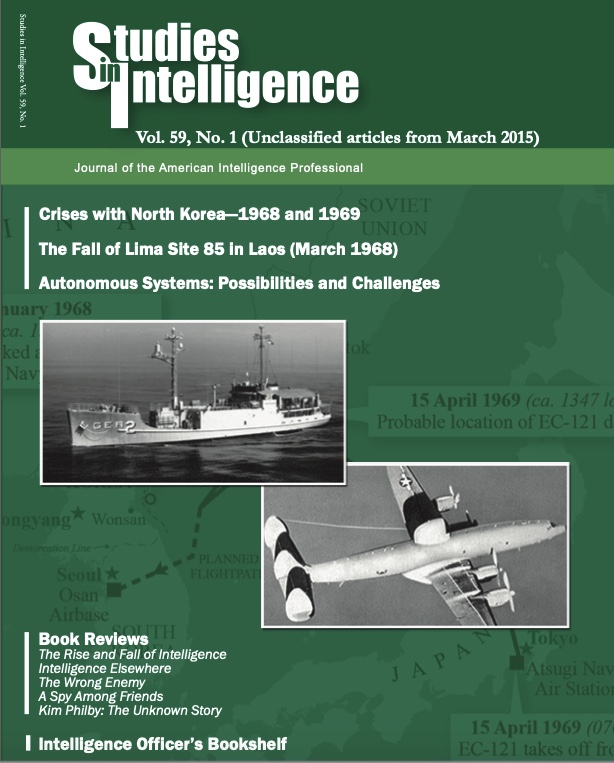
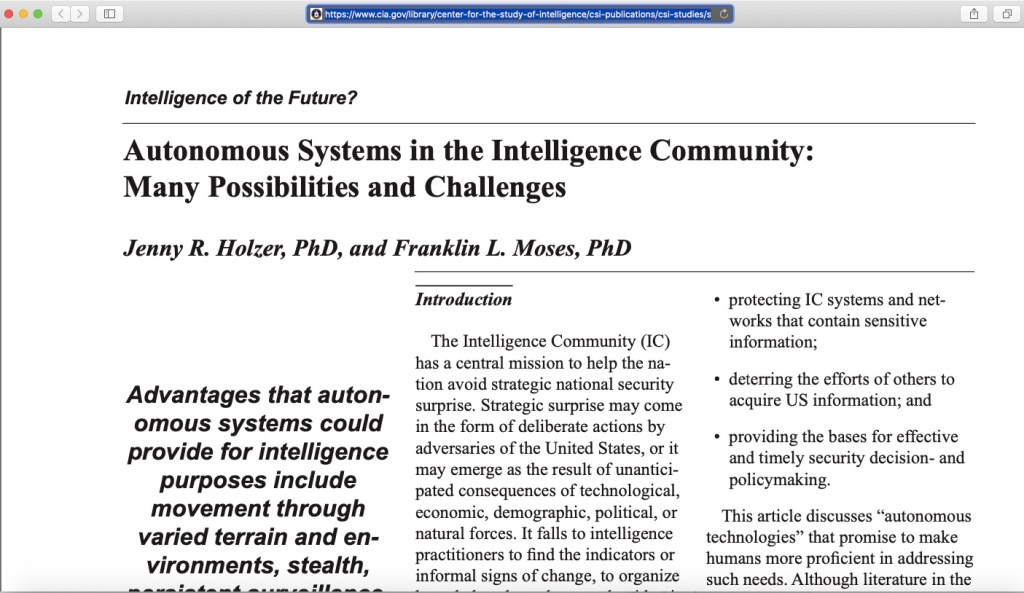
Cited in Studies in Intelligence, Autonomous Systems in the Intelligence Community: Many Possibilities and Challenges, Vol. 59, No.1 (Extracts, March 2015).

Studies in Intelligence, Vol. 59, No.1 (Unclassified articles from March 2015).
Autonomous Systems in the Intelligence Community: Many Possibilities and Challenges by Jenny R. Holzer, PhD, and Franklin L. Moses, PhD in Studies in Intelligence Vol 59, No. 1 (Extracts, March 2015).
Link: https://www.cia.gov/resources/csi/studies-in-intelligence/volume-59-no-1/autonomous-systems-in-the-intelligence-community-many-possibilities-and-challenges/.

More China stories:

Better by Design in China

https://davidsouthconsulting.org/2021/12/20/better-by-design-in-china/

https://davidsouthconsulting.org/2022/10/20/china-consumer-market-asian-perspective-helps/

China Pushing Frontiers of Medical Research

https://davidsouthconsulting.org/2020/04/25/china-pushing-frontiers-of-medical-research/

China Sets Sights on Dominating Global Smartphone Market

https://davidsouthconsulting.org/2020/12/10/china-sets-sights-on-dominating-global-smartphone-market/

https://davidsouthconsulting.org/2022/10/04/chinas-booming-wine-market-can-boost-south/

China’s Outsourced Airliner Development Model

https://davidsouthconsulting.org/2020/04/29/chinas-outsourced-airliner-development-model/

https://davidsouthconsulting.org/2021/03/20/computer-gold-farming-turning-virtual-reality-into-real-profits/

Creating Green Fashion in China

https://davidsouthconsulting.org/2021/01/25/creating-green-fashion-in-china/

https://davidsouthconsulting.org/2020/12/11/cyber-cities-an-oasis-of-prosperity-in-the-south/

Designed in China to Rival ‘Made in China’

https://davidsouthconsulting.org/2021/01/26/designed-in-china-to-rival-made-in-china/

https://davidsouthconsulting.org/2022/10/04/popular-chinese-social-media-chase-new-markets/

https://davidsouthconsulting.org/2021/10/04/putting-quality-and-design-at-the-centre-of-chinese-fashion/

Rammed-Earth Houses: China Shows how to Improve and Respect Traditional Homes

https://davidsouthconsulting.org/2021/02/12/rammed-earth-houses-china-shows-how-to-improve-and-respect-traditional-homes/

Virtual Supermarket Shopping Takes off in China

https://davidsouthconsulting.org/2020/04/17/virtual-supermarket-shopping-takes-off-in-china/

Creative Commons License

This work is licensed under a
Creative Commons Attribution-Noncommercial-No Derivative Works 3.0 License.

ORCID iD: https://orcid.org/0000-0001-5311-1052.

© David South Consulting 2023

Categories
Archive Blogroll

Eco-Cities Up Close | 2013

DS Consulting logo copy

Story: David South

Design and Layout: Solveig Rolfsdottir

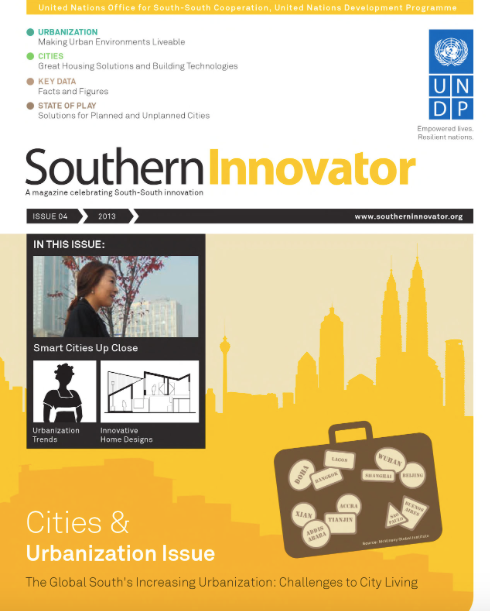
Publication: Southern Innovator Issue 4: Cities and Urbanization

Publisher: United Nations Office for South-South Cooperation (UNOSSC)

Date: 2013

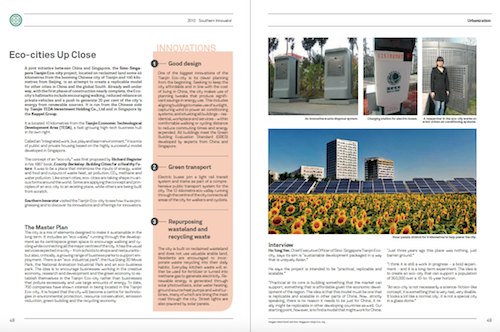
Eco-cities feature Issue 4
Eco-cities Up Close in Southern Innovator Issue 4.
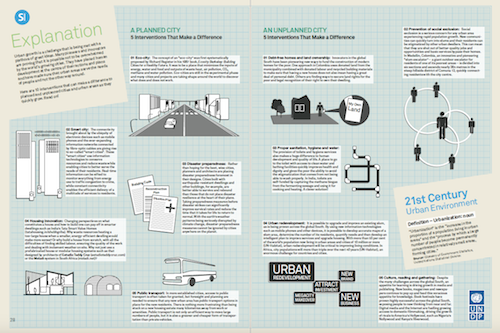
Infographic Issue 4
An infographic showing planned and unplanned cities.
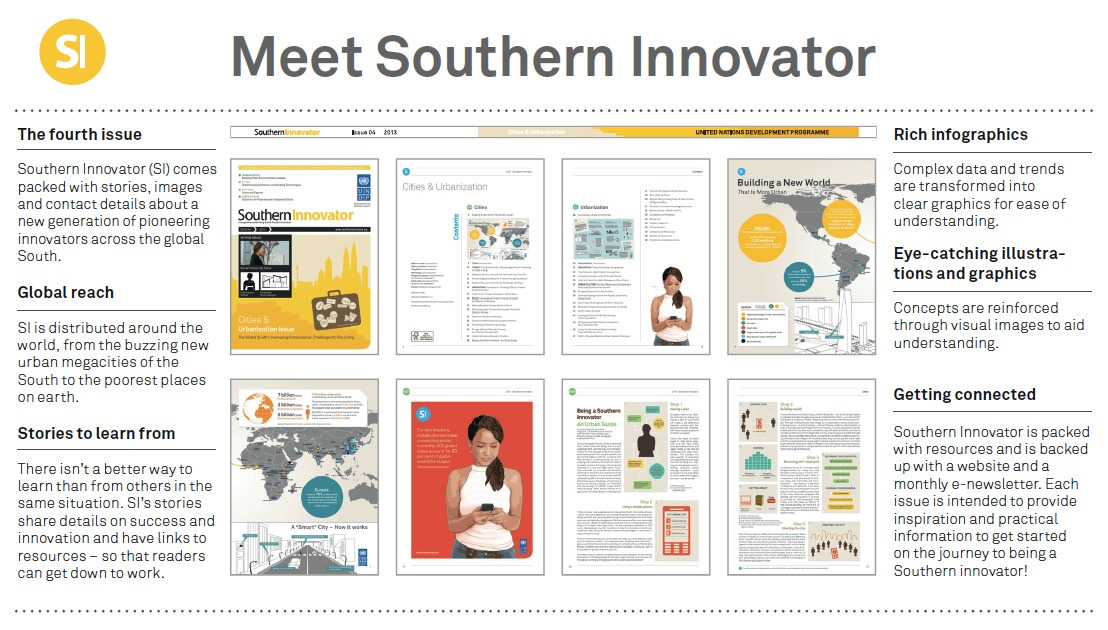
Meet Southern Innovator Issue 4_mini
Meet Southern Innovator.
Issue 4
Southern Innovator Issue 4: Cities and Urbanization is published by the United Nations Office for South-South Cooperation (UNOSSC).
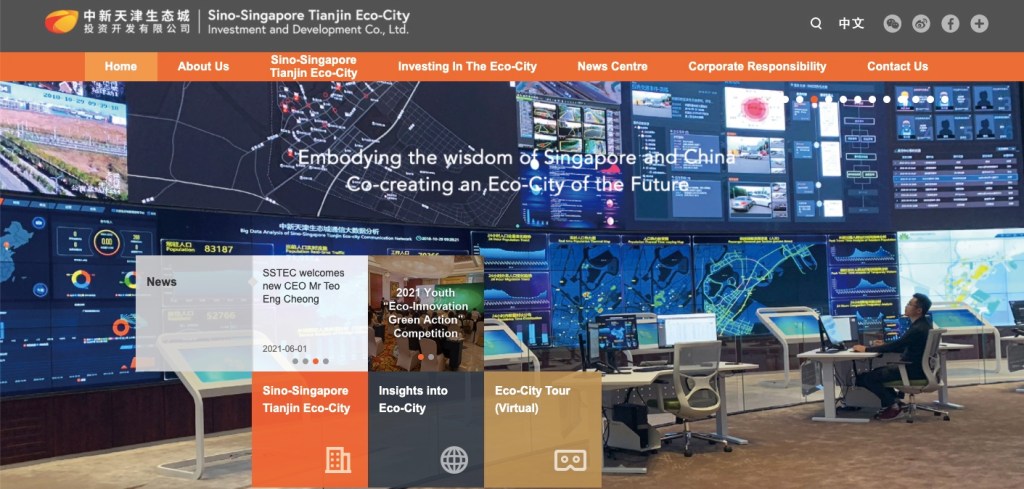
Big screens watch over the eco city. By harnessing big data, the eco city can keep a close watch on the city and the needs of its residents. If resources are to be used efficiently, then big data is required to make this happen.
The eco city has broad streets and the air is clean and free of pollution. Dedicated routes for walking and cycling ensure people can safely move around the city.
Southern Innovator, United Nations Development Program (UNDP)’s quarterly magazine focusing on creativity and innovation emerging from the global South, published an article on the Eco-City entitled “Eco-Cities Up Close”. The article featured the Eco-City’s masterplan, green transport, efforts on waste water treatment and waste management, calling it “a replicable model for other cities in China and the global South”.”

© David South Consulting 2017