Categories
Archive Development Challenges, South-South Solutions Newsletters

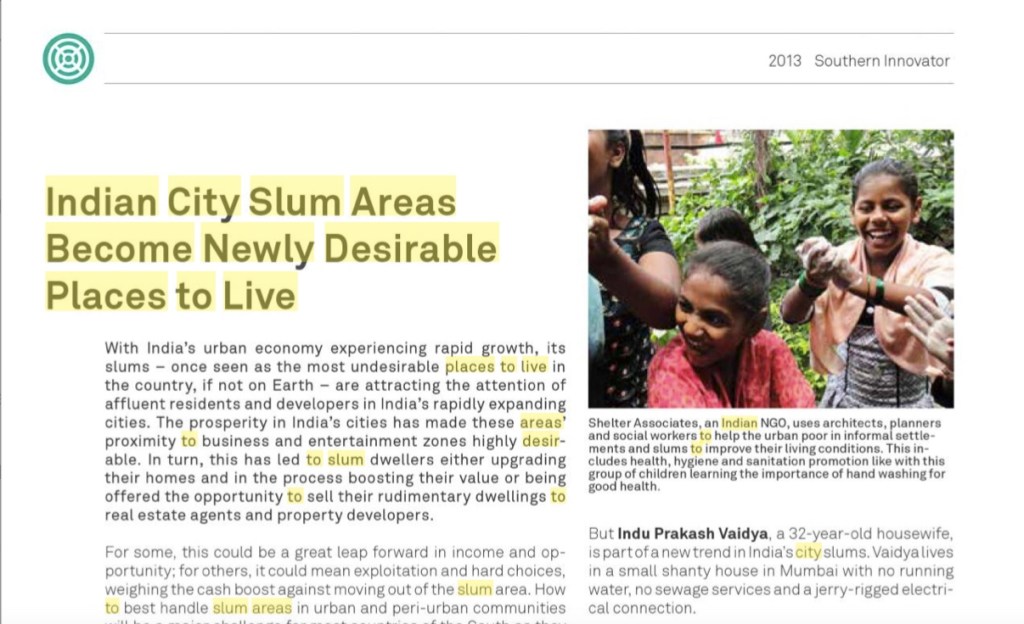
Indian City Slum Areas Become Newly Desirable Places to Live

By David SouthDevelopment Challenges, South-South Solutions

SOUTH-SOUTH CASE STUDY

With India’s urban economy experiencing rapid growth, its slums – once seen as the most undesirable places to live in the country, if not on Earth – are attracting the attention of affluent residents and developers inIndia’s rapidly expanding cities. The prosperity inIndia’s cities has made these areas’ proximity to business and entertainment zones highly desirable. In turn, this has led to slum dwellers either upgrading their homes and in the process boosting their value, or being offered the opportunity to sell their rudimentary dwellings to real estate agents and property developers.

For some, this could be a great leap forward in income and opportunity; for others, it could mean exploitation and hard choices, weighing up the cash boost against moving out of the slum area.

How to best handle slum areas in urban and peri-urban communities will be a major challenge for most countries in the South as they continue to urbanize.

India’s phenomenal economic growth rate – forecast to be 7.9 percent this year by the Asian Development Bank, after averaging 7.7 percent per year over the past decade – has been the force behind an expanding middle class population, now estimated at 50 million people (McKinsey). Forecasts see it swelling from 5 percent ofIndia’s population to 40 percent by 2025.

With 30 percent of the population living in urban areas and cities contributing 60 percent of the country’s GDP and 90 percent of government revenues (Wall Street Journal), city-dwellers’ fate is critical to the functioning of the economy.

According to the 2001 Indian census, slums make up 25 percent of all housing and 26 percent of urban households lack access to sanitation facilities.

But Indu Prakash Vaidya, a 32-year-old housewife, is part of new trend inIndia’s city slums. Vaidya lives in a small shanty house in Mumbai with no running water, no sewage services and a jerry-rigged electrical connection.

Vaidya’s home is a just a single room for the five people in her family. They sleep on the cement floor and the ‘kitchen’ is a two-burner gas stove. The dwelling is so poorly constructed that they have to move around inside the room when it rains outside to avoid getting soaked.

But her humble home has been valued at US $24,000 by people looking to buy it.

According to real estate agent Hari Ram, the average price of a 91 square metre shanty home in Mumbai is now US $46,000.

“Shanties as small as 120 square feet… are as expensive as US $93,000,” Dinesh Prabhu, a construction company owner, told NDTV television.

Sixty percent of Mumbai’s 21 million people live in slums. And many are now finding themselves the subject of a property boom. This has led to the bizarre spectacle of luxury high-rise buildings sprouting up in a sea of slum housing. The slums are attracting the attention of those with money because many busy city workers face long commutes and are desperate for homes closer to work and entertainment areas.

The value of living close to the action is summed up by one slum dweller:

“People would kill to be in a place like this,” said slum dweller Sundar. “There are four local train stations close by. And the bus stop is a stone’s throw away.”

Some say this real estate boom offers enormous potential for the poor.

“All I can say is, given the current real-estate rates, those slums are invaluable,” said Sharad Mahajan of the Pune-based nonprofit organization Mashal (http://mashalindia.org).  Mashal focuses on the problem of urban shelter and also implements housing projects. It has been working in the Dharavi slum area with theMaharashtra government on its redevelopment. The slum is well-known for its representation in the film Slumdog Millionaire, and the area is next to the Bandra-Kurla Complex business district of Mumbai. Mashal has been mapping the area, home to 60,000 families, to make sure the redevelopment is fair to the families living there.

Land tenure is an issue however. Many slum dwellers do not have official title to the land they live on. Over time, they have become semi-official places to live as governments have hooked many up to electricity and drinking water. Issues of corruption and exploitation are also other problems that need addressing if this real estate windfall is to actually benefit slum dwellers.

Typical slum dwellers are day labourers and poor migrants. But others are people who good easily afford to live somewhere else but don’t want the long commutes to work.

“It is simpler and less expensive to live here,” said Sankaralingam, a plastic merchant, who estimates his annual income at around US $9,300: an amount that could get him a home somewhere nicer.

For Indu Prakash Vaidya, the dilemma – to sell or not to sell – makes for some painful choices. While her current home is prone to flooding during the rainy season, she feels she would have nowhere else to go if she sold the home.

Yet the pressure to sell is great and elemental.

“I have three children, and their education and well-being need to be taken care of. Financial constraints can push me to sell this shanty in the future, then where will I live? I will have nowhere to go,” she told NDTV. 

Published: December 2011

Resources

1) New documentary Urbanized gives a passionate over-view of the challenges facing the rapidly urbanizing world around us. Website: http://urbanizedfilm.com/

Development Challenges, South-South Solutions was launched as an e-newsletter in 2006 by UNDP’s South-South Cooperation Unit (now the United Nations Office for South-South Cooperation) based in New York, USA. It led on profiling the rise of the global South as an economic powerhouse and was one of the first regular publications to champion the global South’s innovators, entrepreneurs, and pioneers. It tracked the key trends that are now so profoundly reshaping how development is seen and done. This includes the rapid take-up of mobile phones and information technology in the global South (as profiled in the first issue of magazine Southern Innovator), the move to becoming a majority urban world, a growing global innovator culture, and the plethora of solutions being developed in the global South to tackle its problems and improve living conditions and boost human development. The success of the e-newsletter led to the launch of the magazine Southern Innovator. 

Creative Commons License

This work is licensed under a
Creative Commons Attribution-Noncommercial-No Derivative Works 3.0 License.

ORCID iD: https://orcid.org/0000-0001-5311-1052.

© David South Consulting 2023

Categories
Archive Blogroll Development Challenges, South-South Solutions Newsletters

Popular Chinese Social Media Chase New Markets

By David SouthDevelopment Challenges, South-South Solutions

SOUTH-SOUTH CASE STUDY

China has a vast and growing market for the Internet and mobile devices. Over the past decade that market has been largely confined to China –  most businesses have had enough domestic demand and opportunities inside the country to keep them busy.

But now companies in China’s dynamic Internet and mobile sector are seeking out new markets outside the country. Both online shopping service Alibaba (alibaba.com) and Weibo (weibo.com), the Chinese version of Twitter (twitter.com), are seeking to list on the New York Stock Exchange. The excitement this news has generated shows how many people want to get a piece of the large Chinese market for technology, social networks and online shopping. It is also sending a chill through America’s Silicon Valley – home to the country’s innovative high technology sector – that they are missing out on China’s fast-growing marketplace. Many American services are banned from operating in China. Even more worrying for Silicon Valley, these home-grown Chinese companies, with the market sewn up at home, are now set to compete globally for customers using their increasingly deep pockets.

One example is Tencent (http://www.tencent.com/en-us/index.shtml), owner of popular Chinese social messaging application (app) Weixin (weixin.qq.com), known as WeChat (wechat.com) outside China. Used on mobile phones and smartphones, Weixin has gained 300 million users in just three years, becoming the dominant social messaging service in the world’s largest smartphone market. Its has been so successful that many rivals are trying to chip away at its customer base.

Weixin, pronounced way-shin, allows smartphone users to send messages and share news, photos, videos and web links with friends. One of its selling points is its claim to not store messages on its servers.

Building on its success in social networking in China, it is looking to expand in other markets, including Southeast Asia, Europe and Latin America. It also wants to grow its offerings in online payment and e-commerce.

One factor in Weixin’s success is the ability to send messages by recording a voice message rather than just typing in characters: very useful for non-Latin script users, and especially for Chinese-language users, who use thousands of characters in everyday communication.

One ambitious forecast claims Weixin could reach 400 million users and make US $500 million revenue within a year.

Cosmetics marketer Jenny Zhao, who uses an iPhone 5, told The New York Times: “I’m probably on Weixin six hours a day. A lot of what I do revolves around it.”

“I use Weixin every day,” said Zhang Shoufeng, a food and drinks seller. “My friends are on it and my boss is on it. We are talking about where to eat, where to hang out and where to meet for company conferences. This is how we communicate.”

Analysts believe Weixin has benefitted from not having to compete with banned-in-China American company Facebook (facebook.com).

“Even if Facebook had permission, it’s probably too late,” said Wang Xiaofeng, an analyst at Forrester Research. “Weixin has all the functionality of Facebook and Twitter, and Chinese have already gotten used to it.”

Tencent is an example of a wider trend: As Chinese companies and offerings have become stronger, wealthier and more innovative, they increasingly look to build their customer base outside China.

Founded in November, 1998, Tencent, Inc. has grown into China’s largest and most used Internet service portal. Its most popular services include QQ (QQ Instant Messenger), WeChat, QQ.com, QQ Games, Qzone, 3g.QQ.com, SoSo, PaiPai and Tenpay, as well as Weixin.

The company claims to put innovation at the heart of its business, with more than half of its employees devoted to research and development. The Tencent Research Institute, established in 2007 with RMB 100 million (US $16 million), calls itself “China’s first Internet research institute, with campuses in Beijing, Shanghai, and Shenzhen.” It has patents for technologies it has developed for instant messaging, e-commerce, online payment services, search, information security, and gaming.

Tencent was driven to innovate by a fear it could quickly become irrelevant in the information technology space. Weixin is also pioneering ways to book taxis, hotels and airline flights through the service and even ways to control home appliances.

“Chinese Internet companies are no longer behind,” said William Bao Bean, a managing director at the venture capital firm SingTel Innov8 (http://innov8.singtel.com/). “Now in some areas, they’re leading the way.”

Published: April 2014

Resources

1) Weibo: Sina Weibo is a Chinese microblogging (weibo) website. Akin to a hybrid of Twitter and Facebook, it is one of the most popular sites in China, in use by well over 30 per cent of Internet users, with a market penetration similar to what Twitter has established in the USA. Website: weibo.com

2) Laiwang: A variation on the WeChat service, its biggest competitor. Website: laiwang.com

3) WhatsApp: WhatsApp Messenger is a cross-platform mobile messaging app which allows you to exchange messages without having to pay for SMS. Website: whatsapp.com

4) Southern Innovator Issue 1: Mobile Phones and Information Technology: Pioneering and innovative ways to deploy mobile phones and information technology to tackle poverty. Website: http://www.scribd.com/doc/57980406/Southern-Innovator-Magazine-Issue-1 and here: http://tinyurl.com/q6bfnpz

https://davidsouthconsulting.org/2022/10/20/china-consumer-market-asian-perspective-helps/

https://davidsouthconsulting.org/2020/12/10/china-sets-sights-on-dominating-global-smartphone-market/

https://davidsouthconsulting.org/2021/03/20/computer-gold-farming-turning-virtual-reality-into-real-profits/

https://davidsouthconsulting.org/2021/01/26/designed-in-china-to-rival-made-in-china/

https://davidsouthconsulting.org/2022/10/26/tackling-chinas-air-pollution-crisis-an-innovative-solution/

https://davidsouthconsulting.org/2020/04/17/virtual-supermarket-shopping-takes-off-in-china/

Citation

Qianyu, Ji (2014) “Exploring the Concept of QR Code and the Benefits of Using QR Code for Companies,” Lapland University of Applied Sciences, School of Business and Culture Degree Programme in Business Information Technology, 2014.

Development Challenges, South-South Solutions was launched as an e-newsletter in 2006 by UNDP’s South-South Cooperation Unit (now the United Nations Office for South-South Cooperation) based in New York, USA. It led on profiling the rise of the global South as an economic powerhouse and was one of the first regular publications to champion the global South’s innovators, entrepreneurs, and pioneers. It tracked the key trends that are now so profoundly reshaping how development is seen and done. This includes the rapid take-up of mobile phones and information technology in the global South (as profiled in the first issue of magazine Southern Innovator), the move to becoming a majority urban world, a growing global innovator culture, and the plethora of solutions being developed in the global South to tackle its problems and improve living conditions and boost human development. The success of the e-newsletter led to the launch of the magazine Southern Innovator.  

Creative Commons License

This work is licensed under a
Creative Commons Attribution-Noncommercial-No Derivative Works 3.0 License.

ORCID iD: https://orcid.org/0000-0001-5311-1052.

© David South Consulting 2025

Categories
Archive Development Challenges, South-South Solutions Newsletters Southern Innovator magazine

Model Cities Across the South Challenge Old Ways

By David SouthDevelopment Challenges, South-South Solutions

SOUTH-SOUTH CASE STUDY

Pioneering thinking about how resources are used and how people live their lives is taking place in the dynamic economies of the global South. Facing a vast population surge to urban areas, these include attempts to build “green” cities and low-waste, smart and digital communities.

These model cities are clever solutions for the world’s growing – and urbanizing – populations coping with a stressed and damaged environment. Unlike one-off technologies and ideas developed in isolation, the model cities approach starts from scratch. They become living laboratories on which research and development take place at the heart of the community, not just the preserve of aloof academics hidden away in labs.

This is critical work because the world is rapidly urbanizing and needs solutions to ensure this process does not lead to chaos and misery. How these cities turn out could hold the fate of humanity and much is at stake. According to a report by the International Institute for Environment and Development, Africa now has a larger urban population than North America and 25 of the world’s fastest growing big cities. Getting to grips with urban development will be critical for the future of the continent and the wellbeing of its people.

By 2025, Asia could have 10 or more cities with populations larger than 20 million (Far Eastern Economic Review). People will be living in densely populated cities and they will need to be smart cities if they are to work.

In the United Arab Emirates (http://en.wikipedia.org/wiki/Abu_Dhabi), Masdar City (http://www.masdar.ae/en/home/index.aspx), is a model city not only being built, but being used as way to develop commercially successful environment technologies – renewable energy solutions and clean technologies – that will turn into future income for the city and Abu Dhabi.

The traditional approach in other countries has been to keep scientists and innovators disconnected from the living, breathing city. They toil away in labs or universities and only really get to test their technologies and theories after going through lengthy testing and approval by a city’s government. As Masdar’s website says, this city will develop “from research to commercial deployment – with the aim of creating scalable clean energy solutions.”

The planned community will be 6 square kilometres in size and wants to be “one of the most sustainable cities in the world”. Located 17 kilometres from Abu Dhabi, it hopes to be a pedestrian-friendly town home to 40,000 residents. At the heart of Masdar City is the Masdar Institute: a research university developed with the Massachusetts Institute of Technology (MIT). The students are the city’s first residents and a range of top international companies are planning to locate in there as well. German technology company Siemens will place its Middle East headquarters in Masdar and its Center of Excellence in Building Technologies R&D centre. Others joining them include GE, BASF, Schneider and the Korea Technopark Association.

The Surbana Urban Planning Group (www.surbana.com) spent five decades developing its experience with the rapid growth of Singapore (http://en.wikipedia.org/wiki/Singapore): a city-state boasting the highest quality of life in Asia (Economist Intelligence Unit) which took itself from an impoverished city to one of the world’s leading export and manufacturing economies. Surbana built 26 planned townships in Singapore that now house 85 percent of the city’s 4.5 million residents. It specializes in designing, implementing and maintaining complex urban areas.

Singapore has pioneered a number of ways to house a large population within a small territory. This experience is now being put to work in China at the Tianjin Eco-City development (http://www.tianjinecocity.gov.sg/masterplan.htm). Known for high pollution levels due to heavy industry Tianjin will undergo a big change. The project aims to develop a template that can be used for other cities throughout China and around the world.

The 30-square-kilometre Tianjin Eco-City is being built around a wetland and river. The idea is to offer its residents an environment with easy access to recreational spaces and the natural environment. The transport system will avoid cars and instead use a light rail system as the main mode of transport. It should be home to 350,000 people.

Cleverly, each suburban area will have commercial sub-centres to enable as many people as possible to work locally and avoid the need to commute long distances. The Eco-City will be built by assembling “eco-cell” – like a bee’s honeycomb – neighbourhoods self-contained with schools, child care, commercial and work areas, and parks. This set up is geared to collecting a common mistake in other new developments that only consider housing, forgeting about how people work, shop and recreate.

There will be seven distinct neighbourhoods: Lifescape, Eco-Valley, Solarscape, Urbanscape, Windscape, Earthscape and Eco-Corridors (http://inhabitat.com/tianjin-eco-city-is-a-futuristic-green-landscape-for-350000-residents/). An “Eco-Valley” will run through the city as a green spine connecting north and south.

It is hoped the city will be completed by 2020. Just 10 minutes’ drive from the Tianjin Economic-Technological Development Area (http://en.investteda.org/) business parks, the residents should be well served for jobs.

In South Korea, the Digital Media City in Seoul (http://dmc.seoul.go.kr/eng/index.do) bills itself as a “harmony of nature, high-tech, and culture”. The Seoul municipal government devised the DMC in the 1990s to capitalize on the economic and social benefits of being the world’s most digitally wired nation.

The DMC project serves the nation’s larger goals of transitioning from a manufacturing to an innovation economy and promoting Seoul as an east-Asian hub for commerce. The DMC is about creating new business opportunities.

But this isn’t just about business and research and development: it is a comprehensive digital economy experience, with schools, housing for the affiliates of international firms, moderate and lower-income housing, commercial and convention facilities, entertainment zones, and the city’s central rail station are all located in or near the Digital Media City.

Published: February 2011

Resources

1) More Urban, Less Poor: The first textbook to explore urban development and management and challenge the notion unplanned shanty towns without basic services are the inevitable consequence of urbanization. Website: www.earthscan.co.uk

* Arrival City: The Final Migration and Our Next World by Doug Saunders. Website: www.arrivalcity.net

https://davidsouthconsulting.org/2022/03/29/model-city-to-test-the-new-urbanism-concept-in-india/

https://davidsouthconsulting.org/2022/10/06/africas-fast-growing-cities-a-new-frontier-of-opportunities/

https://davidsouthconsulting.org/2020/12/04/big-data-can-transform-the-global-souths-growing-cities/

https://davidsouthconsulting.org/2022/10/19/chinese-building-solution-for-rapidly-urbanizing-global-south/

https://davidsouthconsulting.org/cities-urbanization/

https://davidsouthconsulting.org/2021/10/21/cities-for-all-shows-how-the-worlds-poor-are-building-ties-across-the-global-south/

https://davidsouthconsulting.org/2020/12/11/cyber-cities-an-oasis-of-prosperity-in-the-south/

https://davidsouthconsulting.org/2017/11/08/eco-cities-up-close-2013/

https://davidsouthconsulting.org/2022/03/20/global-south-eco-cities-show-how-the-future-can-be/

https://davidsouthconsulting.org/2021/11/12/global-souths-rising-megacities-challenge-idea-of-urban-living/

https://davidsouthconsulting.org/2022/11/16/housing-innovation-in-souths-urban-areas/

https://davidsouthconsulting.org/2020/12/14/innovation-in-growing-cities-to-prevent-social-exclusion/

https://davidsouthconsulting.org/2022/10/10/more-futuristic-african-cities-in-the-works/

https://davidsouthconsulting.org/2021/11/12/new-cities-offering-solutions-for-growing-urban-populations/

https://davidsouthconsulting.org/2017/11/08/smart-cities-up-close-2013/

https://davidsouthconsulting.org/2021/10/22/south-south-cooperation-for-cities-in-asia/

https://davidsouthconsulting.org/2021/03/05/southern-innovator-issue-4/

https://davidsouthconsulting.org/2022/09/26/3d-home-printing-landmark-10-houses-in-a-day/

https://davidsouthconsulting.org/2022/11/17/tiny-homes-to-meet-global-housing-crisis/

Development Challenges, South-South Solutions was launched as an e-newsletter in 2006 by UNDP’s South-South Cooperation Unit (now the United Nations Office for South-South Cooperation) based in New York, USA. It led on profiling the rise of the global South as an economic powerhouse and was one of the first regular publications to champion the global South’s innovators, entrepreneurs, and pioneers. It tracked the key trends that are now so profoundly reshaping how development is seen and done. This includes the rapid take-up of mobile phones and information technology in the global South (as profiled in the first issue of magazine Southern Innovator), the move to becoming a majority urban world, a growing global innovator culture, and the plethora of solutions being developed in the global South to tackle its problems and improve living conditions and boost human development. The success of the e-newsletter led to the launch of the magazine Southern Innovator.  
Creative Commons License

This work is licensed under a
Creative Commons Attribution-Noncommercial-No Derivative Works 3.0 License

ORCID iD: https://orcid.org/0000-0001-5311-1052.

© David South Consulting 2023

Categories
Archive data Development Challenges, South-South Solutions Newsletters digital ID

India 2.0: Can the Country Make the Move to the Next Level?

By David SouthDevelopment Challenges, South-South Solutions

SOUTH-SOUTH CASE STUDY

With the global economic crisis threatening to cause turmoil in the emerging markets of the global South, it is becoming clear that what worked for the past two decades may not work for the next two.

For India, the legacy issues of poverty still need to be addressed, and the country’s impressive information technology (IT) industry – which has driven so much of India’s growth – will face stiff competition from other countries in the global South. Some argue that if the IT industry hopes to keep growing and contributing to India’s wealth, things will need to change.

Unlike China, where heavy investment in infrastructure and a strong link between government and the private sector has driven the impressive manufacturing boom in the country, in India the government has de-regulated and taken a back seat, leaving the private sector and entrepreneurs to drive the change and do the innovation.

Many believe various areas need urgent attention if India is to continue to enjoy good growth rates in the coming years. Areas in need of attention include infrastructure, healthcare and education (thesmartceo.in), in particular the knowledge to work in the information technology industry of the 21st century.

One of the founders of Indian outsourcing success Infosys (infosys.com), executive co-chairman Senapathy Gopalakrishnan, told Britain’s Telegraph newspaper, “So many people’s lives have been changed by IT in India.

“People from the middle class and lower middle class have become global employees and have the opportunity to work with some of the best companies in the world. But the challenge for India is that this industry can only create so many jobs. IT is not going to solve the unemployment problem in India.”

But the coming next wave of change in information technology is an opportunity to be seized to reduce unemployment if enough people are educated to handle it.

According to Gopalakrishnan: “I strongly believe, and it’s backed up by data, that there is a shortage of computer professionals everywhere in the world, including India. The application of computers is growing dramatically and will continue to grow dramatically over the next 20 to 30 years. We have to train and create the workforce necessary to grow this industry.”

Various media stories have called this next phase India 2.0. If India 1.0 was the highly successful information technology outsourcing industry developed in the late 1980s, through the 1990s and 2000s, then India 2.0 is the next wave of IT innovation being driven by Big Data, automation, robotics, smart technologies and the so-called “Internet of things.”

Big Data is defined as the large amounts of digital data continually generated by the global population. The speed and frequency with which data is produced and collected – by an increasing number of sources – is responsible for today’s data deluge (UN Global Pulse). It is estimated that available digital data will increase by 40 per cent every year. Just think of all those mobile phones people have, constantly gathering data.

Processing this data and finding innovative ways to use it will create many of the new IT jobs of the future.

“We are living in a world which is boundary-less when it comes to information, and where there is nowhere to hide,” continues Gopalakrishnan, “If you have a cellphone, somebody can find out exactly where you are. Through social networks you’re sharing everything about yourself. You are leaving trails every single moment of your life. Theoretically, in the future you’ll only have to walk through the door at Infosys and we’ll know who you are and everything about you.”

Unlike in the late 1980s, when India was the pioneer in IT outsourcing for large multinational companies and governments, competition is fierce across the global South. The mobile-phone revolution and the spread of the Internet have exponentially increased the number of well-educated people in the global South who could potentially work in IT. China, the Philippines, Kenya, Nigeria and Ghana are just some of the countries heavily involved in this area.

If India fails to meet the India 2.0 challenge, it risks seeing its successful companies and entrepreneurs leaving to work their magic elsewhere in Asia and the new frontiers of Africa, just as many of its best and brightest of the recent past became pioneers and innovators in California’s Silicon Valley.

India’s IT sector contributed 1.2 per cent to the country’s gross domestic product (GDP) in 1998; by 2012, this was 7.5 per cent (Telegraph). The IT industry employs 2.5 million people in India, and a further 6.5 million people indirectly. IT makes up 20 per cent of India’s exports and, according to the National Association of Software and Services Companies (nasscom.in), the industry has revenue of US $100 billion.

India is now the IT and outsourcing hub for more than 120 of the Fortune 500 companies in the United States.

Out of India’s 3.5 million graduates every year, 500,000 are in engineering – a large pool of educated potential IT workers. India produces the world’s third largest group of engineers and scientists, and the second largest group of doctors.

IT has become a route that catapults bright Indian youth into 21st-century businesses and science parks and to the corporations of the world.

One visible example of the prosperity brought by IT services in India is the booming technology sector based in the city of Bangalore (also called Bengaluru) (http://en.wikipedia.org/wiki/Bangalore).

Reflective of the contradictions of India, Bangalore has 10 per cent of its workforce now working in IT, but also 20 per cent of its population living in urban slums.

The nearby Electronics City (elcia.in) is considered “India’s own silicon valley and home to some of the best known global companies.”

To date, aspects of India 2.0 are already taking shape.

One company is called Crayon Data (crayondata.com). It uses Big Data and analytics to help companies better understand their customers and increase sales and deliver more personal choices.
Edubridge (http://acumen.org/investment/edubridge/) is helping to bridge the gap for rural youth with varied education backgrounds and long-term jobs. Edubridge trains youth for the real needs of employers to increase the chances they will get a job. This includes jobs in the IT business process outsourcing sector and banking and financial services.

Infosys is working on innovations for the so-called “Internet of things,” in which smart technologies connect everyday items to the grid and allow for intelligent management of resources and energy use. Infosys is developing sophisticated software using something called semantic analytics – which analyses web content (http://en.wikipedia.org/wiki/Semantic_analytics) – to sort through social media and the Internet to track customer responses to products.

Elsewhere, former Infosys Chief Executive Nanden Nilekani is involved in a Big Data innovation to address the problem of social and economic exclusion of India’s poor. Called Aadhaar (http://uidai.gov.in/), the government-run scheme is gathering biometric data on every Indian to build the world’s largest biometric database. After being enrolled and having fingerprints and iris scans taken, each individual is given a 12-digit identification number. So far 340 million people have been registered with the scheme, and it is hoped 600 million will be registered by the end of 2014.

The idea is to use a combination of access to mobile phones and these unique ID numbers to widen access to all sorts of products and services to poor Indians, including bank accounts for the millions who do not have one. Many people, lacking any identity or official acknowledgment they exist, were prevented from engaging with the formal economy and formal institutions. Being able to save money is a crucial first step for getting out of poverty and it is hoped information technology will play an important role in achieving this.

Published: March 2014

Resources

1) India 2.0 by Mick Brown. Website: http://s.telegraph.co.uk/graphics/india2.0/part-one#top

2) Electronic City Bangalore: Regional information portal for Electronic City, an industrial technology hub located in Bangalore South, India. This portal is becoming the most favourite haunt of ECitizens living and/or working in Electronic City. Website: http://www.electronic-city.in/

3) Electronics City Industries Association: Welcome to the Electronics City, India’s own silicon valley and home to some of the best known global companies. Located in Bangalore, the Electronics City was conceived way back in the mid-1970?s as an Industrial Estate exclusively for Electronics Industries. Today the industrial estate boasts is an oasis of large, medium and small industries spanning software services, hardware; high end telecommunications; manufacture of indigenous components; electronic musical instruments, just  to name a few. Website: elcia.in

4) Godrej E-City: Situated in Electronic city and connected through NICE road and the elevated expressway, Godrej E-City brings your workplace and other major conveniences within your immediate reach. Your travel times become shorter and hassle-free. You have more time for your family and yourself. It’s time to move closer to happiness. Website: https://www.godrejproperties.com/godrejecity/overview

5) Infosys: Infosys is a global leader in consulting, technology and outsourcing solutions. As a proven partner focused on building tomorrow’s enterprise, Infosys enables clients in more than 30 countries to outperform the competition and stay ahead of the innovation curve. Website: http://www.infosys.com/pages/index.aspx

6) Tech Hub Bangalore: partnering with the UK India Business Council to establish TechHub in Bangalore.TechHub is a community and workspace for technology entrepreneurs with 1000’s of members, building the most exciting startups in Europe. We have physical community spaces in London, Manchester, Bucharest, Swansea and Riga and have members from over 50 countries.The Bangalore site will be part of a wider scheme in partnership with other British firms such as Rolls Royce, ADS, Bangalore Cambridge Innovation Network, BAe and PA Consulting with the aim of forging stronger links between the UK and India. Website: http://www.techhub.com/blog/techhub-expands-to-bangalore/

https://davidsouthconsulting.org/2022/09/29/cheap-indian-tablet-seeks-to-bridge-digital-divide/

https://davidsouthconsulting.org/2022/02/17/digital-mapping-to-put-slums-on-the-map/

https://davidsouthconsulting.org/2022/10/09/entrepreneurs-use-mobiles-and-it-to-tackle-indian-traffic-gridlock/

https://davidsouthconsulting.org/2022/10/20/the-e-reader-battle-reaches-india/

https://davidsouthconsulting.org/2022/10/25/indian-city-slum-areas-become-newly-desirable-places-to-live/

https://davidsouthconsulting.org/2021/03/04/indian-id-project-is-foundation-for-future-economic-progress/

https://davidsouthconsulting.org/2022/11/01/indian-newspapers-thrive-with-economy/

https://davidsouthconsulting.org/2022/10/18/indians-fighting-inflation-with-technology/

https://davidsouthconsulting.org/2022/10/06/indian-solar-power-pack-powers-villages/

https://davidsouthconsulting.org/2021/03/31/new-weapon-against-crime-in-the-south/

Development Challenges, South-South Solutions was launched as an e-newsletter in 2006 by UNDP’s South-South Cooperation Unit (now the United Nations Office for South-South Cooperation) based in New York, USA. It led on profiling the rise of the global South as an economic powerhouse and was one of the first regular publications to champion the global South’s innovators, entrepreneurs, and pioneers. It tracked the key trends that are now so profoundly reshaping how development is seen and done. This includes the rapid take-up of mobile phones and information technology in the global South (as profiled in the first issue of magazine Southern Innovator), the move to becoming a majority urban world, a growing global innovator culture, and the plethora of solutions being developed in the global South to tackle its problems and improve living conditions and boost human development. The success of the e-newsletter led to the launch of the magazine Southern Innovator.  

https://davidsouthconsulting.org/2021/03/05/southern-innovator-issue-1/

Creative Commons License

This work is licensed under a
Creative Commons Attribution-Noncommercial-No Derivative Works 3.0 License.

ORCID iD: https://orcid.org/0000-0001-5311-1052.

© David South Consulting 2022