Categories
Archive Development Challenges, South-South Solutions Newsletters

Securing Land Rights for the Poor Now Reaping Rewards

By David SouthDevelopment Challenges, South-South Solutions

SOUTH-SOUTH CASE STUDY

The hotly debated issue of land rights for the poor has never been more relevant. There is mounting evidence that access to land rights can catapult the poor out of poverty and spur growth for the economy. Experience in India and China is now showing the economic power unleashed when the poor gain full legal rights over their land. But it can be a thornier issue in Africa, where much land is still held under customary law, with people either holding it through their clan or tribe, or being considered as owners of where they live, without formal documents. Many countries are now adapting their laws to switch to a system of formal titles, but the process is very uneven and some question whether western-style property titles are appropriate in an African context.

While there are many schemes to alleviate or eliminate poverty through micro-credit, grants or aid, some believe the secret is in creating a sound framework of property rights, giving poor people important collateral to raise money against the value of the land on which they live. The Peruvian economist, Hernando de Soto, has calculated that the total value of informal urban dwellings and rural land owned under customary law is around three times greater than Africa’s entire gross domestic product and 100 times greater than its foreign direct investment.

But the urgency of this problem can be seen in the numbers of rural poor – many of whom will migrate to the world’s fast-growing cities. In China there are 800 million, in India the rural poor number 270 million and 70 percent of Africa’s 888 million (2005,UN) are rural poor.

The Rural Development Institute (www.rdiland.org), an NGO based in Seattle, Washington, USA – and with offices and projects in India, China, Indonesia, Russia, Africa – uses lawyers to advocate and fight for land rights for the rural poor. To date, RDI has helped provide land rights to more than 100 million poor families worldwide. Their approach is called micro-owning whereby the poor are helped to acquire land assets. These are often small plots of land – sometimes 1/10th acre – that can provide the nutritional needs for a family and help them on the road to the virtuous cycle of long-term, sustainable and generational poverty alleviation.

“Micro-ownership transforms the lives of the rural poor,” according to Radha Friedman, Associate Director, Development and Communication, just back from visiting RDI’s Indian projects. “Outside Bangalore in the state of Karnataka one woman who was landless worked two shifts a day in the hot sun. She was barely able to feed her children. She was making 8 to 10 rupees a day – when a bottle of water costs 10 rupees. We helped her secure a plot of land to grow jasmine flowers which she sells in the market. She now makes between 85 to 200 rupees a day. She can eat three times a day and her kids can afford to go to school. She said she had not thought about how far she had come, but it clearly showed she had such pride in what she had achieved. A number of Indian states have adopted this program, enabling people to purchase micro-gardens and micro-plots of land. It has been such a success that other Indian states are now showing interest.”

“All of this didn’t happen overnight,” said Lincoln Miller, Chief Operations Officer at RDI. “We conducted lots of research and surveyed the rural poor. We analyzed how the laws were affecting them. It took a long time to change government attitudes. We hopefully find a voice in the government who will listen to us. They need to recognize that land rights are one of the best routes out of poverty. In Africa we are primarily working in Burundi, Rwanda and Angola. In addition to working with government to change national policy and laws, we also conduct awareness-raising and education at the grassroots level, especially targeting women. Land rights are a political issue. The majority of the world’s poor is rural. By giving them land rights this process can help mitigate migration to the city.”

The benefits of owning land include improved family status, pride and hope, reduced hunger and improved family nutrition from crops produced on land , increased income from sale of excess production, improved rural health, including reduction in infant mortality and reduction in death from disease or infection due to malnutrition, labor-intensive and productivity-enhancing, investments in land motivated by secure land rights, increased family savings as a result of ability to invest in land improvements, ability of poor to benefit from any market increases in land values, enhanced capacity to conduct micro-enterprise activities, empowerment of women, and decreased pressure to migrate to already crowded urban areas.

However in South Africa, land rights have been further complicated by the legacy of apartheid. In 1994, 80 percent of farmland was in white hands. The ruling African National Congress (ANC) want to see 30 percent of that transferred to black ownership by 2015. Blacks are also able to claim ownership for land as long as they live on it.

The strong reaction against past experiments in collectivizing land can be understood in the experience of Zambia. Under President Kenneth Kaunda, everything was nationalized, from copper mines to corner shops. Average annual incomes almost halved in 40 years despite the country receiving more aid per head of population than virtually any other in the world.

Any organizations or individuals seeking land rights need only to contact the RDI by email to get the legal ball rolling.

Published: February 2007

Resources

  • The Centre on Housing Rights and Evictions tracks forcible evictions from land. In its latest global survey of forced evictions from 2003-2006 reveals that nearly 2 million people in Africa and over 2.1 million people in Asia and the Pacific have been forcibly evicted from their homes since 2003. http://www.cohre.org/
  • Based in Cape Town, South Africa, the Shack/Slum Dwellers International targets the plight of people living in semi-urban and urban areas: http://www.sdinet.org/
  • The Cities Alliance: Cities without Slums links together a global coalition of cities and their development partners committed to scaling up successful approaches to poverty reduction: http://www.citiesalliance.org/index.html
  • Rural Development Institute: Email: info@rdiland.org Website: http://www.rdiland.org

Development Challenges, South-South Solutions was launched as an e-newsletter in 2006 by UNDP’s South-South Cooperation Unit (now the United Nations Office for South-South Cooperation) based in New York, USA. It led on profiling the rise of the global South as an economic powerhouse and was one of the first regular publications to champion the global South’s innovators, entrepreneurs, and pioneers. It tracked the key trends that are now so profoundly reshaping how development is seen and done. This includes the rapid take-up of mobile phones and information technology in the global South (as profiled in the first issue of magazine Southern Innovator), the move to becoming a majority urban world, a growing global innovator culture, and the plethora of solutions being developed in the global South to tackle its problems and improve living conditions and boost human development. The success of the e-newsletter led to the launch of the magazine Southern Innovator.

Creative Commons License

This work is licensed under a
Creative Commons Attribution-Noncommercial-No Derivative Works 3.0 License.

ORCID iD: https://orcid.org/0000-0001-5311-1052.

© David South Consulting 2022

Categories
Archive Development Challenges, South-South Solutions Newsletters Southern Innovator magazine

Favela Fashion Brings Women Work

By David SouthDevelopment Challenges, South-South Solutions

SOUTH-SOUTH CASE STUDY

A highly successful cooperative of women in Brazil has shown that it is possible for outsiders to make it in the fast-paced world of fashion. Despite being based in one of Rio de Janerio’s slums, or favelas (http://en.wikipedia.org/wiki/Favela), the women have developed a reputation for high-quality merchandise and even put on fashion shows.

Fashion earns big money around the world: The global clothing industry is estimated to be worth more than US $900 billion a year. But fashion also has a reputation for relying on sweat shops, poor pay and poor working conditions. The poor are the most at risk of exploitation in the industry – upwards of 90 percent of sweatshop workers are women (www.feminist.org).

Yet the COOPA-ROCA cooperative (www.coopa-roca.org.br/en/index_en.html) – or Rocinha Seamstress and Craftwork Co-operative Ltd – has pioneered a way to involve poor women in the business, build their skills while creating high-quality products, and be flexible enough to make time for their families’ needs. It particularly helps single mothers.

The cooperative was founded by Maria Teresa Leal in Rocinha – the largest favela in Rio, home to over 180,000 people. After visiting her housekeeper’s home in the favela, Leal was impressed by the sewing skills of the women but found they weren’t making any money from their work. She decided to found the cooperative in 1981 and start making quilts and pillows. By the early 1990s, the cooperative had attracted the attention of Rio’s fashion scene. And in 1994, it jumped into making clothes for the fashion catwalks. Fashion designers in turn taught the women advanced production skills and about fashion trends.

Today, the coop has established a hard-won reputation for quality and sells its clothes to the wealthy elite of Rio. Its success has led to contracts with major clothing stores, including Europe’s C&A.

“Creativity is an important tool for transforming people and raising their consciousness,” Leal told Vital Voice. “My great passion is beauty. Beauty has the capacity to inspire, to touch individuals in a more subtle way. For this reason, I like to make beautiful things with the artisans of COOPA-ROCA.”

Leal realized that most small businesses helping the poor fail despite their best intentions. They often make the same mistakes: they fail to produce high quality goods, they fail to do market research and understand who they are selling to, they fail to develop the skills of their workers, and most importantly, they fail to see that they have to compete in a global economy with lots of other enterprises. How many people have seen crafts and knickknacks for sale that nobody really wants?

Slum dwellers are on the increase across the South. As the world becomes a more urban place – and 70 million people move every year to the world’s cities (UN) – the growing population of poor women and households presents a dilemma: how to provide meaningful work so they do not fall risk to exploitation? Without work opportunities, women can feel pressured to turn to prostitution, or even be trafficked by gangs for work or sex. And women in slums experience greater levels of unemployment than those who live elsewhere (UNHABITAT).

Women now make up the majority of the world’s poor: 70 percent of the world’s poor are women, as are a majority of the 1.5 billion living on less than US $1 a day (UNESCO).

Established in 1981 from a recycling project for local children, COOPA-ROCA started with finding ways to use thrown away scraps of cloth to make clothing. It eventually evolved into a cooperative. It focused on improving traditional Brazilian decorative craftwork skills like drawstring appliqué, crochet, knot work and patchwork.

“COOPA-ROCA works with traditional handicraft techniques that are widely used by women around the world,” explains Leal. “As COOPA-ROCA works with fashion, and fashion is always linked with media, the COOPA-ROCA artisans inspire other women who recognize in themselves the potential to do the kind of work that COOPA-ROCA does.”

For its first five years, COOPA-ROCA concentrated on building the organization and the skills of the artisans. Once a production structure was in place, quality control workshops were set up to increase the quality of the products so they could compete better in the marketplace.

“Many social projects believe that money is the only resource required to begin their work. The COOPA-ROCA case proves that social organizations must use a more entrepreneurial vision to understand the concept of resources.”

The cooperative’s mission statement is to “provide conditions for its members, female residents of Rocinha, to work from home and thereby contribute to their family budget, without having to neglect their childcare and domestic duties.”

By doing this to a high standard, the profile and reputation of traditional crafts has been raised.

The COOPA-ROCA hopes the work shows others how they can increase income in poor communities. The cooperative has 150 members and has partners in the wider fashion and decorative design markets.

The women equally share responsibility for production, administration and publicity. While they work at home, they come to the office to drop off the completed pieces and pick up more fabric.

The success of the cooperative has led to donations of funds to build a new headquarters designed by architect Joao Mauricio Pegorim.

Despite the cooperative’s success, it is still not easy to work with partners. “There are many negative preconceptions about Rocinha and the people who live there, both within and outside of Brazil. COOPA-ROCA is consistently rejected when it applies for loans,” Leal said. “Furthermore, the cooperative’s commercial partners usually do not enter the favela themselves, and I must serve as a bridge between the two worlds.”

But Leal is still ambitious for bigger things: “I envision COOPA-ROCA expanding to include 400 women artisans, producing for commercial partners, selling their own brand in Brazil and abroad, and carrying out fashion and design projects in the new headquarters in Rocinha.”

Published: March 2010

Resources

1) The online service CafePress is a specially designed one-stop shop that lets entrepreneurs upload their designs, and then sell them via their online payment and worldwide shipping service. Website:http://www.cafepress.com/cp/info/sell/

2) Tips on how to start your own t-shirt business. Website: http://www.pioneerthinking.com/dy_tshirt.html And how to do it online: Website:http://www.ehow.com/how_2135779_start-network-online-tshirt-company.html

3) Once inspired to get into the global fashion business, check out this business website for all the latest news, jobs and events. Website:http://us.fashionmag.com/news/index.php

4) iFashion: This web portal run from South Africa has all the latest business news on fashion in Africa and profiles of up-and-coming designers. Website:http://www.ifashion.co.za/index.php?option=com_frontpage&Itemid=1

5) Kiva: Kiva’s mission is to connect people, through lending, for the sake of alleviating poverty. Website:http://www.kiva.org/

6) Betterplace: Is another great way to solicit funds for NGOs or businesses in the developing world. Website: http://www.betterplace.org

7) Viva Favela: The first Internet portal in Brazil. Viva Favela has a team made up of journalists and “community correspondents” – favela residents qualified to act as reporters and photographers. Website:http://www.vivafavela.com.br/publique/cgi/cgilua.exe/sys/start.htm?infoid=40489&sid=74

8) Women in Poverty: A New Global Underclass by Mayra Buvinic (1998). Website: http://www.onlinewomeninpolitics.org/beijing12/womeninpoverty.pdf

Development Challenges, South-South Solutions was launched as an e-newsletter in 2006 by UNDP’s South-South Cooperation Unit (now the United Nations Office for South-South Cooperation) based in New York, USA. It led on profiling the rise of the global South as an economic powerhouse and was one of the first regular publications to champion the global South’s innovators, entrepreneurs, and pioneers. It tracked the key trends that are now so profoundly reshaping how development is seen and done. This includes the rapid take-up of mobile phones and information technology in the global South (as profiled in the first issue of magazine Southern Innovator), the move to becoming a majority urban world, a growing global innovator culture, and the plethora of solutions being developed in the global South to tackle its problems and improve living conditions and boost human development. The success of the e-newsletter led to the launch of the magazine Southern Innovator. 

Creative Commons License

This work is licensed under a
Creative Commons Attribution-Noncommercial-No Derivative Works 3.0 License.

ORCID iD: https://orcid.org/0000-0001-5311-1052.

© David South Consulting 2023

Categories
Archive Development Challenges, South-South Solutions Newsletters

Indian City Slum Areas Become Newly Desirable Places to Live

By David SouthDevelopment Challenges, South-South Solutions

SOUTH-SOUTH CASE STUDY

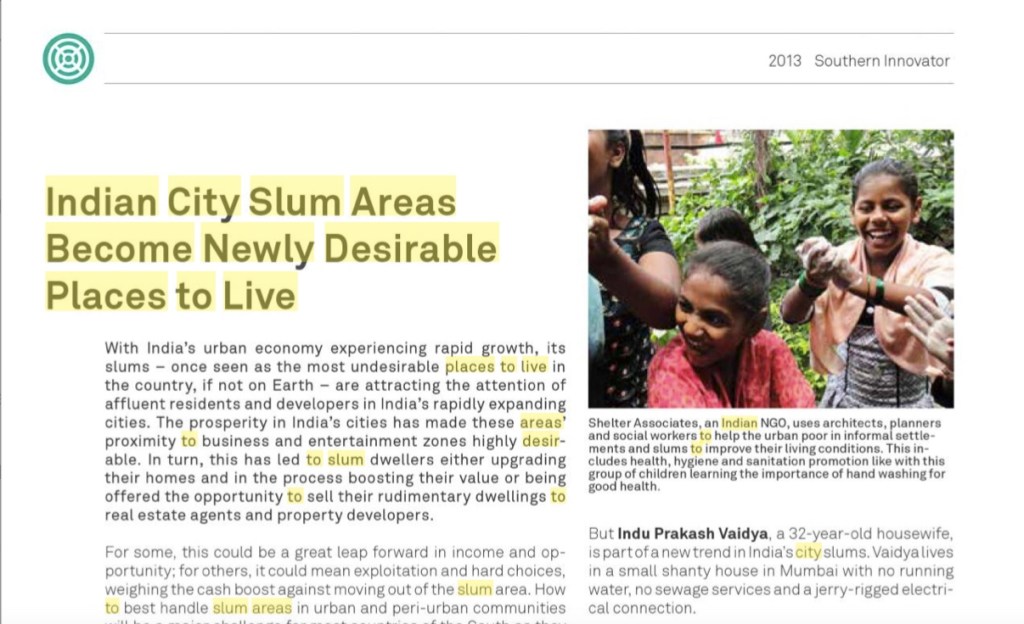
With India’s urban economy experiencing rapid growth, its slums – once seen as the most undesirable places to live in the country, if not on Earth – are attracting the attention of affluent residents and developers inIndia’s rapidly expanding cities. The prosperity inIndia’s cities has made these areas’ proximity to business and entertainment zones highly desirable. In turn, this has led to slum dwellers either upgrading their homes and in the process boosting their value, or being offered the opportunity to sell their rudimentary dwellings to real estate agents and property developers.

For some, this could be a great leap forward in income and opportunity; for others, it could mean exploitation and hard choices, weighing up the cash boost against moving out of the slum area.

How to best handle slum areas in urban and peri-urban communities will be a major challenge for most countries in the South as they continue to urbanize.

India’s phenomenal economic growth rate – forecast to be 7.9 percent this year by the Asian Development Bank, after averaging 7.7 percent per year over the past decade – has been the force behind an expanding middle class population, now estimated at 50 million people (McKinsey). Forecasts see it swelling from 5 percent ofIndia’s population to 40 percent by 2025.

With 30 percent of the population living in urban areas and cities contributing 60 percent of the country’s GDP and 90 percent of government revenues (Wall Street Journal), city-dwellers’ fate is critical to the functioning of the economy.

According to the 2001 Indian census, slums make up 25 percent of all housing and 26 percent of urban households lack access to sanitation facilities.

But Indu Prakash Vaidya, a 32-year-old housewife, is part of new trend inIndia’s city slums. Vaidya lives in a small shanty house in Mumbai with no running water, no sewage services and a jerry-rigged electrical connection.

Vaidya’s home is a just a single room for the five people in her family. They sleep on the cement floor and the ‘kitchen’ is a two-burner gas stove. The dwelling is so poorly constructed that they have to move around inside the room when it rains outside to avoid getting soaked.

But her humble home has been valued at US $24,000 by people looking to buy it.

According to real estate agent Hari Ram, the average price of a 91 square metre shanty home in Mumbai is now US $46,000.

“Shanties as small as 120 square feet… are as expensive as US $93,000,” Dinesh Prabhu, a construction company owner, told NDTV television.

Sixty percent of Mumbai’s 21 million people live in slums. And many are now finding themselves the subject of a property boom. This has led to the bizarre spectacle of luxury high-rise buildings sprouting up in a sea of slum housing. The slums are attracting the attention of those with money because many busy city workers face long commutes and are desperate for homes closer to work and entertainment areas.

The value of living close to the action is summed up by one slum dweller:

“People would kill to be in a place like this,” said slum dweller Sundar. “There are four local train stations close by. And the bus stop is a stone’s throw away.”

Some say this real estate boom offers enormous potential for the poor.

“All I can say is, given the current real-estate rates, those slums are invaluable,” said Sharad Mahajan of the Pune-based nonprofit organization Mashal (http://mashalindia.org).  Mashal focuses on the problem of urban shelter and also implements housing projects. It has been working in the Dharavi slum area with theMaharashtra government on its redevelopment. The slum is well-known for its representation in the film Slumdog Millionaire, and the area is next to the Bandra-Kurla Complex business district of Mumbai. Mashal has been mapping the area, home to 60,000 families, to make sure the redevelopment is fair to the families living there.

Land tenure is an issue however. Many slum dwellers do not have official title to the land they live on. Over time, they have become semi-official places to live as governments have hooked many up to electricity and drinking water. Issues of corruption and exploitation are also other problems that need addressing if this real estate windfall is to actually benefit slum dwellers.

Typical slum dwellers are day labourers and poor migrants. But others are people who good easily afford to live somewhere else but don’t want the long commutes to work.

“It is simpler and less expensive to live here,” said Sankaralingam, a plastic merchant, who estimates his annual income at around US $9,300: an amount that could get him a home somewhere nicer.

For Indu Prakash Vaidya, the dilemma – to sell or not to sell – makes for some painful choices. While her current home is prone to flooding during the rainy season, she feels she would have nowhere else to go if she sold the home.

Yet the pressure to sell is great and elemental.

“I have three children, and their education and well-being need to be taken care of. Financial constraints can push me to sell this shanty in the future, then where will I live? I will have nowhere to go,” she told NDTV. 

Published: December 2011

Resources

1) New documentary Urbanized gives a passionate over-view of the challenges facing the rapidly urbanizing world around us. Website: http://urbanizedfilm.com/

Development Challenges, South-South Solutions was launched as an e-newsletter in 2006 by UNDP’s South-South Cooperation Unit (now the United Nations Office for South-South Cooperation) based in New York, USA. It led on profiling the rise of the global South as an economic powerhouse and was one of the first regular publications to champion the global South’s innovators, entrepreneurs, and pioneers. It tracked the key trends that are now so profoundly reshaping how development is seen and done. This includes the rapid take-up of mobile phones and information technology in the global South (as profiled in the first issue of magazine Southern Innovator), the move to becoming a majority urban world, a growing global innovator culture, and the plethora of solutions being developed in the global South to tackle its problems and improve living conditions and boost human development. The success of the e-newsletter led to the launch of the magazine Southern Innovator. 
Creative Commons License

This work is licensed under a
Creative Commons Attribution-Noncommercial-No Derivative Works 3.0 License.

ORCID iD: https://orcid.org/0000-0001-5311-1052.

© David South Consulting 2023

Categories
Archive Development Challenges, South-South Solutions Newsletters Southern Innovator magazine

Innovation in the Slums can bring Peace and Prosperity

By David SouthDevelopment Challenges, South-South Solutions

SOUTH-SOUTH CASE STUDY

Rioting in Kenya has once again reminded people of the volatility of urban slums and the price to be paid if the dreams of those who live there are not met. As documented by urban development expert Jeb Brugmann, “mismanaged urban migrations have been a central part of political revolutions in our world since the 1960s.” In Kenya, “as elsewhere, these slums have effectively become huge, parallel cities, with their own economies, governance and social dynamics. Two-thirds of Nairobi’s slum dwellers eke a living in the underground informal sector. Ninety per cent of them are tenants. The poverty rate in Nairobi doubled, for instance, between 1992 and 1997.”

Slums are usually despised by the local urban authorities around the world. They end up either being totally ignored and seen as an embarrassment, or in more extreme circumstances like Zimbabwe’s slum clearance in 2005 – “Operation Clean Up Trash” – they are swept away (only to pop up somewhere else). Recently in Ghana, slums were cleared with flame-throwers, as residents were quickly cleared out of their homes to make way for a football stadium. Schoolteacher Ibrahim Addalah, who lost his home, said: “My school is gone. The community had bought us a blackboard; we had made a small school. It took us a long time to get all those things: the benches, the books. They gave us no time to leave; they just burnt our homes and our future to the ground. Now we are living in the rubble with nowhere to go.”

Over 900 million people – almost a sixth of the world’s population – now live in urban slums (UN). Improving conditions for these people is a Millennium Development Goal target. And half the world’s population will soon live in cities: already, in developing countries 43 per cent of urban dwellers live in slums – and in the least-developed countries the figure is 78 per cent. The UN has estimated it will take US $18 billion a year to improve living conditions for these people – and most of it will have to come from the people themselves.

An essential route to improving the situation is to give people living in slums the dignity and respect they deserve as human beings. Initiatives across the South seek to do this and turn the situation on its head: seeing slum dwellers as a valuable asset, not an urban blight.

The concept of ‘slum networking’ has been developed by Indian engineer Himanshu Parikh of Ahmedabad , a winner of the Aga Khan award for architecture. He starts from the point of believing there is no need for slum conditions to exist in India, but that slums do not need to be moved, just upgraded; and that good change can happen quickly.

He also sees the residents’ involvement and financial contribution as critical to the sustainability of any improvements. His approach has already helped one million people overall, including 8,703 families (43,515 people) in Ahmedabad in 41 slum communities. Slum networking does not depend on aid funds but is a self-reliant approach, in which residents make a partnership with private suppliers to get access to the most important services first: clean water and hygiene and sanitation.

Parikh’s approach involves providing channels for sewage, water supply and roadways in existing slum areas by exploiting the natural topography and pattern of development to provide the new infrastructure.

Parikh makes a detailed survey plan of the existing houses and divides them into groups based on the quality of construction. If they are of reasonable quality, they are left in place. Where possible, slum dwellers are allowed to buy the land they are squatting on. By buying the land, the owner now has a direct stake in its development.

“Working inside out, i.e. starting with quality infrastructure in the poor areas and working outwards to produce larger networks for the city or village, not only integrates the two levels, but actually produces far cheaper infrastructure at both levels,” Parikh told Architecture Week magazine.

In the slums of the Indian city of Indore, 181 slums were networked, giving the city 360 kilometres of new roads, 300 kilometres of new sewer lines, 240 kilometres of new water lines, 120 community halls and 120,000 trees. This transformed the two local rivers from open sewers back to water. According to the World Bank, fatal water diseases fell by 90 per cent.

“No project for their rehabilitation could be successful until they were involved as the capital partners,” Parikh told India’s The Tribune. Upgrading “the civic amenities, including sewerage, roads and water supply, was the need of the hour for better living conditions of the slum dwellers.” In South Africa, the country’s fast-growing tourism trade is being directed towards its slums, not just its game parks, wineries and cities.

The sprawling Soweto district on the outskirts of Johannesburg – the heart of the struggle against the former apartheid regime – has lured tourists to come and stay with its network of bed and breakfasts (http://www.sowetonights.co.uk/snaccom_vhavenda.htm): home-based places to stay run by families. Like many slums, Soweto is a heady mix of contrasts: from wealthy suburban homes, to makeshift tin shacks to outright squalor and destitution. But the B and Bs ensure tourists stick around and spend more money, creating lasting jobs.

Over 200,000 visitors a year tour Soweto to see where Nelson Mandela and Bishop Desmond Tutu once lived. And as with all success, it attracts more success: the international hotel chain Holiday Inn has just opened a 48-room hotel in Soweto.
Giving dignity to the lives of slum dwellers is the work of a do-it-yourself “TV station” in Kenya. Kenya’s dramatic turn to violence after recent elections has led to a myopic view of the country, according to the young filmmakers and photographers behind Slum TV (http://www.slum-tv.info/). Based deep inside Nairobi’s largest slum, Mathare, they have been seeking out the stories of hope where international media only see violence and gloom.

“We look at what is good and what is bad. We see what is behind the scenes. The international media only shows the negative side,” said Benson Kamau of Slum TV.

Slum TV is a group of young men in Mathare with only a two-week workshop in the basics of film shooting and editing. They pay their bills by doing odd jobs. A grant from Austria paid for their one camera and a computer.

They screen their films every month to the residents of Mathare on a giant white sheet hanging over some vacant land. They illegally tap an overhanging electricity line for power – few can afford electricity. The films document everyday life in the slum – a man selling dougnuts, women frying potatoes – and the locals can see their lives recorded and acknowledged.

Resources 

1. Shelter Associates: established by Indian architect Pratima Joshi, it is an NGO working on slum rehabilitation. http://www.shelter-associates.org

2. SPARC: one of the largest Indian NGOs working on housing and infrastructure issues for slum dwellers. http://www.sparcindia.org

3. Improving the Lives of Slum Dwellers: published by the Millennium Project. http://www.unmillenniumproject.org/reports/tf_slum.htm

4. For local bed and breakfasts in South Africa, click here sa-venues.com, tourist information at http://www.southafrica.net/

5. Slum Networking: Innovative Approach to Urban Development by Diane Diacon (editor). Website: http://www.amazon.co.uk

https://davidsouthconsulting.org/2022/02/17/digital-mapping-to-put-slums-on-the-map/

https://davidsouthconsulting.org/2022/04/28/envisioning-better-slums/

https://davidsouthconsulting.org/2022/11/16/housing-innovation-in-souths-urban-areas/

https://davidsouthconsulting.org/2020/12/14/innovation-in-growing-cities-to-prevent-social-exclusion/

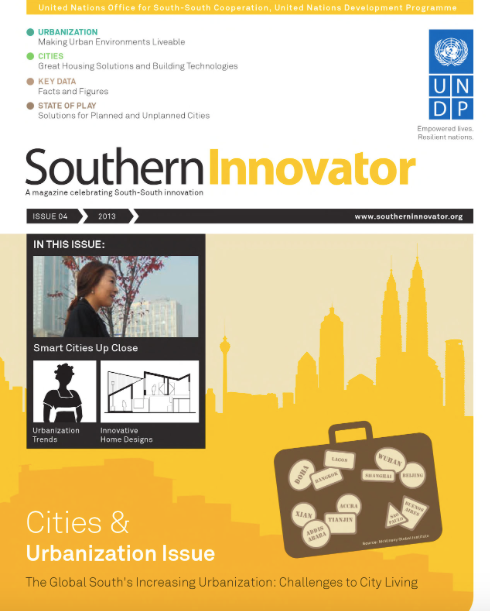
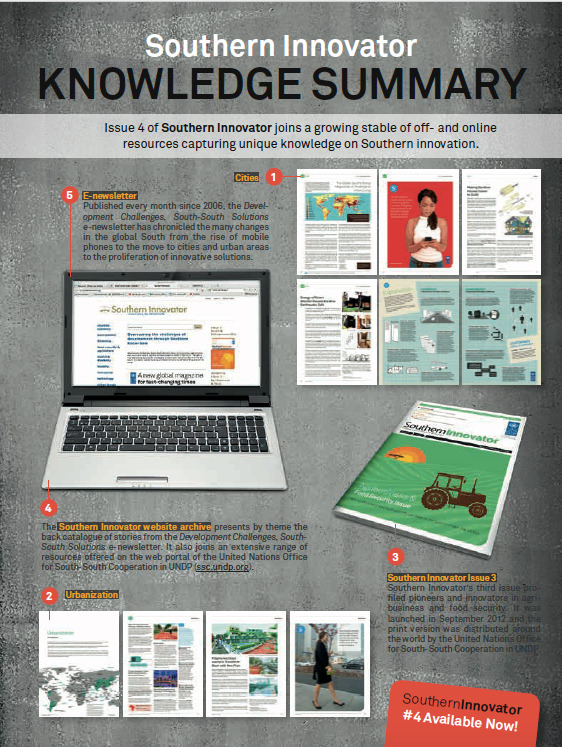
https://davidsouthconsulting.org/2021/03/05/southern-innovator-issue-4/

Development Challenges, South-South Solutions was launched as an e-newsletter in 2006 by UNDP’s South-South Cooperation Unit (now the United Nations Office for South-South Cooperation) based in New York, USA. It led on profiling the rise of the global South as an economic powerhouse and was one of the first regular publications to champion the global South’s innovators, entrepreneurs, and pioneers. It tracked the key trends that are now so profoundly reshaping how development is seen and done. This includes the rapid take-up of mobile phones and information technology in the global South (as profiled in the first issue of magazine Southern Innovator), the move to becoming a majority urban world, a growing global innovator culture, and the plethora of solutions being developed in the global South to tackle its problems and improve living conditions and boost human development. The success of the e-newsletter led to the launch of the magazine Southern Innovator. 

Creative Commons License

This work is licensed under a
Creative Commons Attribution-Noncommercial-No Derivative Works 3.0 License.

ORCID iD: https://orcid.org/0000-0001-5311-1052.

© David South Consulting 2023