Seniors who live in nursing homes and homes for the aged are receiving an inadequate amount of psychiatric care, according to a study conducted by Toronto’s Baycrest Centre for Geriatric Care.
Dr. David Conn, director of psychiatry at Baycrest and an author of the report, says action must be taken to remedy this situation, since at least 80 per cent of elderly long-term care residents suffer from some form of mental disorder.
The issue of psychiatric care for seniors is complex. There are many, often strongly-held, opinions about the nature of this care and what measures will genuinely improve the mental well-being of seniors in institutions.
According to The Senior Citizens’ Consumer Alliance for Long-Care Reform, Ontario has the highest rate of institutionalisation of seniors in the world, with 7.5 per cent of seniors over the age of 65 and 15 per cent over 75 in institutions. The Alliance demanded in its reforms in Ontario that seniors’ mental health problems be taken more seriously and be included in any assessment for care.
Baycrest’s report surveyed 1,148 medical directors and nursing directors in over 500 nursing homes and homes for the aged across Ontario. The 601 who responded reported that 37 per cent of their residents received no psychiatric care, while only 12 per cent received more than five hours per month. The most common psychiatric problems under treatment were depression, agitation, wandering and physical aggression.
“Recognition of significant mental disorders in nursing homes is a recent phenomenon because geriatric psychiatry is a relatively new field,” says Dr. Conn. “The usual approach has been to reach for the prescription pad. We know now that antidepressants have been underused and tranquillizers overused.
“To deliver effective psychiatric care requires more than just psychiatrists – teams of psychiatric nurses can also be involved. Hopefully the staff of these institutions will become better educated as a result of this report.”
Dr. Kenneth Shulman, head of psychiatry at the Sunnybrook Health Sciences Centre, feels the worst neglect occurs in private rest homes.
“There is general lack of accountability when it comes to geriatric psychiatric services.” Schulman advocates a coordinated, comprehensive regional network of services.
Dr. Conn is sensitive to reports of sexual, physical and mental abuse of residents in some institutions. He says staff as well as residents of institutions can benefit from psychiatric consultations. “If more psychiatric consultants were available, the staff could also receive help in working out their problems,” he says. “Unfortunately the fee-for-service system doesn’t include paying for visiting staff.
“Being in an institution is not easy for anyone. It often means being apart from family, living with strangers, loss of freedom and having to live by the institution’s timetable.”
One of the most controversial of psychiatric treatments is electroconvulsive therapy (ECT). ECT involves placing electrodes on the sedated patient’s head and passing 100 to 175 volts of electricity into one of the lobes of the brain to induce grand mal seizure and coma.
Opponents of ECT say the procedure can cause memory loss and confusion, and in some cases proves fatal. A 1985 Ontario government task force report recommended against using ECT in certain cases: “For patients whose work requires a clear and precise memory, ECT is probably contraindicated.”
But many other sources say that while ECT has been abused in the past and, like many other medical procedures, may not be a pretty sight, it is sometimes effective in combating depression.
Dr. Conn confirms that the controversial procedure is still being used on seniors. “ECT is used on very depressed people,” he says. “It is a hospital-based service. The patient is admitted to a psychiatric unit of the hospital. We do it at Baycrest. It is only a last resort and has often been life-saving.”
Don Weitz, a senior citizen and spokesperson for Resistance Against Psychiatry, doesn’t mince words about what he says is the adverse effects of electroshock therapy and psychiatric practice in general. He wears a T-shirt bluntly saying, “Fry rice – not brains.”
“We have known about the adverse effects of shock for years,” says Weitz. “Research from the ‘40s and ‘50s was very clear that there was brain damage.
“What doctors mean by improvement is in fact post-injury euphoria – the brain will overcompensate with giddiness, and this only lasts for two to four weeks. Doctors seldom test people for more than two or three months afterwards.”
“What we know for sure is that within the institutions, they would rather give drugs or shock than talk to seniors. I think this should be called elder abuse – what else could it be? Is it such a mystery why people are depressed in institutions where they are abused? Psychiatrists have a vested interest in billing OHIP for pushing the button.”
But Dr. Shulman disagrees with blaming the atmosphere of institutions. “It is simplistic to think that the environment is responsible for aggressiveness or other problems,” he says. “These people are cognitively impaired – it could be medication-related or something else. These are complicated issues.”
For any nursing home workers who want further advice about psychiatry, Baycrest has produced a “Jargon-free” guide called Practical Psychiatry in the Nursing Home.
Read more of David South’s 1990s health and medical journalism here:
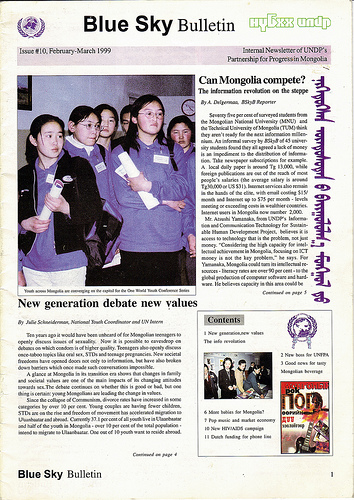
Background: The Partnership for Progress brochure raised the curtain on UNDP’s programme in Mongolia and my work heading UNDP Mongolia’s Communications Office. I led the Office from 1997 to 1999, garnering awards and praise for the quality of the offline and online resources.
A Partnership for Progress
“For years we were under the domination of foreign countries. So really, Mongolia is a new nation.” With these words, Prime Minister M. Enkhsaikhan described the enormity of the task ahead for Mongolians. While Mongolia has been an independent nation for most of this century, this has not been the case with its economy. Just as a new democratic nation was born in the 1990s, so Mongolia’s economy lost the large subsidies and trading arrangements it had in the past with the Soviet Union. The time to learn about free markets and the global economy had arrived.
Under socialism, Mongolia was dependent on the Soviet Union. Prior to the socialist revolution in 1921, the country experienced hundreds of years under the influence of the Chinese. It is only since 1990 that Mongolia has had an opportunity to build the foundations of an independent economy and political culture. But it takes money and know-how to make the transition work. This is the kind of nation-building support the United Nations Development Programme (UNDP) specializes in. UNDP’s fifth country plan for Mongolia has come to an end, and in cooperation with the Mongolian Government the sixth – the Partnership for Progress – has begun.
Meeting the challenges of transition
The international community rapidly responded to Mongolia’s needs in the early 1990s. Along with the large international donors, the UN system is playing a pivotal role with UNICEF, UNFPA, WHO and UNDP to assist in the country’s social reconstruction. Other agencies now operating in Mongolia include UNESCO, UNV, UNHCHR, World Bank and the IMF. The UN’s capacity to coordinate, not only within the UN family of organizations, but also with donors and the international NGO community has proved extremely useful in mobilizing the technical assistance needed at this critical time. The goal is capacity building, or the transformation of both the human and economic resource base to fit the economic and social demands of transition.
UNDP’s Partnership for Progress with the Government of Mongolia serves as the framework for assisting the Government to combat the worst effects of poverty and social disintegration brought on by economic transition. The programmes and projects mounted with UNDP assistance not only tackle the lack of material resources, but also the dearth of practical experience in the strategies and methodologies required to nurture open government and encourage democratic procedures, protect human rights, preserve the environment and promote the private sector.
Mongolia is a large country with poor infrastructure. This means it is not only difficult to transport food or make a phone call, but also to develop and deliver programmes that reach the entire country. It is through the expertise of the UNDP, drawing experience from around the world, that these obstacles to a market economy and an open democracy can be overcome.
UNDP has had a country office in Mongolia since the 1970s. UNDP’s resource mobilization target for the five year programme from 1997 to 2001 is US $27.5 million, with 45 percent to be directed to poverty alleviation, 30 percent to governance and 15 percent to environmental protection. With this material input and the goodwill it generates, the Mongolian Government can design appropriate social and political structures to support their efforts in seeking lasting solutions to the problems brought on by transition. Mongolia can then become an equal player in the global community of the 21st Century.
UNDP in Mongolia
The UNDP’s programmes in Mongolia follow the global principle of helping people to help themselves. Through a close working relationship with the Mongolian Government (the Partnership for Progress), UNDP personnel work with many thousands of Mongolian counterparts in government, academia and NGOs all over the country. In addition, UNDP has a large contingent of United Nations Volunteers (UNVs) deployed in Mongolia. There are over 27 international UNVs working in all UNDP programme areas and further 26 national UNVs working as community activists to foster participation in the poverty alleviation programme. Another six national UNVs are involved in the UNESCO/UNDP decentralization project.
A peaceful transition
The transition in the 1990s from socialism to democracy and free markets has profoundly transformed the country’s political and economic character. Mongolia is a young democracy that is also a model for bloodless political revolution. Today, this participatory democracy boasts scores of newspapers, dozens of political parties and a vigorous parliamentary system. On the economic front, a command-based economy has been replaced by free markets. But there has been a high price to pay in social disintegration and dysfunction, as the former social supports disappear and their replacements fail to “catch” everyone. As with all social upheaval, vulnerable groups – the elderly, the young, the weak – bear the brunt of the social and economic shocks as the old gives way to the new.
The bubble bursts
Before the 1990s, the Mongolian economy was totally dependent on subsidies from the Soviet Union. The state owned all means of production and private enterprise was foresworn. Farmers and herders were organized into cooperatives. Factories had more workers than they needed. Wages were low but no one starved. The state provided for the basics of life – health care, education, jobs and pensions. Free fuel was provided to get through the severely cold winters, and during blizzards lives were saved in stranded communities with food and medicine drops by Russian helicopters.
The bubble burst in 1991 when the Soviet Union disintegrated and the subsidies came to an end. Prior to this, communist countries accounted for 99 percent of Mongolia’s imports and 94 percent of its exports. Mongolia’s economy suddenly lost its buttress and immediately collapsed.
A sense of freedom
Although the economic picture was bleak, politically Mongolians rejoiced and embraced the principles of Western parliamentary democracy. A new sense of political and personal freedom took hold. Freedom of religion ensured a revival of Buddhism. Monasteries sacked and razed under the Communists were restored and religious observance once again became part of daily life.
Collectivization began to give way to free markets and privatization. A voucher system was used to redistribute the assets of many state-owned entities. Each citizen was issued with vouchers to the value of 10,000 tugrigs (at the time worth US $100). They could be bought and sold like shares of stock.
Livestock was privatized and previous limitations regarding ownership of animals were lifted. As a result, the composition of herds changed and the numbers of animals soared to the highest levels in 50 years. While the collapse of the state sector has led to severe hardship, many nomadic herders who astutely manage their herds are self-sufficient in meat and milk. Many continue the old energy saving ways, including collecting dung for fuel and using their animals for transport. Some find it possible to live almost completely outside the cash economy.
Transition shock
The spectre of the worst aspects of market economies soon loomed for many who had known only a poor but predictable life under a command economy. Suddenly unemployment, inflation and reduced services became the norm. Previously reliable export markets in the newly constituted Commonwealth of Independent States disappeared entirely, leaving a ballooning trade deficit and a plummeting tugrig. The fall in global prices for cashmere and copper have only exacerbated an already critical situation.
Poverty strikes
Poverty and starvation hit with a vengeance. According to Food and Agriculture Organization (FAO) figures, a third of the population now lives at starvation levels. The demise of collectivized farming has contributed to both a shortage of food and reduction in food self-sufficiency. Thousands of homeless children work, beg or steal in the streets of the capital, Ulaan Baatar. Many descend into the sewers for warmth to escape the subzero temperatures that prevail for most of the year, while others seek refuge in the few children’s shelters in the city.
Unemployment is high. Women are particularly vulnerable, with more than 100,000 summarily removed from the pension rolls at the beginning of 1997. The retired, whose pensions have decreased dramatically in value are also in severe distress, with almost all relying on their families, friends and neighbours. Those without such support are left to live a precarious existence.
Poverty alleviation
To reverse a rapidly deteriorating situation, the Government instituted a six-year National Poverty Alleviation Programme (NPAP) with the primary objective of reducing poverty by 10 percent by the year 2000. Designed with assistance from UNDP, donors and Mongolian NGOs, the NPAP is founded on new principles unseen before in Mongolia. Responsibility is decentralized, with each of the 21 aimags (provinces) having a local Poverty Alleviation Council with responsibility for identification, formulation and appraisal and approval of projects. Thus the people of the area can respond to local needs – identify them, propose solutions to problems and act to determine their own futures.
The Mongolian National Poverty Alleviation Programme addresses a wide range of social issues, including income poverty and the crisis in the health and education sectors. Solutions to such urgent social welfare problems are a high priority for the Mongolian Government – and international assistance is critical. The introduction of fees for health and education services that were previously free has placed an unbearable financial strain on some families. School drop-out rates and truancy are problems in both urban and rural areas. The costs associated with general maintenance and heating of public buildings adds another financial burden in the transition period.
Emphasis on women
A US $10 million soft loan from the World Bank for the period 1996 to 1999 supports Mongolia’s efforts to follow up on the commitments of the World Summit for Social Development, the Fourth World Conference for Women and other recent global initiatives.
The NPAP institutional framework focuses on explicit measures to alleviate poverty by attending to sustainable livelihoods, employment creation, gender equality, grassroots development and human resource capacity building. Mongolia’s historically high levels of literacy, health care and education auger well for the future of this approach, in spite of the many obstacles facing the people.
In addition, the Women’s Development Fund and the Social Assistance Fund have mobilized national NGOs and international donors for both income generation schemes and distress relief for the vulnerable. The success of women in actively implementing projects with the help of the various funds is a testament to the strength and resilience of ordinary Mongolians.
Working with the National Poverty Alleviation Programme initiatives, the UN System Action Plan and Strategy provides technical assistance and capacity training to realize the objectives of the national programme.
In all, eight new projects are on the agenda for 1997, including credit provision, skills and vocational training, water and sanitation provision, urban renewal, pre-school education and one capacity building project at the institutional level.
Freedom of information
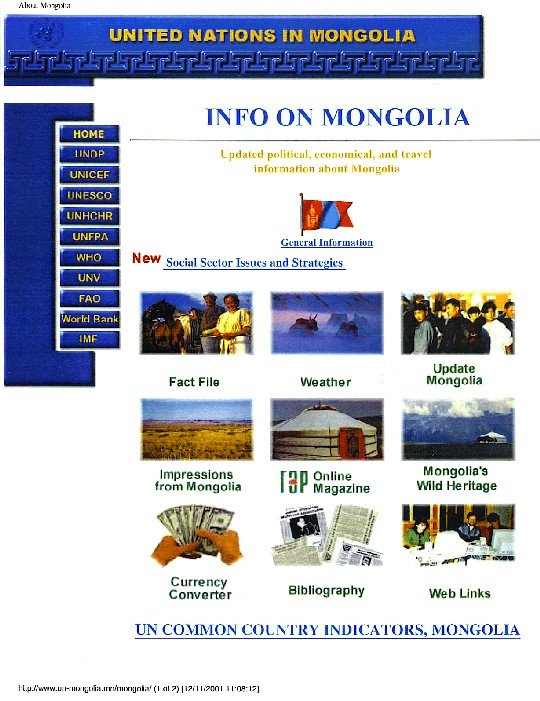
Under the Partnership for Progress, UNDP is working with donors and international NGOs to promote and foster a participatory democracy. A key component of good government and democracy is the free flow of information. That is why UNDP has placed a significant portion of its resources into ensuring government, NGOs and citizens have access to the state-of-the-art computer communications technology, especially the Internet and e-mail. The Governance and Economic Transition Programme will have nine new projects by the end of 1997: seven to support national reforms in government and the civil service, two to support journalists as they come to grips with their new responsibilities in a democratic society, and one in the tertiary education sector, following a series of faculty-strengthening education projects that have been ongoing since the early 1990s.
The Consolidation of Democracy through Strengthening of Journalism project offers direct support to working journalists.
Six journalism centres throughout the country offer hands-on training courses and access to news and information from international and Mongolian sources.
At the aimag level, Citizen Information Service Centres will be custom tailored to the information needs of each aimag’s residents. These centres will increase the free flow of information from the capital, which is currently hampered by poor communications infrastructure.
Decentralization, governance and economic transition
The Government has wisely foreseen the need to engage in a fundamental shift in how Mongolia is governed. Not only should it provide institutions that can address the social and economic shocks of the 1990s, but it also must provide a stable and efficient policy to ensure a prosperous and secure future for Mongolia.
Decentralization in government administration is a cornerstone of the Government’s policy to make managers of public services more responsive to local people’s needs. In an ambitious programme to decentralize and consolidate democracy in Mongolia, the Government has promised to devolve decision-making more and more to the local level. The UNDP plays a key role in ensuring this process continues and that local politicians acquire the skills necessary to handle these new responsibilities.
A respect for nature
Mongolia’s flora, fauna and unspoiled landscapes are at a watershed. Mongolians have traditionally had a respect for the natural environment as a source of food and shelter from the harsh climate. These close ties have meant that environmental preservation and respect for nature form an integral part of cultural traditions. As far back as the reign of Chingis Khan in the 13th century, Mongolia has had nature reserves. The new social and economic imperatives have put a strain both on these traditions and the environment, with a corresponding stress on Mongolians.
Semi-nomadic herding still forms the backbone of the country, and the pressures of the 90s have only re-enforced this. Many Mongolians have turned to herding as the only guarantee of a steady supply of food and economic well-being.
The environment is regularly challenged by natural disasters. In 1996, a rash of forest fires destroyed large swathes of land and caused extensive economic and environmental damage. Floods, heavy snowfall, extremely low temperatures, strong winds, dust storms, and earthquakes are all natural hazards for Mongolia.
Keeping Mongolia green
UNDP’s mandate in environmental protection and preservation is reflected in its support to the Government. As Mongolia addresses the challenge of up-holding international conventions to which it is signatory, it must sustain and preserve a decent and dignified lifestyle for all its citizens.
In the area of disaster management, the Government is emphasizing preventative measures as much as relief. UNDP support is focused on an extensive campaign for preparedness, technical support and capacity building to deal with both natural and man-made disasters.
The flagship programme for the environment is the Government’s Mongolia Agenda for the 21st Century (MAP 21). The Government’s continuing biodiversity programme, under the auspices of the Global Environment Fund (GEF), has already shown results, with the on-going mapping of the country’s biodiversity for future generations.
Two new projects were initiated in 1997: the Sustainable Development Electronic Information Network reaches out to people in remote and isolated locations. The Energy Efficient Social Service Provision Project has introduced straw-bale construction, an environmentally-friendly, energy-efficient and pollution-reducing building technology. This technology uses straw for insulation within the walls of buildings. Schools and health clinics will be built with straw insulation by work crews trained by the project.
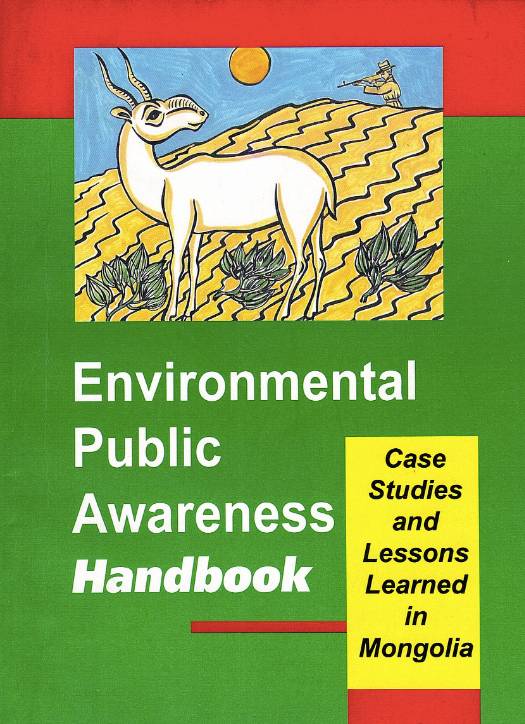
The environmental challenges Mongolia faces are acknowledged by the world community as both requiring a global and a national commitment. UNDP acts as conduit for a number of globally-supported programmes focused on local action. The axiom “think globally, act locally” is the principle guiding the UNDP/Mongolian Partnership for Progress’ environmental activities.
Note: Mongolia was experiencing ‘shock therapy’ during the 1990s, as well as austerity, in response to the collapse in subsidies and state supports when trade relationships with the Soviet Union ended.
By David South (Canada), UNV Information Officer, UNDP, Mongolia
UNV News #78 November 97
After seven years of transition to a market economy, Mongolia – a former satellite of the Soviet Union that has had a democratic government since 1992 – has been profoundly changed. Where it once had a rigid communist government and few contacts with the west, Mongolia has pursued rapid economic, political and social liberalisation. Mongolia has a small population – 2.3 million – spread out over a vast territory wedged between Russia and China.
Communication has in many ways deteriorated over the past seven years as the old communication networks from the communist era have not been fully replaced by the private sector. More and more it became apparent that government and the private sector were almost working in the dark in understanding how transition has affected Mongolians.
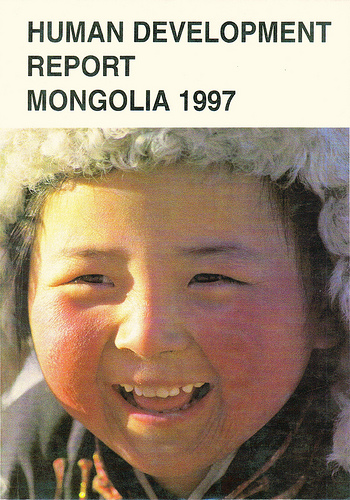
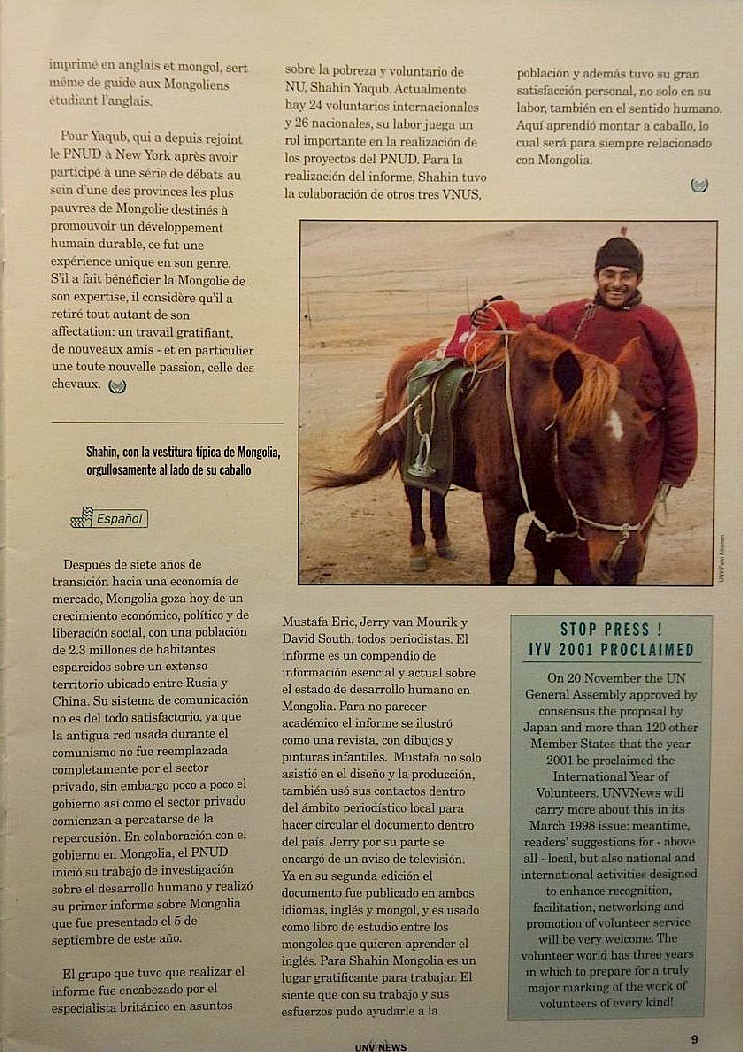
In partnership with the Mongolian government, UNDP initiated the researching of Mongolia’s first human development report back in the middle of 1996. It was launched on September 5 of this year, with UNVs playing a key role. To lead the team in producing the report, British poverty specialist and UNV Shahin Yaqub was brought in. Only 29-years-old – one of the youngest UNVs in Mongolia – Yaqub joined a rapidly expanding UNV presence in the country. There are now 24 international UNVs and 26 Mongolian UNVs deployed throughout the country in UNDP’s projects.
The thirst for expertise in Mongolia – a country undergoing the growing pains of transition to a market economy – has placed high demand on UNVs. UNVs occupy senior roles in all of UNDP’s projects.
The 1997 Mongolian Human Development Report is a prime example of the important goal of capacity building conducted by the UNDP. For Yaqub, the report’s principal author, it was like starting from scratch. A poverty research office had to be set up before the work could begin. A team of Mongolia’s top statistical researchers had to be trained in the latest methodologies for social research.
Yaqub was excited by the project. He said: ”There was no office when I first came. We had to organise the office to understand who does what and basically create the focal point for poverty analysis in Mongolia”.
Yaqub also had some of his basic assumptions tested. The small population of this country – only 2.3 million – had meant the previous communist regime was able to build up a large archive of statistics on the population. A good portion of the information was not up to international standards, but it potentially represented a wellspring of data to start from. “Mongolia is number-rich. To even have that kind of data is very rare for a developing country. But unfortunately we found all this information was stored on Russian mainframe computers that didn’t work anymore!”
During the actual production of the report, Yaqub was joined by three more UNVs: Mustafa Eric, a Turkish journalist working with the Press Institute of Mongolia, Jerry van Mourik, a Dutch journalist now working as the Support Officer to the United Nations Resident Co-ordinator, and UNDP Information Officer David South, a former journalist with the Financial Times in London, England.
The high-profile role played by media UNVs was crucial if the report was to not end up collecting dust on a government shelf. The report is a repository of essential and new information on the state of human development in Mongolia, including data showing rising poverty rates and serious threats to food security. Like all human development reports produced by UNDP, it was not meant to be a prescriptive tract, but a lubricant for a national debate on sustainable development in Mongolia. This altered the design and presentation of the report.
Instead of looking academic, the report took on the appearance of a magazine, from its cover to colourful children’s paintings inside. UNV Mustafa not only assisted with the report’s design and production, he also used his contacts in the Mongolian media to ensure the report was distributed across the country. UNV van Mourik assisted with publicity, including producing an emotionally-charged television commercial weaving together vignettes from Mongolia’s recent history to tell the story of human development.
Already in its second print run in both English and Mongolian, the report has been adopted as their study guide by Mongolians wanting to learn English.
“Mongolia is a rewarding place to work,” said Yaqub. “As a technical specialist and UNV, what you bring to the job is valued. I researched poverty for five years before coming to Mongolia and I felt I had something to contribute. But I also realised I had something to learn as well. You always have to keep in mind you are bringing your own baggage to the job – be it cultural, emotional or intellectual. Coming from an academic background, I was not afraid to be told I was wrong.”
Yaqub, who had worked in poverty analysis in the Philippines and Bangladesh before coming to Mongolia, will never forget the country that sparked his new passion: horses.
“You give up things as a volunteer – your time, your income, all the things you took for granted back home. But what you give up is compensated by rewarding work and good friends. When I learned to ride a horse, I can place it directly and clearly to Mongolia – that memory will always be with me.”
Just before Yaqub left Mongolia for work with UNDP in New York, he participated in a series of public debates in one of Mongolia’s poorest provinces, Khuvsgul aimag. The public debates are used to introduce the report to the grassroots while sparking discussion on sustainable human development.
Starting from scratch – The challenge of transition
Résumé en Français
UNV News #78 November 97
Sept années de transition vers une économie de marché et une libéralisation rapide tant économique et politique que sociale, ont profondément transformé la Mongolie, vaste territoire à faible densité de population bordé par la Russie et la Chine. Les communi-cations se sont fortement détériorées et ni le gouvernement ni le secteur privé ne se trouvaient manifestement en mesure d’évaluer l’impact de la transition sur la population. En collaboration avec le gouvernement, le PNUD a donc procédé à l’établissement du premier rapport sur le développement humain en Mongolie, publié en septembre de cette année.
Plusieurs VNU parmi le nombre croissant de volontaires actuellement en poste en Mongolie au sein de projets du PNUD – 24 internationaux et 26 nationaux – y ont pris une part prépondérante, tout particulièrement Shahin Yaqub, spécialiste britannique en recherche sur la pauvreté. Pour Yaqub, puis pour ses trois collègues VNU Mustafa Erik, Jerry van Mourik et David South, le défi consistait à partir de rien – pas de bureau, une base de statistiques existante… mais sur des ordinateurs russes hors service – pour mettre sur pied un rapport riche en informations qui, une fois terminé, n’irait pas dormir sur l’étagère d’un bureau gouvernemental mais servirait de base à une action durable à l’échelon national. Grâce au format adopté – un magazine abondamment illustré – , à sa présentation par les médias – notamment la télévision – et à sa diffusion à travers le pays entier, c’est chose faite. Le rapport, imprimé en anglais et mongol, sert même de guide aux Mongoliens étudiant l’anglais.
Pour Yaqub, qui a depuis rejoint le PNUD à New York après avoir participé à une série de débats au sein d’une des provinces les plus pauvres de Mongolie destinés à promouvoir un développement humain durable, ce fut une expérience unique en son genre.
S’il a fait bénéficier la Mongolie de son expertise, il considère qu’il a retiré tout autant de son affectation: un travail gratifiant, de nouveaux amis – et en particulier une toute nouvelle passion, celle des chevaux.
Starting from scratch – The challenge of transition
Resumen en Español
UNV News #78 November 97
Después de siete años de transición hacia una economía de mercado, Mongolia goza hoy de un crecimiento económico, político y de liberación social, con una población de 2.3 millones de habitantes esparcidos sobre un extenso territorio ubicado entre Rusia y China. Su sistema de comunicación no es del todo satisfactorio, ya que la antigua red usada durante el comunismo no fue reemplazada completamente por el sector privado, sin embargo poco a poco el gobierno así como el sector privado comienzan a percatarse de la repercusión. En colaboración con el gobierno en Mongolia, el PNUD inició su trabajo de investigación sobre el desarrollo humano y realizó su primer informe sobre Mongolia que fue presentado el 5 de septiembre de este año.
El grupo que tuvo que realizar el informe fue encabezado por el especialista británico en asuntos sobre la pobreza y voluntario de NU, Shahin Yaqub. Actualmente hay 24 voluntarios internacionales y 26 nacionales, su labor juega un rol importante en la realización de los proyectos del PNUD. Para la realización del informe, Shahin tuvo la colaboración de otros tres VNUS, Mustafa Eric, Jerry van Mourik y David South, todos periodistas. El informe es un compendio de información esencial y actual sobre el estado de desarrollo humano en Mongolia. Para no parecer académico el informe se ilustró como una revista, con dibujos y pinturas infantiles. Mustafa no solo asistió en el diseño y la producción, también usó sus contactos dentro del ámbito periodístico local para hacer circular el documento dentro del país. Jerry por su parte se encargó de un aviso de televisión. Ya en su segunda edición el documento fue publicado en ambos idiomas, inglés y mongol, y es usado como libro de estudio entre los mongoles que quieren aprender el inglés. Para Shahin Mongolia es un lugar gratificante para trabajar. El siente que con su trabajo y sus esfuerzos pudo ayudarle a la población y además tuvo su gran satisfacción personal, no solo en su labor, también en el sentido humano. Aquí aprendió montar a caballo, lo cual será para siempre relacionado con Mongolia.
Transitioning Mongolia from little data to Big Data.
Port-au-Prince – Brand-new four-by-four jeeps in various shapes and sizes bounce over the moon-like craters of Port-au-Prince’s roads. The presence of so many expensive vehicles in a country unable to feed all its citizens is hard to take, but it is not one of the worst paradoxes of Haiti.
The appalling state of the roads – more like occassional stretches of asphalt to break up the monotony of potholes – is an apt symbol of Haiti, a reminder with every jar of the tailbone of the public squalor of the many and the private wealth of the few. The shiny new jeeps are not a sign of recent good times, but reveal who has all the money in this nation of almost seven million: the tiny Haitian elite, thieves, the United Nations and the multitude of non-governmental aid agencies.
When democratically-elected president Jean-Bertrand Artistide, deposed in a 1991 coup, returned to complete his term in office in 1994, many Haitians hoped that this country would at last begin to shake off centuries of exploitation at the hands of a selfish elite backed by American corporate masters and begin to build a democratic future.
The United Nations mission in Haiti, which includes 700 Canadian troops, is intended to support the country’s fledgling democracy. But Haiti’s future remains uncertain – as does the role the UN will play in shaping it.
Despite negotiating a peaceful and democratic transition last February 7 from Aristide – a firebrand former priest and passionate advocate of Haiti’s poor – to successor Rene Garcia Preval, Haiti hasn’t stopped its economic freefall. Economists predict the country won’t match 1991 earning levels until the next century. Political unrest resulting from opposition to the government’s privatization plans could also spell trouble ahead.
The United Nations presence, due to end June 30, has been extended another five months at the request of the Haitian government. The newly-minted UN Support Mission in Haiti, a military force of 600 UN troops supported by 700 soldiers paid through voluntary contributions, is being assembled. It will replace the current force of 1900.
Lousy loans
Meanwhile, the government of Rene Preval is negotiating with the International Monetary Fund (IMF), the World Bank and the United States to get much-needed loans to help balance the budget. Critics say the world’s banks are trying to lock the poorest country in the Western hemisphere further into crippling debt. The Haitian budget is US $750 million, 60 per cent of which the government hopes to raise from loans.
But there is a condition. Haiti must embark on a structural adjustment programme: widespread firings of the public service, privatization of most of the public sector, loosening of controls over foreign capital, adherance to the ethos of global trading blocks espoused by the North American Free Trade Agreement (NAFTA). Some call this neo-liberalism, others neo-conservatism. Either way, it forces this impoverished country to limit how it can address rebuilding a crumbling infrastructure.
The government’s hands are tied, though, as the conditions were part of the deal to return Aristide to power.
A Canadian public relations company, Gervais-Gagnon-Covington Associates, has been paid US $800,000 by the American government to sell the idea of privatization of Haiti’s handful of idle and near-bankrupt state enterprises.
In order to plunge deep into this Haitian quagmire, I pitch up at the legendary Hotel Oloffson – made famous by novelist Graham Greene in The Comedians – and begin interviewing in the languid atmosphere by the pool.
“Aristide has put Haitians in a giant trap with the IMF plan,” says Jane Regan, who runs an independent news service based in Port-au-Prince. “The US $1 billion in loans will double the national debt.
“Haiti used to be self-sufficient in rice – last year they bought US $56 billion in US rice. The roads are worse now than a year ago. Right now the UN mission is of questionable worth and Canadians are getting taken advantage of. They have been sent to clean up after the Americans. These are the same neo-liberal economic policies that hurt Canadian workers – just imagine what Haitians are feeling!”
Regan thinks that, so far, the only people to make any money out of this arrangement are businesses and the more than 800 NGOs operating in Haiti. And on that note, the feisty Regan disrobes and plunges into the Hotel’s pool.
According to Kim Ives, a reporter with the Haitian newspaper Haiti Progres, there are a few cracks in the solidarity between Preval and Aristide: “Aristide is hitting out against privatizations. In a two-hour TV interview, he drew a line between himself and Preval.”
One of the few visible signs of change in Haiti is the dusty Octobre 15 road leading from the airport past former president Aristide’s palatial home on its way to the wealthy suburb of Petionville. It is bordered on one side by Camp Maple Leaf, and on the other by dilapidated shanty towns and desperate street vendors.
Cynics point out the road conveniently serves the interests of the elite once again. It offers a direct and more or less pothole-free route from the secluded mansions of Petionville to the airport – a crucial escape route in a politically volatile developing country. In fact, a development of monster homes that would make a Canadian suburbanite blush is going up near the airport to capitalise on this.
Canadian troops
Caught between the Haitian government and its people is the United Nations, including Canada’s troops. Canadian troops form the first line of defence – along with Preval’s personal secuity guards – to defend the National Palace. They accompany the president wherever he goes, 24 hours a day.
Some fear growing resentment among Haitians for government policies will pitch the population against the soldiers.
At Camp Maple Leaf, the home base of Canada’s military contingent in Haiti, the troops are scrambling to adjust to a new mission sanctioned by the United Nations. As of June 30, they must take a back seat to the troubled Haitian police force as it tries to prove that the intensive training provided by police from around the world has paid off.
In the first week of July, the Canadian soldiers of the Royal 22nd Regiment – the famous Vandoos – receive confusing news about a change in their firing orders or Rules of Engagement. ROEs dictate the tone and behaviour of peacekeepers on a UN mission and, as the experience of Somalia demonstrates, they can be the difference between success and disaster.
As the new mandate starts, the Canadians are first told they will be only able to use deadly force to defend themselves and not Haitians. If a member of the government is assassinated, they must stand by. If a Haitian is clubbed to death before their eyes, they must stand back. It is a qualitative change from their ROEs prior to June 30.
Ottawa military spokesman Captain Conrad Bellehumour says the change is indicative of an evolving mandate. But a military spokesman in Haiti says the old ROEs are now back in force, and Canadians can intervene to save a Haitian’s life.
“Maybe somebody’s been listening to Jean-Luc Picard too much,” quips retired Brigadier-General Jim Hanson, in a reference to TV show Star Trek’s prime directive of non-interference in a culture.
Preval’s police
A large banner hangs over a Port-au-Prince street: “Police + Population = Securite + Paix”. The UN has placed its greatest emphasis on reforming Haiti’s policing and justice system. The Police Nationale d’Haiti (PNH) was formed, and the RCMP and the American Federal Bureau of Investigation (FBI) were asked to provide training. The idea is to break from the past – when the military used policing as an opportunity to terrorize the population – and establish a police force to serve and protect.
But the efforts of the Haitians and their international police advisers have had a mixed success. According to Canadian soldiers, the Haitian police need to be coaxed into conducting routine patrols and have not given up patrolling in large numbers in the back of a pick up truck with rifles at the ready. To be fair, seven police officers have been killed since January, in what many believe is an organized campaign of terror orchestrated by sympathizers of the old dictatorship and drug gangs.
According to Sergeant Serge Martin of the Vandoos, “The PNH use 15 police officers to patrol and don’t talk to anybody.”
“You don’t depend on police to protect you,” claims Regan. “The Haitian government has no control over them. You don’t know if there is going to be a coup tomorrow.”
Jean-Yves Urfie, editor of the pro-democracy Libete newspaper in Port-au-Prince, believes the campaign to kill police goes back to the United States. “I am convinced the coup d’etat was financed by the Republican administration. I believe the Republicans want to destroy things here to show (President) Clinton wasted his time bringing Aristide back.
“The government was forced to incorporate former members of the military into the police force. And it would be terrible if the population develops the impression all cops are bad.”
“They are 10 years away from a viable police force,” concludes Hanson.
A stop at the fourth precinct police station shows just how far things still need to go. At the counter is a lone police officer, sharply turned out in his beige shirt and yellow-striped navy pants, courtesy of the Royal Canadian Mounted Police. But this proves to be a veneer of change. Canadian soldiers ask if everything is alright. They then ask to see tonight’s prisoners. The officer sheepishly leads the troops down a narrow corridor to 9 ‘ by 12 ‘ foot cell stuffed with nine prisoners. It is very hot and the stench from an open drain overflowing with sewage is nauseating.
Outside the Penitencier National in downtown Port-au-Prince, a yellow concrete structure with peeling pain, Haitians lined up to feed the inmates, talk about their frustrations with a justice system that has collapsed. Many complain that only the rich, who can hire lawyers, can enjoy the fruits of democracy. While state-directed beatings and killings have been dramatically reduced, most prisoners rot on remand until they are charged with a crime. Heiner Rosentdahl, the UN representative in Haiti in charge of prison reform, tries to be upbeat. “There have been no changes in conditions in Haiti’s prisons. Treatment of the prisoners is better, though there have been some abuses. We have developed a nation-wide register book of prisoners to help keep track of who is in prison.”
Another mixed blessing, according to Rosendahl, is the new requirement that all prisoners be fed two meal a day. The food is so poor, prisoners have been getting sick.
He is frustrated with the pace of penal reform. “The Haitian prison system hasn’t had a budget since October 1995, because of battles within the parliament,” he says. “The Haitian government didn’t ask for a plan to change this situation despite the minister of justice visiting the prison for the first time.”
According to Rosendahl, it is not the routine killing of thieves by mobs that worries the elite. Nor is it the assassination of police officers, or the untold thousands dying of disease and hunger. The only thing that is beginning to rock their world is a new phenomenon for Haiti: kidnapping and extortion.
Voodoo economics
For such a seriously depressed economy, there is an astonishingly large number of lottery booths – or Borlettes – on Haitian streets. They are so plentiful, they join gas stations as the main landmarks of the streets.
The industrial park which is now home to the remaining American troops stationed in Port-au-Prince, is a good monument to Haiti’s economic problems. Dilapidated and only barely functioning, this facility once supported, directly and indirectly, a large portion of the city’s population. As crummy as the sweatshop jobs were, they provided valuable income for the capital’s poor.
The Haitian economy under Francois Duvalier and his son, Jean-Claude, before the chaos of the late 1980s and 1990s, was based on assembling manufactured goods for the US market. Haiti was the world’s largest producer of baseballs, and ranked as “top three in the assembly of such diverse products as stuffed toys, dolls and apparel, especially brassieres. All told, the impact of international subcontracting was considerable,” according to author Paul Farmer in his book, The Uses of Haiti.
Today, Pierre Joseph, a Haitian-American from New York City, has a new job: he screens the ID cards of Haitian workers as they enter the park. He says there were once over 50 factories operating here; now there are 30.
Evidence of Haiti’s economic collapse is everywhere. On the walls outside the National Palace is scrawled Aba Preval Granhanje – Preval is a liar. Across the wide boulevard in a square are around 75 homeless children. They joke with the Canadian soldiers, especially boyish 2nd Lt. Marc Verret, who looks like a baby in soldiers clothes. The kids beg him for water and money.
In the market area, the piles of garbage, rotting meat and excrement make a muddy devil’s stew. Homeless children sleep on top of the abandoned crates. One small child is curled up in an American flag, asleep.
Desecrating dead
The dead also suffer the indignities of economic ruin. Outside the gates of the Hopital Generale, a man lies dead on a broken trolley in the yard. Others still alive, with limbs missing, are sprawled out on the ground. Chickens and goats roam the grounds. In the back is the main morgue for Port-au-Prince. The odour just 25 feet from the entrance to the morgue is normal for this city strewn with rotting garbage and stewed by a hot sun.
Inside, an overpowering odour like rotten chicken meat is the product of 450 human cadavers. Like rag dolls laid out in a ghoulish toy store, row upon row of children dead from starvation and disease – Haiti’s infant mortality rate is 127 per 1,000 babies born – are stacked almost to the ceiling. There are also adults. Old women, young men badly mutilated for stealing, are strewn out on the dirty concrete floor and on shelves.
There is no refrigeration, and according to military doctor Major Tim Cook, “something really nasty is going to come out of there if they don’t do something.”
Proving peacekeeping
More is at stake in Haiti than the re-building of a politically and economically devastated nation. For Canada’s armed forces, shaken and little stirred by the Somalia scandal, it is an opportunity to make amends. This time around, the peacekeepers are keeping the needs of the local population foremost in their gun sights. When the Vandoos head out on another one of their 24-hour patrols, the atmosphere is friendly and filled with gentle ribbing with the locals. They have the advantage of being able to speak French, a language understood to varying degrees by most of the population.
The approach of the individual soldiers varies widely. On a routine patrol, Alpha Company engaged in good-natured kidding around, with splashing the locals the worst offence. But a day out with Charlie Company, led by Sergeant Serge Martin, proved another story. The two privates assigned to accompany a group of journalists were a couple of operators. The day included a visit to a perfume shop, a trip through the wharf area looking for prostitutes and constant propositioning of the local women.
One Canadian corporal with the Vandoos, Eric Charbonneau, has been trying to make a small difference to the lives of the 400 people living in the community of Cazeau, a shanty town near the international airport. He has started literacy and hygiene lessons and raised money to help the residents build concrete houses to replace the mud dwellings they currently inhabit.
“I was walking along the fence and started to build a relationship with the kids,” he explains. “Some guy approached me and needed some help. It took three weeks to build a relationship. They are too used to white people giving away things for doing nothing. They were surprised when they had to work for it.”
At the gates to Camp Maple Leaf is a spray-painted sign. In Creole, French and English beside a Canadian flag, it says “No More Jobs.” While it could look at home back in Canada, it illustrates how important the presence of soldiers, the United Nations and charities are right now to the economy.
Some observers see the UN presence as part of a slide back into dependency on foreign money, restricting Haiti’s ability to assert itself. But others believe the turn to the international community is Haiti’s last hope of breaking with a past littered with dictatorships and poverty.
According to Captain Roberto Blizzard – an erudite and wise observer of the situation – the base has been stampeded with desperate Haitians looking for work. Blizzard has tried to find work for as many Haitians as he can, even helping them to form a laundry co-operative he hopes will survive long past the Canadians’ stay.
“There is a danger of the Haitian people turning into full-time beggars,” he says with sadness.

















 David South Consulting
You must be logged in to post a comment.