Tag: shock therapy

  • CASE STUDY 4: UN + UNDP Mongolia | 1997 – 1999

    CASE STUDY 4: UN + UNDP Mongolia | 1997 – 1999

    Expertise: Crisis leadership, mission leadership, strategy, communications, web strategy, digital media, crisis recovery, public health, Northeast Asia, UN system.  

    Location: Ulaanbaatar, Mongolia 1997 to 1999

    UN/UNDP Mongolia Communications Coordinator: David South

    Abstract

    “The transformation of Mongolia from a largely rural nomadic society of herdsmen to a community dominated by the increasingly ultra-globalized city of Ulan Bator, where almost a third of the population lives, is nothing short of astounding. The New Mongolia: From Gold Rush to Climate Change, Association for Asian Studies, Volume 18:3 (Winter 2013): Central Asia

    From 1997 to 1999, I served as the Communications Coordinator (head of communications) for the United Nations (UN)/United Nations Development Programme (UNDP) mission in Mongolia, founding and directing its UNDP Mongolia Communications Office. 

    About

    The question posed itself from the start of the assignment: In the middle of a major crisis, is it possible to recover quickly while simultaneously growing and modernizing the United Nations mission (this was the dawn of the digital revolution)? It was only possible by teaching and mentoring colleagues, offering leadership, vision, strategy, and practical actions to get there – all with a budget and mandate for two years.

    The mission had to tackle in particular, three, severe crises: the country’s turbulent transition from Communism to free markets and democracy, the social and economic crash this caused, and, later in 1997, the Asian Financial Crisis (Pomfret 2000)– all combined with the political instability this exacerbated. Richard Pomfret said in 1994, “In 1991 Mongolia suffered one of the biggest peacetime economic collapses ever (Mongolia’s Economic Reforms: Background, Content and Prospects, Richard Pomfret, University of Adelaide, 1994).” From Curbing Corruption in Asia: A Comparative Study of Six Countries by Jon S. T. Quah: “The combined effect of these three shocks was devastating as ‘Mongolia suffered the most serious peacetime economic collapse any nation has faced during this century’. Indeed, Mongolia’s economic collapse ‘was possibly the greatest of all the (peaceful) formerly’” Communist countries.
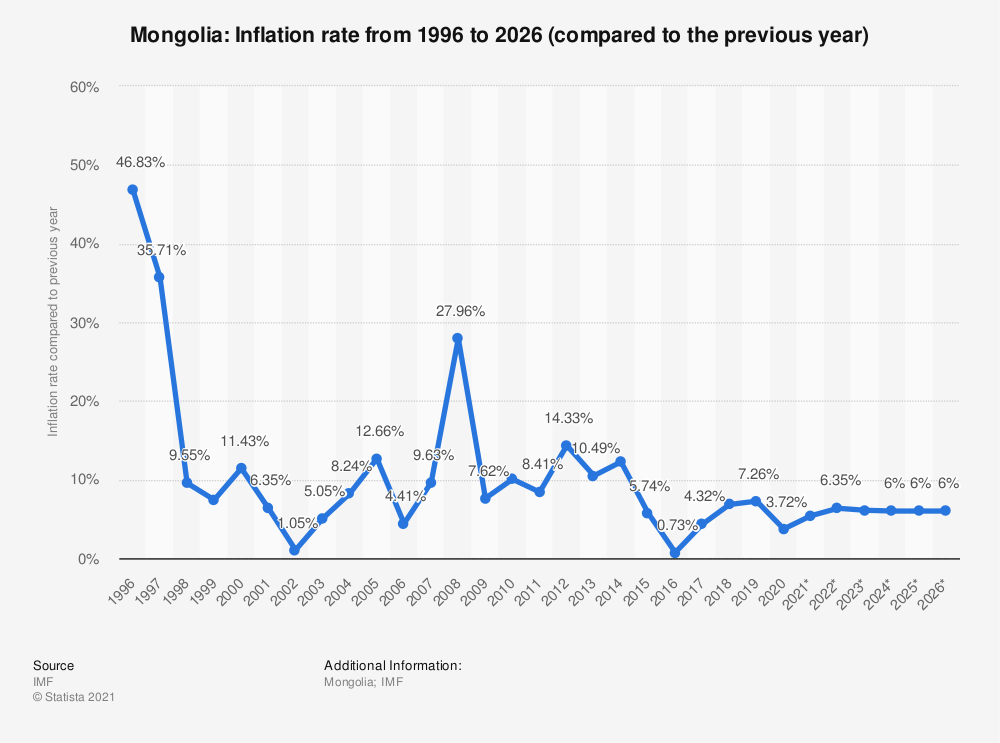
    A dramatic decline in inflation paired with political and economic stabilisation allowed Mongolia to enjoy the fruits of the fast-growing economies of the 2000s. Source: Statista.

    https://www.statista.com/statistics/727562/inflation-rate-in-mongolia/
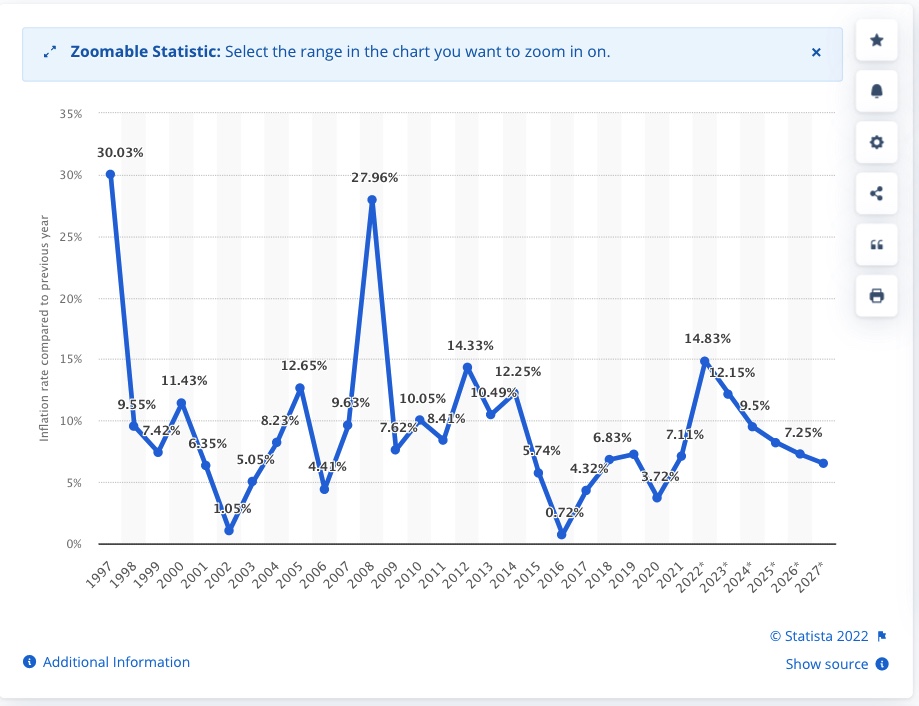
    https://www.statista.com/statistics/727562/inflation-rate-in-mongolia/

    During the last 16 years the financial and monetary system of our country saw the worst crisis in 1991-1994, there was a recovery in 1995-1997 and another crisis in 1997-1999. However, it has entered a stable stage since 2000.

    Mongolia at the Market
    Dedicated to the 60th Anniversary of the School of Economic Studies
    , Editors: Chuluundorzh Khashchuluun, Namsrai Batnasan, Ni︠a︡msu̇rėngiĭn Batnasan, P. Luvsandorzh, LIT Verlag, 2012.

    From the World Bank: 1997: Stabilization at the heart of policy choices
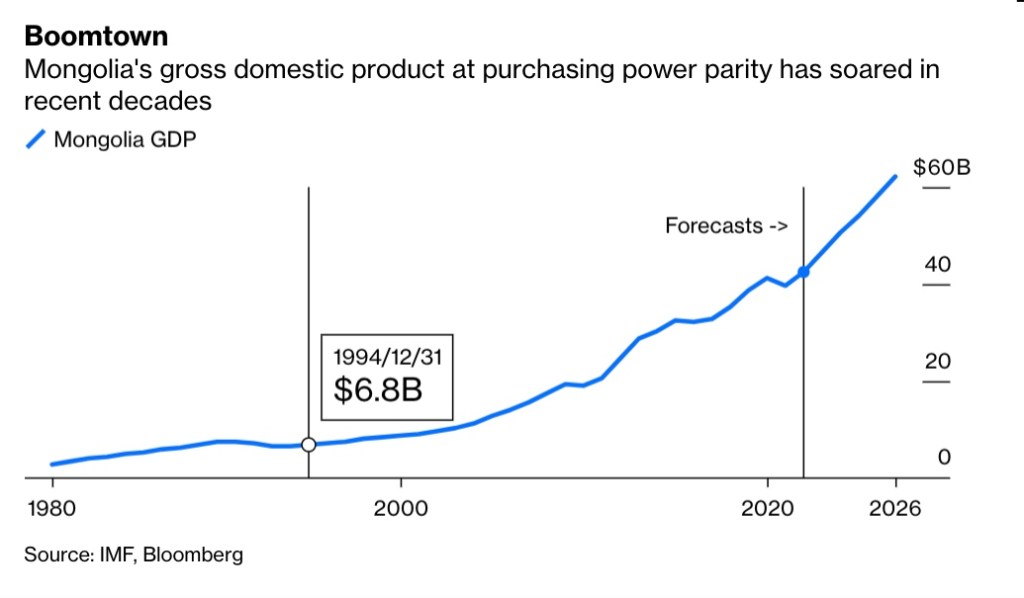
    A resources “boomtown” throughout the 2000s. Source: Bloomberg. When I left in 1999, Mongolia’s PPP was US $8.8 bn; today (2021) it is US $42.4 bn.
    Graph from Migration under economic transition and changing climate in Mongolia, Journal of Arid Environments, Volume 185, February 2021. “Urbanization in Mongolia accounted for over 80% of all migration, mostly into the capital city Ulaanbaatar (UB), where nearly 70% of recent population growth was from migration.”
    As can be seen in this chart, Mongolia’s economic growth since 2000 has benefited greatly from its proximity to China.
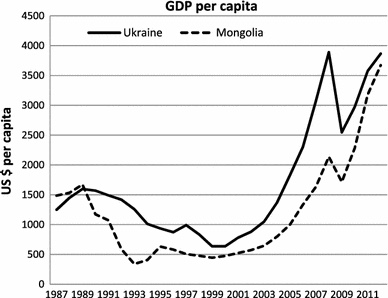
    As this chart shows, increasing connectivity had a profound impact on living standards in Ukraine and Mongolia post-2000. The extreme turbulence Mongolia experienced in the 1990s – after the collapse of support mechanisms from the Soviet Union – calmed down as Mongolia integrated with the global economy, especially a booming China. Read about my work in Ukraine here: UN Ukraine Web Development Experience | 2000.
    The Economist: “Those free-trading Mongolians” was published Apr 24th 1997. I arrived in May of 1997 to find a country on the cusp of great and turbulent change.

    In this role, I pioneered innovative uses of the Internet and digital resources to communicate the UN’s work and Mongolia’s unfolding crises. The UN called this work a “role model” for the wider UN and country offices. A survey of United Nations country office websites in 2000 ranked the UN Mongolia website I launched in 1997 and oversaw for two years (1997-1999), third best in the world, saying: “A UN System site. A very nice, complete, professional site. Lots of information, easily accessible and well laid out. The information is comprehensive and up-to-date. This is a model of what a UNDP CO web site should be.” (http://www.scribd.com/doc/274319690/UNDP-Mongolia-United-Nations-2000-Survey-of-Country-Office-Websites)

    “The years 1998 and 1999 have been volatile ones for Mongolia, with revolving door governments, the assassination of a minister, emerging corruption, a banking scandal, in-fighting within the ruling Democratic Coalition, frequent paralysis within the Parliament, and disputes over the Constitution. Economically, the period was unstable and rife with controversies.” Mongolia in 1998 and 1999: Past, Present, and Future at the New Millennium by Sheldon R. Severinghaus, Asian Survey, Vol. 40, No. 1, A Survey of Asia in 1999 (Jan. – Feb., 2000). pp. 130-139 (Publisher: University of California)

    As part of a strategic plan to raise awareness of Mongolia’s development challenges and to spur action on meeting them, a Communications Office was established for the UN mission in 1997 – a structure that is commonplace in UN missions today. The Office also led on digital communications, marking many firsts, from the first digital photo and video library, the first online magazine, the first web portal, the first online newsletter, and many other firsts. It gathered numerous stories on resilience in a crisis, and documented in data and storytelling the country’s development challenges, while introducing a transparent way of working and communicating unprecedented for the time (the country was still recovering from the state secrecy of its years under Communism), and led on modernizing communications in the country. Acting as a strategic hub, the Communications Office and its dynamic and talented team, were able to leverage the existing budget to spur action on many fronts, including:

    UN/UNDP Mongolia Development Web Portal (www.un-mongolia.mn)

    I launched it in 1997 in the middle of a major crisis, and oversaw its expansion and development for two years. A pioneering digital resource, this award-winning United Nations Mongolia development web portal was singled out by UN headquarters in New York as an example of what a country office website should be like. It featured extensive resources in both Mongolian and English and also was home to the bilingual online magazine, Ger – Mongolia’s first web magazine. It can be viewed at www.archive.org and there is more at Wikipedia here: https://en.wikipedia.org/wiki/Ger_(magazine).

    Media

    Working with journalists and media both within Mongolia and outside, the Communications Office was able to significantly raise awareness of Mongolia and its development challenges. This was reflected in a substantial increase in media coverage of the country and in the numerous books and other publications that emerged post-1997. The book In Their Own Words: Selected Writings by Journalists on Mongolia, 1997-1999 (ISBN 99929-5-043-9) published by UNDP Mongolia archived the stories by theme.  

    Ger Magazine

    Ger Magazine (the Mongolian word for home and traditional tent dwelling) was published as the country’s first e-magazine in 1998. There were four issues in total from 1998 to 2000. The launch issue was on the theme of youth in the transition. Mongolia was transitioning from Communism to free markets and democracy and this had been both an exhilarating time and a wrenching time for young people. The magazine drew on talented journalists from Mongolia and the handful of international journalists based there to create a mix of content, from stories about life adapting to free markets to stories on various aspects of Mongolian culture and life.

    The second issue of the magazine proved particularly effective and inspiring, with its modern life theme and cover story on a thriving Mongolian fashion scene.

    Archived issues of the magazine can be found at the Wayback Machine here: https://archive.org/. Just type in the UN Mongolia website address for the years 1997 to 1999: http://www.un-mongolia.mn.

    An online survey of the state of Mongolia’s media and its history (www.pressreference.com/Ma-No/Mongolia.html), had this to say: “An interesting variation from some of the other publications available is Ger Magazine (published online with guidance from the United Nations Development Program, UNDP), which is concerned with Mongolian youth in cultural transition. The name of the magazine is meant to be ironic because a ger is the Mongolian word for yurt—a yurt being traditional nomadic housing—but the magazine is about urbanization and globalization of Mongolian youth.”

    Blue Sky Bulletin

    The Blue Sky Bulletin newsletter was launched in 1997 initially as a simple, photocopied handout. It quickly founds its purpose and its audience, becoming a key way to communicate what was happening in the country and a crucial resource for the global development community, scholars, the media and anyone trying to figure out what was happening in a crazy and chaotic time. It eschewed the typical ‘grip and grin’ content found in many development newsletters and instead offered stories, data and insights useful to anyone seeking to understand Mongolia’s development challenges. The Blue Sky Bulletin was distributed via email and by post and proved to be a popular and oft-cited resource on the country. The quality of its production also paralleled Mongolia’s growing capacity to publish to international standards, as desktop publishing software became available and printers switched to modern print technologies. The Blue Sky Bulletin evolved from a rough, newsprint black and white publication to becoming a glossy, full-colour, bilingual newsletter distributed around Mongolia and the world. 

    Archived issues can be found online here:

    Blue Sky Bulletin Issue 1

    Blue Sky Bulletin Issue 2

    Blue Sky Bulletin Issue 3

    Blue Sky Bulletin Issue 4 

    Blue Sky Bulletin Issue 5

    Blue Sky Bulletin Issue 6

    Blue Sky Bulletin Issue 7

    Blue Sky Bulletin Issue 8

    Blue Sky Bulletin Issue 9

    Blue Sky Bulletin Issue 10

    Publishing

    MHDR 1997

    The Mongolian Human Development Report 1997 (MHDR), the country’s first, placed the story of the Mongolian people during the transition years (post-1989) at its heart, using photographs, stories and case studies to detail the bigger narrative at play.

    This groundbreaking Mongolian Human Development Report – the country’s first – went beyond just chronicling Mongolia’s state of development in statistics and graphs. Designed, laid out and published in Mongolia, the report broke with the practices of many other international organisations, who would publish outside of Mongolia – denying local companies much-needed work and the opportunity to develop their skills. The report’s costs helped to kick-start a publishing boom in the country and significantly raised standards in design and layout in the Mongolia. The foundations laid down by the project producing the report ushered in a new age in publishing for Mongolia.

    The report’s launch was innovative, not only being distributed for free across the country, but also part of a multimedia campaign including television programming, public posters, town hall meetings and a ‘roadshow’ featuring the report’s researchers and writers.

    The initial print run of 10,000 copies was doubled as demand for the report increased. To the surprise of many, once hearing about the free report, herders would travel to the capital, Ulaanbaatar, to pick up their copy. The report proved people cared passionately about the development of their country and that development concepts are not to be the secret domain of ‘development practitioners’. The report also became an English language learning tool as readers compared the Mongolian and English-language versions.

    You can read the report’s pdf here: http://www.mn.undp.org/content/mongolia/en/home/library/National-Human-Development-Reports/Mongolia-Human-Development-Report-1997.html 
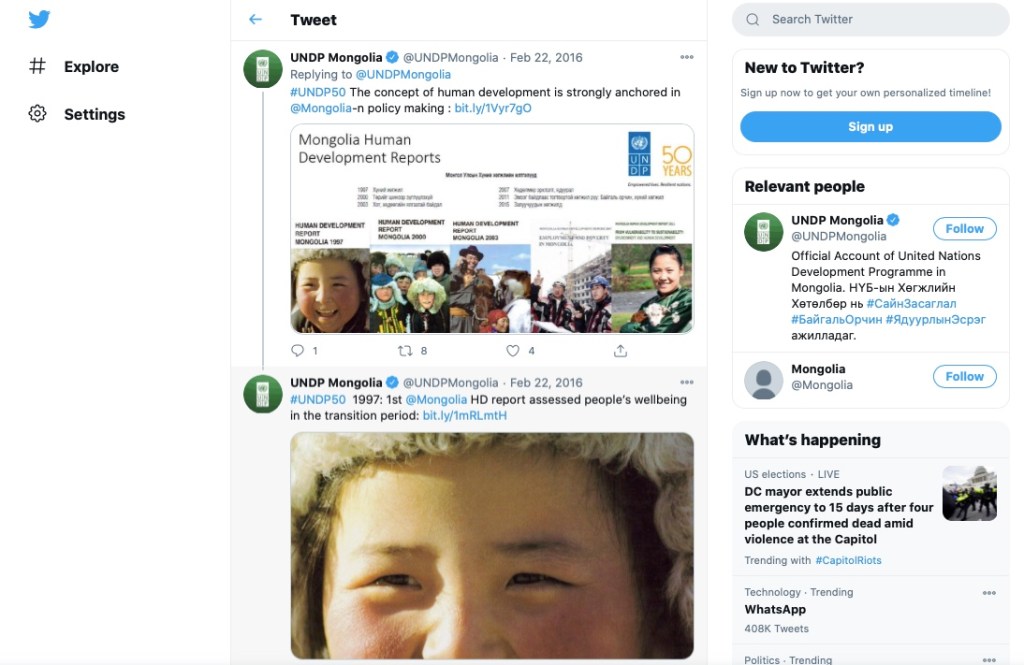
    1997 saw the launch of the first human development report for Mongolia.

    Mongolian AIDS Bulletin

    UNDP acted swiftly to address a breaking HIV/AIDS crisis in 1997, offering a key lesson for others working in public health (the Ebola Crisis and global air pollution crisis both show those lessons have still yet to be fully absorbed).

    Assembled by a team of health experts after the Fourth International Congress on AIDS in Asia and the Pacific, the Mongolian AIDS Bulletin was published in 1997 in the middle of an HIV/AIDS crisis. It provided timely information and health resources in the Mongolian language and was distributed across the country.

    “Mongolia’s first AIDS Bulletin marked the beginning of the UNDP Response to HIV/AIDS/STDs Project back in the autumn of 1997. Over 5,000 copies of the magazine were distributed across the country, offering accurate information on the HIV/AIDS situation. The project has been pivotal in the formulation of a national information, education and communication (IEC) strategy, bringing together NGOs, donors, UN agencies and the government.”

    Source: YouandAids: The HIV/AIDS Portal for Asia Pacific

    Green Book

    In the Mongolian language, the Mongolian Green Book details effective ways to live in harmony with the environment while achieving development goals. Based on three years’ work in Mongolia – a Northeast Asian nation coping with desertification, mining, and climate change – the book presents tested strategies.  

    EPAP Handbook

    The Environmental Public Awareness Handbook was published in 1999 and features the case studies and lessons learned by UNDP’s Mongolian Environmental Public Awareness Programme (EPAP). The handbook draws on the close to 100 small environmental projects the Programme oversaw during a two-year period. These projects stretched across Mongolia, and operated in a time of great upheaval and social, economic and environmental distress. The handbook is intended for training purposes and the practice of public participation in environmental protection.

    In its 2007 Needs Assessment, the Government of Mongolia found the EPAP projects “had a wide impact on limiting many environmental problems. Successful projects such as the Dutch/UNDP funded Environmental Awareness Project (EPAP), which was actually a multitude of small pilot projects (most costing less than $5,000 each) which taught local populations easily and efficiently different ways of living and working that are low-impact on the environment.”

    Mongolia Updates 1997, 1998, 1999

    Mongolia Update 1998 detailed how the country was coping with its hyperinflation and the Asian economic crisis.

    The mission simultaneously had to deal with the 1997 Asian Crisis (http://en.wikipedia.org/wiki/1997_Asian_Financial_Crisis) and the worst peacetime economic collapse in post-WWII history (http://www.jstor.org/pss/153756).  

    Mongolia Update 1998 – Political Changes

    1998 proved a tumultuous year for Mongolia. The country’s existing economic crisis caused by the transition from Communism to free markets was made worse by the wider Asian Crisis. The government was destabilised, leading to an often-confusing revolving door of political figures. In order to help readers better understand the political changes in the country, a special edition of Mongolia Update was published that year.  

    UNDP Mongolia: The Guide

    The Guide, first published in 1997, provided a rolling update on UNDP’s programmes and projects in Mongolia during a turbulent time (1997-1999). The mission simultaneously had to deal with the 1997 Asian Crisis (http://en.wikipedia.org/wiki/1997_Asian_financial_crisis) and the worst peacetime economic collapse in post-WWII history.

    Each edition came with short project and context summaries, key staff contacts, and facts and figures on how the country was changing. For the first time, any member of the public could grasp what the UN was up to in the country and be able to contact the project staff. An unusual level of transparency at the time for a UN mission.

    Memoranda of Understanding

    Three Memoranda of Understanding were negotiated with the Mongolian Government to help focus efforts and aid the attainment of internationally-agreed resolutions. This was affirmed by a series of youth conferences, One World, held in 1998 and 1999.

    Strategy and Leadership in a Crisis

    The scale and gravity of the crisis that struck Mongolia in the early 1990s was only slowly shaken off by the late 1990s. The economic and social crisis brought on by the collapse of Communism and the ending of subsidies and supports from the Soviet Union, led to a sharp rise in job losses, poverty, hunger, and family and community breakdowns.

    The challenge was to find inspiring ways out of the crisis, while building confidence and hope. The sort of challenges confronted by the UNDP Mongolia Communications Office included:

    1) A food crisis: agricultural production was down sharply, and the traditional nomadic herding economy, while at peak herd, was failing to get the meat to markets and to a high enough standard to restore export levels to where they once were. As a result, a cross-border trading frenzy became the solution to falling domestic food production and availability.

    2) HIV/AIDS/STDs crisis.

    3) A major banking crisis.

    4) Both the Asian Financial Crisis and the Russia Crisis.

    5) An ongoing political crisis and an inability to form stable governments.

    UN Annual Reports

    Editor and designer. 1998 Report called by Under-Secretary-General Nafis Sadik “a clear, well-written, attractive and colourful report.”

    One of many documents from that time held in the United Nations Archives Search Engine. In this case, reporting on Mongolia’s follow-up to global conferences to then-Secretary-General Kofi A. Annan in 1999.
    Mongolia’s Follow-Up To The UN Global Conferences (1999) UNDP Mongolia Communications Office, Ulaanbaatar, Mongolia.
    Production/Design Supervision: David South, UNDP Communications Coordinator; Proof Reading: N. Oyuntungalag, UNDP Communications Officer/David South (1999).

    Timeline 

    1997: Arrive in the capital of Mongolia, Ulaanbaatar, to undertake a two-year assignment with the United Nations mission. Quickly get to work founding the UNDP Mongolia Communications Office and pursuing a strategic communications approach with a busy online and offline bilingual publishing programme. Launch award-winning UN Mongolia Development Web Portal (www.un-mongolia.mn). Launch first Human Development Report Mongolia 1997, and a Mongolian AIDS Bulletin during crisis. Assist the Government of Canada to establish the first Honorary Consul in Ulaanbaatar on December 1, 1997 and the Canada Fund Mongolia.

    Canada Fund Mongolia

    1998: International media tours of the country, launching of Mongolia’s first online magazine, Ger, distribute globally a regular newsletter on Mongolia’s development challenges, Blue Sky Bulletin. Open United Nations Info Shop for the public. Assist the Government of Canada to connect with Canadians working with the United Nations in Mongolia during the first official visit by a Canadian Government Minister.

    1999: Launch a string of books documenting insights gleaned from the Mongolia development experience.  

    Testimonials

     “Mongolia is not an easy country to live in and David [South] showed a keen ability to adapt in difficult circumstances. He was sensitive to the local habits and cultures and was highly respected by his Mongolian colleagues. … David’s journalism background served him well in his position as Director of the Communications Unit. … A major accomplishment … was the establishment of the UNDP web site. He had the artistic flare, solid writing talent and organizational skills that made this a success. … we greatly appreciated the talents and contributions of David South to the work of UNDP in Mongolia.” Douglas Gardner, UN Resident Coordinator and UNDP Resident Representative Mongolia

    Impact 

    Micro

    • strategic communications approach including establishing the UN/UNDP Mongolia Communications Office and team and strategic communications plan
    • led on digital transformation, including use of digitial media (photo/video archive) and digital publishing (web site, online magazine and newsletter, etc.)
    • established and ran the United Nations Info Shop – a one-stop resource open to the public with archive of development publications and current periodicals and Internet access
    • began largest bilingual online and offline publishing programme in country – led on publishing and design modernisation
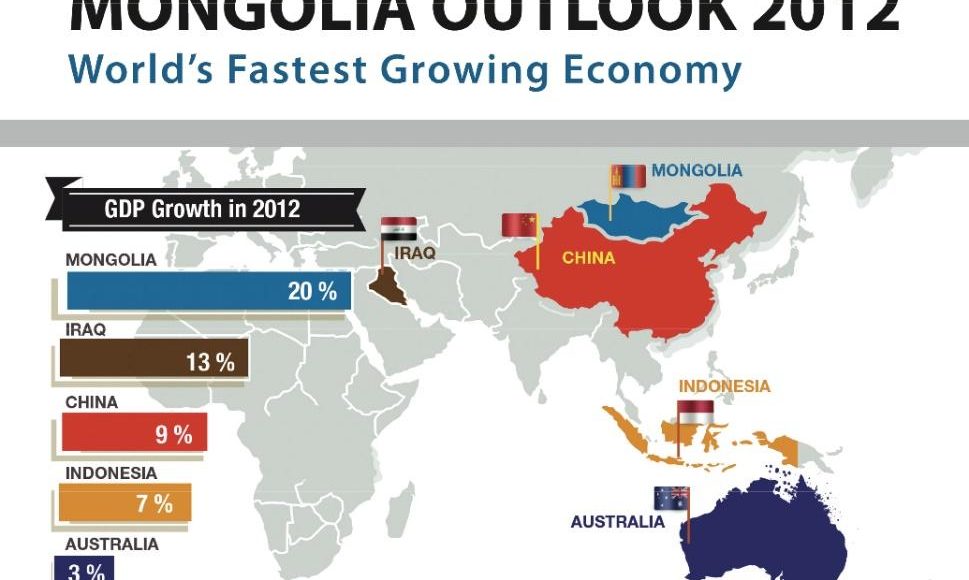
    • laid down the foundations for many UN initiatives in Mongolia that are still underway. Contributed to stabilizing the country in a turbulent time. Mongolia was briefly the fastest-growing economy in the world by 2011
    • championed transparency and access to information and media freedoms
    • oversaw a period in which Transparency International found lower levels of perceived corruption
    • managing editor for country’s first Human Development Report

    Macro

    • raised profile of country and its development challenges. Donor pledges rose 
    • 2 international media tours
    • strong relationship with Mongolian and international journalists
    • championed innovators in commnications
    • crisis response: AIDS, economy, political
    • country’s largest website and one of its first. Called “Godfather of the Mongolian web”
    • called a “role model” for the wider UN
    • led on new approach to UN communications in the digital age
    • design-led approach
    • transparent and timely updates
    • negotiated three Memoranda of Understanding (MOUs): youth, food security and nutrition, STDs/HIV/AIDS
    • One World youth conferences

    Publications

    David South Consulting Summary of Impact

    Environmental Public Awareness Handbook: Case Studies and Lessons Learned in Mongolia

    Ger Magazine: Modern Life Issue

    Ger Magazine: Youth Issue

    Human Development Report Mongolia 1997

    Mongolian Green Book

    Mongolia Update – Coverage of 1998 Political Changes

    Mongolia Update 1998

    Mongolian AIDS Bulletin

    Mongolian Rock and Pop Book

    Partnership for Progress: The United Nations Development Programme in Mongolia

    UNDP Mongolia Online Development Portal

    UNDP in Mongolia: The Guide 

    Stories

    Freedom of Expression: Introducing Investigative Journalism to Local Media in Mongolia

    Lamas Against AIDS

    Philippine Conference Tackles Asia’s AIDS Crisis

    Starting from Scratch: The Challenge of Transition

    UNDP Mongolia Partnership for Progress 1997 to 1999 Key Documents 

    A UNDP Success Story: Grassroots Environmental Campaign Mobilizes Thousands in Mongolia

    Citations

    The response by the UNDP Mongolia Communications Office has been cited in numerous articles, books, publications and stories. It has also contributed to the development of the human development concept and understanding of human resilience in a crisis and innovation in a crisis. 

    Book citations include:

    Dateline Mongolia: An American Journalist in Nomad’s Land by Michael Kohn, RDR Books, 2006

    Modern Mongolia: From Khans to Commissars to Capitalists by Morris Rossabi, University of California Press, 2005

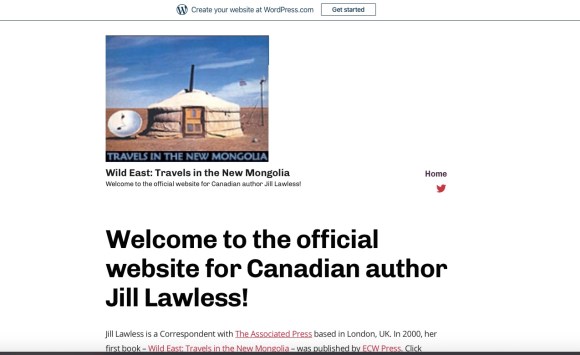
    Wild East: Travels in the New Mongolia by Jill Lawless, ECW Press, 2000

    Paper citations include: 

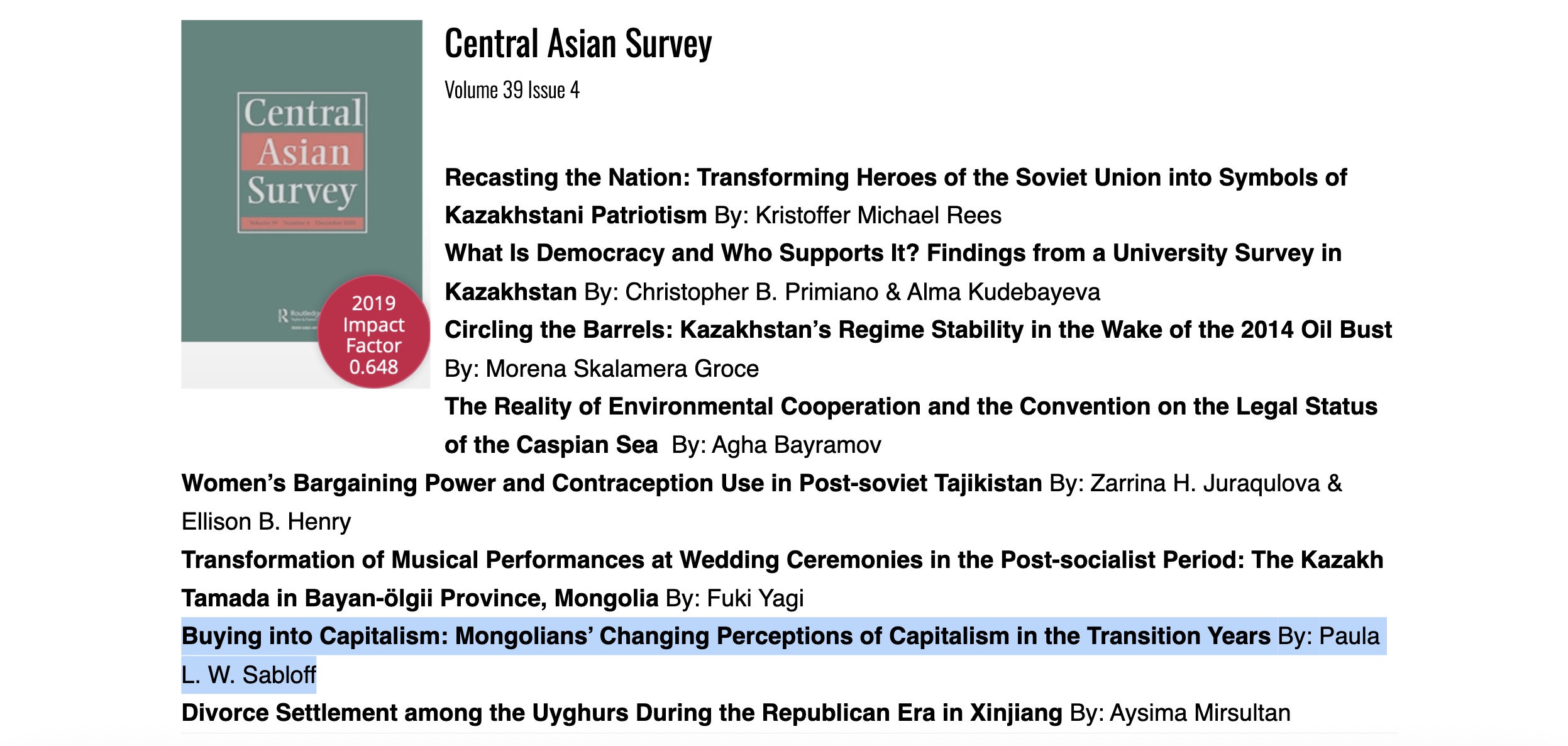
    Paula L. W. Sabloff (2020) Buying into capitalism: Mongolians’ changing perceptions of capitalism in the transition years, Central Asian Survey, 39:4, 556-577, DOI: 10.1080/02634937.2020.1823819

    A more detailed list of citations can be found here: http://www.davidsouthconsulting.com/about/

    For research purposes, key documents were compiled together and published online here: https://books.google.ca/books?id=K76jBgAAQBAJ&dq=undp+mongolia+key+documents&source=gbs_navlinks_s

    This resource was praised for having: “Very useful references and original materials that documented UNDP Mongolia work. I needed to trace community-based development, and this book provided a valuable source.” Review on Google Books

    In 2001, the UN won the Nobel Peace Prize for “their work for a better organized and more peaceful world” and its communications innovations, with work such as that in Mongolia being cited as a contributing factor to the awarding of the Prize.

    The Nobel Peace Prize 2001 joint winners.

    In 2000, the Millennium Development Goals (MDGs) were launched in a 15-year bid to use a focused approach to development centred around eight goals to accelerate improvements to human development. From 2000 to 2005, consulting work was undertaken in various UN missions (Mongolia, South Africa, Turkmenistan, Ukraine) to communicate the goals and to reshape communications activities around the goals.

    Transition and Democracy in Mongolia by Richard Pomfret, Europe-Asia Studies, Vol. 52, No. 1 (Jan., 2000), pp. 149-160, published by Taylor & Francis, Ltd. (http://www.jstor.org/stable/153756?seq=1#page_scan_tab_contents)

    The Milk of Kindness flows in a Peculiar Land A Steppe From Nowhere by Leslie Chang, The Asian Wall Street Journal, 15 August 1998

    Mongolia prepares for a magazine explosion by Jill Lawless, UB Post, 08-09-98

    Other Resources

    Letter from Mongolia: Herding instinct by Jill Lawless, The Guardian, 9 June 1999

    Connect with me on Devex here: https://www.devex.com/people/david-s-361357

    ORCID iD: https://orcid.org/0000-0001-5311-1052.

    © David South Consulting 2025
  • Wild East 17 Years Later | 2000 – 2017

    Wild East 17 Years Later | 2000 – 2017

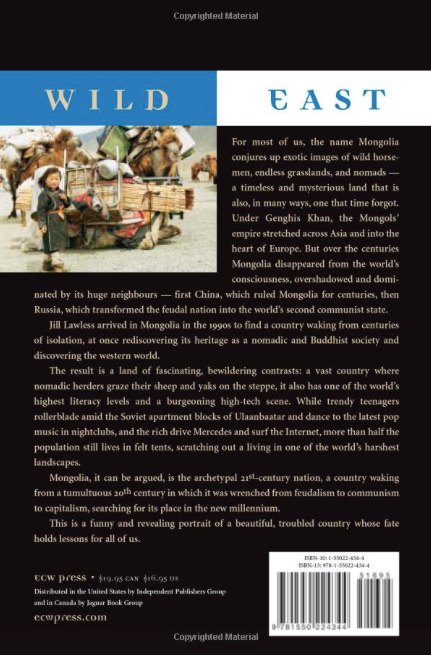
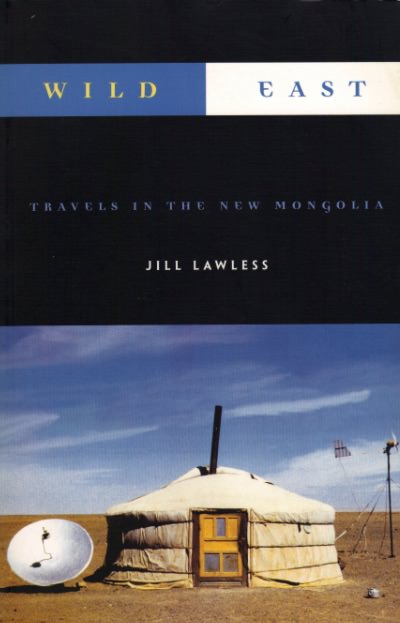
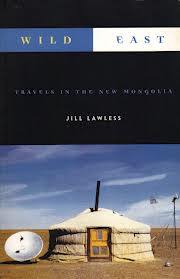
    Published in 2000 (ECW Press: Toronto), Wild East: Travels in the New Mongolia is 17 years old. It is also 100 years since the 1917 October Revolution in Russia that began the long experiment of the Soviet Union. Mongolia was the second country after Russia to adopt Communism.

    “Engaging…a revealing and often amusing account of her journeys through a beautiful country awakening from a tumultuous era.”

    Wild East author and foreign correspondent Jill Lawless.

    “One of the top 10 Canadian travel books of 2000.” The Globe and Mail

    The world has changed considerably since then; and so has Mongolia. The digital revolution has rolled across the planet, the attacks of 9/11 unleashed a wave of violence and wars, and Mongolia even became the fastest-growing economy in the world a few years ago (2012). But back when this book was researched, Mongolia was just coming out of decades of isolation within the Soviet orbit under Communism, and the country experienced in the 1990s “one of the biggest peacetime economic collapses ever” (Mongolia’s Economic Reforms: Background, Content and Prospects, Richard Pomfret, University of Adelaide, 1994). 

    “The years 1998 and 1999 have been volatile ones for Mongolia, with revolving door governments, the assassination of a minister, emerging corruption, a banking scandal, in-fighting within the ruling Democratic Coalition, frequent paralysis within the Parliament, and disputes over the Constitution. Economically, the period was unstable and rife with controversies.” Mongolia in 1998 and 1999: Past, Present, and Future at the New Millennium by Sheldon R. Severinghaus, Asian Survey, Vol. 40, No. 1, A Survey of Asia in 1999 (Jan. – Feb., 2000), pp. 130-139 (Publisher: University of California)

    That collapse made for some crazy times, as Wild East shows. 

    Wild East was called one of the top 10 Canadian travel books of 2000 by The Globe and Mail. 

    Reviews for Wild East: Travels in the New Mongolia by Jill Lawless:

    The Globe and Mail

    “Engaging…a revealing and often amusing account of her journeys through a beautiful country awakening from a tumultuous era.”

    The Georgia Straight, Vancouver

    “This readable and reportorial book is the perfect antidote to … those tiresomely difficult, pointlessly dangerous, and essentially fake expedtions undertaken against the advice of local people who know better.”

    Toronto Star

    “Lawless introduces us to Mongolia’s tabloid press, to teenage mineworkers, sharp-eyed young hustlers, nomads whose only possessions are their livestock, Mongolian wrestlers and Mongolian horse races.”

    Mongolian Buryat Civilisation Bookstore

    “Wryly funny and wide-spectrum account of Mongolia’s tumultuous rebirthing into the 21st century. Half the population lives in Soviet apartment blocks and watches satellite TV but the other half still eek a living from the exquisite, barren hills while living in nomadic felt tents. Of course, I’d much rather be in the tents… but whatever your preference, you will definitely enjoy Ms. Lawless’ writing. She was editor of an Ulaan Baator newspaper for two years, and she tells it like it is. Very highly recommended.”

    Alicia J. Campi in Mongolian Studies

    “Jill Lawless’ book is not a scholarly tome per se, yet it is of definite value to the contemporary Mongolian scholar … Lawless’ period is 1997-1999, the heart of the tumultuous and ill-spent years of Democratic Coalition Government… a period of great hopes for democratic flowering and free market enterprise leading the nation to prosperity and progress.” 

    Join the conversation about Wild East: Travels in the New Mongolia at goodreads and post reviews: https://www.goodreads.com/book/show/773080.Wild_East

    Read a story by Jill in The Guardian (9 June 1999): Letter from Mongolia | Herding instinct .

    Copies of Wild East: Travels in the New Mongolia by Jill Lawless are still available in various editions and languages.
    A promotional poster for Wild East from 2003.

    Explore further Jill Lawless’ work here: https://muckrack.com/jilllawless

    UK edition (Summersdale Travel: 2002). Front cover images © David South and Liz Lawless.

    The New York Post called Wild East: Travels in the New Mongolia “harrowing, hilarious” (April 26, 2016).
    New brand sites for Jill Lawless and Wild East on the way for 2021.
    “This is a good, fun book about life in Mongolia. … it’s an interesting and often amusing series of stories loosely connected.”

    On the difference between Wild East: Travels in the New Mongolia and other travel writing on contemporary Mongolia: 

    “Others sent me Jill Lawless’s Wild East: The New Mongolia, a compilation of pieces she wrote when she was editor of Mongolia’s English-language newspaper, the UB Post, during Mongolia’s transition from a socialist people’s republic to young democracy. With the wind shaking the frame of my ger, I lit the stove and read what these and other writers claimed to have found just outside my flapping felt walls.

    “By the time veteran journalist Jasper Becker’s Mongolia: Travels in an Untamed Land arrived, I had put aside books written since Mongolia opened up to the West in the early 1990s. Most Western travellers and writers discovered the same sights from the back of a borrowed horse. Only Lawless had investigated the place over time on its own terms. The others, full of pith and vinegar and a standard set of assumptions about what they would find, built books on flights of fancy – golfing across Mongolia, following the path of medieval monks, ‘rediscovering shamanism’ – that were flimsier even than those that had set me in motion. The books were as exciting as museum diorama, papier-mâché models of their ‘medieval’ travels and capitalist fantasies.” Three Years in Mongolia: Trying to be a Travel Writer, Luke Meinzen, Kill Your Darlings, 10 April 2012

    “I put Becker away and pulled out Wild East by Jill Lawless. She was heaps better than Becker, which wasn’t hard.” MÖRÖN TO MÖRÖNTwo Men, Two Bikes, One Mongolian Misadventure, Tom Doig, Allen & Unwin, 2013

    “In the early 2000s, Canadian journalist Jill Lawless accepted a correspondent position at a news outlet in the remote and isolated foreign capital of Ulaanbaatar, Mongolia. At that time, Mongolia’s media was newly privatized from beneath Communist oversight, and her role was as much a consultant for how to run a newspaper under freedom of the press, as she was a journalist with the UB Post.

    Lawless was in Mongolia during a time of exciting political and cultural transition. Wild East is less of a travel memoir, but rather essays and shorter narratives of creative non-fiction that describe her adventures in reporting. Even so, it provides a compelling narrative into the historical moment when Mongolia dropped its isolation and began to connect to China and Europe on its journey toward modernization.” Three Works of Travel Writing to Ignite Your Imagination (while we patiently wait for the pandemic to run its course), Barefoot Journey with Amanda, 10 Nov 2020.

    Creative Commons License

    This work is licensed under a
    Creative Commons Attribution-Noncommercial-No Derivative Works 3.0 License.

    ORCID iD: https://orcid.org/0000-0001-5311-1052.

    © David South Consulting 2022

  • “Buying into capitalism”

    “Buying into capitalism”

    Buying into capitalism: Mongolians’ changing perceptions of capitalism in the transition years by Paula L. W. Sabloff (12 Oct 2020).

    It was a pleasure to have the opportunity to comment on a draft of Buying into capitalism: Mongolians’ changing perceptions of capitalism in the transition years by External Professor Emeritus Paula L. W. Sabloff from the Santa Fe Institute (12 Oct 2020: Central Asian Survey). 

    “A political anthropologist, she uses complex-systems tools to analyze three different databases: Mongolians’ changing ideas on democracy and capitalism, the emergence of early states all over the world, and 19-20th century Cozumel.”

    The Santa Fe Institute “is the world’s leading research center for complex systems science.”

    Paula L. W. Sabloff (2020) Buying into capitalism: Mongolians’ changing perceptions of capitalism in the transition years, Central Asian Survey, 39:4, 556-577, DOI: 10.1080/02634937.2020.1823819.

    ORCID iD: https://orcid.org/0000-0001-5311-1052.

    © David South Consulting 2024

  • Casino Calamity: One Gambling Guru Thinks The Province Is Going Too Far

    Casino Calamity: One Gambling Guru Thinks The Province Is Going Too Far

    By David South

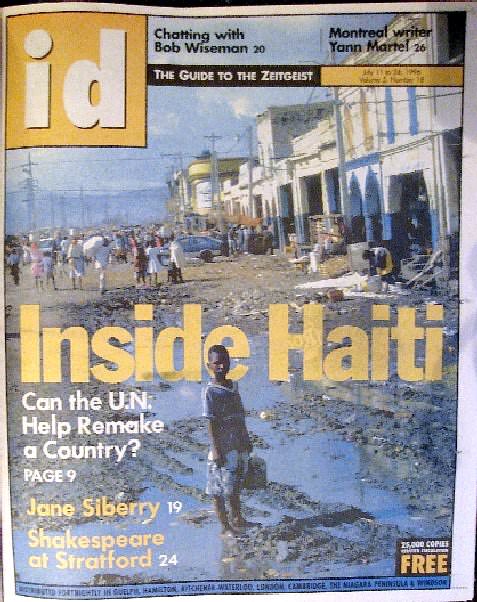
    Id Magazine (Canada), May 16-29, 1996

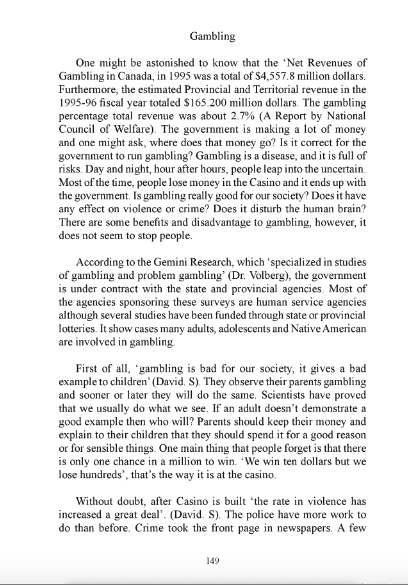
    Will Ontario become saturated with gambling? It is a question being asked more and more as the provincial government moves to allow unprecedented choice for gamblers.

    Bars and hotels will soon have video one-armed bandits (known as video lottery terminals and slammed by the Addiction Research Foundation as video crack) and permanent charity casinos will be set up throughout the province.

    Finance minister Ernie Eves’ budget may have brought joy to the hearts of the province’s gambling fanatics, but whether this is sound economic policy is less certain. Eves hopes to reap $60 million this year from the VLTs, or fruit machines.

    Speaking to id under anonymity due to the sensitivity of his work, a private gambling consultant to the provincial government says the extended gambling could monkey-wrench the government’s on-going plans to build casinos to attract American tourists.

    He says, “There is a maximum to any market area, to the number of people who will come. In Ontario, the idea was to have monopoly markets to create jobs and revenue for government. Spreading casinos out on the border areas would maximize jobs. But the introduction of VLT machines and permanent charity casinos means there will be a narrowing of the market. As soon as you set up the VLTs, there will be a permanent impact.”

    He believes littering the province with casinos – both large and small – and VLTs, will be the equivalent of pissing in the wind for the government, arguing tourists will only be attracted to Ontario casinos if they consist of only a few, flashy must-see attractions based on the Las Vegas model.

    Tourist temptation

    The focus on tourists is key. Research has shown that gambling aimed at residents living near casinos can actually harm other local businesses like restaurants and movie theatres, as people spend more of their entertainment budgets on gambling. Add to this equation the fact that most of the profits go out of the community to Queen’s Park, and a casino can hurt local economies.

    Knowing this, the government has instead focused on attracting tourists. In the case of the Windsor casino, it has worked – 80 per cent of gamblers there come from the US. The economic equation is simple: every dollar sucked in by the casino is a net gain for Canada that doesn’t hurt any other Canadian businesses (as for Detroit, that is anther story).

    If the government keeps on its current course, Ontario could have 10 working government-owned casinos in the near future. By year’s end, the Windsor casino will be joined by Niagara Falls and the Rama First Nations casino near Orillia.

    According to Anne Rappe of the government-owned Ontario Casino Corporation public outrage could change plans. “The government has been clear in its commitment to letting voters voice their view on casinos for other sites.”

    Just a fad

    Governments, like people, follow fads. The trend towards harder forms of gambling, like casinos and VLTs, as opposed to softer gambling like lotteries, represents a desperate move by local governments to hang on to tax revenues.

    Even more than flashy schemes to build theme parks, art galleries and museums, casinos are seen as a sure-fire way to revive ailing communities by attracting tourists. Throughout North America, consultants and casino companies are telling government to turn to gambling if they hope to boost public treasuries and generate jobs. The pitch in these hard economic times goes down a treat with governments beseiged by voters to, on the one hand, reduce debt and deficits, and on the other be seen to be creating economic opportunity in the age of downsizing.

    Casinos also serve another purpose. While taxes seem punitive, making money off of gamblers appears on the surface to be a win-win situation. The government gets the money it wants,while gamblers get the adrenaline rush they crave, and maybe some cash. The whole arrangement seems to be victimless – if you want to gamble, you pay the price.

    For their part, gambling advocates envision Ontario as a Mecca for American gamblers chasing our low dollar, low crime, no tax casinos. They say we can have it both ways: a safe, low-crime Ontario in which islands of gambling fever suck in much-needed American dollars to prop up the provincial government treasury.

    Gambling has been legal in Canada since 1969 (though the oldest casino is the gold rush-era Diamond Gerties in Dawson City, Yukon), but it wasn’t until the New Democrat government of Bob Rae that the idea of government-run or sanctioned permanent casinos became an option in Ontario.

    The gambling consultant says the appeal of casinos is that they offer a sure-fire anchor to a local economy. He criticizes other developments like theme parks for being “too risky.” To make the most money, he says, casinos should avoid any pretensions to be slick, high-society affairs and instead go after the folks with “the family restaurant-style dress code.”

    While the casino in Windsor is a lucrative success for the government – taking in a “win” of $500 million – local businesses have yet to report any of that money coming their way. Gambling experts say that isn’t about to change. With $400 million going directly to the government, and the rest covering expenses and the management fee paid to an American consortium running the casino, there will be little left for anyone else.

    The Windsor casino is also drawing criticism for being a social parasite on Detroit, which supplies 80 per cent of the casino users. The influx of $1 million into Windsor means between 2,000 and 3,000 jobs are lost in Detroit, according to gambling expert William Thompson of the University of Nevada. Because of this, it is believed Detroit will soon set up a casino if voters say so.

    A 1993 Coopers and Lybrand study commissioned by the government estimated Windsor’s win would be reduced by 60 per cent if Detroit were to open a casino.

    That same study strangely found comfort in its findings that the average “pathological gambler” is male, under 30, non-Caucasian, unmarried and without a high school diploma.

    It then goes on to say, “The typical US casino gaming patron earns thirty per cent more than the average of the US population, is between the ages of 40-64, is college educated and lives in a household of two or more members.” Just the kind of market that sends corporations into ecstasy.

    Quebec example

    The Quebec experience offers some valuable lessons for Ontario. Quebec’s three casinos were also looking to be a success until recently. The Quebec government and gambling advocates maintained the casinos (located in Montreal, Pointe-au-Pic and Ottawa’s sin-bin, Hull) were squeaky clean. Just like in Ontario, they remarked upon the impressive revenues – $1 million a day – and the huge influx of tourists. But closer scrutiny reveals the three casinos have not come without a cost.

    Both Montreal and Pointe-au-Pic casinos have been criticized for preying on poor locals who spend the pittance out of their entertainment budgets on gambling. The casinos have also been involved in high-profile drug busts, money laundering scams and even murders committed by gambling addicts trying to extort money from relatives. At the Montreal casino, enterprising youth gangs targeted winners as they left the casino when it closed at three am. The robberies worked like this: A confidant would spot winners in the casino and then use a cellphone to tell accomplices waiting outside to mug the unsuspecting “lucky” ones still intoxicated by their good fortune.

    All the rosy projections about casinos reviving the Ontario economy are based on several key assumptions: Americans will be the main users of the casinos, casinos in Ontario will not compete with each other or other sectors of the economy (restaurants, movie theatres, etc.), the social costs will be low and crime will not increase significantly, and most importantly, American casinos won’t lure away gamblers.

    As for the gambling consultant, he doesn’t think the casinos slated to open later this year in Niagara Falls will drag the city down any farther. “Niagara Falls isn’t the nicest place now. The casino will finally give an economic reason to upgrade these places (hotels, motels and restaurants).”

    And while the Niagara Falls casino will most certainly be popular, it will not be able to operate free of competition for long. Across the Rainbow Bridge at Niagara Falls, New York, preparations are being made to open a casino by 1997.

    Windsor will also face competition from the American side. Voters in the state of Michigan will be asked to vote on whether to allow casinos at the next state elections. Several groups, including a local Indian band, have been pushing for a casino to be located in downtown Detroit. Canadian casinos must also compete with river boats from Illinois and Indiana.

    The government has reached a watershed in its gambling policy, leaving it with few choices. It can either allow unfettered growth in casinos as more and more communities scramble to find any means necessary to generate jobs and tax revenues, or it can recognize there is a limit to gambling as a solution to economic woes.

    As the source says, “The government is in a quandry: they like the revenue but hate the way it is raised.”

    Id Magazine was published in the mid to late 1990s in Canada.

    https://davidsouthconsulting.org/2021/07/20/case-study-3-id-magazine-1996-1997-2/

    Citations

    Story cited in Schizophrenia: A Patient’s Perspective by Abu Sayed Zahiduzzaman (Author House), 2013. 

    https://davidsouthconsulting.org/2020/11/17/land-of-the-free-home-of-the-bored/

    https://davidsouthconsulting.org/2020/12/22/man-out-of-time-the-world-once-turned-on-the-ideas-of-this-guelph-grad-but-does-the-economist-john-kenneth-galbraith-know-the-way-forward/

    https://davidsouthconsulting.org/2022/06/24/professor-puts-chronic-fatigue-into-historical-perspective/

    https://davidsouthconsulting.org/2021/03/17/province-for-sale-step-right-up-for-an-opportunity-to-buy-what-you-already-paid-for/

    https://davidsouthconsulting.org/2020/06/14/psychiatric-care-lacking-for-institutionalised-seniors/

    https://davidsouthconsulting.org/2021/01/20/pulling-the-plug-on-hate-rock-1996/

    https://davidsouthconsulting.org/2021/01/16/redneck-renaissance-a-coterie-of-journalists-turn-cracker-culture-into-a-leisure-lifestyle/

    https://davidsouthconsulting.org/2021/01/14/from-special-report-sexual-dealing-todays-sex-toys-are-credit-cards-cash-a-report-on-the-sex-for-money-revolution/

    https://davidsouthconsulting.org/2020/04/22/state-of-decay-haiti-turns-to-free-market-economics-and-the-un-to-save-itself/

    https://davidsouthconsulting.org/2021/02/03/swing-shift-sexual-liberation-is-back-in-style/

    https://davidsouthconsulting.org/2022/08/13/truckus-maximus-the-big-boys-with-the-big-toys-do-some-hardcore-pogo-at-monster-truck-show/

    https://davidsouthconsulting.org/2020/12/11/tvs-moral-guide-in-question-again/

    https://davidsouthconsulting.org/2021/09/13/will-niagara-falls-become-the-northern-vegas/

    Creative Commons License

    This work is licensed under a
    Creative Commons Attribution-Noncommercial-No Derivative Works 3.0 License.

    ORCID iD: https://orcid.org/0000-0001-5311-1052.

    © David South Consulting 2023