Categories
Archive Development Challenges, South-South Solutions Newsletters

Poorest Countries Being Harmed by Euro Currency Crisis

By David SouthDevelopment Challenges, South-South Solutions

SOUTH-SOUTH CASE STUDY

The ongoing economic crisis in Europe is forecast to harm the economies of the world’s poorest countries if it continues, according to a study by the United Kingdom’s Overseas Development Institute (ODI) (odi.org.uk).

As an example, Kenya’s shilling currency has weakened and increased the cost of imports, leading to a surge in inflation, while the number of European tourists has declined, according to Business Daily.

Raging since 2009 (http://www.bbc.co.uk/news/business-13856580), the eurozone crisis has seen several European countries struggling to pay debts built up during the boom years, and this has threatened the currency compact among countries that use the euro single currency (http://www.ecb.europa.eu/euro/html/index.en.html). Several countries have introduced harsh austerity measures to try and rein in the debts and stabilize economies while keeping countries within the eurozone.

This has had the consequence of dramatically raising unemployment levels, reducing consumption of goods and services and increasing poverty rates in many European countries. Some governments have responded by reducing the amount of legal labour migration allowed into their countries.

The study estimates that the euro crisis could amount to a loss of US $238 billion for poorer countries from 2012 to 2013 as aid, trade, investment and remittance payments sent home to relatives and friends are damaged by the crisis.

This would particularly harm export-dependent, emerging-market countries. The study found demand was weakening for products from low and low-to-middle income countries. This would in turn harm growth in these countries. Growth in the past decade has helped many countries lift millions of people out of poverty and enabled the growth of new middle classes, who in turn use their rising incomes to purchase consumer goods and invest.

The crisis will cause developing countries’ currencies to drop in value if they are pegged to the euro, and for countries to be economically harmed because of austerity policies in European countries, said the study’s author, Dr. Isabella Massa.

“The EU remains the largest single export market for poorer countries, although it is the emerging BRIC economies which are their main source of imports.”

The European Union (EU) (http://europa.eu/index_en.htm) is the biggest market in the world and the largest importer of goods from developing countries. The ODI report found a 1 per cent drop in global export demand has the knock-on affect of reducing growth in poor countries by 0.5 per cent. The countries most at risk from the crisis are Mozambique, Kenya, Niger, Cameroon, Cape Verde and Paraguay.

For example, 17 per cent of Ivory Coast’s exports go to the EU. Mozambique sends 14 per cent of its exports to the EU and Nigeria sends 10 per cent.

Tajikistan in Central Asia was the most highly dependent economy on remittance payments from its workers living outside the country to prop up its GDP (gross domestic product). Remittance payments from Tajik citizens outside the country made up 40 per cent of GDP.

Liberia and the Democratic Republic of Congo were both heavily dependent on foreign direct investment (FDI) from Europe in 2010.

Many countries have also grown used to strong demand for their resources in recent years as China has rapidly developed and urbanized, sucking in more and more resources from around the world, including sub-Saharan Africa.

“Poor countries are vulnerable to the euro crisis not only because of their exposure (due to dependence on trade flows, remittances, private capital flows and aid) but also because of their weaker resilience compared to 2007, before the onset of the global financial crisis,” said Massa.

“The ability of developing countries to respond to the shock waves emanating from the euro area crisis is likely to be constrained if international finance dries up and global conditions deteriorate sharply.

“The escalation of the euro crisis and the fact that growth rates in emerging BRIC economies, which have been the engine of the global recovery after the 2008-9 financial crisis, are now slowing down make the current situation really worrying for developing countries.”

Despite the gloom, there are many positive and powerful antidotes to this economic crisis, including rising South-South trade and innovation, which shows it is possible to reduce dependency on wealthy-developed countries alone for economic prosperity.

Published: September 2013

Resources

1) UNRISD: United Nations Research Institute for Social Development: The United Nations Research Institute for Social Development (UNRISD) is an autonomous research institute within the UN system that undertakes multidisciplinary research and policy analysis on the social dimensions of contemporary development issues. Website: unrisd.org/

2) The Global Urbanist: News and analysis of cities around the world: planning, governance, economy, communities, environment, international. Website: globalurbanist.com

3) OECD: The global economic crisis is entering a new phase amid signs of a return to positive growth in many countries. But unemployment is likely to remain high and much still needs to be done to underpin a durable recovery. This website will track the recovery. Website: http://www.oecd.org/general/tacklingthecrisisastrategicresponse.htm

4) African Union: This vision of a new,  forward looking, dynamic and integrated Africa will be fully realized through relentless struggle on several fronts and as a long-term endeavor. The African Union has shifted focus from supporting liberation movements in the erstwhile African territories under colonialism and apartheid, as envisaged by the OAU since 1963 and the Constitutive Act, to an organization spear-heading Africa’s development and integration. Website: http://www.au.int/en/

5) Youth-Inclusive Financial Services (YFS-Link) Program website: The first space for financial services providers (FSPs) and youth-service organizations (YSOs) to gather, learn and share about youth-inclusive financial services. Website: http://www.makingcents.com/ourWork/yfsLink.php

6) Triple Crisis Blog: Global Perspectives on Finance, Development and Environment: Website: http://triplecrisis.com/

7) African Economic Outlook: A unique online tool that puts rigorous economic data, information and research on Africa at your fingertips. A few clicks gives access to comprehensive analyses of African economies, placed in their social and political contexts. This is the only place where African countries are examined through a common analytical framework, allowing you to compare economic prospects at the regional, sub-regional and country levels. Website: africaneconomicoutlook.org/en

Creative Commons License

This work is licensed under a
Creative Commons Attribution-Noncommercial-No Derivative Works 3.0 License.

ORCID iD: https://orcid.org/0000-0001-5311-1052.

© David South Consulting 2023

Categories
Archive Development Challenges, South-South Solutions Newsletters Southern Innovator magazine

Solar Bottle Bulbs Light Up Dark Homes

By David SouthDevelopment Challenges, South-South Solutions

SOUTH-SOUTH CASE STUDY

Finding ways to generate low-cost or free light has captured the imagination of innovators across the global South. The desire for light is strong: Light gives an immediate boost to income-making opportunities and quality of life when the sun goes down or in dark homes with few windows.

More than 1.7 billion people around the world have no domestic electricity supply, of whom more than 500 million live in sub-Saharan Africa (World Bank). Without a source of electricity, it is difficult to use conventional technology to switch the lights on.

While it is possible to run lights using batteries or diesel generators, these are expensive options that are not possible for many poor people. The more of a slim income that is spent on light, heat or cooking fuel, the less there is left for better-quality food, clothing, transport or education and skills development.

Low-cost light is great, but free light is even better – and one Brazilian solution is offering this.

Brazilian innovator and mechanic Alfredo Moser has taken the common plastic water bottle and created a low-cost lighting solution for dark spaces. Often makeshift homes lack decent lighting or a good design that lets the light in during the day. This means it may be a bright, sunny day outside, but inside the home or workplace, it is very dark and reading or working is difficult.

Moser came upon the idea during regular blackouts in his home city of Uberaba (http://www.uberaba.mg.gov.br/portal/principal) in southern Brazil during 2002. During the blackouts, only factories were able to get electricity, leaving the rest of the population in the dark.

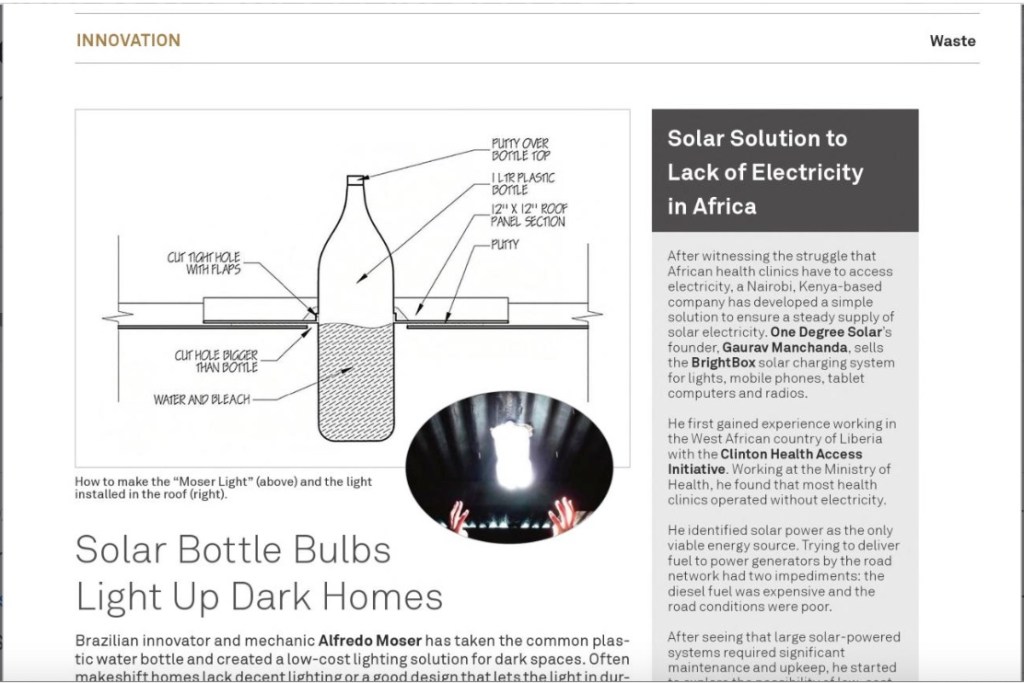
The “Moser Light” involves taking plastic bottles, which are usually just thrown away or recycled, and filling them with water and bleach to draw on a basic physical phenomenon: the refraction of sunlight when it passes through a water-based medium.

It is a simple idea: Holes are drilled in the ceiling of a room and the bottles placed in the holes. The liquid-filled bottle amplifies the existing sunlight (or even moonlight) and projects it into the dark room. This turns the plastic bottle into a very bright lightbulb that does not require any electricity.

Moser uses a solution of two capfuls of bleach added to the water to prevent anything growing in the water such as algae because of the exposure to sunlight.

“The cleaner the bottle, the better,” he said.

Polyester resin is used to seal the hole around the plastic bottle and make it watertight from rain.

Moser claims his bottle innovation can produce between 40 and 60 watts of light.

Moser uses recycled plastic bottles, so the carbon footprint is minimal compared to the manufacture of one incandescent bulb, which takes 0.45 kilograms of CO2 (UN). Running a 50 Watt incandescent light bulb for 14 hours a day for a year, around the same light as produced by the bottle bulb, produces a carbon footprint of nearly 200 kilograms of CO2.

“There was one man who installed the lights and within a month he had saved enough to pay for the essential things for his child, who was about to be born. Can you imagine?” Moser told the BBC.

The plan is to try and get as many as a million homes fitted with the lighting system by the end of 2013.

In many poor areas, it is common to live in makeshift or rudimentary dwellings. These are often built to crude designs and, in order to keep costs down and boost security, will have few or no windows. These dwellings will consequently be very dark inside, even on the brightest days. This leaves people having to turn to a source of artificial light if they want to do something indoors like read or work. And this costs money. Be it electricity from a mains, or battery-powered lamps or gas-powered lanterns, the cost will eat into a person’s tight income. This is where Moser’s simple solution saves the day and saves pennies: it is free light once the bottle lamp system is installed.

Placing the bottle lights in the ceiling transforms the ceiling into something akin to the night sky, with many points of light shining down into the room like stars. It also means the occupant of the room does not just have to strain to see with the use of a single light but now has many lights illuminating the room from all angles.

“It’s a divine light,” Moser told the BBC World Service. “God gave the sun to everyone, and light is for everyone. Whoever wants it saves money. You can’t get an electric shock from it, and it doesn’t cost a penny.”

It has not been a road to riches for Moser. He has made some money installing the system in a local supermarket and nearby homes, and he has inspired a charity to install the lighting system and to train people to do the installation and make an income from it.

The MyShelter Foundation in the Philippines was inspired by Moser’s invention and has installed the system in some 140,000 homes there, the BBC reported.

“We want him to know that there are a great number of people who admire what he is doing,” MyShelter Executive Director Illac Angelo Diaz said of Moser.

Using bottle bulbs instead of electricity or generators means families can save US $6 per month, according to Diaz (CNN). The Philippines is reported to have the most expensive electricity in Asia and slum homes usually do not have electricity.

It is estimated 15 other countries also have homes using the Moser system. The MyShelter Foundation believes 1 million homes worldwide have used the Moser system as of 2013.

Liter of Light (http://aliteroflight.org), run by the MyShelter Foundation, offers instructions on how to install the lighting system on its website.

Published: September 2013

Resources

1) D-Lab: MIT: Development through Dialogue, Design and Dissemination: D-Lab is building a global network of innovators to design and disseminate technologies that meaningfully improve the lives of people living in poverty. The program’s mission is pursued through interdisciplinary courses, technology development, and community initiatives, all of which emphasize experiential learning, real-world projects, community-led development, and scalability. Website: http://d-lab.mit.edu/

2) d.light Solar: d.light is a for-profit social enterprise whose purpose is to create new freedoms for customers without access to reliable power so they can enjoy a brighter future. d.light design manufacture and distribute solar light and power products throughout the developing world. Website: http://www.dlightdesign.com/

3) Liter of Light:  It brings the eco-friendly bottle light to communities living without electricity. Website: http://aliteroflight.org

4) Solar Sister: Solar Sister eradicates energy poverty by empowering women with economic opportunity.  They combine the breakthrough potential of solar technology with a deliberately woman-centered direct sales network to bring light, hope and opportunity to even the most remote communities in rural Africa. Website: http://www.solarsister.org/

Creative Commons License

This work is licensed under a
Creative Commons Attribution-Noncommercial-No Derivative Works 3.0 License.

ORCID iD: https://orcid.org/0000-0001-5311-1052.

© David South Consulting 2023
Categories
Archive Blogroll data Development Challenges, South-South Solutions Newsletters

Affordable Space Programmes Becoming Part Of South’s Development

By David SouthDevelopment Challenges, South-South Solutions

SOUTH-SOUTH CASE STUDY

Space: the final frontier. At least that was how heading off into the stars was portrayed in cult television and film series Star Trek. While many countries are working to raise living standards and eradicate poverty on earth, some are also looking to space for solutions to earth-bound problems.

Traditional space programmes were government-led and state-financed. They involved enormous armies of technicians, engineers and scientists. Each launch and mission had to be overseen by a vast mission control centre with row upon row of technicians watching computer screens in real time. Space technology advanced rapidly in the 1950s and 1960s with so many bright brains hard at work and with brave people willing to put their lives at risk, leading to humans walking on the surface of the moon in 1969.

All of this expensive expertise meant few governments had the resources to set up space programmes – and it was even out of the hands of most of the private sector. In time, these leviathan space efforts lost the financial support of governments and the pace of new developments and achievements slowed. Nobody has set foot on the moon in 40 years – or on any other planet, for that matter.

But various developments are changing the space scene today and promising a bright future and a return to rapid innovation.

Space programmes are playing a greater role in the economic and innovation strategies of countries in the global South. New technologies and trends are turning space exploration into more affordable, small-scale operations within the reach of many countries.

New information technologies and innovations in miniaturization mean satellites can be very small and light. These developments bring down costs considerably, and also reduce the number of people needed to monitor space missions.

For example, on 14 September 2013 Japan’s space agency, JAXA, proved a slimmed-down space launch can work when it fired off its Epsilon rocket with a small satellite onboard. What made this mission different was how little it took to monitor the mission: just two laptop computers  and a small team of eight people. Previously, similar missions required a team of 150 people.

Fewer people meant the launch was much cheaper. One of the reasons for having many people involved in the launch of a rocket is the need to perform multiple systems checks to make sure the launch is successful. The Epsilon is a “smart” rocket and saves on the need for people to micro-manage the launch procedures by having its own on-board computer with artificial intelligence (AI) capable of doing the laborious checklists before launch.

Billing itself as “The first Latin American space development company,” Colombia’s Sequoia Space (sequoiaspace.com) was established in 2008 to build miniature satellites (called nano or pico satellites) that are affordable to countries in the global South.

Located in Bogota’s trendy neighbourhood of Chapinero, Sequoia has set itself up to exploit the technological trend towards making things smaller and smaller.

The firm manufactures satellites that range in size from 1.3 kilograms to 16 kilograms and are custom built for the customer’s needs. One satellite it is working on for the Colombian air force weighs 4.5 kilograms. It can make satellites to conduct missions in earth observation, remote sensing, micro-gravity experiments and other scientific experiments.

The company was launched in 2007 by a team of Colombian engineers, who turned their extensive experience in developing satellites for the aerospace industry into a start-up. Their dream is to further develop the aerospace industry in Latin America and grow its role in the global space industry. They hope to make it possible for more and more countries in Latin America to carry out space missions.

The company currently has clients in Colombia, Chile, Ecuador and Peru.

Other Latin American space programmes include Peru’s CONIDA (http://www.conida.gob.pe/). Its mission is to “To promote, to research, to develop and to disseminate science and space technology for national interests, in order to create unique and differentiated services driving national development.”

Ecuador’s Ecuadorean Civilian Space Agency (EXA) (http://www.exa.ec/index-en.html) has had a rough ride with its space programme with the failure of the Pegasus nano-satellite. Ultra-small, Pegasus was a small cube measuring just 10 centimeters along its edge and weighing just 1.2 kilograms (BBC). It was launched on 25 April 2013 from the Chinese spaceport of Jiuquan (http://www.cgwic.com/LaunchServices/LaunchSite/JSLC.html) but collided with a cloud of particles from an old Soviet-era rocket. It was declared lost by August 2013, having cost the government US $700,000.

A second satellite, Krysaor (http://www.exa.ec/nee-02-eng.htm), is set to be launched in November 2013. It is intended as a partner to Pegasus and is for educational uses and also to monitor space debris, its website states.

Other trends in the space race include radical changes in how space missions can be funded and the range of players who can do it. Space entrepreneurs who are using their own private wealth to finance space missions and technology development are now driving innovation.

Pioneers in this new frontier include two US-based private companies. SpaceX (spacex.com), headed by Internet entrepreneur Elon Musk, boasts of having “the world’s first reusable rockets.” Started in 2002, it now employs more than 3,000 people and has an ultimate goal of creating the technological capability for humans to live on other planets.

The way SpaceX offers access to space as a service is also radical. The company website shows how the re-usable rockets work and then offers potential customers a price list and various options for delivering payloads to space (spacex.com/falcon9).

Another pioneering company is run by the founder of the online shopping service Amazon (amazon.com). Jeff Bezos’ Blue Origin (blueorigin.com) seeks to lower the costs of getting humans into space.

Inspired by the revolution in project funding brought about by the Internet, Denmark’s Copenhagen Suborbitals (http://www.copenhagensuborbitals.com/) is looking to crowd-fund space missions from donations and says it will use the money to launch peaceful-purpose suborbital spacecraft.

“We aim to show the world that human space flight can be different from the usual expensive and government controlled project,” its website says.

How are these companies relevant to countries coping with wide-scale poverty and economic underdevelopment? There are many space technology applications that can aid poor countries. They can improve communications technology and provide more sophisticated communications services. Satellites can monitor weather and agriculture and conduct sophisticated mapping activities. This can help with planning for fast-growing urban areas.

The West African country of Nigeria is running one of Africa’s largest space programmes to boost its effectiveness as an agricultural economy. Nigeria announced its space programme in 2003 and launched its first satellite in 2007 with the Chinese. Unfortunately, this satellite failed and fell out of orbit.

But Nigeria did not give up and now has three satellites in space.

In 2011, President Goodluck Johnathan said the satellites would “substantially reduce the annual expenditure of over $1 billion arising from the use of foreign bandwidth for GSM Communications, cable television, e-commerce and e-government by both public and private users in the country” (allAfrica).

The Nigerian government is using these satellites to help with its planning and monitoring of disaster-prone areas.

Two countries of the global South, India and China, got involved in space programmes early on in the global space race. India started its space programme in the late 1960s and launched its first satellite in 1975. China began its space programme more than 50 years ago but did not launch its first satellite until the early 1970s. Since then, the country has also launched human beings into space.

And their ambitions are rising: both India and China have their sights set on large-scale space voyages, including missions to the planet Mars.

China is now working on a 60-ton space station to orbit around the earth which is planned to be finished by 2020. Ambitiously, the country is also working towards sending human beings to the planet Mars sometime around 2040 to 2060.

Published: September 2013

https://davidsouthconsulting.org/2021/01/14/from-special-report-nmm-new-media-markets-spotlight-on-the-emergence-of-satellite-porn-channels-in-the-uk/

https://davidsouthconsulting.org/2021/03/24/frugal-innovation-trend-meets-global-souths-innovation-culture/

https://davidsouthconsulting.org/2017/10/18/innovation-agenda-and-timeline-2007-2015/

https://davidsouthconsulting.org/2020/04/27/innovation-from-the-global-south/

https://davidsouthconsulting.org/2021/03/03/kommunikation-total-der-siebte-kontinent/

https://davidsouthconsulting.org/2022/10/09/next-generation-of-innovation-for-the-grassroots/

https://davidsouthconsulting.org/2022/04/21/nsd-partners-in-bitter-row-over-choice-of-satellite-as-brussels-deadline-nears/

https://davidsouthconsulting.org/2016/04/14/southern-innovator-and-the-growing-global-innovation-culture-14-april-2016/

https://davidsouthconsulting.org/2022/11/01/southern-innovator-magazine-2010-2014/

https://davidsouthconsulting.org/2021/02/01/uk-laws-on-satellite-porn-among-toughest-in-europe/

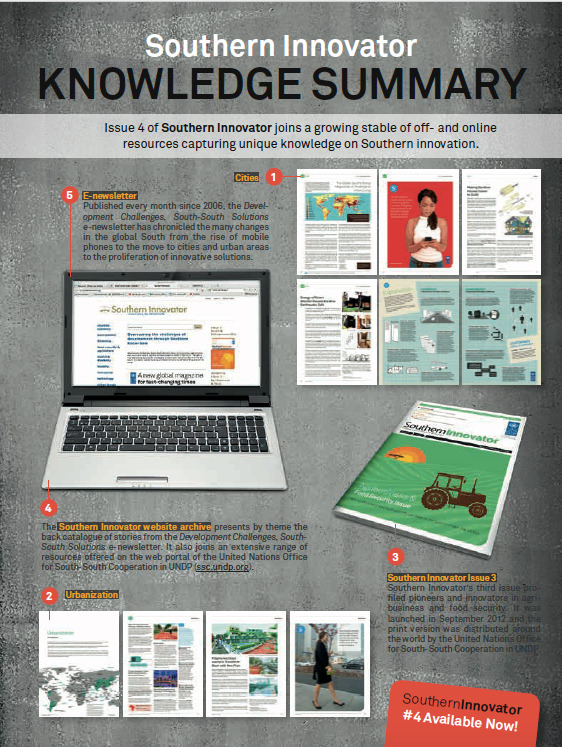
Development Challenges, South-South Solutions was launched as an e-newsletter in 2006 by UNDP’s South-South Cooperation Unit (now the United Nations Office for South-South Cooperation) based in New York, USA. It led on profiling the rise of the global South as an economic powerhouse and was one of the first regular publications to champion the global South’s innovators, entrepreneurs, and pioneers. It tracked the key trends that are now so profoundly reshaping how development is seen and done. This includes the rapid take-up of mobile phones and information technology in the global South (as profiled in the first issue of magazine Southern Innovator), the move to becoming a majority urban world, a growing global innovator culture, and the plethora of solutions being developed in the global South to tackle its problems and improve living conditions and boost human development. The success of the e-newsletter led to the launch of the magazine Southern Innovator.  

Follow @SouthSouth1

Google Books: https://books.google.co.uk/books?id=bfhcAwAAQBAJ&dq=development+challenges+september+2013&source=gbs_navlinks_s

Slideshare: http://www.slideshare.net/DavidSouth1/september-2013-development-challenges

Southern Innovator Issue 1: https://books.google.co.uk/books?id=Q1O54YSE2BgC&dq=southern+innovator&source=gbs_navlinks_s

Southern Innovator Issue 2: https://books.google.co.uk/books?id=Ty0N969dcssC&dq=southern+innovator&source=gbs_navlinks_s

Southern Innovator Issue 3: https://books.google.co.uk/books?id=AQNt4YmhZagC&dq=southern+innovator&source=gbs_navlinks_s

Southern Innovator Issue 4: https://books.google.co.uk/books?id=9T_n2tA7l4EC&dq=southern+innovator&source=gbs_navlinks_s

Southern Innovator Issue 5: https://books.google.co.uk/books?id=6ILdAgAAQBAJ&dq=southern+innovator&source=gbs_navlinks_s

Creative Commons License
This work is licensed under a
Creative Commons Attribution-Noncommercial-No Derivative Works 3.0 License.

ORCID iD: https://orcid.org/0000-0001-5311-1052.

© David South Consulting 2023
Categories
Archive Blogroll data Development Challenges, South-South Solutions Newsletters digital ID Southern Innovator magazine

China Sets Sights on Dominating Global Smartphone Market

By David SouthDevelopment Challenges, South-South Solutions

SOUTH-SOUTH CASE STUDY

The rise of smartphones – mobile phones capable of Internet access and able to run ‘apps’ or applications – is the latest wave of the global connectivity revolution. Mobile phones rapidly made their way around the world to become almost ubiquitous – the most successful take-up of a piece of communications technology in history – and now smartphones are set to do the same. The number of mobile phone subscriptions in the world surpassed 6 billion in 2012 (out of a population of 7 billion) and, according to the International Telecommunications Union (ITU), the number of mobile phones will exceed the world’s population by 2014.

Over the last five years, with the increasing popularity of smartphones, the focus of the mobile industry has shifted from voice and messaging to apps and data services.

Smartphones are complex pieces of technology and any country that can develop the capability to make them and innovate is set to make a lot of money.

The high export value potential of designing and making “computer equipment, office equipment, telecommunication equipment, electric circuit equipment, and valves and transistors” was flagged up as a priority for developing nations back in 2005 at a UN meeting looking for “New and Dynamic Sectors of World Trade” (UNCTAD).

At present, smartphones have a long way to go to surpass old-style mobile phones: by the end of 2016, according to Portio Research (portioresearch.com), the number of non-smartphones in the Asia-Pacific region alone will still be bigger than the entire worldwide number of all smartphones. Even so, it’s predicted that by 2016, there will be 555 million active smartphones in China alone, as well as half a billion smartphones in Europe by the end of 2014. By 2013, North America’s smartphones will make up 50 per cent of all mobile phones. All in all, a lucrative market.

The main factor holding back the rise of smartphones is price. Smartphones tend to cost more than a basic mobile phone. But as China gets more heavily involved in the smartphone marketplace with its own smartphone and mobile phone brands, low income consumers will find themselves with a wider choice of affordable and powerful smartphones, each one a mini-computer.

Out of the 10 largest global manufacturers of smartphones, four are Chinese: Lenovo, Yulong, Huawei and ZTE (Gartner).

Huawei (http://www.huawei.com/en/), the world’s biggest smartphone seller (according to research firm Canalys) (canalys.com), has started to move some of its design team to London in the United Kingdom, to better tailor its products for foreign markets. It has revenues each year of US $35 billion.

China’s mobile phone market is vast, accounting for a third of all smartphones sold in the world. Getting a foothold in this marketplace places a company in a very strong position to build the expertise and capital to push into the wider global marketplace. And that is what Chinese brands are starting to do. So far, Chinese exports of branded smartphones make up a fifth of those sold around the world (Canalys).

The big global competitors to date have been South Korea’s Samsung (samsung.com) and the American Apple brand (apple.com). Other large competitors are Canada’s troubled Blackberry and Finland’s Nokia.

To compete with them, popular and successful Chinese brands include Xiaomi (xiaomi.cn), which sells more mobile phones in China than does the American Apple brand, and ZTE (http://wwwen.zte.com.cn/en/).

For years, many of the top global brands have had their phones and the components manufactured in China. This meant Chinese manufacturers were assembling the phones but not benefiting from the high value that can be extracted from being the owner of the brand name and the originator of the innovation and holder of the copyrights and trademarks.

But now China’s Lenovo brand (http://www.lenovo.com/uk/en/), for example, has successfully pulled past U.S. electronics maker Hewlett-Packard (www.hp.com) to become the largest seller of personal computers in the world. It is also selling more mobile phones and tablet computers than personal computers.

Lenovo Chief Executive Yang Yuanqing espouses a two-part strategy to defend market share at home in China while going hard at overseas markets. Lenovo started with so-called emerging markets in Russia, India and Indonesia.

“We have very aggressive plans to explore overseas markets,” Lenovo’s mobile phone division head Liu Jun told China Daily. “We hope the overseas market will contribute more than half of Lenovo’s total smartphone revenue in the long run.”

Xiaomi founder Lei Jun is considered part of a new generation of dynamic Chinese technology leaders. His casual clothing and charismatic public presentations have had some equate him to the late Apple founder Steve Jobs. But Jun is not happy with selling smartphones and instead sees the company’s future in software and that the phones are just a tool to access the software. Xiaomi hopes to make even more money from selling games, running online marketplaces and offering social media.

The Chinese-made smartphone brand Coolpad (http://coolpadamericas.com/) – made by Yulong Computer Telecommunication Scientific Co. – is the third best-selling in the Chinese marketplace, surpassing Huawei and Apple and has global annual revenue of US $1.8 billion, according to Forbes magazine. Sino Market Research found 10.2 per cent of China’s smartphone users own a Coolpad, behind Korean brand Samsung and China’s Lenovo.

Coolpad has succeeded by investing heavily in research and development (R&D) and innovation to make the phones cheap but also powerful.

Innovations include technology that lets users have more than one phone number for the same phone by being able to connect to two different network technologies. The phones also include security and privacy protections that make them popular with businesspeople and government officials.

The Coolpad brand has also been frenetic in launching different models of the phones to appeal to its customers. In 2012, it launched 48 different models, selling for between US $50 and US $500.

Coolpad was launched in 2012 in the US as part of the company’s global expansion plans.

China has placed innovation at the core of its economic development policies. China increased its R&D spending in 2009 to US $25.7 billion, a 25.6 per cent rise over 2008, according to Du Zhanyuan, vice minister of the Ministry of Science and Technology. In 2011, China surpassed South Korea and Europe in total patents filed and was in a neck-and-neck race with Japan and the United States.

China now boasts twice as many Internet users as the United States, and is the main global maker of computers and consumer electronics, from toys to games consoles to digital everything.

China is also on course to become the world’s largest market for Internet commerce and computing.

The drive to change and transform China’s global economic role was promoted in 2011’s Beijing International Design Week (http://www.bjdw.org/en/), with its theme of transforming “Made in China to Designed in China.”

Published: September 2013

Resources

1) iHub Nairobi: iHub – Nairobi’s Innovation Hub for the technology community is an open space for the technologists, investors, tech companies and hackers in the area. This space is a tech community facility with a focus on young entrepreneurs, web and mobile phone programmers, designers and researchers. Website: http://www.ihub.co.ke/

2) Venture Capital for Africa: Venture Capital for Africa (www.vc4africa.biz) is the continent’s leading founder’s network, the largest and fastest growing community of  entrepreneurs and investors building promising companies in Africa. Website: https://vc4africa.biz/

Red Dot: The red dot logo stands for belonging to the best in design and business. The red dot is an internationally recognized quality label for excellent design that is aimed at all those who would like to improve their business activities with the help of design. Website: http://www.red-dot.de

C3: C3 offers product design and product engineering services in Shanghai, China. Their strong point is managing innovative design processes from scratch (market research) until production: a one shop service: Website: chinacreativecompany.com

North Korea Tech: North Korea Tech is dedicated to covering and collecting information regarding the state of information technology and related industry in North Korea. You can expect to find articles related to Internet connectivity in the country (yes, it does exist), North Korea’s use of technology, and the country’s centrally-controlled and heavily-censored mass media. Website: http://www.northkoreatech.org/

ISSN 2227-3905

Google Snippit December 2020.

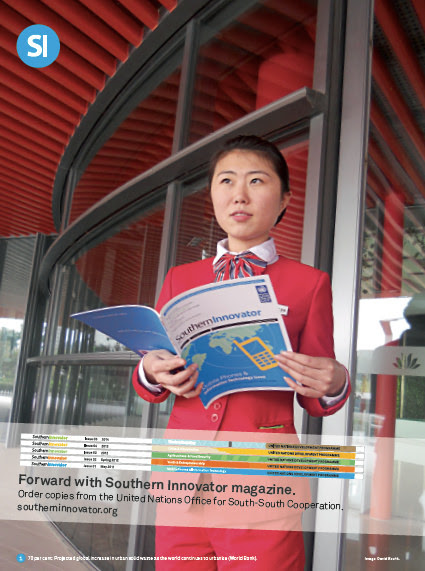
Note on story: Very few outside of China in 2013 were talking about this topic, let alone the increasing market share of smartphone manufacturer Huawei. This was one of many stories to result from a research trip to China. For the keen-eyed, try and spot the Huawei logo in the accompanying photo taken in Tianjin.

https://davidsouthconsulting.org/2020/04/30/crowdsourcing-mobile-phones-to-make-the-poor-money/

https://davidsouthconsulting.org/2020/05/01/diy-solution-charges-mobile-phones-with-batteries/

https://davidsouthconsulting.org/2022/10/09/entrepreneurs-use-mobiles-and-it-to-tackle-indian-traffic-gridlock/

https://davidsouthconsulting.org/2022/06/15/indian-mobile-phone-application-innovators-empower-citizens/

https://davidsouthconsulting.org/2022/11/01/innovative-mobile-phone-applications-storm-south/

https://davidsouthconsulting.org/2020/12/20/kenya-reaches-mobile-phone-banking-landmark/

https://davidsouthconsulting.org/2022/10/27/kenyan-mobile-phone-innovations/

https://davidsouthconsulting.org/2022/10/10/mobile-applications-market-opportunities-for-south/

https://davidsouthconsulting.org/2022/03/08/mobile-phone-microscopes-to-revolutionize-health-diagnostics/

https://davidsouthconsulting.org/2022/04/06/mobile-phone-peacekeeping/

https://davidsouthconsulting.org/2020/12/12/mobile-phone-shopping-to-create-efficient-markets-across-borders/

https://davidsouthconsulting.org/2020/12/20/mobile-phones-bring-the-next-wave-of-new-ideas-from-the-south/

https://davidsouthconsulting.org/2020/12/20/mobile-phones-engineering-souths-next-generation-of-entrepreneurs/

https://davidsouthconsulting.org/2020/12/12/mobile-phones-new-market-tools-for-the-poor/

https://davidsouthconsulting.org/2022/10/09/a-new-mobile-phone-aimed-at-the-poor/

https://davidsouthconsulting.org/2021/11/09/ring-tones-and-mobile-phone-downloads-are-generating-income-for-local-musicians-in-africa/

Development Challenges, South-South Solutions was launched as an e-newsletter in 2006 by UNDP’s South-South Cooperation Unit (now the United Nations Office for South-South Cooperation) based in New York, USA. It led on profiling the rise of the global South as an economic powerhouse and was one of the first regular publications to champion the global South’s innovators, entrepreneurs, and pioneers. It tracked the key trends that are now so profoundly reshaping how development is seen and done. This includes the rapid take-up of mobile phones and information technology in the global South (as profiled in the first issue of magazine Southern Innovator), the move to becoming a majority urban world, a growing global innovator culture, and the plethora of solutions being developed in the global South to tackle its problems and improve living conditions and boost human development. The success of the e-newsletter led to the launch of the magazine Southern Innovator.  

Follow @SouthSouth1

Google Books: https://books.google.co.uk/books?id=uXWUyfb4MacC&dq=development+challenges+september+2009&source=gbs_navlinks_s

Slideshare: http://www.slideshare.net/DavidSouth1/development-challengessouthsouthsolutionsseptember2009issue

Southern Innovator Issue 1: https://books.google.co.uk/books?id=Q1O54YSE2BgC&dq=southern+innovator&source=gbs_navlinks_s

Southern Innovator Issue 2: https://books.google.co.uk/books?id=Ty0N969dcssC&dq=southern+innovator&source=gbs_navlinks_s

Southern Innovator Issue 3: https://books.google.co.uk/books?id=AQNt4YmhZagC&dq=southern+innovator&source=gbs_navlinks_s

Southern Innovator Issue 4: https://books.google.co.uk/books?id=9T_n2tA7l4EC&dq=southern+innovator&source=gbs_navlinks_s

Southern Innovator Issue 5: https://books.google.co.uk/books?id=6ILdAgAAQBAJ&dq=southern+innovator&source=gbs_navlinks_s

This work is licensed under a Creative Commons Attribution 4.0 International License.

https://davidsouthconsulting.org/2021/03/05/southern-innovator-issue-1/

Creative Commons License

This work is licensed under a
Creative Commons Attribution-Noncommercial-No Derivative Works 3.0 License.

ORCID iD: https://orcid.org/0000-0001-5311-1052.

© David South Consulting 2023