Tag: sdgssinnovators

  • Cheap Farming Kit Hopes to Help More Become Farmers

    Cheap Farming Kit Hopes to Help More Become Farmers

    By David SouthDevelopment Challenges, South-South Solutions

    SOUTH-SOUTH CASE STUDY

    Food security is key to economic growth and human development. A secure and affordable food supply means people can meet their nutrition needs and direct their resources to improving other aspects of their lives, such as housing, clothing, health services or education.

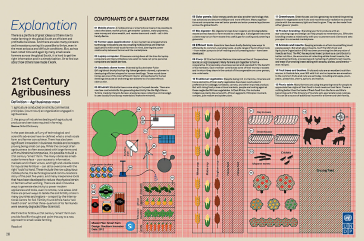
    One solution hopes to boost productivity for small-scale farmers and make agriculture a more attractive income source to the young and poor, by making it possible to grow food year-round. Kenyan social enterprise Amiran Kenya is selling the Amiran Foundation Kit (amirankenya.com), a simple-to-use greenhouse farming kit. As well as helping people grow both food and their agricultural business, Amiran Kenya hopes young people will also buy the kits at a discount and then sell them for a profit to others.

    The technology to grow food year-round is already available, but it is generally expensive to set up. This cost is usually prohibitive to the poor and young: two groups who could really benefit from the income. And if young people in Africa learn the basics of farming, in time they could expand and develop into agribusinesses and benefit from the growing food demand on the continent.

    Africa, a continent undergoing significant economic change, has yet to fully realize its potential as a producer of agricultural products to feed itself and the world. Africa currently has a labour-intensive but very inefficient agriculture system. While many Africans either make their living in agriculture or engage in subsistence farming for survival, much of Africa’s farming is inefficient and fails to make the most of the continent’s rich resources and potential.

    At present, agriculture, farmers and agribusinesses make up almost 50 per cent of Africa’s economic activity, and the continent’s food system is worth an estimated US $313 billion a year (World Bank). A World Bank report, Growing Africa: Unlocking the Potential of Agribusiness (http://siteresources.worldbank.org/INTAFRICA/Resources/africa-agribusiness-report-2013.pdf), argues that Africa could have a trillion-dollar agriculture market by 2030.

    While large-scale agribusinesses are increasing in Africa, it is still reliant on small-scale farmers to meet the daily food needs of most of the population.

    “The time has come for making African agriculture and agribusiness a catalyst for ending poverty,” said Makhtar Diop, World Bank Vice President for Africa. The continent needs to “boost its high growth rates, create more jobs, significantly reduce poverty, and grow enough cheap, nutritious food to feed its families, export its surplus crops, while safeguarding the continent’s environment.”

    Any country that has to import food will be vulnerable to currency fluctuations and the inflation in prices this can cause. A country that has many options for food, and reduces its dependency on imported food resources, will have greater resilience when crisis strikes.

    Greenhouses are a great way to expand the growing season, avoiding ups and downs in temperature. But they can be expensive to set up – something the kit hopes to resolve. A typical greenhouse kit will cost a Kenyan an estimated 10 times more than the Amiran Foundation Kit, which retails at Sh 14,500 (US $168).

    The package includes a drip-feed kit, a 250 liter water tank, a one liter sprayer, instructional growing guides, fertilizer, agro chemicals and high-quality seeds. Crops that can be grown include cabbage, watermelon, kale and spinach. The drip kit is highly durable and can last eight years, according to its manufacturer.

    The kit is being marketed as a “kick starter for the small scale farmers who want to adopt agribusiness” as their method for growing food.

    “The farmers will have a chance to start small and grow bit by bit until they are able to afford the modern greenhouses which will set the ball rolling for them to enjoy the benefits of modern agribusiness,” Yariv Kedar, Amiran Kenya’s Deputy Director, explains on the company’s website.

    The plan is to draw more people into agriculture by showing they do not need to be prisoners of weather patterns. Larger agribusiness enterprises already have the resources to benefit from technology such as greenhouses and avoid the worst effects of the weather.

    By transcending fickle weather patterns, it is possible to reduce the risk of crop failure and the resulting financial damage – one reason people shy away from farming.

    Amiran’s philosophy behind the kit is simple: knowledge and know-how matched with high-quality inputs that do not harm the environment. The idea is to introduce people to the concept of agribusiness, no matter how small their land size. Amiran estimates that by investing Sh 14,500 (US $168), a person could make Sh 25,000 (US $290) per season – making back in a season the initial investment cost.

    Urban farmers and home gardeners are among those who can benefit, along with small-scale farmers in arid and semi-arid areas of Kenya.

    Kedar said the kit’s drip pipes, which deliver water directly to the root of the plant, ensure that “every drop counts” and save between 30 to 60 per cent of water compared to other methods of irrigation.

    “Using the Amiran Foundation Kit, farmers are now able to grow all year round and experience high yields while still conserving the scarce resource, water,” he said.

    Published: March 2014

    Resources

    1) World Vegetable Center: The World Vegetable Center is the world’s leading international non-profit research and development institute committed to alleviating poverty and malnutrition in developing countries through vegetable research and development. Website: http://www.avrdc.org

    2) Songhai Centre: a Benin-based NGO that is a training, production, research, and development centre in sustainable agriculture. Website: http://www.songhai.org/english

    3) Marketing African Leafy Vegetables: Challenges and Opportunities in the Kenyan Context by Kennedy M. Shiundu and Ruth. K. Oniang. Website: http://www.ajfand.net/Issue15/PDFs/8%20Shiundu-IPGR2_8.pdf

    4) African Alliance for Capital Expansion: A management consultancy focused on private sector development and agribusiness in West Africa. Website: http://www.africanace.com/v3

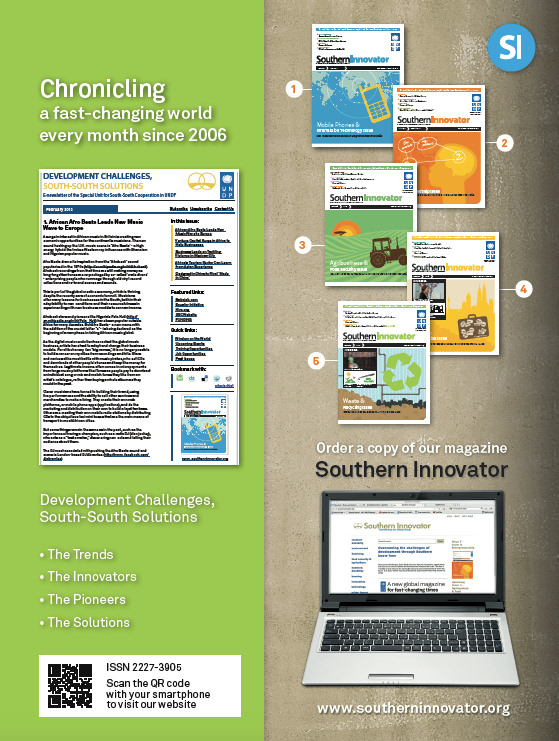
    Development Challenges, South-South Solutions was launched as an e-newsletter in 2006 by UNDP’s South-South Cooperation Unit (now the United Nations Office for South-South Cooperation) based in New York, USA. It led on profiling the rise of the global South as an economic powerhouse and was one of the first regular publications to champion the global South’s innovators, entrepreneurs, and pioneers. It tracked the key trends that are now so profoundly reshaping how development is seen and done. This includes the rapid take-up of mobile phones and information technology in the global South (as profiled in the first issue of magazine Southern Innovator), the move to becoming a majority urban world, a growing global innovator culture, and the plethora of solutions being developed in the global South to tackle its problems and improve living conditions and boost human development. The success of the e-newsletter led to the launch of the magazine Southern Innovator. 

    Creative Commons License

    This work is licensed under a
    Creative Commons Attribution-Noncommercial-No Derivative Works 3.0 License.

    ORCID iD: https://orcid.org/0000-0001-5311-1052.

    © David South Consulting 2023

  • Mobile Applications Market: Opportunities for South

    Mobile Applications Market: Opportunities for South

    By David SouthDevelopment Challenges, South-South Solutions

    SOUTH-SOUTH CASE STUDY

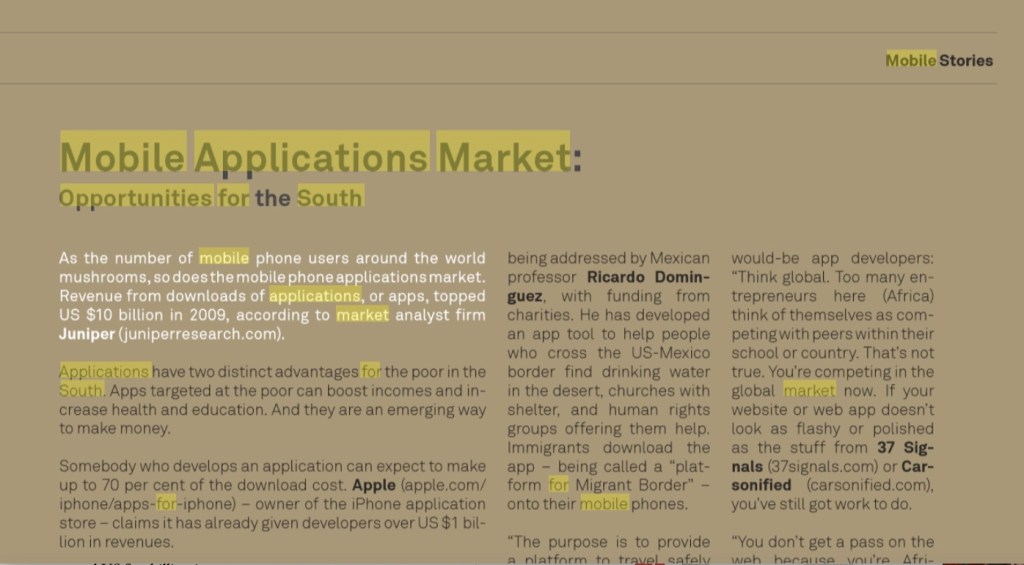
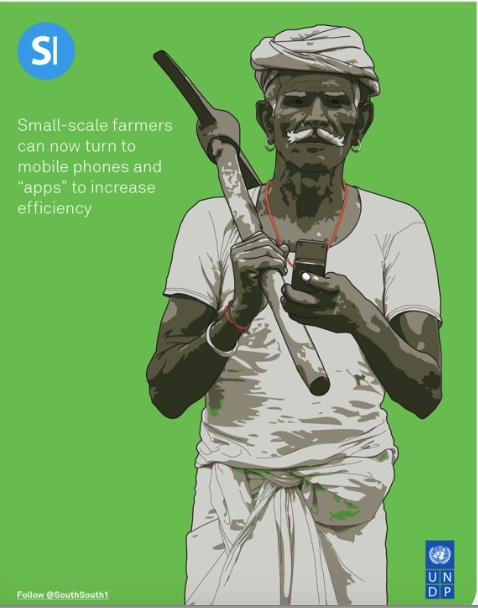
    As the number of mobile phone users around the world mushrooms, so does the mobile phone applications market. Revenue from downloads of applications, or apps, topped US $10 billion in 2009, according to market analyst firm Juniper (http://juniperresearch.com).

    Applications have two distinct advantages for the poor in the South. Apps targeted at the poor can boost incomes and increase health and education. And they are an emerging way to make money.

    Somebody who develops an application can expect to make up to 70 percent of the download cost. Apple (http://www.apple.com/iphone/apps-for-iphone) – owner of the iPhone application store – claims it has already given developers over US $1 billion in revenues.

    It is a growing industry. The market-leading Apple App Store now boasts more than 225,000 applications for download and sale. It says they have been downloaded an impressive 5 billion times.

    Android Market (http://www.android.com/market/#app=com.com2us.HG), run by the search engine Google, has more than 60,000 apps on offer. GetJar (www.getjar.com), an independent mobile phone application store from Sweden, says it has 72,000 apps available and has had 1 billion downloads.

    Now that the apps economy has been running for a couple years, it is possible to divine what increases a developer’s success. Some believe the apps marketplace mimics the dynamics of the music business, rather than the traditional software business.

    GetJar chief executive Ilja Laurs told the Economist that it takes as long to write an app as a song. Apps on average cost about the same as a music download: US $1.90. And just like the pop music charts, a few become big hits but most never make it. Apps are also a quick hit: even after becoming successful they can quickly fade back to obscurity again. In short, they are fad and trend driven and are very much about the moment and a current need.

    That means they are wide open to newcomers from the South.

    With mobile phones now the main channel for information in East Africa, for example, and mobile penetration exceeding 40 percent of the population there, vast markets have opened for apps. East Africa has more than 120 million citizens, with a large majority living in rural areas: many needing poverty-fighting apps to change their lives.

    Various new applications show the creative thinking already coming out of the South. South Africa’s Afridoctor (www.afridoctor.com) is Africa’s first personal mobile health clinic. Users submit photos of ailments and receive advice from a panel of professionals, or use the mapping feature to find doctors, clinics and all health industry related services nearby. The emergency feature notifies next of kin of your distress and location. Features include symptom checkers, first-aid information, health calculators and quizzes. Afridoctor hopes to make health care affordable and accessible to Africans. It is made by 24.com (http://store.ovi.com/publisher/24.com), South Africa’s largest digital brands group.

    In Mexico, the tragedy of migrants dying as they try to cross the border to the United States is being addressed by Mexican professor Ricardo Dominguez, with funding from charities. He has developed an app tool to help people who cross the US-Mexico border find drinking water in the desert, churches with shelter, and human right groups offering them help. Immigrants download the app – being called a “platform for Migrant Border” – onto their mobile phones.

    “The purpose is to provide a platform to travel safely through the desert,” said Dominguez, who led the design team.

    App action has heated up in India, where Spice Mobiles (http://www.spiceglobal.com/SpiceMobiles/SpiceMobiles.aspx) – a wing of the Spice Group – is launching an application store with 250 content providers. India’s Bharti Airtel launched its first home-grown mobile application store in February of this year – Airtel App Central (http://www.airtel.in/apps). It clocked up over 13 million downloads in four months.

    India’s Reliance Communications (http://www.rcom.co.in/Rcom/personal/home/index.html) also launched an application called Socially. It has been designed to enable users to follow the recent activity of friends, and also allows the user to update their status on different social networks like Facebook, Twitter and LinkedIn through a single client.

    Jon Gosier, from Appfrica Labs (http://appfrica.net/blog) – behind the highly successful crisis crowdsourcing Ushahidi application (http://www.ushahidi.com) – explained the thinking behind apps in Africa:

    “Our goal is to show the world that Africa is capable of solving some of its own problems,” he told CP-Africa.com. “Too often Africans aren’t even considered as a resource when discussing how to improve their own quality of life.”

    He has the following advice for would-be app developers: “Think global. Too many entrepreneurs here (Africa) think of themselves as competing with peers within their school or country. That’s not true. You’re competing in the global market now. If your website or web app doesn’t look as flashy or polished as the stuff from 37 Signals (www.37signals.com) or Carsonified (www.carsonified.com), you’ve still got work to do.

    “You don’t get a pass on the web because you’re African. You get the challenge of working harder.”

    NEW: Apps4Africa Competition: Apps 4 Africa is a regional competition with the goal of promoting local technology entrepreneurs as they build tools to serve the needs of NGOs and the local community. This unprecedented partnership meshes civil society with developers and designers to create technical solutions to local challenges. The competition will ask civil society and citizens throughout the region to submit local community challenges on issues like transparency and better governance, health, education and more where technology can be a part of the solution. The burgeoning ranks of innovative techies in the region will then use this list of community challenges as the basis of their work, thus creating “an app for that.” Website:www.apps4africa.org

    Published: August 2010

    Deadline: August 31, 2010

    Resources

    Development Challenges, South-South Solutions was launched as an e-newsletter in 2006 by UNDP’s South-South Cooperation Unit (now the United Nations Office for South-South Cooperation) based in New York, USA. It led on profiling the rise of the global South as an economic powerhouse and was one of the first regular publications to champion the global South’s innovators, entrepreneurs, and pioneers. It tracked the key trends that are now so profoundly reshaping how development is seen and done. This includes the rapid take-up of mobile phones and information technology in the global South (as profiled in the first issue of magazine Southern Innovator), the move to becoming a majority urban world, a growing global innovator culture, and the plethora of solutions being developed in the global South to tackle its problems and improve living conditions and boost human development. The success of the e-newsletter led to the launch of the magazine Southern Innovator.  
    Creative Commons License

    This work is licensed under a
    Creative Commons Attribution-Noncommercial-No Derivative Works 3.0 License.

    ORCID iD: https://orcid.org/0000-0001-5311-1052.

    © David South Consulting 2022

  • Indian Solar Power Pack Powers Villages

    Indian Solar Power Pack Powers Villages

    By David SouthDevelopment Challenges, South-South Solutions

    SOUTH-SOUTH CASE STUDY

    Developments in India are showing the way forward for low-cost solar power for the poor. The Duron Solar Home Power System (http://www.duronenergy.com/product_info/) is now enabling the rural poor to generate and store solar electricity. It is powerful enough to charge gadgets and appliances and run LED lights. It allows people to do their household chores into the dark hours and to study or earn extra income.

    As the company says, it “allows ample light for cooking, for children to study at night, and for shop owners to stay open later to earn more money.”

    The system removes the need for polluting and dangerous kerosene lamps, which are used by an estimated one million families for lighting in India.

    Kerosene lamps are a major contributor to indoor air pollution, which itself claims the lives of 1.5 million people each year. Kerosene lamps have also caused countless deaths by suffocation, burns and fatal fires.

    The United Nations Environment Program says kerosene fumes are responsible for around 64 percent of deaths for children under the age of five in developing countries.

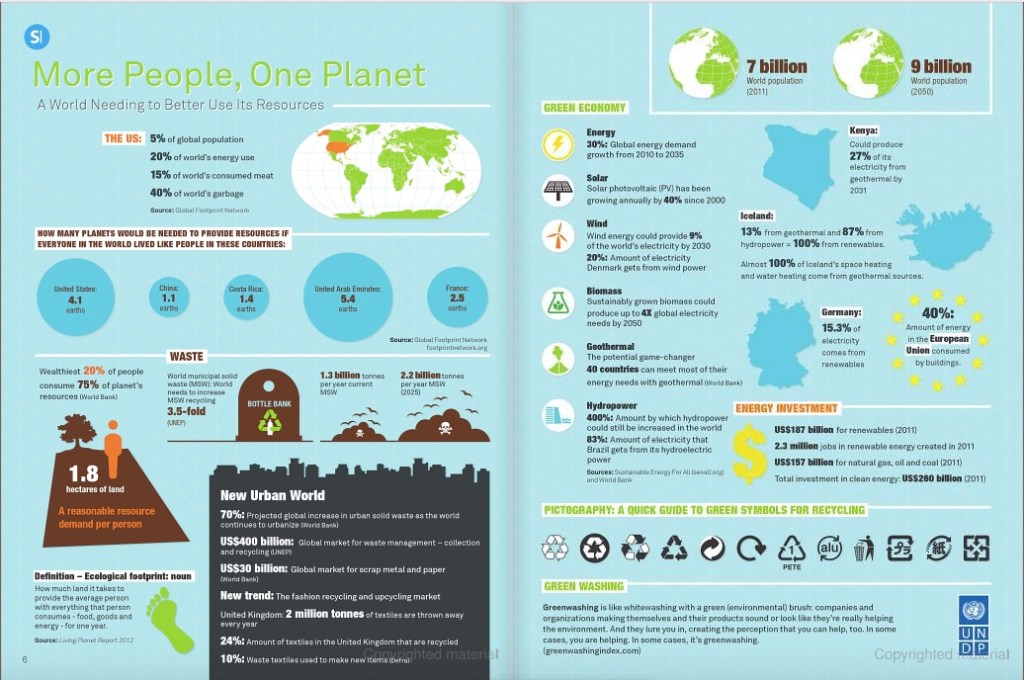
    More than 1.7 billion people around the world have no domestic electricity supply, of whom more than 500 million live in sub-Saharan Africa (World Bank). Some 400 million people in India do not have access to electricity, according to the World Bank, and 600,000 villages lack an electrical supply. Prime Minister Manmohan Singh has pledged “power for all” by 2012. Without electricity, many development goals remain dreams that will never be achieved.

    Being able to see at night unleashes a vast range of possibilities, but for the very poor lighting is often the most expensive household expense, soaking up 10 to 15 percent of income.

    According to Greenpeace (http://www.greenpeace.org/international/), India could generate 10 percent of its electricity from solar power by 2030.

    The Duron package comes with a five watt solar panel, a cell phone charger connection, three LED (http://en.wikipedia.org/wiki/LED_lamp) lights, and an AC grid charger. After a day of charging, the Duron can power three hours of bright lighting or 10 hours of dim lighting.

    The Duron system sells for about 5,999 rupees, or around US $130, and the typical user to date has been small businesses and schools.

    Duron is selling several thousand units a month and the company is currently scaling up its sales efforts.

    Duron’s approach is to provide a market solution to the huge problem of providing electricity to India’s rural poor.

    The company was launched in 2008 with the goal of providing electricity to those without around the world. It was developed out of the Idea Lab (http://www.idealab.com/), a Pasadena, Californian incubator of technology companies.

    Extensive field research was conducted across India to determine what was the best solution and what were the needs of rural dwellers. Duron moved its headquarters to Bangalore, India in 2009 to be closer to its customers and expand sales. The company operates in the Indian states of Uttar Pradesh and Karnataka.

    By August 2009, more than 2,100 people had light because of the Duron system. The company calculates this translated into 172,500 hours of light.

    One customer, Anil Singh, lives with his family in the unelectrified village of Narainpur. His family used kerosene lamps and was paying US $4 a day for unreliable lighting. But after seeing his neighbour, Santosh Singh, with bright, powerful lights at his home, he was curious as to why. When he found out about Duron’s system, he installed a system to light his front porch and two rooms in his house. His family now enjoys two-and-half hours of reliable light in the evening to do things.

    “The Duron has made my life so much easier,” said Anil. “It’s a much cheaper (lighting) option compared to kerosene lamps, and I now have a reliable source of power on a daily basis,” he told the company’s website.

    Another innovative start-up with offices in India and Africa, is the d.light company, which also has a new, highly-efficient solar-powered product available. The Kiran LED lamp (http://www.dlightdesign.com/products_kiran_global.php) stays lit for eight hours on a full battery and is four times brighter than a kerosene lamp. It illuminates 360 degrees and produces an even, bright white light.

    Published: February 2010

    Resources

    1) Lighting Africa: this website run by the World Bank is a virtual business community and has forums, market intelligence, access to grants, network and partnership opportunities. Website: http://lightingafrica.org/index.cfm?Page=Home

    2) D.light Design is dedicated to bringing modern lighting and power to more than 1.6 billion people globally currently living without electricity. They aim to be the number one player in off-grid lighting and power solutions worldwide. Website: http://www.dlightdesign.com/

    3) Solar Power Answers is a one-stop-shop for everything to do with solar power. It has a design manual and guides to the complex world of solar power equipment. Website: http://www.solar-power-answers.co.uk/index.php

    4) Sun King solar lantern: The lantern provides 16 hours of light for a day’s charge. Website: http://www.greenlightplanet.com/ourusers.html

    Development Challenges, South-South Solutions was launched as an e-newsletter in 2006 by UNDP’s South-South Cooperation Unit (now the United Nations Office for South-South Cooperation) based in New York, USA. It led on profiling the rise of the global South as an economic powerhouse and was one of the first regular publications to champion the global South’s innovators, entrepreneurs, and pioneers. It tracked the key trends that are now so profoundly reshaping how development is seen and done. This includes the rapid take-up of mobile phones and information technology in the global South (as profiled in the first issue of magazine Southern Innovator), the move to becoming a majority urban world, a growing global innovator culture, and the plethora of solutions being developed in the global South to tackle its problems and improve living conditions and boost human development. The success of the e-newsletter led to the launch of the magazine Southern Innovator.  

    Creative Commons License

    This work is licensed under a
    Creative Commons Attribution-Noncommercial-No Derivative Works 3.0 License.

    ORCID iD: https://orcid.org/0000-0001-5311-1052.

    © David South Consulting 2022

  • Battery Business Brings Tanzanians Cheap Electricity

    Battery Business Brings Tanzanians Cheap Electricity

    By David SouthDevelopment Challenges, South-South Solutions

    SOUTH-SOUTH CASE STUDY

    Access to electricity is critical for making substantial development gains. With steady supplies of electricity, it is possible to read and study at night, to run modern appliances, to better use the latest information technologies and to work using time- and labour-saving devices. A home with electricity literally switches the light on modern life and gives a family huge advantages compared to those without electricity.

    But there are two potential obstacles to providing electricity for the poor: one is just getting access to a steady supply; the other is paying for it.

    In Africa, much of the population suffers from an electricity famine. The situation is worse than on any other continent: the proportion of people in Africa still without electricity is higher – and the rate of urban electrification is lower – than anywhere else. Four out of five rural residents in Africa live without electricity. The rate of rural electrification is also lower than on any other continent and the proportion of Africans who depend on inefficient traditional energy sources is higher than elsewhere (Desertec-Africa).

    EGG-energy (http://egg-energy.com) is a Tanzanian company using an innovative business model to bring affordable electricity to rural communities.

    Its co-founder, Jamie Yang, said Tanzania has a huge potential market for offgrid energy services. About 85 per cent of the population lacks access to electricity, a figure that rises to 98 per cent of the rural population.

    EGG-energy says it is “dedicated to helping low-income consumers in sub-Saharan Africa gain access to clean, affordable energy, using a unique strategy based around portable rechargeable batteries.” The company has eight full-time staff based in their Makumbusho office, 6 kilometres north of Dar es Salaam, the capital.

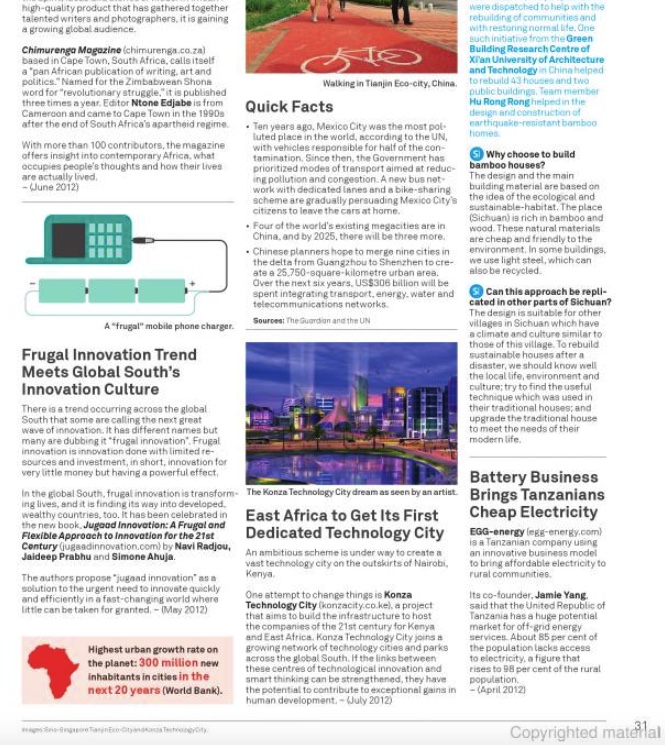
    It calls its system the “portable grid,” and it works like this: customers have a power system installed in their home that runs on brick-sized, re-chargeable batteries. The batteries are re-charged at a central charging station using power from the Tanzanian power grid, and sent to local distribution centres where customers can pick them up. Customers rent the batteries for a subscription fee, and they last about five nights in a home. When the battery is empty, the customer returns it, swaps for a fresh battery and pays a small swapping fee.

    It is a brilliant solution to the problem of getting power from the main Tanzanian power grid to people’s homes. According to EGG-energy, most Tanzanians live within 5 kilometres from a power grid line. Yet the majority of the population lack access to electricity.

    “After researching the energy situation in Tanzania and other countries with similar electricity access problems, it became clear that one of the primary problems was a lack of last-mile distribution,” explained Yang. “The only way to get power from the source into homes and businesses were power lines, and for the vast majority of rural Tanzanians, this was very much out of reach.

    We saw situations in which power lines would pass right over large populations that were still using kerosene for lighting. We also saw that distributed generation like solar was finding only very limited markets because there was no share or sell power from that source without an affordable way to distribute the electricity.”

    While EGG-energy is based in Tanzania, it hopes hope to expand across the developing world.

    In order to develop an effective distribution network, EGG-energy partners with local store owners and delivery businesses to help with distributing the batteries. The batteries are based on those used in the airline industry and are light enough to be held in one hand.

    Yang believes marketing is critical to the success of the technology.

    “Don’t underestimate the cost of sales, marketing, and distribution,” he said.

    “Many companies focus on the technology and in lowering the cost of the technology, while not paying enough attention to the gaps in the distribution channels.

    “We have a sales team that communicates what we do through a variety of methods, including door-to-door sales, road shows and village meetings. We also make contact with the local political leaders and offer referral awards to our existing customers. Potential customers come to our charging stations to purchase the system and to connect to EGG.”

    When a customer signs up with EGG-energy, a technician is dispatched to their home to make sure the electricity system is sound and effective. The company also sells energy-efficient lights, radios and mobile phone chargers to complement the electricity system. It’s a wise business model, since having a steady and reliable supply of electricity is a great motivator for customers to purchase other electric-powered appliances.

    “We have technicians that have received vocational training through the Tanzanian system and technicians that we train ourselves,” Yang said. “We have very standardized electricity installations that are easy to teach, and have more experienced technicians that we rely on for troubleshooting and support.”

    EGG-energy also makes the claim it can reduce a household’s energy expenses by 50 per cent as they make the switch from traditional batteries for radios and kerosene lamps for light.

    EGG-energy calls itself a “for-profit company with a social mission.” It sees the provision of affordable electricity and energy as a spur for small entrepreneurs to build their businesses, boost educational opportunities through longer study time, and help with connecting families with the outside world.

    It uses regular feedback with customers to make sure their service is actually cheaper than other options – a good habit for any business looking to build a lasting customer relationship.

    “One of the key deficiencies in the energy supply chain is customer support,” said Yang. “We have seen multiple solar installations given by NGOs to community organizations that are no longer functioning because the user doesn’t have someone reliable to call or hasn’t allotted a budget to maintain the system.

    “Customer support is a key component of last mile distribution, and something that EGG-energy is focusing on as an energy services company with a local, physical presence.”

    Published: April 2012

    Resources

    1) ANSOLE (the African Network for Solar Energy) is a research-oriented network of 200 scientists from 22 African and 10 non-African countries. It believes, according to Mammo Muchie, founding editor of the African Journal of Science, Technology, Innovation, and Development, “solar power will become the major renewable energy source on the continent only by organized research, training, design, and engineering.” Website: ansole.org

    2) The Kenya-based non-governmental organization (NGO) Access: energy is tackling the problem of 84 per cent of Kenyans – 32 million people – lacking access to electricity at home. It is doing this by teaching people how to make and assemble wind turbines out of scrap metal and car parts and other materials found within communities. Their turbine design is called the Night Heron Turbine. Website: http://access-collective.com/energy/

    4) TANESCO: Tanzania Electric Supply Company: Website: http://www.tanesco.co.tz

    https://davidsouthconsulting.org/2022/10/24/brazilian-solar-powered-wifi-for-poor-schools/

    https://davidsouthconsulting.org/2022/10/06/indian-solar-power-pack-powers-villages/

    https://davidsouthconsulting.org/2022/11/20/new-battery-back-up-technology-targeting-developing-countries-and-remote-regions/

    https://davidsouthconsulting.org/2022/10/02/powerful-solar-light-spurring-income-making-opportunities/

    https://davidsouthconsulting.org/2022/10/24/solar-power-bringing-light-and-opportunity-to-the-poor/

    https://davidsouthconsulting.org/2021/03/24/solar-powered-mobile-clinics-to-boost-rural-healthcare-in-africa/

    https://davidsouthconsulting.org/2021/03/30/solar-powered-village-kick-starts-development-goals/

    https://davidsouthconsulting.org/2022/10/06/solar-sisters-doing-it-for-themselves-tackling-african-light-famine/

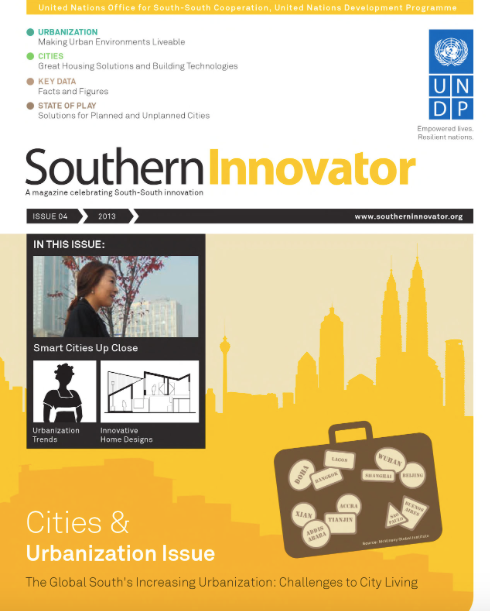
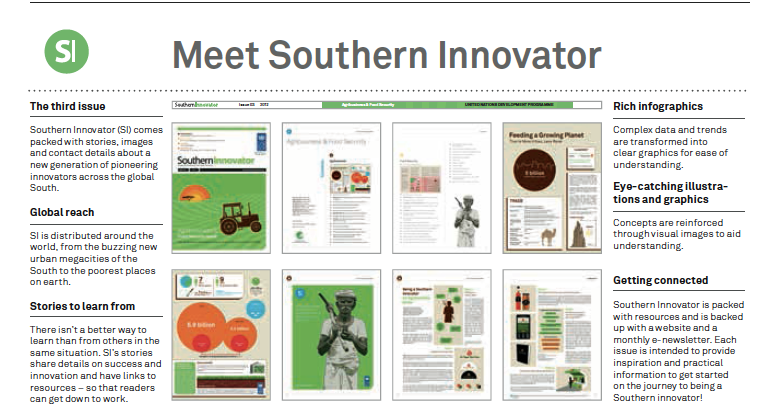
    Development Challenges, South-South Solutions was launched as an e-newsletter in 2006 by UNDP’s South-South Cooperation Unit (now the United Nations Office for South-South Cooperation) based in New York, USA. It led on profiling the rise of the global South as an economic powerhouse and was one of the first regular publications to champion the global South’s innovators, entrepreneurs, and pioneers. It tracked the key trends that are now so profoundly reshaping how development is seen and done. This includes the rapid take-up of mobile phones and information technology in the global South (as profiled in the first issue of magazine Southern Innovator), the move to becoming a majority urban world, a growing global innovator culture, and the plethora of solutions being developed in the global South to tackle its problems and improve living conditions and boost human development. The success of the e-newsletter led to the launch of the magazine Southern Innovator.  
    https://davidsouthconsulting.org/2021/03/05/southern-innovator-issue-4/

    Creative Commons License

    This work is licensed under a
    Creative Commons Attribution-Noncommercial-No Derivative Works 3.0 License.

    ORCID iD: https://orcid.org/0000-0001-5311-1052.

    © David South Consulting 2023