“I think you [David South] and the designer [Solveig Rolfsdottir] do great work and I enjoy Southern Innovator very much!”
Ines Tofalo, Programme Specialist, United Nations Office for South-South Cooperation
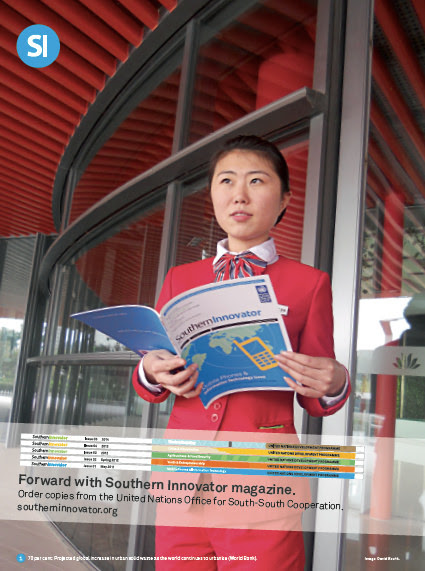
Southern Innovator in Tianjin, China.Issue 5 of Southern Innovator at the Global South-South Development Expo (GSSD Expo) 2014 held in Washington, D.C.Volunteers in Nairobi, Kenya pose with Southern Innovator Issue 4 at the Global South-South Development Expo (GSSD Expo) in 2013.Southern Innovator Editor and Writer David South in Australia.Southern Innovator Graphic Designer and Illustrator Sólveig Rolfsdóttir in Iceland.
Some comments that have come in so far about SI’s first issue:
“What a tremendous magazine your team has produced! It’s a terrific tour de force of what is interesting, cutting edge and relevant in the global mobile/ICT space… Really looking forward to what you produce in issues #2 and #3. This is great, engaging, relevant and topical stuff.”, to “Looks great. Congratulations. It’s Brill’s Content for the 21st century!”
What they are saying about SI on Twitter: From @CapacityPlus Nice job RT @ActevisCGroup: RT @UNDP: Great looking informative@SouthSouth1 mag on South-South Innovation; @UNDP Great looking informative @SouthSouth1 mag on South-South Innovation; @JeannineLemaireGraphically beautiful & informative @UNDP Southern Innovator mag on South-South Innov.
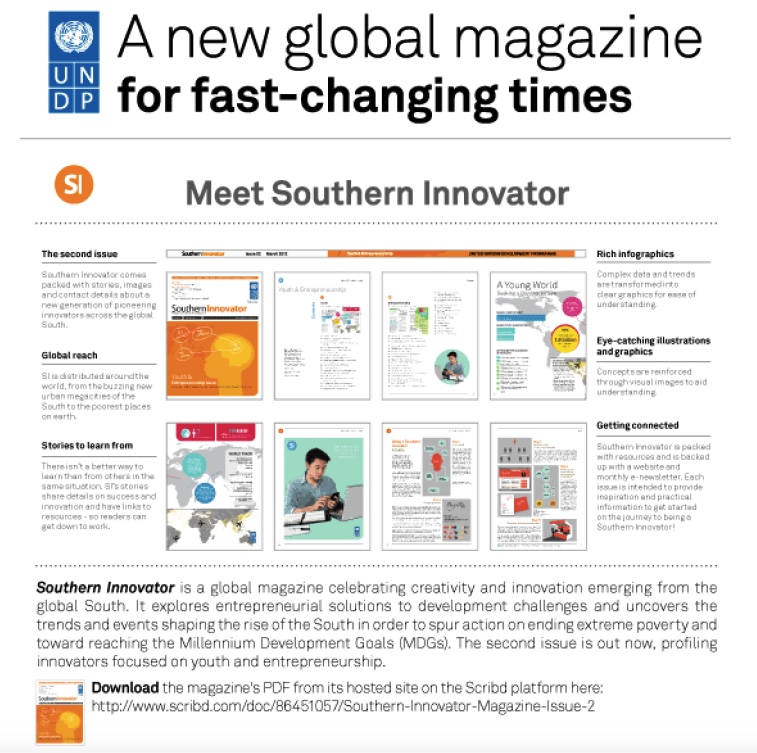
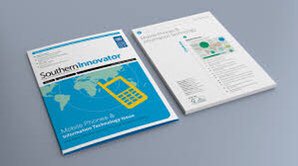
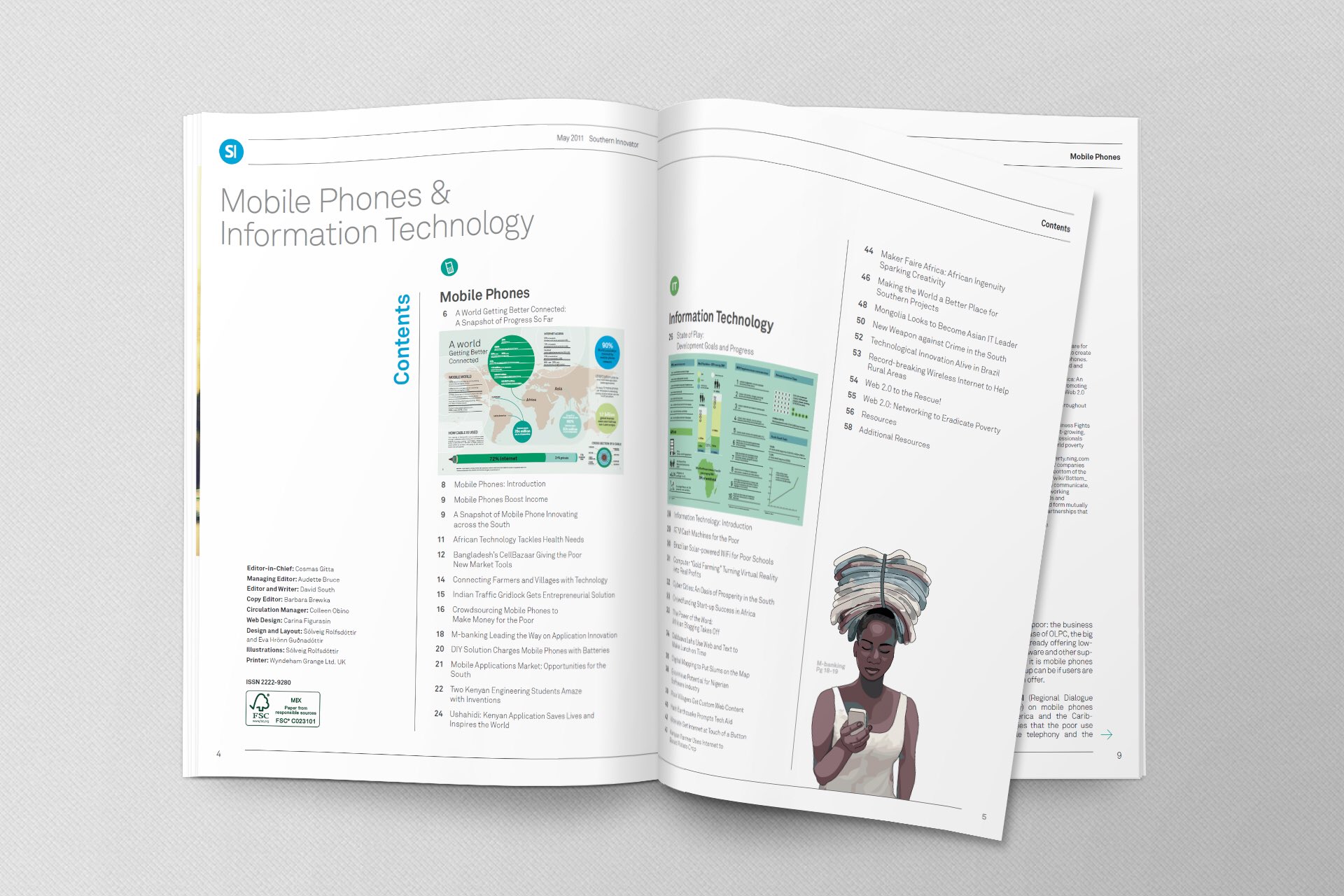
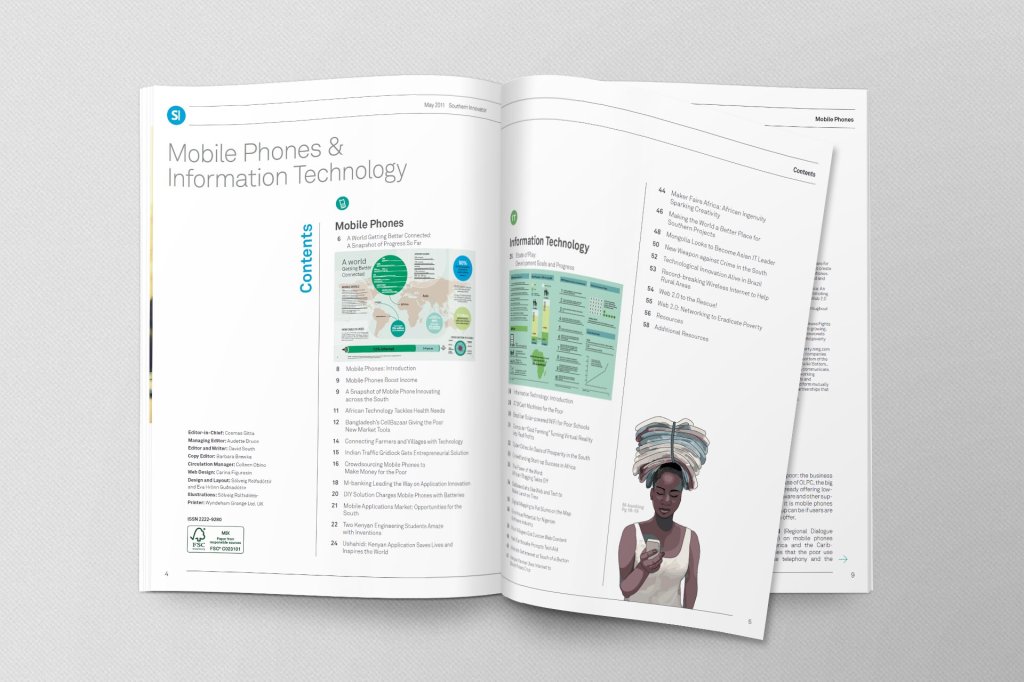
Development Challenges, South-South Solutions was launched as an e-newsletter in 2006 by UNDP’s South-South Cooperation Unit (now the United Nations Office for South-South Cooperation) based in New York, USA. It led on profiling the rise of the global South as an economic powerhouse and was one of the first regular publications to champion the global South’s innovators, entrepreneurs, and pioneers. It tracked the key trends that are now so profoundly reshaping how development is seen and done. This includes the rapid take-up of mobile phones and information technology in the global South (as profiled in the first issue of magazine Southern Innovator), the move to becoming a majority urban world, a growing global innovator culture, and the plethora of solutions being developed in the global South to tackle its problems and improve living conditions and boost human development. The success of the e-newsletter led to the launch of the magazine Southern Innovator.
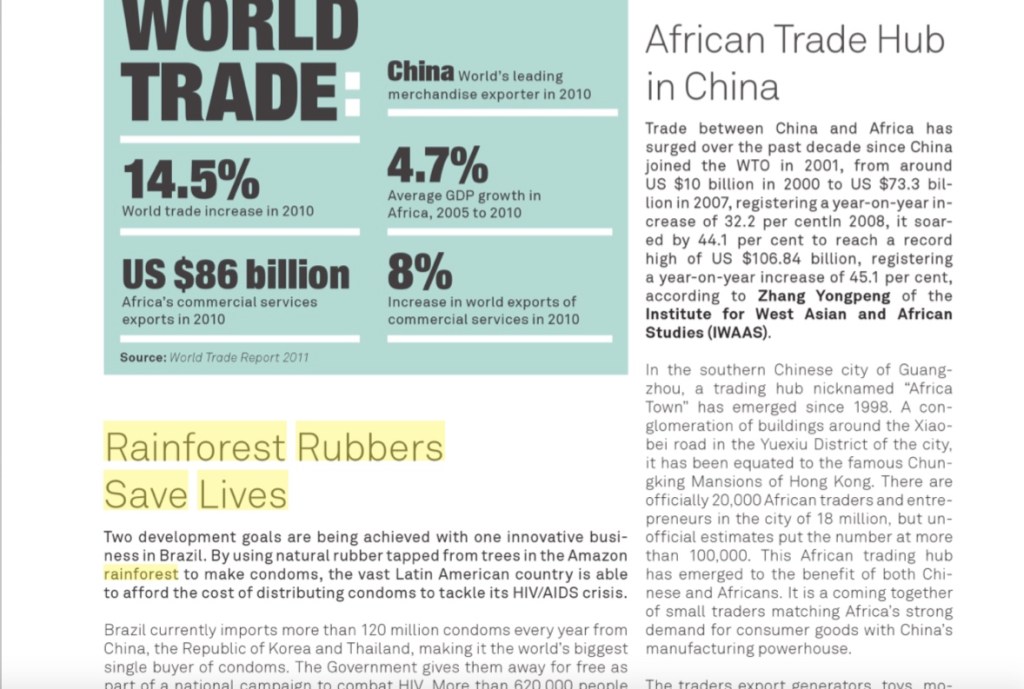
Two development goals are being achieved with one innovative business in Brazil. By using natural rubber tapped from trees in the Amazon rainforest to make condoms, Brazil is able to afford the cost of distributing condoms to tackle its HIV/AIDS crisis. Brazil currently imports more than 120 million condoms every year from China, Republic of Korea and Thailand, making it the world’s biggest single buyer of condoms. The government gives them away for free as part of a national campaign to combat HIV. More than 620,000 people in Brazil are living with HIV out of a population of more than 186 million (UNAIDS, 2005).
The Natex company, co-owned by the public health ministry and the north-western state government of Acre, has established a factory to turn rubber from the world’s biggest rainforest into condoms. The business has created 500 jobs at the factory and 150 jobs for the local indigenous population – the Xapuri – who are traditional rubber tappers.
The factory hopes to produce 100 million condoms a year from local rubber – just 20 million shy of all the condoms the country currently has to import – and could even reach 270 million at full capacity.
“This product will allow people to make love with security and to better plan their futures,” said Raimundo Barros, vice president of the local agricultural association.
The 15,000 Xapuri people who live on the Chico Mendes reserve – named after a conservationist and rubber tapper murdered by ranchers in 1988 – tap seringai trees, which produce rubber that is said to be a more effective barrier to the transmission of sexually transmitted diseases (STDs), than synthetic rubber condoms.
The factory’s 500 employees will earn a total of Reais $2.2 million (US $1.3 million) while the tappers will see their income increase by 250 per cent as demand goes up for the rubber, according to Natex.
“Because of this I’ve managed to buy a few cows and give my family a better life,” rubber tapper Hugo Paz de Souza, 43, told local newspaper Pagina 20. Paz de Souza said the factory will double his income to US $394 a month.
The fact the trees will be saved because of their value as sources of rubber is a great boon to the world’s environment. The trees in the Amazon rainforest – the “world’s lungs” as some call it – face the threat of being chopped down to make way for Brazil’s booming agricultural economy. Official figures released in January 2008 showed that between August and December 2007, about 2,700 square miles were chopped down illegally in the Amazon rainforest. It was the first increase in deforestation after three years of declines and coincided with a rise in global food prices.
Marina Silva, Brazil’s environment minister, told the Guardian newspaper the Natex condom would help create “a new pattern of production and a new process of inclusion that would value the forest being left standing”.
Development Challenges, South-South Solutions was launched as an e-newsletter in 2006 by UNDP’s South-South Cooperation Unit (now the United Nations Office for South-South Cooperation) based in New York, USA. It led on profiling the rise of the global South as an economic powerhouse and was one of the first regular publications to champion the global South’s innovators, entrepreneurs, and pioneers. It tracked the key trends that are now so profoundly reshaping how development is seen and done. This includes the rapid take-up of mobile phones and information technology in the global South (as profiled in the first issue of magazine Southern Innovator), the move to becoming a majority urban world, a growing global innovator culture, and the plethora of solutions being developed in the global South to tackle its problems and improve living conditions and boost human development. The success of the e-newsletter led to the launch of the magazine Southern Innovator.
Kenya is home to a vibrant innovation culture centred around mobile phones. While not all the services launched will be successful, the flurry of start-ups shows the country has the right combination of technical skills, bright ideas and cash to make a go of new services.
With the number of mobile phone users leaping 28 per cent in 2011, to reach 25 million subscribers out of a population of 39 million (Reuters), the country has a large market for mobile phone-based services. Kenya also has 10 million people with access to the Internet, up from 4 million in 2009.
Two issues critical to the well-being of Kenyans – health services and farming – are being tackled by new mobile phone services. One is a service being run and marketed by a major player in the market, and the other, by a small start-up.
Statistics indicate that in Kenya, one doctor attends to over 10,000 patients. The World Health Organization recommends a ratio of 1:600. There are just over 7,500 licensed medical facilities in the country.
Safaricom, Kenya’s largest telecoms operator, is trying to take the pressure off overstretched medical and health systems with a new mobile health service. Its 24-hour health advice and referral service is called ‘Daktari 1525’ and lets people call and speak with a doctor or an expert to get advice on any health issue. The number 1525 refers to the dialling code which links users directly to the Safaricom call centre. Daktari 1525 is available to the 18 million Safaricom subscribers.
Safaricom has partnered with ‘Call-a-Doc’ to launch the tool. The new service hopes to relieve outpatient departments in government hospitals and health facilities with its advice and referrals. The Daktari 1525 service does not prescribe a treatment to the callers, avoiding the legal risks of remote diagnosis.
It also offers home remedies and health tips on healthy lifestyles. In an emergency, users can also dial Daktari 1525 if there is Safaricom network coverage.
The partnership is divided between Safaricom and Call-a-Doc. Safaricom handles all the mobile phone network infrastructure, the call centre facility and the marketing of the service. Call-a-Doc takes care of recruiting doctors.
But how does the service use the doctors’ time well? The shifts are designed to surge the number of doctors to 15 during peak times, falling to as few as four doctors during off-peak times. The doctors work on a part-time basis and there are currently 50 employed by the service.
Not everyone is convinced the service will work.
“It is a good attempt to venture into the field; however we would like to caution the practitioners involved that they must remain ethical and must at all times uphold professional confidentiality,” Medical Practitioners and Dentist Board Chief Executive Officer Daniel Yumbya told Capital News.
Another new service based in the capital, Nairobi, is trying to shake up the world of farming. Its new mobile phone service, “MFarm: connecting farmers” (http://mfarm.co.ke/) calls itself “a transparency tool for Kenyan farmers”.
It bills itself as a “factory of ideas” looking to find “creative agribusiness solutions.” The service is a paid-for web platform that helps farmers keep track of prices in the capital, Nairobi, and claims to have signed up 3,000 farmers in the first year of operations.
The service offers crop prices by sending a text to the numbers 3535 if the user gives the crop location required. As an example, the user texts “price crop location” “price maize Nairobi”. Users can also sell their crops, or buy farm supplies.
It also allows farmers to group sell their crops by getting together with other small-scale farmers. This is a crucial service because it allows the smaller farmer to sell into the wholesale markets where prices are better. Farmers can also group buy, benefiting from lower prices by buying bulk from suppliers. It cleverly offers several ‘plans’ to suit budgets. There is an ‘Eco Plan’ at the low end, a mid-range ‘Pro Plan’, and a bells-and-whistles option, ‘Biz Plan’.
The service also benefits from its connections with iHub Nairobi (http://ihub.co.ke/pages/home.php), the buzzing “open space for technologists, investors, tech companies and hackers in Nairobi.” It provides a strong support network to turn to when problems arise.
It seems as if it would be a mistake to enter the African market with any new tech solution without first checking out the scene in Nairobi.
Published: January 2012
Resources
1) iHub Nairobi: Nairobi’s Innovation Hub for the technology community is an open space for the technologists, investors, tech companies and hackers in the area. The space has a focus on young entrepreneurs, web and mobile phone programmers, designers and researchers. Website: http://ihub.co.ke/pages/home.php
2) EPROM: Entrepreneurial Programming and Research on Mobiles aims to foster mobile phone-related research and entrepreneurship. Website: http://www.media.mit.edu/ventures/EPROM
Development Challenges, South-South Solutions was launched as an e-newsletter in 2006 by UNDP’s South-South Cooperation Unit (now the United Nations Office for South-South Cooperation) based in New York, USA. It led on profiling the rise of the global South as an economic powerhouse and was one of the first regular publications to champion the global South’s innovators, entrepreneurs, and pioneers. It tracked the key trends that are now so profoundly reshaping how development is seen and done. This includes the rapid take-up of mobile phones and information technology in the global South (as profiled in the first issue of magazine Southern Innovator), the move to becoming a majority urban world, a growing global innovator culture, and the plethora of solutions being developed in the global South to tackle its problems and improve living conditions and boost human development. The success of the e-newsletter led to the launch of the magazine Southern Innovator.
Mobile phones are ubiquitous across the global South. They have spawned whole new business opportunities and changed the way people solve problems and find solutions.
Sub-Saharan Africa is now home to approximately 650 million mobile phone subscribers, more than the United States and the European Union (World Bank). A recent World Bank report estimated mobile phones led directly to the creation of 5 million jobs in Africa in 2012, contributing to seven per cent of Africa’s gross domestic product (GDP).
Mobile phones have also led to contests and challenges, set up to spark further innovation in this area and spur the development of so-called “apps”, or applications, to run on these electronic devices.
These prizes encourage and reward useful innovation that directly tackles the problems and challenges of the South.
In Cairo, Egypt – a city notorious for some of the worst traffic congestion in the world – many have been trying to find smart solutions to the gridlock. The World Bank says in its Cairo Traffic Congestion Study that the annual cost of congestion in Cairo is estimated at up to US $8 billion. This is four per cent of Egypt’s gross domestic product (GDP) – four times the impact on national GDP experienced by other comparable large cities. The study found that at least 1,000 Cairo residents die each year in traffic-related accidents, more than half of them pedestrians. And rapid growth in the city is making it ever-harder to get on top of the problem.
Rising traffic congestion is a problem around the world. In the United States, traffic jumped 236 per cent as the population grew by 20 per cent between 1982 and 2001 (IBM).
The IBM Commuter Pain Study conducted in 2011, ranking the emotional and economic toll of commuting in 20 international cities, found that the commute in Beijing is four times more painful than the commute in Los Angeles or New York, and seven times more painful than the commute in Stockholm.
Commuter pain leads to productivity loss as people lose time stuck in traffic and fuel is wasted as engines idle in traffic jams – not to mention damage to the environment from the increased pollution.
According to the World Business Council for Sustainable Development, 95 per cent of congestion growth in the coming years will be in developing countries. Even in developed countries like the United States, in 2000, the average driver experienced 27 hours of delays (up seven hours from 1980) (MIT Press). This ballooned to 136 hours in Los Angeles.
Developing countries are seeing vehicle numbers rise by between 10 and 30 per cent per year (World Bank). In economic hotspots, growth is even faster.
The contest’s press release says it aims to connect transport and urban development experts with volunteer technology communities to build “applications to address pressing transport challenges in Cairo through leveraging the new information and communication technologies (ICT) – such as mobile phones, smartphones and GPS-enabled devices – as well as the talent of Egyptian software developers and innovators.”
The first winner of the US $3,000 in prize money is a mobile phone app that helps drivers get help on the road and with car maintenance.
Users can use the Belya app to find the best routes, and to get help if their vehicle breaks down. The app is essentially a portable virtual car mechanic. It uses Global Positioning System (GPS) technology to locate service centres, which are then contacted when somebody needs help. The app gives details to the repair shop on what is wrong, the date and time.
“It is also linked to the General Traffic Administration, to provide quick and regular updates of the traffic situation,” according to a statement from Egypt’s Ministry of Communications and Information Technology, which awarded the prize.
The content’s second prize was won by E-mokhalfa (http://www.emokhalfa.com/emokhalfa/),which helps communities create safer roads by using peer pressure to make drivers behave better. Third place went to the app called “Where is my bus?” (https://twitter.com/AutobeesyFeen). It helps passengers find bus stations, routes, journey times and all mass transport options on their mobile phones.
2) Android: Android is the world’s most popular mobile platform. Website: android.com
3) Arab Republic of Egypt, Ministry of Communications and Information Technology. Website:http://www.mcit.gov.eg/
4) IBM Smart Traffic: IBM Intelligent Transportation, a compliment to the Intelligent Operations Center for Smarter Cities, enables advanced analysis of the many factors that make up traffic flow, and gives planners and responders a comprehensive look at the state of their city’s roadways on ground level. Website:http://www.ibm.com/smarterplanet/eg/en/traffic_congestion/ideas/index.html
Development Challenges, South-South Solutions was launched as an e-newsletter in 2006 by UNDP’s South-South Cooperation Unit (now the United Nations Office for South-South Cooperation) based in New York, USA. It led on profiling the rise of the global South as an economic powerhouse and was one of the first regular publications to champion the global South’s innovators, entrepreneurs, and pioneers. It tracked the key trends that are now so profoundly reshaping how development is seen and done. This includes the rapid take-up of mobile phones and information technology in the global South (as profiled in the first issue of magazine Southern Innovator), the move to becoming a majority urban world, a growing global innovator culture, and the plethora of solutions being developed in the global South to tackle its problems and improve living conditions and boost human development. The success of the e-newsletter led to the launch of the magazine Southern Innovator.














 David South Consulting
You must be logged in to post a comment.