Tag: SDGs

  • Rainforest Rubbers Save Lives

    Rainforest Rubbers Save Lives

    By David SouthDevelopment Challenges, South-South Solutions

    SOUTH-SOUTH CASE STUDY

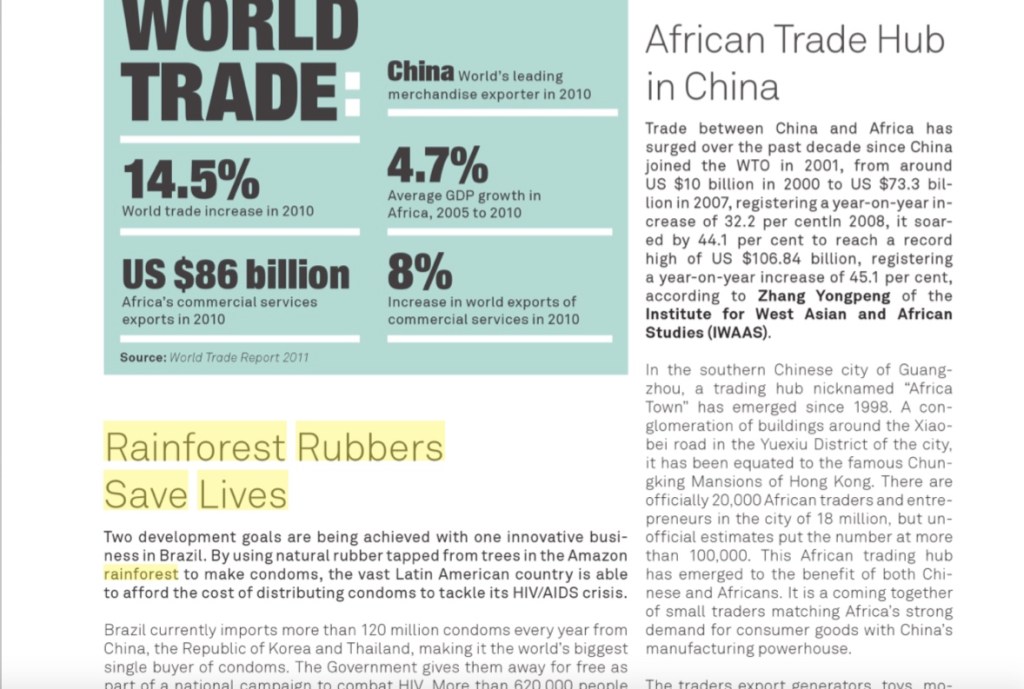
    Two development goals are being achieved with one innovative business in Brazil. By using natural rubber tapped from trees in the Amazon rainforest to make condoms, Brazil is able to afford the cost of distributing condoms to tackle its HIV/AIDS crisis. Brazil currently imports more than 120 million condoms every year from China, Republic of Korea and Thailand, making it the world’s biggest single buyer of condoms. The government gives them away for free as part of a national campaign to combat HIV. More than 620,000 people in Brazil are living with HIV out of a population of more than 186 million (UNAIDS, 2005).

    The Natex company, co-owned by the public health ministry and the north-western state government of Acre, has established a factory to turn rubber from the world’s biggest rainforest into condoms. The business has created 500 jobs at the factory and 150 jobs for the local indigenous population – the Xapuri – who are traditional rubber tappers.

    The factory hopes to produce 100 million condoms a year from local rubber – just 20 million shy of all the condoms the country currently has to import – and could even reach 270 million at full capacity.

    “This product will allow people to make love with security and to better plan their futures,” said Raimundo Barros, vice president of the local agricultural association.

    The 15,000 Xapuri people who live on the Chico Mendes reserve – named after a conservationist and rubber tapper murdered by ranchers in 1988 – tap seringai trees, which produce rubber that is said to be a more effective barrier to the transmission of sexually transmitted diseases (STDs), than synthetic rubber condoms.

    The factory’s 500 employees will earn a total of Reais $2.2 million (US $1.3 million) while the tappers will see their income increase by 250 per cent as demand goes up for the rubber, according to Natex.

    “Because of this I’ve managed to buy a few cows and give my family a better life,” rubber tapper Hugo Paz de Souza, 43, told local newspaper Pagina 20. Paz de Souza said the factory will double his income to US $394 a month.

    The fact the trees will be saved because of their value as sources of rubber is a great boon to the world’s environment. The trees in the Amazon rainforest – the “world’s lungs” as some call it – face the threat of being chopped down to make way for Brazil’s booming agricultural economy. Official figures released in January 2008 showed that between August and December 2007, about 2,700 square miles were chopped down illegally in the Amazon rainforest. It was the first increase in deforestation after three years of declines and coincided with a rise in global food prices.

    Marina Silva, Brazil’s environment minister, told the Guardian newspaper the Natex condom would help create “a new pattern of production and a new process of inclusion that would value the forest being left standing”.

    Published: May 2008

    Resources

    https://davidsouthconsulting.org/2020/12/17/lamas-against-aids/

    https://davidsouthconsulting.org/2020/12/17/philippine-conference-tackles-asias-aids-crisis/

    Development Challenges, South-South Solutions was launched as an e-newsletter in 2006 by UNDP’s South-South Cooperation Unit (now the United Nations Office for South-South Cooperation) based in New York, USA. It led on profiling the rise of the global South as an economic powerhouse and was one of the first regular publications to champion the global South’s innovators, entrepreneurs, and pioneers. It tracked the key trends that are now so profoundly reshaping how development is seen and done. This includes the rapid take-up of mobile phones and information technology in the global South (as profiled in the first issue of magazine Southern Innovator), the move to becoming a majority urban world, a growing global innovator culture, and the plethora of solutions being developed in the global South to tackle its problems and improve living conditions and boost human development. The success of the e-newsletter led to the launch of the magazine Southern Innovator. 
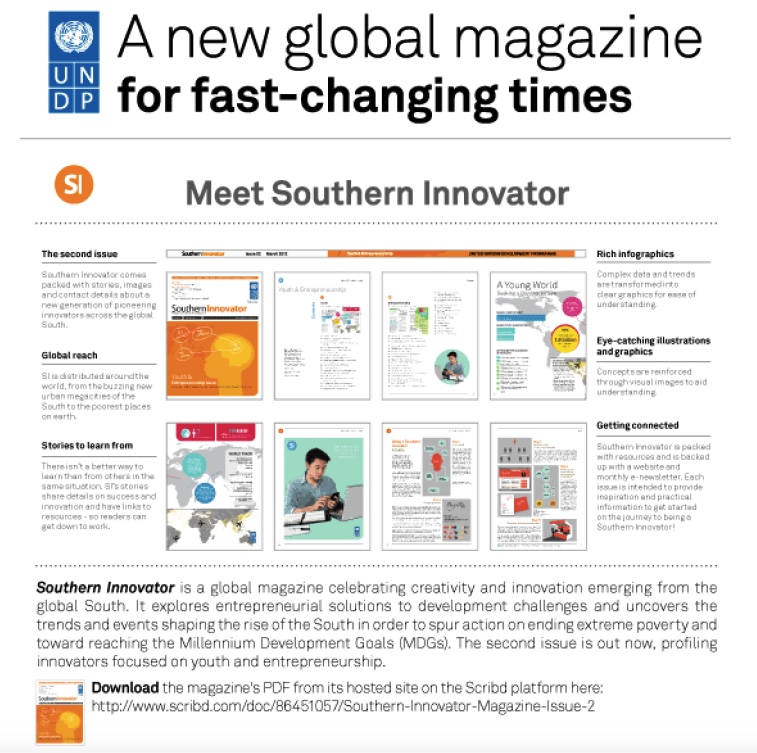
    https://davidsouthconsulting.org/2021/03/05/southern-innovator-issue-2/

    Creative Commons License

    This work is licensed under a
    Creative Commons Attribution-Noncommercial-No Derivative Works 3.0 License.

    ORCID iD: https://orcid.org/0000-0001-5311-1052.

    © David South Consulting 2022

  • New Kenyan Services to Innovate Mobile Health and Farming

    New Kenyan Services to Innovate Mobile Health and Farming

    By David SouthDevelopment Challenges, South-South Solutions

    SOUTH-SOUTH CASE STUDY

    Kenya is home to a vibrant innovation culture centred around mobile phones. While not all the services launched will be successful, the flurry of start-ups shows the country has the right combination of technical skills, bright ideas and cash to make a go of new services.

    With the number of mobile phone users leaping 28 per cent in 2011, to reach 25 million subscribers out of a population of 39 million (Reuters), the country has a large market for mobile phone-based services. Kenya also has 10 million people with access to the Internet, up from 4 million in 2009.

    Two issues critical to the well-being of Kenyans – health services and farming – are being tackled by new mobile phone services. One is a service being run and marketed by a major player in the market, and the other, by a small start-up.

    Statistics indicate that in Kenya, one doctor attends to over 10,000 patients. The World Health Organization recommends a ratio of 1:600. There are just over 7,500 licensed medical facilities in the country.

    Safaricom, Kenya’s largest telecoms operator, is trying to take the pressure off overstretched medical and health systems with a new mobile health service. Its 24-hour health advice and referral service is called ‘Daktari 1525’ and lets people call and speak with a doctor or an expert to get advice on any health issue. The number 1525 refers to the dialling code which links users directly to the Safaricom call centre. Daktari 1525 is available to the 18 million Safaricom subscribers.

    Safaricom has partnered with ‘Call-a-Doc’ to launch the tool. The new service hopes to relieve outpatient departments in government hospitals and health facilities with its advice and referrals. The Daktari 1525 service does not prescribe a treatment to the callers, avoiding the legal risks of remote diagnosis.

    It also offers home remedies and health tips on healthy lifestyles. In an emergency, users can also dial Daktari 1525 if there is Safaricom network coverage.

    The partnership is divided between Safaricom and Call-a-Doc. Safaricom handles all the mobile phone network infrastructure, the call centre facility and the marketing of the service. Call-a-Doc takes care of recruiting doctors.

    But how does the service use the doctors’ time well? The shifts are designed to surge the number of doctors to 15 during peak times, falling to as few as four doctors during off-peak times. The doctors work on a part-time basis and there are currently 50 employed by the service.

    Not everyone is convinced the service will work.

    “It is a good attempt to venture into the field; however we would like to caution the practitioners involved that they must remain ethical and must at all times uphold professional confidentiality,” Medical Practitioners and Dentist Board Chief Executive Officer Daniel Yumbya told Capital News.

    Another new service based in the capital, Nairobi, is trying to shake up the world of farming. Its new mobile phone service, “MFarm: connecting farmers” (http://mfarm.co.ke/) calls itself “a transparency tool for Kenyan farmers”.

    It bills itself as a “factory of ideas” looking to find “creative agribusiness solutions.” The service is a paid-for web platform that helps farmers keep track of prices in the capital, Nairobi, and claims to have signed up 3,000 farmers in the first year of operations.

    The service offers crop prices by sending a text to the numbers 3535 if the user gives the crop location required. As an example, the user texts “price crop location” “price maize Nairobi”. Users can also sell their crops, or buy farm supplies.

    It also allows farmers to group sell their crops by getting together with other small-scale farmers. This is a crucial service because it allows the smaller farmer to sell into the wholesale markets where prices are better. Farmers can also group buy, benefiting from lower prices by buying bulk from suppliers. It cleverly offers several ‘plans’ to suit budgets. There is an ‘Eco Plan’ at the low end, a mid-range ‘Pro Plan’, and a bells-and-whistles option, ‘Biz Plan’.

    The service also benefits from its connections with iHub Nairobi (http://ihub.co.ke/pages/home.php), the buzzing “open space for technologists, investors, tech companies and hackers in Nairobi.” It provides a strong support network to turn to when problems arise.

    It seems as if it would be a mistake to enter the African market with any new tech solution without first checking out the scene in Nairobi.

    Published: January 2012

    Resources

    1) iHub Nairobi: Nairobi’s Innovation Hub for the technology community is an open space for the technologists, investors, tech companies and hackers in the area. The space has a focus on young entrepreneurs, web and mobile phone programmers, designers and researchers. Website: http://ihub.co.ke/pages/home.php

    2) EPROM: Entrepreneurial Programming and Research on Mobiles aims to foster mobile phone-related research and entrepreneurship. Website: http://www.media.mit.edu/ventures/EPROM

    Development Challenges, South-South Solutions was launched as an e-newsletter in 2006 by UNDP’s South-South Cooperation Unit (now the United Nations Office for South-South Cooperation) based in New York, USA. It led on profiling the rise of the global South as an economic powerhouse and was one of the first regular publications to champion the global South’s innovators, entrepreneurs, and pioneers. It tracked the key trends that are now so profoundly reshaping how development is seen and done. This includes the rapid take-up of mobile phones and information technology in the global South (as profiled in the first issue of magazine Southern Innovator), the move to becoming a majority urban world, a growing global innovator culture, and the plethora of solutions being developed in the global South to tackle its problems and improve living conditions and boost human development. The success of the e-newsletter led to the launch of the magazine Southern Innovator. 

    Creative Commons License

    This work is licensed under a
    Creative Commons Attribution-Noncommercial-No Derivative Works 3.0 License.

    ORCID iD: https://orcid.org/0000-0001-5311-1052.

    © David South Consulting 2023

  • Kenyan Mobile Phone Innovations

    Kenyan Mobile Phone Innovations

    By David SouthDevelopment Challenges, South-South Solutions

    SOUTH-SOUTH CASE STUDY

    A couple of enterprising Kenyan engineering students are showing how mobile phones are an inventor’s dream. Their two inventions – one a way to re-charge phones while bicycling, the other an aid for catching fish – show the potential for adapting this technology to the needs of the poor.

    The rapid spread of mobile phones across the South is giving rise to a flurry of invention and experimentation. While many of the new mobile phone-users do not have much money, they are often driven by poverty to invent solutions – and in so doing prove the phones offer many ways to generate income.

    According to the International Telecommunications Union (ITU), Africa is the world’s fastest-growing mobile phone market, and the number of subscribers surpassed 300 million in 2008. The number of mobile phone users in the world passed 4 billion in 2008, and the fastest growth was in the South (ITU). The trend towards increasing development of inexpensive handsets means more phones will be reaching even more poor people in the future.

    Kenya has seen blistering growth in mobile phone ownership: from just 200,000 users in 2000, there are now more than 17.5 million people with mobile phones out of a population of 38.5 million

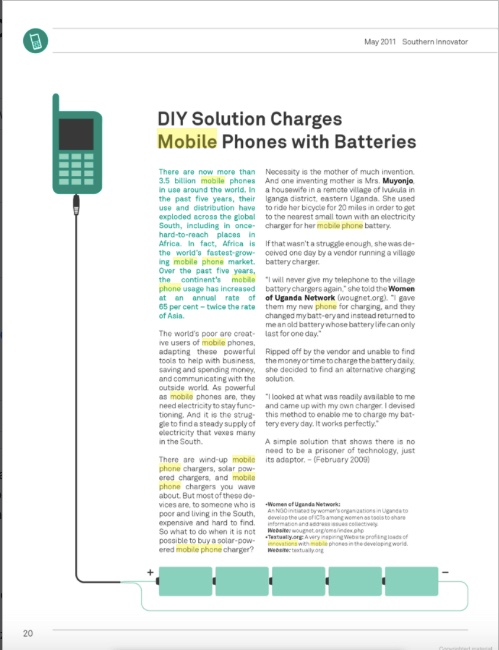
    As powerful as mobile phones are, they need electricity to keep working. The struggle to find a steady supply of electricity vexes many in the South, so finding cheap or free ways to recharge the phones represents a huge market opportunity.

    While mobile phone recharging has become a business in its own right across the South, it is costly as well as time-consuming. Some people spend hours just getting to recharging stations.

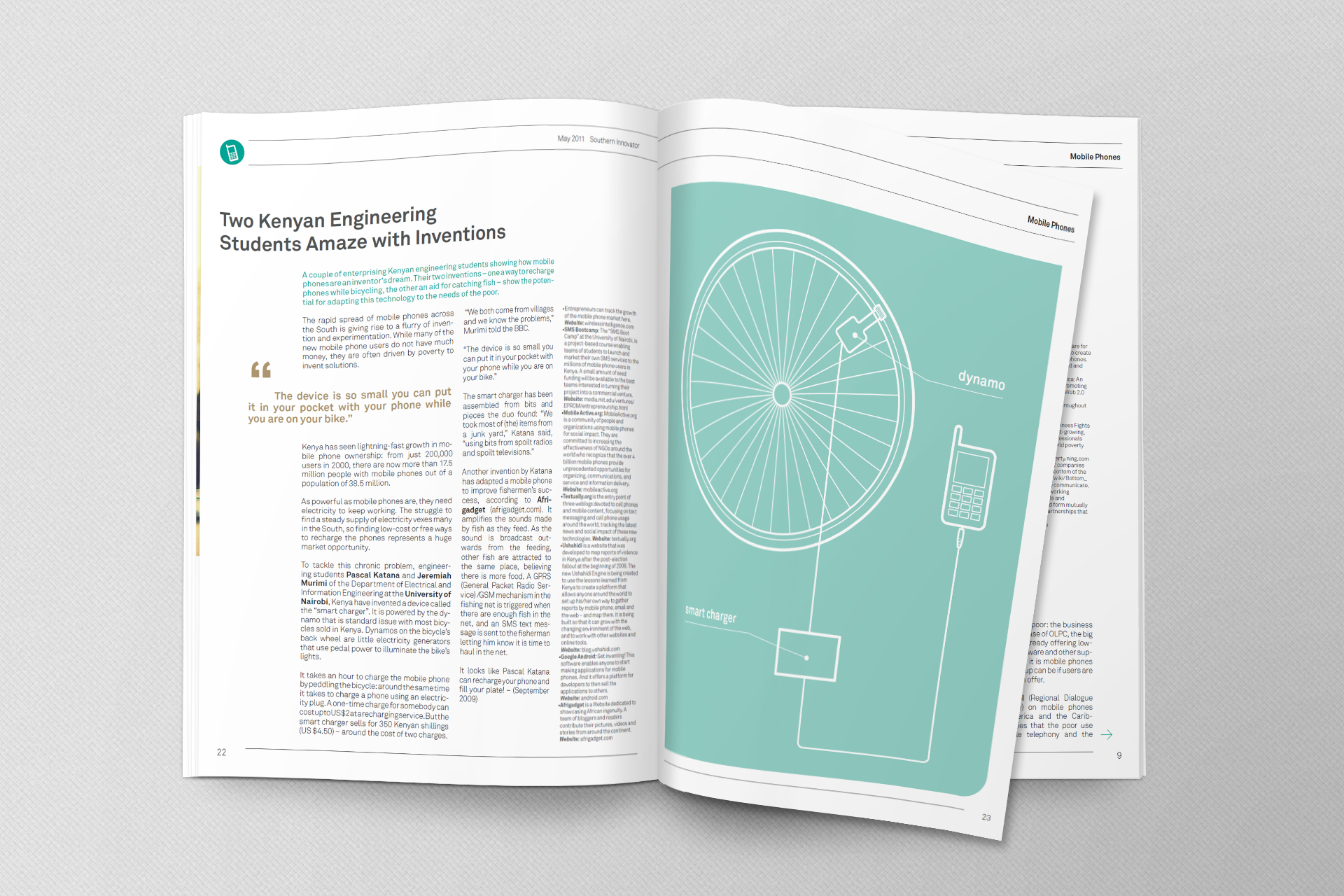
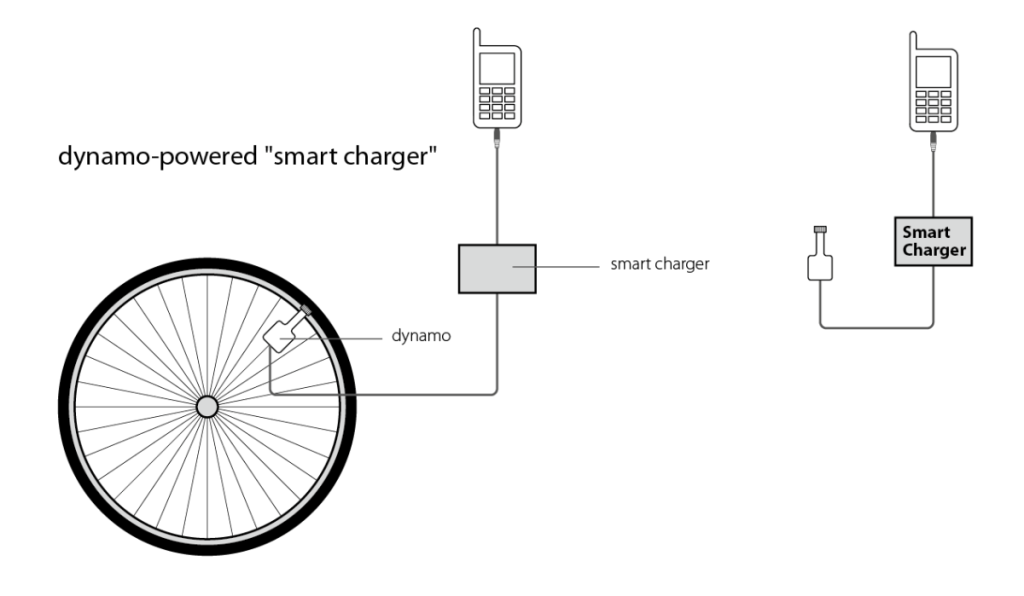
    To tackle this chronic problem, Engineering students Pascal Katana and Jeremiah Murimi of the Department of Electrical and Information Engineering at the University of Nairobi, Kenya (http://uonbi.ac.ke/departments/index.php?dept_code=HE&fac_code=32) have invented a device called the “smart charger.” It is powered by the dynamo that is standard issue with most bicycles sold in Kenya. Dynamos on the bicycle’s back wheel are little electricity generators that use pedal power to illuminate the bike’s lights.

    It takes an hour to charge the mobile phone by peddling the bicycle: around the same time it takes to charge a phone using an electricity plug. A one-time charge for somebody can cost up to US $2 at a recharging service. But the smart charger sells for 350 Kenyan shillings (US $4.50) – around the cost of two charges.

    “We both come from villages and we know the problems,” Murimi told the BBC.

    “The device is so small you can put it in your pocket with your phone while you are on your bike.”

    The smart charger has been assembled from bits and pieces the duo found: “We took most of (the) items from a junk yard,” Katana said. “Using bits from spoilt radios and spoilt televisions.”

    To test the experimental device, workers at the university campus were recruited to have a go.

    “I use a bicycle especially when I’m at home in the rural areas, where we travel a lot,” said campus security guard David Nyangoro. “It’s very expensive nowadays charging a phone. With the new charger I hope it will be more economical, as once you have bought it, things will be easier for you and no more expenses.”

    Kenya’s National Council for Science and Technology (http://www.ncst.go.ke/) has now backed the project and the students are exploring ways to mass-produce the smart charger.

    Another invention by Katana has adapted a mobile phone to improve fishermen’s success, according to Afrigadget (www.afrigadget.com). It amplifies the sounds made by fish as they feed. As the sound is broadcast outwards from the feeding, other fish are attracted to the same place, believing there is more food. A GPRS/GSM (http://en.wikipedia.org/wiki/General_Packet_Radio_Service) mechanism in the fishing net is triggered when there is enough fish in the net, and an SMS text message is sent to the fisherman letting him know it is time to haul in the net.

    It looks like Pascal Katana can re-charge your phone and fill your plate!

    Published: August 2009

    Resources

    1) Entrepreneurs can track the growth of the mobile phones market here. Website: http://www.wirelessintelligence.com

    2) SMS Bootcamp: The “SMS Boot Camp” at the University of Nairobi, is a project-based course enabling teams of students to launch and market their own SMS services to the millions of mobile phone users in Kenya. A small amount of seed funding will be available to the best teams interested in turning their project into a commercial venture. Website: http://eprom.mit.edu/entrepreneurship.html

    3) Mobile Active.org: MobileActive.org is a community of people and organizations using mobile phones for social impact. They are committed to increasing the effectiveness of NGOs around the world who recognize that the over 4 billion mobile phones provide unprecedented opportunities for organizing, communications, and service and information delivery. Website: www.mobileactive.org

    4) Textually.org: is the entry point of three weblogs devoted to cell phones and mobile content, focusing on text messaging and cell phone usage around the world, tracking the latest news and social impact of these new technologies. Website: http://www.textually.org/

    5) Ushahidi: is a website that was developed to map reports of violence in Kenya after the post-election fallout at the beginning of 2008. The new Ushahidi Engine is being created to use the lessons learned from Kenya to create a platform that allows anyone around the world to set up their own way to gather reports by mobile phone, email and the web – and map them. It is being built so that it can grow with the changing environment of the web, and to work with other websites and online tools. Website: http://blog.ushahidi.com/

    6) Google Android: Get inventing! This software enables anyone to start making applications for mobile phones. And it offers a platform for developers to then sell the applications to others. Website: www.android.com/

    7) Afrigadget: is a website dedicated to showcasing African ingenuity. A team of bloggers and readers contribute their pictures, videos and stories from around the continent. Website: http://www.afrigadget.com

    Development Challenges, South-South Solutions was launched as an e-newsletter in 2006 by UNDP’s South-South Cooperation Unit (now the United Nations Office for South-South Cooperation) based in New York, USA. It led on profiling the rise of the global South as an economic powerhouse and was one of the first regular publications to champion the global South’s innovators, entrepreneurs, and pioneers. It tracked the key trends that are now so profoundly reshaping how development is seen and done. This includes the rapid take-up of mobile phones and information technology in the global South (as profiled in the first issue of magazine Southern Innovator), the move to becoming a majority urban world, a growing global innovator culture, and the plethora of solutions being developed in the global South to tackle its problems and improve living conditions and boost human development. The success of the e-newsletter led to the launch of the magazine Southern Innovator. 

    Creative Commons License

    This work is licensed under a
    Creative Commons Attribution-Noncommercial-No Derivative Works 3.0 License.

    ORCID iD: https://orcid.org/0000-0001-5311-1052.

    © David South Consulting 2023

  • Electric Bicycles Become Urban Transport Success

    Electric Bicycles Become Urban Transport Success

    By David SouthDevelopment Challenges, South-South Solutions

    SOUTH-SOUTH CASE STUDY

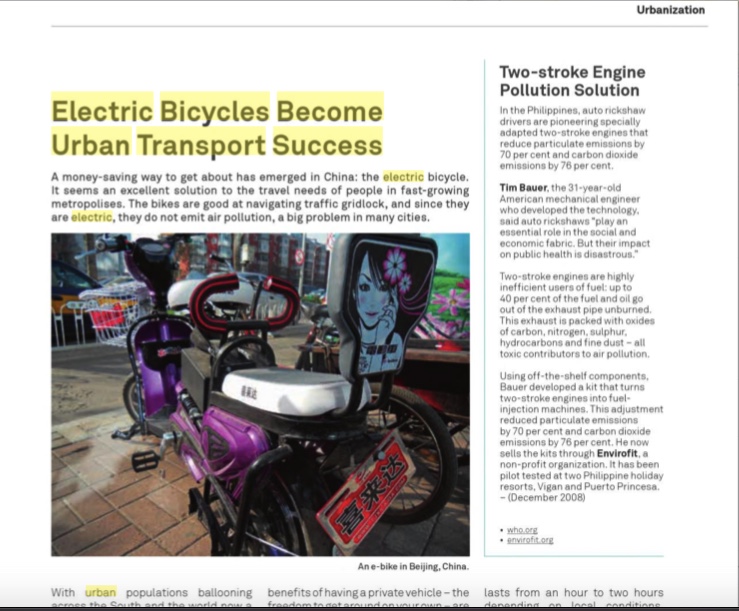
    A money-saving way to get about has emerged in China: the electric bicycle. It seems an excellent solution to the travel needs of people in fast-growing metropolises. The bikes are good at navigating traffic gridlock, and since they are electric they do not emit air pollution, a big problem in many cities.

    With urban populations ballooning across the South – and the world now a majority urban place – the challenge of moving people around economically and cleanly is a big issue. While turning to cars seems an appealing option for people who have raised their incomes, the resulting traffic jams and pollution are a major drawback. Gridlock (http://en.wikipedia.org/wiki/Gridlock) is a daily reality in cities across Asia and Africa.

    The success of e-bikes in China is striking: It is estimated there are four times more electric bikes than cars in the country, 120 million in all. According to the Electric Bikes website (www.electricbikee.com), the number of electric bicycles produced each year has grown from 200,000 eight years ago to 22 million in 2008. It is estimated to be a US $11 billion a year business: a true Southern success story that is going around the world.

    A typical electric bicycle has a rechargeable power pack, with a battery that takes up to four hours to charge and lasts from an hour to two hours depending on local conditions, like hills. The batteries can range from heavy lead acid models (around only 100 charges) to nickel metal to lightweight, long-lasting lithium batteries. The batteries range from 12 volts to 36 volts. How long a battery lasts depends on its energy retention ability, road and temperature conditions and the rider’s weight.

    And while some cities are turning to encouraging more peddle power with human-powered bicycles, this is an unappealing option in hot or humid climates. Who wants to turn up at work hot and sweaty?

    In China, a highly competitive market of manufacturers has sprung up in the last 10 years to provide e-bikes for every taste and need.

    China has a long tradition as a cycling nation: in the 1980s, four out of five commuters used bicycles. But that changed dramatically as people bought cars with their rising incomes.

    In the capital, Beijing, rapid economic development and rising incomes have led to serious traffic congestion. There are over 4 million cars on Beijing’s roads. The pollution in the city is very bad and has led to various campaigns to ban high-polluting vehicles.

    The ensuing traffic gridlock means the benefits of having a private vehicle – the freedom to get around on your own – are eroded as a driver wastes time in long commutes. So, many have turned to the nimble electric bicycles.

    One resident, David Dai, told the BBC “It takes only 10 minutes to ride my electric bike from home to work.”

    “If I took the bus, I’d have to spend time waiting for it, and then I could be trapped in a traffic jam. It could take me half an hour to make the same journey.”

    Competition is fierce in the electric bike market, with shops sometimes sitting side-by-side.

    A manager of a Beijing electric bicycle store, Zhang Zhiyong, puts the success down to this: “Beijing is not like other smaller cities – it’s big. If people ride their bicycles to work, they get really tired. If they drive to work, the roads are often congested,” he told the BBC.

    “But an electric bike is environmentally friendly and convenient. Promoting the use of these bikes would benefit us all.”

    And the price is a definite incentive: just 2,680 yuan (US $390), while cars sell for thousands of dollars.

    The electric bicycles are so successful they are now growing faster than cars in a country that has become the fastest growing car market in the world.

    Some believe the bikes are just a stop gap before people get enough money to buy automobiles. But the bigger trend of growing urban populations and the ensuing traffic jams will ensure they remain a practical option to get around the gridlock.

    Published: April 2010

    Resources

    1) Electric Bike Website: Home to news and links to manufacturers. Also lots of resources on how to convert peddle bikes into electric bikes. Website:http://www.electricbikee.com/

    2) The Luyuan Electric Vehicle Company of Jinhua City in China has been making the bikes for 10 years. They come fully equipped with lights, baskets, fenders and in many colours. Website: http://en.luyuan.cn/?gclid=CJXu_tr576ACFclr4wodG1GsGQ

    3) Empowered Ebikes: An online retailer of e-bikes specializing in urban commuters. Website:http://www.empoweredebikes.com/index.php

    4) Made-in-China.com: A large list of e-bike manufacturers in China and how to contact the dealers and manufacturers. Website: http://www.made-in-china.com/products-search/hot-china-products/E-bike.html

    5) Pedego: An American company making high-end e-bikes. Website: http://www.pedegoelectricbikes.com/index.php

    Development Challenges, South-South Solutions was launched as an e-newsletter in 2006 by UNDP’s South-South Cooperation Unit (now the United Nations Office for South-South Cooperation) based in New York, USA. It led on profiling the rise of the global South as an economic powerhouse and was one of the first regular publications to champion the global South’s innovators, entrepreneurs, and pioneers. It tracked the key trends that are now so profoundly reshaping how development is seen and done. This includes the rapid take-up of mobile phones and information technology in the global South (as profiled in the first issue of magazine Southern Innovator), the move to becoming a majority urban world, a growing global innovator culture, and the plethora of solutions being developed in the global South to tackle its problems and improve living conditions and boost human development. The success of the e-newsletter led to the launch of the magazine Southern Innovator. 

    Creative Commons License

    This work is licensed under a
    Creative Commons Attribution-Noncommercial-No Derivative Works 3.0 License.

    ORCID iD: https://orcid.org/0000-0001-5311-1052.

    © David South Consulting 2023