By 2030, some 5 billion people around the world will live in cities. Next year, 2008, is predicted to be the tipping point, when urban dwellers (3.3 billion people) will outnumber rural residents for the first time. These are the conclusions of UNFPA’s State of the World Population 2007 Report. Even more strikingly, the cities of Africa and Asia are growing by a million people a week. And 72 percent of the population in sub-Saharan Africa live in slum conditions.
But as populations grow — and most will be poor, unemployed and under 25 — it becomes critical that effective solutions are found to ensure people can live with dignity and comfort. And design is being used more and more to overcome this challenge.
George Martine, author of the UNFPA report, is blunt: “We’re at a crossroads and can still make decisions which will make cities sustainable. If we don’t make the right decisions the result will be chaos,” he told the UK newspaper The Independent.
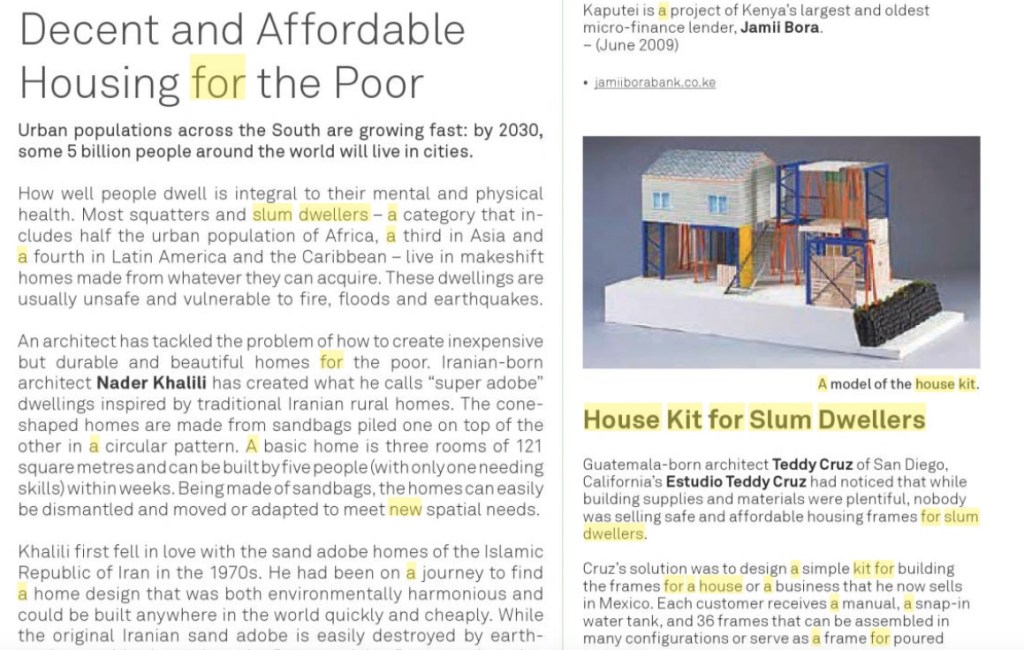
Guatemala-born architect Teddy Cruz of Estudio Teddy Cruz in San Diego, California, joins a small but growing number of socially responsible architects. He applies a concept more associated with middle class shoppers at the furniture design emporium Ikea to the world’s estimated one billion urban slum dwellers (UN-Habitat). Without legal title to the land they live on, packed tightly into densely overcrowded shantytowns, most squatters and slum dwellers live in makeshift homes made from whatever they can get their hands on. This is estimated to include half the urban population of Africa, a third of Asia and a fourth of Latin America and the Caribbean (Click here for more information).
The ad-hoc shelters and houses they build can be dangerously unstable, and vulnerable to natural disaster from flash floods to earthquakes. Cruz had noticed that while building supplies and materials were plentiful, nobody was selling safe and affordable housing frames for slum dwellers. According to the International Labor Organization, formal housing markets in developing countries rarely supply more than 20 percent of housing stock.
Cruz’s solution was to design a simple kit for building the frames for a house or a business that he now sells in Mexico. Each customer receives a manual, a snap-in water tank, and 36 frames that can be assembled in many configurations, or serve as a frame for poured concrete. These sturdy frames can also be added to with locally found materials. Cruz said he was inspired by “the resourcefulness of poverty” and by the cheap and affordable pre-fabricated homes that once were sold by catalogue by the American retailer Sears.
Cruz has been testing the structures in Tijuana, Mexico – a rapidly growing city on the border with the United States and a destination for Mexico’s poor. His work as an architect has centred on exploring how informal settlements grow faster than the cities they surround. These settlements, he says, break the rules and blur the boundaries between what is urban, suburban and rural. Cruz’s frame kits can be used to build a home, or combination of home and business, acknowledging the fact many people need to use their home as a business for a livelihood.
“These start-up communities gradually evolve,” said Cruz., ”or violently explode out of conditions of social emergency, and are defined by the negotiation of territorial boundaries, the ingenious recycling of materials, and human resourcefulness.”
Published: July 2007
Resources
More Urban, Less Poor: The first textbook to explore urban development and management and challenge the notion unplanned shanty towns without basic services are the inevitable consequence of urbanization.
Architecture for Humanity: An NGO to promote architectural and design solutions to global, social and humanitarian crises.
There are many ways to play around with your dwelling and architecture ideas. Here are some products available online:
Arckit: Arckit is a tangible and hands-on design tool for spontaneously bringing your architectural ideas to life right before your eyes. Website: https://www.arckit.com
SmartLab Archi-TECH Electronic Smart House: Build your house and power it up! This creative STEAM toy allows aspiring architects and engineers to design and build modular structures – and then power them up with lights, sounds, sensors, and motorized parts! Website: https://www.mastermindtoys.com/products/smart-lab-archi-tech-electronic-smart-house
Development Challenges, South-South Solutions was launched as an e-newsletter in 2006 by UNDP’s South-South Cooperation Unit (now the United Nations Office for South-South Cooperation) based in New York, USA. It led on profiling the rise of the global South as an economic powerhouse and was one of the first regular publications to champion the global South’s innovators, entrepreneurs, and pioneers. It tracked the key trends that are now so profoundly reshaping how development is seen and done. This includes the rapid take-up of mobile phones and information technology in the global South (as profiled in the first issue of magazine Southern Innovator), the move to becoming a majority urban world, a growing global innovator culture, and the plethora of solutions being developed in the global South to tackle its problems and improve living conditions and boost human development. The success of the e-newsletter led to the launch of the magazine Southern Innovator.
Like this story? Here is a dirty secret: this website is packed with stories about global South innovators. We spent 7 years researching and documenting these stories around the world. We interviewed the innovators to learn from them and we visited them to see how they did it. Why not use the Search bar at the top and tap in a topic and see what stories come up? So, stick around and read some more!
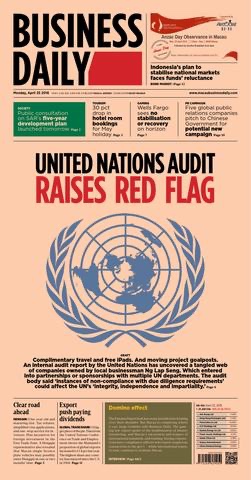
Beginning in 2011 and ending in 2014, each issue of Southern Innovator was launched at the annual Global South-South Development Expo (GSSD Expo) run by the United Nations Office for South-South Cooperation (UNOSSC). The issues (there were five) would connect with that year’s Expo theme and were intended to reinforce the solutions presented at the Expo, as well as those solutions discovered through research for the influential United Nations e-newsletter Development Challenges, South-South Solutions. An Expo was not run in 2015 for the following reason: U.S. Finds Macau Billionaire Guilty in U.N. Bribery Case.
Studies have shown the importance of reading to real change. Not just online, but in paper form. The retention of information and knowledge is greater when a person reads something in a book or a magazine. Another factor is quality design (which makes the published material both attractive and effective). Trashy, gaudy or slap-dash design, while it has its place and context, is not suitable for well-funded, transparent, public organizations seeking to communicate across borders in a professional manner. Southern Innovator was designed following the UN and UNDP design guidelines at the time, while also adhering to the UN Global Compact and the UN Consultants Remuneration Guidelines. The content was also written to follow those guidelines as well as the Plain English Campaign, which seeks to reduce the presence of “gobbledygook, jargon and misleading public information”. On top of this, the magazine benefited from experience: the experience of one of Iceland’s top graphic designers and illustrators, the team based at the UNOSSC in New York who oversaw the editing and proof reading, and the researcher, editor and writer who has led many successful and award-winning publishing ventures, including during “one of the biggest peacetime economic collapses ever”.
“What a tremendous magazine your team has produced! It’s a terrific tour de force of what is interesting, cutting edge and relevant in the global mobile/ICT space… This is great, engaging, relevant and topical stuff.” Rose Shuman, Founder & CEO, Open Mind and Question Box, Santa Monica, CA, U.S.A.
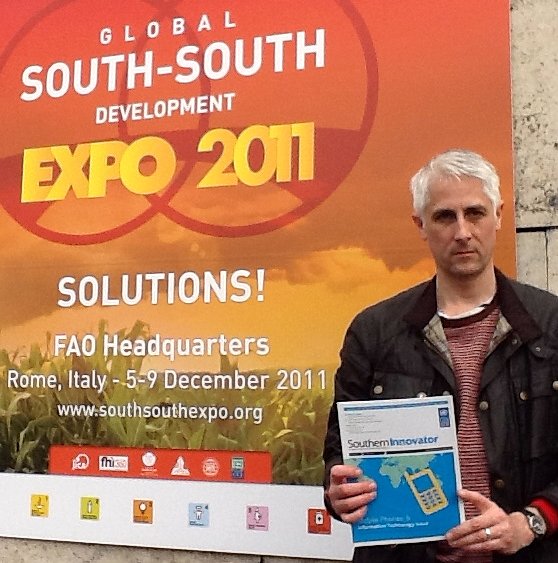
Southern Innovator Issue 1: Mobile Phones and Information Technology was published in 2011 and launched at the Expo in Rome, Italy.
Southern Innovator Issue 2: Youth and Entrepreneurship was published in 2012 and launched at the Expo in Vienna, Austria.Southern Innovator Issue 3: Agribusiness and Food Security was published in 2012 and launched at the Expo in Vienna, Austria.Southern Innovator Issue 4: Cities and Urbanization was published in 2013 and launched at the Expo in Nairobi, Kenya (the first time in Africa).
Issue 6 of Southern Innovator was to be on the theme of science, technology and innovation. Southern Innovator Issue 5: Waste and Recycling was published in 2014 and launched at the Expo in Washington, D.C.
A pioneering technology social enterprise has found a way to connect people around the world to the new digital economy, transforming their lives and providing long-term employment opportunities. It is closing the digital divide in a very practical way, teaching new skills and, most importantly, providing income to the poor and vulnerable.
The San Francisco, USA-based non-profit social enterprise Samasource (samasource.org) uses what it calls microwork – a virtual assembly line of small tasks broken down from a larger project so they can be completed over the Internet – to outsource work to its network of workers around the world.
The tasks in this virtual piecework range from writing to transcribing to organizing online content.
The company organizes the projects using its own online work distribution system connecting workers around the world to the SamaHub in San Francisco. Most of the workers are women, youth and refugees. When they complete their task, it is sent back to the SamaHub in San Francisco where the staff check it and assure its quality. Once approved and completed, the project is returned to the client.
The company was founded in 2008 and draws on experts in “distributed work, economic development, and outsourcing.”
The microwork is divided into three areas: content services, data enrichment and transcription.
Content services can include writing descriptions for online business listings, organizing large databases on information or creating brief descriptions of existing content to make it easier for search engines to find it. “Data enrichment” tackles the vast quantity of information on the Internet that needs to be kept up to date and reliable. It also includes ‘tagging’, where text or images on the Internet need to have appropriate ‘tags’ or labels. And finally, transcription services include digitizing paper documents like receipts or books or transcribing audio and video files for the web.
All these tasks are labour intensive and require high attention to detail. And they are critical to any online business’s success if it wants a reputation for accuracy and consistency.
Samasource is optimistic about its future potential because of the sheer size of the market for business process outsourcing: estimated to be worth over US $100 billion. What Samasource does, called ‘impact sourcing’ – outsourcing to people in the developing world living in poor or remote communities – is a market worth US $5 billion, according to Samasource’s website.
It differs from conventional business process outsourcing in a number of respects, including the educational background of the workers. Most conventional outsourcing goes to college graduates in cities in India, China and the Philippines. Impact outsourcing is done by people with at most a high school education.
The digital economy needs these workers to handle the many millions of detailed tasks required to link together information. It is easy to take this for granted because it is hidden from view, but it is what enables the Internet to function and businesses to thrive. Samasource provides outsourcing services including content moderation and data entry to clients like LinkedIn, Intuit and the US State Department.
“We bring dignified, computer-based work to women, youth, and refugees living in poverty,” said Samasource’s founder and chief executive officer, Leila Janah.
Janah has a background in development studies and formerly worked for the World Bank. This experience convinced her that much foreign aid was failing to target what poor people are really looking for: a job that pays well.
Samasource sees what it does as work, and not handouts.
It also believes it is changing perspectives, proving people from the poorest places on earth can become trustworthy, hard-working knowledge workers.
The Internet is a unique medium because it transcends borders and smooths contact between people with varying linguistic, cultural and educational capabilities.
“The Internet reduces the friction of collaboration across all of these centres and time zones, and with a highly distributed workforce,” said Janah.
Samasource claims to have paid out US $1 million in wages to more than 1,500 workers around the world. Ambitiously, it wants to expand this to reach some of the 144 million youth between 16 and 24 living on less than US $2 a day.
Youth are a particular focus for Samasource. Samasource targets young people who are literate and have received an education but still can’t get a job.
As for the many women employed by Samasource, they were either unemployed or earning poverty-level wages doing precarious work in low-level manufacturing and not building their skills.
Samasource currently has 16 partnerships in Haiti, India, Pakistan, Kenya, Uganda and South Africa. Criteria to work with Samasource includes being in a high-poverty region. Another criteria is for most of the money earned to stay within the region where the work is done and adhere to the standards laid down by Samasource.
Samasource’s success means it has attracted further funding. In December 2011, it was given a US $1.5 million grant from Google.org – the Google.com search engine’s charity. It has also raised US $5 million from non-profit investors, including the Ford Foundation, the Rockefeller Foundation and the eBay Foundation. The challenge for the Samasource model will be to prove, with this new funding, that it can scale its operations to pay out more to its workers than it is taking in to meet its operating costs.
Microwork is turning out to be big work indeed!
Published: January 2012
Development Challenges, South-South Solutions was launched as an e-newsletter in 2006 by UNDP’s South-South Cooperation Unit (now the United Nations Office for South-South Cooperation) based in New York, USA. It led on profiling the rise of the global South as an economic powerhouse and was one of the first regular publications to champion the global South’s innovators, entrepreneurs, and pioneers. It tracked the key trends that are now so profoundly reshaping how development is seen and done. This includes the rapid take-up of mobile phones and information technology in the global South (as profiled in the first issue of magazine Southern Innovator), the move to becoming a majority urban world, a growing global innovator culture, and the plethora of solutions being developed in the global South to tackle its problems and improve living conditions and boost human development. The success of the e-newsletter led to the launch of the magazine Southern Innovator.
Like this story? Here is a dirty secret: this website is packed with stories about global South innovators. We spent 7 years researching and documenting these stories around the world. We interviewed the innovators to learn from them and we visited them to see how they did it. Why not use the Search bar at the top and tap in a topic and see what stories come up? As for my work, I have been involved with start-ups and media ventures since the early 1990s. In the years since I have learned a great deal about innovation and digital and have shared these insights in the stories on this website as well as in the 5 issues of Southern Innovator magazine. So, stick around and read some more!
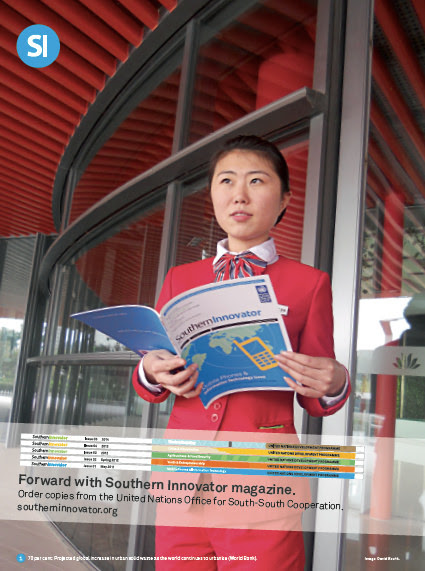
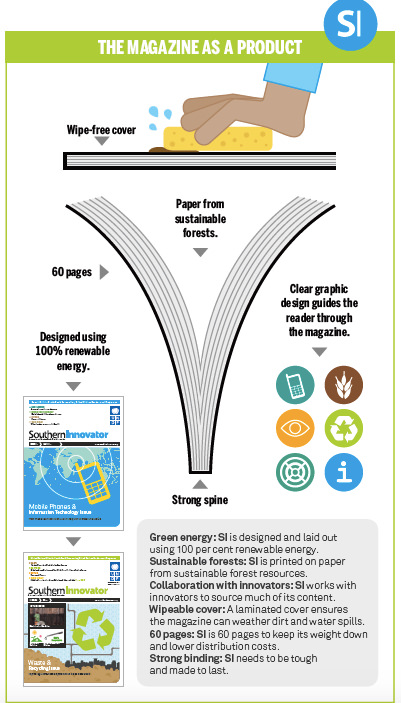
While Southern Innovator’s digital presence has been key to its success and global reach, the hard copy of the magazine was designed with special features. The magazine neded to be robust and able to stand a fair bit of abuse and hard wear. It needed to be easy to read in low light conditions. And it needed to look sharp and eye-catching to reach as wide an audience as possible.
“We will be asking: is bribery business as usual at the UN?”, US Attorney Preet Bharara, October 2015
Disrupted!! Issue 6 of Southern Innovator never came about and here is the story of why. One part of the story is very positive and inspiring; the other part is disappointing and frustrating (though always a risk when working in the international realm).
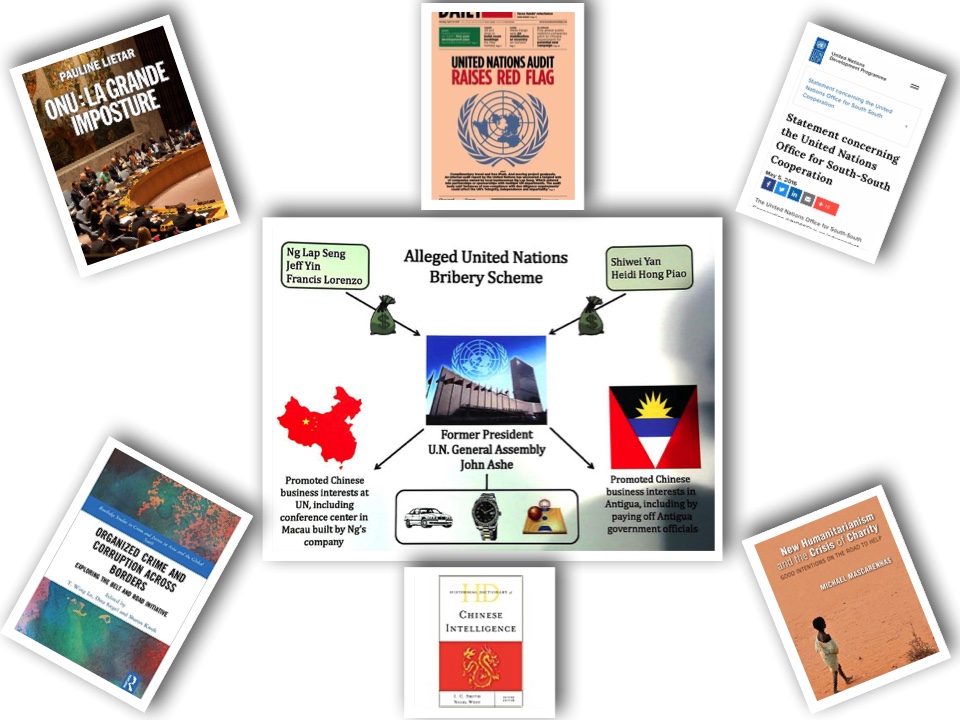
First, the disappointing and frustrating part. We had been working with the UNOSSC (the funder of Southern Innovator) on a scale-up plan which would provide the funds for the brand to better chronicle the global South innovator culture of the 21st century. We had not anticipated various individuals involved with the UNOSSC not only acting in bad faith, but actually being involved with a multinational network to bribe UN officials and launder money into the United States, as was exposed during arrests by US authorities in late 2015 in New York (home of the UNOSSC and the UN’s headquarters). As we found out, gradually, through media coverage and court trial testimonies and confessions under oath by co-conspirators following the arrests, there was a fundamental conflict of interest between the work we were doing and the UNOSSC’s funding relationship with an entity that had its own news agency working out of the United Nations, South-South News. South-South News was established and funded by an Interpol Watch List individual, flagged up as a person not to do business with because of his involvement with human and sex trafficking and international criminal networks. South-South News’ executives pushed for the building of a new “Geneva of Asia” for the UN in Macau, which would also host the UNOSSC’s annual Global South-South Development Expo (GSSD Expo). As confessed by the executives of South-South News, the news agency was established to facilitate bribes to UN officials and launder money into the United States – violating the Foreign Corrupt Practices Act (FCPA). This bribery and corruption case led to the UNOSSC’s budget being suspended pending two internal UN audits.
For the first time, setting a legal precedent, an FCPA case involving bribery and money laundering at the United Nations went all the way to the U.S. Supreme Court. Wrongly, many senior UN officials believe their diplomatic status affords them immunity to legal prosecution, especially under the FCPA. However, this case was a successful enforcement of the FCPA, appealed all the way to the U.S. Supreme Court. The question remains: will future FCPA enforcement actions at the international level test the protection of ‘diplomatic immunity’?
“The FCPA is explicit in defining ‘foreign official’ to include ‘any officer or employee . . . of a public international organization.’ The FCPA defines a public international organization as an organization designated by Executive Order pursuant to Section 1 of the International Organizations Immunities Act (22 U.S.C. § 288) or by Executive order of the President. This includes any ‘public international organization in which the US participates pursuant to any treaty or under the authority of any Act of Congress authorizing such participation or making an appropriation for such participation.’ (22 U.S.C. § 288). For instance, The UN was declared a public international organization by Executive Order 9698 in 1946.”
Books covering the 2015 United Nations SDGs bribery scandal: ONU: La Grande Imposture, Organized Crime and Corruption Across Borders, New Humanitarianism and the Crisis of Charity: Good Intensions on the Road to Help, Historical Dictionary of Chinese Intelligence.
“What a tremendous magazine your team has produced! It’s a terrific tour de force of what is interesting, cutting edge and relevant in the global mobile/ICT space… Really looking forward to what you produce in issues #2 and #3. This is great, engaging, relevant and topical stuff.” Rose Shuman, Founder & CEO, Open Mind and Question Box
And now the positive and inspiring part: Southern Innovator evolved from the e-newsletter Development Challenges, South-South Solutions, first launched in 2006 (and we came on board to research and write stories in 2007). Much has happened since, including the Global Financial Crisis, and the global financial system re-boot that occurred afterwords. Both the e-newsletter and the magazine Southern Innovator fall into the category of ‘crisis media’: media used to bring together a response where the old methods and methodologies no longer work and something has caused system failure. Back in 2007, there was little discussion in the media about the global South, innovation, innovators, social entrepreneurship, and the mobile and information technology revolution occurring in the global South. Both the e-newsletter and the magazine identified a global 21st-century innovator culture that was unique since it was being fuelled by the rapid adoption of mobile and information technologies, often in places with high levels of poverty and turmoil.
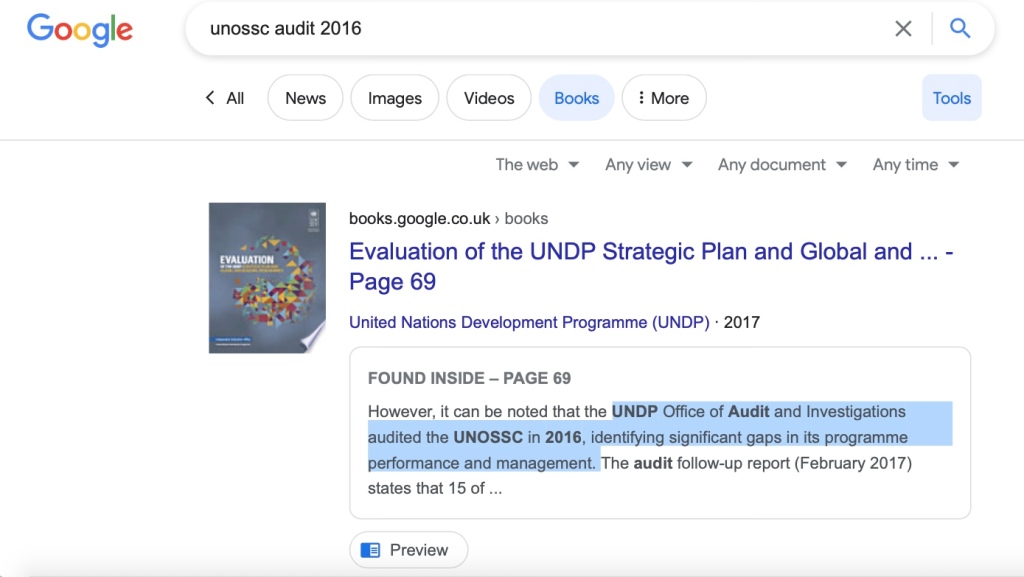
According to the Final evaluation of the performance of the United Nations Office for South-South Cooperation under its strategic framework, 2014-2017, in light of the adoption of the 2030 Agenda for Sustainable Development, prepared by Marcia Brewster, Consultant for the United Nations Office for South-South Cooperation (UNOSSC):
“The reviewer observed that, although the Policy and UN Coordination Unit had produced all of the reports requested by intergovernmental bodies, especially for the High-level Committee, it had not been able to produce many of the publications (evidence-based analytical reports) that had previously been within its purview. Such publications included Southern Innovator magazine and the monthly e-newsletter “Development Challenges, South-South Solutions”. In the case of Southern Innovator, one issue (No. 5 on waste and recycling) was published during the four-year period of the framework but did not have wide online distribution, and issue No. 6 was awaiting funds for publication. The e-newsletter was last issued in July 2014 even though the reviewer found it a good way to communicate with focal points at the national and inter-agency levels. In fact, the shortage of funds for those knowledge products was the main reason that they had ceased being produced during the evaluation period.”
“With respect to the analytical reports previously produced by the Office, such as Southern Innovator, they have not been produced in recent years owing to lack of funding.”
From the beginning, the e-newsletter and magazine were about changing perspectives and inspiring action. And so they have. Rather than say so in my words, I shall offer the words of others as we received them:
“Great economic and business reporting! Very helpful for us.”Africa Renewal, Africa Section, Strategic Communications Division, United Nations Department of Public Information
“I just went over your June newsletter. It’s very well done and far reaching. Congratulations!” Violette Ruppanner, Director, 3D -> Trade – Human Rights – Equitable Economy, Geneva, Switzerland
“Just to let you know I enjoyed the newsletter a lot – it was interesting to learn about things going on that I would never otherwise find out about, and also the listing of future conferences and events proved very useful.” IanSanderson, Deloitte, Geneva, Switzerland
“Congratulations on another great newsletter that’s packed with fascinating information! I really enjoy getting it each month.” Whitney Harrelson, Making Cents, Washington D.C.
Blogger Taline Haytayan from Brighton, England, found a case study on story telling in the South particularly interesting: “I came across this interesting article entitled ‘The South Has a Good Story to Tell’, which talks about storytelling in developing countries, and its use as a critical tool for passing on history, while teaching morals and ethics – so I would like to share it here with you. It’s a nice surprise to see that this article appears in UNDP’s South to South Cooperation unit newsletter. It gives an overview of storytelling in a number of countries, such as the movement of urban storytellers in Colombia, inspired by Italo Calvino; tale-spinners in Argentina; the halakis, or storytelling sages, of Morocco; and digital storytelling by women in South Africa.” (http://talinita.blogspot.com/2008/05/south-has-good-story-to-tell.html)
“A few weeks ago, David South, Development consultant and author of UNDPs Development Challenges, South-South Solutions Newsletter, came by the betterplace office to take a look at our work. When I asked him how he had come about betterplace.org, he answered: he found me on twitter! So much for the twitter-scepticts.” Joana Breidenbach, betterplace.org, Berlin, Germany (http://blog.betterplace.org/en/2009/09/15/690/)
“This is a WONDERFUL site. I read–and at least bookmarked to read again–your stories with the photo of the homeless gentleman “will write HTML code for food,” and of the young African girl who was hungry, and how they are predicting (and it seems inevitable) famine an a high voltage bolt in the poverty percentages. … your writing is phenomenal–the few stories that I have seen are actually SUPERIOR in their professional, technical, and relevant accounts. Their VERY interesting, and I unfortunately have not seen other sources of news lately (other than from my school’s library database, and old Public Broadcasting documentaries). God has blessed your works, and I am thankfully blessed by them!” Sincerely, J. (Au) Whi, (from NowPublic site)
“Many thanks for sending me a copy of your interesting work. I read just one article in Spanish thus far but found it well written and useful. For us here in Colombia, it will be most useful having regular access to your publication and, of course, I am pleased that the articles are in Spanish as well as French and English. I hope that one day I might invite you to take a closer look at the Arranque Automático operation in Colombia and perhaps invite you to do a write-up on the technique and its ample theoretical foundations.” David Cuanespero Boriol, Colombia
“What a tremendous magazine your team has produced! It’s a terrific tour de force of what is interesting, cutting edge and relevant in the global mobile/ICT space… Really looking forward to what you produce in issues #2 and #3. This is great, engaging, relevant and topical stuff.” Rose Shuman, Founder & CEO, Open Mind and Question Box
“Question Box was featured in Southern Innovator, a new publication of UNDP that profiles some of the most innovative ideas coming out of the global South. We were pleased to see many friends in the sector profiled as well, such as Ushahidi, Medic Mobile, and TxtEagle. Take a look at the magazine, as it is a great primer on ICT and mobile innovation from around the globe.” Question Box News.
“Looks great. Congratulations. It’s Brill’s Content for the 21st century!” Conan Tobias, Managing Editor, Canadian Business
What they are saying about SI on Twitter: From @CapacityPlus Nice job RT @ActevisCGroup: RT @UNDP: Great looking informative @SouthSouth1 mag on South-South Innovation; @UNDP Great looking informative @SouthSouth1 mag on South-South Innovation; @JeannineLemaireGraphically beautiful & informative @UNDP Southern Innovator mag on South-South Innov.
“Beautiful, inspiring magazine from UNDP on South-South innovation. Heart is pumping adrenaline and admiration just reading it”
“Thank you David – Your insight into the issues facing us a[s] [a] “global Village” is made real in the detail of your article – 10 out of 10 from the moladi team.” Moladi, South Africa (http://www.moladi.net/index.htm)
“The magazine looks fantastic, great content and a beautiful design!”
“Btw, I really enjoyed reading them, impressive work & a great resource. Looking forward to Issue 6. My best wishes to you & your team at SI.”
“… great magazine, nice design.”
2014 proved a significant year for our work, as Southern Innovator is cited in various strategy documents as a resource contributing to a shift in funding priorities at the United Nations and other international development funders, and the adoption of South-South innovation as a key part of the UN’s work. The e-newsletter and magazine are also cited in many papers and books and are clearly contributing to a better understanding of the 21st-century global South innovator culture.
By 2015, Southern Innovator was still drawing praise for its timely resources on South-South innovation and innovators:
“@SouthSouth1 is one of the best sources out there for news and info on #solutions to #SouthSouth challenges.” Adam Rogers, Assistant Director, Regional Representative, Europe, United Nations Office for South-South Cooperation (UNOSSC)















 David South Consulting
You must be logged in to post a comment.