Tag: SDGs

  • Landmark Study Finds Simple Toys Key to Boosting Educational Development and Meeting MDGs

    Landmark Study Finds Simple Toys Key to Boosting Educational Development and Meeting MDGs

    By David SouthDevelopment Challenges, South-South Solutions

    SOUTH-SOUTH CASE STUDY

    African youth need to play more according to a new landmark study published in the UK’s leading medical journal, The Lancet. The study tackles the high rates of illiteracy and educational under-achievement in Africa and finds that malnourishment and lack of stimulation are leaving millions unable to benefit from schooling. It found projects that encouraged learning through play led to children boosting their IQs and getting better reading skills. And it comes up with a very simple and low-cost solution – but excellent opportunity for entrepreneurs – toys and play.

    “These are not high tech interventions,” said team leader for the study, Professor Sally McGregor of the Institute of Child Health of University College London. “Research over decades in Jamaica (and other countries) has shown that women with only primary school-level education and a few home made toys can be trained to make a significant difference in the education, intelligence and mental health of disadvantaged children. The Millennium Goal of universal primary education for all cannot be met unless these children’s poor development is tackled.”

    The paper – Strategies to Avoid the Loss of Developmental Potential among Over 200 Million Children in the Developing World – is published in three parts in the journal.

    Twenty projects around the world were evaluated for the benefits they produce for children under five who use toys. McGregor, who has set up several projects in Kenya, Tanzania and Uganda designing and constructing toys using whatever materials are available, was appalled by the widespread neglect of play throughout these countries. With play, the study found children read better, have better mental health and better self-esteem. In Africa it is ‘desperate, really desperate’ she says.

    African primary school enrolments and literacy rates are among the lowest in the world, with over 42 million school children in sub-Saharan Africa not enrolled in school, and many children not able to afford to go or stay in primary school. Today a little more than half of African adults are literate and some 60 per cent of children go to school, according to UNESCO. The agency has forecasted the need for an additional 1.6 million teachers in Sub-Saharan African classrooms by 2015 – an increase of 68 percent.

    The materials used to construct the toys do not need to be expensive or sophisticated. Toys can be constructed from banana trees, mud, corn on the cob, old plastic bottles, or cloth and straw dolls. It is key that the toys are safe for children under five and that anyone building such toys for sale must follow existing manuals.

    McGregor continues: ‘One mother in a village was doing marvellous things with tiny scraps of material to make a doll. She received no recognition in the village for the work she was doing yet it was so important. It doesn’t take much – dolls or simple wooden blocks – they are so versatile. You see schools with nothing – it is unforgivable. The problem is how poor these people are – food just takes priority over toys – it is that stark.”

    Locally produced toys are key to resolving this crisis for several reasons. Cost is the most important, with those most adversely affected also the least able to pay for toys and who are already living a precarious existence where basic survival takes precedence over play. Another factor is Africa being home to the countries who import the least number of toys: Somalia, Liberia, Togo, Rwanda and Chad. But the situation for African toymakers is often desperate as well, with many craft workers living at the economic margins. Several initiatives have emerged in the last couple of years to address this problem and ensure African toys are local and toymakers earn a living.

    Initiatives like the African Toyshop based in Johannesburg, South Africa – a fair trade business – work to ensure African toymakers can make a living and get their wares to as wide a market as possible. The toymakers featured all use natural resources or recycled materials. Most work at the village level and produce toys that are culturally relevant to Africa. The organization COFTA – Cooperation For Fair Trade in Africa – is a network of Fair Trade producer Organizations in Africa involved and working with disadvantaged grassroots producers to eliminate poverty through fair trade. It is an excellent resource for grassroots organizations wanting to work with African toymakers.

    Published: January 2007

    Resources

    The UK charity TALC – Teaching-aids At Low Cost – is planning to make available toy making manuals on a CD. Tel: (0) 1727 853869

    This website also has excellent resources for budding toy and play area makers in Africa.

    Online exhibition of African toys: Click here

    Book: Africa on the Move: Toys from West Africa Stefan Eisenhofer, Karin Guggeis, Jacques Froidevaux Stuttgart, Germany: Arnoldsche, 2004. 216 pp., 195 color, 28 b/w illustrations. $75.00, cloth.

    SDG Resource Centre: The southern origins of sustainable development goals: Ideas, actors, aspirations.

    https://davidsouthconsulting.org/2021/06/02/case-study-5-gosh-ich-child-health-portal-2001-2003/

    https://davidsouthconsulting.org/2021/02/05/channel-regulation-swedes-will-fight-childrens-advertising-all-the-way/

    https://davidsouthconsulting.org/2021/07/29/infographics-2005-2014/

    https://davidsouthconsulting.org/2021/03/04/innovation-villages-tackling-mdgs/

    https://davidsouthconsulting.org/2016/04/14/interviews-for-the-gosh-child-health-portal-2001-2003-14-april-2016/

    https://davidsouthconsulting.org/2020/12/10/one-world-youth-conferences-mongolia-1998-1999/

    https://davidsouthconsulting.org/2021/03/05/southern-innovator-issue-2/

    https://davidsouthconsulting.org/2020/12/09/study-finds-simple-toys-key-to-boosting-educational-development-january-2007/

    https://davidsouthconsulting.org/2022/10/27/tapping-the-power-of-child-play/

    https://davidsouthconsulting.org/2021/02/11/turning-street-children-into-entrepreneurs/

    Creative Commons License

    This work is licensed under a
    Creative Commons Attribution-Noncommercial-No Derivative Works 3.0 License.

    ORCID iD: https://orcid.org/0000-0001-5311-1052.

    © David South Consulting 2023

  • Prisons With Green Solutions

    Prisons With Green Solutions

    By David SouthDevelopment Challenges, South-South Solutions

    SOUTH-SOUTH CASE STUDY

    An ingenious solution is helping Rwanda reduce the cost of running its bursting prisons, while improving conditions for the prisoners and helping protect the environment.

    The country’s prison population soared to a peak of 120,000 suspects awaiting trial for their role in the 1994 genocide, in which 800,000 Tutsis and moderate Hutus were killed. The traditional court system, gacaca, is being used for national reconciliation, but the process is slow and costly for a country where 90 per cent of the population exist on subsistence agriculture, and where food production has dropped below 70 per cent of the levels needed for self-sufficiency (USAID).

    But thanks to enormous, bee-hive shaped human manure digesters, a steady supply of biogas is on tap for cooking and lighting at prisons – the first country in Africa to do this. Five of the country’s largest prisons – two at Gitarama and one each in Butare, Kigali and Cyangugu – now have biogas plants producing 50 per cent of the gas needed to cook for prisoners. It has also saved half of each prison’s US $44,000 a year firewood costs. The money saved is being ploughed back into renovations to the prisons to improve conditions, and to provide more services like healthcare.

    Biogas is produced from the fermentation of household or agricultural waste or animal or human feces, and has become a viable alternative when traditional gas sources become more expensive. The waste is placed in a 150 cubic meter beehive-shaped digester and fermented until a gas is produced. According to lead engineer on the project, Ainea Kimaro, 100 cubic meters of waste is turned into 50 cubic meters of fuel by bacteria devouring the manure in just four weeks.

    The digesters are a project of the Kigali Institute of Sciences, Technology and Management ‘s Center for Innovations and Technology Transfer.

    “Biogas kills two birds with one stone,” Kimaro told the BBC. It gets rid of all the human waste and helps cover the enormous costs of feeding so many prisoners. Prior to the digesters, the quantity of human waste was a real problem: it was flooding down hillsides and leaking into rivers and lakes.

    A school, the Lycee de Kigali , also has a digester. “The methane gas is used to cook for 400 students and for operating Bunsen burners in the school laboratories”, Kimaro said.

    Many would think this a smelly affair, but in fact the whole process isn’t that pungent. Most of the digester is underground and the gas produced burns a clean, blue smokeless flame. It is much cleaner than the smoke from firewood. The remaining sludgy residue is used as an odourless compost for soil. This is used in the prison gardens to grow maize, mangos, bananas and tomatoes – all of which ends up back on the prisoner’s plates, improving the quality of their nutrition.

    “The firewood savings are excellent – they really make a difference for us,” a Cyangugu prison warden said, adding that the odour-free compost had done wonders for the prison gardens. “Look at all these bananas! This fertiliser really is the best,” he said to the BBC.

    In Uganda, human urine and feces are being mixed with banana peels, algae, water hyacinth and poultry droppings to make biogas. In Uganda’s rural Mukono district, biogas is used for cooking, lighting pressure lamps and to power engines. The slurry left over is then used to fertilise the soil. For Ugandans, most of whom are rural dwellers, electricity is rare and petrol to run generators and refrigeration units is expensive.

    “It keeps the environment free of organic wastes, is convenient, time-saving and reduces smoke-related illnesses often associated with the use of firewood,” said Patrick Nalere, country director of the Heifer Project International, an American NGO which shares livestock and knowledge to reduce poverty. “If the majority of Ugandans adopted biogas, we would preserve our biodiversity. People should exploit decomposing raw materials, which are free. Therefore, no monthly power tariffs.”

    Published: February 2008

    Development Challenges, South-South Solutions was launched as an e-newsletter in 2006 by UNDP’s South-South Cooperation Unit (now the United Nations Office for South-South Cooperation) based in New York, USA. It led on profiling the rise of the global South as an economic powerhouse and was one of the first regular publications to champion the global South’s innovators, entrepreneurs, and pioneers. It tracked the key trends that are now so profoundly reshaping how development is seen and done. This includes the rapid take-up of mobile phones and information technology in the global South (as profiled in the first issue of magazine Southern Innovator), the move to becoming a majority urban world, a growing global innovator culture, and the plethora of solutions being developed in the global South to tackle its problems and improve living conditions and boost human development. The success of the e-newsletter led to the launch of the magazine Southern Innovator.  

    Follow @SouthSouth1

    Google Books: https://books.google.co.uk/books?id=waeXBgAAQBAJ&dq=Development+Challenges+February+2008&source=gbs_navlinks_s

    Slideshare: http://www.slideshare.net/DavidSouth1/development-challengessouthsouthsolutionsfebruary2008issue

    Southern Innovator Issue 1: https://books.google.co.uk/books?id=Q1O54YSE2BgC&dq=southern+innovator&source=gbs_navlinks_s

    Southern Innovator Issue 2: https://books.google.co.uk/books?id=Ty0N969dcssC&dq=southern+innovator&source=gbs_navlinks_s

    Southern Innovator Issue 3: https://books.google.co.uk/books?id=AQNt4YmhZagC&dq=southern+innovator&source=gbs_navlinks_s

    Southern Innovator Issue 4: https://books.google.co.uk/books?id=9T_n2tA7l4EC&dq=southern+innovator&source=gbs_navlinks_s

    Southern Innovator Issue 5: https://books.google.co.uk/books?id=6ILdAgAAQBAJ&dq=southern+innovator&source=gbs_navlinks_s

    Creative Commons License
    This work is licensed under a
    Creative Commons Attribution-Noncommercial-No Derivative Works 3.0 License.

    ORCID iD: https://orcid.org/0000-0001-5311-1052.

    © David South Consulting 2023

  • Digital Mapping to put Slums on the Map

    Digital Mapping to put Slums on the Map

    By David SouthDevelopment Challenges, South-South Solutions

    SOUTH-SOUTH CASE STUDY

    Mobile phones are more and more part of daily life in the South’s slums – even for the poorest people. One result is that it has now become possible to undertake digital mapping initiatives to truly find out who is where and what is actually going on.

    About one-third of the world’s urban dwellers live in slums, and the United Nations estimates that the number of people living in such conditions will double by 2030 as a result of rapid urbanization in developing countries. How to improve their living conditions and raise their standard of living is the big challenge of the 21st century.

    With just over five years until the 2015 deadline to meet the Millennium Development Goals (http://www.undp.org/mdg/), and the current economic downturn reversing some gains, any tool that can make development decisions more precise has to be a benefit.

    People are now turning to the growing penetration of digital technologies into slums and poor areas to find solutions. With mobile phones available across much of the global South, and plans underway to expand access to broadband internet even in poorly served Africa, it is becoming possible to develop a digital picture of a slum area and map its needs and population.

    Put to the right use, this powerful development tool can fast-track the delivery of aid and also better connect people to markets and government services.

    In November, an NGO called Map Kibera (www.mapkibera.org) began work on an ambitious project to digitally map Africa’s largest slum, Kibera in Nairobi, Kenya .

    The partners behind Map Kibera are Humanitarian OpenStreetMap, JumpStart International, WhereCampAfrica, the Social Development Network, Pamoja Trust, Hands on Kenya and others.

    Estimates place the number of residents in Kibera at one million, but nobody really knows how many live there (UN-HABITAT). The slum is typical of such deprived areas, lacking in health and water resources and plagued by chaotic traffic and housing. Few fully grasp where everything is in the sprawl.

    While data does exist on the slum, it is not shared or collated into one source. The Map Kibera project uses an open-source software programme, OpenStreetMap (http://www.openstreetmap.org/), to allow users to edit and add information as it is gathered. This information is then free to use by anybody wanting to grasp what is actually happening in Kibera: residents, NGOs, private companies and government officials.

    This will literally put Kibera on Kenya’s map.

    The mapping team started with 12 young people recruited in Kibera to start the work in November of this year. They will be trained and also receive support from the growing Nairobi technology community.

    “The project will provide open-source data that will help illustrate the living conditions in Kibera,” said Map Kibera’s Mikel Maron. “Without basic knowledge of the geography of Kibera it is impossible to have an informed discussion on how to improve the lives of residents of Kibera.”

    Workshops will communicate with local residents and show them the findings available from the map. Paper maps will be distributed to residents and then updated as new information comes in. It is critical local people are kept informed to build trust and avoid conflict. As can be seen from the Google Street Views (http://www.google.co.uk/help/maps/streetview/) controversy, nobody likes to be mapped without their permission or consent.

    Like Kenya, Brazil has a long history of sprawling slums sprouting around its cities. Called favelas, they are complex places, with both rudimentary dwellings and elaborate mansions. Walking into a favela can be a journey through the dreams and aspirations of generations of people, often reflected in their dwellings. Favelas have many services, including hospitals, and there are restaurants and coffee shops. In short, while they are not in the official development plans, the favelas are vibrant economic entities and home to hundreds of thousands of people.

    But since they are chaotic and undocumented by official maps, the economic and social development of the favelas is hindered as even basic services like mail delivery are difficult to provide.

    An NGO called Rede Jovem (http://www.redejovem.org.br/) is deploying youths armed with GPS (global positioning system)-equipped (http://en.wikipedia.org/wiki/Global_Positioning_System) mobile phones to map the favelas of Rio de Janerio. To start with, they are mapping five favelas: Complexo do Alemão, Cidade de Deus, Morro do Pavão-Pavãozinho, Morro Santa Marta and Complexo da Maré.

    “The main goal was to mark public interest spots on a map and show places like schools and institutions and hospitals and restaurants,” Natalia Santos, the executive coordinator for Rede Jovem, told MobileActive (www.mobileactive.org) . “We wanted to spread the news about what slums do have, so all the people can get to know that the slum is not just a place for violence and marginality and robbery.”

    The mapping process works like this: the mappers physically travel around the favela and upload information on each, individual landmark (restaurants, roads etc.) as they go. They use Nokia N95s mobile phones that are connected to Google Maps (www.maps.google.com).

    According to Santos, reporters enter the information on the map displayed on the phone, and they can video or photograph to add more detail. They are using Wikimapa (www.wikimapa.org.br), and Twitter (www.twitter.com) to log the information.

    As Rede Jovem recruited young mappers, they discovered an interesting fact: the male reporters (aged between 17 and 25) were frightened to enter a favela with a mobile phone for fear of either being mugged or being stopped by the police. Because of this fact, all the mappers are young women.

    They are ambitious for the future despite their funds running out in December. “We want everyone who has a cell phone with GPS to be a wikireporter,” said Santos .

    How important it is to the favela residents to be recognised like this can’t be overstated. “I think they are very happy because they’re seeing that they exist,” said Santos. “And the mailman says that now he can deliver the mail.”

    Published: December 2009

    Resources

    • Mobile Active.org: MobileActive.org is a community of people and organizations using mobile phones for social impact. They are committed to increasing the effectiveness of NGOs around the world who recognize that the over 4 billion mobile phones provide unprecedented opportunities for organizing, communications, and service and information delivery. Website: http://www.mobileactive.org
    • Google Android: Get inventing! This software enables anyone to start making applications for mobile phones. And it offers a platform for developers to then sell the applications to others. Website: http://www.android.com/
    • Ushahidi: is a website that was developed to map reports of violence in Kenya after the post-election fallout at the beginning of 2008. The new Ushahidi Engine is being created to use the lessons learned from Kenya to create a platform that allows anyone around the world to set up their own way to gather reports by mobile phone, email and the web – and map them. It is being built so that it can grow with the changing environment of the web, and to work with other websites and online tools. Website: http://blog.ushahidi.com/
    • Textually.org: is the entry point of three weblogs devoted to cell phones and mobile content, focusing on text messaging and cell phone usage around the world, tracking the latest news and social impact of these new technologies. Website: http://www.textually.org/
    • Betavine Social Exchange has launched. It’s a matching site for NGOs looking for mobile solutions, and developers who can help build them, all brought to you by Vodafone. Website: http://www.betavine.net

    Citations

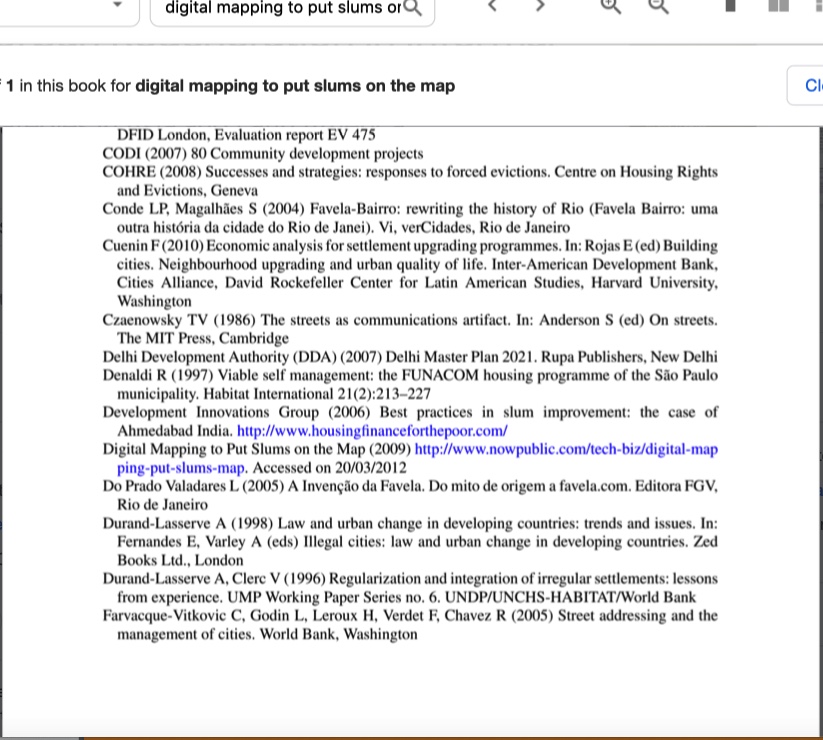
    Resilient Urban Regeneration in Informal Settlements in the Tropics: Upgrading Strategies in Asia and Latin America, Publisher: Springer Singapore (2020)

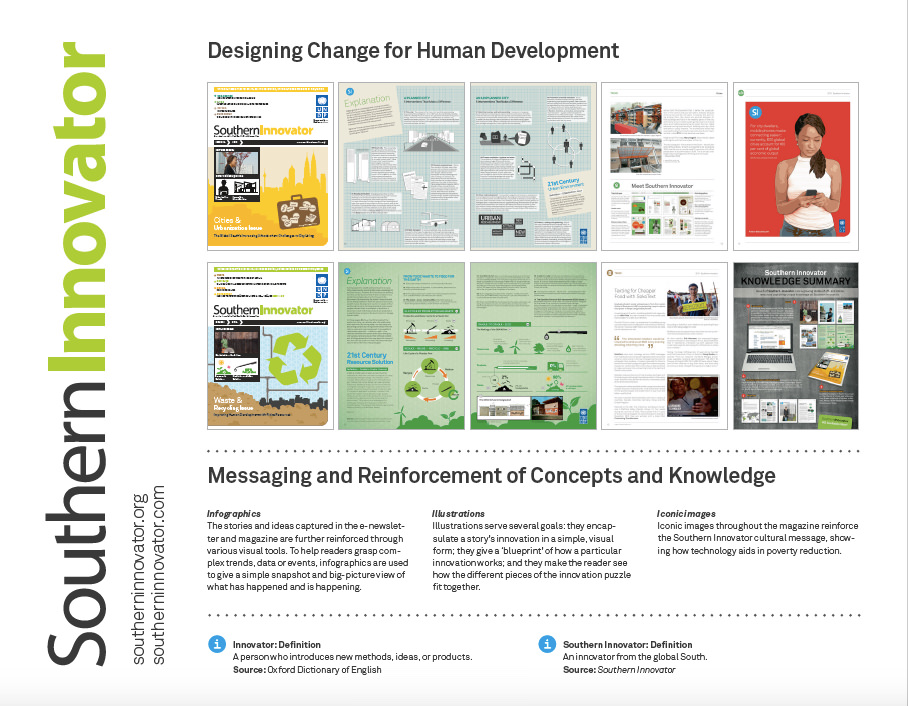
    The story first appeared in the UN e-newsletter Development Challenges, South-South Solutions in 2009. It was simultaneously published on the Vancouver, Canada-based crowd-powered news website, NowPublic. It was then published in the UN magazine Southern Innovator.

    Streets as Tools for Urban Transformation in Slums: A Street-led Approach to Citywide Slum Upgrading, Publisher: United Nations Human Settlements Programme (UN-Habitat) (2012)

    Other Stories on Mapping

    https://davidsouthconsulting.org/2021/08/28/african-entrepreneur-wants-to-bring-order-to-urban-chaos/

    https://davidsouthconsulting.org/2020/12/04/big-data-can-transform-the-global-souths-growing-cities/

    https://davidsouthconsulting.org/2021/03/04/indian-id-project-is-foundation-for-future-economic-progress/

    https://davidsouthconsulting.org/2022/10/31/mapping-beirut-brings-city-to-light/

    https://davidsouthconsulting.org/2022/10/17/mapping-to-protect-kenyas-environment-the-emazingira-solution/

    https://davidsouthconsulting.org/2021/03/31/new-weapon-against-crime-in-the-south/

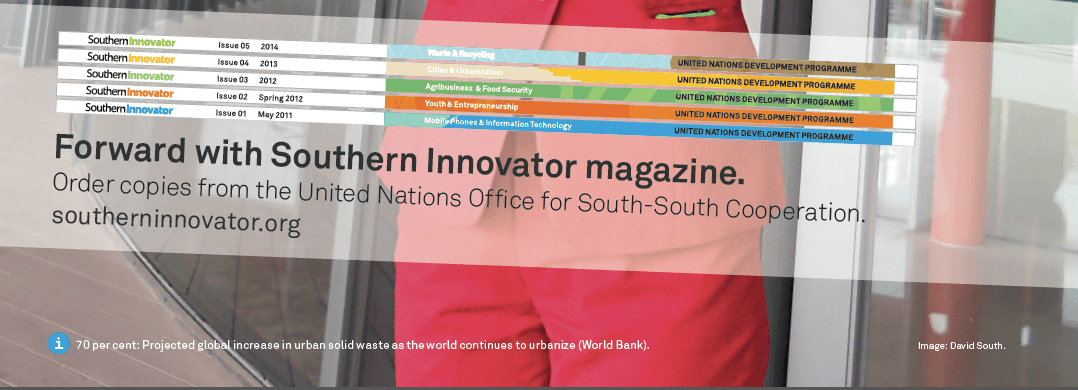
    By 2014, Southern Innovator had published five issues and become a recognised global innovation brand.

    https://davidsouthconsulting.org/2021/03/05/southern-innovator-issue-4/

    Follow @SouthSouth1

    Slideshare: http://www.slideshare.net/DavidSouth1/development-challengessouthsouthsolutionsnovember2010issue

    Southern Innovator Issue 1: https://books.google.co.uk/books?id=Q1O54YSE2BgC&dq=southern+innovator&source=gbs_navlinks_s

    Southern Innovator Issue 2: https://books.google.co.uk/books?id=Ty0N969dcssC&dq=southern+innovator&source=gbs_navlinks_s

    Southern Innovator Issue 3: https://books.google.co.uk/books?id=AQNt4YmhZagC&dq=southern+innovator&source=gbs_navlinks_s

    Southern Innovator Issue 4: https://books.google.co.uk/books?id=9T_n2tA7l4EC&dq=southern+innovator&source=gbs_navlinks_s

    Southern Innovator Issue 5: https://books.google.co.uk/books?id=6ILdAgAAQBAJ&dq=southern+innovator&source=gbs_navlinks_s

    Creative Commons License

    This work is licensed under a
    Creative Commons Attribution-Noncommercial-No Derivative Works 3.0 License.

    ORCID iD: https://orcid.org/0000-0001-5311-1052.

    © David South Consulting 2022

  • Vietnamese Google Rival Challenging Global Giant

    Vietnamese Google Rival Challenging Global Giant

    By David South, Development Challenges, South-South Solutions

    New UNOSSC banner Dev Cha 2013

    SOUTH-SOUTH CASE STUDY 

    Information technologies are creating new business opportunities across the global South. As more and more people gain access to the Internet in one form or another, opportunities to offer them services also increase.

    A number of key trends show how the Internet’s profile is being reshaped by the growing number of users from the global South. One of those trends is language. English was the first language to dominate the Internet – but this is changing, according to the latest data.

    China has the largest number of Internet users in the world (China Internet Network Information Center) and the Chinese language is the second-most often used online, behind English and before Spanish and Japanese (http://www.internetworldstats.com/stats7.htm).

    While most English-language users turn to the giant Google search engine to look things up on the Internet, Google also has many rivals chasing its tail. In China, Baidu (baidu.com) offers searches in Mandarin using Chinese characters, making the Internet easier to navigate for Mandarin speakers. Elsewhere, Arabic language Internet users are being offered new services and urls using Arabic characters.

    In short, the Internet is becoming multilingual, customized and local, and creating new opportunities with it.

    One new business in Vietnam is challenging Google with its own locally tailored search engine. Called Coc Coc (http://coccoc.com/) – Knock Knock in English – it has already spent US $10 million to hire 300 staff at its Hanoi base, according to the Associated Press. Whether Coc Coc is successful or not in the long term, it is clear as a business it is already helping the local economy by hiring so many people and investing in Vietnam. Google currently does not have any staff in Vietnam because of its concerns about legal conflict with the government over censorship of content on the Internet, AP reports.

    Coc Coc believes it has developed a system that better understands the grammar, syntax and nuances of the Vietnamese language. Another advantage it believes it has over Google is its large presence on the ground in Vietnam. With a headquarters in Hanoi, it can quickly make marketing deals and agreements with content providers. To further its local advantage, Coc Coc has dispatched camera crews and photographers to film and photograph streets and log the details of shops, cafes and businesses – all to make search results more accurate and richer in detail.

    The headquarters is spread out over four floors of a downtown office block in Hanoi, and according to the Associated Press has a relaxed atmosphere similar to that found in many places in California’s technology start-up culture.

    Coc Coc is a joint Russian-Vietnamese venture and is hoping to ride the fast-growing Asian Internet market by offering a search tool that understands the nuances of the Vietnamese language online. By using algorithms (https://en.wikipedia.org/wiki/Algorithm) it promises to give a faster and better search experience to Vietnamese-language users. It also uses its knowledge of the local scene to  tailor results to users’ needs.

    The plan is to spend US $100 million during the next five years to lure 97 per cent of Vietnamese Internet users to make the switch from Google.

    “When I came here, I had some understanding why Vietnam was a good market to beat Google,” said Mikhail Kostin, the company’s chief search expert. “But after living here for one year, I understand the language and market much more deeply. I’m sure it’s right.”

    Having a local search engine tool can be a successful approach. The Yandex (http://www.yandex.com/) search engine in Russia beats Google in the Russian-speaking market. In South Korea, there is the Naver (naver.com) search engine.

    Google battled it out with the Chinese search engine Baidu in 2010 before leaving the country when Google refused to abide by government censorship guidelines. Baidu in the meantime has become the number one search engine in China and is planning to expand to other markets throughout Asia.

    “Google is a foreign company, and they are not here,” said one of the three founders of Coc Coc, Nguyen Duc Ngoc. “We can serve the interests of the local market better.”

    Vietnam has been experiencing rapid economic growth since the introduction of the Doi Moi (https://en.wikipedia.org/wiki/Doi_Moi) economic reforms two decades ago in 1986.  Vietnam is fast becoming an Internet success story, with a third of its population of 88 million (World Bank) (http://www.worldbank.org/en/country/vietnam) now online. Many are accessing the Internet through their mobile phones and electronic devices.

    Vietnam connected to the Internet in the 1990s and the infrastructure was built up in the mid-2000s. A national plan that kicked off in 2005 accelerated take-up of the Internet in the country as more and more people accessed the Internet through mobile phones, often at home, rather than just in public Internet centres. One study found 71 per cent of users in major cities were accessing the Internet at home (https://opennet.net/research/profiles/vietnam). One in three people in Vietnam now has access to the Internet. Significantly, the Internet has been an overwhelming success with youth in the main cities of Hanoi and Ho Chi Minh City, where 95 per cent of people in the 15-to-22 age group has Internet access.

    Optimists point to Vietnam’s large youth population, fast-growing economy and its modern Internet infrastructure as advantages that will boost its Internet economy. This is attracting entrepreneurs and investors from across Asia and around the world working in the field of online content, e-payments systems and other online services.

    With Vietnam’s Internet scene on fire, many people and companies are piling in to come up with the Next Big Thing online. Many have failed, but the same is true in every other country where new information technologies have been introduced. The nature of information technology innovation means ideas quickly rise or die depending on whether Internet users find the innovation useful or attractive. Despite great ideas, there are often far too many factors at play to guarantee any one person or company will have a success on their first try. As has happened elsewhere, ideas hatched by small start-ups, if good, are gobbled up by larger companies. Talented and skilled people usually find themselves being chased by other companies.

    Resources

    1) Techinasia: “Vietnam is Asia’s New Tech Manufacturing Hub”. Website: http://www.techinasia.com/vietnam-asias-tech-manufacturing-hub/

    2) Allo’ Expat Vietnam: A list of Vietnam’s Internet Service Providers (ISPs). Website: http://www.vietnam.alloexpat.com/vietnam_information/internet_service_providers_vietnam.php

    3) Telecommunications in Vietnam: A quick explanation from Wikipedia on the state of play in Vietnam. Website: http://en.wikipedia.org/wiki/Telecommunications_in_Vietnam

    4) Vietnam Women’s Innovation Day 2013: Theme: “Women’s Economic Empowerment”. Website: http://www.worldbank.org/en/news/press-release/2013/03/13/vietnam-womens-innovation-day-2013-launched-themed-womens-economic-empowerment-8221

    Creative Commons License

    This work is licensed under a
    Creative Commons Attribution-Noncommercial-No Derivative Works 3.0 License.

    ORCID iD: https://orcid.org/0000-0001-5311-1052.

    © David South Consulting 2022