Tag: SDG9

  • Next Generation of Innovation for the Grassroots

    Next Generation of Innovation for the Grassroots

    By David SouthDevelopment Challenges, South-South Solutions

    SOUTH-SOUTH CASE STUDY

    Taking inspiration from science fiction sagas like the TV show Star Trek, the next generation of innovation is already taking shape in the South. A group of innovative facilities called Fab Labs (short for Fabrication Laboratory) in Ghana, India, Kenya, South Africa and Costa Rica are applying cutting-edge technology to address the everyday needs of people.

    Like the futuristic “replicator” in Star Trek, Fab Labs allow people to design and produce what they need there and then. The labs are mushrooming throughout the South as people get the innovation bug.

    Originally an idea from the Massachusetts Institute of Technology’s Center for Bits and Atoms, which sponsors nine of the labs, Fab Labs let people use digital technology to build physical objects, from eyeglass frames to toys and computer parts. Fab Labs empower local invention by turning education, problem-solving and job creation into a creative process.

    Started by Professor Neil Gershenfeld, Fab Labs use US $20,000 worth of computers, open source design software, laser cutters, milling machines and soldering irons, letting people harness their creativity to build things they need, including tools, replacement parts and essential products unavailable in the local market.

    With minimal training, children and adults are designing and making their own toys, jewellery and even computer circuit boards with the machines. It turns people from consumers into inventors.

    “Instead of bringing information technology to the masses, the Fab Labs bring information technology development to the masses,” said Gershenfeld.

    In Ghana, the Takoradi Technical Institute in the southwest of the country hosts a Fab Lab, allowing a wide variety of people to use the “replicator” – from local street children to tribal chiefs – to make a wide range of products. The Ghana lab has several projects on the go, including antennae and radios for wireless internet networks and solar-powered machinery for cooking, cooling and cutting. The labs have found that the younger the users, the faster the skills are picked up.

    John Silvester Boafo, principal at the Takoradi Technical Institute, is proud of what he calls a fu-fu pounder. “In a Ghanaian home, the main dish is fu-fu,” he told the BBC. “Fu-fu is made of plaintain and cassava, which are cooked. After they are cooked, they are put into a mortar and pounded by hand. People go through hard labour just to get a meal to eat. So, we thought we could fabricate this machine to alleviate the hard labour they use in pounding.”

    They are also working on portable hand-held chargeable solar panels for televisions and refrigerators.

    In Pabal, in the western part of Maharashtra, India, a Fab Lab was established at the Vigyan Ashram in 2002 and is now working on developing agricultural instruments. They are also testing milk for quality and safety, and tuning diesel engines to run more efficiently, especially with bio fuels. Another lab in Bithoor in the state of Uttar Pradesh (operated with the Indian Institute of Technology, Kanpur) is working on 3-D scanning and printing for rural artisans, such as producing wooden blocks used in Chikan embroidery.

    In South Africa, officials are in the process of setting up four labs. The first is in the capital Pretoria, home to Africa’s first “science park”. The second is in the township of Shoshanguve, a very poor community with high unemployment.

    “We have these very high-tech small start-up companies that are excited by the proximity of the lab,” said Sushil Borde, head of the government agency charged with rolling out the four labs. “The companies say, ‘We have these brilliant ideas, we have these business models, but we don’t know how to get these ideas into tangible products.”

    Borde hopes the network of Fab Labs will enable South African entrepreneurs and engineers to test their ideas and “fast track the process of growth and development.”

    Seventeen-year-old Kenneth Chauke has been able to build a robot in the Fab Lab in Pretoria, he told the Christian Science Monitor.

    IT supervisor Nthabiseng Nkadimeng at the Fab Lab in Shoshanguve, has been encouraging South African youth to dream expansively about new technology. “We want to encourage innovation,” she told the Christian Science Monitor. “A lot of the kids, right now, they’re making toys. That’s okay, it’s a start. But eventually we want them to do things that haven’t been done before.”

    “It’s the idea that if you’re somewhere in rural South Africa, and you want something for solar energy, you can go to a Fab Lab and make your own,” said Naas Zaayman, who works for the government on coordinating the Fab Lab strategy.

    Published: October 2007

    Resources:

    • id21 Insights: A series of articles by the UK ’s Institute of Development Studies on how to make technology and science relevant to the needs of the poor:
    • Biography: Professor Neil Gershenfeld
    • eMachineShop: This remarkable service allows budding inventors to download free design software, design their invention, and then have it made in any quantity they wish and shipped to them: Amazing!

    https://davidsouthconsulting.org/2022/02/17/african-digital-laser-breakthrough-promises-future-innovation/

    https://davidsouthconsulting.org/2022/10/05/african-innovation-eco-system-taking-shape/

    https://davidsouthconsulting.org/2021/05/18/african-innovation-helps-make-banking-transactions-safer/

    https://davidsouthconsulting.org/2022/10/10/bringing-the-invention-and-innovation-mindset-to-young-kenyans/

    https://davidsouthconsulting.org/2020/04/25/china-looking-to-lead-on-robot-innovation/

    https://davidsouthconsulting.org/2022/10/24/flurry-of-anti-poverty-innovations/

    https://davidsouthconsulting.org/2021/03/24/frugal-innovation-trend-meets-global-souths-innovation-culture/

    https://davidsouthconsulting.org/2022/10/09/grassroots-entrepreneurs-now-have-many-ways-to-fund-their-enterprises/

    https://davidsouthconsulting.org/2017/10/18/innovation-agenda-and-timeline-2007-2015/

    https://davidsouthconsulting.org/2022/11/11/innovation-cairos-green-technology-pioneers/

    https://davidsouthconsulting.org/2020/04/27/innovation-from-the-global-south/

    https://davidsouthconsulting.org/2020/12/14/innovation-in-growing-cities-to-prevent-social-exclusion/

    https://davidsouthconsulting.org/2022/04/28/innovation-in-the-slums-can-bring-peace-and-prosperity/

    https://davidsouthconsulting.org/2021/03/04/innovation-villages-tackling-mdgs/

    https://davidsouthconsulting.org/2021/10/22/innovations-in-green-economy-top-three-agenda/

    https://davidsouthconsulting.org/2022/10/27/kenyan-mobile-phone-innovations/

    https://davidsouthconsulting.org/2021/03/02/new-3d-technology-makes-innovation-breakthrough-and-puts-mind-over-matter/

    https://davidsouthconsulting.org/2016/04/14/southern-innovator-and-the-growing-global-innovation-culture-14-april-2016/

    https://davidsouthconsulting.org/2022/04/08/technological-innovation-alive-in-brazil/

    https://davidsouthconsulting.org/2022/09/26/3d-home-printing-landmark-10-houses-in-a-day/

    https://davidsouthconsulting.org/2022/09/26/3d-printing-gives-boy-a-new-arm-in-sudan/

    https://davidsouthconsulting.org/2021/01/02/a-undp-success-story-grassroots-environmental-campaign-mobilizes-thousands-in-mongolia-1998/

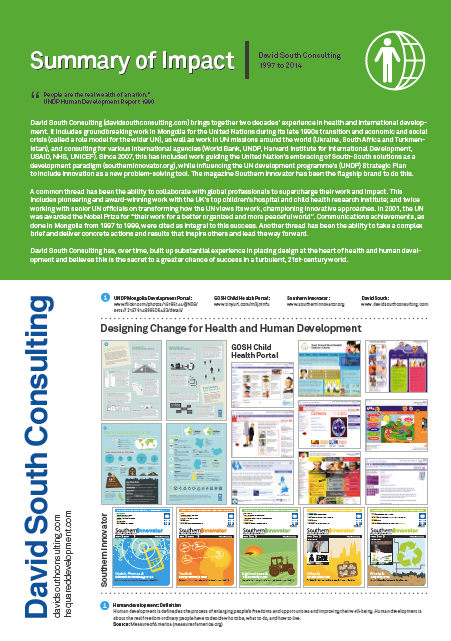
    Development Challenges, South-South Solutions was launched as an e-newsletter in 2006 by UNDP’s South-South Cooperation Unit (now the United Nations Office for South-South Cooperation) based in New York, USA. It led on profiling the rise of the global South as an economic powerhouse and was one of the first regular publications to champion the global South’s innovators, entrepreneurs, and pioneers. It tracked the key trends that are now so profoundly reshaping how development is seen and done. This includes the rapid take-up of mobile phones and information technology in the global South (as profiled in the first issue of magazine Southern Innovator), the move to becoming a majority urban world, a growing global innovator culture, and the plethora of solutions being developed in the global South to tackle its problems and improve living conditions and boost human development. The success of the e-newsletter led to the launch of the magazine Southern Innovator.  

    https://davidsouthconsulting.org/2021/03/05/southern-innovator-issue-1/

    https://davidsouthconsulting.org/2021/03/05/southern-innovator-issue-2/

    Creative Commons License

    This work is licensed under a
    Creative Commons Attribution-Noncommercial-No Derivative Works 3.0 License.

    ORCID iD: https://orcid.org/0000-0001-5311-1052.

    © David South Consulting 2023

  • The BRCK: Kenyan-Developed Solution to Boost Internet Access 

    The BRCK: Kenyan-Developed Solution to Boost Internet Access 

    By David SouthDevelopment Challenges, South-South Solutions

    SOUTH-SOUTH CASE STUDY

    Using the Internet in Africa has its challenges, as anyone who has worked there knows. Issues can include weak Wi-Fi signals, slow Internet service providers, electricity outages and power surges that can damage or destroy sensitive electronic devices.

    Power surges (http://electronics.howstuffworks.com/everyday-tech/surge-protector3.htm) can occur for a variety of reasons but are usually a sudden surge in the current flowing to the wall outlet from the power mains. They are common in developing countries, and can be tragic for electronic devices.
    Most electronic devices are designed for use in developed countries where people can take the power supply, and ubiquitous Internet access, for granted. This affects the way devices are made. Designers will assume many things are available to users and build the electronic devices accordingly. But for users in Africa and across the global South, what seems easy in the developed world is fraught with frustration and wasted time.

    This is a big obstacle to economic development and places people in Africa at a disadvantage in the modern world of fast communications.

    One initiative is out to transform this experience for the better with a made-in-Africa solution that is being modified based on real-world experience and user feedback.

    The BRCK (brck.com) bills itself as “your backup generator for the Internet” and is intended to address the problems of finding a reliable Internet connection, staying online in a power blackout and saving devices from destruction when there is a power surge.

    Anyone who has tried to use a laptop computer to upload some photographs in Africa will know the frustration felt when the Wi-Fi signal drops away. The BRCK hunts around for the strongest signal and grabs it so the user can carry on working.

    Built to be robust and take knocks and bruises, it is a sleek, black plastic brick-shaped device with the letters BRCK elegantly embossed on the side.
    The BRCK can function as a hub for up to 20 devices, with a built-in Wi-Fi signal able to cover multiple rooms (so a team can work off a single Internet connection), a battery that can last eight hours, a 16-gigabyte on board memory hard drive, and software to allow for remote management  by apps on other devices such as smartphones. While it is not able to speed up an already poor connection or increase low bandwidth, it can “scavenge” around to find the strongest signal and hop to it right away. It can work with Ethernet, Wi-Fi, and 3G and 4G networks.

    If a blackout occurs, it quickly switches to the onboard battery without forcing a re-boot of the computer.

    It has been developed in Nairobi, Kenya and the first plastic prototype of the BRCK device was milled at the Fab Lab Nairobi (http://fablab.uonbi.or.ke/) using a 3D fabricator machine.

    The BRCK’s makers describe it as a tool “trying to create ubiquitous Internet” and an “enabler of the Internet of things.” The BRCK is designed around the changing way people work and access the Internet, frequently moving from place to place. People now don’t just rely on one device but have many – a mobile phone or smartphone, a laptop, a tablet, an iPod or other device.

    A Kickstarter fundraising campaign (https://www.kickstarter.com/projects/1776324009/brck-your-backup-generator-for-the-internet) gives more details on the origins of the project and offers many ways to support the different stages of development, right up to mass manufacturing of the BRCK.

    One application of the BRCK is for research. It could be deployed to gather data at a field site, then connect via the Cloud (http://en.wikipedia.org/wiki/Cloud_computing) to pass data back to a lab at a university in another country for analysis.

    The BRCK is being built by Ushahidi (ushahidi.com), a non-profit technology company that makes open source software and made its name with the crowdsourced mapping platform it built during the post-election violence in Kenya in 2008. The Ushahidi platform has been deployed around the world since in many crisis situations.

    Founded by David Kobia, Juliana Rotich and Erik Hersman, the Ushahidi team is focused on “building tools that improve the way information flows in the world.” It is about making tools to help people communicate in the most difficult places.

    BRCK comes with a visually appealing website that makes excellent use of the BRCK’s ebony good looks.

    The website boasts: “If it works in Africa, it’ll work anywhere”.

    The ongoing development of the BRCK can be followed on the website’s blog: http://www.brck.com/2014/01/they-case-for-engineering-brck-in-africa-part-1/.

    “The idea is to build a company around the product rather than just do a one-off product – and to gradually improve the product through new versions,” said BRCKs chief technology officer Reg Orton.

    “Our engineers are based in Kenya now – we are not based in China, we are not based in the (Silicon) Valley. What that means for us we are able to go out there and (be) able to see the problems directly.”

    The BRCK can be ordered online and will be available for sale soon, according to the website.

    Published: April 2014

    Resources

    1) Momax iPower Milk External Battery:  Inspired from daily life, the creative iPower Milk looks like a cute and fresh milk carton. It fulfills your daily energy need just as pure milk. iPower Milk comes in a variety of cheerful candy colors, so choose one which suits your taste. The tiny and delicate iPower Milk has 1.5A USB output, which is compatible with most digital devices, including tablets. Website: http://shop.brando.com/Momax-iPower-Milk-External-Battery-2600mAh_p09700c1595d003.html

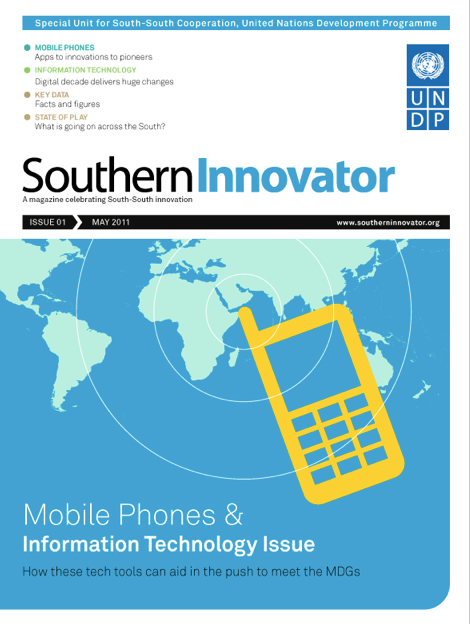
    2) Southern Innovator Issue 1: Mobile Phones and Information Technology: Pioneering and innovative ways to deploy mobile phones and information technology to tackle poverty. Website: http://www.scribd.com/doc/57980406/Southern-Innovator-Magazine-Issue-1 and here: http://tinyurl.com/q6bfnpz
    3) iHub Nairobi: Nairobi’s Innovation Hub for the technology community is an open space for the technologists, investors, tech companies and hackers in the area. This space is a tech community facility with a focus on young entrepreneurs, web and mobile phone programmers, designers and researchers. It is part open community workspace (co-working), part vector for investors and VCs (venture capitalists) and part incubator. Website: ihub.co.ke

    4) Fab Lab Nairobi: Fablab (fabrication laboratory or “fabulous laboratory”) is a workshop with an array of computer controlled tools with the aim to make “almost anything”. Fab labs provide widespread access to modern means for invention. They began as an outreach project from MIT’s Center for Bits and Atoms (CBA). CBA assembled millions of dollars in machines for research in digital fabrication, ultimately aiming at developing programmable molecular assemblers that will be able to make almost anything. Fab labs fall between these extremes, comprising roughly fifty thousand dollars in equipment and materials that can be used today to do what will be possible with tomorrow’s personal fabricators. Website: http://fablab.uonbi.or.ke/

    https://davidsouthconsulting.org/2021/03/20/accessing-global-markets-via-design-solutions/

    https://davidsouthconsulting.org/2022/10/26/africa-to-get-own-internet-domain/

    https://davidsouthconsulting.org/2022/10/24/brazilian-solar-powered-wifi-for-poor-schools/

    https://davidsouthconsulting.org/2020/04/30/crowdsourcing-mobile-phones-to-make-the-poor-money/

    https://davidsouthconsulting.org/2020/05/01/diy-solution-charges-mobile-phones-with-batteries/

    https://davidsouthconsulting.org/2022/10/17/east-africa-to-get-its-first-dedicated-technology-city/

    https://davidsouthconsulting.org/2020/12/20/kenya-reaches-mobile-phone-banking-landmark/

    https://davidsouthconsulting.org/2022/11/23/kenyan-farmer-uses-internet-to-boost-potato-farm/

    https://davidsouthconsulting.org/2020/12/20/mobile-phones-bring-the-next-wave-of-new-ideas-from-the-south/

    https://davidsouthconsulting.org/2021/03/20/texting-for-cheaper-marketplace-food-with-sokotext/

    https://davidsouthconsulting.org/2022/10/10/wireless-internet-culture-helping-zimbabwe-economy-recover/

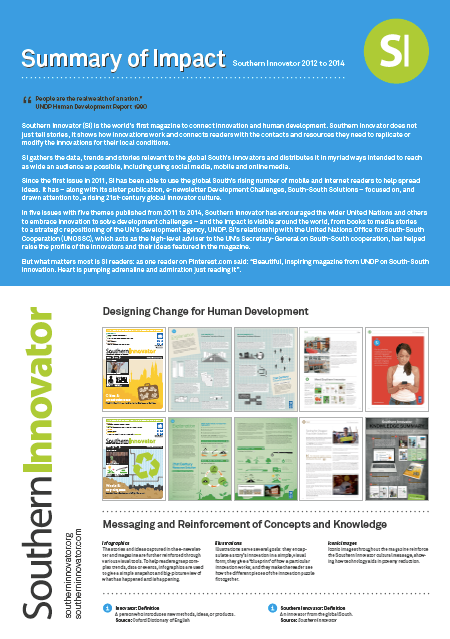
    Development Challenges, South-South Solutions was launched as an e-newsletter in 2006 by UNDP’s South-South Cooperation Unit (now the United Nations Office for South-South Cooperation) based in New York, USA. It led on profiling the rise of the global South as an economic powerhouse and was one of the first regular publications to champion the global South’s innovators, entrepreneurs, and pioneers. It tracked the key trends that are now so profoundly reshaping how development is seen and done. This includes the rapid take-up of mobile phones and information technology in the global South (as profiled in the first issue of magazine Southern Innovator), the move to becoming a majority urban world, a growing global innovator culture, and the plethora of solutions being developed in the global South to tackle its problems and improve living conditions and boost human development. The success of the e-newsletter led to the launch of the magazine Southern Innovator.  
    https://davidsouthconsulting.org/2021/03/05/southern-innovator-issue-1/

    Creative Commons License

    This work is licensed under a
    Creative Commons Attribution-Noncommercial-No Derivative Works 3.0 License.

    ORCID iD: https://orcid.org/0000-0001-5311-1052.

    © David South Consulting 2023

  • Cheap Indian Tablet Seeks to Bridge Digital Divide

    Cheap Indian Tablet Seeks to Bridge Digital Divide

    By David SouthDevelopment Challenges, South-South Solutions

    SOUTH-SOUTH CASE STUDY

    India has had many false starts in innovating in information technology. While the country and its talented army of software engineers have a global reputation for innovation, the fits and starts that have accompanied attempts to create new hardware and devices have drawn a range of emotions, from amusement to frustration.

    India faces an urgent problem: the country is falling behind others in the global South in access to the Internet. Based on 2009 data, there are 5.1 Internet users for every 100 Indians. This compares poorly with Brazil at 39.2 per 100 and China at 28.5.

    The challenge is to find inexpensive devices that allow people to access the Internet through mobile phone networks. With 37 percent of India’s 1.21 billion people living below the official poverty line – and some estimates placing the number at up to 77 percent – cheap devices are urgently needed to reach the poor. A study developed by the Oxford Poverty and Human Development Initiative (OPHI),  found eight Indian states account for more poor people than the 26 poorest African countries combined. The Indian states had 421 million “poor” people, compared to 410 million poor in the poorest African countries, it concluded.

    The World Bank recently criticised India for lacklustre results in addressing poverty levels.

    Five years ago, the Indian government launched a competitive search for an inexpensive device for the masses. The government has been supporting the development of these devices through its National Mission on Education through Information and Communication Technology (Sakshat) (http://www.sakshat.ac.in). It aims to link 25,000 colleges and 400 universities in India in an e-learning program.

    The motivation behind these attempts is a good one: to try and find an affordable device to bridge the digital divide (http://en.wikipedia.org/wiki/Digital_divide) and reach the majority of the population living on less than US $2 a day.

    But the search has had mixed results.

    Low points included a failed attempt to make a rival to the One Laptop Per Child (http://www.onelaptop.org) computer from MIT (Massachusetts Institute for Technology) with an Indian version selling for US $10. What was offered instead in 2009 was a device with no screen or keyboard, requiring an additional laptop and paper to access its stored files. It was also made in Taiwan, rather than India.

    Another first stab at making a US $35 tablet computer was launched in 2010 with much fanfare, but by January 2011 the Indian government had dropped manufacturers HCL Technologies for failing to honour its 600 million rupee (US $13 million) contract.

    What these first steps show is the complexity of hardware development and how challenging it is to get the user experience right for customers while keeping the price affordable.

    But India recently relaunched what it is calling the world’s cheapest tablet computer, selling for US $35. It is called Aakash (http://www.akashslate.com) (http://www.aakashcomputer.co.in), meaning “sky” in the Sanskrit language, and is being sold as an e-learning tool to bridge the digital divide in the country.

    The utility of tablets (http://en.wikipedia.org/wiki/Tablet_personal_computer) and e-readers (http://en.wikipedia.org/wiki/Comparison_of_e-book_readers) for people in the global South is clear: they can enable people to bypass the lack of local library facilities to store vast personal archives of books. This is a powerful educational tool: imagine a village doctor with easy access to thousands of medical texts and papers, or a child preparing for university exams no longer having to worry they can find study texts. It also is a cost-effective way to publish in many local languages and break the stranglehold English-language publishing has had on delivering e-books.

    Aakash will be sold for US $35 to educational institutions and marketed for private sale for US $61 under the UbiSlate brand name (http://www.ubisurfer.com). It is also hoped the tablet can be sold in the UK and the USA.

    Jointly developed by engineers in India, Canada and the UK, it will be assembled at DataWind’s manufacturing plant in Hyderabad, India (http://datawind.com/products.html). Datawind also makes other low-cost, portable devices like the PocketSurfer3 (http://www.pocketsurfer.co.uk).

    The project is run by two Indian-born Canadians, DataWind chief executive officer Suneet Singh Tuli and his brother Raja Singh Tuli.

    Based in Montreal, Canada, DataWind bills itself as “a leading developer of wireless web access products and services.”

    Suneet Singh Tuli wants to sell 1 million tablets a month. The first 100,000 tablets are being bought by the Indian government and then sold to university students.

    The Aakash uses the Google Android operating system (http://www.android.com) and has a WiFi capability, 17.78 centimetre wide screen, two USB ports (http://en.wikipedia.org/wiki/USB) and battery that can last three hours. It can stream high-definition videos, read e-books and run Microsoft Windows Office applications.

    The components in the device are a mix, including parts DataWind has designed itself to save costs.

    “This is not a one-time opportunity,” Suneet Singh Tuli told the Toronto Star newspaper. “There are 2½ to 3 million students entering university every year, as well as 80 million students in Grades 9 to 12, and the government is very serious about making mobile products available to this age group.

    “I could tell you a romantic story about two Indian brothers who arrive in Montreal to get a great Canadian education, become citizens, and then go back to India to bring Internet to the masses,” says Tuli.

    “But the reality is, this is all about profit – my investors and board wouldn’t want it any other way.”

    To compare, the Amazon Kindle Fire device (http://www.amazon.com/Kindle-Fire-Color/dp/B0051VVOB2), which launched recently, sells for US $199 and has fewer features.

    “The rich have access to the digital world; the poor and ordinary have been excluded. Aakash will end that digital divide,” Kapil Sibal, India’s education minister told the Financial Times.

    India’s initiatives are heating up competition with the One Laptop Per Child project set up by MIT professor Nicholas Negroponte (http://one.laptop.org). The colourful OLPC laptop sells for around US $200, and 2 million have been distributed to Latin America, Africa elsewhere.

    While many companies and entrepreneurs are developing products for the poor and the bottom of the pyramid (BOP) markets, it is still a difficult thing to get right. A big issue is aspiration: consumers are still attracted to products they perceive as aspirational and quality, despite a higher price.

    “(Aakash) might suffer the Nano syndrome,” Shashi Bhusan, technology analyst at brokerage Prabhudas Lilladher, told the Financial Times, referring to the cheap made-in-India car that failed to catch on (http://tatanano.inservices.tatamotors.com/tatamotors). “It is always difficult to predict the market’s reaction to a product, but what we have learnt from the Nano is that people don’t want to buy the ‘car-like’ product, they want the real thing … I feel the same will probably happen with this ‘laptop-like’ product.”

    And others strongly disagree that gadgets can transcend the deep-seated social problems that need radical change.

    “It is charity of a very superficial nature,” said George Mathew, director of Delhi’s Institute of Social Sciences. “It has nothing to do with the structure and permanency of our society and our system – you have to work for systemic change.”

    Earlier this year an Indian company produced a rival to Amazon’s Kindle (http://www.amazon.co.uk/Kindle-Store/b?ie=UTF8&node=341677031). The Wink (http://www.thewinkstore.com/ereader/index) is designed to accommodate 15 common Indian languages, comes in an eye-catching design and is complemented by a sleek website stuffed with e-books ready for download. The entire package is very well-thought-out and marketed.

    The Wink was developed and built by EC Media International and retails, according to its website, for Rs 8,999 (US $200). It looks similar to the Kindle, but where the Kindle is grey the Wink is white. This Indian rival has some impressive capabilities: it can not only support 15 Indian languages, it can also access an online library of more than 200,000 book titles. They range from arts and entertainment to biography, newspapers and science topics. There is also a large archive of free books for download.

    But it has come in for criticism for its price, which some say is far too high for the Indian market.

    As has been shown by the information technology experience in other countries, it is constant innovation and trial and error which will eventually create successes. But with persistence, this is one space to keep watching.

    Published: October 2011

    Resources

    1) How to build your own personal computer: This guide helps to demystify computing hardware and shows how to build a computer at home. Website: http://www.buildeasypc.com/

    2) Hardware design and architecture: An archive of free e-books on all aspects of computer hardware and architecture design. An outstanding resource to get anyone started in computer engineering. Website: http://www.e-booksdirectory.com/listing.php?category=38

    3) Jonathan Ive is the man behind the highly successful and user-friendly modern design that has turned the Apple computer brand into such a global success story. He provides tips on how to design usable computer hardware and shares the secrets of his success. Website: http://www.wired.com/culture/design/news/2003/06/59381

    Development Challenges, South-South Solutions was launched as an e-newsletter in 2006 by UNDP’s South-South Cooperation Unit (now the United Nations Office for South-South Cooperation) based in New York, USA. It led on profiling the rise of the global South as an economic powerhouse and was one of the first regular publications to champion the global South’s innovators, entrepreneurs, and pioneers. It tracked the key trends that are now so profoundly reshaping how development is seen and done. This includes the rapid take-up of mobile phones and information technology in the global South (as profiled in the first issue of magazine Southern Innovator), the move to becoming a majority urban world, a growing global innovator culture, and the plethora of solutions being developed in the global South to tackle its problems and improve living conditions and boost human development. The success of the e-newsletter led to the launch of the magazine Southern Innovator.  
    Creative Commons License

    This work is licensed under a
    Creative Commons Attribution-Noncommercial-No Derivative Works 3.0 License

    ORCID iD: https://orcid.org/0000-0001-5311-1052.

    © David South Consulting 2023
  • Asian Factories Starting to go Green

    Asian Factories Starting to go Green

    By David SouthDevelopment Challenges, South-South Solutions

    SOUTH-SOUTH CASE STUDY

    Media headlines have recently highlighted the growing air pollution crisis in Asia’s expanding cities. This is caused by a mix of factors – the growing number of vehicles, coal-powered factories, people burning dirty fuels to heat their homes, and poor enforcement of standards – and has severe consequences for human health. If it’s not tackled, more and more countries will see large rises in respiratory problems, cancers and early deaths from pollution-caused illnesses (http://www.nrdc.org/air/).

    The World Health Organization (WHO) says air pollution is the world’s largest environmental health risk, killing 7 million people every year. Asia has the largest number of air pollution deaths in the world, with 3.3 million deaths linked to indoor air pollution and 2.6 million deaths related to outdoor air pollution (Clean Air Asia).

    While most of the Asian countries where this is a problem are also aggressively growing their economies in order to get richer and raise living standards, there is a rising awareness of the need to balance a modern, industrial economy with human health and the environment.

    One solution is to adopt green and sustainable building standards when constructing new factories. This is more than just a public relations exercise: the energy savings possible from building smart pay off in the long run. And green factories not only pollute less, they save lives and the environment.

    Asia plays a critical role in producing the world’s consumer products, from the small and simple to the highly complex components used in 21st-century computing technologies.

    Intel (intel.com), the manufacturer of electronic devices and the computer chips that go inside them, is trying to lead the way. It has built a US $1 billion manufacturing plant 16 kilometers outside Ho Chi Minh City, Vietnam, and it is designed to exceed Vietnamese environmental and sustainability guidelines and laws.

    Opened in 2010, it boasts the country’s largest solar power system. It is also currently working on a water reclamation system to reduce water consumption at the plant by 68 per cent, according to The New York Times. It is hoping to receive certification from the US Green Building Council (usgbc.org).

    It is all part of a wider trend that is starting to reverse the damaging, short-termist approach of the past. More and more Western multinationals and their Asian suppliers are building environmentally sound factories in the developing world.

    According to the US Green Building Council, around 300 manufacturing facilities in Asia are either certified or are awaiting Leadership in Energy and Environmental Design (LEED) certification. The LEED certification recognizes the building has met certain standards in becoming a ‘green’ building.

    Going green is more and more part of corporate policy for companies that want to avoid the bad publicity of disasters such as the garment factory collapse that killed 1,135 people in Bangladesh in April 2013.

    But it is not just driven by a desire to avoid bad publicity: large corporations that build factories in the global South are also realizing there are big financial savings to be made.

    Intel has been able to reduce its global energy costs by US $111 million since 2008. It did this by investing US $59 million in 1,500 projects to boost sustainability across its facilities worldwide. The projects have reduced carbon dioxide emissions equivalent to the amount produced by 126,000 American households per year.

    Intel’s solar array in Vietnam, which cost US $1.1 million, offsets the equivalent of 500 pollution-belching motorbikes every day.

    How effective are LEED-certified buildings? The New York Times reported that a 2011 survey compared a typical shoe factory with a LEED factory run by the American sport shoe maker Nike. It found the LEED factory used 18 per cent less electricity and fuel and 53 per cent less water.

    And this trend is creating a new economy unto itself. As an example, a new marketplace for industrial efficiency upgrading is developing in India. Power outages are frequent in India, so finding a way to save electricity and alternatives to dependence on the national power grid is attractive to any economic enterprise.

    Prashant Kapoor, principal industry specialist for green buildings at the International Finance Corporation (IFC), believes demand for upgrades is strong enough that various companies can specialize in this field and profit from it.

    And things are also happening in the notoriously smog-choked cities of China. By the end of 2012, China had certified eight factories and 742 buildings as LEED, according to the China buildings programme at the Energy Foundation (ef.org) in San Francisco.

    Damien Duhamel of Solidiance (solidiance.com), a firm that advises businesses on how to grow in Asia, believes avoiding risk caused by environmental accidents or scandals is heightened by the growing presence of social media, which amplifies negative publicity.

    “The next battle will be here” for higher corporate environmental standards, Duhamel believes. “This is why some smart companies – Intel, for example – took the steps of being proactive.”

    Published: April 2014

    Resources

    1) Leadership in Energy and Environmental Design (LEED): LEED, or Leadership in Energy & Environmental Design, is a green building certification program that recognizes best-in-class building strategies and practices. Website: http://www.usgbc.org/leed

    2) US Green Building Council (USGBC): Its mission is to transform the way buildings and communities are designed, built and operated, enabling an environmentally and socially responsible, healthy, and prosperous environment that improves the quality of life. Website: http://www.usgbc.org/

    3) Dwell: Dwell magazine is focused on demonstrating that modern design can be both functional and comfortable. Website: dwell.com

    4) Inhabitat: Design for a Better World: Inhabitat.com is a weblog devoted to the future of design, tracking the innovations in technology, practices and materials that are pushing architecture and home design towards a smarter and more sustainable future. Website: inhabitat.com

    5) Solidiance: Singapore-based consulting firm specializing in Asia’s green-building sector. Website: solidiance.com

    6) Clean Air Asia: Clean Air Asia was established in 2001 as the premier air quality network for Asia by the Asian Development Bank, World Bank, and USAID. Its mission is to promote better air quality and livable cities by translating knowledge to policies and actions that reduce air pollution and greenhouse gas emissions from transport, energy and other sectors. Website: cleanairinitiative.org

    7) Southern Innovator Issue 4: Cities and Urbanization: This issue is packed with ideas on to how make cities and urban environments greener and reduce air pollution. Website: http://www.scribd.com/doc/133622315/Southern-Innovator-Magazine-Issue-4-Cities-and-Urbanization and here: http://tinyurl.com/oc2mqgm

    8) Better Air Quality Conference 2014 and 8th Regional Environmentally Sustainable Transport Forum in Asia:  From 19 to 21 November 2014 in Colombo, Sri Lanka, BAQ is the leading event on air quality in Asia, covering the key sectors of transport, energy, industry and climate change, with a particular emphasis on government policies and measures. Website: http://cleanairinitiative.org/portal/node/12274

    9) Tianjin Eco-city: The Sino-Singapore Tianjin Eco-city’s vision is to be a thriving city which is socially harmonious, environmentally-friendly and resource-efficient. Website: tianjinecocity.gov.sg

    10) Songdo: Songdo International Business District (IBD) officially opened on August 7, 2009 as a designated Free Economic Zone and the first new sustainable city in the world designed to be an international business district. Website: songdo.com

    https://davidsouthconsulting.org/2022/09/27/caribbean-island-st-kitts-goes-green-for-tourism/

    https://davidsouthconsulting.org/2021/01/25/creating-green-fashion-in-china/

    https://davidsouthconsulting.org/2021/02/01/ethiopia-and-djibouti-join-push-to-tap-geothermal-sources-for-green-energy/

    https://davidsouthconsulting.org/2023/02/03/environmental-public-awareness-handbook-case-studies-and-lessons-learned-in-mongolia/

    https://davidsouthconsulting.org/2021/08/29/indian-business-model-makes-green-energy-affordable/

    https://davidsouthconsulting.org/2022/11/11/innovation-cairos-green-technology-pioneers/

    https://davidsouthconsulting.org/2021/10/22/innovations-in-green-economy-top-three-agenda/

    https://davidsouthconsulting.org/2021/08/07/mongolian-green-book/

    https://davidsouthconsulting.org/2022/04/14/prisons-with-green-solutions/

    https://davidsouthconsulting.org/2021/02/04/us-450-million-pledged-for-green-economy-investments-at-kenyan-gssd-expo/

    Development Challenges, South-South Solutions was launched as an e-newsletter in 2006 by UNDP’s South-South Cooperation Unit (now the United Nations Office for South-South Cooperation) based in New York, USA. It led on profiling the rise of the global South as an economic powerhouse and was one of the first regular publications to champion the global South’s innovators, entrepreneurs, and pioneers. It tracked the key trends that are now so profoundly reshaping how development is seen and done. This includes the rapid take-up of mobile phones and information technology in the global South (as profiled in the first issue of magazine Southern Innovator), the move to becoming a majority urban world, a growing global innovator culture, and the plethora of solutions being developed in the global South to tackle its problems and improve living conditions and boost human development. The success of the e-newsletter led to the launch of the magazine Southern Innovator.  

    Creative Commons License

    This work is licensed under a
    Creative Commons Attribution-Noncommercial-No Derivative Works 3.0 License

    ORCID iD: https://orcid.org/0000-0001-5311-1052.

    © David South Consulting 2022