Tag: SDG3

  • Small-scale Farmers Can Fight Malaria Battle

    Small-scale Farmers Can Fight Malaria Battle

    By David SouthDevelopment Challenges, South-South Solutions

    SOUTH-SOUTH CASE STUDY

    Malaria is one of Africa’s biggest killers. Each year globally 300 to 500 million people are infected, and around 1 million die from the disease (theglobalfund). Ninety percent of malaria deaths occur in sub-Saharan Africa – mostly to children under the age of five. The disease costs African countries US$12 billion a year in lost gross domestic product.

    Malaria is a parasitic disease – the parasite plasmodium – transmitted by mosquito bites. Symptoms include fever, headache and vomiting. Internal bleeding, kidney and liver failure may follow and can result in coma and death.

    The most common and effective treatment, recommended by the World Health Organization, is artemisinin-based combination therapies, known as ACTs. ACTs have low toxicity, few side effects and act rapidly against the parasite. Research shows that artemisinin remedies cure 90 percent of patients within three days.

    But there are far fewer doses available than people who need them. WHO has claimed the quantity made available by pharmaceutical companies falls far short of the more than 130 million doses required to combat malaria throughout the world.

    And ACTs are very expensive to deliver: in just one country, Tanzania, providing such therapy for three years would cost US $48.3 million. Every year, this would account for 9.5 percent of Tanzania’s health budget, and 28.7 percent of yearly spending on medical supplies: a six-fold increase in budget for malaria treatment (Malaria Journal 2008, 7:4).

    But a cheap alternative to the expensive pill form of the treatment is being piloted across Africa. It involves the drinking of a tea made from the bushes of the artemisia plant. Artemisia annua is an annual shrub and the active ingredient in the pills (artemisinin). It is native to China and Vietnam and has been used for 2,000 years to treat fevers.

    Bushes cultivated by farmers in Kenya, Malawi, Tanzania, Zambia, Zimbabwe and Mozambique under the supervision of the World Agroforestry Centre in Nairobi, Kenya, are helping to bring down malaria rates without the long wait for the pills to arrive.

    The leaves are boiled and made into a tea. Drinking the tea gives a high enough dose of artemisinin in the blood to cure malaria. Helen Meyer, a nurse operating nine mobile health clinics in rural Mozambique, is using the bitter tea made from the dried leaves. Even in treating drug resistant malaria, she has found the artemisia tea effective: “If you drink the tea, you feel better after the first day. Other medicines take a few days.”

    A special hybrid of artemisia, A-3, is used because it is adapted for warmer climates. The wild variety grows to only five centimetres in the tropics, but A-3 grows to three metres and packs 20 times more artemisinin. It is also highly economical: thousands of plants can come from a single stem.

    The daily adult dose of anti-malaria tea just needs five grams of dried A-3 leaves in one litre of water. The tea is drunk every six hours for seven days. Each plant produces 200 grams of dried leaves, and a thousand shrubs can cure 5,700 people. Since it is a cheap cure, money can be spent instead on other things. Farmers are also able to supplement their income by growing the bushes. And the dried leaves have long-lasting power: even after three years the leaves retain close to a 100 percent of their artemisinin.

    Access to authentic artemisinin is critical: it is estimated 16 percent of malaria medicines in Kenya are counterfeit. Elsewhere, the proliferation of counterfeit anti-malarials substantially raises the risk of the emergence of resistance to artemesinin combination therapy, the last truly effective treatment against malaria. Past misuse of other malaria drugs, such as chloroquine in the 1980s and sulphadoxine/pyrimethamine in the 1990s, resulted in the malaria parasite becoming resistant. Hundreds of thousands of people in malaria-prone areas may have died as a result.

    The World Agroforestry Centre, recognizing potential problems with artemesinin monotherapies, is working to combine it with indigenous herbal remedies made from other anti-malarial trees, producing a herbal combination therapy (HCT).

    “I used to grow fruits and beans here,” said Charles Kiruthi, a Kenyan farmer, to the IRIN news service. “but I will get a better return from this plant. No pests attack it, and until harvesting time it requires very little labour.”

    “I expect to get a good return, and I am also very happy to be helping fight malaria,” continued Kiruthi. “I recently lost two friends to the disease, and my child gets sick with malaria sometimes.”

    Published: July 2008

    Resources

    Development Challenges, South-South Solutions was launched as an e-newsletter in 2006 by UNDP’s South-South Cooperation Unit (now the United Nations Office for South-South Cooperation) based in New York, USA. It led on profiling the rise of the global South as an economic powerhouse and was one of the first regular publications to champion the global South’s innovators, entrepreneurs, and pioneers. It tracked the key trends that are now so profoundly reshaping how development is seen and done. This includes the rapid take-up of mobile phones and information technology in the global South (as profiled in the first issue of magazine Southern Innovator), the move to becoming a majority urban world, a growing global innovator culture, and the plethora of solutions being developed in the global South to tackle its problems and improve living conditions and boost human development. The success of the e-newsletter led to the launch of the magazine Southern Innovator. 

    Creative Commons License

    This work is licensed under a
    Creative Commons Attribution-Noncommercial-No Derivative Works 3.0 License.

    ORCID iD: https://orcid.org/0000-0001-5311-1052.

    © David South Consulting 2023

  • The Water-Free South African Bathing Solution

    The Water-Free South African Bathing Solution

    By David SouthDevelopment Challenges, South-South Solutions

    SOUTH-SOUTH CASE STUDY

    As the world’s population grows from its current 7 billion to a projected 9 billion in 2050 (UN), competition for access to the Earth’s resources will become fiercer. The most essential resource for life on the planet – and an increasingly precious resource – is water. Water is necessary for the very survival of humans, animals and plants, and is also used in vast quantities by industries and farms.

    As demand increases, water resources will need to be conserved more and more, while clever ways will have to be developed to use less water. And there is also another factor to consider for the world’s poor: many millions live in very constrained conditions in urban and rural areas. For their health and dignity, the ability to wash every day is critical. Being clean is vital to being able to economically advance in life: it is something that sounds obvious but is often not a possibility for many millions of people living in slums.

    Many will face lives where water is an uncertain resource that will be either expensive to purchase or will require lots of labour to obtain.

    Anyone who can come up with a way to help bring the dignity of being clean and healthy while also saving water is onto a winner.

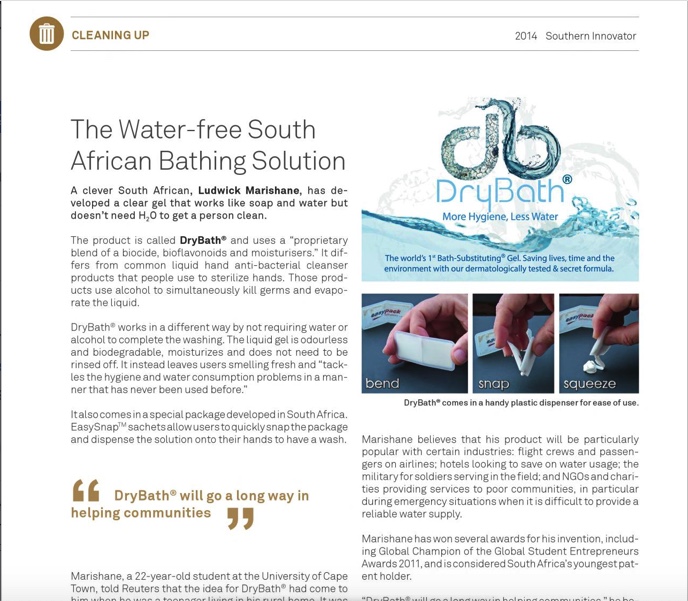
    A clever South African, Ludwick Marishane, has developed a clear gel that works like soap and water but doesn’t need H2O to get a person clean.

    The product is called DryBath (http://headboy.org/drybath/) and uses a “proprietary blend of a biocide, bioflavonoids and moisturisers.” It differs from common liquid hand anti-bacterial cleanser products that people use to sterilize hands. Those products use alcohol to simultaneously sterilize germs and evaporate the liquid.

    DryBath works in a different way by not requiring water or alcohol to complete the washing. The liquid gel is odourless, biodegradable and moisturises and does not need to be rinsed off. It instead leaves users smelling fresh and “tackles the hygiene and water consumption problems in a manner that has never been used before.”

    It also comes in a special package developed in South Africa. EasySnap™ sachets allow users to quickly snap the package and dispense the solution on to their hands to have a wash. EasySnap is a rectangular sachet that is snapped in the middle to open.

    Marishane, a 22-year-old student at the University of Cape Town, told Reuters that the idea for DryBath came to him when he was a teenager living in his rural home. It was wintertime and his friend didn’t want to bother washing because there was no hot water available.

    “He was lazy and he happened to say, ‘why doesn’t somebody invent something that you can just put on your skin and you don’t have to bathe’,” Marishane said.

    That was when the light bulb went off in his head.

    Intrigued, he started doing research on his web-enabled mobile phone. He trawled through the search engine Google and the online encyclopedia Wikipedia to find what would work as a water-free wash. After six months of research, he came up with the formula for DryBath and acquired a patent.

    Now the strategy of Headboy Industries Inc. (headboy.org) – the company set up by Marishane – is to sell DryBath to corporate clients and in turn donate a free sachet for each sale to DryBath’s global charity partners, who will distribute DryBath to poor communities either for free or at a subsidized cost.

    Marishane believes his product will be particularly popular with certain industries: flight crews and passengers on airlines; hotels looking to save on water usage; the military for soldiers serving in the field; and NGOs and charities providing services to poor communities, in particular during emergency situations when it is difficult to provide a reliable water supply.

    Marishane has won several awards for his invention, including Global Champion of the Global Student Entrepreneurs Awards 2011, and is considered South Africa’s youngest patent holder.

    “DryBath will go a long way in helping communities,” he believes.

    Published: September 2012

    Resources

    1) How to register for a patent in South Africa. Website:https://www.sabs.co.za/index.php?page=patents

    2) SABS Design Institute: The SABS Design Institute promotes the benefits of good design in order to stimulate the economic and technological development of South Africa. Website: https://www.sabs.co.za/index.php?page=designinstitute

    Development Challenges, South-South Solutions was launched as an e-newsletter in 2006 by UNDP’s South-South Cooperation Unit (now the United Nations Office for South-South Cooperation) based in New York, USA. It led on profiling the rise of the global South as an economic powerhouse and was one of the first regular publications to champion the global South’s innovators, entrepreneurs, and pioneers. It tracked the key trends that are now so profoundly reshaping how development is seen and done. This includes the rapid take-up of mobile phones and information technology in the global South (as profiled in the first issue of magazine Southern Innovator), the move to becoming a majority urban world, a growing global innovator culture, and the plethora of solutions being developed in the global South to tackle its problems and improve living conditions and boost human development. The success of the e-newsletter led to the launch of the magazine Southern Innovator. 
    Creative Commons License

    This work is licensed under a
    Creative Commons Attribution-Noncommercial-No Derivative Works 3.0 License.

    ORCID iD: https://orcid.org/0000-0001-5311-1052.

    © David South Consulting 2023

  • African Technology Tackles Health Needs

    African Technology Tackles Health Needs

    By David SouthDevelopment Challenges, South-South Solutions

    SOUTH-SOUTH CASE STUDY

    Africa is becoming a world leader in mobile phone applications for health and healthcare. Despite dramatic improvements to the quality of hospitals and the number of qualified doctors, the continent’s healthcare services are still a patchwork, with rural and slum dwellers poorly served and the stresses of treating patients with contagious diseases like HIV/AIDS and malaria pushing resources to the limit.

    But innovative inventions are coming along to provide new tools to doctors and medical personnel and to better engage patients with remote services.

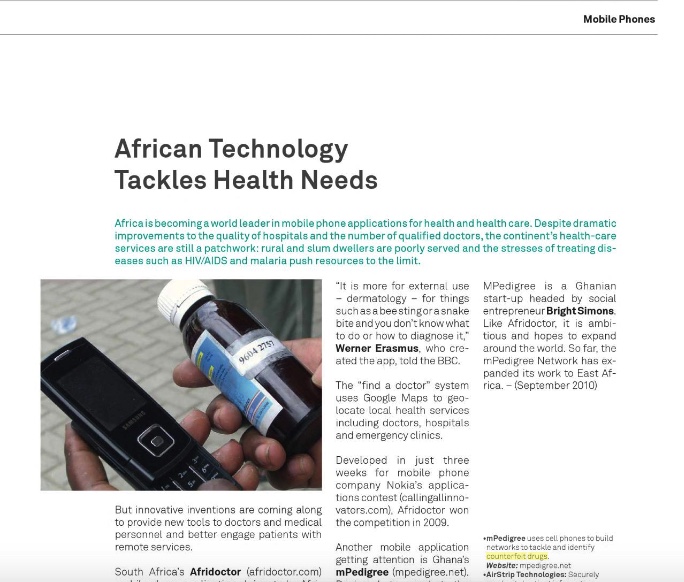
    South Africa’s Afridoctor (http://twitter.com/afridoctor) mobile phone application claims to be Africa’s first personal mobile health clinic. It lets patients use its “SnapDiagnosis” system to submit photos of their ailments and in turn receive advice from a panel of medical professionals, or use the mapping feature to find doctors, clinics and health industry-related services nearby.

    Afridoctor was conceived to fill the gap across Africa for basic health information that is reliable and trustworthy.

    There is an emergency feature to notify next of kin during a medical emergency and provide a location. Other features include symptom checkers, first-aid information, health calculators and quizzes.

    Expert feedback comes within 48 hours after submission of a request.

    A winner of a Nokia competition, Afridoctor was developed by the labs of media company 24.com (http://20fourlabs.com) of Cape Town, South Africa.

    “It is more for external use – like dermatology – for things like a bee sting or a snake bite and you don’t know what to do or how to diagnose it,” Werner Erasmus, who created the app, told the BBC.

    The “find a doctor” system uses Google Maps to geo-locate local health services including doctors, hospitals and emergency clinics.

    The distress feature enables users to contact a family member or friend at the touch of a button. It does this by storing the mobile phone number of a selected relative. When the distress button is pressed, they are notified of the phone’s location.

    Developed in just three weeks, to enter mobile phone company Nokia’s contest (http://www.callingallinnovators.com) for mobile phone applications, Afridoctor went on to win the competition in 2009. It is now being expanded to be usable on most, if not all, smart phones.

    As in the rest of Africa, mobile phone use in South Africa has dramatically increased in the past 10 years. It is estimated that over 70 percent of South Africans now have access to one.

    Another application getting attention is Ghana’s mPedigree (http://mpedigree.net). Designed to combat the damage done by counterfeit drugs in Africa and across the South, mPedigree works by letting a person send a text message by mobile phone to the mPedigree service to check a drug’s authenticity. A message comes back confirming whether the medicine is authentic or not.

    The World Health Organization (WHO) has estimated that 25 percent of medicines sold around the developing world are counterfeit. Some contain no active ingredients, and others are even harmful.

    MPedigree is a Ghanian start-up headed by social entrepreneur Bright Simons (http://www.worldpress.org/freelancers/index.cfm/hurl/page=freelancerDetails/id=7). Like Afridoctor, it is ambitious and hopes to expand around the world. So far, the mPedigree Network has expanded its work to East Africa.

    Published: September 2010

    Resources

    Development Challenges, South-South Solutions was launched as an e-newsletter in 2006 by UNDP’s South-South Cooperation Unit (now the United Nations Office for South-South Cooperation) based in New York, USA. It led on profiling the rise of the global South as an economic powerhouse and was one of the first regular publications to champion the global South’s innovators, entrepreneurs, and pioneers. It tracked the key trends that are now so profoundly reshaping how development is seen and done. This includes the rapid take-up of mobile phones and information technology in the global South (as profiled in the first issue of magazine Southern Innovator), the move to becoming a majority urban world, a growing global innovator culture, and the plethora of solutions being developed in the global South to tackle its problems and improve living conditions and boost human development. The success of the e-newsletter led to the launch of the magazine Southern Innovator.  
    Creative Commons License

    This work is licensed under a
    Creative Commons Attribution-Noncommercial-No Derivative Works 3.0 License.

    ORCID iD: https://orcid.org/0000-0001-5311-1052.

    © David South Consulting 2023

  • Combating Counterfeit Drugs

    Combating Counterfeit Drugs

    By David SouthDevelopment Challenges, South-South Solutions

    SOUTH-SOUTH CASE STUDY

    Access to good quality drugs is a serious problem across the South. The International Narcotics Control Board estimates that up to 15 per cent of all drugs sold around the world are fake or counterfeit, and in parts of Africa and Asia this figure jumps to 50 per cent. The US Food and Drug Administration estimates counterfeit drugs make up 10 per cent of the global medicine market. The US Centre for Medicines in the Public Interest predicts counterfeit drug sales will reach US $75 billion globally in 2010, an increase of more than 90 per cent from 2005.

    Fake drugs are a major cause of unnecessary death and destroy public confidence in medicines and health services. While counterfeit drugs have been on the rise, there is little co-ordinated or effective action to counter this menace afflicted on the sick.

    But in Ghana, a solution has emerged that shows a way to guarantee that quality drugs get to the sick who need them. CareShop Ghana uses the franchise model – where licenses are sold to approved vendors who adhere to strict guidelines – to ensure that the quality, accessibility and affordability of essential medicines in and around Accra is guaranteed. CareShop has made deals with close to 300 franchisee pharmacies – often modest operations – who sell over-the-counter drugs.

    In Ghana, preventable and curable illnesses like malaria and diarrhoeal diseases are among the leading causes of death. Their treatment pushes many people to financial despair; they can ill afford the extra burden of worrying about counterfeit drugs and the harm they do. Like many countries in the South, Ghana’s public healthcare system is unable to meet these needs and so most people turn to the private sector for help.

    An estimated 65 per cent of people turn to licensed pharmacies. But many of these operate haphazard businesses, dispensing expired or counterfeit drugs.

    The Ghana Social Marketing Foundation Enterprises Limited (GSMFEL) founded CareShop in 2002, hoping to battle common infectious diseases in poor areas by making sure good drugs get through to the sick.

    GSMFEL makes a small profit as the franchisor by selling high-quality drugs to the franchisees. The key to CareShop’s success is imposing standardization on franchisees, so they have to stick to common diagnosis, quality and pricing. They make more money when they adhere to these rules than when they break them. To ensure there is no tampering with the drugs, they are delivered straight to the vendor’s doorsteps, and it is all backed up with health and business training support and branded materials.

    The tide can be turned around on fake drugs: in 2002, the WHO reported that 70 per cent of drugs in Nigeria were fake or substandard: by 2004 that figure had fallen to 48 per cent.

    Stimulating private sector solutions to African healthcare problems is now receiving an additional boost from a new fund established by the World Bank’s private sector arm, the International Finance Corporation. Launched in 2007, it offers cash and loans totalling US $500 million to commercial healthcare projects in Africa. According to its own statistics, 60 per cent of health expenditure in sub-Saharan Africa is privately funded, and the market, excluding South Africa, is worth US $19 billion.

    Published: May 2008

    Resources

    • SafeMedicines.org is a website offering the latest reports on fake medicines and is a good place to report incidences.
      Website: http://safemedicines.org/in_the_news/
    • A paper on the global threat of counterfeit drugs: Click here.

    Development Challenges, South-South Solutions was launched as an e-newsletter in 2006 by UNDP’s South-South Cooperation Unit (now the United Nations Office for South-South Cooperation) based in New York, USA. It led on profiling the rise of the global South as an economic powerhouse and was one of the first regular publications to champion the global South’s innovators, entrepreneurs, and pioneers. It tracked the key trends that are now so profoundly reshaping how development is seen and done. This includes the rapid take-up of mobile phones and information technology in the global South (as profiled in the first issue of magazine Southern Innovator), the move to becoming a majority urban world, a growing global innovator culture, and the plethora of solutions being developed in the global South to tackle its problems and improve living conditions and boost human development. The success of the e-newsletter led to the launch of the magazine Southern Innovator.  

    Creative Commons License

    This work is licensed under a
    Creative Commons Attribution-Noncommercial-No Derivative Works 3.0 License.

    ORCID iD: https://orcid.org/0000-0001-5311-1052.

    © David South Consulting 2022