Categories
Archive Development Challenges, South-South Solutions Newsletters Southern Innovator magazine

Indian Toilet Pioneer Champions Good Ideas

By David SouthDevelopment Challenges, South-South Solutions

SOUTH-SOUTH CASE STUDY

Access to adequate sanitation and toilet facilities is critical to making development gains. Yet this simple fact of life often gets overlooked, especially in fast-growing cities where populations are on the rise or in transit. Out of an estimated 2.6 billion people in the world without toilets, two-thirds are in southern and eastern Asia (World Toilet Organization).

It is easy to take toilet technology for granted in developed countries, but in the fast-growing urban world of the global South, increasing access will be the dividing line between a future of good human health and dignity, or misery and poor health. The biggest gains in human health always come about once people have access to clean water and sanitation. Yet this proven fact gets lost in many places for a wide variety of reasons.

One country currently failing to meet the needs of its population is India. According to the McKinsey Global Institute, by 2030, 70 percent of India’s jobs will be created in its cities, and 590 million Indians will be city-dwellers. An enormous infrastructure task lies ahead for India: a city the size of Chicago needs to be built every year. But so far this challenge is not being met, leaving the country with the largest number of urban slum dwellers anywhere in the world. Housing is just not keeping up with populations’ needs.

As K.T. Ravindran, a professor of urban development, told the New York Times: “We require radical rethinking about urban development. It is not that there are no ideas. It is that there is no implementation of those ideas.”

It is this ability to act that makes the Sulabh International Social Service Organization stand out. The Indian non-governmental organization (NGO) sees itself as a movement and is a passionate advocate for toilets and toilet innovation for the poor and underserved.

Sulabh was founded in 1970 by Dr. Bindeshwar Pathak, who saw the vast task ahead. “I thought the challenges to provide toilet facilities have been overcome in rich countries; it has still to be met in developing countries like India,” he said.

So far, Sulabh has brought together 50,000 volunteers across the country to build toilets and sanitation facilities.

The organization’s success flows from understanding that it needs to do more than supply the ‘hardware’ of the toilets; it also needs to address the ‘software’: ideas and innovation and concepts.

The organization has directly built 1.2 million household toilets – but the government of India has built a further 54 million toilets based on the designs made by Sulabh. It’s an example of a good idea multiplying its impact when picked up by others.

While 10 million Indians use a Sulabh-built sanitation facility each day, according to the group’s website, an estimated 300 million are using a toilet based on Sulabh’s designs.

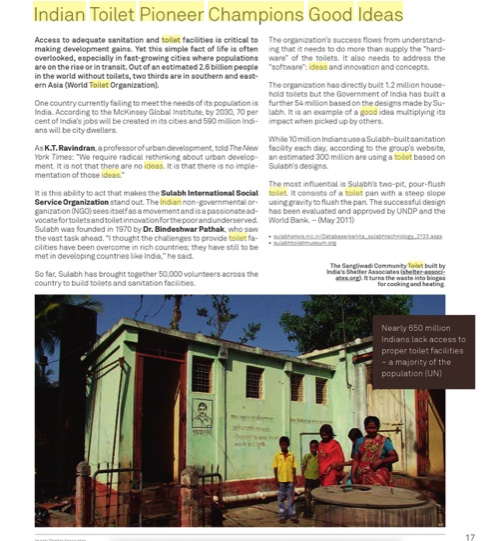
Most influential is Sulabh’s two-pit, pour-flush toilet (www.sulabhenvis.nic.in/Sulabhtechnology.htm). It consists of a toilet pan with a steep slope using gravity to flush the pan. Water is poured in to the pan to flush the toilet and the waste goes into either one of two pits. As one pit fills up with waste, waste is diverted to the second pit. After around 18 months, the first, filled pit’s waste becomes a safe, organic fertiliser suitable for agriculture and the fertiliser’s value covers the cost of emptying the pit. The successful design has been evaluated and approved by UNDP and the World Bank.

Sulabh has also been designing ways to get power and energy from toilets, building 200 biogas plants that turn the gas generated from the human excrement deposited in the toilets into a source of energy. Biogas (http://en.wikipedia.org/wiki/Biogas) is a clean-burning gas that can be made from animal, plant and human waste with the right technology and is a green solution to the need for gas to cook and run electricity generators.

Pride of place for the NGO is its vast toilet and bath complex at the holy shrine of Shri Sai Baba in Shirdi, Maharashtra (http://en.wikipedia.org/wiki/Maharashtra). Millions flock to the shrine every year, but it lacked proper sanitation facilities. To solve this problem Sulabh’s local branch has built a vast complex occupying two acres. The brightly coloured and palace-like facility has 120 toilets, 108 bathing cubicles, six dressing rooms, and urinals and can serve 30,000 people a day. There are telephones and 5,000 lockers for tourists to keep possessions safe.

There are also three biogas plants connected to the facility, generating electricity and hot water for bathing used by the toilet and bath complex. This solves the puzzle of how to fund the utilities. Water discharged from the facility is used to irrigate the surrounding green spaces.

Sulabh has also built a museum dedicated to toilets and toilet technology (http://www.sulabhtoiletmuseum.org). The museum places the toilet as a critical part of human civilisation and shows how it fits in with the cultural context of India. Toilets and toilet designs from around the world and throughout history are gathered together and make a fascinating journey through this essential human need.

Published: May 2011

Resources

1) World Toilet Organization: World Toilet Organization (WTO) is a global non- profit organization committed to improving toilet and sanitation conditions worldwide. Website: http://www.worldtoilet.org

2) World Toilet Day: On November 19 every year, this event draws attention to the lack of access for 2.6 billion people. Website: http://www.worldtoilet.org

3) Dirt: The Filthy Reality of Everyday Life: An exhibit by the prestigious Wellcome Collection on the human relationship with dirt and hygiene in history. Website:http://www.wellcomecollection.org/whats-on/exhibitions/dirt.aspx

4) World Toilet College: Established in 2005, the World Toilet College (WTC) started as a social enterprise, with the belief that there is need for an independent world body to ensure the best practices and standards in Toilet Design, Cleanliness, and Sanitation Technologies are adopted and disseminated through training. Website:http://worldtoilet.org/ourwork3.asp

Development Challenges, South-South Solutions was launched as an e-newsletter in 2006 by UNDP’s South-South Cooperation Unit (now the United Nations Office for South-South Cooperation) based in New York, USA. It led on profiling the rise of the global South as an economic powerhouse and was one of the first regular publications to champion the global South’s innovators, entrepreneurs, and pioneers. It tracked the key trends that are now so profoundly reshaping how development is seen and done. This includes the rapid take-up of mobile phones and information technology in the global South (as profiled in the first issue of magazine Southern Innovator), the move to becoming a majority urban world, a growing global innovator culture, and the plethora of solutions being developed in the global South to tackle its problems and improve living conditions and boost human development. The success of the e-newsletter led to the launch of the magazine Southern Innovator. 

Creative Commons License

This work is licensed under a
Creative Commons Attribution-Noncommercial-No Derivative Works 3.0 License.

ORCID iD: https://orcid.org/0000-0001-5311-1052.

© David South Consulting 2023

Categories
Archive Development Challenges, South-South Solutions Newsletters Southern Innovator magazine

New Appetite for Nutritious Traditional Vegetables

By David SouthDevelopment Challenges, South-South Solutions

SOUTH-SOUTH CASE STUDY

Throughout the history of farming, around 7,000 species of plants have been domesticated. Yet everyday diets only draw on 30 percent of these plants and even this number has been going down as more people consume mass-market foods (FAO).

One consequence has been poor nutrition resulting from the reduction in consumption of high-vitamin foods, leading to stunted mental and physical development across the global South.

Once-rich culinary traditions have wilted and left many people not knowing what to do with formerly common vegetables and fruits, even if they can actually find them in markets.

Between 94,000 and 144,000 plant species — a quarter to a half of the world’s total — could die out in the coming years, according to an estimate by Scientific American (2002). Among them are vital food crops, threatened by a world in which climate change is causing more weather turbulence and diseases and viruses can spread rapidly and destroy crops.

This scale of plant loss risks leaving the world’s food security dependent on fewer – and more vulnerable – domesticated species.

Despite being rich in vitamins, minerals and trace elements, African leafy vegetables have been overlooked in preference for cabbage, tomatoes, carrots, and other imported produce. But with rising food prices at local markets, people are looking again at these neglected African vegetables. In East Africa, this includes indigenous plants like amaranth (http://en.wikipedia.org/wiki/Amaranth), African eggplant, Ethiopian mustard, cowpea, jute mallow and spider plant.

Like tomatoes and potatoes, some of these vegetables are members of the nightshade family — but unlike those imports, they are indigenous to Africa. According to Patrick Maundu of Bioversity International (http://www.bioversityinternational.org/), African nightshades provide good levels of protein, iron, vitamin A, iodine, zinc, and selenium at seven times the amounts derived from cabbage. The high levels of vitamins and micronutrients, he says, are especially important to people at risk of malnutrition and disease, particularly HIV/AIDS.

As the cost for basic foodstuffs have shot up during the global economic crisis, growing food has become an increasingly lucrative source of income. Estimates of the number of people doing this across Africa range from hundreds of thousands to millions.

In the bid to reduce the over-dependence on imported foods, urban farming is coming to the rescue and becoming an effective survival tactic in Africa’s fast-growing cities. Thousands of urban workers in Kenya’s capital, Nairobi, are supplementing their wages by investing in farms growing food.

Eunice Wangari, a nurse in Kenya, supplements her US $350/month salary with money earned from growing food. “For too long our country has been flooded with imported food and westernized foods,” Wangari told The Guardian newspaper. “This is our time to fight back – and grow our own.”

In Kenya, this type of agriculture usually involves an urbanite taking a stake in farmland outside the city. Relatives then do the farming. Mobile phones play a key role in this approach. The urban dweller can keep in touch with the farm by phone and receive updates on progress. They use their knowledge of urban food tastes to then adjust the crops and increase profits.

An accountant, James Memusi in Nairobi, is growing mushrooms in a spare bedroom in his home and then selling them to hotels and supermarkets, according to The Guardian. Miringo Kinyanjui is selling unrefined maize and wheat. Loved for its nutritional qualities, the flour is also flavoured with amarathan, a common green vegetable in Kenya.It is a clever way to make the most of the fact that many urban dwellers have some access to land in the countryside.

Pride is also returning to the topic of food, as people re-discover traditional foods and vegetables and fruits.

In Liberia, president Ellen Johnson-Sirleaf has launched a “Back to the Soil” campaign to get urban dwellers to farm and help the country lose its dependence on foreign food imports.

Liberia is trying to reduce the importing of rice and tomatoes.

In Zambia, the embracing of traditional foods has been fuelled by recipes used by a chain of popular restaurants. This appetite has driven demand for dried pumpkins, ‘black jack’ leaves and fresh okra.

The success of this revival of traditional foods has attracted big multinationals as well. Unilever Kenya ran a campaign in 2008 called ‘taste our culture,’ promoting African herbs and spices.

Published: November 2009

Resources

1) The Global Trees Campaign, a partnership between Fauna & Flora International, Botanic Gardens Conservation International and many other organisations around the world, aims to save threatened tree species through provision of information, conservation action and support for sustainable use. Website: http://www.globaltrees.org

2) World Vegetable Center: The World Vegetable Center is the world’s leading international non-profit research and development institute committed to alleviating poverty and malnutrition in developing countries through vegetable research and development. Website: http://www.avrdc.org/

3) Sylva Professional Catering and College: A well-known Zambian food entrepreneur who runs a range of businesses, including restaurants, a cooking school and a guest house. Website: http://sadcbiz.com/countries/zambia/categories/index.htm

4) Marketing African Leafy Vegetables: Challenges and Opportunities in the Kenyan Context By Kennedy M. Shiundu and Ruth. K. Oniang. Website: http://www.ajfand.net/Issue15/PDFs/8%20Shiundu-IPGR2_8.pdf

Development Challenges, South-South Solutions was launched as an e-newsletter in 2006 by UNDP’s South-South Cooperation Unit (now the United Nations Office for South-South Cooperation) based in New York, USA. It led on profiling the rise of the global South as an economic powerhouse and was one of the first regular publications to champion the global South’s innovators, entrepreneurs, and pioneers. It tracked the key trends that are now so profoundly reshaping how development is seen and done. This includes the rapid take-up of mobile phones and information technology in the global South (as profiled in the first issue of magazine Southern Innovator), the move to becoming a majority urban world, a growing global innovator culture, and the plethora of solutions being developed in the global South to tackle its problems and improve living conditions and boost human development. The success of the e-newsletter led to the launch of the magazine Southern Innovator. 

Creative Commons License

This work is licensed under a
Creative Commons Attribution-Noncommercial-No Derivative Works 3.0 License.

ORCID iD: https://orcid.org/0000-0001-5311-1052.

© David South Consulting 2023

Categories
Archive Development Challenges, South-South Solutions Newsletters

South Africa Innovates Healthcare with Prepay Phone Vouchers

By David SouthDevelopment Challenges, South-South Solutions

SOUTH-SOUTH CASE STUDY

Pioneers in Africa are experimenting with new ways to fund the delivery of healthcare that is affordable and sustainable and not dependent on foreign aid and donations. A South African company is prototyping the selling of pre-payment healthcare services through mobile phones with a range of vouchers that can be bought and downloaded at the tap of a keypad. They are priced at between US $12 and US $49 and cover medical and dental check-ups, tests, treatments, chronic care and medicines. They are flexible and can also be sent to friends and family who need help.

In South Africa, poverty is still widespread. The majority black population has a median income of US $2,000 a year (New Internationalist) and many still live in crowded townships and poor rural communities. Poverty has also increased for many white Afrikaner South Africans (http://en.wikipedia.org/wiki/Afrikaner). A study by the Standard Bank of South Africa found the number of whites earning less than US $80 a month grew from 2000 to 2004 by more than 50 per cent. In the government capital of Pretoria, 50 Afrikaner squatter camps have emerged in recent years. For many, affordable healthcare is a critical issue.

The story of healthcare in Africa is not a linear one of constant progress. The continent as whole achieved its lowest child mortality rates in the 1970s. But after that, the quality of healthcare declined as a result of various factors including economic crises and the HIV/AIDS crisis – both of which overwhelmed public systems. In sub-Saharan Africa, health systems reached rock bottom in the late 1990s.

“Few people could afford annual check-ups, medicines or user fees at hospitals,” wrote Dr. Ebrahim Malick Samba in the paper “African health care systems: what went wrong?” for News Medical (www.news-medical.net). “One result was the resurgence of infectious diseases such as malaria, tuberculosis and cholera.

“Prior to the 1980s, the district hospitals, community health centres and other outreach health posts provided medical services and essential drugs free of charge. With reforms, user fees and cost recovery were introduced, and the sale of drugs was liberalized.

“Many governments discontinued budget support to the health sector which paralysed the public health system. There was no money for medical equipment and maintenance; salaries and working conditions declined.”

Things have been steadily improving from this low base through the 2000s, the result of increased aid funding for public health systems and greater national investments in staff, facilities and equipment. There is still a long way to go, but Africa is becoming a world leader in developing and deploying mobile phone applications for health and healthcare.

Despite dramatic improvements to the quality of hospitals and the number of qualified doctors, the continent’s healthcare services are still a patchwork, with rural and slum dwellers poorly served and the stresses of treating patients with contagious diseases like HIV/AIDS and malaria pushing resources to the limit.

Research has shown it is better and fairer to develop pre-payment mechanisms for healthcare than to just hit patients with fees when they are ill. With pre-payment, a person can buy care services when they are financially able to and bank up care for when they become ill and not able to work and save.

This is a crucial issue for people with low incomes who can quickly be devastated by their illness or that of loved one or family member.

The World Health Organization (WHO) has taken a firm stand against so-called out-of-pocket payments and encourages the growth in pre-payment methods. The World Health Report 2000 found that “Fairness of financial risk protection requires the highest possible degree of separation between contributions and utilization.”

South Africa’s Yarona Care (www.yaronacare.co.za/prepaid.html) – a health insurance provider network – is rolling out prepaid mobile phone vouchers, allowing patients to see doctors or dentists and even traditional healers for treatment. When a patient visits, the healthcare worker redeems the mobile phone voucher to get paid. One product, Impilo Go, allows people to pay for one visit to a doctor and seven days of medicine for R230 (US $34). For people on a tighter budget, there is Impilo Care for R80 (US$12). A patient can visit a nurse practitioner for a medical check-up and receive tests.

Impilo One offers medicines alone for R100, while Impilo Plus for R195 (US $29) is aimed at people with chronic conditions. They can get a prescription from the doctor and then go to a pharmacy participating in the scheme to receive medicines.

Dental work is also covered by the vouchers.

An online demonstration shows how the mobile phone process works (www.yaronacare.co.za/cellphonedemo.html).

The service is marketed at a mix of customers, from individuals to corporate clients looking to cover large numbers of people to government and NGOs. They can purchase services by voucher, payroll schemes or mobile phones.

Prepaid by mobile phone as a concept is already well established across Africa. It is a simple way to make payments and sell services. In the case of Yarona’s offering, the customer or patient uses their mobile phone to dial a code to pay for a service. When at the doctor or dentist’s office, he or she spends the voucher for the service by giving a unique code to the healthcare professional. Once this is done, Yarona Care pays the healthcare provider for the service.

The voucher approach allows customers to buy health services for family members for a defined period of time. Vouchers can also be sent to family members for emergencies.

Published: April 2011

Resources

1) South Africa’s Afridoctor mobile phone application claims to be Africa’s first personal mobile health clinic. It lets patients use its “SnapDiagnosis” system to submit photos of their ailments and in turn receive advice from a panel of medical professionals, or use the mapping feature to find doctors, clinics and health industry-related services nearby. Website: http://twitter.com/afridoctor

2) Ghana’s mPedigree uses cell phones to build networks to tackle and identify counterfeit drugs. Website: http://mpedigree.net

Development Challenges, South-South Solutions was launched as an e-newsletter in 2006 by UNDP’s South-South Cooperation Unit (now the United Nations Office for South-South Cooperation) based in New York, USA. It led on profiling the rise of the global South as an economic powerhouse and was one of the first regular publications to champion the global South’s innovators, entrepreneurs, and pioneers. It tracked the key trends that are now so profoundly reshaping how development is seen and done. This includes the rapid take-up of mobile phones and information technology in the global South (as profiled in the first issue of magazine Southern Innovator), the move to becoming a majority urban world, a growing global innovator culture, and the plethora of solutions being developed in the global South to tackle its problems and improve living conditions and boost human development. The success of the e-newsletter led to the launch of the magazine Southern Innovator. 

Creative Commons License

This work is licensed under a
Creative Commons Attribution-Noncommercial-No Derivative Works 3.0 License.

ORCID iD: https://orcid.org/0000-0001-5311-1052.

© David South Consulting 2023

Categories
Archive Development Challenges, South-South Solutions Newsletters

Safe Healthcare is Good Business and Good Health

By David SouthDevelopment Challenges, South-South Solutions

SOUTH-SOUTH CASE STUDY

Many people have been shocked by recent stories about the proliferation of counterfeit drugs and the rate at which they are killing and harming people in Nigeria. The International Narcotics Control Board found that up to 50 percent of medicines in developing countries are counterfeit. This has driven home the point that without the presence of legitimate players in the African drug market, the illegal sharks will step in to make large profits – and a literal killing.

To counter this negative trend, what is most needed is support for reliable Africa-based companies: businesses that are long-term, sustainable and not living from one grant to the next. But as experience has shown around the world, nurturing businesses requires certain fundamentals: they must work to be profitable, they must find a market and exploit it, and they need cash infusions that are timed to the company’s growth, not to the cycle of international donors. This role, often served in developed countries by venture capitalists, who want a fast return of 35 percent – is too onerous a burden for most African businesses. What African companies need is a more conservative, long-term approach; one that expects returns of between five and 10 percent.

Kenyan company Advanced Bio-Extracts (ABE) is one good example. Only 18 months old and based in Nairobi, the company produces one of a new generation of low-cost anti-malarials known as artemisinin-based combination therapies (ACTs). The drug is produced from the green leafy plant Artemisia, or sweet wormwood. The company is the first in Africa to make this drug, and employs 7,000 local farmers in Kenya, Tanzania and Uganda, as well as scientists.

ABE has received two infusions of cash from non-profit social venture capitalists Acumen, as well as investment from Swiss drug giant Novartis. Acumen has so far invested US $9.6 million in 11 active investments focused on a diverse set of health challenges, including basic healthcare access in rural areas and treatment for malaria and HIV/AIDS.

“We are commercializing a product that had never been commercialized,” said ABE’s owner, Doug Henfrey, to the New York Times. “Those little windows of support make these things happen. We could not have done it otherwise.”

Acumen’s Kenya country director, Nthenya Mule, said “there are positive things happening in Africa, but they are not happening overnight, and some are happening quietly. ABE is exemplary. You will not see it as front-page news, but in 18 months they set up a factory with 160 people interfacing with 7,000 farmers and supplying one of the major pharma companies in the world.”

Stimulating private sector solutions to African healthcare problems is receiving an additional boost from a new fund established by the World Bank’s private sector arm, the International Finance Corporation. To be launched later in 2007, it will offer cash and loans totaling US $500 million to commercial healthcare projects in Africa. According to its own statistics, 60 percent of health expenditure in sub-Saharan Africa is privately funded, and the market, excluding South Africa, is worth US $19 billion.

Published: May 2007

Resources

  • Roll Back Malaria Partnership: Launched in 1998 by the World Health Organization. UNICEF, UNDP and the World Bank to coordinate the global campaign, to fight malaria.
  • Malaria Atlas Project (MAP): An online map showing up-to-date information on high-risk areas for malaria.
  • A paper on the global threat of counterfeit drugs: Click here

Development Challenges, South-South Solutions was launched as an e-newsletter in 2006 by UNDP’s South-South Cooperation Unit (now the United Nations Office for South-South Cooperation) based in New York, USA. It led on profiling the rise of the global South as an economic powerhouse and was one of the first regular publications to champion the global South’s innovators, entrepreneurs, and pioneers. It tracked the key trends that are now so profoundly reshaping how development is seen and done. This includes the rapid take-up of mobile phones and information technology in the global South (as profiled in the first issue of magazine Southern Innovator), the move to becoming a majority urban world, a growing global innovator culture, and the plethora of solutions being developed in the global South to tackle its problems and improve living conditions and boost human development. The success of the e-newsletter led to the launch of the magazine Southern Innovator. 

Creative Commons License

This work is licensed under a
Creative Commons Attribution-Noncommercial-No Derivative Works 3.0 License.

ORCID iD: https://orcid.org/0000-0001-5311-1052.

© David South Consulting 2023