Categories
Archive data Development Challenges, South-South Solutions Newsletters Southern Innovator magazine

New Kenyan Services to Innovate Mobile Health and Farming

By David SouthDevelopment Challenges, South-South Solutions

SOUTH-SOUTH CASE STUDY

Kenya is home to a vibrant innovation culture centred around mobile phones. While not all the services launched will be successful, the flurry of start-ups shows the country has the right combination of technical skills, bright ideas and cash to make a go of new services.

With the number of mobile phone users leaping 28 per cent in 2011, to reach 25 million subscribers out of a population of 39 million (Reuters), the country has a large market for mobile phone-based services. Kenya also has 10 million people with access to the Internet, up from 4 million in 2009.

Two issues critical to the well-being of Kenyans – health services and farming – are being tackled by new mobile phone services. One is a service being run and marketed by a major player in the market, and the other, by a small start-up.

Statistics indicate that in Kenya, one doctor attends to over 10,000 patients. The World Health Organization recommends a ratio of 1:600. There are just over 7,500 licensed medical facilities in the country.

Safaricom, Kenya’s largest telecoms operator, is trying to take the pressure off overstretched medical and health systems with a new mobile health service. Its 24-hour health advice and referral service is called ‘Daktari 1525’ and lets people call and speak with a doctor or an expert to get advice on any health issue. The number 1525 refers to the dialling code which links users directly to the Safaricom call centre. Daktari 1525 is available to the 18 million Safaricom subscribers.

Safaricom has partnered with ‘Call-a-Doc’ to launch the tool. The new service hopes to relieve outpatient departments in government hospitals and health facilities with its advice and referrals. The Daktari 1525 service does not prescribe a treatment to the callers, avoiding the legal risks of remote diagnosis.

It also offers home remedies and health tips on healthy lifestyles. In an emergency, users can also dial Daktari 1525 if there is Safaricom network coverage.

The partnership is divided between Safaricom and Call-a-Doc. Safaricom handles all the mobile phone network infrastructure, the call centre facility and the marketing of the service. Call-a-Doc takes care of recruiting doctors.

But how does the service use the doctors’ time well? The shifts are designed to surge the number of doctors to 15 during peak times, falling to as few as four doctors during off-peak times. The doctors work on a part-time basis and there are currently 50 employed by the service.

Not everyone is convinced the service will work.

“It is a good attempt to venture into the field; however we would like to caution the practitioners involved that they must remain ethical and must at all times uphold professional confidentiality,” Medical Practitioners and Dentist Board Chief Executive Officer Daniel Yumbya told Capital News.

Another new service based in the capital, Nairobi, is trying to shake up the world of farming. Its new mobile phone service, “MFarm: connecting farmers” (http://mfarm.co.ke/) calls itself “a transparency tool for Kenyan farmers”.

It bills itself as a “factory of ideas” looking to find “creative agribusiness solutions.” The service is a paid-for web platform that helps farmers keep track of prices in the capital, Nairobi, and claims to have signed up 3,000 farmers in the first year of operations.

The service offers crop prices by sending a text to the numbers 3535 if the user gives the crop location required. As an example, the user texts “price crop location” “price maize Nairobi”. Users can also sell their crops, or buy farm supplies.

It also allows farmers to group sell their crops by getting together with other small-scale farmers. This is a crucial service because it allows the smaller farmer to sell into the wholesale markets where prices are better. Farmers can also group buy, benefiting from lower prices by buying bulk from suppliers. It cleverly offers several ‘plans’ to suit budgets. There is an ‘Eco Plan’ at the low end, a mid-range ‘Pro Plan’, and a bells-and-whistles option, ‘Biz Plan’.

The service also benefits from its connections with iHub Nairobi (http://ihub.co.ke/pages/home.php), the buzzing “open space for technologists, investors, tech companies and hackers in Nairobi.” It provides a strong support network to turn to when problems arise.

It seems as if it would be a mistake to enter the African market with any new tech solution without first checking out the scene in Nairobi.

Published: January 2012

Resources

1) iHub Nairobi: Nairobi’s Innovation Hub for the technology community is an open space for the technologists, investors, tech companies and hackers in the area. The space has a focus on young entrepreneurs, web and mobile phone programmers, designers and researchers. Website: http://ihub.co.ke/pages/home.php

2) EPROM: Entrepreneurial Programming and Research on Mobiles aims to foster mobile phone-related research and entrepreneurship. Website: http://www.media.mit.edu/ventures/EPROM

Development Challenges, South-South Solutions was launched as an e-newsletter in 2006 by UNDP’s South-South Cooperation Unit (now the United Nations Office for South-South Cooperation) based in New York, USA. It led on profiling the rise of the global South as an economic powerhouse and was one of the first regular publications to champion the global South’s innovators, entrepreneurs, and pioneers. It tracked the key trends that are now so profoundly reshaping how development is seen and done. This includes the rapid take-up of mobile phones and information technology in the global South (as profiled in the first issue of magazine Southern Innovator), the move to becoming a majority urban world, a growing global innovator culture, and the plethora of solutions being developed in the global South to tackle its problems and improve living conditions and boost human development. The success of the e-newsletter led to the launch of the magazine Southern Innovator. 
Creative Commons License

This work is licensed under a
Creative Commons Attribution-Noncommercial-No Derivative Works 3.0 License.

ORCID iD: https://orcid.org/0000-0001-5311-1052.

© David South Consulting 2023

Categories
Archive Development Challenges, South-South Solutions Newsletters

New Apps Make Driving and Travelling in Egypt Easier, Safer

By David SouthDevelopment Challenges, South-South Solutions

SOUTH-SOUTH CASE STUDY

Mobile phones are ubiquitous across the global South. They have spawned whole new business opportunities and changed the way people solve problems and find solutions.

Sub-Saharan Africa is now home to approximately 650 million mobile phone subscribers, more than the United States and the European Union (World Bank).  A recent World Bank report estimated mobile phones led directly to the creation of 5 million jobs in Africa in 2012, contributing to seven per cent of Africa’s gross domestic product (GDP).

Mobile phones have also led to contests and challenges, set up to spark further innovation in this area and spur the development of so-called “apps”, or applications, to run on these electronic devices.

These prizes encourage and reward useful innovation that directly tackles the problems and challenges of the South.

In Cairo, Egypt – a city notorious for some of the worst traffic congestion in the world – many have been trying to find smart solutions to the gridlock. The World Bank says in its Cairo Traffic Congestion Study that the annual cost of congestion in Cairo is estimated at up to US $8 billion. This is four per cent of Egypt’s gross domestic product (GDP) – four times the impact on national GDP experienced by other comparable large cities. The study found that at least 1,000 Cairo residents die each year in traffic-related accidents, more than half of them pedestrians. And rapid growth in the city is making it ever-harder to get on top of the problem.

Rising traffic congestion is a problem around the world. In the United States, traffic jumped 236 per cent as the population grew by 20 per cent between 1982 and 2001 (IBM).

The IBM Commuter Pain Study conducted in 2011, ranking the emotional and economic toll of commuting in 20 international cities, found that the commute in Beijing is four times more painful than the commute in Los Angeles or New York, and seven times more painful than the commute in Stockholm.

Commuter pain leads to productivity loss as people lose time stuck in traffic and fuel is wasted as engines idle in traffic jams – not to mention damage to the environment from the increased pollution.

According to the World Business Council for Sustainable Development, 95 per cent of congestion growth in the coming years will be in developing countries. Even in developed countries like the United States, in 2000, the average driver experienced 27 hours of delays (up seven hours from 1980) (MIT Press). This ballooned to 136 hours in Los Angeles.

Developing countries are seeing vehicle numbers rise by between 10 and 30 per cent per year (World Bank). In economic hotspots, growth is even faster.

The Cairo Transport App Challenge (https://www.facebook.com/CairoTransportAppChallenge) is a contest aimed at taming the city’s traffic chaos. It is hosted by the Technology Innovation Entrepreneurship Center (TIEC) (http://www.tiec.gov.eg/en-us/Pages/default.aspx) and is organized by the World Bank in collaboration with others.

The contest’s press release says it aims to connect transport and urban development experts with volunteer technology communities to build “applications to address pressing transport challenges in Cairo through leveraging the new information and communication technologies (ICT) – such as mobile phones, smartphones and GPS-enabled devices – as well as the talent of Egyptian software developers and innovators.”

The first winner of the US $3,000 in prize money is a mobile phone app that helps drivers get help on the road and with car maintenance.

Users can use the Belya app to find the best routes, and to get help if their vehicle breaks down. The app is essentially a portable virtual car mechanic. It uses Global Positioning System (GPS) technology to locate service centres, which are then contacted when somebody needs help. The app gives details to the repair shop on what is wrong, the date and time.

“It is also linked to the General Traffic Administration, to provide quick and regular updates of the traffic situation,” according to a statement from Egypt’s Ministry of Communications and Information Technology, which awarded the prize.

The content’s second prize was won by E-mokhalfa (http://www.emokhalfa.com/emokhalfa/),which helps communities create safer roads by using peer pressure to make drivers behave better. Third place went to the app called “Where is my bus?” (https://twitter.com/AutobeesyFeen). It helps passengers find bus stations, routes, journey times and all mass transport options on their mobile phones.

Published: February 2013

Resources

1) A guide to making mobile phone apps: Here are some resources to building your own phone app online or through a provider. Website:http://www.brandignity.com/2011/03/building-mobile-iphone-phone-app-onlin/

2) Android: Android is the world’s most popular mobile platform. Website: android.com

3) Arab Republic of Egypt, Ministry of Communications and Information Technology. Website: http://www.mcit.gov.eg/

4) IBM Smart Traffic: IBM Intelligent Transportation, a compliment to the Intelligent Operations Center for Smarter Cities, enables advanced analysis of the many factors that make up traffic flow, and gives planners and responders a comprehensive look at the state of their city’s roadways on ground level. Website:http://www.ibm.com/smarterplanet/eg/en/traffic_congestion/ideas/index.html

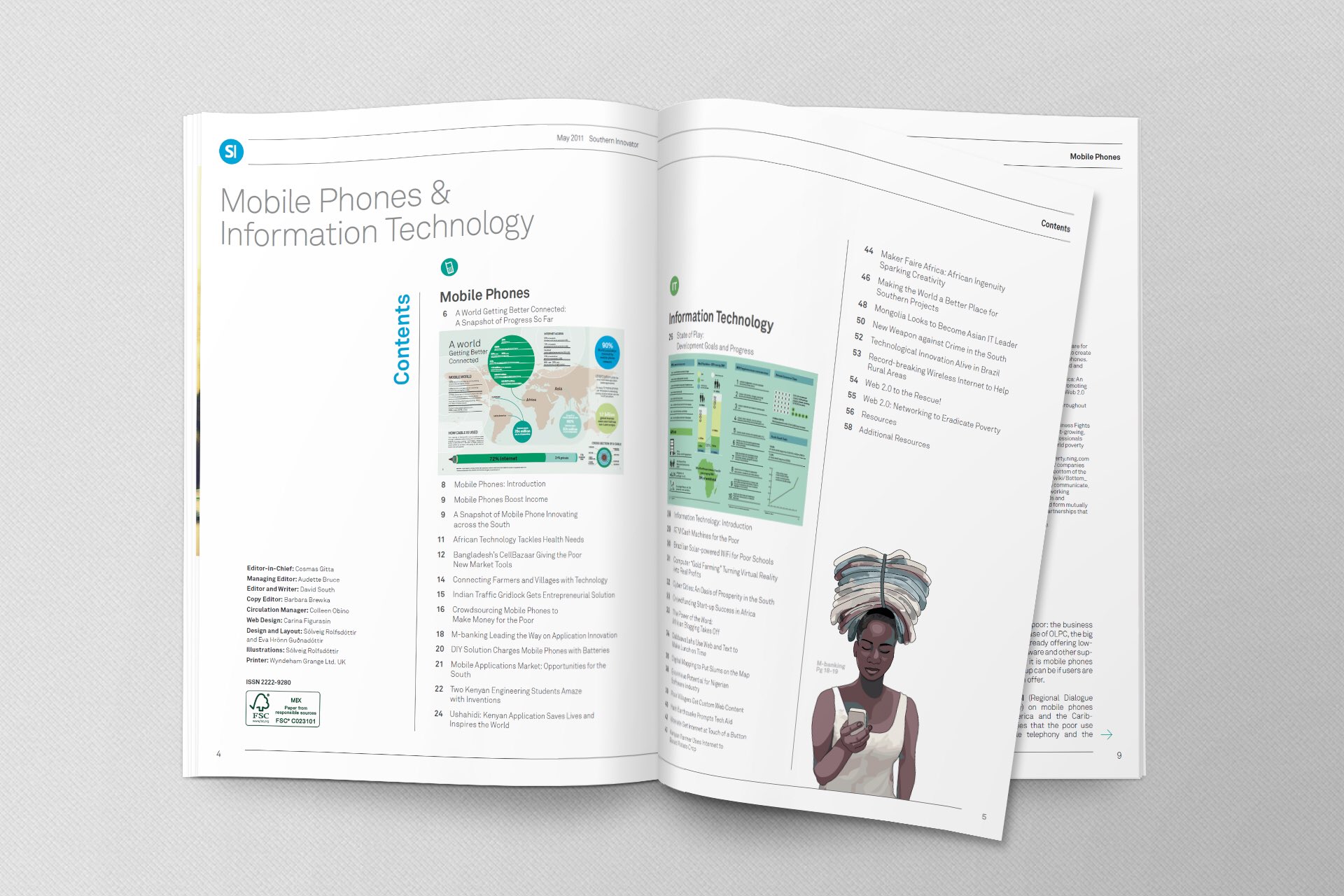
5) Southern Innovator Magazine Issue 1: Mobile Phones and Information Technology. Website:http://www.scribd.com/doc/95410448/Southern-Innovator-Magazine-Issue-1-Mobile-Phones-and-Information-Technology

Southern Innovator logo

London Edit

31 July 2013

Development Challenges, South-South Solutions was launched as an e-newsletter in 2006 by UNDP’s South-South Cooperation Unit (now the United Nations Office for South-South Cooperation) based in New York, USA. It led on profiling the rise of the global South as an economic powerhouse and was one of the first regular publications to champion the global South’s innovators, entrepreneurs, and pioneers. It tracked the key trends that are now so profoundly reshaping how development is seen and done. This includes the rapid take-up of mobile phones and information technology in the global South (as profiled in the first issue of magazine Southern Innovator), the move to becoming a majority urban world, a growing global innovator culture, and the plethora of solutions being developed in the global South to tackle its problems and improve living conditions and boost human development. The success of the e-newsletter led to the launch of the magazine Southern Innovator. 
Creative Commons License

This work is licensed under a
Creative Commons Attribution-Noncommercial-No Derivative Works 3.0 License.

ORCID iD: https://orcid.org/0000-0001-5311-1052.

© David South Consulting 2023

Categories
Archive Development Challenges, South-South Solutions Newsletters

Perfume of Peace Helps Farmers Switch From Drug Trade

By David SouthDevelopment Challenges, South-South Solutions

SOUTH-SOUTH CASE STUDY

A tragedy in a time of war has led to a social enterprise that is creating jobs – and making the world smell a little better, too.

The 7 Virtues perfume range was started by Canadian Barb Stegemann (http://www.barbstegemann.com/barb-stegemann-in-the-news.html) to harness the energy of social enterprise and women’s buying power to change the dynamic of war and misery created by conflict around the world.

Stegemann ran a successful public relations company when she was inspired to do something after tragedy struck a good friend who was serving in Afghanistan with the Canadian Armed Forces as part of the NATO mission (http://www.isaf.nato.int/). Hit on the head with an axe while involved in a village meeting, Captain Trevor Greene was thought to be fatally injured but survived, though he is still unable to walk.

The violent attack shocked Stegemann into action. The enterprise was founded not out of hatred and revenge, but as a way of addressing the serious economic problems and poverty of Afghanistan.

Wanting to do something, Stegemann was referred to the Turquoise Mountain Foundation (turquoisemountain.org), which is based in Afghanistan’s capital, Kabul. The Turquoise Mountain Foundation is a social enterprise working in Afghanistan to regenerate the country’s traditional arts and historic areas in order to create jobs and boost skills.

Stegemann was inspired by a farmer called Abdullah Arsala from Jalalabad in the eastern part of the country. He was growing the ingredients for making essential oils, rather than the much more lucrative opium poppies which are used to make the drug heroin and help fuel a vast global illegal drug trade. Heroin addiction ruins many lives around the world and often leads to crime and violence.

The Turquoise Mountain Foundation did a study and found that if farmers could be paid US $9,912 for a litre of rose oil or US $7,994 for orange blossom oil it would be enough of a market incentive to lure them away from growing opium poppies.

Stegemann decided to provide that incentive.

Using her life savings, she established a perfume company. To start, Stegemann bought Arsala’s entire stock of orange blossom oil. After getting further investment through the Canadian television program Dragons’ Den – on which entrepreneurs compete for funding – she launched the company with two perfumes: Orange Blossom of Afghanistan and Noble Rose of Afghanistan.

With the whole collection rebranded as The 7 Virtues (http://www.the7virtues.com/), the Afghanistan Orange Blossom went on sale at the prestigious Selfridges department store in London, U.K.

Using Arsala as a go-between, 2,500 farmers in Afghanistan are now supplying essential oils for the perfumes.

To further expand the concept, Stegemann has launched Middle East Peace (http://www.the7virtues.com/middle_east_peace.php), a perfume made from sweetie grapefruit oil from Israel with lime and basil oils from Iran.

In Haiti, a country still recovering from the 2010 earthquake disaster and decades of grinding poverty and political and economic chaos, she has created a scent for men using fragrant grass.

She hopes to also do the same for Rwanda and Syria.

The perfumes are all-natural and are put together in Toronto, Canada. They are sold in stores in Canada and the United States, as well as Selfridges in London.

The success has snowballed and a special gift pack has been put together for American Airlines.

“I never imagined I’d end up on a beauty counter, but this is where the women are and we must connect with them if we are going to reverse this cycle of war and poverty,” Stegemann told The Sunday Times. “Imagine if there were 300 women like me doing things like this. We could make a real difference.”

Published: November 2013

Resources

1) Centre for International Policy Studies: University of Ottawa: A focal point for scholarship and debate on international affairs in Canada. Website: http://cips.uottawa.ca/

2) Post-war Reconstruction and Development Unit: The PRDU is an international centre of excellence for the study of post-conflict societies and their recovery. Website: http://www.york.ac.uk/politics/centres/prdu/

3) Peacebuilding and post-conflict recovery: The experience of recent years has also led the United Nations to focus as never before on peacebuilding – efforts to reduce a country’s risk of lapsing or relapsing into conflict by strengthening national capacities for conflict management, and to lay the foundations for sustainable peace and development. Website: http://www.un.org/en/ecosoc/about/peacebuilding.shtml

United Nations Office on Drugs and Crime: UNODC is a global leader in the fight against illicit drugs and international crime. UNODC is mandated to assist Member States in their struggle against illicit drugs, crime and terrorism. Website: http://www.unodc.org

Development Challenges, South-South Solutions was launched as an e-newsletter in 2006 by UNDP’s South-South Cooperation Unit (now the United Nations Office for South-South Cooperation) based in New York, USA. It led on profiling the rise of the global South as an economic powerhouse and was one of the first regular publications to champion the global South’s innovators, entrepreneurs, and pioneers. It tracked the key trends that are now so profoundly reshaping how development is seen and done. This includes the rapid take-up of mobile phones and information technology in the global South (as profiled in the first issue of magazine Southern Innovator), the move to becoming a majority urban world, a growing global innovator culture, and the plethora of solutions being developed in the global South to tackle its problems and improve living conditions and boost human development. The success of the e-newsletter led to the launch of the magazine Southern Innovator. 
Creative Commons License

This work is licensed under a
Creative Commons Attribution-Noncommercial-No Derivative Works 3.0 License.

ORCID iD: https://orcid.org/0000-0001-5311-1052.

© David South Consulting 2022

Categories
Archive Development Challenges, South-South Solutions Newsletters

Tackling China’s Air Pollution Crisis: An Innovative Solution

By David SouthDevelopment Challenges, South-South Solutions

SOUTH-SOUTH CASE STUDY

China reached an undesired landmark in 2013. While the country’s impressive economic growth has amazed the world, it has come at a price: pollution. China recorded record levels of smog in 2013, with some cities suffering air pollution many times above what is acceptable for human health.

This is evidence of the perils of rapid industrialization using non-green technologies. China relies on coal burning, a highly polluting resource, for 70 to 80 per cent of its electricity. It also uses coal for factories and winter heating.

Burning coal causes smog, soot, acid rain, global warming, and toxic air emissions (http://www.ucsusa.org/clean_energy/coalvswind/c01.html). Environmental group Greenpeace claims 83,500 people died prematurely in 2011 from respiratory diseases in Shandong, Inner Mongolia and Shanxi – the top three coal-consuming provinces in China.

Anyone visiting Beijing or other Chinese cities will notice the high levels of smog and how this interferes with access to sunshine and curbs visibility. Worse still for human beings and the environment, this level of pollution causes severe respiratory problems, and has the potential to cause a rise in cancer rates, among other health problems.

Beijing had record pollution levels in January 2013. That haze, according to China’s Ministry of Environmental Protection, covered 1.43 million square kilometers.

Generated by industry and coal-fired power stations, particulate matter (http://www.epa.gov/pm/) or PM, is a complex mix of extremely small particles and liquid droplets. Particle pollution is made up of a number of components, including acids (such as nitrates and sulfates), organic chemicals, metals, and soil or dust particles.

In October 2013, Beijing announced a series of emergency measures to tackle the record high levels of pollution and smog (http://edition.cnn.com/2013/10/23/world/asia/china-beijing-smog-emergency-measures/index.html). The Heavy Air Pollution Contingency Plan uses a color-coded warning system if serious pollution levels occur in three consecutive days. This means kindergartens, primary and middle schools will need to stop classes. Eighty per cent of government cars must come off the roads and private cars can only enter the city on alternate days based on a ballot system. Emergency measures will come into play when the air quality index for fine particulate matter, called PM2.5 (http://www.epa.gov/pmdesignations/faq.htm#0) – very fine particles that lodge in the lungs and are very harmful to human health – exceed 300 micrograms per cubic meter for three days in a row. According to the World Health Organization (WHO), the safe limit for human beings is 20 micrograms (http://www.who.int/mediacentre/factsheets/fs313/en/).

The only serious, long-term solution is to switch to non or low-polluting green energy sources. But, meanwhile, some are coming up with stop-gap measures that also help to educate people about the necessity to do away with this major threat to human health.

Dutch designer Daan Roosegaarde (studioroosegaarde.net) thinks he has a temporary solution to the pollution problem – a “vacuum cleaner” to clean up the sky. And the city of Beijing is taking the solution seriously.

The proposed technology works like this: a system of buried coils of copper produce an ion electrostatic field that attracts smog particles. The particles are magnetized and are drawn downwards, creating a gap of clean air above the coil.

Called the Smog project, it is already under discussion with the mayor of Beijing. An animation video explains how it works: http://studioroosegaarde.net/video/the-smog-project/.

Talking to CNN, Roosegaarde likened the science behind the invention to what happens when “you have a balloon which has static (electricity) and your hair goes toward it. Same with the smog.”

In a deal with the Beijing city government, the technology will be tested in the city’s parks.

Roosegaarde has successfully tested the technology indoors and found it worked in the experiment.

He told CNN: “Beijing is quite good because the smog is quite low, it’s in a valley so there’s not so much wind. It’s a good environment to explore this kind of thing.”

“We’ll be able to purify the air and the challenge is to get on top of the smog so you can see the sun again.”

Roosegaarde thinks that successfully running the experiment in a Beijing park makes a radical statement and shows the benefits of breathing clean air and being able to see the sun on most days.

But he is not deluded that this is the final solution for pollution: “This is not the real answer for smog. The real answer has to do with clean cars, different industry and different lifestyles.”

With many people resigned to the pollution, at least for now, China’s entrepreneurs are making the face masks and air filters people wear to protect their lungs from the pollution more fashionable and appealing to look at, the South China Morning Post reported.

Xiao Lu, a saleswoman at Panfeng Household Products, explained the varying fashion tastes in masks: “Young people tend to like bright colors. Men prefer blue or black masks. Right now, UV proof masks are popular.”

Lu told the newspaper that customers make their decisions based on comfort and price.

Popular brands include Respro (http://respro.com/), Totobobo (totobobo.co.uk) and 3M9010 (http://solutions.3m.com/wps/portal/3M/en_US/3M-PPE-Safety-Solutions/Personal-Protective-Equipment/Products/Product-Catalog/?N=5022986&rt=c3).

But, why not just move out of cities and avoid breathing bad air? Things are not that simple from an economic perspective. The South China Morning Post quoted Rena from Urumqi in China’s western Xinjiang province, who came to Beijing for the better job opportunities.

“Going back to Urumqi means less job opportunities and the air is not necessarily better,” she said. “Staying in Beijing means wearing a mask most days. It’s not very comfortable.

“But I can’t cover my face forever,” she said. “I’d prefer to live in a cleaner environment.

Published: December 2013

Resources

1) eChinacities: Waiting to Exhale: Guide to Buying Face Masks in China. Website: http://www.echinacities.com/expat-corner/Waiting-to-Exhale-Guide-to-Buying-Face-Masks-in-China

2) Pollution-China.com: Living in China despite the pollution. Website: http://www.pollution-china.com/vmchk/RESPRO-masks/View-all-products.html

3) My Health Beijing: A family doctor’s evidence-based guide to wellness and public health. Website: http://www.myhealthbeijing.com/china-public-health/respro-vs-totobobo-which-mask-works-better-for-air-pollution/

4) Dutch Design in Development: DDiD is the agency for eco design, sustainable production and fair trade. We work with Dutch importers and designers and connect them to local producers in developing countries and emerging markets. Together products are made that are both profitable and socially and environmentally sustainable. Website: http://www.ddid.nl/english/

5) Coal power: A map of China’s 2,300 coal-burning plants. Website: http://world.time.com/2013/12/13/one-map-shows-you-why-pollution-in-china-is-so-awful/

https://davidsouthconsulting.org/2021/02/20/baker-cookstoves-designing-for-the-african-customer/

https://davidsouthconsulting.org/2022/02/14/cleaner-stoves-to-reduce-global-warming/

https://davidsouthconsulting.org/2023/02/03/environmental-public-awareness-handbook-case-studies-and-lessons-learned-in-mongolia/

https://davidsouthconsulting.org/2022/11/18/successful-fuel-efficient-cookers-show-the-way/

https://davidsouthconsulting.org/2020/04/25/two-stroke-engine-pollution-solution/

https://davidsouthconsulting.org/2021/01/02/a-undp-success-story-grassroots-environmental-campaign-mobilizes-thousands-in-mongolia-1998/

Development Challenges, South-South Solutions was launched as an e-newsletter in 2006 by UNDP’s South-South Cooperation Unit (now the United Nations Office for South-South Cooperation) based in New York, USA. It led on profiling the rise of the global South as an economic powerhouse and was one of the first regular publications to champion the global South’s innovators, entrepreneurs, and pioneers. It tracked the key trends that are now so profoundly reshaping how development is seen and done. This includes the rapid take-up of mobile phones and information technology in the global South (as profiled in the first issue of magazine Southern Innovator), the move to becoming a majority urban world, a growing global innovator culture, and the plethora of solutions being developed in the global South to tackle its problems and improve living conditions and boost human development. The success of the e-newsletter led to the launch of the magazine Southern Innovator. 
Creative Commons License

This work is licensed under a
Creative Commons Attribution-Noncommercial-No Derivative Works 3.0 License.

ORCID iD: https://orcid.org/0000-0001-5311-1052.

© David South Consulting 2023