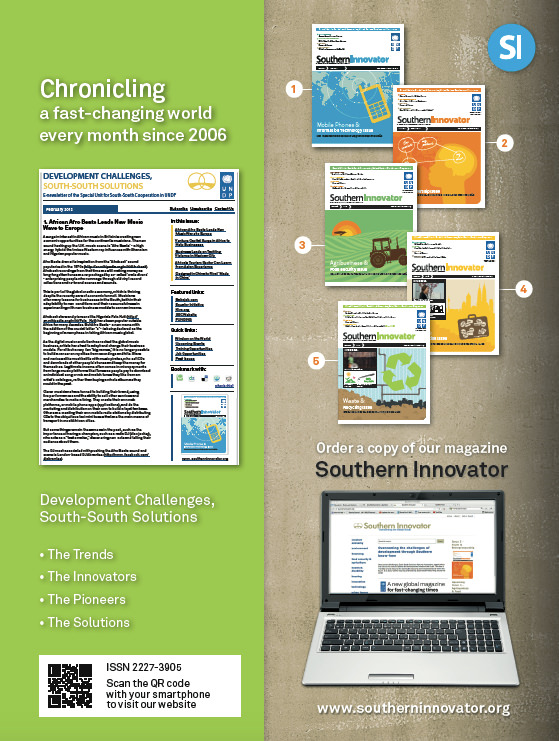
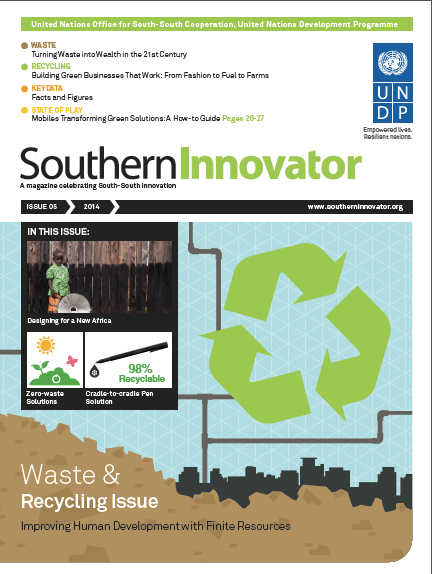
The fifth issue of Southern Innovator has launched online and in print. Order copies now for distribution. Email: southerninnovator@yahoo.co.uk.
Issue six will be on science, technology and innovation. This issue will be different from previous issues and will be including supplements and inserts to boost the impact of the magazine. Southern Innovator is seeking sponsors to fund this and also to help us expand the print run (currently 5,000 copies for global distribution).
July
3D Home Printing Landmark: 10 Houses in a Day Development Challenges: The global South is experiencing urban growth on a scale unprecedented in human history, far outstripping the great urbanization wave that swept across Europe and North America during the 19th and 20th centuries.
Old Boats Become New Furniture in SenegalDevelopment Challenges: Every country has its fair share of waste and the remnants of past economic activity. Old cars nobody wants, discarded tins of food, old plastic bags, spare copper wire, cast-off clothing – all can have a new life in the right hands.
Innovative Solutions Celebrated in Ashden Awards Development Challenges: The world’s population is heading towards 9.6 billion by 2050 (UN). Combined with a growing middle class and rising living standards across the global South, that means ever-greater demand on the world’s finite resources. This raises a crucial question: Where will the energy to power rising living standards come from, and how much damage will be done to the planet’s environment by pollution created generating it (https://www.un.org/en/development/desa/news/population/un-report-world-population-projected-to-reach-9-6-billion-by-2050.html)?
Innovative Ways to Collect Water from AirDevelopment Challenges: World water resources are being depleted quickly as populations grow, urbanize and demand better living standards. Many scientists believe we are reaching peak water – the point at which fresh water is consumed faster than it is replenished.
June
Caribbean Island St. Kitts Goes Green for Tourism Development Challenges: Going green may sound like the right thing to do but it can also be associated with being a costly burden and boring. But, as one island nation is proving, being green is a great selling point for attracting tourists and investors – especially in a world where many places are grappling with pollution and resource depletion.
Big Data Can Transform the Global South’s Growing Cities Development Challenges: The coming years will see a major new force dominating development: Big Data. The term refers to the vast quantities of digital data being generated as a result of the proliferation of mobile phones, the Internet and social media across the global South – a so-called ‘data deluge’ (UN Global Pulse). It is an historically unprecedented surge in data, much of it coming from some of the poorest places on the planet and being gathered in real time.
Indian Business Model Makes Green Energy Affordable Development Challenges: The technology already exists to provide renewable energy and electricity to all the world’s poor. The trick is finding a way to pay for it and to make it sustainable. Many innovators are experimenting with business models to reach the so-called Bottom of the Pyramid (BOP) cohort, and the 1.2 billion poorest people in the world who do not have access to electricity (World Bank) (http://tinyurl.com/n9p3f5x). A further 2.8 billion have to rely on wood or other biomass materials to cook and heat their homes.
South-South Trade Helping Countries During Economic CrisisDevelopment Challenges: Weathering the global economic crisis is testing the stability of countries across the global South. But many countries are finding South-South trade and catering to their domestic middle classes can lift incomes and maintain growth rates despite the global turmoil.
May
3D Printing Gives Boy a New Arm in SudanDevelopment Challenges: 3D printing is rapidly going mainstream and is now starting to make a big impact in health care. One innovative solution is using the technology to manufacture artificial arms for amputees harmed by war in Africa.
African Hotel Boom Bringing in New Investment and Creating JobsDevelopment Challenges: Africa is experiencing a boom not seen for decades. The IMF forecasts economic growth in sub-Saharan Africa of 6 per cent in 2014, compared to global growth of 3.6 per cent.
China’s Outsourced Airliner Development Model Development Challenges: Many emerging-market countries in the global South have built up substantial foreign currency reserves. Much of this has been a response to past foreign currency crises, particularly the Asian Crisis in the late 1990s (http://en.wikipedia.org/wiki/1997_Asian_financial_crisis).
Brazilian Design for New Urban, Middle-Class World Development Challenges: Countries across the global South are experiencing rapid urbanization as people move to cities for better economic opportunities — and this massive social change is creating new business opportunities. Those who recognize how fundamentally people’s lifestyles are changing will be those who will benefit from this big shift in populations.
April
Cheap Paper Microscope to Boost Fight Against Diseases Development Challenges: To tackle diseases in the developing world, the most important first step is diagnosis. Without effective diagnosis, it is difficult to go to the next steps of either treatment or cure. While much attention is given to the high costs involved in treating and curing ailments, screening for diagnosis is also expensive, especially if it involves lots of people. Anything that can reduce the cost of diagnosis will free up resources to expand the number of people who can be checked, and help eradicate contagious diseases.
Asian Factories Starting to go GreenDevelopment Challenges: Media headlines have recently highlighted the growing air pollution crisis in Asia’s expanding cities. This is caused by a mix of factors – the growing number of vehicles, coal-powered factories, people burning dirty fuels to heat their homes, and poor enforcement of standards – and has severe consequences for human health. If it’s not tackled, more and more countries will see large rises in respiratory problems, cancers and early deaths from pollution-caused illnesses (http://www.nrdc.org/air/).
Reality Television Teaches Business Skills in Sudan Development Challenges: Learning how to thrive in a market economy does not necessarily come naturally. But for young people who have grown up under a different economic system or known nothing but economic chaos, learning business skills can give them the tools to get on in life.
Popular Chinese Social Media Chase New Markets Development Challenges: China has a vast and growing market for the Internet and mobile devices. Over the past decade that market has been largely confined to China – most businesses have had enough domestic demand and opportunities inside the country to keep them busy.
The BRCK: Kenyan-Developed Solution to Boost Internet AccessDevelopment Challenges: Using the Internet in Africa has its challenges, as anyone who has worked there knows. Issues can include weak Wi-Fi signals, slow Internet service providers, electricity outages and power surges that can damage or destroy sensitive electronic devices.
March
Women Empowered by Fair Trade Manufacturer Development Challenges: There is sometimes a great deal of negativity surrounding the issue of manufacturing in Africa. Some claim the risks of doing business are too high or that the workers are not motivated enough. But one garment manufacturer is out to prove the skeptics wrong. It pays decent wages and gives its mostly female workforce a stake in the business in a bid to drive motivation and make it worthwhile to work hard.
Global South Trade Boosted with Increasing China-Africa Trade in 2013Development Challenges: It was announced in January 2014 that China has surpassed the United States to become the world’s number one trading nation, as measured by the total value of exports and imports. This new economic behemoth also continued to grow its trade relationships with Africa.
India 2.0: Can the Country Make the Move to the Next Level?Development Challenges: With the global economic crisis threatening to cause turmoil in the emerging markets of the global South, it is becoming clear that what worked for the past two decades may not work for the next two.
“Pocket-Friendly” Solution to Help Farmers Go Organic Development Challenges: Interest in organic food and farming is high, and organics have become a growing global industry. The worldwide market for organic food grew by more than 25 per cent between 2008 and 2011, to US $63 billion, according to pro-organic group the Soil Association. That is an impressive accomplishment given the backdrop of the global economic crisis, and evidence that people value quality food, even in tough times.
Cheap Farming Kit Hopes to Help More Become Farmers Development Challenges: Food security is key to economic growth and human development. A secure and affordable food supply means people can meet their nutrition needs and direct their resources to improving other aspects of their lives, such as housing, clothing, health services or education.
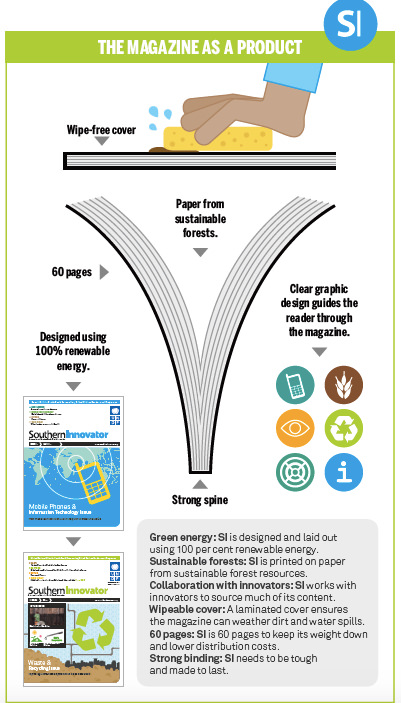
While Southern Innovator’s digital presence has been key to its success and global reach, the hard copy of the magazine was designed with special features. The magazine needed to be robust and able to stand a fair bit of abuse and hard wear. It needed to be easy to read in low light conditions. And it needed to look sharp and eye-catching to reach as wide an audience as possible.
South-South cooperation for development, SSC/17/3, High-level Committee on South-South Cooperation, 12 April 2012.
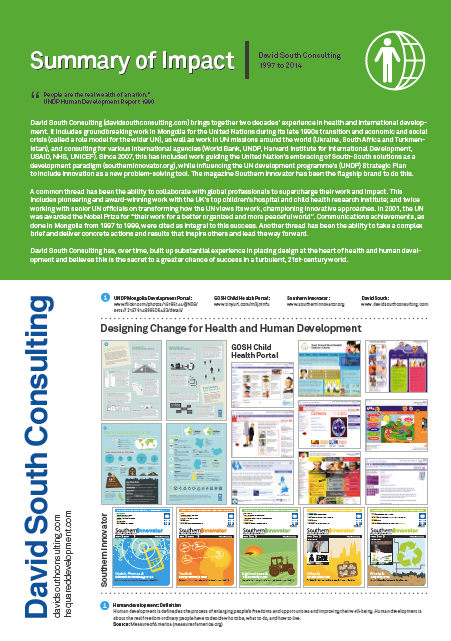
Development Challenges, South-South Solutions was launched as an e-newsletter in 2006 by UNDP’s South-South Cooperation Unit (now the United Nations Office for South-South Cooperation) based in New York, USA. It led on profiling the rise of the global South as an economic powerhouse and was one of the first regular publications to champion the global South’s innovators, entrepreneurs, and pioneers. It tracked the key trends that are now so profoundly reshaping how development is seen and done. This includes the rapid take-up of mobile phones and information technology in the global South (as profiled in the first issue of magazine Southern Innovator), the move to becoming a majority urban world, a growing global innovator culture, and the plethora of solutions being developed in the global South to tackle its problems and improve living conditions and boost human development. The success of the e-newsletter led to the launch of the magazine Southern Innovator.
The third issue of Southern Innovator magazine has launched. Order advance copies now for distribution. Email: southerninnovator@yahoo.co.uk.
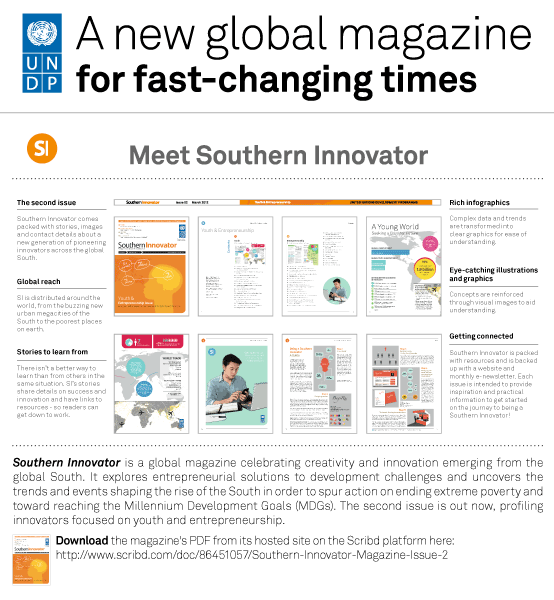
The second issue of Southern Innovator magazine has launched: Read and download the magazine here: Southern Innovator Issue 2.
December
New Cities Offering Solutions for Growing Urban Populations Development Challenges: Across the global South, new cities are being dreamed up by architects, city planners and governments, or are already under construction. Two new urban areas being built offer lessons for others in the global South. They both deploy intelligent solutions to the combined demands of urbanization, growing populations and rising expectations.
Creating Green Fashion in China Development Challenges: China is the world’s largest manufacturer (Euromonitor) and the largest clothing maker, producing a quarter of all textiles and clothing. It is a global fashion production hub, and many major global clothing brands have their products made there – whether they admit it or not.
Biogas Digester-in-a-Bag Brings Portability Development Challenges: Securing energy sources that are cheap (or free) and renewable can significantly reduce the cost of living for the world’s poor. The cost of fuel for essentials such as cooking and lighting can quickly eat up household incomes.
Powerful Solar Light Spurring Income-Making Opportunities Development Challenges: A clever innovator from India has built a highly durable solar lantern that also doubles as a mobile phone charger.
Global South Urbanization Does Not Have to Harm Biodiversity Development Challenges: How to balance fragile ecosystems with rapid urbanization will be the challenge for planners and governments across the global South in the coming years. The urbanization trend is clear: the world’s total urban area is expected to triple between 2000 and 2030, with urban populations set to double to around 4.9 billion in the same period (UNEP). This urban expansion will draw heavily on water and other natural resources and will consume prime agricultural land.
November
All-in-One Solar Kiosk Business Solution for Africa Development Challenges: Kiosks are ubiquitous throughout commercial areas in the global South. These highly efficient little business outlets enable small-scale entrepreneurs to sell necessary products without the expense of renting and running a shop.
Ugandan Fish Sausages Transform Female Fortunes Development Challenges: What to do when your food production enterprise is just not making much money? It is a common problem in the global South, where farmers and fishers often struggle to survive and can face the threat of bankruptcy and destitution when trying to provide essential food for their communities.
Woman Restaurant Entrepreneur Embraces Brand-Driven Growth Development Challenges: The journey of Zhang Lan is the tale of an entrepreneur who exemplifies the story of globalization. She has gone from working many part-time jobs while studying overseas, to becoming one of China’s most successful food entrepreneurs.
Better by Design in ChinaDevelopment Challenges: In recent decades, China has been known more for its inexpensive manufactured goods than as a producer of high quality products. But this is changing as the country seeks to move up the economic chain.
Energy-Efficient Wooden Houses are also Earthquake Safe Development Challenges: In Argentina, an innovative housing project has married good design with energy efficiency, earthquake resilience and the use of local materials and labour. As energy resources continue to be stretched around the global South, innovative building designs will be critical to the creation of sustainable housing for the future.
October
Chinese Building Solution for Rapidly Urbanizing Global South Development Challenges: The global South is currently experiencing the biggest surge in urban population ever seen in human history. This transformation from urban to rural is happening in many different ways across the global South. Some countries have highly detailed plans and are building new cities from scratch, while other countries feel overwhelmed by their booming urban populations.
Diaspora Bonds to Help Build up Infrastructure Development Challenges: Many people are aware of the significant role played in global development by remittance payments from migrant workers working in the wealthy North to the global South. But they may not be aware of the significant sums migrant workers have saved in bank accounts in these wealthy countries. Across the global South, efforts are underway to lure these sums back to home countries to boost development efforts.
African Supercomputers to Power Next Phase of Development Development Challenges:Information technology developments in Africa have long lagged behind those in other parts of the world. But the transformation being brought about by the widespread adoption and use of mobile phones – each one a mini-computer – and the expansion of undersea fibre optic cable connections to Africa are creating the conditions for an exciting new phase of computing growth on the continent.
Africa to Get Own Internet Domain Development Challenges: Africa is in the midst of an Internet revolution that is set only to accelerate. The continent is one of the last places to experience the information technology revolution that has swept the world in the past two decades.
Geothermal Energy to Boost Global South’s Development Development Challenges: The geothermal heat produced by the earth’s molten core is a resource receiving more and more attention across the global South.
September
Free Magazine Boosts Income for Rickshaw Drivers Development Challenges: In the bustling, congested cities of Asia, rickshaws and auto-rickshaws are common forms of transport. Smaller, cheaper and more nimble than cars, they play a key role in the transit infrastructure, helping to get people to work and to get around.
Design Collaborations Revitalize Traditional Craft Techniques Development Challenges: Keeping alive traditional craft techniques and methods in the age of globalization is a tricky balance to get right. As countries seek to increase living standards and income, traditional craft-making methods are often jettisoned in favour of attracting manufacturing and other high-value activities – meaning rich and potentially lucrative skills can be lost.
Profile of African Innovators Continues to Rise Development Challenges: A mix of developments is proving that African innovators no longer need to see themselves as lone operators working in isolation.
The Water-Free South African Bathing Solution Development Challenges: As the world’s population grows from its current 7 billion to a projected 9 billion in 2050 (UN), competition for access to the Earth’s resources will become fiercer. The most essential resource for life on the planet – and an increasingly precious resource – is water. Water is necessary for the very survival of humans, animals and plants, and is also used in vast quantities by industries and farms.
August
Mobile Phone Shopping to Create Efficient Markets across BordersDevelopment Challenges: An anticipated game-changing revolution in African trading set for 2013 is getting one innovative business very excited.
Egyptian Youth Turns Plastic Waste into FuelDevelopment Challenges: The challenge of finding alternate fuel sources is capturing the imagination of innovators across the global South. As the world’s population increases – it recently reached 7 billion (UN) – and the number of people seeking a better life grows in turn, the energy demands on the planet are pushing up competition for existing conventional fuel sources.
Shopping and Flying in Africa’s Boom TownsDevelopment Challenges: As economies across Africa grow, the continent still has a long way to go to create infrastructure to match people’s rising expectations of what a modern, prosperous life looks like.
Teenager Uses Technology to Protect Livestock from Lions Development Challenges: In Kenya, a teenage Maasai(http://en.wikipedia.org/wiki/Maasai_people) inventor has developed a way to chase lions away from livestock that doesn’t harm the lions. It is a common practice to kill lions when they threaten or kill livestock, and this has led to a precipitous drop in the local lion population at Nairobi National Park(http://www.kws.org/parks/parks_reserves/NANP.html/), near the country’s capital, Nairobi. Lions are a significant tourist attraction for Kenya and the population decline is a threat to the future of the tourist industry.
July
African Innovation Eco-system Taking ShapeDevelopment Challenges: How to increase the rate of innovation in Africa? And specifically, innovation that actually improves people’s lives and reduces poverty. It is a hard question to answer, but some are putting in place the building blocks of a 21st century innovation culture by riding the information technology revolution as it rolls across Africa.
African Fuel Pioneer Uses Crisis to InnovateDevelopment Challenges: Crisis, as the old saying goes, is also a window of opportunity. And there is one African entrepreneur who knows this better than most. Daniel Mugenga has been on a journey of innovation that has led him to become a pioneer in the emerging new field of algae technologies. The story of how he got there is a testament to the power of using business to both solve problems and make profits.
Indian Entrepreneur Brings Dignity to Poor Women Development Challenges: Driven by the revelation that his wife was torn between spending money on milk for the children and buying commercially manufactured sanitary napkins, Indian innovator and inventor Arunachalam Muruganantham embarked on a long and intensive journey to find a solution. His achievement – a simple machine – is bringing dignity to poor women and providing them with a much-needed income source.
Turning Human Waste to Fertilizer: An African Solution Development Challenges: While South Africa has been free of the racist Apartheid regime since the mid-1990s, the expected boost to living standards for the majority black population has not been as widespread and as quick as many had expected.
East Africa to get its First Dedicated Technology City Development Challenges: An ambitious scheme is underway to create a vast technology city on the outskirts of Nairobi, Kenya.
June
Indonesian Wooden Radio Succeeds with Good Design Development Challenges: One Indonesian industrial designer has pioneered an innovative business that has rejuvenated the economy of a farming village and improved the sustainability of local forests – and he’s doing it all with wood.
Gobi Desert Wine to Tackle Poverty and Boost IncomesDevelopment Challenges: In the arid Gobi desert spanning the two Asian nations of China and Mongolia is a bold attempt to make wine and reduce poverty. The environment is harsh, with temperatures swinging from sub-zero winter cold to sweltering summer heat. The desert is also home to high winds and notorious dust storms that plague China’s capital Beijing every year.
Mauritanian Music Shop Shares Songs and FriendshipDevelopment Challenges: Around the world, traditional music stores selling vinyl records, tapes and CDs (compact discs) are closing down. Digital downloads distributed over the Internet and mobile phones make it unnecessary to build a music collection in these hard formats.
Global South Eco-cities Show How the Future Can BeDevelopment Challenges: The world is currently undergoing a high-stress transition on a scale not seen since the great industrial revolution that swept Europe in the 19th and 20th centuries. Today’s urban and industrial transition involves many more people and is taking place on a greater proportion of the planet. With rapid urbanization comes a demand for middle class lifestyles, with their high-energy usage and high consumption of raw materials.
New Journal Celebrates Vibrancy of Modern Africa Development Challenges: Africa has seen huge changes to its communications and media in the past five years. The rise and rise of mobile phones, the expansion of the Internet and the explosion in African blogging and social media, on top of flourishing print and broadcast media, all bring an increasing range of options for telling African stories and increasing dialogue.
May
An Innovator’s ‘Big Chicken Agenda’ for AfricaDevelopment Challenges: Increasing the quantity and quality of food in Africa will be critical to improving the continent’s human development. And a key element in giving Africa a more secure food supply will be boosting science and knowledge on the continent and making sure it is focused on Africa’s needs and situation.
New Swimwear for Plus-size Women in BrazilDevelopment Challenges: Brazil is well known for its stylish swimwear, with styles usually targeted at young women and those with more conventional, media-friendly body shapes. But now a company is making visiting the beach more comfortable and empowering for plus-size women.
Havana’s Restaurant Boom Augers in New Age of EntrepreneursDevelopment Challenges: Cuba, the Caribbean island nation known for its 1959 revolution and its tourism industry, is undergoing a shift in its economic strategy. The country has had heavy state control of its industries and business activities since the country adopted the official policy of state socialism and joined the Communist economic sphere headed by the Soviet Union.
Global South’s Rising Megacities Challenge Idea of Urban LivingDevelopment Challenges:The world crossed the threshold from being a majority rural world to a majority urban one at the end of the first decade of the 21st century. The reason for this is the fast-growing urban areas of the global South. And this is having a profound affect on how the world’s people live.
Frugal Innovation Trend Meets Global South’s Innovation CultureDevelopment Challenges: There is a trend occurring across the global South that some are calling the next great wave of innovation. It has different names but many are dubbing it ‘frugal innovation’. Frugal innovation is basically innovation done with limited resources and investment. In short, innovation on the cheap but packing a big punch.
April
Battery Business Brings Tanzanians Cheap ElectricityDevelopment Challenges: Access to electricity is critical for making substantial development gains. With steady supplies of electricity, it is possible to read and study at night, to run modern appliances, to better use the latest information technologies and to work using time- and labour-saving devices. A home with electricity literally switches the light on modern life and gives a family huge advantages compared to those without electricity.
Global South’s Rising Economies Gain Investor Spotlight Development Challenges: A new book is arguing that the world’s attention should switch away from BRICS countries – Brazil, Russia, India, China and South Africa – and take another look at nations and regions elsewhere across the global South. It argues many are lodestones of future growth and prosperity in the making and will see dramatic changes over the next decade.
Hip-driven Pump Brings Water to Parched Fields Development Challenges:Finding ways to increase agricultural productivity is key to expanding food supplies and making farming pay. With the world’s population continuing to rise and becoming more urban, there is a pressing need to improve both the quantity and quality of food supplies.
Cooking Bag Helps Poor Households Save Time, Money Development Challenges: For millions of poor people around the world, life is lived on the economic margins and household and personal budgets are tight. There were 1.29 billion people in the world living on less than US $1.25 a day as of 2008 (World Bank), and 1.18 billion living on US $1.25 to US $2 per day. There was only a modest drop in the number of people living below US $2 per day – the average poverty line for developing countries – between 1981 and 2008, from 2.59 to 2.47 billion.
Help is at Hand for India’s Beleaguered Bus-ridersDevelopment Challenges:The website is a simple affair: a distinctive logo sits above a lean-looking booking system that allows users to enter their journey start and end destination, date and then click for available buses and prices. Its simplicity is deceptive: redBus is a smart technological solution to a very complicated problem in India: booking and buying a bus ticket. The service it offers – relief from a chaotic, frustrating and time-consuming task – is transforming the experience of travel in India.
March
China Looking to Lead on Robot Innovation Development Challenges: Since the 1950s, science fiction has been telling the world we will soon be living with robots. While robots have emerged, they have been mostly kept to heavy industry, where machines can perform dangerous, hot and unpleasant repetitive tasks to a high standard.
New Cuban Film Seeks to Revive SectorDevelopment Challenges: Since Cuba’s 1959 revolution, the country’s film sector has largely survived on the largesse of the state. The switch to Communism as the guiding economic model of the country after the revolution led, at first, to generous support to filmmakers. The government ranked cinema ahead of television seeing both cinema and television as the two most important forms of artistic expression in the country. But as state funding has dwindled in recent years, adventurous independent filmmakers have tried to keep the Cuban film tradition going using other sources.
India’s Modernizing Food Economy Unleashing New Opportunities Development Challenges: Increasing prosperity in India is reshaping the country’s relationship to its food. A number of trends are coming together that point to significant improvements to India’s long-running problems with food supply and distribution. This matters because India, despite its two-decade economic boom – and increasing middle-class population – is still home to about 25 per cent of the world’s hungry poor, according to the World Food Programme (WFP).
Kenya Turns to Geothermal Energy for Electricity and GrowthDevelopment Challenges: In an effort to diversify its power supply and meet growing electricity demand, Kenya is looking to increase its use of geothermal energy sources (http://en.wikipedia.org/wiki/Geothermal_electricity). Tapping the abundant heat and steam that lurks underground to drive electric power plants offers a sustainable and long-term source of low-cost energy.
February
African Afro Beats Leads New Music Wave to EuropeDevelopment Challenges: A surge in interest in African music in Britain is creating new economic opportunities for the continent’s musicians. The new sound heating up the U.K. music scene is “Afro Beats” – a high energy hybrid that mixes Western rap influences with Ghanaian and Nigerian popular music.
Venture Capital Surge in Africa to Help BusinessesDevelopment Challenges: Africa’s potential economic powerhouse lies in its small and medium enterprises (SMEs). Foreign direct investment (FDI) into Africa ebbs and flows based on the state of the global economy – and most of it is directed towards large enterprises and multinational companies.
Business Leads on Tackling Violence in Mexican City Development Challenges: The damaging affects of crime and violence can ruin a city. They act as a drag on efforts to increase wealth and improve living conditions, and a city that gets a bad reputation, especially in the age of the Internet, will lose investment opportunities.
Africa’s Tourism Sector Can Learn from Asian Experience Development Challenges:Africa continues to be seen as new territory for global tourism, yet it still is not even close to meeting its potential, according to a report by a South African think tank. In fact, many resorts and tourist areas are failing to fill up with visitors. This contrasts with the booming world tourism industry, which broke records in arrivals in 2011 (UNWTO).
Designed in China to Rival ‘Made in China’ Development Challenges: Harnessing the power of design to improve products and the way they are manufactured is a critical component of successful economic development. And the high export value of designing and making “computer equipment, office equipment, telecommunication equipment, electric circuit equipment, and valves and transistors” was flagged up as a priority for developing nations back in 2005 at a meeting looking for “New and Dynamic Sectors of World Trade” (UNCTAD).
January
Microwork Pioneer Transforms Prospects for Poor, VulnerableDevelopment Challenges: A pioneering technology social enterprise has found a way to connect people around the world to the new digital economy, transforming their lives and providing long-term employment opportunities. It is closing the digital divide in a very practical way, teaching new skills and, most importantly, providing income to the poor and vulnerable.
African Farming Wisdom Now Scientifically Proven Development Challenges: Increasing the agricultural productivity of Africa is critical for the continent’s future development, and the world’s. Two-thirds of Africans derive their main income from agriculture, but the continent has the largest quantity of unproductive – or unused – potential agricultural land in the world.
Vietnam Launches Low-cost, High-Quality Video Game Development Challenges: The creative economy offers huge opportunities to the countries of the global South. With the proliferation of new technologies – mobile phones, digital devices, personal computers with cheap or free software, the Internet – the tools to hand for creative people are immense. This begins to level the playing field and allows hardworking and talented people in poor countries to start to compete directly with those in wealthy countries.
Lagos Traffic Crunch Gets a New SolutionDevelopment Challenges: Around the world, traffic congestion is often accepted as the price paid for rapid development and a dynamic economy. But as anyone who lives in a large city knows, there comes a tipping point where the congestion begins to harm economic activity by wasting people’s time in lengthy and aggravating commuting, and leaving commuters frazzled and burned out by the whole experience.
New Kenyan Services to Innovate Mobile Health and FarmingDevelopment Challenges: Kenya is home to a vibrant innovation culture centred around mobile phones. While not all the services launched will be successful, the flurry of start-ups shows the country has the right combination of technical skills, bright ideas and cash to make a go of new services.
South-South cooperation for development, SSC/17/3, High-level Committee on South-South Cooperation, 12 April 2012.
Development Challenges, South-South Solutions was launched as an e-newsletter in 2006 by UNDP’s South-South Cooperation Unit (now the United Nations Office for South-South Cooperation) based in New York, USA. It led on profiling the rise of the global South as an economic powerhouse and was one of the first regular publications to champion the global South’s innovators, entrepreneurs, and pioneers. It tracked the key trends that are now so profoundly reshaping how development is seen and done. This includes the rapid take-up of mobile phones and information technology in the global South (as profiled in the first issue of magazine Southern Innovator), the move to becoming a majority urban world, a growing global innovator culture, and the plethora of solutions being developed in the global South to tackle its problems and improve living conditions and boost human development. The success of the e-newsletter led to the launch of the magazine Southern Innovator.
The global food crisis has hit the impoverished Caribbean country of Haiti especially hard. Already suffering from decades of food crises brought on by the collapse of domestic farming, the country has become notorious for its people being reduced to eating cakes made of mud to stave off hunger pains. It is the poorest country of Latin America and the Caribbean and one of the poorest in the world.
Haiti imports some 52 percent of its food, including over 80 percent of its rice. Local food production only covers 43 percent of the country’s demand and food aid supplies only 5 percent of its needs. Of the estimated 9.8 million Haitians, 5.1 million live on less than US $1 a day and 7.6 million on less than US $2 a day. At current prices, one dollar buys only half a meal per day (Source: United Nations Country Team in Haiti).
Haiti’s problems are made worse by a global food crisis. So-called agflation (agricultural inflation) has seen spiralling food prices around the world, which in turn are causing food shortages, hunger and malnutrition. On international commodity markets, food prices have gone up 54 percent over the last year, with cereal prices soaring 92 percent (FAO – World Food Situation). U.N. Secretary General Ban Ki-moon has called for food production to increase 50 percent by 2030 just to meet rising demand – and right now there are 862 million people worldwide who are undernourished (FAO).
In Haiti, most agriculture is done on a small scale by about 700,000 family farmers. Few belong to any production association or mechanism to market and distribute their products, and local produce has been pushed out of the market by imports.
Subsidized U.S. rice began flooding in 30 years ago, becoming so cheap that Haitians began eating it instead of the corn, sweet potatoes, cassava and domestic rice they grew. The U.S. imports drove rice farmers out of business and incited a rural exodus that swelled the slums of the capital, Port-au-Prince. That dependence on imports has caused dangerous food insecurity. Today, the U.S. rice that is the staple of many Haitians’ diet has doubled in price in little more than a year.
“The problem is that Haiti doesn’t have the land to give every peasant family enough to allow them to make a living,” said Bernard Etheart, head of the National Institute for Agrarian Reform. Etheart estimates that if all arable land was planted, each farmer would have no more than half a hectare, or 1.25 acres.
A cooperative of dairy farmers is doing its bit to revive domestic production of milk products and reduce the crippling costs of importing milk for Haiti. Importing 85,000 tonnes of milk from Europe and the United States costs Haiti US $40 million a year. A walk through the capital, Port-au-Prince, will reveal how much milk is imported in one form or another: tiny cans of evaporated milk are sold in the street markets, while the wealthy can buy powdered and long-life milk in the air conditioned supermarkets of the upscale neighbourhood of Petionville.
Dairy production in Haiti was in decline for 20 years until, in 2002, the country ceased to produce any milk at all. The urgent need for milk in Haiti is shown in the average consumption: per child, only 110 ml is consumed per day. In Uruguay, for example, it is 520 ml a day (190 litres per head of population per year).
Lèt Agogo (Creole for Unlimited Milk) is a cooperative using small-scale farmers to bring milk to the hungry. Founded by the NGO Veterimed six years ago, it now has a network of 13 dairies across the island.
Lèt Agogo is hoping to get Haiti’s milk production up to 145,000 tons a year from the current 45,000 tons. So far, the product’s single biggest client is the Haitian government. It buys bottles of sterilized milk below cost and distributes them to 130,000 school children in 44 government-funded schools. Dr. Michel Chancy told the Miami Herald that the government would like to expand the distribution to 800 schools.
“Haiti is a country where we consume a lot of milk,” said Chancy, a veterinarian and one of the visionaries behind Lèt Agogo. “After rice, milk is the second-largest import.”
At present, Haiti has 500,000 dairy cows out of more than a million head of cattle. The problem came down to marketing and distributing the dairy products. With no structure in place, few farmers bothered milking their animals. But by the end of 2007, 600 farmers had joined the network and 400 producers in dairy product making and grass pasture management. In 2007, they turned 540,000 litres into yoghurt and sterilised milk that can stay on the shelf for six to nine months without refrigeration. Made from sterilized milk, the yogurt comes in 280 ml bottles and sells in stores throughout the country and has a shelf life of nine months.
The farmers have seen their income almost double, from 4 (US 10 cents) to 8 (US 20 cents) gourdes per litre, from 10 (US 25 cents) to 12 (US 30 cents) gourdes per litre.
Farmers walk to processing centres with their litres of milk and receive US $2.20 for each US gallon (4.55 litres).
“The milk is here,” Chancy said, but the lack of roads and electricity in the country pose huge challenges. “The problem is transporting it.”
Haiti’s president, Rene Preval, has cited Lèt Agogo as an excellent example of how Haiti can recover its domestic food production capability. The scheme won a US $10,000 first prize in the W.K. Kellogg Foundation and Economic Commission for Latin America and the Caribbean Experiences in Social Innovation Award.
Lèt Agogo believes it will take 100 dairies throughout Haiti’s rugged terrain to truly take over the import market, and would cost US $10 million to set up. ”Normally in five to ten years, a dairy would pay for itself. But you need the investments,” Chancy said.
“It’s not the production of milk that is important here… It’s accomplishing it together,” said Philippe Mathieu, from Oxfam International in Quebec, Canada, who is working on helping the brand produce cheese, noting that Haiti is at a difficult crossroads with today’s global price hikes. “The goal is to show Haitians there is a way to do things — a way to construct something collectively.
“Haitian peasants have always taken care of their cattle; tying them, feeding them and giving them water to drink,” Mathieu said. ”The cow has always been their bank book, something they could sell for money during hard times. Now it has become a revenue source for them.”
Growing Inclusive Markets, a new web portal from UNDP packed with case studies, heat maps and strategies on how to use markets to help the poor. Website:http://www.growinginclusivemarkets.org/
Development Challenges, South-South Solutions was launched as an e-newsletter in 2006 by UNDP’s South-South Cooperation Unit (now the United Nations Office for South-South Cooperation) based in New York, USA. It led on profiling the rise of the global South as an economic powerhouse and was one of the first regular publications to champion the global South’s innovators, entrepreneurs, and pioneers. It tracked the key trends that are now so profoundly reshaping how development is seen and done. This includes the rapid take-up of mobile phones and information technology in the global South (as profiled in the first issue of magazine Southern Innovator), the move to becoming a majority urban world, a growing global innovator culture, and the plethora of solutions being developed in the global South to tackle its problems and improve living conditions and boost human development. The success of the e-newsletter led to the launch of the magazine Southern Innovator.
What to do when your food production enterprise is just not making much money? It is a common problem in the global South, where farmers and fishers often struggle to survive and can face the threat of bankruptcy and destitution when trying to provide essential food for their communities.
Some fish farmers in Uganda – many of them women – were caught up in this dilemma, unable to find a way to make a good income from the fish they were harvesting.
But a lucky hire for one fish cooperative, in the form of a humble secretary, has turned into a business and food success story that is getting set to jump across borders in Africa.
Lovin Kobusingya is the former secretary and university graduate who, through tenacity and ingenuity, has built a business selling fish sausages that has become a hit in Kampala, Uganda in East Africa.
Through trial and error, Kobusingya came upon the idea of turning the fish into sausages. The product, basically unknown in Uganda before, became a tidy solution to the dilemma of how to sell fish at a premium price that could boost the income of the farmers.
She joins the growing number of female entrepreneurs in Africa. Africa has the highest rate of female entrepreneurship in the world, according to the World Bank, which says two-thirds of women in Africa are in the labour force.
The 29-year-old mother of two set up Kati Fish Farms (http://katifarms.org) and Kati Farm Supplies Ltd. and now sells 500 kilograms of fish sausage a day.
Located in the country’s capital, Kampala, Kati Farm Supplies Ltd. prepares and sells a wide range of food products made with chicken, beef, fish, pork, goat, lamb and honey.
Kobusingya is notable not only for her success as a food entrepreneur, but also for the way she has generated attention and excitement around her business and products.
According to Kenya’s Nation newspaper, Kobusingya boosted her profile by gaining customers in Uganda’s hotels.
She graduated six years ago from Makerere University in Kampala (http://mak.ac.ug) and originally planned to go into banking. Like many graduates, she found it hard to break into the sector and get a steady job. After a year of frustrating job hunting, she found a position as a secretary with a fish cooperative society.
“I got a job after a rigorous interview,” she told the Nation. “It was not well-paying.
“The most challenging part of the job was dealing with fish farmers, who were grappling with an unsteady market for their produce.”
Despite all the problems facing the fish industry, Kobusingya became inspired to do something about it. Rather than just hoping market prices would turn in favour of the fish farmers, she diversified the cooperative’s products to add value to the raw fish ingredients.
“Most of our members were women who had taken up aquaculture (fish farming),” she said. “At the time, this was still a novelty.”
It is a tale of trial and error, as Kobusingya tells it.
“We tried selling our products, such as fish feeds, and even selling directly to consumers. But I felt that there was something more we could do to help the farmers even more.”
Becoming frustrated with the constraints of her role, she decided to start the business on top of her day job. She started buying fish directly from the farmers, filleting it herself and selling it to customers.
Yet, still fish was not selling and going to waste.
Then the eureka moment came: make fish sausages. This had never been done in Uganda and she set about undertaking research on the Internet to learn how to do it.
“I assembled bits and pieces of information from the Net on how to make the sausages,” Kobusyingya said.
“Everywhere I went seeking more information, people thought I was out of my mind.
“Nobody had heard of fish sausages but I received support from the Uganda Industrial Research Institute in 2011. They helped me to develop a formula for the product,” she said.
With the new product developed, Kobusingya tried selling it to the hotels in Kampala. And this was the crucial moment when her fortunes changed: people were excited by the new and novel product.
The first orders earned her US $800 and with that jolt of cash, she was able to launch the product in February 2012.
Production started at 100 kilograms of fish sausage a day. By the third month, she was able to produce 500 kilograms a day. And because the product is so popular, she is running hard to meet demand from hotels, food outlets and institutions.
Expanding into selling smoked fish and frozen chicken and beef, she is now working with 470 fish farmers, most of whom are women.
“This business has motivated farmers throughout Uganda,” she said.
“The enterprise, now worth about Ush50 million (US $19,230), has 16 permanent employees,” she said.
She also took the fish sausages on the road and introduced them to the SmartFish trade event in Lusaka, Zambia, where they became a hit with attendees.
SmartFish (http://www.smartfish-coi.org/#!home/mainPage) is funded by the European Union through the European Development Fund and is implemented by the Indian Ocean Commission in partnership with regional trade organizations. The objective of the event was to increase trade within the region.
With her confidence further boosted by the positive international reaction, Koubusingya is exploring how to sell into Kenya, Tanzania, Rwanda and Burundi.
“I always knew I was a businesswoman,” she told The New York Times. “When I was in high school, I used to sell illegal sweets. And I made money.”
“I am very happy and proud” of being a female entrepreneur. “When I was young, they said: ‘A woman is a woman – a man should take care of you.’ But women are actually contributing a lot more than men. We always find ourselves multitasking,” when juggling work and a family.
Published: November 2012
Resources
1) SmartFish: The SmartFish Programme aims at contributing to an increased level of social, economic and environmental development and deeper regional integration in the ESA-IO region through improved capacities for the sustainable exploitation of fisheries resources. Website: http://fisheries.ioconline.org/smartfish.html
3) Uganda Industrial Research Institute: Uganda Industrial Research Institute is Uganda Government’s lead agency for industrialization. Website: http://www.uiri.org/
Development Challenges, South-South Solutions was launched as an e-newsletter in 2006 by UNDP’s South-South Cooperation Unit (now the United Nations Office for South-South Cooperation) based in New York, USA. It led on profiling the rise of the global South as an economic powerhouse and was one of the first regular publications to champion the global South’s innovators, entrepreneurs, and pioneers. It tracked the key trends that are now so profoundly reshaping how development is seen and done. This includes the rapid take-up of mobile phones and information technology in the global South (as profiled in the first issue of magazine Southern Innovator), the move to becoming a majority urban world, a growing global innovator culture, and the plethora of solutions being developed in the global South to tackle its problems and improve living conditions and boost human development. The success of the e-newsletter led to the launch of the magazine Southern Innovator.










 David South Consulting
You must be logged in to post a comment.