Food inflation has taken off at the beginning of 2011. As the global economic crisis enters its next phase, both developed and developing countries are experiencing inflation. There are many factors fuelling the rise in prices – inefficient distribution and storage systems, lack of investment in agriculture, devaluing currencies, high demand, natural and man-made disasters, use of food products like corn to make biofuels – but there are also ways to counter the effects of food inflation that have been tried and tested across the South.
The United Nations Conference on Trade and Development (UNCTAD) says the least developed countries spent US $9 billion on food imports in 2002. By 2008, that amount had risen to US $23 billion. Supachai Panitchpakdi, secretary general of UNCTAD, says “the import dependence has become quite devastating.”
Worse, more people had less money to buy the food. The number of individuals living in extreme poverty “increased by 3 million per year during the boom years of 2002 and 2007,” reaching 421 million people in 2007.
For millions of people, it is a matter of life and death that food remains affordable. The poor pay the largest share of their income on food. Raise that cost, and the poor quickly have little money left for other things, like housing, transport, clothing or education.
Approached as a problem needing a solution, it is possible to deal with a bout of food inflation. Every food crisis has its origins and can be resolved. A staggering amount of food goes to waste every year, and a vast quantity can’t get from the farm to the market in time because of infrastructure problems.
An Indian refrigerator – the ChotuKool fridge (http://www.godrej.com/godrej/godrej/index.aspx?id=1) – is designed to stay cool for hours without electricity and to use half the power of conventional refrigerators. Priced at US $69, it is targeted at India’s poor – a population of over 456 million, almost half the total Indian population (World Bank).
Manufactured by Godrej and Boyce and weighing just 7.8 kilograms, it is designed around the stated needs of the poor, who wanted a fridge capable of cooling 5 to 6 bottles of water and 3 to 4 kilograms of vegetables. Portability was crucial as well, since needs to be moved when large family gatherings take place in small rooms.
In Ghana, a mobile phone-driven Internet marketplace is helping to improve efficiencies in farming and selling food. Esoko (esoko.com/#lang=en), tracks products including ground nuts, sesame, tomato, maize and white beans. It offers market information from Afghanistan, Benin, Burkina Faso, Cameroon, Cote d’Ivoire, Ghana, Madagascar, Mali, Mozambique, Nigeria, Sudan and Togo.
India’s e-Choupal is making food distribution more efficient in a country experiencing high inflation. E-Choupal (http://www.echoupal.com) has developed a reputation for both controlling prices and increasing incomes for poor farmers. Started in 2000 by the major Indian company ITC Limited (http://www.itcportal.com), it links farmers to the latest prices for products including soybeans, wheat, coffee and prawns.
E-Choupal works through computers set up in rural areas and has built one of the largest internet initiatives in rural India, reaching 4 million farmers in 40,000 villages.
Brazil, over the last 30 years, has transformed itself from a food importer to one of the world’s major food exporters. It made these impressive achievements with few government subsidies. The agricultural success is down to Embrapa (http://www.embrapa.br/english) – short for Empresa Brasileira de Pesquisa Agropecuária, or the Brazilian Agricultural Research Corporation. A public company set up in 1973, it has turned itself into the world’s leading tropical research institution. It breeds new seeds and cattle and has developed innovations from ultra-thin edible wrapping paper for foodstuffs that turns colour when the food goes off to a nano-tech lab creating biodegradable ultra-strong fabrics and wound dressings.
Another approach can be found with a farmer in Kenya, Zack Matere, who boosted his potato crop by turning to Facebook for help. On his farm in Seregeya, Matere used the internet to find a cure for his ailing potato crop.
He uses his mobile phone to access the internet at a costs of about US 0.66 cents a day. One example of the kind of intelligence Matere is able to glean from the internet is reports of cartels deceiving farmers by buying potatoes in over-large 130 kg bags instead of 110 kg bags. Matere takes this information, translates it into Swahili and posts it on community notice boards.
Another fast-growing solution is bringing farming to urban and semi-urban spaces, where the majority of the world’s population now lives.
Urban farmers can take advantage of their close proximity to consumers, keeping costs down and profits up. They can also solve one of agriculture’s enduring problems – where to find water for irrigation by using existing waste water. Waste water is plentiful in urban environments, where factories usually pump out waste water into streams, rivers and lakes.
In Accra, Ghana, more than 200,000 people depend on food grown with wastewater. In Pakistan, a full quarter of the grown vegetables use wastewater.
Family farms are critical to weathering economic crises and ensuring a steady and secure food supply. The International Fund for Agricultural Development (IFAD) (www.ifad.org) called in 2008 for small family farms – which sustain the livelihoods of more than 2 billion people _ to be put at the heart of the global response to high food prices and uncertain food security.
In Brazil, this call is being answered by a bold initiative to create a “social technology,” combining a house-building programme with diverse family farms.
This is where the Brazilian farmer’s cooperative Cooperhaf: Cooperativa de Habitacao dos Agricultores Familiares (http://www.cooperhaf.org.br/) steps in.
“We see the house as the core issue,” said Adriana Paola Paredes Penafiel, a projects adviser with the Cooperhaf. “The farmers can improve their productivity but the starting point is the house.
“Family farming is very important for the country – 70 percent of food for Brazilians comes from family farming,” said Penafiel. “The government wants to keep people in rural areas.”
Making farming more appealing is being shown as a great way to get ahead in modern Africa. One woman hopes more people will be attracted to farming and boost the continent’s food security and reduce costly imports.
Leading by example, Umoru has set up a successful and modern agribusiness focusing on high-quality food products using modern packaging and fast delivery. She produces meat products, from seafood like shrimps and prawns to snails, beef, chicken, and birds. Her niche is to deliver the product however the customer wishes: fresh, frozen or processed.
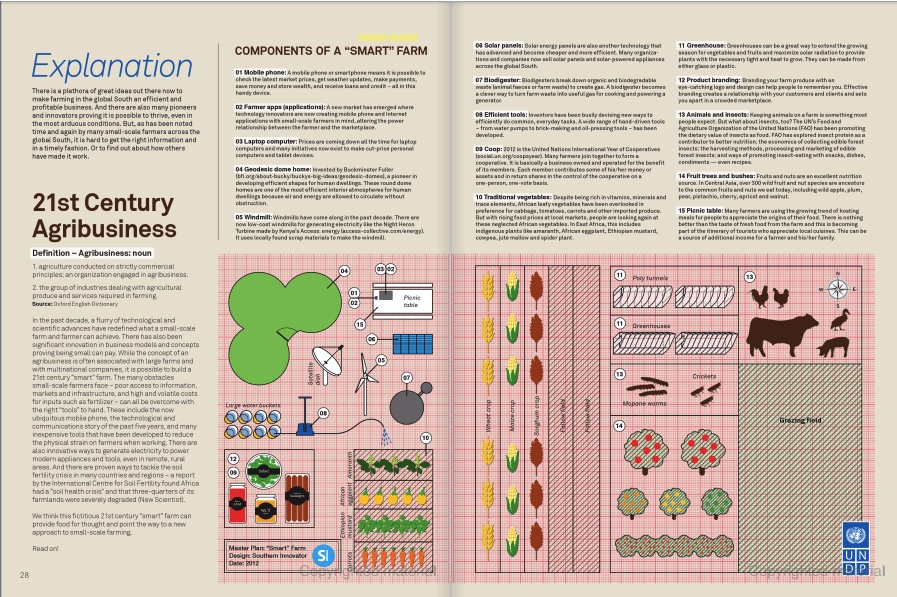
Radical new food sources are also another option over time. The Food and Agricultural Organization (FAO) has explored insect protein as a contributor to better nutrition, the economics of collecting edible forest insects, methods of harvesting, processing and marketing edible forest insects, and ways of promoting insect eating with snacks, dishes, condiments — even recipes.
The range of insects that can be tapped for food is huge, and includes beetles, ants, bees, crickets, silk worms, moths, termites, larvae, spiders, tarantulas and scorpions. More than 1,400 insect species are eaten in 90 countries in the South. Entrepreneurs in the South are making insects both palatable and marketable – and in turn profitable. These innovations are adding another income source for farmers and the poor, and supplying another weapon to the battle for global food security.
Published: January 2011
Resources
1) The global movement for slow food, which encourages organic production and appreciation of traditional foods and cooking. Website: www.SlowFood.com
3) Olam: The story of Olam – a global food supply company in ‘agri-products’ that got its start in Nigeria – shows how a Southern brand can grow and go global, and overcome the difficulties of cross-border trade. Website:http://www.olamonline.com/home/home.asp
4) South African company Eat Your Garden: It provides urban dwellers and food businesses with their own food gardens bursting with juicy and tasty foods whilst at the same time reducing carbon footprints, and creating employment and provide training, helping poverty alleviation. Website:http://www.eatyourgarden.co.za/
5) Vertical farming, where hothouses are piled one on top of the other, is an option being promoted as a solution to the food needs of urban dwellers. Website:http://www.verticalfarm.com/
In the Northeast Asian nation of Mongolia – landlocked between Russia and China – the traditional diet is based on the nomadic ways of its herders. Rich in meat and milk products, it is a diet that has evolved from the need to survive in a harsh climate doing hard physical labour – winter temperatures can drop below minus 50 degrees Celsius.
Social changes brought about by Mongolia’s economic journey since embracing free markets and democracy in the early 1990s have led to a growing urban population. The capital, Ulaanbaatar, has seen its population balloon for a variety of reasons – from collapsing rural economies to environmental disasters to the need to find work and opportunities – and is estimated to be over a million, out of a national population of just 2.6 million (World Bank).
Mongolia is experiencing serious food security problems due to factors including economic inflation and weather-related disasters, and is also confronting problems common to many countries in the age of globalization. According to the World Diabetes Foundation, 10 percent of the population is at risk of the disease, which it calls a lurking catastrophe.
As the paper “Lessons from a small country about the global obesity crisis” by Kelly D. Brownell and Derek Yach notes: “Globalization changes many features of modern life, including diets. As trade changes, diets can become more secure (hunger becomes less of a problem), but the cheapening of calories, the reliance on imported food, and the influence of food marketing drive up consumption and drive down nutrient density. Obesity, diabetes, and other chronic diseases are not far behind.”
In response to these problems, increasing awareness of healthy lifestyles has led to some new business ventures in Ulaanbaatar. This past summer, saw the opening of an organic vegetarian restaurant and shop: the Organic Café Shop, reports Green Traveler Guides.
Started by business partner-sisters Bayarmaa Jarantai and Enkhmaa Jarantai with nephew Lkhagvasuren, the modest four-table restaurant and shop is a mini-revolution for a country as meat-loving as Mongolia. It serves up organic vegetarian meals and sells certified organic products. The spark of inspiration came when Bayarmaa read three books on the macrobiotic diet translated into Mongolian. The macrobiotic diet (http://en.wikipedia.org/wiki/Macrobiotic_diet) avoids highly processed foods and uses grains, beans and vegetables as its staples.
The cafe’s menu includes: vegetable salads (shredded cabbage, bell peppers, carrots and seasoning), stir-fried vegetables with tofu and asparagus soup, 10-grain soup, eggplant, and Mongolian vegetarian fried vegetables. Prices range between 2,500 Mongolian tugrug and 4,500 tugrug (US $1.75 and US $3.00).
The vegetables are sourced locally from Mongolian farmers and gardeners and are chemical-free. While not officially certified as organic, they are effectively that.
The shop sells certified organic products from China. The products include rice, grains, sugars and jams. (Made-in-Mongolia organic produce is a business opportunity waiting to happen: so far there are no certified organic packaged-product producers in the country).
But despite the Organic Café Shop’s good intentions, it is not immune to the country’s food security issues: Bayarmaa admits to being puzzled about how she will be able to continue to source the fresh vegetables she needs during the harsh winter months. Ulaanbaatar is the coldest national capital in the world and fresh produce has to be imported at considerable expense.
Another enterprise promoting healthy living in Ulaanbaatar is the Ananda Café and Meditation Centre (http://www.anandacenter.org/), a vegetarian restaurant and yoga (http://en.wikipedia.org/wiki/Yoga) centre. Yoga is the traditional physical and mental discipline from ancient India used to keep physically fit. It is a form of exercise that appeals to a wide age range and can be done pretty well anywhere.
The Ananda Centre offers courses in yoga and meditation, vegetarian cooking classes and nature retreats.
Global Food Security Crisis: A joint UN website with frequent updates on the global food crisis and how to respond. Website:http://www.un-foodsecurity.org/
Ananda Yoga Centre: Part of the increasing awareness of the importance of a healthy lifestyle, this yoga and meditation centre is located in Ulaanbaatar, Mongolia. Website:http://www.yogamongolia.org/
Ger: Mongolia’s First Web Magazine (And A Pioneering Web Project For The United Nations).
Interest in organic food and farming is high, and organics have become a growing global industry. The worldwide market for organic food grew by more than 25 per cent between 2008 and 2011, to US $63 billion, according to pro-organic group the Soil Association. That is an impressive accomplishment given the backdrop of the global economic crisis, and evidence that people value quality food, even in tough times.
One Kenyan company is hoping to help farmers benefit from this global surge in interest in organic food. The company is selling a healthy alternative to chemical fertilizers and is hoping it will soon be able to source its products in Kenya, too.
BioDeposit (http://biodeposit.lv/index.php?page=elixir-3) sells soil conditioner and natural fertilizer made from two ingredients: peat found in marshlands and silt dredged up from lakes, which is called sapropel (http://en.wikipedia.org/wiki/Sapropel). This naturally occurring resource is rich in all the elements required for abundant crops and has the added benefit of not poisoning the soil and water table when used on farmer’s fields.
It is sold as a solution to the multiple pressures hitting farmers, from chaotic weather patterns to soil damage and decreasing yields. It offers a way to boost farm productivity without damaging the soil in the long term.
In 2011 the amount of farmland that was organic reached 37.2 million hectares in 162 countries – but this is still just 0.86 per cent of the world’s agricultural land (Research Institute of Organic Agriculture and International Federation of Organic Agriculture Movements). If BioDeposit has its way, Kenyan farmers could help to grow the number of hectares being farmed organically.
Presenting the solution in October 2013 at the Global South-South Development Expo (southsouthexpo.org) at the headquarters of the UN’s Environment Programme (UNEP) in Nairobi, Kenya, BioDeposit communications and media chief Nelly Makokha (http://ke.linkedin.com/pub/nelly-makokha/29/a08/634), explained that the company is hoping to bring the technology behind BioDeposit to Kenya, if they can get permission.
At present, the source materials for the products are dredged from lakes in Latvia in Eastern Europe. Because of the political structures of Kenya, it means a long political process is ahead to gain permission to dredge any of the country’s lakes. BioDeposit’s Latvian scientists conducted research on the potential for Lake Naivasha (http://en.wikipedia.org/wiki/Lake_Naivasha) in the Rift Valley and claim it has enough deposits to provide Kenya’s farmers with organic fertilizer for the next 200 years.
“If the government agrees, the fertilizer is basically cheaper than any other fertilizer the farmer [will] have ever used in a long time,” said Makokha. “It will be pocket-friendly for them. As they earn more money from the more yields, they are spending less on the fertilizer.
“Our slogan is ‘smart agriculture for health and wealth’ – health in terms of you become organically grown, and if you are looking for organic certification, we will organize that for the certifiers. Right now most countries are looking for organic food and cannot find it.
“So when you become organic that means you earn more money on your products so it means you are healthy and you are wealthy!”
The fertilizer comes in 12 milliliter packets that cost 200 Kenyan shillings (US $2.30). A farmer would need two packets for each quarter acre of farmland.
Based on a Russian discovery from the early 20th century, BioDeposit draws on naturally occurring resources.
Its products include BioDeposit Agro, described as a “biologically active soil conditioner,” and BioDeposit Elixir, described as a “humic plant growth stimulator.” The Elixir is a “sustainable, water-soluble” concentrate made from peat and can be used to soak seeds prior to planting, increasing the germination cycle. For the farmer, it means more seedlings in a shorter time. It also can be poured on compost piles to boost humic content to speed compost decay. Peat is formed from above-ground marsh plants, either on the surface or under a layer of water.
BioDeposit Agro is made from sapropel from the sediment at the bottom of freshwater lakes. It is a renewable, naturally-occurring resource as it has been formed from the accumulated settling of plants such as reeds, algae, trees, grasses and animals over time as they decay.
Unlike other chemical fertilizers, using the BioDeposit product does not require special protective clothing and does not harm human health. Children are also not at risk if they accidentally ingest the product.
“Most farmers have small farms – quarter acre, half acre, at most three acres,” said Makokha. “For a quarter acre you spend five dollars and you get more yields. Two of them would be approximately five dollars – that’s enough for a whole season – so it is pocket friendly.”
And if the company is able to harvest the material in Kenya, it would be even cheaper.
“You can imagine if we dredge here – probably (get the cost down to) a dollar – so it makes more sense for the farmers.”
The dredging has another positive impact: it helps with managing flooding by making the lake deeper once the silt is dredged out, making life better and safer for people living nearby.
BioDeposit has been operating in Kenya for a year and, Makokha said, “the response is awesome.”
BioDeposit organizes workshops for farmers through cooperative societies, helping to guide farmers through the whole process of becoming organically certified.
The company believes its products will help avert problems such as what happened recently when the European Union prevented some flowers – a major source of overseas income for Kenyan farmers – from entering the EU because of banned pesticides.
Cleverly, BioDeposit does most of its business digitally through mobile phones. It conducts its business with sales representatives by phone and conducts training by phone as well. All payments and bank transfers are done by phone using the M-PESA system (http://www.safaricom.co.ke/?id=257).
“It is the easiest way to do business in Kenya,” said Makokha. “Everybody right now owns a mobile phone. When we get the M-PESA, we transfer directly to the account. You get the money and transfer to the bank account and you are done, very easy for everybody … doing wonders for us.”
5) Integrating Ethno-Ecological and Scientific Knowledge of Termites for Sustainable Termite Management and Human Welfare in Africa by Gudeta W. Sileshi et al, Ecology and Society, Volume 14, Number 1. Website: http://www.ecologyandsociety.org/vol14/iss1/art48
6) Soil Association: The Soil Association was founded in 1946 by a group of farmers, scientists and nutritionists who observed a direct connection between farming practice and plant, animal, human and environmental health. Website: http://www.soilassociation.org/marketreport
7) Research Institute of Organic Agriculture: FiBL is an independent, non-profit, research institute with the aim of advancing cutting-edge science in the field of organic agriculture. Website: http://www.fibl.org/en/fibl.html
International Federation of Organic Agriculture Movements: Since 1972, IFOAM has occupied an unchallenged position as the only international umbrella organization of the organic world, i.e. all stakeholders contributing to the organic vision. Website: http://www.ifoam.org/
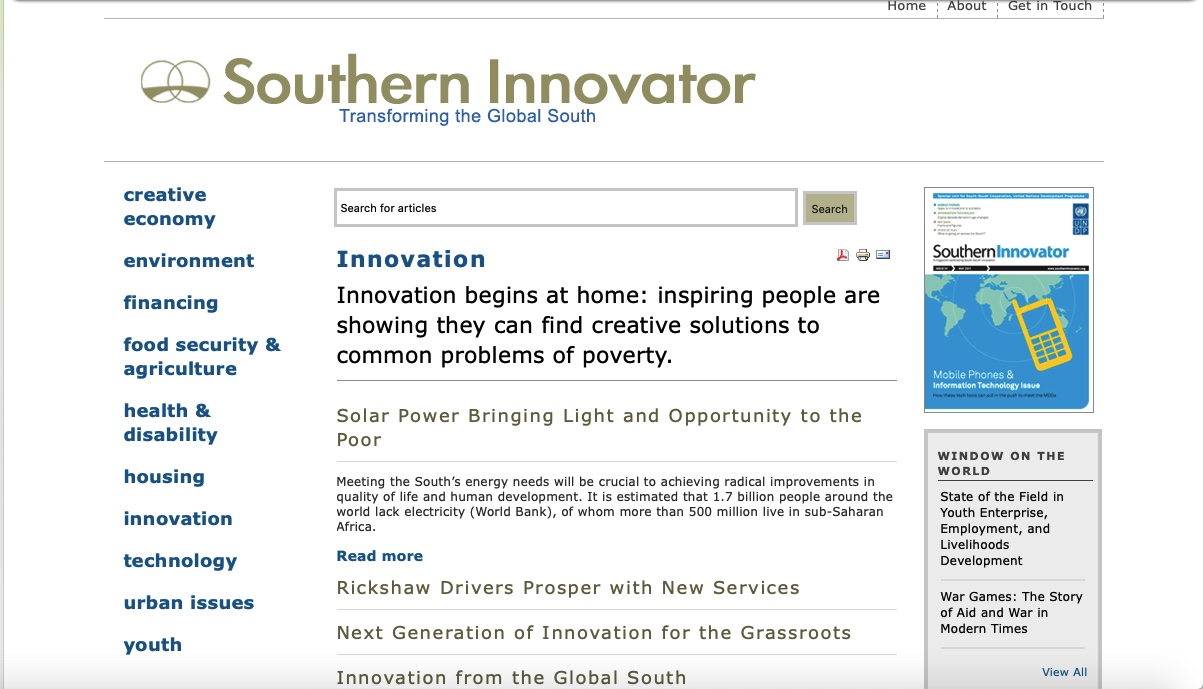
Development Challenges, South-South Solutions was launched as an e-newsletter in 2006 by UNDP’s South-South Cooperation Unit (now the United Nations Office for South-South Cooperation) based in New York, USA. It led on profiling the rise of the global South as an economic powerhouse and was one of the first regular publications to champion the global South’s innovators, entrepreneurs, and pioneers. It tracked the key trends that are now so profoundly reshaping how development is seen and done. This includes the rapid take-up of mobile phones and information technology in the global South (as profiled in the first issue of magazine Southern Innovator), the move to becoming a majority urban world, a growing global innovator culture, and the plethora of solutions being developed in the global South to tackle its problems and improve living conditions and boost human development. The success of the e-newsletter led to the launch of the magazine Southern Innovator.
NEW: A new design template has been launched for the e-newsletter (see below). The Southern Innovator website archive of Development Challenges stories is also now online: southerninnovator.org
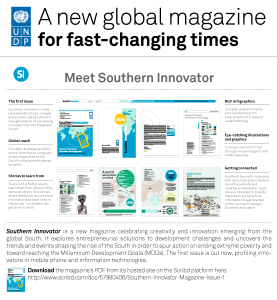
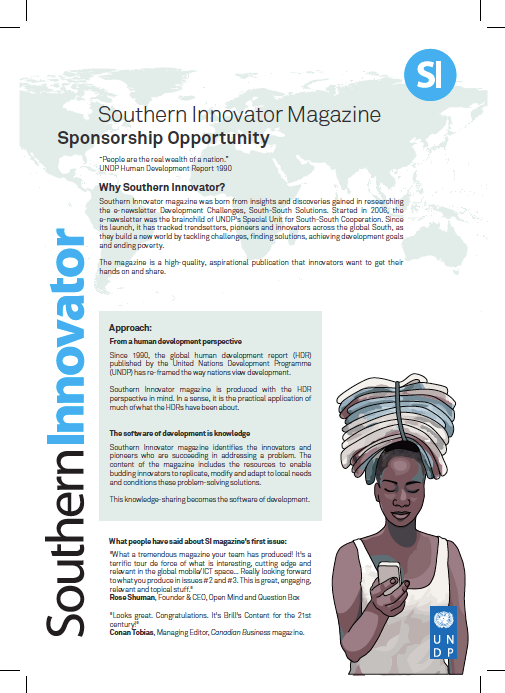
New magazine Southern Innovator has launched: Read and download the magazine here: Southern Innovator Issue 1
December
Mapping to Protect Kenya’s Environment: the eMazingira SolutionDevelopment Challenges: Powerful new grassroots crowd-mapping tools have sprung up in the past few years across the global South, from Brazil’s Wikicrimes (www.wikicrimes.org) real-time crime mapping technology to the now famous Ushahidi (http://ushahidi.com) – a non-profit company making the free and open source Ushahidi software for information collection, visualization and interactive mapping – from its base in Kenya. They share some common features. All draw on the widespread use of mobile phones in the global South combined with growing access to the Internet, either through 3G mobile phone services, WiFi wireless connections, Internet centres or increasingly available broadband Internet services.
Building an Interactive Radio Network for Farmers in NigeriaDevelopment Challenges: As solar power technology has improved, new pioneers have emerged to exploit this innovation. Several decades ago, solar power was seen as too expensive for wide-scale roll out in poor countries and communities. But today, an army of solar technology pioneers has fanned out across the world to show the new wave of innovations and how they make solar power affordable.
African Manufacturing Pioneers Proving it is Possible to ThriveDevelopment Challenges: Africa’s paradox is that it is home to the greatest share of the world’s unexploited resources, yet has some of the world’s lowest per capita incomes. History has shown that exploiting the continent’s resources alone for export markets does little to improve incomes and living conditions in Africa, which in turn does nothing to improve human development. The key to resolving this paradox is made-in-Africa jobs, in particular high-value jobs that make products.
Indian City Slum Areas Become Newly Desirable Places to LiveDevelopment Challenges: With India’s urban economy experiencing rapid growth, its slums – once seen as the most undesirable places to live in the country, if not on Earth – are attracting the attention of affluent residents and developers in India’s rapidly expanding cities. The prosperity in India’s cities has made these areas’ proximity to business and entertainment zones highly desirable. In turn, this has led to slum dwellers either upgrading their homes and in the process boosting their value, or being offered the opportunity to sell their rudimentary dwellings to real estate agents and property developers.
November
New African Film Proving Power of Creative EconomyDevelopment Challenges: A new movie is generating excitement around life in the war-torn, chaotic and impoverished Democratic Republic of the Congo (http://en.wikipedia.org/wiki/Democratic_Republic_of_the_Congo) – the central African nation – and proving how versatile and resilient a creative economy can be in a crisis.
Recycling Waste to Boost Incomes and Opportunities Development Challenges: We all know that green is good, but often the best way to encourage recycling and other environment-improving activities is to put in place economic incentives. It is one thing to admonish people and tell them something is the right thing to do; it is another to make keeping a clean environment pay.
Virtual Supermarket Shopping Takes off in China Development Challenges: An ingenious use of technological innovation and savvy trend-spotting is radically transforming the way people do their grocery shopping in China. Busy urban dwellers with time-poor lifestyles can now do their grocery shopping as they pass through Shanghai’s subway system and have their weekly shopping delivered to their home.
Bolivia Grabs World Media Attention with Salt Hotel Development Challenges: Tourism is a great way to attract foreign currency to a country and build local economies, especially in remote or isolated places. But the catch is finding a way to get people to go the distance and come and visit and spend their money.
October
Indian Mobile Phone Application Innovators Empower Citizens Development Challenges: With mobile phones becoming ubiquitous across the global South, the opportunity to make money – and possible fortunes – by providing ‘apps’ for these devices is now a reality.
Mapping Beirut Brings City to LightDevelopment Challenges: As cities in the global South grow ever larger, their often-chaotic evolution can create sprawling urban mazes that would confuse even the brightest brains.
Putting Quality and Design at the Centre of Chinese FashionDevelopment Challenges: Awareness of the sourcing of materials for fashion has been on the rise in the past decade. Concerns about how the global fashion industry functions and its impact on the environment have given rise to savvy retailers who take care over the sourcing of their materials and the working conditions of their employees.
Cheap Indian Tablet Seeks to Bridge Digital Divide Development Challenges:India has had many false starts in innovating in information technology. While the country and its talented army of software engineers have a global reputation for innovation, the fits and starts that have accompanied attempts to create new hardware and devices have drawn a range of emotions, from amusement to frustration.
September
Filipino Architect wants to Transform Slum with New PlanDevelopment Challenges: A clash is occurring across the global South over the future of urban planning and the ever-growing slums of the world’s megacities. This will be a decisive clash of visions: should cities flatten slums and relocate their residents, or work with slum dwellers, acknowledge the role they play in city economies and improve their lives with better dwellings?
Model City to Test the New Urbanism Concept in IndiaDevelopment Challenges: India’s phenomenal economic growth rate – forecast to be 7.9 percent this year by the Asian Development Bank, after averaging 7.7 percent per year over the past decade – has been the force behind an expanding middle class population, now estimated at 50 million people (McKinsey). Forecasts see it swelling from 5 percent of the population to 40 percent by 2025.
Pulque: Aztec Drink Ferments New EconomyDevelopment Challenges:Reviving traditional foods and drinks can be an income-boosting source of new economic activity. Many cultures can benefit from looking again at their rich traditions to find new ways to increase enterprise. This can be difficult at first. Big global brands have many initial advantages: they are backed by wealthy and experienced international companies and can deploy aggressive marketing and distribution power to get products into the hands of consumers. The power of Coca Cola to reach all corners of the earth is legendary.
Ghana: Oil-rich City Sparks Entrepreneurs and DebateDevelopment Challenges: Commodity booms can seem like the answer to a poor nation’s prayers, a way to fulfil all their development dreams and goals. The reality, however, is far more complex. More often than not, the discovery of resources sparks a mad scramble for profits and patronage, as politicians and politically connected elites carve out their slice of the new resource boom before anyone else.
August
Anti-bribery Website in India Inspires Others Development Challenges: An Indian website tackling corruption has been so successful it has inspired a wave of followers in China. The I Paid a Bribe website – motto: “Uncover the Market Price of Corruption” – was set up by the Janaagraha Centre for Citizenship and Democracy (www.janaagraha.org), a non-profit organisation based in Bangalore, India.
Turning African Youth on to TechnologyDevelopment Challenges: An African NGO believes the Internet is the single biggest key to rapid development in Africa – and it is working to connect youth, women and rural populations to the web, and in turn, switch them on to the vast resources stored across the world’s Internet sites.
Pakistan Simplifies Job-matching ServicesDevelopment Challenges: An innovative job-matching service from Pakistan is trying to bring together people who normally live separate lives. It is eliminating the middlemen who gouge both employers and employees for job-seeking fees and opening up a new world of opportunities for the poor.
Data Surge across Global South Promises to Re-shape the Internet Development Challenges: The deluge of data gathered by the digital revolution underway in the global South continues to offer a significant economic opportunity. How this data is harvested will forge the successful Internet business models of the future.
July
Bringing the Invention and Innovation Mindset to Young Kenyans Development Challenges: A highly innovative new way to teach the basics of electronics, computing and technological innovation is being pioneered in the slums of Nairobi, Kenya. Driven by the desire to counter perceptions of apathy among young people, NGO Kuweni Serious is running a training course for girls aged over 8 years in some of the poorest parts of the city to turn on a new generation to the power of technology to make change.
Arab World Domain Name Opportunity Huge Economic HelpDevelopment Challenges: With the so-called Arab Spring still unfolding across much of the Arabic-speaking world, it is easy to miss a rising new economic opportunity: The introduction of an Arabic domain name system for the Internet.
African Youth Want to do Business in Fast-growing Economy Development Challenges: Africa’s growing economy is meeting head-on an optimistic young population keen to start businesses. At least that is what a new poll of African youth says, finding that one in five Africans between the ages of 15 and 24 without a current business wants to start one in the next 12 months.
Kenyan Safari Begins Minutes from AirportDevelopment Challenges: Many people find the prospect of staying in airport hotels dreary at best. They tend to be located in industrial parts of cities or far from city centres. They can be surrounded by roads and highways and are built to move lots of people, not to look nice. The surrounding areas can be very common to all nations – warehouses, office parks, nondescript restaurants and hotels – and give few clues to where you are apart from the weather and the languages on the sign boards.
June
Brazilian Restaurant Serves Amazonian TreatsDevelopment Challenges: The vast Amazon rainforest has inspired a cuisine pioneer in Brazil. Combining the sensual pleasures of fine dining and the joy of tasting new flavours with a pursuit of sustainable and profitable local farming, a chef is inventing a new Brazilian cuisine and showing the way to create sustainable incomes.
Civet Cat Coffee Brews Filipino OpportunityDevelopment Challenges: In the Philippines, one animal’s call of nature has become a business opportunity.The civet cat, a member of the mongoose family, ingests the fruit of coffee plants, and expels the beans. This has created an unexpected by-product – a prized beverage for the world’s savvy coffee drinkers seeking the next taste sensation. The partially digested coffee beans are gathered from the faeces of the cat and used to make a much-coveted, smooth-flavoured cup of coffee.
Indonesia Best for EntrepreneursDevelopment Challenges: A global survey has unearthed hotspots across the global South for start-up businesses and private enterprise. It shows there are now many places in the South where people are actively encouraged to start businesses and engage in innovation and enterprise. The top place in the world for entrepreneurship, according to the survey for the British Broadcasting Corporation (BBC), is Indonesia.
The e-Reader Battle Reaches IndiaDevelopment Challenges: The rise and rise of e-books and electronic publishing has prompted the development of e-readers: handy, portable devices that try to mimic the reading experience of paper books while offering the storage and navigation capability of computers.
May
African Botanicals to be used to Boost Fight against Parasites Development Challenges: More than 1 billion people in the developing world currently suffer from tropical diseases, which leave a trail of disfigurement, disability and even death. Yet only 16 out of 1,393 – 0.01 percent – of new medicines marketed between 1975 and 1999 targeted tropical diseases (International Journal of Public Health).
Floating Bank Floats New Dreams for Brazilian Middle Class Development Challenges: Brazil’s booming economy has seen a dramatic increase in the size of its middle class. More and more people have been lifted out of poverty as a growing, stable economy overcomes years of political and economic instability. In 2010, Brazil’s economy grew by a record 7.5 percent, surpassing a previous peak in 1986 (Brazilian Institute of Geography and Statistics) (IBGE) (www.ibge.gov.br/english). The country’s gross domestic product (GDP) reached 3.67 trillion reais (US $2.21 trillion) in 2010, making it Latin America’s largest economy.
Indonesian Food Company Helps Itself by Making Farmers More Efficient Development Challenges: The current global economic crisis is taking place at the same time as a global food crisis. Food inflation took off at the beginning of 2011. This is having a devastating affect on countries dependent on food imports and experiencing decreasing domestic production capabilities. The least developed countries (LDCs) saw food imports rise from US $9 billion in 2002, to US $23 billion by 2008 (UNCTAD), prompting Supachai Panitchpakdi, secretary general of UNCTAD, to say “the import dependence has become quite devastating.”
Indian Toilet Pioneer Champions Good Ideas Development Challenges:Access to adequate sanitation and toilet facilities is critical to making development gains. Yet this simple fact of life often gets overlooked, especially in fast-growing cities where populations are on the rise or in transit. Out of an estimated 2.6 billion people in the world without toilets, two-thirds are in southern and eastern Asia (World Toilet Organization).
April
Solar Sisters Doing it for Themselves: Tackling African Light Famine Development Challenges: A social enterprise is seeking to capture the power of the sun to bring light and economic opportunity to women in Africa. Using a direct-marketing distribution system, it sells solar lamps and lanterns to some of Africa’s remotest communities. Solar Sister (www.solarsister.org), launched in Uganda in 2010, is hoping to do for power generation what mobile phones have done for communication in Africa: make a technological leap to a model of grassroots power generation, rather than waiting for large-scale power schemes to eventually reach the poor and rural.
South Africa Innovates Healthcare with Prepay Phone Vouchers Development Challenges: Pioneers in Africa are experimenting with new ways to fund the delivery of healthcare that is affordable and sustainable and not dependent on foreign aid and donations. A South African company is prototyping the selling of pre-payment healthcare services through mobile phones with a range of vouchers that can be bought and downloaded at the tap of a keypad.
Indian ID Project is Foundation for Future Economic Progress Development Challenges: India is in the midst of the biggest national identification project in the country’s history. The aim is for every Indian to receive a voluntaryelectronic identification card containing his or her details and a unique number. Called an Aadhaar, it is a 12-digit unique number registered with the Unique Identification Authority of India (http://uidai.gov.in) (UIDAI). The project joins a growing trend across the global South to map populations in order to better achieve development goals.
Ghana’s Funeral Economy Innovates and Exports Development Challenges: The West African nation of Ghana’s funeral economy is attracting innovation and grabbing attention outside the country. The nation’s elaborate – but expensive – funeral rituals provide craftsmen with a good income. And new products are being introduced to handle the financial consequences of this unavoidable fact of life.
March
Bolivian Film School’s Film Scene Paying Off Development Challenges: A film school in Bolivia shows how a creative hub can become the start of something much bigger. The school is inspiring a new generation of young people to get into filmmaking. And one of its lecturers is already experiencing global success acting in an award-winning new Spanish film.
Happy Nigeria: West African Nation Has Good Attitude Development Challenges: In the last 10 years, an increasing amount of attention has been paid to the concept of national happiness. The notion was first developed in the tiny Asian Kingdom of Bhutan (http://en.wikipedia.org/wiki/Bhutan), whose advocacy of ‘gross national happiness’ (http://www.grossnationalhappiness.com/) as a measure of national achievement just as important as Gross National Product (GNP), has been met with equal parts ridicule, respect and research.
Cambodian Bloggers Champion New, Open Ways Development Challenges: The Southeast Asian nation of Cambodia has had a very difficult history over the past few decades. In the 1950s and 1960s, it was seen as a glamorous and vibrant place. Dynamic, ambitious and newly independent from French colonial rule, Cambodia embarked on an extensive programme of building that is now called “New Khmer Architecture.” It is the most visible legacy of this modernizing time.
China Consumer Market: Asian Perspective HelpsDevelopment Challenges:The rise of China since 1989 has been the most remarkable development story of our times. The number of people lifted out of poverty is historically unprecedented: 65 percent of Chinese people lived below the poverty line in 1981; in 2007 it was 4 percent (World Bank).
February
Disaster Recovery, Ten Years After: The Gujarat, India Experience Development Challenges: In the past decade, there have been many devastating natural disasters, from Iran’s 2003 Bam earthquake and the Asian tsunami of 2004 to Hurricane Katrina in the United States in 2005 and the earthquakes in Chile and Haiti in 2010. All of these events received extensive media attention and drew a large aid response. Those who track natural disasters have noticed a serious increase in frequency over the past decade (http://www.marketoracle.co.uk/Article26290.html).
Chilean Eco-Buildings Pioneering Construction MethodsDevelopment Challenges: Across the global South, the search is on for new ways to build without extracting a high price from local environments.More and more people are recognizing the advantages of energy-saving methods like prefabrication. Prefab building techniques involve assembling a structure from pre-assembled parts or modules made in a factory, or transporting a completed, factory-made structure to a site (http://en.wikipedia.org/wiki/Prefabricated_building).
Model Cities Across the South Challenge Old WaysDevelopment Challenges: Pioneering thinking about how resources are used and how people live their lives is taking place in the dynamic economies of the global South. Facing a vast population surge to urban areas, these include attempts to build “green” cities and low-waste, smart and digital communities.
Indian Newspapers Thrive with Economy Development Challenges: The onslaught of digital media in the developed countries of the world regularly brings pronouncements of the death of the traditional newspaper. But this assumption of digital triumph misses out on the reality in countries across the global South.
Extra story: 2011 Trends for the South Development Challenges: The world has been through a dramatic and fascinating period since the global economic crisis erupted in 2008. While the wealthy, developed nations of the North have been pitched into one crisis after another, the countries of the global South (many of whom are well accustomed to crises) have been part of a powerful new economic phenomenon: the rapid growth of South-South trade, investment and exchange. Its effects include stronger ties between Asia and South America and between China and Africa.
Africa’s Consumer Market in Spotlight for 2011Development Challenges:While other parts of the world will spend 2011 worrying about their debt levels and how to spur economic growth, many factors are pointing to Africa potentially following a different story. A frenzy of activity has been building around Africa’s market opportunities and its growing middle class consumer population.
China’s Booming Wine Market Can Boost SouthDevelopment Challenges: A great South-South opportunity has emerged with the recent boom in wine drinking in China and the pursuit of quality tastes. Matching high-quality wine producers from the global South – including South Africa, Chile, Morocco, and Lebanon – with China’s thirsty wine drinkers could deliver a major income boost.
Food Inflation: Ways to Fight ItDevelopment Challenges: Food inflation has taken off at the beginning of 2011. As the global economic crisis enters its next phase, both developed and developing countries are experiencing inflation. There are many factors fuelling the rise in prices – inefficient distribution and storage systems, lack of investment in agriculture, devaluing currencies, high demand, natural and man-made disasters, use of food products like corn to make biofuels – but there are also ways to counter the effects of food inflation that have been tried and tested across the South.
Turning Animal Waste Into PaperDevelopment Challenges: Animal waste is a messy fact of daily life in rural communities across the global South. This byproduct of life has many uses – but an ingredient for making writing paper is probably not the first that springs to mind.
Development Challenges, South-South Solutions was launched as an e-newsletter in 2006 by UNDP’s South-South Cooperation Unit (now the United Nations Office for South-South Cooperation) based in New York, USA. It led on profiling the rise of the global South as an economic powerhouse and was one of the first regular publications to champion the global South’s innovators, entrepreneurs, and pioneers. It tracked the key trends that are now so profoundly reshaping how development is seen and done. This includes the rapid take-up of mobile phones and information technology in the global South (as profiled in the first issue of magazine Southern Innovator), the move to becoming a majority urban world, a growing global innovator culture, and the plethora of solutions being developed in the global South to tackle its problems and improve living conditions and boost human development. The success of the e-newsletter led to the launch of the magazine Southern Innovator.















 David South Consulting

You must be logged in to post a comment.