Categories
Archive Development Challenges, South-South Solutions Newsletters

A New African Beer Helps Smallholder Farmers

By David SouthDevelopment Challenges, South-South Solutions

SOUTH-SOUTH CASE STUDY

Africa’s growth in the past decade has held steady despite the trauma of the global economic crisis and the tumult of the “Arab Spring” in several countries of North Africa. African economies are growing because of a number of resilient trends. These include growing regional trade links, greater investment in infrastructure and the remarkable rise of China to become Africa’s number one trade partner, pushing the United States to second place (Technology + Policy). This has given birth to a growing consumer marketplace and consumer class – some 300 million people earning about US $200 a month (Africa Rising).

The continent as a whole now stands as the 10th largest economy in the world.

How will Africans spend this new money in their pockets (or more than likely, on their mobile phones)? They could go for the big, famous global brands that they see advertised in magazines or on television. Or they could also spend it on local products and services that seem just as enticing and life-improving. Creating local African products and services with strong brands will have an important knock-on effect of creating new wealth and jobs within Africa.

One new product being introduced to the West African country of Ghana’s thirsty beer drinkers is the Eagle beer brand. But this is not just any beer made from the traditional ingredients of water, hops, malted barley and yeast (http://en.wikipedia.org/wiki/Beer) – it is brewed from the root vegetable cassava.

A staple of many African diets, cassava (http://en.wikipedia.org/wiki/Cassava) is a starchy, tuberous root vegetable and a common crop across the continent.

It is believed that 70 per cent of Ghana’s farms are just 3 hectares in size or smaller. They grow many things, but cassava is the most common crop.

Cassava soon spoils once it has been harvested and needs to be consumed quickly. Currently, too much of it goes to waste. In Ghana, according to The Guardian, there is an annual surplus of some 40 per cent of cassava produced.

The Accra Brewery Limited (ABL) (http://www.sabmiller.com/index.asp?pageid=1156) decided to find a way to put the cassava from smallholder farms to good use and stop the waste. The brewery had observed the success of parent company SABMiller (http://www.sabmiller.com/index.asp?pageid=27) elsewhere in Africa, in turning cassava and the grain sorghum from smallholder farmers into beer. Farmers had directly benefited from the purchase of their surplus product.

Eagle brand cassava beer is creating opportunities for business, consumers and smallholder farmers in Ghana. According to The Guardian, the company hopes to source cassava from 1,500 smallholders.

By having a guaranteed purchase from the brewery on a regular basis, farmers are able to move beyond subsistence agriculture and turn themselves into functioning businesses.

The spare income from selling the cassava also can be used to improve a farmer’s household access to healthcare and education.

The Accra Brewery provides advice on agricultural techniques and growing a diverse range of crops, to ensure farmers are not dependent on a monocrop harvest. It also offers advice on business and developing commercial relationships.

The Eagle brand cassava beer will be sold at a 30 per cent discount to low-income drinkers in order to lure them away from illicit and informal alcohol drinks of dubious quality.

Professor Ethan Kapstein of business school INSEAD found that ABL and its water business Voltic (GH) Ltd. was a creator and supporter of high-quality jobs in Ghana and supported 17,600 jobs throughout the Ghanaian economy.

Adjoba Kyiamah (http://www.sabmiller.com/index.asp?pageid=1766&blogid=172), corporate and legal affairs director at Accra Brewery, told The Guardian she believes Eagle brand beer will help create even more jobs, boost government revenues and expand consumer choice.

This is an innovative first, as cassava beer had never been made before in Ghana on a commercial scale. This had not been possible in the past because of the challenge of collecting fresh cassava from farms widely spread out over a large territory. As well as spoiling quickly, Cassava is heavy, being mostly made up of water, and is difficult to transport over large distances.

“Part of our strategy across Africa is to make high quality beer which is affordable for low-income consumers while simultaneously creating opportunities for smallholder farmers in our markets. The launch of Eagle in Ghana ticks both these boxes,” said Mark Bowman, Managing Director of SABMiller Africa.

“Eagle is aimed at attracting low-income consumers away from illicit alcohol. This is a virtuous circle: smallholder cassava farmers have a guaranteed market for their crop, which is then used to make consistently high quality, affordable beer for consumers; and the government realises increased revenues as people trade up into formal, taxable alcohol consumption.”

ABL is using a mobile processing unit developed by DADTCO (Dutch Agricultural Development and Trading Company) Cassava Processing Ghana Ltd. It is designed to process the cassava on site, preserving the integrity of the starch.

Eagle is sold in 375 millilitre bottles at a price 70 per cent lower than that charged for other lager beers. The use of local ingredients, and a reduced excise tax awarded to the brand because is it is boosting local agriculture, allows for the lower price.

Production of cassava beer got its start first in Mozambique, with the launch of the Impala brand (http://www.sabmiller.com/index.asp?pageid=149&newsid=1748), the first commercial-scale cassava-based clear beer, in October 2011.

Published: April 2013

Resources

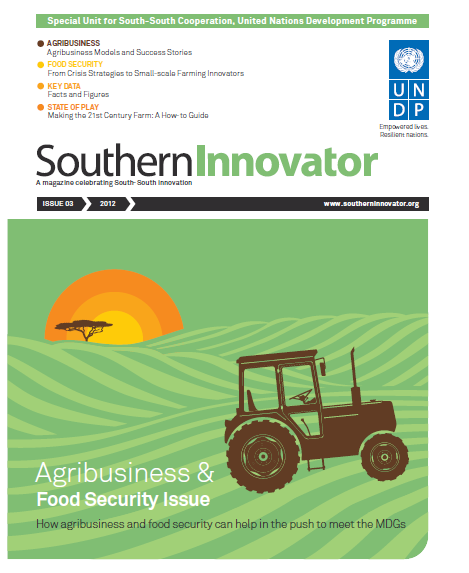
1) Southern Innovator Magazine Issue 3: Agribusiness and Food Security. Packed with information, insights and business models to turn smallholder farmers into agribusinesses. Website: http://www.scribd.com/doc/106055665/Southern-Innovator-Magazine-Issue-3-Agribusiness-and-Food-Security

2) Cassava can become Africa’s new cash crop: Cassava is abundant in sub-Saharan Africa, and could be an ideal crop to improve food security for millions of people. Website: http://www.guardian.co.uk/global-development-professionals-network/2013/mar/28/cassava-food-security-sub-saharan-africa

3) Cassava recipes from the BBC. Website: http://www.bbc.co.uk/food/cassava

Southern Innovator logo

London Edit

31 July 2013

Development Challenges, South-South Solutions was launched as an e-newsletter in 2006 by UNDP’s South-South Cooperation Unit (now the United Nations Office for South-South Cooperation) based in New York, USA. It led on profiling the rise of the global South as an economic powerhouse and was one of the first regular publications to champion the global South’s innovators, entrepreneurs, and pioneers. It tracked the key trends that are now so profoundly reshaping how development is seen and done. This includes the rapid take-up of mobile phones and information technology in the global South (as profiled in the first issue of magazine Southern Innovator), the move to becoming a majority urban world, a growing global innovator culture, and the plethora of solutions being developed in the global South to tackle its problems and improve living conditions and boost human development. The success of the e-newsletter led to the launch of the magazine Southern Innovator. 

Creative Commons License

This work is licensed under a
Creative Commons Attribution-Noncommercial-No Derivative Works 3.0 License.

ORCID iD: https://orcid.org/0000-0001-5311-1052.

© David South Consulting 2022

Categories
Archive Development Challenges, South-South Solutions Newsletters Southern Innovator magazine

Protecting Threatened Fruits and Nuts in Central Asia

By David SouthDevelopment Challenges, South-South Solutions

SOUTH-SOUTH CASE STUDY

Between 94,000 and 144,000 plant species — a quarter to a half of the world’s total — could die out in the coming years, according to an estimate by Scientific American (2002).  Among them are vital food crops, threatened by a world in which climate change is causing more weather turbulence and diseases and viruses can spread rapidly and destroy crops.

This scale of plant loss risks leaving the world’s food security dependent on fewer – and more vulnerable – domesticated species. The hunt is on for hardy plant species that can survive these ups and downs while protecting the world’s food security for this and the next generation.

In the Central Asian nations of Kyrgyzstan and Tajikistan, conservation of trees and their fruits and nuts are being placed at the centre of the economic lives of people who had been unwittingly destroying the trees’ habitat. Two projects, one to preserve walnut trees in Tajikistan, and the other to preserve apple trees in Kyrgyzstan, are beginning to bear fruit.

The Red List of Trees of Central Asia published in April 2009 by the Global Trees Campaign (http://www.globaltrees.org/rl_centralasia.htm), identified the 44 species most at risk in Kyrgyzstan, Kazakhstan, Uzbekistan, Turkmenistan and Tajikistan. Growing in rugged, mountainous terrain, the plants have high genetic diversity and are thought to be critical in the development of disease-resistant and climate-tolerant fruit varieties.

The diverse environments of Central Asia are host to over 300 wild fruit and nut species that are ancestors to the fruits and nuts we eat today, including wild apple, plum, pears, pistachios, cherry, apricot, and walnut.

Many face extinction as local people — driven by the need for fire wood, or to earn an income — cut down this precious resource. The Red List estimates that over 90 percent of the trees in the fruit and nut forests across Central Asia have been destroyed in the past 50 years.

The importance of these fruits and nuts can’t be over-emphasized: all the common varieties of apricot come from one living ancestor, the species Armeniaca vulgaris, now very rare in Central Asia. Central Asia’s Malus sieversii (http://en.wikipedia.org/wiki/Malus_sieversii) gave birth to today’s domestic apples. It spread its way around the world along the ancient Silk Road (http://en.wikipedia.org/wiki/Silk_Road). The name of Kazakhstan’s former capital city is Almaty (http://en.wikipedia.org/wiki/Almaty), which literally means ‘Grandfather of Apples’.

Scientists have found genetic diversity and disease resistance greater in wild plant species that have not been domesticated, like Malus sieversii. Malus sieversii is highly resistant to Fire Blight (http://en.wikipedia.org/wiki/Fire_blight), a nasty disease that turns the fruits black (USDA).

To stop this free-for-all in which resources are plundered to extinction and trees wiped out to be used for firewood, deals are being struck to guarantee local communities’ rights to exploit the trees as a resource, while also obligating them to preserve them.

In Tajikistan, the walnut trade is a critical source of income for some villages, with most of the crop exported to Turkey. The country shares with Kyrgyzstan the world’s largest natural-growth walnut forest. But the use of short-term land leases discouraged long-term management, while local people were lacking any other sources of income and over-exploited the trees.

Jilly McNaughton of British NGO Fauna and Flora International (www.fauna-flora.org), said the current situation “is not good, with use of the forest by local people both heavy and inadequately controlled.” “Collection of firewood and grazing are perhaps the biggest concerns,” she said. “There is very little natural regeneration of wild trees due to grazing and hay making in the forest. “As the walnut is valued as an income generating crop, other trees are cut for firewood and timber, meaning parts of the forest have become a park-like landscape with scattered large walnut trees.”

Fauna and Flora International, which specializes in species preservation, is encouraging local people to work towards long-term leases and diversify their sources of income. The strategy includes encouraging other ways to make a living, including raising chickens, making clothes and bee keeping.

As one villager said: “We have bought honey buckets and bees. Next year we will get a lot of honey – it will be a great income. We got a job.”

The Red List of Trees found the causes of species’ destruction are multiple: over-exploitation, human development, pests and diseases, overgrazing, desertification and fires. Since the break up of the Soviet Union, funds have been short to help reverse these threats.

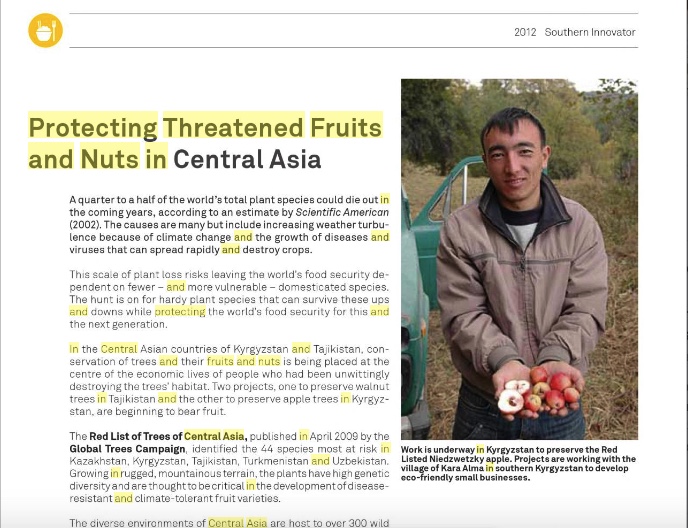
The most threatened apple species in the Red List is the Niedzwetzky apple (Malus niedzwetzkyana) (www.globaltrees.org/kyrgyzstan_apple.htm).

In Kyrgyzstan, work to preserve the Niedzwetsky apple is directly involving the community. Projects are working with the village of Kara Alma in southern Kyrgyzstan and government forest services to encourage eco-friendly small businesses to earn incomes and protect the forests.

They have catalogued all 111 trees that still survive, and have set up a community-run nursery to grow more. The ambition is to expand this approach across the region, both preserving these great resources and bringing hope and employment to the people.

Published: July 2009

Resources

  • The Global Trees Campaign, a partnership between Fauna & Flora International, Botanic Gardens Conservation International and many other organisations around the world, aims to save threatened tree species through provision of information, conservation action and support for sustainable use. Website: www.globaltrees.org
  • The Red List of Trees of Central Asia: Has evaluated 96 of the region’s tree species, identifying 44 as globally threatened with extinction. Website: www.globaltrees.org/news_RLCA.htm
  • Association of Cities of Kyrgyz Republic. Website: www.citykr.kg/en/index.php
  • Planeta: One of the first ecotourism resources to go online (since 1994) and still offers plenty of information for those wanting to start a business. Website: www.planeta.com
  • Environmental Public Awareness Handbook: A thorough account with case studies of a successful two-year project in Mongolia to combine environmental protection with livelihoods. Website: http://tiny.cc/oZ9sA

Development Challenges, South-South Solutions was launched as an e-newsletter in 2006 by UNDP’s South-South Cooperation Unit (now the United Nations Office for South-South Cooperation) based in New York, USA. It led on profiling the rise of the global South as an economic powerhouse and was one of the first regular publications to champion the global South’s innovators, entrepreneurs, and pioneers. It tracked the key trends that are now so profoundly reshaping how development is seen and done. This includes the rapid take-up of mobile phones and information technology in the global South (as profiled in the first issue of magazine Southern Innovator), the move to becoming a majority urban world, a growing global innovator culture, and the plethora of solutions being developed in the global South to tackle its problems and improve living conditions and boost human development. The success of the e-newsletter led to the launch of the magazine Southern Innovator. 

Creative Commons License

This work is licensed under a
Creative Commons Attribution-Noncommercial-No Derivative Works 3.0 License.

ORCID iD: https://orcid.org/0000-0001-5311-1052.

© David South Consulting 2023

Categories
Archive Development Challenges, South-South Solutions Newsletters

Preserving Beekeeping Livelihoods in Morocco

By David SouthDevelopment Challenges, South-South Solutions

SOUTH-SOUTH CASE STUDY

The clever combining of tourism and long-standing beekeeping skills has revived a local craft and is also helping to preserve the ecology of Morocco.

Beekeeping, or apiculture (http://en.wikipedia.org/wiki/Beekeeping), has two clear benefits. Bee products, including honey, beeswax, propolis, pollen and royal jelly can be a valuable source of income. The other benefit is the critical role bees play in the ecology by pollinating flowers and plants as they go about their daily business.

Bees are at risk around the world, as reports of the dying-off of bees from colony collapse disorder (http://en.wikipedia.org/wiki/Colony_collapse_disorder) raise concerns about the impact on the earth’s ecology and plant life should bees disappear.

North Africa and the Middle East are considered the cradle of beekeeping, with records showing beekeeping going back to 2400 BC in Egypt. According to “A review of beekeeping in Arab countries” by Moustafa H. Hussein, “The total number of honey bee colonies in Arab countries is approximately 42 million, the total number of beekeepers is 321,700”.

In the paper “The Future of Bees and Honey Production in Arab Countries” by Moustafa A. EL-Shehawy, Egypt has the largest number of bee colonies in Arab countries (48 per cent), with Algeria in second place and Morocco with 9 per cent of the bee colonies.

Support for beekeeping comes from the Arab Beekeepers Union (http://abu.saudibi.com/index.php?page_id=115), which was established in 1994 with the aim to improve “the beekeeping profession all over the Arab World”, according to its website, and the Arab Apicultural Congress, first launched in 1996.

Beekeeping has significant potential for further development, many argue, and can be a great source of income and sustainable livelihoods for communities with a long history of beekeeping.

In Morocco, one solution to preserve beekeeping as a skill and source of income is to turn beekeeping into a tourist destination and event, which has the dual aim of boosting a local food product and reviving a traditional craft and skill.

The Berber heartland of the Agadir region is an area with a reputation for beauty, filled with waterfalls and mountains – and plentiful flowers, which attract bees. As a result, the area is home to the proud local specialty of honey, as well as for its argan nuts and oil, almonds, palm, juniper and olive production.

Now a “Honey Road” route for tourists, combined with community honey festivals, is helping preserve local skills and give a boost to this long-standing economic activity.

Beekeeping is a centuries old skill for the Berber people of North Africa. Berbers (http://en.wikipedia.org/wiki/Berber_people) are spread out across North Africa and were traditionally nomadic herders. Most now live in Morocco and Algeria, but Berbers can also be found in Tunisia, Libya, Mauritania, Mali and Niger.

Starting at the beginning of May, a honey festival takes place in the Moroccan village of Imouzzer des Ida Outanane (http://en.wikipedia.org/wiki/Imouzzer_Ida_Ou_Tanane), 60 kilometres from Agadir.

The honey festival brings together the region’s beekeepers. Tourists can sample honey and prizes are offered based on the quality of the product. It is part of the “Honey Road” route that tourists are encouraged to journey along.
The villagers share responsibility for the care of the bees. Demonstrations take place showing the basics of honey production and the keeping of queen bees.

A few kilometres away on the Honey Road is the village of Izourki Oufella, which produces honey perfumed with thyme and lavender.

The Honey Road runs a triangular pattern south and west of Marrakech between Argana, Oued Tinkert, Asif Tamraght, Agadir and Imouzzer. Argana is reputed to have the “largest and oldest collective beehive in the world” (http://www.morocco.com/blog/tantalizing-tastes-of-the-honey-festival).

Abdelhakim Sabri, owner of Auberge Zolado (aubergezolado.com) – a hilltop hotel with a restaurant and spa – is located in Agadir on the Honey Road.

Sabri works to preserve local culture. “Rural beekeepers struggle, so we’re introducing visitors to apiculturists like Ahmed – and Morocco’s finest honey,” he told High Life magazine.

Ahmed is a Berber beekeeper. He builds cylindrical hives for the bees by rolling sheets of woven reed and then caking them in earth. When the earth has dried, the bees quickly make it their home.

The region’s honey is prized for its distinctive flavour, infused with the aroma of herbs such as thyme, or flowers such as lavender, orange blossom or cactus. A mixture is made of honey, argan oil and almonds and is usually given to couples on their honeymoon.

“Different flowers bloom during different periods, so honey changes through the year,” said Sabri.

It sounds like the Honey Road is worth regular visits to sample the honey as it changes with the seasons!

Published: April 2013

Resources

1) A documentary on the Honey Route from Morocco’s travel promotion agency. Website: http://www.visitmorocco.com/index.php/eng/content/view/full/3975

2) Apinews: Latest apiculture news. Website: http://www.apinews.com/en/

3) Saudi Beekeeping Industry: An association to coordinate efforts to promote and support apiculture. Website: http://www.saudibi.com/?page_id=115
4) Laboratory of Apiculture and Social Insects (LASI): The Laboratory of Apiculture and Social Insects (LASI) at the University of Sussex is the largest research group in the UK studying honey bees and other social insects. Website: http://www.sussex.ac.uk/lasi/

5) Apimondia 2013: This year’s International Apicultural Congress will take place in Kiev, Ukraine from 29 September to 4 October 2013. Website: http://apimondia2013.org.ua/en/

6) International Bee Research Association: Founded in 1949, the International Bee Research Association (IBRA) is a not for profit organisation. It collects, collates and disseminates information on all species of bees.  It is a publishing house, producing a varied and extensive selection of bee publications. Website: http://www.ibra.org.uk/

Southern Innovator logo

London Edit

31 July 2013

Development Challenges, South-South Solutions was launched as an e-newsletter in 2006 by UNDP’s South-South Cooperation Unit (now the United Nations Office for South-South Cooperation) based in New York, USA. It led on profiling the rise of the global South as an economic powerhouse and was one of the first regular publications to champion the global South’s innovators, entrepreneurs, and pioneers. It tracked the key trends that are now so profoundly reshaping how development is seen and done. This includes the rapid take-up of mobile phones and information technology in the global South (as profiled in the first issue of magazine Southern Innovator), the move to becoming a majority urban world, a growing global innovator culture, and the plethora of solutions being developed in the global South to tackle its problems and improve living conditions and boost human development. The success of the e-newsletter led to the launch of the magazine Southern Innovator. 

Creative Commons License

This work is licensed under a
Creative Commons Attribution-Noncommercial-No Derivative Works 3.0 License.

ORCID iD: https://orcid.org/0000-0001-5311-1052.

© David South Consulting 2022
Categories
Archive Development Challenges, South-South Solutions Newsletters Southern Innovator magazine

New Appetite for Nutritious Traditional Vegetables

By David SouthDevelopment Challenges, South-South Solutions

SOUTH-SOUTH CASE STUDY

Throughout the history of farming, around 7,000 species of plants have been domesticated. Yet everyday diets only draw on 30 percent of these plants and even this number has been going down as more people consume mass-market foods (FAO).

One consequence has been poor nutrition resulting from the reduction in consumption of high-vitamin foods, leading to stunted mental and physical development across the global South.

Once-rich culinary traditions have wilted and left many people not knowing what to do with formerly common vegetables and fruits, even if they can actually find them in markets.

Between 94,000 and 144,000 plant species — a quarter to a half of the world’s total — could die out in the coming years, according to an estimate by Scientific American (2002). Among them are vital food crops, threatened by a world in which climate change is causing more weather turbulence and diseases and viruses can spread rapidly and destroy crops.

This scale of plant loss risks leaving the world’s food security dependent on fewer – and more vulnerable – domesticated species.

Despite being rich in vitamins, minerals and trace elements, African leafy vegetables have been overlooked in preference for cabbage, tomatoes, carrots, and other imported produce. But with rising food prices at local markets, people are looking again at these neglected African vegetables. In East Africa, this includes indigenous plants like amaranth (http://en.wikipedia.org/wiki/Amaranth), African eggplant, Ethiopian mustard, cowpea, jute mallow and spider plant.

Like tomatoes and potatoes, some of these vegetables are members of the nightshade family — but unlike those imports, they are indigenous to Africa. According to Patrick Maundu of Bioversity International (http://www.bioversityinternational.org/), African nightshades provide good levels of protein, iron, vitamin A, iodine, zinc, and selenium at seven times the amounts derived from cabbage. The high levels of vitamins and micronutrients, he says, are especially important to people at risk of malnutrition and disease, particularly HIV/AIDS.

As the cost for basic foodstuffs have shot up during the global economic crisis, growing food has become an increasingly lucrative source of income. Estimates of the number of people doing this across Africa range from hundreds of thousands to millions.

In the bid to reduce the over-dependence on imported foods, urban farming is coming to the rescue and becoming an effective survival tactic in Africa’s fast-growing cities. Thousands of urban workers in Kenya’s capital, Nairobi, are supplementing their wages by investing in farms growing food.

Eunice Wangari, a nurse in Kenya, supplements her US $350/month salary with money earned from growing food. “For too long our country has been flooded with imported food and westernized foods,” Wangari told The Guardian newspaper. “This is our time to fight back – and grow our own.”

In Kenya, this type of agriculture usually involves an urbanite taking a stake in farmland outside the city. Relatives then do the farming. Mobile phones play a key role in this approach. The urban dweller can keep in touch with the farm by phone and receive updates on progress. They use their knowledge of urban food tastes to then adjust the crops and increase profits.

An accountant, James Memusi in Nairobi, is growing mushrooms in a spare bedroom in his home and then selling them to hotels and supermarkets, according to The Guardian. Miringo Kinyanjui is selling unrefined maize and wheat. Loved for its nutritional qualities, the flour is also flavoured with amarathan, a common green vegetable in Kenya.It is a clever way to make the most of the fact that many urban dwellers have some access to land in the countryside.

Pride is also returning to the topic of food, as people re-discover traditional foods and vegetables and fruits.

In Liberia, president Ellen Johnson-Sirleaf has launched a “Back to the Soil” campaign to get urban dwellers to farm and help the country lose its dependence on foreign food imports.

Liberia is trying to reduce the importing of rice and tomatoes.

In Zambia, the embracing of traditional foods has been fuelled by recipes used by a chain of popular restaurants. This appetite has driven demand for dried pumpkins, ‘black jack’ leaves and fresh okra.

The success of this revival of traditional foods has attracted big multinationals as well. Unilever Kenya ran a campaign in 2008 called ‘taste our culture,’ promoting African herbs and spices.

Published: November 2009

Resources

1) The Global Trees Campaign, a partnership between Fauna & Flora International, Botanic Gardens Conservation International and many other organisations around the world, aims to save threatened tree species through provision of information, conservation action and support for sustainable use. Website: http://www.globaltrees.org

2) World Vegetable Center: The World Vegetable Center is the world’s leading international non-profit research and development institute committed to alleviating poverty and malnutrition in developing countries through vegetable research and development. Website: http://www.avrdc.org/

3) Sylva Professional Catering and College: A well-known Zambian food entrepreneur who runs a range of businesses, including restaurants, a cooking school and a guest house. Website: http://sadcbiz.com/countries/zambia/categories/index.htm

4) Marketing African Leafy Vegetables: Challenges and Opportunities in the Kenyan Context By Kennedy M. Shiundu and Ruth. K. Oniang. Website: http://www.ajfand.net/Issue15/PDFs/8%20Shiundu-IPGR2_8.pdf

Development Challenges, South-South Solutions was launched as an e-newsletter in 2006 by UNDP’s South-South Cooperation Unit (now the United Nations Office for South-South Cooperation) based in New York, USA. It led on profiling the rise of the global South as an economic powerhouse and was one of the first regular publications to champion the global South’s innovators, entrepreneurs, and pioneers. It tracked the key trends that are now so profoundly reshaping how development is seen and done. This includes the rapid take-up of mobile phones and information technology in the global South (as profiled in the first issue of magazine Southern Innovator), the move to becoming a majority urban world, a growing global innovator culture, and the plethora of solutions being developed in the global South to tackle its problems and improve living conditions and boost human development. The success of the e-newsletter led to the launch of the magazine Southern Innovator. 

Creative Commons License

This work is licensed under a
Creative Commons Attribution-Noncommercial-No Derivative Works 3.0 License.

ORCID iD: https://orcid.org/0000-0001-5311-1052.

© David South Consulting 2023