Categories
Archive Development Challenges, South-South Solutions Newsletters

Venture Capital Surge in Africa to Help Businesses

By David SouthDevelopment Challenges, South-South Solutions

SOUTH-SOUTH CASE STUDY

Africa’s potential economic powerhouse lies in its small and medium enterprises (SMEs). Foreign direct investment (FDI) into Africa ebbs and flows based on the state of the global economy – and most of it is directed towards large enterprises and multinational companies.

Finding ways to support grassroots SMEs has the potential to truly build in sustainable prosperity for the continent and construct stable middle class jobs.

But building a continent-wide network of investors, and directing that investment at the grassroots business entrepreneurs who employ the majority of Africans, is not easy.

Foreign direct investment to Africa rose fivefold from 2000, peaking at US $72 billion in 2008 (African Economic Outlook). A surge in raw material prices fed this boom. FDI is, however, unevenly distributed and much of it goes to extractive industries like mining and oil and gas in a handful of countries. When the global economic crisis hit, FDI inflows to African countries fell by 20 per cent, to US $59 billion in 2009.

Venture Capital for Africa: Connecting Entrepreneurs and Investors (http://vc4africa.biz), is a free service trying to nurture the SME sector and help entrepreneurs overcome the challenges of funding start-ups in Africa. Members are expected to contribute, collaborate and show their seriousness, bringing resources or their ideas and enthusiasm.

It has a detailed website with a mix of resources available. People can register and connect with others, check out venture ideas and the most popular ones in the past day to month, read about featured entrepreneurs, register as an investor looking for investees, and meet-up with others in their city. This includes expatriate communities in places like Oslo, Norway.

VC4Africa believes its mission is to champion entrepreneurship, and particularly SMEs, as the main driver of Africa’s economic growth. These businesses provide the majority of the continent’s employment and income. And as it says on its website, they offer “hope for a better future.” It is estimated SMEs contribute two thirds of national income for many African countries and are a major source of middle class jobs.

VC4Africa believes “that the most meaningful impact will still come from grass roots level i.e. entrepreneurs bold enough to start potentially great companies. It aims to connect these individuals with the additional network,knowledge and capital they need to realize their potential.”

VC4Africa started from a group on the social media and connecting platform Linkedin in 2008. It claims to be the largest online community “dedicated to entrepreneurs and investors building companies on the continent.” It is a free service and was founded by “serial entrepreneurs” Bill Zimmerman, formerly of Microsoft in the USA, and Ben White, founding member of AfriLabs (afrilabs.com), a network of technology incubators. Both have extensive experience founding and investing in technology initiatives in Africa.

VC4Africa is sponsored by a long list of well-known names in supporting African entrepreneurs: Acumen Fund (acumenfund.org), Afribiz (afribiz.info), AfricaNews.com, How We Made It In Africa.com, iHub Nairobi (ihub.co.ke), and others.

Consulting firm McKinsey (mckinsey.com) believes Africa’s more than 1 billion citizens should be seen as consumers and says the continent’s growing number of middle-income consumers now outstrips India’s. It boldly claims consumer spending will reach US $1.4 trillion in Africa by 2020, up from US $860 billion in 2008. Ventures that target these consumers could do very well indeed.

The future is looking good for the venture capital model if VC4Africa continues with its successes. Two of VC4Africa’s ventures – BongoLive and Njorku – were hailed by Forbes Africa magazine in February 2012 as top start-ups in Africa.

Founded in 2010, BongoLive is a mobile and SMS services company in Tanzania. Njorku, founded in 2011, is a Cameroonian career and recruitment services platform focused on Africa.

A long and impressive list of African ventures is being supported by the VC4Africa network. Not all will succeed, and they are in very different stages of development, from embryonic to established. The failure rate for start-ups anywhere is always high. But this doesn’t have to be a bad thing. What tends to happen from experience in other countries is this: a buzz is generated as like-minded people gather around a tech scene. They feed off each others’ideas and when one idea dies, it is often feasted on – like a lion on a wildebeest – and becomes the meal for another start-up. Or, the idea is taken on board by a more established outfit.

The dynamic around tech start-ups can seem strange to more traditional business cultures. Tech start-ups tend to be more forgiving of failure and more willing to see all their labour as part of a bigger thing. It is accepted that some ideas will fly, and others will die. It is not a culture heavily laden with the shame that can be associated with more traditional business failures.

Some of the ventures supported by VC4Africa include:

MXit – Founded in 2003, MXit was one of the first Mobile Instant messaging services in the world and in Africa, and has a user base of about 45 million. (South Africa)

Dropifi – Founded in 2011, Dropifi helps businesses better respond to incoming messages via their websites, and also includes analytics for website owners. (Ghana)

FloCash – Founded in 2010, FloCash allows anyone with an email address and mobile number to send and receive money across Africa simply and easily. (UK)

Bandeka – Founded in 2011, Bandeka is an exclusive social network for building relationships/dating. (Ghana and Nigeria)

Motribe – Founded in 2011, Motribe is a mobile platform enabling users, brands, agencies and publishers across the world to build and manage their own mobile social communities. (South Africa)

Hummba – Founded in 2011, Hummba is a social and travel networking website that lets users download free audio travel guides and share travel experiences directly from mobile phones.

10Layer – Founded in 2011, 10Layer is a CMS (content management) system targeted specifically at newsrooms. (South Africa)

Published: February 2012

Resources

1) African Venture Capital Association is a not-for-profit entity founded to promote, develop and stimulate private equity and venture capital in Africa. AVCA is committed to promoting high ethical standards of business conduct and professional competence in the private equity and venture capital industries. Website: avcanet.com

2) Venture Capital Investment for SMEs: Africa Report explores what venture capitalists look for in African businesses.Website: http://www.africareport.com/latest-business-news/2010/10/22/venture-capital-investment-for-smes

3) New book: Africa’s Future: Darkness to Destiny: How the past is shaping Africa’s economic evolution by Duncan Clarke.Website: http://www.amazon.co.uk/Africas-Future-Darkness-economic-evolution/dp/1846685699

4) The Co-Creation Hub Nigeria, a technology innovations center in Lagos, is working to start 30 profitable social tech ventures in the next two years. “The thinking behind CcHub is that the techies should not believe that they can just stay in a corner and create solutions for the market”, says Bosun Tijani, CEO of CcHub Nigeria. “You need to engage the market in the creation process and that is where co-creation comes into play.” Website: cchubnigeria.com

https://davidsouthconsulting.org/2022/11/21/africa/

https://davidsouthconsulting.org/2022/10/20/african-hotel-boom-bringing-in-new-investment-and-creating-jobs/

https://davidsouthconsulting.org/2021/05/18/african-innovation-helps-make-banking-transactions-safer/

https://davidsouthconsulting.org/2022/10/05/african-innovation-eco-system-taking-shape/

https://davidsouthconsulting.org/2022/10/26/africas-consumer-market-in-spotlight-for-2011/

https://davidsouthconsulting.org/2022/10/04/the-brck-kenyan-developed-solution-to-boost-internet-access/

https://davidsouthconsulting.org/2022/10/25/business-as-a-tool-to-do-good/

https://davidsouthconsulting.org/2020/10/19/buying-into-capitalism/

https://davidsouthconsulting.org/2022/10/14/cash-machines-for-the-poor/

https://davidsouthconsulting.org/2022/10/10/crowdfunding-technology-start-up-success-in-africa/

https://davidsouthconsulting.org/2020/12/15/development-challenges-south-south-solutions-newsletter-2011-2014-2/

https://davidsouthconsulting.org/2022/11/17/diaspora-bonds-to-help-build-up-infrastructure/

https://davidsouthconsulting.org/2017/10/18/innovation-agenda-and-timeline-2007-2015/

https://davidsouthconsulting.org/regions/

https://davidsouthconsulting.org/2022/10/19/safe-healthcare-is-good-business-and-good-health/

https://davidsouthconsulting.org/2022/10/26/shopping-and-flying-in-africas-boom-towns/

https://davidsouthconsulting.org/2021/03/05/southern-innovator-issue-2/

https://davidsouthconsulting.org/2021/02/04/us-450-million-pledged-for-green-economy-investments-at-kenyan-gssd-expo/

Development Challenges, South-South Solutions was launched as an e-newsletter in 2006 by UNDP’s South-South Cooperation Unit (now the United Nations Office for South-South Cooperation) based in New York, USA. It led on profiling the rise of the global South as an economic powerhouse and was one of the first regular publications to champion the global South’s innovators, entrepreneurs, and pioneers. It tracked the key trends that are now so profoundly reshaping how development is seen and done. This includes the rapid take-up of mobile phones and information technology in the global South (as profiled in the first issue of magazine Southern Innovator), the move to becoming a majority urban world, a growing global innovator culture, and the plethora of solutions being developed in the global South to tackle its problems and improve living conditions and boost human development. The success of the e-newsletter led to the launch of the magazine Southern Innovator. 

Creative Commons License

This work is licensed under a
Creative Commons Attribution-Noncommercial-No Derivative Works 3.0 License.

ORCID iD: https://orcid.org/0000-0001-5311-1052.

© David South Consulting 2023

Categories
Archive Development Challenges, South-South Solutions Newsletters

Pioneering African Airlines Help to Expand Routes

By David SouthDevelopment Challenges, South-South Solutions

SOUTH-SOUTH CASE STUDY

The last decade has seen a revolution in African air travel. The number of air routes has grown and this has paralleled the economic growth across the continent. As demand has been strong for Africa’s resources, it has also fueled a consumer boom that is benefiting an increasing number of people.

More and more people can afford to fly and flights are taking Africans to cities across Africa and out of Africa to visit cities around the world. These flights also bring in a growing number of tourists and business people.

As growth continues despite the many obstacles and challenges, and as urbanization rolls onwards, new routes have sprung up linking the continent’s cities to each other and to the world. National and local airlines have evolved to meet growing demand for flights, with the big global airlines moving in to compete.

Africa’s airlines, tourism and airport authorities gathered in early 2013 to discuss how better to link the continent up by air, and the fruits of this collaboration are coming to light.

A recent new entrant is Fastjet (http://www.fastjet.com/us/). Bringing the highly competitive budget airline model to Africa that has proven so successful in Europe, it is owned by Britain’s Easyjet and has its hub in Dar es Salaam, Tanzania. It will offer low-cost flights to South Africa, Zambia, and Rwanda in autumn 2013 and, ambitiously, hopes to become “Africa’s first pan-continental low-cost airline” (BBC). It has 10 aircraft.

If people book early, they can snag a one-way flight between Johannesburg and Dar es Salaam for just US $100.
Fastjet is also creating a low-cost airline in Nigeria in partnership with Nigeria’s Red 1 Airways (red1air.com).

One airline also expanding its routes is Daallo Airlines (daallo.com) from the small nation of Djibouti (http://en.wikipedia.org/wiki/Djibouti) in the northeast Horn of Africa.

Its website shows straight away how the airline is able to help link up cities normally left out of global air routes. Flights can be booked for journeys between Djibouti and Somalia, a country only now beginning to recover from decades of civil war and anarchy. Daallo also flies to Nairobi, Kenya, the East African hub for international agencies and corporations, to Dubai in the United Arab Emirates, to Jeddah in Saudi Arabia and Hargeisa, capital of the autonomous region of Somaliland (http://somalilandgov.com/).

It also offers weekly cargo flights to these destinations. Daallo has a Boeing 777 and an Antanov AN-12.

Djibouti is tiny but well positioned as a transport and shipping hub. It has invested heavily recently in its port facilities and benefits from good security, with a large U.S. base located in the country, Camp Lemonnier (http://www.cnic.navy.mil/regions/cnreurafswa/installations/camp_lemonnier_djibouti.html), home to Combined Joint Task Force – Horn of Africa.

Further improving flight access in Africa, in August 2013, South Africa saw a new low-cost airline enter the marketplace. Safair (safair.co.za) is operating 10 daily flights between Johannesburg and Cape Town using Boeing 737-400s.

Ethiopian Airlines (http://www.flyethiopian.com/en/default.aspx) has also started a strategic partnership with Malawi Airlines as part of its Ethiopian Vision 2025. This will make the capital of Malawi, Lilongwe, Ethiopian Airlines’ third hub on the African continent. It has its main hub in Addis Ababa, Ethiopia and its West African hub in the Togo capital Lomé.

Published: October 2013

LINKS:

1) Routes Online: The Routes business is focused entirely on aviation route development and the company’s portfolio includes events, media and online businesses. The company organizes and operates world-renowned airline and airport networking events through its regional and World Route Development Forums. They are held in key markets throughout the year in Asia, Africa, Europe, the Americas and the CIS. Website: http://www.routesonline.com/

2) IATA: The International Air Transport Association (IATA) is the trade association for the world’s airlines, representing some 240 airlines or 84 per cent of total air traffic. IATA support many areas of aviation activity and help formulate industry policy on critical aviation issues. Website: http://www.iata.org/Pages/default.aspx

3) Airlines International magazine: Airlines International is IATA’s flagship magazine, available in print, on tablets and online. Website: http://www.iata.org/publications/airlines-international/Pages/index.aspx

4) African Airlines Association: “To be the leader and catalyst for the growth of a globally competitive and integrated African airline industry”. Website: afraa.org

Development Challenges, South-South Solutions was launched as an e-newsletter in 2006 by UNDP’s South-South Cooperation Unit (now the United Nations Office for South-South Cooperation) based in New York, USA. It led on profiling the rise of the global South as an economic powerhouse and was one of the first regular publications to champion the global South’s innovators, entrepreneurs, and pioneers. It tracked the key trends that are now so profoundly reshaping how development is seen and done. This includes the rapid take-up of mobile phones and information technology in the global South (as profiled in the first issue of magazine Southern Innovator), the move to becoming a majority urban world, a growing global innovator culture, and the plethora of solutions being developed in the global South to tackle its problems and improve living conditions and boost human development. The success of the e-newsletter led to the launch of the magazine Southern Innovator. 

Creative Commons License

This work is licensed under a
Creative Commons Attribution-Noncommercial-No Derivative Works 3.0 License.

ORCID iD: https://orcid.org/0000-0001-5311-1052.

© David South Consulting 2023

Categories
Archive Development Challenges, South-South Solutions Newsletters

Grassroots Entrepreneurs Now Have Many Ways to Fund their Enterprises

By David SouthDevelopment Challenges, South-South Solutions

SOUTH-SOUTH CASE STUDY


In the past, African entrepreneurs were extremely limited in the options for funding their plans. They had to rely on often ineffective national banks or local networks based on political, tribal or family connections to secure funding for enterprises. That has now changed, and there is an explosion in new thinking on business start-ups and how best to help grassroots entrepreneurs.

Concepts such as socially responsible investing, social enterprises and fair trade have opened up new frontiers for business development. All focus on the so-called triple bottom line: people, planet, profit. Economist Milton Friedman’s refrain that the only social responsibility of business was to increase profits, is being proven wrong. Some even go as far as to say social enterprise is the model for the 21st century.

“There’s lots of money to be made here,” said James Baderman of What If, an innovation company in the UK that employs 300 people and devotes 10 percent of its profits to helping social enterprises develop and grow. “There are huge opportunities; just look at the double-digit growth in fair trade and organic goods over the past decade. Consumers are increasingly making choices based on the ethical nature of products.”

Many in the social enterprise movement believe breaking the cycle of poverty and economic stagnation requires more than charity; it requires the creation of sustainable businesses that will pay local taxes and employ local people. They have also adopted and adapted the techniques used by multinational companies to improve the desirability of their products. A key part of these new socially responsible businesses is branding and marketing.

In Kenya, the UK’s Traidcraft (www.traidcraft.co.uk) – an organization that fights poverty through a wide range of trade-related activities combining a development charity with a trading company – is working with the Kenya Organic Agriculture Network to develop markets for Kenyan herbs, spices and related products in local and international markets. These include gums, resins (e.g. frankincense), herbs such as coriander, oregano, garlic and lemon grass; spices such as paprika, chillies, rosemary, lemon balm, and essential oils such as pepper tree oil, sinoni oil, and megalocapus oil – all grown in marginalised, arid areas.In another development focused on Kenya – but applicable across Africa – is being led by the UK-based Mark Leonard Trust (http://markleonard.net/). Called the Mainstreaming African Crafts project, it seeks to boost demand for Kenyan craft products in the UK market. It will build demand by focusing on growth areas (such as baskets, jewellery, leather), emphasizing the distinctiveness of African craft products and support product development in line with identified market trends. The aim is to launch a branded Kenyan product range at an international trade fair in 2008.

Along with improving the branding and marketing of social enterprises and fair trade businesses, funding options are becoming more varied. One new source of funding for budding social entrepreneurs is the William James Foundation’s 4th Annual Socially Responsible Business Plan Competition. It awards winners who develop business plans that blend people, planet and profit together with over US $40,000 in cash and expert advice to make sure it is spent well. Past winners have included business ventures as varied as an Afghan company that sends SMS text messages on security alerts, to others making hand-made organic clothing and portable vaccine packs for remote areas.

“We’re at a tipping point wherein the entrepreneur who builds in long-term values of sustainability is the one who will be successful,” said Ian Fisk, executive director of the William James Foundation and a long-time sustainable business activist through Net Impact (http://www.netimpact.org/index.cfm). “Most of what people think of as environmental and social activism in business is simply long-term thinking about energy costs and human resources. There are thousands of good ideas out there. The foundation wants to find those that are attached to solid business plans and help them succeed.”

The success of this approach has also attracted the attention of multinational companies like the oil company Shell. At the Shell Foundation (www.shellfoundation.org), they look at all the enterprises they support from a hardnosed, business perspective. Rather than seeing a producer who needs to produce, they look first at the market and the consumer, and then work backwards to get the producer to make the appropriate products that will sell. “No micro-enterprise is sustainable unless there is a viable route to market,” said Sharna Jarvis, Programme Manager for the Shell Foundation. “The problem with the standard model for micro-finance is that it begins with the producer, not the consumer. It is all about what someone wants to make – there is not enough emphasis on whether anyone will buy it.”

A new internet search engine has also been launched that is seeking a new way to create a steady flow of funds to nonprofit enterprises working to reduce poverty. Called GoodSearch (www.GoodSearch.com), it plows 50 percent of its advertising revenue (about a penny a search) back into nonprofits selected by its users. Powered by the well-known portal Yahoo!, if for example 1,000 supporters just searched twice a day, it would raise US $7,300 a year for an organization.

Published: February 2007

Resources

  • The Fairtrade Foundation (FTF) helps farmers and other producers to earn a decent living and obtain good healthcare and education. Fair Trade Resource Network: http://fairtraderesource.org/about.html
  • Unltd (pronounced Unlimited), a charity supporting social entrepreneurs: www.unltd.org.ukExcellent resource to link with branded social enterprises and all the resources required to get started: www.socialenterprise.org.uk
  • Equitrade helps businesses in poor countries to develop finished or part-finished products to sell in rich countries: www.equitrade.org
  • The 4th Annual Socially Responsible Business Plan Competition is open to for-profit business (or business ideas) with at least one member who is a current student or has graduated within the past five years.
  • For more information contact: www.williamjamesfoundation.org or email ian.fisk@williamjamesfoundation.org.

https://davidsouthconsulting.org/2021/02/04/cuban-entrepreneurs-embracing-changes-to-economy/

https://davidsouthconsulting.org/2022/10/09/entrepreneurs-use-mobiles-and-it-to-tackle-indian-traffic-gridlock/

https://davidsouthconsulting.org/2022/10/20/ghana-oil-rich-city-sparks-entrepreneurs-and-debate/

https://davidsouthconsulting.org/2022/11/11/havanas-restaurant-boom-augers-in-new-age-of-entrepreneurs/

https://davidsouthconsulting.org/2022/11/15/indonesia-best-for-entrepreneurs/

https://davidsouthconsulting.org/2020/12/20/mobile-phones-engineering-souths-next-generation-of-entrepreneurs/

https://davidsouthconsulting.org/2020/12/17/mongolias-musical-entrepreneurs-led-way-out-of-crisis-2018/

https://davidsouthconsulting.org/2021/02/11/turning-street-children-into-entrepreneurs/

Development Challenges, South-South Solutions was launched as an e-newsletter in 2006 by UNDP’s South-South Cooperation Unit (now the United Nations Office for South-South Cooperation) based in New York, USA. It led on profiling the rise of the global South as an economic powerhouse and was one of the first regular publications to champion the global South’s innovators, entrepreneurs, and pioneers. It tracked the key trends that are now so profoundly reshaping how development is seen and done. This includes the rapid take-up of mobile phones and information technology in the global South (as profiled in the first issue of magazine Southern Innovator), the move to becoming a majority urban world, a growing global innovator culture, and the plethora of solutions being developed in the global South to tackle its problems and improve living conditions and boost human development. The success of the e-newsletter led to the launch of the magazine Southern Innovator.  

https://davidsouthconsulting.org/2021/03/05/southern-innovator-issue-2/

Creative Commons License

This work is licensed under a
Creative Commons Attribution-Noncommercial-No Derivative Works 3.0 License.

ORCID iD: https://orcid.org/0000-0001-5311-1052.

© David South Consulting 2023

Categories
Archive Blogroll Southern Innovator magazine

Finding Southern Innovator Magazine | 2022

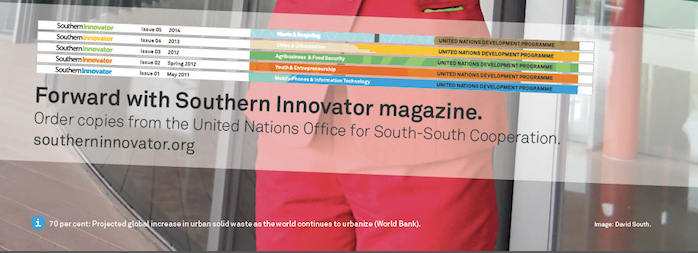
An ad promoting the magazine’s fourth issue is below:

Team | Southern Innovator Phase 1 Development (2010 – 2015)

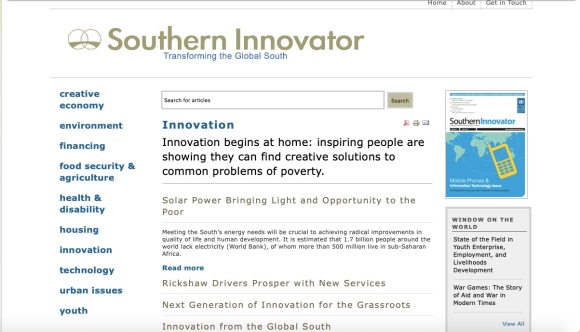
Southern Innovator can be read online here:

ISSN: 2222-9280

Website of the United Nations Office for South-South Cooperation (UNOSSC): https://unsouthsouth.org/2014/12/25/southern-innovator-magazine/

Scribd

Issue 1: http://www.scribd.com/doc/57980406/Southern-Innovator-Issue-1

Issue 2: http://www.scribd.com/doc/86451057/Southern-Innovator-Magazine-Issue-2

Issue 3: http://www.scribd.com/doc/106055665/Southern-Innovator-Magazine-Issue-3-Agribusiness-and-Food-Security

Issue 4: http://www.scribd.com/doc/128283953/Southern-Innovator-Magazine-Issue-4

Issue 5:  http://www.scribd.com/doc/207579744/Southern-Innovator-Magazine-Issue-5-Waste-and-Recycling

Google Books

Issue 1: https://books.google.co.uk/books?id=Q1O54YSE2BgC&dq=southern+innovator&source=gbs_navlinks_s

Issue 2: https://books.google.co.uk/books?id=Ty0N969dcssC&dq=southern+innovator&source=gbs_navlinks_s

Issue 3: https://books.google.co.uk/books?id=AQNt4YmhZagC&dq=southern+innovator&source=gbs_navlinks_s

Issue 4: https://books.google.co.uk/books?id=9T_n2tA7l4EC&dq=southern+innovator&source=gbs_navlinks_s

Issue 5: https://books.google.co.uk/books?id=6ILdAgAAQBAJ&dq=southern+innovator&source=gbs_navlinks_s

Southern Innovator is held in the library collections below:

Biblioteca de la Asamblea Legislativa de El Salvador: https://biblioteca.asamblea.gob.sv/101180_southerninnovator-a-magazine-celebrating-south-south-innovation-may-2011?q=

Biblioteca Nationala a Republicii Moldova: http://cc.sibimol.bnrm.md/opac/bibliographic_view/399949;jsessionid=C516885A73E277718AE64598E869BC70

British Library: https://bll01.primo.exlibrisgroup.com/discovery/fulldisplay?docid=alma990158672410100000&context=L&vid=44BL_INST:BLL01&lang=en&search_scope=BL_Available&adaptor=Local%20Search%20Engine&tab=BL_Available&query=any,contains,Southern%20Innovator&offset=0

Central Michigan University Libraries: https://cmich.primo.exlibrisgroup.com/discovery/fulldisplay?docid=alma991015822649303781&context=L&vid=01CMICH_INST:01CMICH&lang=en&search_scope=UNIVERSITY_CI&adaptor=Local%20Search%20Engine&tab=Everything&query=any,contains,Southern%20Innovator&offset=0

Centre multimédia sur l’environnement et le développement Dakar, Senegal: http://enda-cremed.org/bpd/opac_css/index.php?lvl=serie_see&id=674

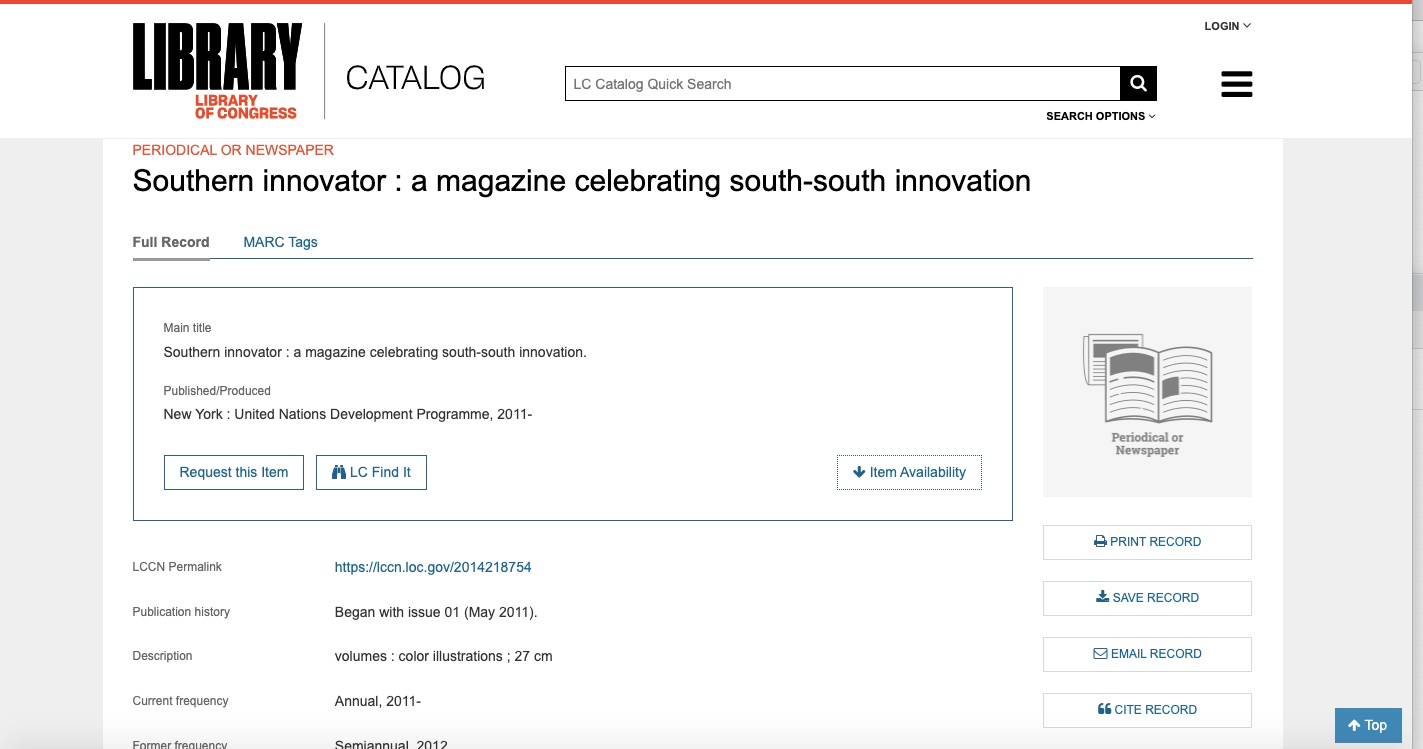
Library of Congress: http://catalog.loc.gov/vwebv/holdingsInfo?searchId=15784&recCount=25&recPointer=0&bibId=17462965

Louisiana State University, LSU Libraries: https://lsu.ent.sirsi.net/client/en_US/lsu/search/detailnonmodal/ent:$002f$002fSD_LSU$002f0$002fSD_LSU:7935129/ada?qu=southern+innovator&d=ent%3A%2F%2FSD_LSU%2F0%2FSD_LSU%3A7935129%7ESD_LSU%7E0&te=SD_LSU

Malaysian Academic Library Union: https://malcat.uum.edu.my/kip/Record/ukm.b15483824

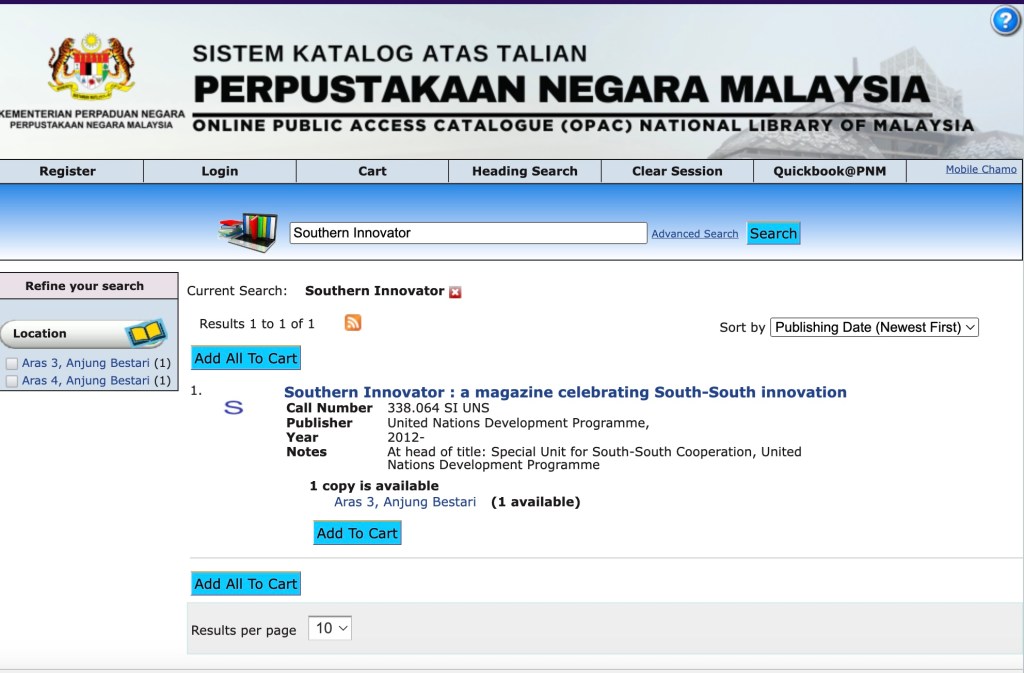
National Library of Malaysia: https://opac.pnm.gov.my/search/query?term_1=Southern+Innovator&theme=PNM2

Toronto Public Library: http://vc4kb8yf3q.search.serialssolutions.com/?V=1.0&N=100&L=VC4KB8YF3Q&S=AC_T_B&C=southern+innovator

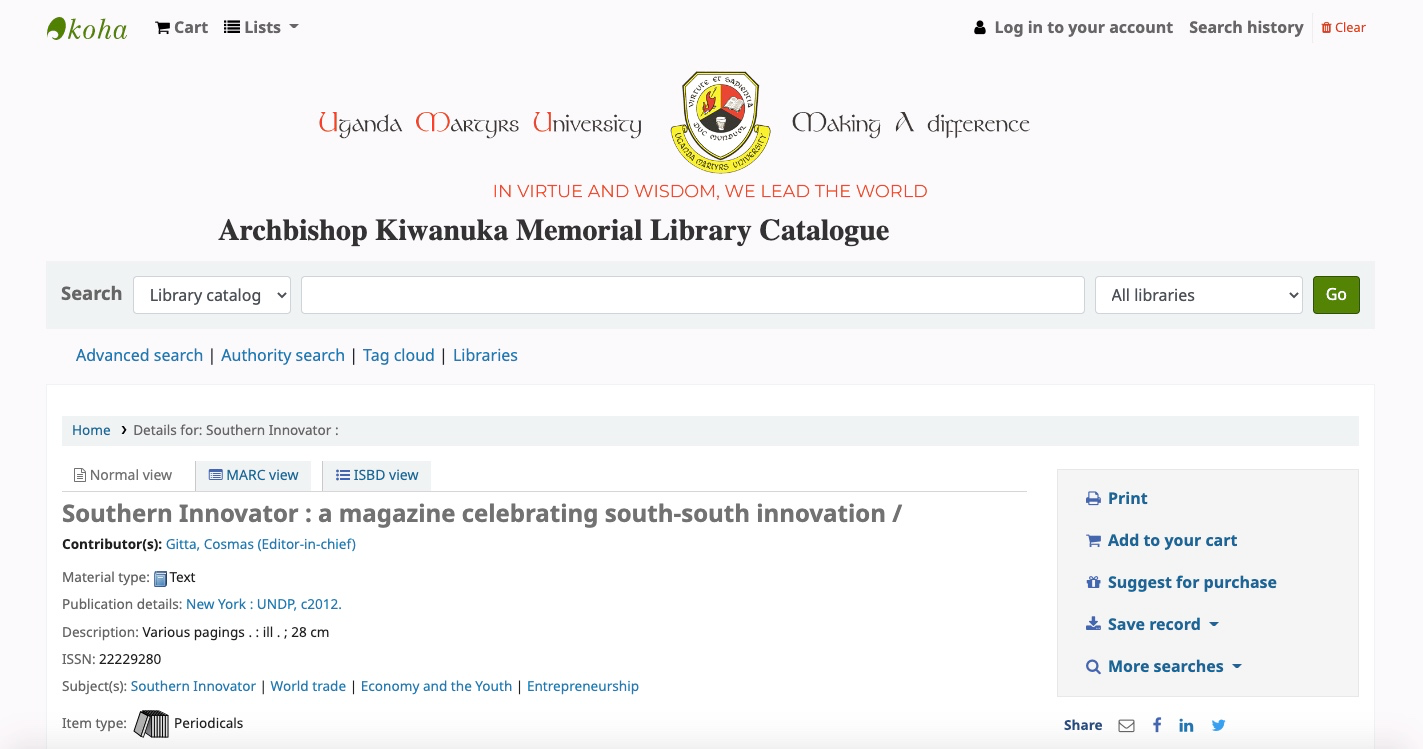
Uganda Martyrs University: https://catalogue.umu.ac.ug/cgi-bin/koha/opac-detail.pl?biblionumber=33335

United Nations Library Geneva: Issues 2, 4, 5: Click ‘Get It’: 

Issue 1: https://tinyurl.com/3s22f236

University of Birmingham: https://birmingham-primo.hosted.exlibrisgroup.com/primo-explore/fulldisplay?docid=44BIR_ALMA_DS51193861790004871&context=L&vid=44BIR_VU1&lang=en_US&search_scope=CSCOP_44BIR_DEEP&adaptor=Local%20Search%20Engine&tab=local&query=any,contains,Southern%20Innovator&offset=0

The University of British Columbia: https://webcat.library.ubc.ca/vwebv/holdingsInfo?searchId=168763&recCount=100&recPointer=1&bibId=6682400

Universitat de Valencia: http://xv9lx6cm3j.search.serialssolutions.com/?V=1.0&L=XV9LX6CM3J&S=JCs&C=JC_018470248&T=marc

Universiti Teknologi Malaysia Libraries: http://ent.library.utm.my/client/en_AU/main/search/detailnonmodal/ent:$002f$002fSD_ILS$002f820$002fSD_ILS:820407/ada?qu=Youth&rw=1200&ic=true&ps=300

University of Cape Town Libraries (print copies destroyed in 2021 fire): https://tinyurl.com/2p8fnv6f

University of Liverpool: https://liverpool.primo.exlibrisgroup.com/discovery/fulldisplay?docid=alma991023308133807351&context=L&vid=44LIV_INST:44LIV_INST&lang=en&search_scope=MyInst_and_CI&adaptor=Local%20Search%20Engine&tab=Everything&query=any,contains,Southern%20Innovator&offset=0

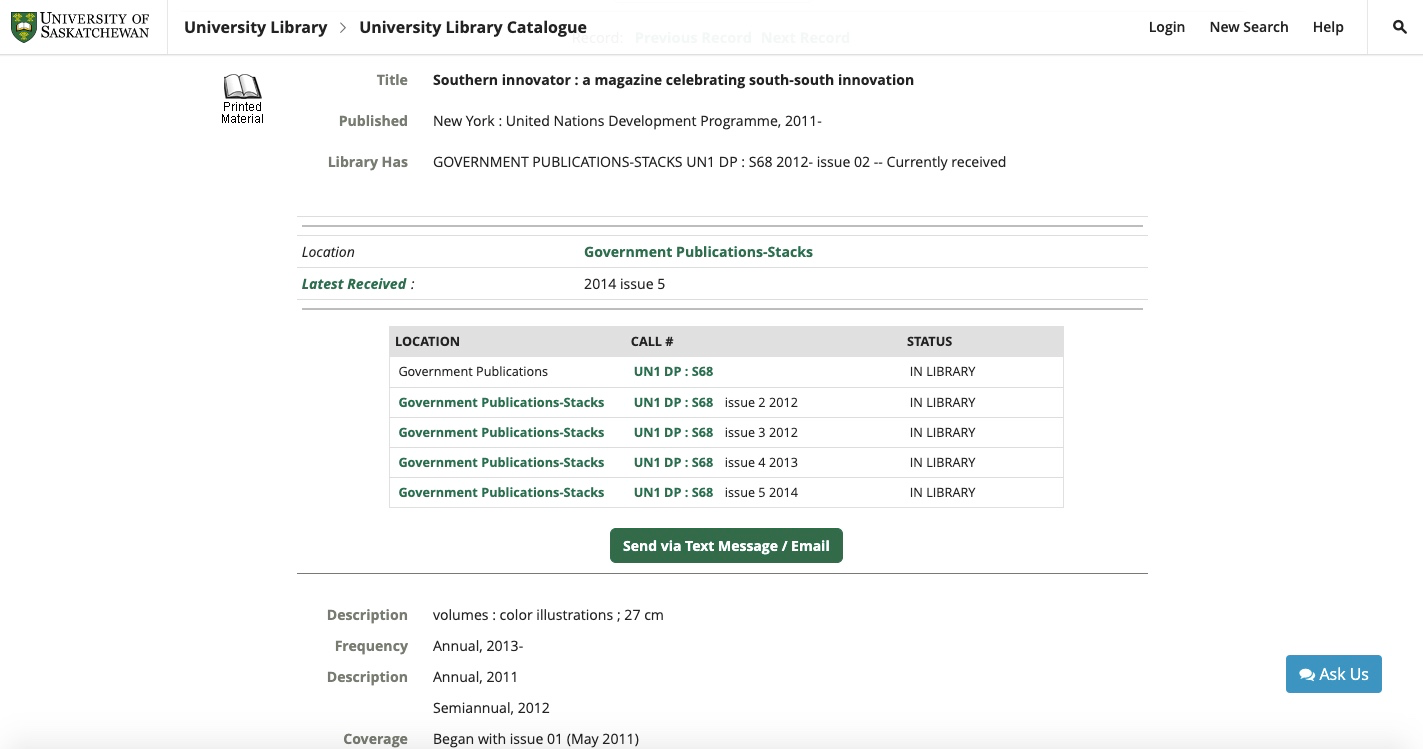
University of Saskatchewan: http://sundog.usask.ca/search/t?SEARCH=southern+innovator&sortdropdown=-&searchscope=8

University of Zambia Online Public Access Catalogue

Washington State University: https://searchit.libraries.wsu.edu/discovery/fulldisplay?docid=alma99900557958601842&context=L&vid=01ALLIANCE_WSU:WSU&lang=en&search_scope=WSU_everything&adaptor=Local%20Search%20Engine&tab=default_tab&query=any,contains,Southern%20Innovator&offset=0

If you would like hard copies of the magazine for distribution, then please contact the United Nations Office for South-South Cooperation: Website: http://ssc.undp.org/content/ssc.html. If you would like to either sponsor an issue of Southern Innovator or place an advertisement in the magazine, then please contact southerninnovator@yahoo.co.uk. This is a great opportunity to reach millions around the world and to connect with the pioneers and innovators shaping this new world. With Issue 5 tackling the timely theme of Waste and Recycling, this is the moment to get on board and help support SI. With global urbanization levels continuing to rise, fresh thinking of the kind found in Southern Innovator‘s fifth issue is urgently required.

Follow @SouthSouth1

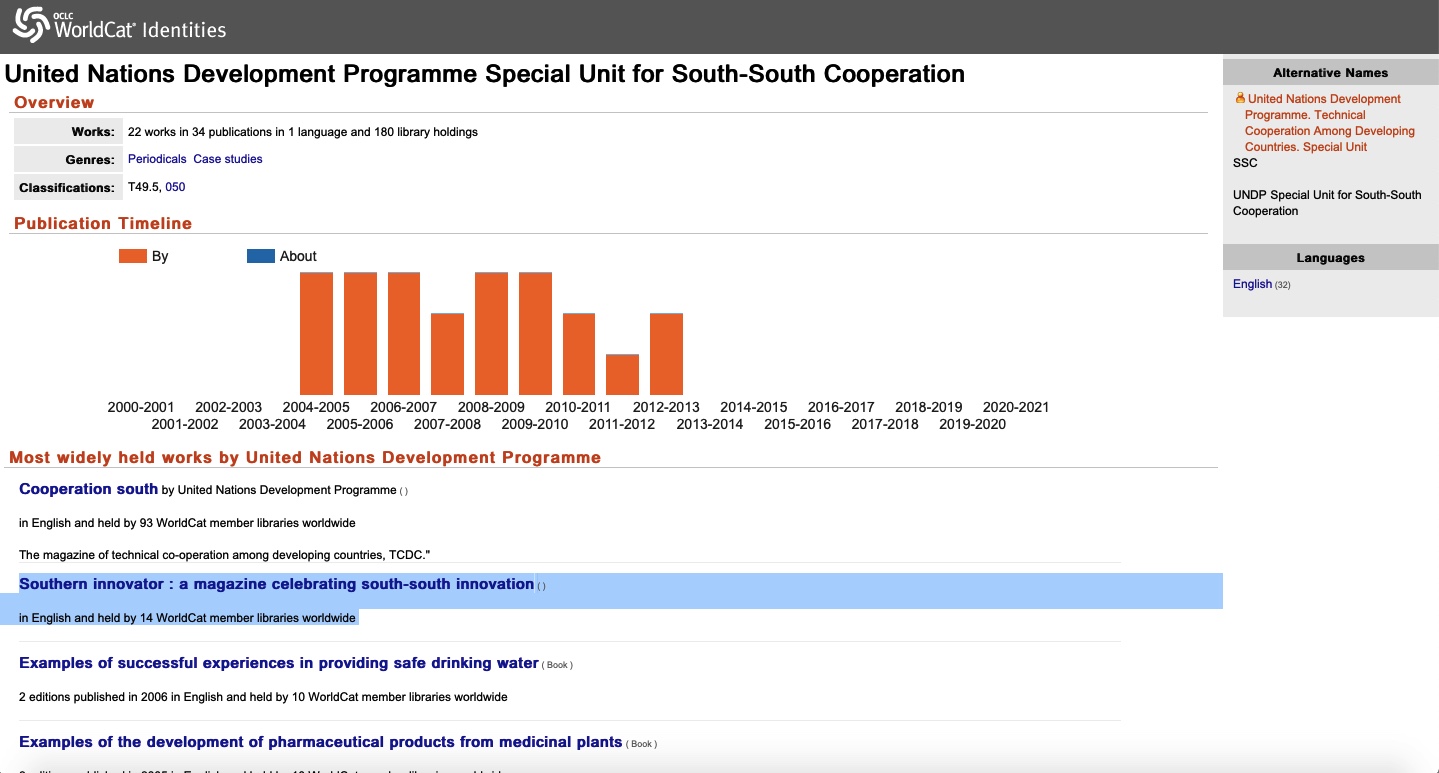
https://www.worldcat.org/title/southern-innovator-a-magazine-celebrating-south-south-innovation/oclc/1127120816?referer=list_view

https://davidsouthconsulting.org/southern-innovator-scale-up-fundraiser/

Creative Commons License

This work is licensed under a
Creative Commons Attribution-Noncommercial-No Derivative Works 3.0 License.

ORCID iD: https://orcid.org/0000-0001-5311-1052.

© David South Consulting 2024