Categories
Archive Development Challenges, South-South Solutions Newsletters

Bangladesh Coffin-Maker Offers an Ethical Ending

By David SouthDevelopment Challenges, South-South Solutions

SOUTH-SOUTH CASE STUDY

Few people want to think about death, and many are ill-prepared when it happens to a loved one or friend. But it will happen to us all – and growing ethical and environmental concerns are reshaping the way many deal with the inevitable event. More and more people are seeking a lower-cost option for being disposed of that also does not harm the environment.

There are many ideas out there, but one that is getting attention is using sustainably sourced and fairly traded coffins as a way of reducing carbon emissions resulting from a person’s death.

Bangladeshi pioneers Oasis Coffins (oasiscoffins.com) are crafting ecologically sound, Fair Trade coffins and generating jobs and income for an impoverished region of the country. The coffins are made from locally grown bamboo, seagrass and willow and are a clever piece of design.

Bamboo is as strong as steel and yet flexible, and the coffins made from it look like typical burial boxes – but can be folded back into their footprint to be stored flat. This is a great space-saving innovation and makes it easier to store the coffins and also to ship them to overseas markets. This clever design is reducing the amount of energy used.

Oasis has a manufacturing workshop employing 70 people in the Nilphamari district of Bangladesh (http://en.wikipedia.org/wiki/Nilphamari_District), about 400 kilometres north from the capital, Dhaka. The region is poor, but large quantities of bamboo grow in the area.

It is a region where employment is seasonal and erratic, making family life chaotic as parents constantly search for stable work.
Oasis Coffins is located in the Uttara Export Processing Zone (http://www.epzbangladesh.org.bd/bepza.php?id=EPZ-U), run under the authority of the Bangladesh Export Processing Zones Authority (BEPZA), a government agency that aims to “promote, attract and facilitate foreign investment in the Export Processing Zones.”  Its sales office is based in Birmingham in the United Kingdom.

The company began in 2006 with the idea of creating high-quality products using local materials while creating good quality jobs to achieve a double impact: changed lives and a protected environment. The hope is to create a business model that can be replicated elsewhere.

The company is structured to include both its product development and manufacturing in rural Bangladesh. It took its time conducting market research and product development to make sure it had a product people were willing to buy.

“We make beautiful, high quality products in an environment that gives people reliable employment and good working conditions,” said managing director David How on the company’s website. “Our products are in demand from people who are becoming increasingly conscious of their impact on the environment and others.

“It is encouraging to know that in bereavement, we can give life into people and a community in Bangladesh. We want people to know where their products are coming from, and to know that what they buy can benefit people elsewhere.”

According to its website, Oasis Coffins abides by the standards prescribed by the World Fair Trade Organization (wfto.com) and the European Fair Trade Association (http://www.european-fair-trade-association.org/) and is also a member of ECOTA (ecotaftf.org). The ECOTA Fair Trade Forum started in 1990 and is a networking and coordinating body for small and medium sized Fair Trade Enterprises of Bangladesh.

Employees are divided equally between women and men, and many have never been to school. They are paid 30 per cent more than the recommended rate for garment workers in Bangladesh.

Oasis Coffins know by name the farmers who provide the bamboo and all of it is harvested within 20 kilometres of the manufacturing workshop. Oasis Coffins also takes pride in the construction of the workshop, which features plenty of natural light, good ventilation and easy access in and out. A comfortable workshop is important for the health and happiness of manufacturing workers.

Employees receive a pension scheme, paid holidays, sick leave and a lump-sum payment if they leave. There is also a doctor available during working hours for free medical advice.

To help upgrade the skills of the workers, there are lunchtime literacy classes, and employees are also taught how to manufacture products to a high global standard.

The Oasis coffins are benefiting from the growing marketplace for green funerals in Europe and North America.

In Britain, ecological funerals are on the rise as people seek an affordable and environmentally sound way to be dispatched.
The UK’s Co-operative Funeral Care, part of the Co-operative Group, is selling the Bangladeshi coffins at more than 900 of its funeral homes in the United Kingdom as part of its ethical strategy.

Providing funeral services can be an effective income generator. In Ghana, craftsmen have developed a global reputation for their quirky coffin designs celebrating the lives of the deceased. Ghana is also pioneering the selling of funeral insurance through mobile phones. Bereavement services are among the many basic needs of all communities, no matter where they are located. Just as people will always be born and get sick, they will also eventually die. Providing services that offer dignity to the families and the deceased can be a boost to local economies.

Published: March 2013

Resources

1) Ghana coffin pioneer: Paa Joe’s sculpted coffins blur the line between art and craft. Each work is carefully constructed to reflect the ambition or the trade of the person for whom it was made. Website:http://www.jackbellgallery.com/artists/35-Paa-Joe/overview/

2) African funeral insurance providers: “Stanbic Bank launches FuneralPlan insurance product”. Website:http://www.modernghana.com/news/427917/1/stanbic-bank-launches-funeralplan-insurance-produc.html

3) Southern Innovator Magazine Issue 2: Youth and Entrepreneurship. Website:http://www.scribd.com/doc/106055335/Southern-Innovator-Magazine-Issue-2-Youth-and-Entrepreneurship

Ghanaian Coffins Prove Design and Craftsmanship Boost Incomes

Southern Innovator logo

London Edit

31 July 2013

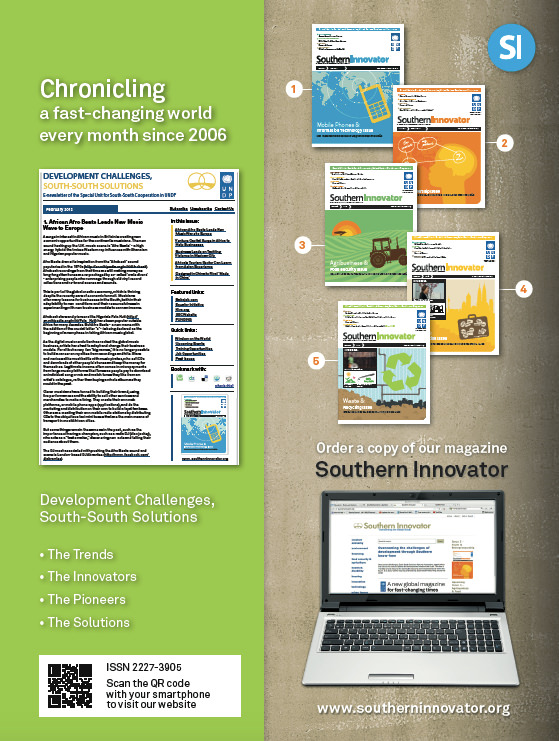
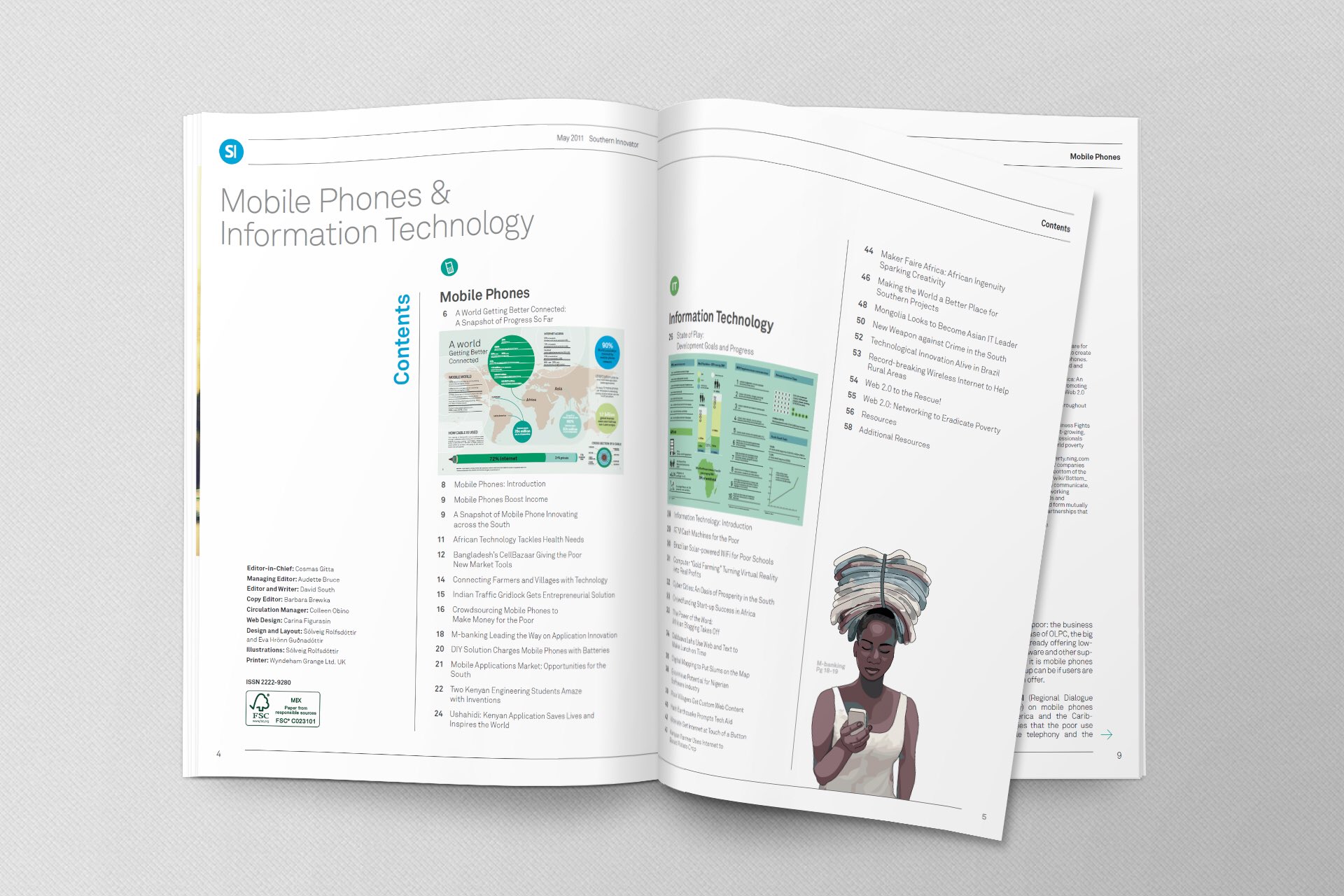
Development Challenges, South-South Solutions was launched as an e-newsletter in 2006 by UNDP’s South-South Cooperation Unit (now the United Nations Office for South-South Cooperation) based in New York, USA. It led on profiling the rise of the global South as an economic powerhouse and was one of the first regular publications to champion the global South’s innovators, entrepreneurs, and pioneers. It tracked the key trends that are now so profoundly reshaping how development is seen and done. This includes the rapid take-up of mobile phones and information technology in the global South (as profiled in the first issue of magazine Southern Innovator), the move to becoming a majority urban world, a growing global innovator culture, and the plethora of solutions being developed in the global South to tackle its problems and improve living conditions and boost human development. The success of the e-newsletter led to the launch of the magazine Southern Innovator. 
Creative Commons License

This work is licensed under a
Creative Commons Attribution-Noncommercial-No Derivative Works 3.0 License.

ORCID iD: https://orcid.org/0000-0001-5311-1052.

© David South Consulting 2023

Categories
Archive Development Challenges, South-South Solutions Newsletters

Asian Factories Starting to go Green

By David SouthDevelopment Challenges, South-South Solutions

SOUTH-SOUTH CASE STUDY

Media headlines have recently highlighted the growing air pollution crisis in Asia’s expanding cities. This is caused by a mix of factors – the growing number of vehicles, coal-powered factories, people burning dirty fuels to heat their homes, and poor enforcement of standards – and has severe consequences for human health. If it’s not tackled, more and more countries will see large rises in respiratory problems, cancers and early deaths from pollution-caused illnesses (http://www.nrdc.org/air/).

The World Health Organization (WHO) says air pollution is the world’s largest environmental health risk, killing 7 million people every year. Asia has the largest number of air pollution deaths in the world, with 3.3 million deaths linked to indoor air pollution and 2.6 million deaths related to outdoor air pollution (Clean Air Asia).

While most of the Asian countries where this is a problem are also aggressively growing their economies in order to get richer and raise living standards, there is a rising awareness of the need to balance a modern, industrial economy with human health and the environment.

One solution is to adopt green and sustainable building standards when constructing new factories. This is more than just a public relations exercise: the energy savings possible from building smart pay off in the long run. And green factories not only pollute less, they save lives and the environment.

Asia plays a critical role in producing the world’s consumer products, from the small and simple to the highly complex components used in 21st-century computing technologies.

Intel (intel.com), the manufacturer of electronic devices and the computer chips that go inside them, is trying to lead the way. It has built a US $1 billion manufacturing plant 16 kilometers outside Ho Chi Minh City, Vietnam, and it is designed to exceed Vietnamese environmental and sustainability guidelines and laws.

Opened in 2010, it boasts the country’s largest solar power system. It is also currently working on a water reclamation system to reduce water consumption at the plant by 68 per cent, according to The New York Times. It is hoping to receive certification from the US Green Building Council (usgbc.org).

It is all part of a wider trend that is starting to reverse the damaging, short-termist approach of the past. More and more Western multinationals and their Asian suppliers are building environmentally sound factories in the developing world.

According to the US Green Building Council, around 300 manufacturing facilities in Asia are either certified or are awaiting Leadership in Energy and Environmental Design (LEED) certification. The LEED certification recognizes the building has met certain standards in becoming a ‘green’ building.

Going green is more and more part of corporate policy for companies that want to avoid the bad publicity of disasters such as the garment factory collapse that killed 1,135 people in Bangladesh in April 2013.

But it is not just driven by a desire to avoid bad publicity: large corporations that build factories in the global South are also realizing there are big financial savings to be made.

Intel has been able to reduce its global energy costs by US $111 million since 2008. It did this by investing US $59 million in 1,500 projects to boost sustainability across its facilities worldwide. The projects have reduced carbon dioxide emissions equivalent to the amount produced by 126,000 American households per year.

Intel’s solar array in Vietnam, which cost US $1.1 million, offsets the equivalent of 500 pollution-belching motorbikes every day.

How effective are LEED-certified buildings? The New York Times reported that a 2011 survey compared a typical shoe factory with a LEED factory run by the American sport shoe maker Nike. It found the LEED factory used 18 per cent less electricity and fuel and 53 per cent less water.

And this trend is creating a new economy unto itself. As an example, a new marketplace for industrial efficiency upgrading is developing in India. Power outages are frequent in India, so finding a way to save electricity and alternatives to dependence on the national power grid is attractive to any economic enterprise.

Prashant Kapoor, principal industry specialist for green buildings at the International Finance Corporation (IFC), believes demand for upgrades is strong enough that various companies can specialize in this field and profit from it.

And things are also happening in the notoriously smog-choked cities of China. By the end of 2012, China had certified eight factories and 742 buildings as LEED, according to the China buildings programme at the Energy Foundation (ef.org) in San Francisco.

Damien Duhamel of Solidiance (solidiance.com), a firm that advises businesses on how to grow in Asia, believes avoiding risk caused by environmental accidents or scandals is heightened by the growing presence of social media, which amplifies negative publicity.

“The next battle will be here” for higher corporate environmental standards, Duhamel believes. “This is why some smart companies – Intel, for example – took the steps of being proactive.”

Published: April 2014

Resources

1) Leadership in Energy and Environmental Design (LEED): LEED, or Leadership in Energy & Environmental Design, is a green building certification program that recognizes best-in-class building strategies and practices. Website: http://www.usgbc.org/leed

2) US Green Building Council (USGBC): Its mission is to transform the way buildings and communities are designed, built and operated, enabling an environmentally and socially responsible, healthy, and prosperous environment that improves the quality of life. Website: http://www.usgbc.org/

3) Dwell: Dwell magazine is focused on demonstrating that modern design can be both functional and comfortable. Website: dwell.com

4) Inhabitat: Design for a Better World: Inhabitat.com is a weblog devoted to the future of design, tracking the innovations in technology, practices and materials that are pushing architecture and home design towards a smarter and more sustainable future. Website: inhabitat.com

5) Solidiance: Singapore-based consulting firm specializing in Asia’s green-building sector. Website: solidiance.com

6) Clean Air Asia: Clean Air Asia was established in 2001 as the premier air quality network for Asia by the Asian Development Bank, World Bank, and USAID. Its mission is to promote better air quality and livable cities by translating knowledge to policies and actions that reduce air pollution and greenhouse gas emissions from transport, energy and other sectors. Website: cleanairinitiative.org

7) Southern Innovator Issue 4: Cities and Urbanization: This issue is packed with ideas on to how make cities and urban environments greener and reduce air pollution. Website: http://www.scribd.com/doc/133622315/Southern-Innovator-Magazine-Issue-4-Cities-and-Urbanization and here: http://tinyurl.com/oc2mqgm

8) Better Air Quality Conference 2014 and 8th Regional Environmentally Sustainable Transport Forum in Asia:  From 19 to 21 November 2014 in Colombo, Sri Lanka, BAQ is the leading event on air quality in Asia, covering the key sectors of transport, energy, industry and climate change, with a particular emphasis on government policies and measures. Website: http://cleanairinitiative.org/portal/node/12274

9) Tianjin Eco-city: The Sino-Singapore Tianjin Eco-city’s vision is to be a thriving city which is socially harmonious, environmentally-friendly and resource-efficient. Website: tianjinecocity.gov.sg

10) Songdo: Songdo International Business District (IBD) officially opened on August 7, 2009 as a designated Free Economic Zone and the first new sustainable city in the world designed to be an international business district. Website: songdo.com

https://davidsouthconsulting.org/2022/09/27/caribbean-island-st-kitts-goes-green-for-tourism/

https://davidsouthconsulting.org/2021/01/25/creating-green-fashion-in-china/

https://davidsouthconsulting.org/2021/02/01/ethiopia-and-djibouti-join-push-to-tap-geothermal-sources-for-green-energy/

https://davidsouthconsulting.org/2023/02/03/environmental-public-awareness-handbook-case-studies-and-lessons-learned-in-mongolia/

https://davidsouthconsulting.org/2021/08/29/indian-business-model-makes-green-energy-affordable/

https://davidsouthconsulting.org/2022/11/11/innovation-cairos-green-technology-pioneers/

https://davidsouthconsulting.org/2021/10/22/innovations-in-green-economy-top-three-agenda/

https://davidsouthconsulting.org/2021/08/07/mongolian-green-book/

https://davidsouthconsulting.org/2022/04/14/prisons-with-green-solutions/

https://davidsouthconsulting.org/2021/02/04/us-450-million-pledged-for-green-economy-investments-at-kenyan-gssd-expo/

Development Challenges, South-South Solutions was launched as an e-newsletter in 2006 by UNDP’s South-South Cooperation Unit (now the United Nations Office for South-South Cooperation) based in New York, USA. It led on profiling the rise of the global South as an economic powerhouse and was one of the first regular publications to champion the global South’s innovators, entrepreneurs, and pioneers. It tracked the key trends that are now so profoundly reshaping how development is seen and done. This includes the rapid take-up of mobile phones and information technology in the global South (as profiled in the first issue of magazine Southern Innovator), the move to becoming a majority urban world, a growing global innovator culture, and the plethora of solutions being developed in the global South to tackle its problems and improve living conditions and boost human development. The success of the e-newsletter led to the launch of the magazine Southern Innovator.  

Creative Commons License

This work is licensed under a
Creative Commons Attribution-Noncommercial-No Derivative Works 3.0 License

ORCID iD: https://orcid.org/0000-0001-5311-1052.

© David South Consulting 2022

Categories
Archive Development Challenges, South-South Solutions Newsletters

Caribbean Island St. Kitts Goes Green for Tourism

By David SouthDevelopment Challenges, South-South Solutions

SOUTH-SOUTH CASE STUDY

Going green may sound like the right thing to do but it can also be associated with being a costly burden and boring. But, as one island nation is proving, being green is a great selling point for attracting tourists and investors – especially in a world where many places are grappling with pollution and resource depletion.

St. Kitts, an island located between the Caribbean Sea and the Atlantic Ocean, is part of the Federation of Saint Kitts and Nevis and has a population of around 35,000 (stkittstourism.kn).

The country shut down its main source of income, the sugar industry, in 2005. Facing dropping profits, it decided the industry was not worth supporting anymore.

But what would be the replacement source of income and employment? St. Kitts has turned to tourism for the answer. While many other Caribbean islands have long drawn on tourism – along with banking and finance, in some cases – in order to diversify economies away from dependence on agriculture, St. Kitts had not developed this sector. As a latecomer, St. Kitts needed to think about how it could do things differently and stand out from the crowd.

St. Kitts decided to become a regional champion for green tourism and green energy, and to lure tourists to the island by championing its green credentials.

The launch in 2013 of a Euro 1.8 million (US $2.48 million) one-megawatt solar energy farm nearby the Robert L. Bradshaw International Airport (http://www.stkittstourism.kn/explore-st-kitts-getting-here-airport.php) – enough to power a few hundred houses – showed St. Kitts was getting serious about going green (http://www.cuopm.com/?m=201302&paged=13).

Joining the new solar farm, an all-green resort is hoping to further boost St. Kitts’ green credentials. The ambitious Kittitian Hill (kittitianhill.com) resort stretches across 162 hectares and includes four hotels, an organic farm and multiple restaurants. In the pipeline is a plan to open film production and editing facilities to lure movie-makers looking for a green film-making studio.

Kittitian Hill is the brainchild of property developer Val Kempadoo (http://www.linkedin.com/pub/valmiki-kempadoo/8/53a/339), who is trying to set a precedent for sustainable resorts in the Caribbean. It is being developed with a mix of foreign experts and local contractors.

The resort boasts organic food fresh from tropical farms and an on-site tropical forest, described as an “edible landscape” offering a bounty of fresh fruit and vegetables. Around the resort, “Pick Me” signs encourage visitors to pick ripe fruit and sit down and make a meal of it.

The grounds include rare and heirloom fruit trees, and the resort hopes to create a reserve to protect endangered species. To spread the green message, the plants and seeds are shared locally with farmers and others. It is part of a strategy to encourage farmers to produce organic food, avoiding pesticides and chemicals, and to farm animals ethically.

The resort’s green ethos even extends to its 18-hole golf course. Golf courses are notorious water-wasters, but this one has a smart water management system, using organic crops and fruit trees to help keep the soil moist, interweaving a farm throughout the golf course. Caddies will guide golfers to the ripest fruits while they putt their way around the course.

“My vision is to bring together community and culture, along with mindful conservation of natural resources,” said Kempadoo. “This means we can offer our guests an unforgettable experience, while bringing lasting, life-changing benefits to the local people and economy.”

As an added sweetener to get investment coming in, St. Kitts and Nevis offers citizenship to investors in the country. In return, investors can travel visa-free to 120 countries – something that has appealed to investors from around the global South.

“It is important for St. Kitts to be selective and careful about development and focus on high-end rather than high-volume tourism,” Kempadoo told Monocle magazine. “The best asset of this island is its natural beauty, and we want to preserve it.”

Published: June 2014

Resources

1) The International Ecotourism Society: The International Ecotourism Society (TIES) is a 501(c)(3) nonprofit organization dedicated to promoting ecotourism. Website: https://www.ecotourism.org/what-is-ecotourism

2) Top Five Eco Resorts of Mexico: Website: http://www.ecotourismtrips.org/topics/show/3809

3) 3 Rivers Dominica Eco Lodge: “An award-winning range of comfortable and charming self-contained cottages, nature, adventure and community-based ecotourism activities, restaurant, rivers and relaxation”. Website: http://www.3riversdominica.com/

4) Jungle Bay Resort and Spa: Award-winning Jungle Bay was built and is operated in alignment with international Geotourism and Ecotourism guidelines. As an alternative to traditional Caribbean tourism, the focus is on enjoyable nature-based activities and wellness of guests with quality service, guided by the principles as set by both National Geographic’s Center for Sustainable Destinations and The International Ecotourism Society (TIES). Website: junglebaydominica.com

https://davidsouthconsulting.org/2022/10/20/african-tourism-leads-the-world-and-brings-new-opportunities/

https://davidsouthconsulting.org/2022/09/28/asian-factories-starting-to-go-green/

https://davidsouthconsulting.org/2022/02/07/boosting-tourism-in-india-with-surfing-culture/

https://davidsouthconsulting.org/2021/01/25/creating-green-fashion-in-china/

https://davidsouthconsulting.org/2022/11/20/ecotourism-to-heal-the-scars-of-the-past/

https://davidsouthconsulting.org/2023/02/03/environmental-public-awareness-handbook-case-studies-and-lessons-learned-in-mongolia/

https://davidsouthconsulting.org/2021/02/01/ethiopia-and-djibouti-join-push-to-tap-geothermal-sources-for-green-energy/

https://davidsouthconsulting.org/2022/11/11/innovation-cairos-green-technology-pioneers/

https://davidsouthconsulting.org/2021/10/22/innovations-in-green-economy-top-three-agenda/

https://davidsouthconsulting.org/2022/10/10/a-solution-to-stop-garbage-destroying-tourism/

https://davidsouthconsulting.org/2021/03/05/southern-innovator-issue-5/

https://davidsouthconsulting.org/2021/02/04/us-450-million-pledged-for-green-economy-investments-at-kenyan-gssd-expo/

Development Challenges, South-South Solutions was launched as an e-newsletter in 2006 by UNDP’s South-South Cooperation Unit (now the United Nations Office for South-South Cooperation) based in New York, USA. It led on profiling the rise of the global South as an economic powerhouse and was one of the first regular publications to champion the global South’s innovators, entrepreneurs, and pioneers. It tracked the key trends that are now so profoundly reshaping how development is seen and done. This includes the rapid take-up of mobile phones and information technology in the global South (as profiled in the first issue of magazine Southern Innovator), the move to becoming a majority urban world, a growing global innovator culture, and the plethora of solutions being developed in the global South to tackle its problems and improve living conditions and boost human development. The success of the e-newsletter led to the launch of the magazine Southern Innovator.  

Creative Commons License

This work is licensed under a
Creative Commons Attribution-Noncommercial-No Derivative Works 3.0 License

ORCID iD: https://orcid.org/0000-0001-5311-1052.

© David South Consulting 2023

Categories
Archive Blogroll Southern Innovator magazine

Finding Southern Innovator Magazine | 2022

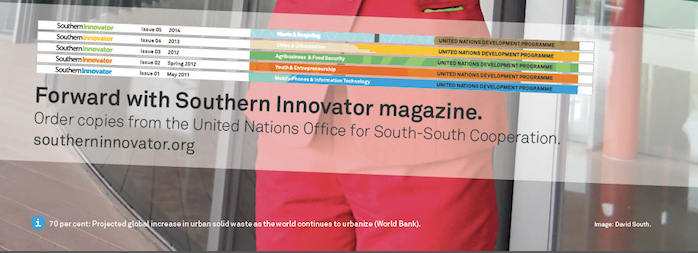
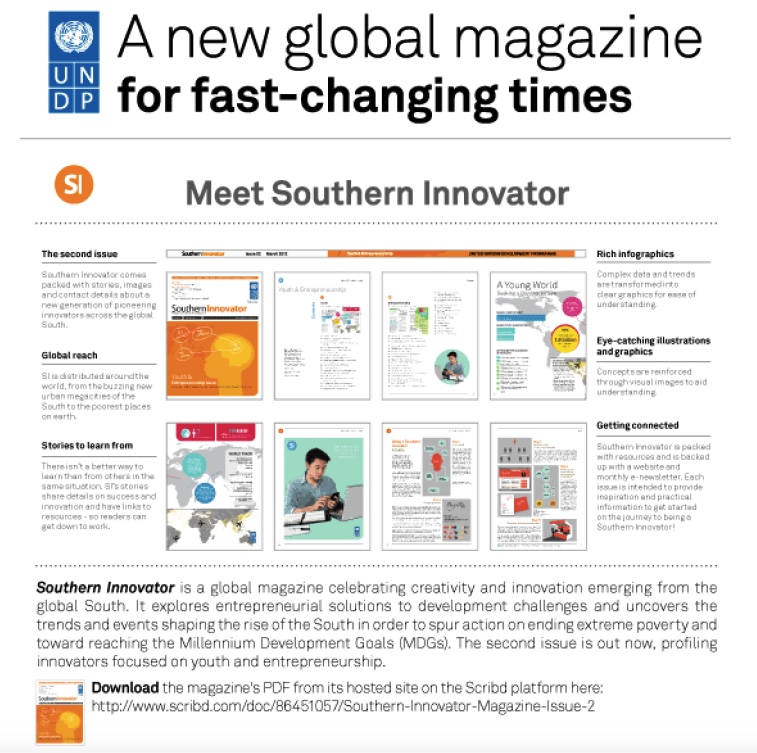
An ad promoting the magazine’s fourth issue is below:

Team | Southern Innovator Phase 1 Development (2010 – 2015)

Southern Innovator can be read online here:

ISSN: 2222-9280

Website of the United Nations Office for South-South Cooperation (UNOSSC): https://unsouthsouth.org/2014/12/25/southern-innovator-magazine/

Scribd

Issue 1: http://www.scribd.com/doc/57980406/Southern-Innovator-Issue-1

Issue 2: http://www.scribd.com/doc/86451057/Southern-Innovator-Magazine-Issue-2

Issue 3: http://www.scribd.com/doc/106055665/Southern-Innovator-Magazine-Issue-3-Agribusiness-and-Food-Security

Issue 4: http://www.scribd.com/doc/128283953/Southern-Innovator-Magazine-Issue-4

Issue 5:  http://www.scribd.com/doc/207579744/Southern-Innovator-Magazine-Issue-5-Waste-and-Recycling

Google Books

Issue 1: https://books.google.co.uk/books?id=Q1O54YSE2BgC&dq=southern+innovator&source=gbs_navlinks_s

Issue 2: https://books.google.co.uk/books?id=Ty0N969dcssC&dq=southern+innovator&source=gbs_navlinks_s

Issue 3: https://books.google.co.uk/books?id=AQNt4YmhZagC&dq=southern+innovator&source=gbs_navlinks_s

Issue 4: https://books.google.co.uk/books?id=9T_n2tA7l4EC&dq=southern+innovator&source=gbs_navlinks_s

Issue 5: https://books.google.co.uk/books?id=6ILdAgAAQBAJ&dq=southern+innovator&source=gbs_navlinks_s

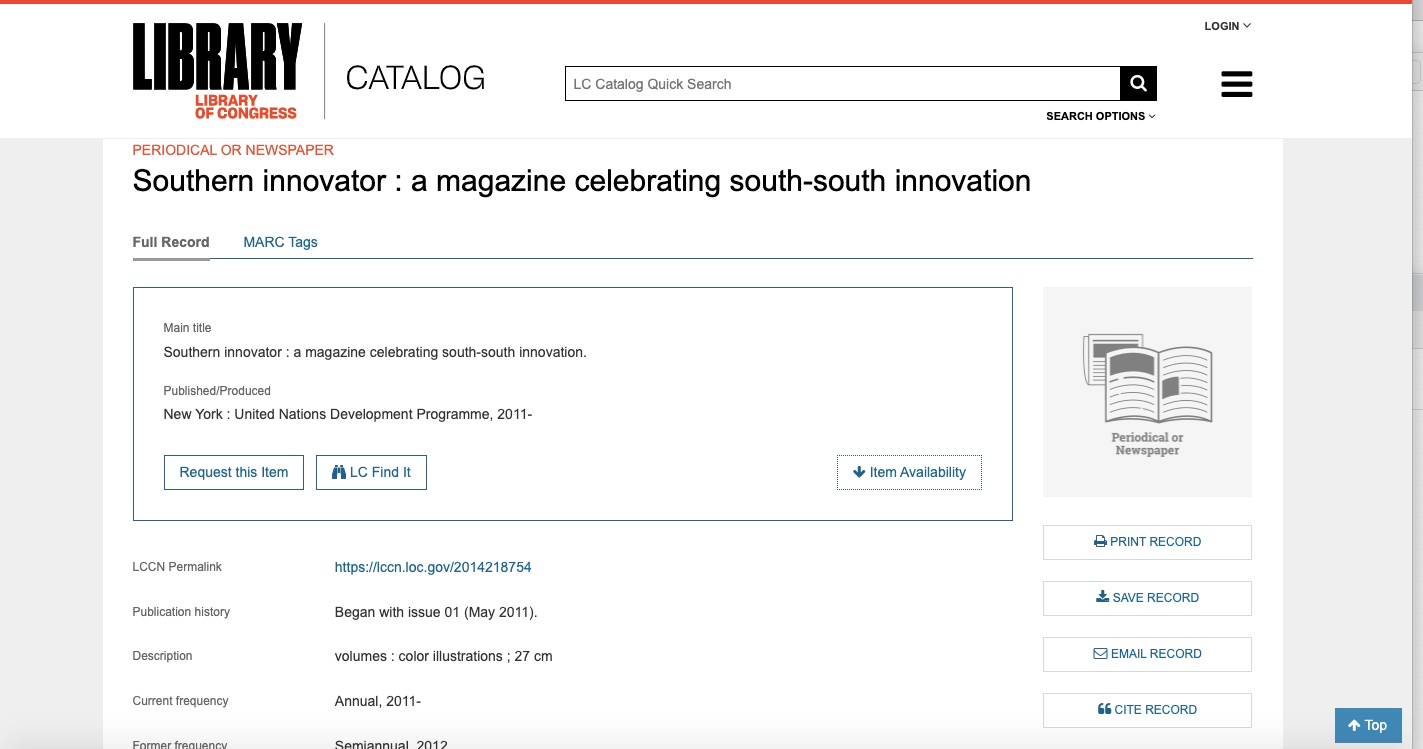
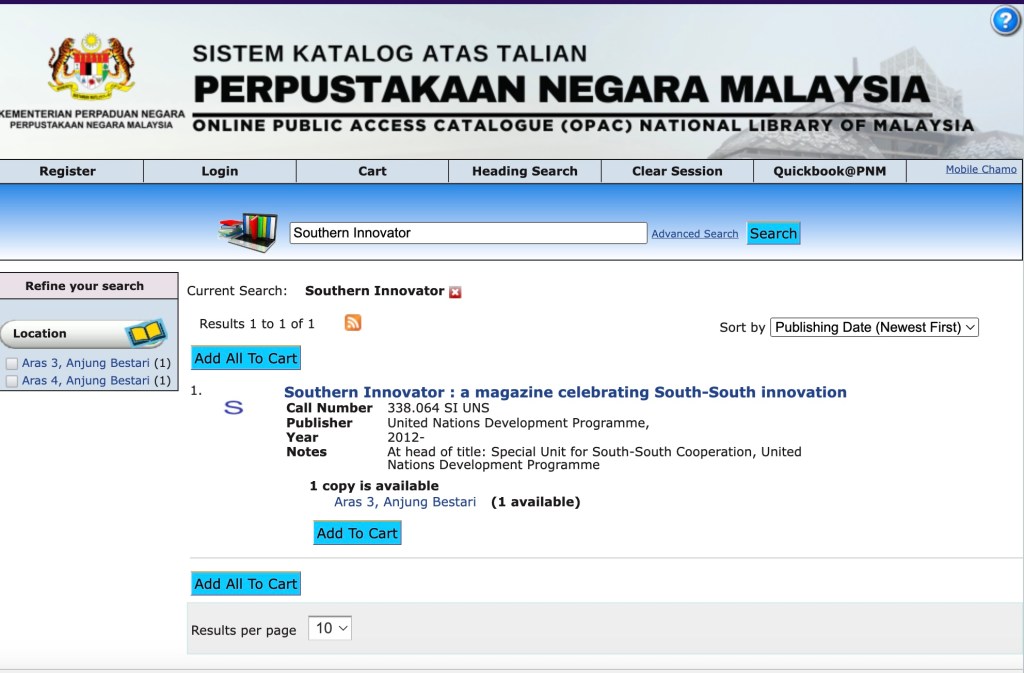
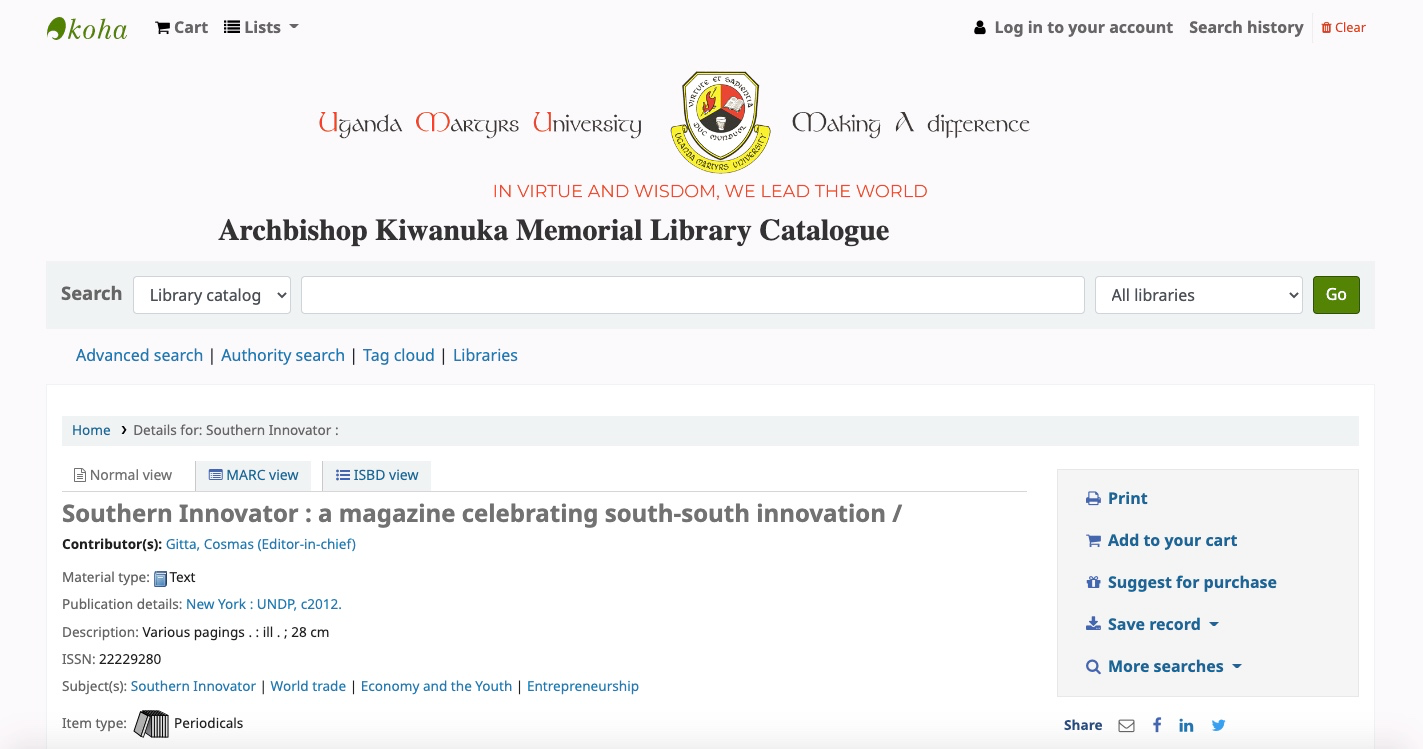
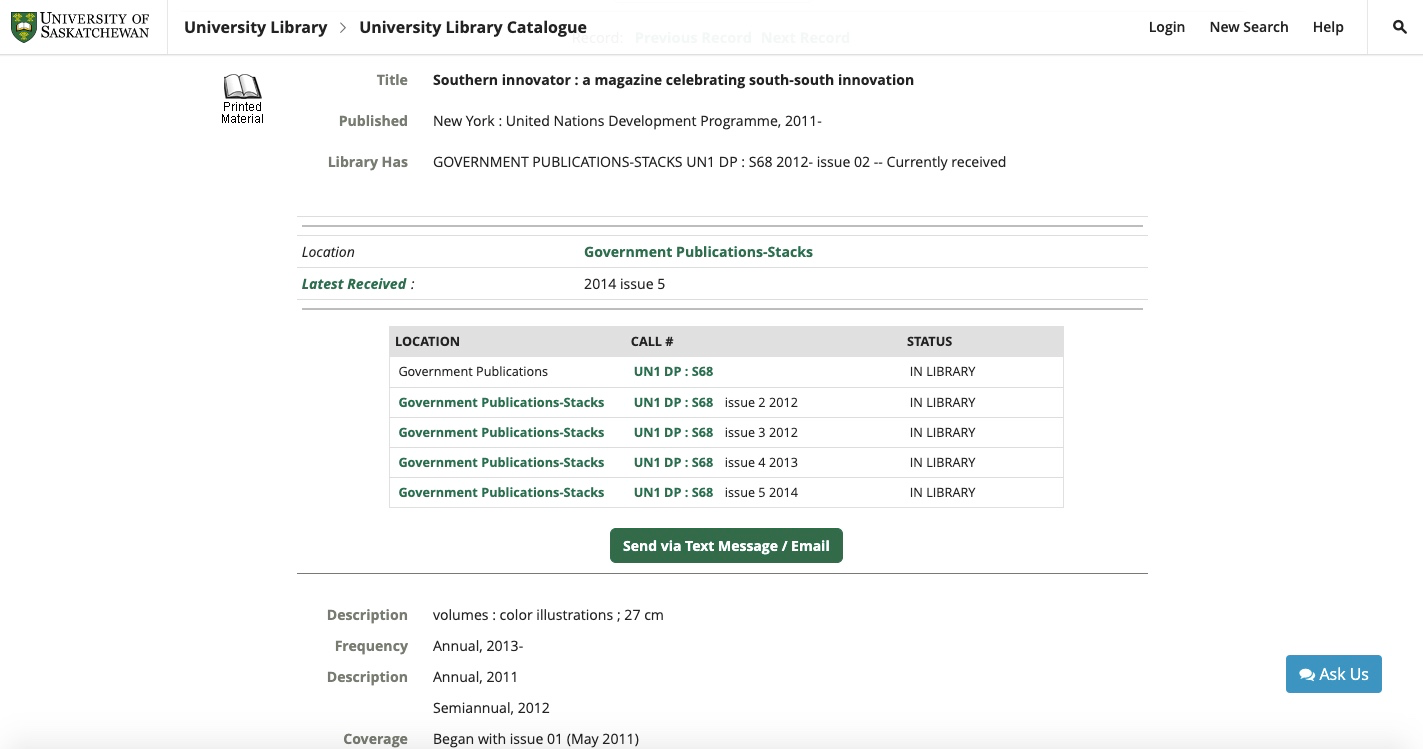
Southern Innovator is held in the library collections below:

Biblioteca de la Asamblea Legislativa de El Salvador: https://biblioteca.asamblea.gob.sv/101180_southerninnovator-a-magazine-celebrating-south-south-innovation-may-2011?q=

Biblioteca Nationala a Republicii Moldova: http://cc.sibimol.bnrm.md/opac/bibliographic_view/399949;jsessionid=C516885A73E277718AE64598E869BC70

British Library: https://bll01.primo.exlibrisgroup.com/discovery/fulldisplay?docid=alma990158672410100000&context=L&vid=44BL_INST:BLL01&lang=en&search_scope=BL_Available&adaptor=Local%20Search%20Engine&tab=BL_Available&query=any,contains,Southern%20Innovator&offset=0

Central Michigan University Libraries: https://cmich.primo.exlibrisgroup.com/discovery/fulldisplay?docid=alma991015822649303781&context=L&vid=01CMICH_INST:01CMICH&lang=en&search_scope=UNIVERSITY_CI&adaptor=Local%20Search%20Engine&tab=Everything&query=any,contains,Southern%20Innovator&offset=0

Centre multimédia sur l’environnement et le développement Dakar, Senegal: http://enda-cremed.org/bpd/opac_css/index.php?lvl=serie_see&id=674

Library of Congress: http://catalog.loc.gov/vwebv/holdingsInfo?searchId=15784&recCount=25&recPointer=0&bibId=17462965

Louisiana State University, LSU Libraries: https://lsu.ent.sirsi.net/client/en_US/lsu/search/detailnonmodal/ent:$002f$002fSD_LSU$002f0$002fSD_LSU:7935129/ada?qu=southern+innovator&d=ent%3A%2F%2FSD_LSU%2F0%2FSD_LSU%3A7935129%7ESD_LSU%7E0&te=SD_LSU

Malaysian Academic Library Union: https://malcat.uum.edu.my/kip/Record/ukm.b15483824

National Library of Malaysia: https://opac.pnm.gov.my/search/query?term_1=Southern+Innovator&theme=PNM2

Toronto Public Library: http://vc4kb8yf3q.search.serialssolutions.com/?V=1.0&N=100&L=VC4KB8YF3Q&S=AC_T_B&C=southern+innovator

Uganda Martyrs University: https://catalogue.umu.ac.ug/cgi-bin/koha/opac-detail.pl?biblionumber=33335

United Nations Library Geneva: Issues 2, 4, 5: Click ‘Get It’: 

Issue 1: https://tinyurl.com/3s22f236

University of Birmingham: https://birmingham-primo.hosted.exlibrisgroup.com/primo-explore/fulldisplay?docid=44BIR_ALMA_DS51193861790004871&context=L&vid=44BIR_VU1&lang=en_US&search_scope=CSCOP_44BIR_DEEP&adaptor=Local%20Search%20Engine&tab=local&query=any,contains,Southern%20Innovator&offset=0

The University of British Columbia: https://webcat.library.ubc.ca/vwebv/holdingsInfo?searchId=168763&recCount=100&recPointer=1&bibId=6682400

Universitat de Valencia: http://xv9lx6cm3j.search.serialssolutions.com/?V=1.0&L=XV9LX6CM3J&S=JCs&C=JC_018470248&T=marc

Universiti Teknologi Malaysia Libraries: http://ent.library.utm.my/client/en_AU/main/search/detailnonmodal/ent:$002f$002fSD_ILS$002f820$002fSD_ILS:820407/ada?qu=Youth&rw=1200&ic=true&ps=300

University of Cape Town Libraries (print copies destroyed in 2021 fire): https://tinyurl.com/2p8fnv6f

University of Liverpool: https://liverpool.primo.exlibrisgroup.com/discovery/fulldisplay?docid=alma991023308133807351&context=L&vid=44LIV_INST:44LIV_INST&lang=en&search_scope=MyInst_and_CI&adaptor=Local%20Search%20Engine&tab=Everything&query=any,contains,Southern%20Innovator&offset=0

University of Saskatchewan: http://sundog.usask.ca/search/t?SEARCH=southern+innovator&sortdropdown=-&searchscope=8

University of Zambia Online Public Access Catalogue

Washington State University: https://searchit.libraries.wsu.edu/discovery/fulldisplay?docid=alma99900557958601842&context=L&vid=01ALLIANCE_WSU:WSU&lang=en&search_scope=WSU_everything&adaptor=Local%20Search%20Engine&tab=default_tab&query=any,contains,Southern%20Innovator&offset=0

If you would like hard copies of the magazine for distribution, then please contact the United Nations Office for South-South Cooperation: Website: http://ssc.undp.org/content/ssc.html. If you would like to either sponsor an issue of Southern Innovator or place an advertisement in the magazine, then please contact southerninnovator@yahoo.co.uk. This is a great opportunity to reach millions around the world and to connect with the pioneers and innovators shaping this new world. With Issue 5 tackling the timely theme of Waste and Recycling, this is the moment to get on board and help support SI. With global urbanization levels continuing to rise, fresh thinking of the kind found in Southern Innovator‘s fifth issue is urgently required.

Follow @SouthSouth1

https://www.worldcat.org/title/southern-innovator-a-magazine-celebrating-south-south-innovation/oclc/1127120816?referer=list_view

https://davidsouthconsulting.org/southern-innovator-scale-up-fundraiser/

Creative Commons License

This work is licensed under a
Creative Commons Attribution-Noncommercial-No Derivative Works 3.0 License.

ORCID iD: https://orcid.org/0000-0001-5311-1052.

© David South Consulting 2024