Tag: SDG11

  • Ending Gang Violence While Cleaning the Streets in Haiti

    Ending Gang Violence While Cleaning the Streets in Haiti

    By David SouthDevelopment Challenges, South-South Solutions

    SOUTH-SOUTH CASE STUDY

    The Caribbean nation of Haiti is the poorest country in the western hemisphere, with 80 percent of the population living below the poverty line (CIA World Factbook). The country had been enjoying some positive economic growth since 2005 after decades of economic and political turmoil.

    The country’s political vacuum and economic problems gave rise to violent gang rule on its streets and a collapse in public services, in particular garbage collection. The piles of waste became a source of disease and squalor as well as providing barricades for gangs to wage their street battles.

    Haiti was also hit by four devastating hurricanes in 2008, with heavy damage to the country’s agricultural sector and transport infrastructure.

    But a project by UNDP’s Special Unit for South-South Cooperation (http://ssc.undp.org/Home.118.0.html) has turned around a Haitian neighbourhood by simultaneously cleaning up the garbage, creating employment and income and reducing gang violence and despair. The United Nations has been working in Haiti to restore the economy and bring peace and good government to the country since the 1990s. Its most recent mission, MINUSTAH (http://minustah.org/),has been running since 2004.

    Called ‘Love n’ Haiti’ and located in the Carrefour-Feuilles district (http://www.maplandia.com/haiti/ouest/carrefour-feuilles/) of the capital Port-au-Prince, the project used a ground-up strategy to tackle the problem of waste removal.

    “I know we have a bad image. But the violence is going down in my neighbourhood,” said Gislène La Salle, a widow and a mother of six from Carrefour-Feuilles, to the Indo-Asian News Service (IANS).

    “But when the security situation deteriorated sharply, I could not work in the streets. Luckily, six months ago, I found work in this project. Now, life is more stable. I have a regular income,” she said.

    “The money I earn allows me to feed my family better and send three of my six children to school.”

    The neighbourhood has a population of 150,000. Nine community leaders were identified and a management committee set up called the Committee d’Action Sanitaire de Carrefour Feuilles (CASCAF). The management committee then undertook difficult negotiations with local street vendors to establish garbage collection points. A waste collection plan was drawn up, and around 400 workers were hired to clean the streets and canals and collect the waste.

    The workers were divided up into nine street cleaning teams and three waste collection teams, comprising people who were members of rival groups.

    The project started in 2006 from a very basic point: generating awareness in the population about the dangers of waste and the need for it to be disposed of. The breakdown in public services from decades of political turmoil and poverty had meant a culture of waste disposal no longer existed. The project drew on similar experiences in Brazil and used Brazilian expertise.

    A triage (http://en.wikipedia.org/wiki/Business_Triage)centre was set up to sort the waste into paper, plastic, metal, glass and organic matter for recycling. Two products are made from the waste to earn income: cooking briquettes and fertilizer.

    The cooking briquettes may also help stem Haiti’s horrific deforestation. The country shares its island with the Dominican Republic in the Caribbean, and anyone flying over the island can see a sharp dividing line between the green and lush forests of the Dominican Republic and the almost-barren and dusty Haitian hills.

    By turning the trash into cooking briquettes, people are being offered an alternative to chopping down the forests and burning trees to make charcoal fuel for cooking.

    Income for the waste collectors has increased to US $3 a day and the project has removed 70 percent of the neighbourhood’s waste, making it easier to get around and get things done (another boost to incomes).

    Georginette is also a widow. Like Gislène, this mother of seven is thrilled to find a regular job. “Earlier, only three of my seven children went to school. Many children from the neighbourhood roamed the streets. But since November 2007 when I began working here, I can afford to send five,” she said.

    Prior to the project, the neighbourhood was one of the most dangerous in Port-au-Prince. The project unexpectedly found the history of violence and conflict were quickly overcome when the project began to make quick progress.

    Collecting the waste now earns an income for 380 families. And by gravitating community leadership to nonviolent leaders, relationships between people and groups improved.

    The 50 waste collection points and public garbage bins now contribute to a reduction in common diseases that are rife in other parts of Haiti: leptospirosis, worms, canicola fever, tetanus, yellow fever, typhoid, dengue, and malaria.

    Originally, the government of Haiti appealed to the India, Brazil and South Africa Facility for Poverty and Hunger Alleviation (IBSA Trust Fund) (http://www.indianembassy.org/newsite/press_release/2007/Sept/17.asp) to get to grips with the woeful garbage collection in the capital, while tackling the violence in the slums and lack of economic opportunity.

    The project is also a partnership between Port-au-Prince’s city hall, the Ministry of Public Works and other government ministries, Quisqueya University, UNDP Haiti, IBSA, and the Special Unit for South-South Cooperation. The project is run on the ground by UNDP Haiti.

    Where once the trash made flooding worse by blocking canals, having it removed has prevented the stew of waste that was produced when floods occurred.

    “Impressed by the positive results so far, the Haitian government would like to replicate this model in other regions of the country,” said Eliana Nicolini, the UNDP project coordinator.

    It is hoped the project can be scaled up to reach across Haiti and even be replicated in other countries. The UN Special Envoy for Haiti, former US President Bill Clinton, has been drafted in to help with raising funds for expanding the project.

    The Love n’ Haiti project has been selected by the BBC’s World Challenge contest, which invites the general public to vote for which project they think is the best. Voting takes place on their website:http://www.theworldchallenge.co.uk.The project is number eight in the list on the website.

    “It is not easy to choose who to hire in a place where so many are desperately in need of work. Many people beg us for work but we don’t have vacancies at the moment. If we can hire even 100 more persons, it would solve a lot of problems,” said Patrick Massenat, a local youth heading a committee created to implement activities contributing to waste management and to ensure effective involvement of governmental institutions.

    “Most people in this area never knew real work. Now, they have experienced it. They also have families. The area is cleaner; the women who lost their husbands in gang wars and police firing are happier. It’s a beginning.”

    Published: October 2009

    Resources

    1) A Bangladesh case study on social entrepreneurs turning refuse into wealth. Website:http://proxied.changemakers.net/journal/01may/index.cfm

    2) The Ethical Super Store has a wide range of recycled shopping bags and hand bags made to Fair Trade standards. Website:http://www.ethicalsuperstore.com/search/bag/recycled.htm

    3) A collective of women in the slums of Delhi, India sell fashionable recycled shopping bags online. Website:http://www.theindiashop.co.uk/

    4) Proyecto Alcatraz (Project Alcatraz): This Venezuelan project offers violent gang members the opportunity to go straight and make their way into the economic mainstream with real job opportunities and skills. Website:http://www.proyectoalcatraz.org/home_eng.php

    https://davidsouthconsulting.org/2022/10/24/business-leads-on-tackling-violence-in-mexican-city/

    https://davidsouthconsulting.org/2023/02/03/environmental-public-awareness-handbook-case-studies-and-lessons-learned-in-mongolia/

    https://davidsouthconsulting.org/2021/09/01/haiti-earthquake-prompts-tech-aid/

    https://davidsouthconsulting.org/2021/01/08/haitian-coffee-becoming-a-hit-with-american-connoisseurs/

    https://davidsouthconsulting.org/2021/10/28/milk-co-operatives-help-hungry-haiti/

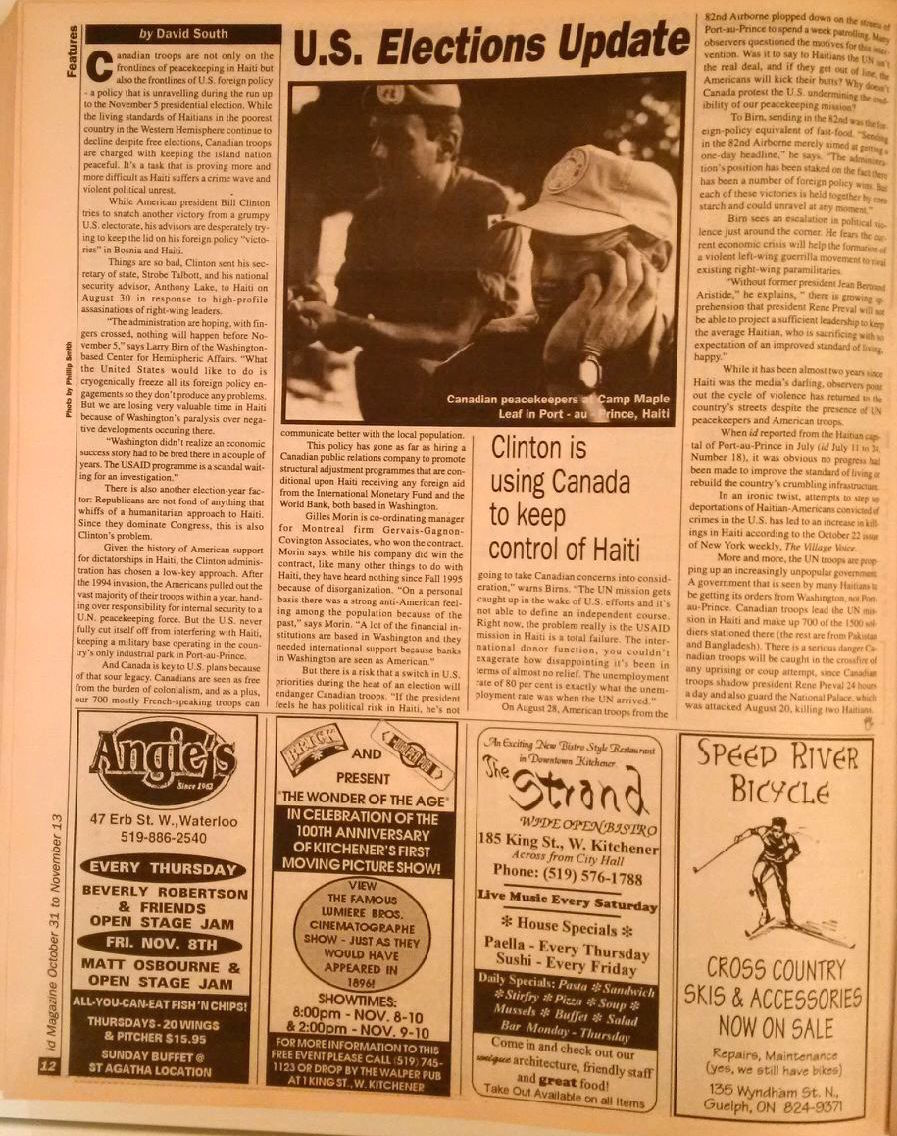
    https://davidsouthconsulting.org/2022/09/23/opinion-canada-is-allowing-u-s-to-dictate-haitis-renewal-more-news-and-opinion-on-what-the-un-soldiers-call-the-haitian-vacation/

    https://davidsouthconsulting.org/2020/04/22/state-of-decay-haiti-turns-to-free-market-economics-and-the-un-to-save-itself/

    https://davidsouthconsulting.org/2021/01/02/a-undp-success-story-grassroots-environmental-campaign-mobilizes-thousands-in-mongolia-1998/

    https://davidsouthconsulting.org/2021/01/26/u-s-elections-update-clinton-is-using-canada-to-keep-control-of-haiti/

    Development Challenges, South-South Solutions was launched as an e-newsletter in 2006 by UNDP’s South-South Cooperation Unit (now the United Nations Office for South-South Cooperation) based in New York, USA. It led on profiling the rise of the global South as an economic powerhouse and was one of the first regular publications to champion the global South’s innovators, entrepreneurs, and pioneers. It tracked the key trends that are now so profoundly reshaping how development is seen and done. This includes the rapid take-up of mobile phones and information technology in the global South (as profiled in the first issue of magazine Southern Innovator), the move to becoming a majority urban world, a growing global innovator culture, and the plethora of solutions being developed in the global South to tackle its problems and improve living conditions and boost human development. The success of the e-newsletter led to the launch of the magazine Southern Innovator.  

    Follow @SouthSouth1

    Google Books: https://books.google.co.uk/books?id=tRKYBgAAQBAJ&dq=development+challenges+october+2009&source=gbs_navlinks_s

    Slideshare: http://www.slideshare.net/DavidSouth1/development-challengessouthsouthsolutionsoctober2009issue

    Southern Innovator Issue 1: https://books.google.co.uk/books?id=Q1O54YSE2BgC&dq=southern+innovator&source=gbs_navlinks_s

    Southern Innovator Issue 2: https://books.google.co.uk/books?id=Ty0N969dcssC&dq=southern+innovator&source=gbs_navlinks_s

    Southern Innovator Issue 3: https://books.google.co.uk/books?id=AQNt4YmhZagC&dq=southern+innovator&source=gbs_navlinks_s

    Southern Innovator Issue 4: https://books.google.co.uk/books?id=9T_n2tA7l4EC&dq=southern+innovator&source=gbs_navlinks_s

    Southern Innovator Issue 5: https://books.google.co.uk/books?id=6ILdAgAAQBAJ&dq=southern+innovator&source=gbs_navlinks_s

    Creative Commons License

    This work is licensed under a
    Creative Commons Attribution-Noncommercial-No Derivative Works 3.0 License.

    ORCID iD: https://orcid.org/0000-0001-5311-1052.

    © David South Consulting 2023

  • Cities For All Shows How The World’s Poor Are Building Ties Across The Global South

    Cities For All Shows How The World’s Poor Are Building Ties Across The Global South

    By David SouthDevelopment Challenges, South-South Solutions

    SOUTH-SOUTH CASE STUDY

    Cities for All, recently published by Habitat International Coalition, draws together thinkers and innovators in a compilation of case studies addressing the challenges of inclusive cities in the global South. The book seeks to articulate experiences of South-South cooperation and enhance the links between different regions. David South interviews the co-editor, Charlotte Mathivet.

    Published: 24 August 2010

    Global Urbanist (http://globalurbanist.com/2010/08/24/cities-for-all-shows-how-the-worlds-poor-are-building-ties-across-the-global-south)

    The largest movements of people in human history are occurring right now, as vast populations relocate to urban and semi-urban areas in pursuit of a better quality of life, or because life has become intolerable where they currently live. In Arrival City, Canadian journalist Doug Saunders finds that this movement —

    — is creating new urban spaces that are this century’s focal points of conflict and change — centres of febrile settlement that will reshape our cities and reconfigure our economies. These Arrival Cities are where the next great economic and cultural boom will be born, or where the next explosion of violence will occur.

    For most, this process is chaotic, unplanned, and fraught with risk, hardship, poverty and stress; yet, because so many are also able to dramatically improve their life chances, many millions will continue to follow this path.

    The speed of urbanisation makes the question of how to build liveable cities increasingly urgent. A new book hopes to help people get closer to solutions to these vexing problems.

    Cities for All: proposals and experiences towards the right to the city, published by Habitat International Coalition (HIC) in Santiago, Chile, and co-edited by HIC’s Ana Sugranyes and Charlotte Mathivet, was launched during this year’s World Urban Forum in Rio de Janeiro, and highlights ways in which urban residents across the South are defining how they would like their cities to evolve, refusing to accept social exclusion and demanding a “right to the city”.

    The book is published in three languages — EnglishSpanish and Portuguese.

    “A lot of social initiatives based on the right to the city are coming from these ‘new cities of the South’”, says Mathivet. “The book highlights original social initiatives: protests and organising of the urban poor, such as the pavement dwellers’ movements in Mumbai where people with nothing, living on the pavements of a very big city, organise themselves to struggle for their collective rights, just as the park dwellers did in Osaka.”

    “Another innovative experience came from the children’s workshops in Santiago, aimed at including children in urban planning in order to make a children-friendly city.”

    The cities of Africa and Asia are growing by a million peole a week. If current trends continue, mega-cities and sprawling slums will be the hallmarks of this majority urban world. In sub-Saharan Africa, 72 per cent of the population lives in slum conditions. And by 2015, there will be 332 million slum-dwellers in Africa, with slums growing at twice the speed of cities.

    “The consequences have produced a deeper gap between the city and countryside, and also within the city between the rich and poor,” said Mathivet.

    Cities for All details African experiences from Nigeria, Cameroon, Ghana and South Africa. Mathivet believes “one common topic affecting these countries is the problem of forced evictions, due to the rural exodus and growing urbanisation. It is therefore very important for the right to the city to include a perspective of linking the struggle between rural and urban movements, because problems in cities and the countryside are closely connected, especially in Africa.”

    And the current surge to cities in Africa raises the issue of what type of development will occur. The book argues that cities aren’t automatically a solution to the plight of the poor. Cities need to be worked on, and many of the problems faced by the South’s fast-growing cities stem from a power imbalance.

    “A very important thing to realise is that a city life is not a synonym for a better life or a miracle solution for poor people, nor for the ‘capitalist’ way of life,” says Mathivet. “African nations and their people have to find effective solutions on their own to overcome poverty — which they are doing — without copying development models from the North.”

    “In my understanding, urban growth is not haphazard or poorly planned in ‘developing’ countries. Rather, I think that urban ‘planning’ or lack of planning is done with a goal of generating more benefits for powerful interests and fewer benefits for poor people.”

    The book argues for a two-way relationship with the people who make up the majority of these fast-growing cities. And it says each city will have to customise its solutions.

    “It is very difficult to apply social innovations to other countries without understanding the history and the social, economic, cultural and political context,” says Mathivet.

    “Hope comes from learning of different experiences. For example, if a social movement in South Africa succsesfully avoided an eviction from a slum, it may help another social movement in Brazil to strengthen its own strategy. One of the book’s goals was to articulate the various South-South experiences and enhance the links between different regions.”

    In one chapter, contributor David Harvey argues that “the right to the city is not simply the right to what already exists in the city; it is also the right to transform the city into something radically different.”

    “The right to the city itself will not stop the over-whelming phenomenon of urban growth,” believes Mathivet. “The consequences produced by implementing this collective right would rather change people’s daily lives by achieving more equality in cities as well as in the relationship between the city and coutnryside in regards to growing urban populations.”

    Cities for All highlights the existence of ‘cities without citizens’: the vast numbers of slum dwellers and the poor who live mostly ignored by authorities (unless they are in the way of commercial development).

    “The expression ‘cities without citizens’ means the exact opposite of the right to the city proposal,” Mathivet says. “This alternative to the present global paradigm proposes to allow people to participate in the process of creating the city in terms of urban planning, decision-making, budget, public policies, etc. It is possible for people to influence their own lives and the community.”

    “There is no miracle solution, and the right to the city is a banner around which people can organise themselves to articulate their struggles and demand social justice.”

    The book concludes by arguing for the advantages of a ‘slow city’ approach. But how does this work in fast-growing urban areas where people are looking to quickly escape poverty, or are seeking rapid improvements to their quality oflife? Would they not find a slow city approach frustrating?

    Mathivet believes a leap of imagination is required: “Cities for All is not intended to be a recipe book. The slow city experience was chosen as a conclusion to the book in order to present a different approach, but not to propose a clear solution to follow. Concluding with the slow city experience, which is radically different and difficult to apply in African and Asian cities, where the spread of urbanisation is uncontrollable and leads to major problems, emphasises that the fight for the right to the city involves imagination and the desire for another possible city …

    “Moreover, slow city experiences have been developed otuside of wealthy European countries, for example in some small Argentine and South Korean cities.”

    And with the coming decade unfolding, what will cities in the South be like? Are we on the cusp of a new, dark age akin to the misery of Europe’s cities during the industrial revolution?

    Mathivet acknowledges that “we can see a dark future where the interests of the most vulnerable will not be the priority. However, looking at the experiences by and for the people, we cannot consider them poor, but rich of knowledge, cognitive capital, and with courage to change their lives and their communities, through self-management and autonomy.

    Cities for All aimed to show this richness … the challenges are for civil society to deepen links between different movements to build a stronger global strategy, during events like the next World Social Forum in Dakar, February 2011.”

    David South is an international development consultant and writer. He writes the Development Challenges: South-South solutions e-newsletter for UNDP’s Special Unit for South-South Cooperation. He led the Communications Office for the UN in Ulaanbaatar from 1997 to 1999 and has worked for the UN in South Africa, Turkmenistan and Ukraine.

    The Special Unit for South-South Cooperation is mandated to promote, coordinate and support South-South and triangular cooperation on a global and UN-systemwide basis.

    This story is adapted from a piece in the July 2010 edition of Development Challenges.

    http://globalurbanist.com/2010/08/24/cities-for-all-shows-how-the-worlds-poor-are-building-ties-across-the-global-south

    https://www.hic-net.org/es/hic-book-cities-for-all-shows-how-the-worlds-poor-are-building-ties-across-the-global-south/

    Development Challenges, South-South Solutions was launched as an e-newsletter in 2006 by UNDP’s South-South Cooperation Unit (now the United Nations Office for South-South Cooperation) based in New York, USA. It led on profiling the rise of the global South as an economic powerhouse and was one of the first regular publications to champion the global South’s innovators, entrepreneurs, and pioneers. It tracked the key trends that are now so profoundly reshaping how development is seen and done. This includes the rapid take-up of mobile phones and information technology in the global South (as profiled in the first issue of magazine Southern Innovator), the move to becoming a majority urban world, a growing global innovator culture, and the plethora of solutions being developed in the global South to tackle its problems and improve living conditions and boost human development. The success of the e-newsletter led to the launch of the magazine Southern Innovator. 

    Creative Commons License

    This work is licensed under a
    Creative Commons Attribution-Noncommercial-No Derivative Works 3.0 License.

    ORCID iD: https://orcid.org/0000-0001-5311-1052.

    © David South Consulting 2021

  • A New House Kit for Slum Dwellers that is Safe and Easy to Build

    A New House Kit for Slum Dwellers that is Safe and Easy to Build

    By David SouthDevelopment Challenges, South-South Solutions

    SOUTH-SOUTH CASE STUDY

    By 2030, some 5 billion people around the world will live in cities. Next year, 2008, is predicted to be the tipping point, when urban dwellers (3.3 billion people) will outnumber rural residents for the first time. These are the conclusions of UNFPA’s State of the World Population 2007 Report. Even more strikingly, the cities of Africa and Asia are growing by a million people a week. And 72 percent of the population in sub-Saharan Africa live in slum conditions.

    But as populations grow — and most will be poor, unemployed and under 25 — it becomes critical that effective solutions are found to ensure people can live with dignity and comfort. And design is being used more and more to overcome this challenge.

    George Martine, author of the UNFPA report, is blunt: “We’re at a crossroads and can still make decisions which will make cities sustainable. If we don’t make the right decisions the result will be chaos,” he told the UK newspaper The Independent.

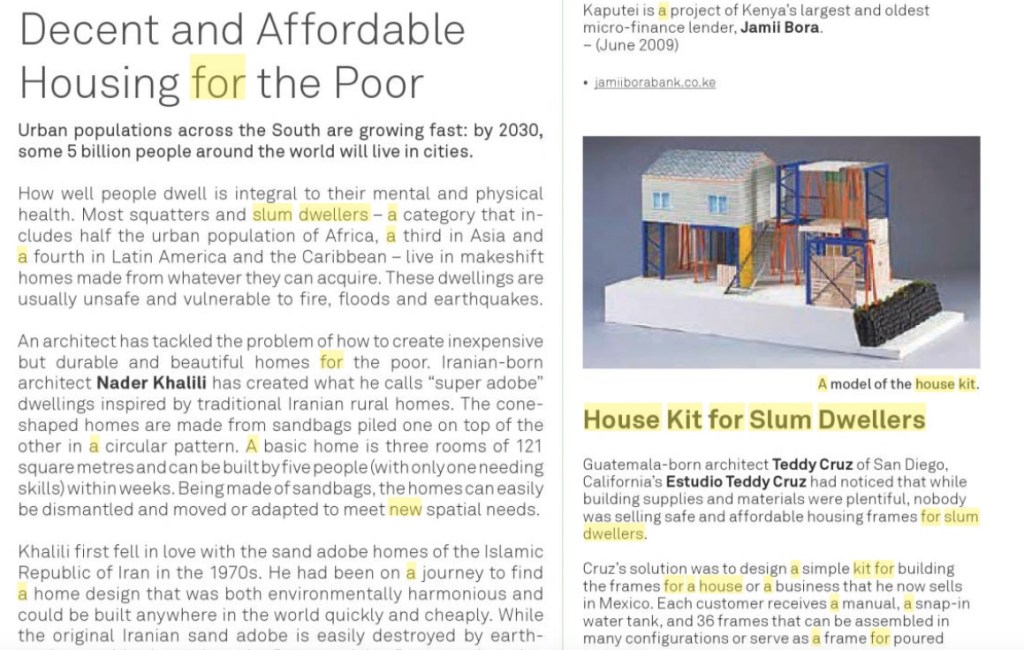
    Guatemala-born architect Teddy Cruz of Estudio Teddy Cruz in San Diego, California, joins a small but growing number of socially responsible architects. He applies a concept more associated with middle class shoppers at the furniture design emporium Ikea to the world’s estimated one billion urban slum dwellers (UN-Habitat). Without legal title to the land they live on, packed tightly into densely overcrowded shantytowns, most squatters and slum dwellers live in makeshift homes made from whatever they can get their hands on. This is estimated to include half the urban population of Africa, a third of Asia and a fourth of Latin America and the Caribbean (Click here for more information).

    The ad-hoc shelters and houses they build can be dangerously unstable, and vulnerable to natural disaster from flash floods to earthquakes. Cruz had noticed that while building supplies and materials were plentiful, nobody was selling safe and affordable housing frames for slum dwellers. According to the International Labor Organization, formal housing markets in developing countries rarely supply more than 20 percent of housing stock.

    Cruz’s solution was to design a simple kit for building the frames for a house or a business that he now sells in Mexico. Each customer receives a manual, a snap-in water tank, and 36 frames that can be assembled in many configurations, or serve as a frame for poured concrete. These sturdy frames can also be added to with locally found materials. Cruz said he was inspired by “the resourcefulness of poverty” and by the cheap and affordable pre-fabricated homes that once were sold by catalogue by the American retailer Sears.

    Cruz has been testing the structures in Tijuana, Mexico – a rapidly growing city on the border with the United States and a destination for Mexico’s poor. His work as an architect has centred on exploring how informal settlements grow faster than the cities they surround. These settlements, he says, break the rules and blur the boundaries between what is urban, suburban and rural. Cruz’s frame kits can be used to build a home, or combination of home and business, acknowledging the fact many people need to use their home as a business for a livelihood.

    “These start-up communities gradually evolve,” said Cruz., ”or violently explode out of conditions of social emergency, and are defined by the negotiation of territorial boundaries, the ingenious recycling of materials, and human resourcefulness.”

    Published: July 2007

    Resources

    There are many ways to play around with your dwelling and architecture ideas. Here are some products available online:

    1. Arckit: Arckit is a tangible and hands-on design tool for spontaneously bringing your architectural ideas to life right before your eyes. Website: https://www.arckit.com
    2. SmartLab Archi-TECH Electronic Smart House: Build your house and power it up! This creative STEAM toy allows aspiring architects and engineers to design and build modular structures – and then power them up with lights, sounds, sensors, and motorized parts! Website: https://www.mastermindtoys.com/products/smart-lab-archi-tech-electronic-smart-house

    Development Challenges, South-South Solutions was launched as an e-newsletter in 2006 by UNDP’s South-South Cooperation Unit (now the United Nations Office for South-South Cooperation) based in New York, USA. It led on profiling the rise of the global South as an economic powerhouse and was one of the first regular publications to champion the global South’s innovators, entrepreneurs, and pioneers. It tracked the key trends that are now so profoundly reshaping how development is seen and done. This includes the rapid take-up of mobile phones and information technology in the global South (as profiled in the first issue of magazine Southern Innovator), the move to becoming a majority urban world, a growing global innovator culture, and the plethora of solutions being developed in the global South to tackle its problems and improve living conditions and boost human development. The success of the e-newsletter led to the launch of the magazine Southern Innovator.  

    Follow @SouthSouth1

    Like this story? Here is a dirty secret: this website is packed with stories about global South innovators. We spent 7 years researching and documenting these stories around the world. We interviewed the innovators to learn from them and we visited them to see how they did it. Why not use the Search bar at the top and tap in a topic and see what stories come up? So, stick around and read some more!    

    Archive.org: https://archive.org/details/Httpwww.slideshare.netDavidSouth1development-challengessouthsouthsolutionsjuly2007issue

    Slideshare: http://www.slideshare.net/DavidSouth1/development-challengessouthsouthsolutionsjuly2007issue

    Southern Innovator Issue 1: https://books.google.co.uk/books?id=Q1O54YSE2BgC&dq=southern+innovator&source=gbs_navlinks_s

    Southern Innovator Issue 2: https://books.google.co.uk/books?id=Ty0N969dcssC&dq=southern+innovator&source=gbs_navlinks_s

    Southern Innovator Issue 3: https://books.google.co.uk/books?id=AQNt4YmhZagC&dq=southern+innovator&source=gbs_navlinks_s

    Southern Innovator Issue 4: https://books.google.co.uk/books?id=9T_n2tA7l4EC&dq=southern+innovator&source=gbs_navlinks_s

    Southern Innovator Issue 5: https://books.google.co.uk/books?id=6ILdAgAAQBAJ&dq=southern+innovator&source=gbs_navlinks_s

    Creative Commons License

    This work is licensed under a
    Creative Commons Attribution-Noncommercial-No Derivative Works 3.0 License.

    ORCID iD: https://orcid.org/0000-0001-5311-1052.

    © David South Consulting 2023

  • Haiti Earthquake Prompts Tech Aid

    Haiti Earthquake Prompts Tech Aid

    By David SouthDevelopment Challenges, South-South Solutions

    SOUTH-SOUTH CASE STUDY

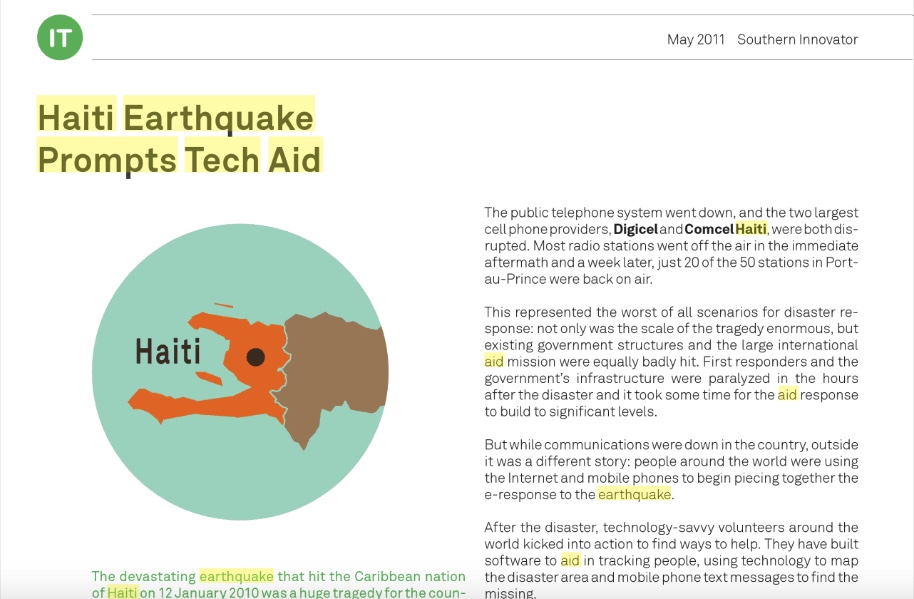
    The devastating earthquake that hit the Caribbean nation of Haiti on January 12 was a huge tragedy for the country’s people and for the large international aid community, including the United Nations. But the disaster has seen the use of new information technologies – often assembled by volunteers – to bridge the gaps in critical information and bring a semblance of order to the chaos of a large disaster. And many of the technologies being used in Haiti now arose from past disasters and crises in the South.

    Remarkable stories from the disaster include a woman who used her mobile phone to text message Canadian officials she was trapped and needed rescue, to a filmmaker who used an application on his iPhone (http://www.apple.com/iphone/) to treat his wounds: “I was able to look up treatment of excessive bleeding and compound fracture, so I used my shirt to tie my leg and a sock on the back of my head and later used it for other things like to diagnose shock,” claimed Dan Woolley to NBC Miami.

    Measuring 7.0 in magnitude (http://en.wikipedia.org/wiki/2010_Haiti_earthquake), the quake killed over 212,000 people, injured 300,000 and affected more than 3 million out of Haiti’s population of 9 million. Hundreds of thousands have lost their homes and are now dependent on food aid to survive. Haiti is the poorest country in the western hemisphere, and is ranked 149th of 182 countries on the Human Development Index.

    In the aftermath of the earthquake, communications were knocked out and it was difficult to grasp the scale of the disaster. Major infrastructure was either severely damaged or completely destroyed.

    The public telephone system went down, and the two largest cell phone providers, Digicel and Comcel Haiti, were both disrupted. Most radio stations went off the air in the immediate aftermath and a week later, just 20 of the 50 stations in Port-au-Prince were back on air.

    This represented the worst of all scenarios for disaster response: not only was the scale of the tragedy enormous, but existing government structures and the large international aid mission were equally badly hit. First responders and the government’s infrastructure were paralyzed in the hours after the disaster and it took some time for the aid response to build to significant levels.

    But while communications were down in the country, outside it was a different story: people around the world were using the internet and mobile phones to begin piecing together the e-response to the earthquake.

    After the disaster, technology-savvy volunteers around the world kicked into action to find ways to help. They have built software to aid in tracking people, using technology to map the disaster area and ways to use mobile phone text messages to find the missing.

    Kenya’s Ushahidi (www.ushahidi.com) is a free software mashup (http://en.wikipedia.org/wiki/Mashup_%28web_application_hybrid%29) born after the post-election violence in Kenya in 2007 and 2008. It gathers citizen-generated crisis information – SMS (text messages), email or web resources – and then places the information on a map or timeline. It is put together by volunteers from Kenya, Ghana, South Africa, Malawi, the Netherlands and the United States.

    Ushahidi’s founder is Kenyan Ory Okolloh, and the first version of the software for download is called “Mogadishu,” after the capital of Somalia.

    It was put to use in Haiti (http://haiti.ushahidi.com/reports/submit) as users populated its online maps and timelines with information on the location of people in need of food and water, those trapped in rubble or those in need of medical attention. It is a real-time reporting system for people in a disaster, offering a way for people in need to broadcast to the outside world.

    Sample reports on the timeline look like this (http://haiti.ushahidi.com/reports): ” SOS food, water and care needed in the Bertin Zone of Carrefour S.O.S. for the people of Carefour in the Bertin area, Titus Road, Froide River, these people haven’t recieved anything yet like water, food, care.”

    “Alive under the Rubble of Bar Lakay Restaurant, Ave. Christophe 6633. Carole Joseph is alive under the rubble of the Bar Lakay restaurant on Avenue Christophe.”

    The UN estimates there are more than 900 non-governmental organizations operating in Haiti. One of the best ways to try and coordinate this large aid response is through innovative information technology.

    The Ushahidi software has spawned many creative variations to track a wide range of problems. In the Philippines, TXTpower (http://www.cp-union.com/ushahidi/) is put together by the Computer Professionals’ Union to keep an eye on mobile phone companies and their business practices. In Mexico, a mashup (http://www.cuidemoselvoto.org/) was put together for the 2009 federal elections. Stop Stockouts (http://stopstockouts.org/) keeps track of near real-time pharmacy and medical supplies in health facilities and pharmacies in Kenya, Uganda, Malawi and Zambia.

    In San Diego, California, computer programmer Tim Schwartz quickly contacted his network of fellow programmers to address the problem of information being spread too widely across many web sources. In a few hours they put together http://www.haitianquake.com, a way for people to post and locate missing relatives.

    It was online in less than 24 hours. It was followed by many other similar services and they were merged into a service eventually put together by Google called PersonFinder two days later. Google’s PersonFinder grew to have more than 32,000 missing people listed.

    Another response has been Crisis Camps (http://crisiscampmiami.org/) in London England and cities across the United States. Technology workers got together to brainstorm relevant solutions to help the aid effort, and developed tools including Tweak the Tweet, Port Au Prince Basemap (up-to-date data on what his happening on the ground), The Haiti Timeline (developing a real-time history of events as they unfold), Family Reunification Systems, crisis wikis (http://crisiscommons.org/wiki/index.php?title=Crisis_Wiki), Mobile Applications 4 Crisis Response, translation (Creole to English for example), Mapping NGOs in Action (in the chaos of a crisis, this seeks to track what NGOs are working where), We Need, We Have Exchange (a way to post requests for resources or help).

    “It really is amazing the change in the way crisis response can be done now,” Noel Dickover, a Washington, DC-based organiser of the Crisis Camp tech volunteer movement, told The Independent newspaper.

    “Developers, crisis mappers and even internet-savvy folks can actually make a difference.”

    Josh Nesbit is a co-creator of a text message service for mobile phones that is being used by international organizations like the United Nations and the Red Cross. Haitians are able to send free text messages from mobile phones on the country’s Digicel service. The messages include requests for water and food. The messages are organized and tagged with key words by volunteers in the Haitian community in New York City, and Haitian radio stations promote the service. It was developed based on similar systems already running in hospitals in Malawi.

    In Haiti, mobile phone networks were back up and running within a few days – many within 24 hours. Haiti is poor, but it nonetheless has impressive mobile phone ownership rates: one-in-three people has one.

    OpenStreetMap (http://www.openstreetmap.org/) is another excellent resource in a disaster and represents a significant step forward in helping people to respond. Real time data is uploaded to satellite photographs of the disaster area and people then can add updates on the location of working hospitals or where infrastructure has been damaged. The information comes in by many forms, from the micro-blogging service Twitter (www.twitter.com) to eyewitness reports.

    Reports from Haiti have talked of rescue teams uploading the maps to their GPS (global positioning system) devices for easy access, or printing then in A4 form to carry around.

    The utility of this service has been confirmed by many working on helping Haiti. “We have already been using their data in our initial post-disaster needs assessment,” Stuart Gill of the World Bank told The Independent.

    Dutch mobile phone maker Intivation (http://www.intivation.nl/) is distributing for free solar-powered mobile phones in Haiti to help with aid efforts and is launching the phones for sale around the world as well.

    Published: February 2010

    Resources

    1) SMS activism: A blog report on how people are using SMS text messaging in the developing world. Website: http://www.guardian.co.uk/katine/katine-chronicles-blog/2010/feb/02/mobile-phone-sms-uprising

    2) The Magazine Popular Mechanics has excellent resources on how anyone can prepare their family and community for disasters. Website:http://www.popularmechanics.com/survival/

    3) The US Government has extensive resources online on how to prepare for a wide variety of natural and man-made disasters. Website: http://www.fema.gov/areyouready/

    4) UNICEF: Community-Based Disaster Preparedness Projects (CBDPs) in India have been helping communities restructure to survive when disaster strikes. Website:http://www.unicef.org.uk/campaigns

    5) How to activate support from the global technology community in a disaster. Website: http://crisiscommons.org/

    6) International Community on Information Systems for Crisis Response and Management: They will be having their conference on Defining Crisis Management 3.0 from May 2-5, 2010 in Seattle Washington USA. Website:http://www.iscram.org/

    7) Telecoms Sans Frontiers: Focuses on providing communications in the first days after an emergency. Website: http://www.tsfi.org/

    8) InSTEDD NGO: InSTEDD’s mission is to harness the power of technology to improve collaboration for global health and humanitarian action. An innovation lab for tools designed to strengthen networks, build community resilience and improve early detection and response to major health-related events and natural or human-caused disasters. Website: http://instedd.org/

    9) Web mash-ups: Programmable Web website offers all the resources required to get started. Website: www.programmableweb.com/

    https://davidsouthconsulting.org/2021/10/28/ending-gang-violence-while-cleaning-the-streets-in-haiti/

    https://davidsouthconsulting.org/2021/01/08/haitian-coffee-becoming-a-hit-with-american-connoisseurs/

    https://davidsouthconsulting.org/2021/10/28/milk-co-operatives-help-hungry-haiti/

    https://davidsouthconsulting.org/2020/04/22/state-of-decay-haiti-turns-to-free-market-economics-and-the-un-to-save-itself/

    Development Challenges, South-South Solutions was launched as an e-newsletter in 2006 by UNDP’s South-South Cooperation Unit (now the United Nations Office for South-South Cooperation) based in New York, USA. It led on profiling the rise of the global South as an economic powerhouse and was one of the first regular publications to champion the global South’s innovators, entrepreneurs, and pioneers. It tracked the key trends that are now so profoundly reshaping how development is seen and done. This includes the rapid take-up of mobile phones and information technology in the global South (as profiled in the first issue of magazine Southern Innovator), the move to becoming a majority urban world, a growing global innovator culture, and the plethora of solutions being developed in the global South to tackle its problems and improve living conditions and boost human development. The success of the e-newsletter led to the launch of the magazine Southern Innovator.  

    Follow @SouthSouth1

    Google Books: https://books.google.co.uk/books?id=p03–n51i44C&dq=development+challenges+april+2008&source=gbs_navlinks_s

    Slideshare: http://www.slideshare.net/DavidSouth1/development-challengessouthsouthsolutionsapril2008issue

    Southern Innovator Issue 1: https://books.google.co.uk/books?id=Q1O54YSE2BgC&dq=southern+innovator&source=gbs_navlinks_s

    Southern Innovator Issue 2: https://books.google.co.uk/books?id=Ty0N969dcssC&dq=southern+innovator&source=gbs_navlinks_s

    Southern Innovator Issue 3: https://books.google.co.uk/books?id=AQNt4YmhZagC&dq=southern+innovator&source=gbs_navlinks_s

    Southern Innovator Issue 4: https://books.google.co.uk/books?id=9T_n2tA7l4EC&dq=southern+innovator&source=gbs_navlinks_s

    Southern Innovator Issue 5: https://books.google.co.uk/books?id=6ILdAgAAQBAJ&dq=southern+innovator&source=gbs_navlinks_s

    More on Haiti here: State Of Decay: Haiti Turns To Free-Market Economics And The UN To Save Itself

    https://davidsouthconsulting.org/2022/11/01/southern-innovator-magazine-2010-2014/

    Creative Commons License

    This work is licensed under a
    Creative Commons Attribution-Noncommercial-No Derivative Works 3.0 License.

    ORCID iD: https://orcid.org/0000-0001-5311-1052.

    © David South Consulting 2023