Tag: SDG11

  • Ambitious Schemes Hope to Advance Economic Development

    Ambitious Schemes Hope to Advance Economic Development

    By David SouthDevelopment Challenges, South-South Solutions

    SOUTH-SOUTH CASE STUDY

    Sometimes it takes a bold, fresh start to speed up economic and human development goals. Taking a large-scale approach has been used around the world, either establishing new trade zones or even a new city.

    Two recent examples in Nigeria and Afghanistan are attempting to speed economic development in their respective countries, with both receiving help from experienced Asian practitioners of rapid economic development.

    The role models for this approach are the so-called “Asian Tigers”: they include Taiwan, Hong Kong, Singapore and South Korea. They are admired because each country rose from extreme poverty to become some of the Earth’s richest nations. Importantly, what they did stands as proof that extreme poverty can be escaped from; people can become much wealthier in just a decade or two.

    The pioneer of using trade zones to speed development is the Asian city state of Singapore (http://www.gov.sg/government/web/content/govsg/classic/home)..Fifty years ago it was one of Asia’s poorest countries. With its port (http://www.mpa.gov.sg/) it had a way to turn things around but it also realized in the early 1960s it could not just compete by having cheap labour, something that was plentiful across the developing world (http://www.mti.gov.sg/MTIInsights/Pages/Economic-History-and-Milestones.aspx). It needed unique technical skills that could not be found elsewhere.

    The country was unable to create products and services that it could export and compete in global markets because of a lack of skills, the Government determined. Authorities employed a mix of measures to make the country attractive to foreign companies to boost skills. These included fair enforcement of local laws, tax incentives and upgraded infrastructure, much of it paid for with an infrastructure tax, rather than borrowing. With the influx of new thinking and high-quality skills, new technologies and new ways of doing things, in time, a culture of innovation became hardwired into the way things were done in Singapore.

    Beginning in 1961 with the Jurong Industrial Estate (http://infopedia.nl.sg/articles/SIP_246_2004-12-16.html), the Singapore government set aside land to develop the economy by attracting international businesses and boosting its existing port facilities. It also established the Economic Development Board (EDB) in 1961 and the Singapore Tourism Promotion Board (STPB) in 1964.

    By creating favorable conditions for international businesses to come in and operate, Singapore quickly developed to become one of Asia’s wealthiest trading and manufacturing centres.

    This is a strategy China successfully implemented in the 1980s and 1990s and in turn generated the largest and quickest population shift out of poverty in human history, turning the country into an economic powerhouse.

    The secrets to making this strategy work include understanding what modern infrastructure requirements are necessary for international businesses. These days, this means speedy and generous bandwidth for the Internet, modern airports, roads, security, and quality housing and food.

    One of the biggest contemporary challenges is competition. Whereas Singapore was a pioneer in its day, now, many countries across the global South are pursuing this strategy to spur growth. An international company has many options to consider, and will more than likely gravitate towards the country that makes the best offer with the least risk.

    Trade zones are places ripe with opportunity for innovators. New places tend to be seeking the latest in information and communication technologies, the latest in transportation options, modern housing and office facilities. All of these changes require innovators with fresh thinking to make them work. It is also often easier to introduce new ways of doing things to places that are not coping with legacy infrastructure and old habits and ways.

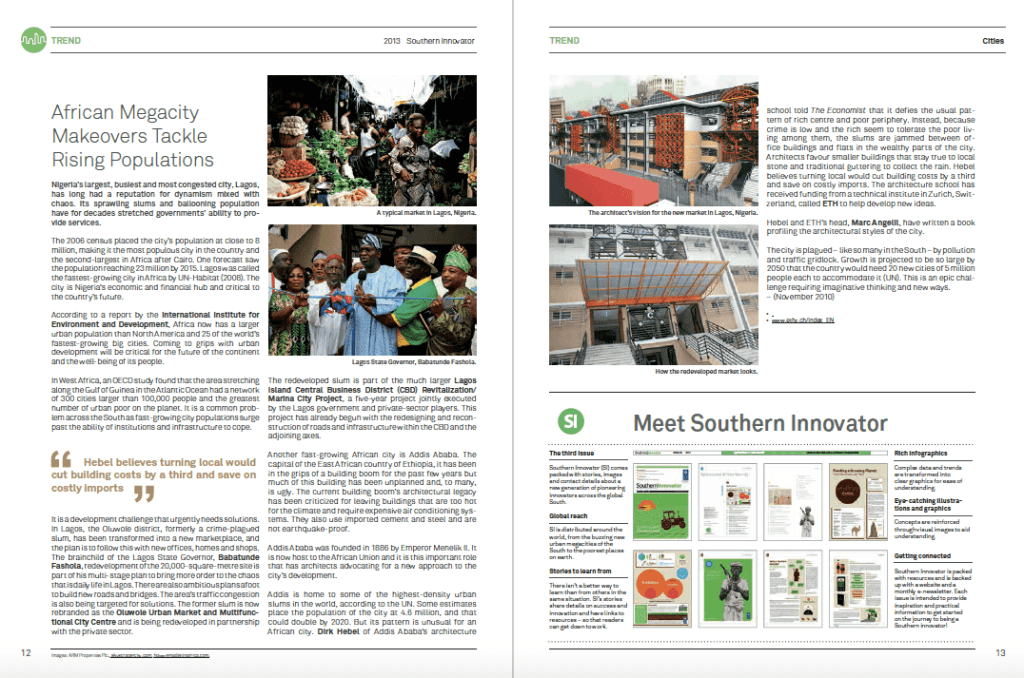
    Billing itself as a “new model city,” the Lekki Free Zone Lagos, Nigeria (lekkizone.com) in West Africa is trying to bring a fresh start to the city and the region. It is a joint partnership between investors from China and Nigeria.

    Its goal is to better connect regional markets to the global economy. The free trade zone hopes to remove barriers to growth and to attract international investment, becoming the top destination for inward investment in Africa. The project is being run by the Lagos State Government but funded with private capital investment.

    Nigeria has been looking into Free Zones since 1982, as it sought additional ways to earn income apart from oil exports. The Export Processing Zone Act 63 was passed in 1992 and the Calabar Export Processing Zone was eventually set up in 1999 (http://www.nepza.gov.ng/index.php?option=com_content&task=view&id=18&Itemid=34). Since then, a slew of Free Zones have been set up, or are in the works.

    The Lekki Free Zone is envisioned as a high-tech zone that will eventually lead to the creation of 2 million jobs. The Zone’s investors are targeting businesses working in oil and gas, petrochemicals, electronics, light and heavy equipment, machinery and automobiles, pharmaceuticals, textiles, shopping and banking and financial services.

    Lagos State is home to 21 million people, and the current city of Lagos is on course to become the third-largest megacity in the world. Officials claim the area has an economic growth rate of 16.8 per cent per year.

    The 16,500 hectare Lekki Free Zone, to the southeast of the city, is divided into two parts: an industrial zone and a residential zone. The residential zone will include apartments and villas, shopping malls and plazas, hospitals and clinics, schools and research and development centres and a hotel, tour and recreational centres, golf courses, gyms and water sports facilities.

    Located on the southern coast of Nigeria with connections to the Atlantic Ocean and the Gulf of Guinea, the Lekki Free Zone says it will give companies access to the largest consumer market in Africa, with a potential reach of 500 million people.

    The companies will also be able to draw on Nigeria’s natural resources, including oil, natural gas, timber, rubber, cocoa, Arabic gum and sesame seeds as examples.

    Another new beginning is being sought in war-torn Afghanistan, which is working on building a new city close to the capital, Kabul.

    Kabul New City started construction in 2013 and is planned to be a city of canals, parks and villas. It will be home to 1.5 million people, cost US $33 billion and take 15 years to complete. It is being partly funded by Japan.

    It is a very ambitious scheme for a country that has been mired in conflict for decades. It is hoped the initial seed capital invested by Japan will attract other investors to fully fund the project. Japan got the project going with a commitment to contribute US $106 million between 2009 and 2015.

    The site of Kabul New City is 19 kilometres from the existing Kabul, near the Bagram airbase used by NATO forces in the country.

    Foreign military forces are looking to leave Afghanistan in 2014 and the new city offers a fresh start for the country after years of conflict.

    Located in an area surrounded by the Marko mountains, it is in “one of the safest areas of Afghanistan,” Abdul Habib Zadran, Chief Financial Officer of the Dehsabz-Barikab City Development Authority (http://www.dcda.gov.af/), the agency in charge of the project, told The Sunday Times.

    The project could be a significant leap ahead in modernization from the current conditions in Kabul, where the streets are in poor condition and buildings in disrepair. Kabul was originally built for 800,000 people, according to The Sunday Times, but now has over 4 million residents. Projections forecast the city growing to 6.5 million people by 2025. Kabul will experience extreme pressure to handle this growing population and find the resources to serve it.

    The homes would receive electricity from solar panels and renewable energy sources. Kabul New City will need to tackle the problem of access to enough water to service the growing new city’s population. Plans are afoot to provide water from rivers north of the city.

    The master plan for the new city has been designed by Zahra Breshna (breshna-consulting.com), an Afghan-German company which has also built the new Kabul Bank headquarters. The company calls the project “a new beginning for Kabul.”

    Published: May 2013

    Resources

    1) Tianjin Eco-city: The Sino-Singapore Tianjin Eco-city’s vision is to be a thriving city which is socially harmonious, environmentally-friendly and resource-efficient. Website: tianjinecocity.gov.sg/

    2) Songdo International Business District: Songdo International Business District (IBD) is home to the UN’s Green Climate Fund and is a smart city located in the Republic of Korea built to the highest green building standards. Website: songdo.com/

    3) Singapore: An island and islets in the heart of Southeast Asia, between Malaysia and Indonesia. Website: http://app.www.sg/

    4) Djibouti Free Zone: Djibouti Free Zone was created with one primary goal in mind – to bring about a sea-change in the way Africa thinks and does business. No red tape, ruthless efficiency and genuinely exhaustive services – in essence, we offer the ideal conditions for trade and commerce to flourish in. Website: djiboutifz.com/

    5) Cisco Smart + Connected Cities: Cisco Smart+Connected Communities solutions use intelligent networking capabilities to bring together people, services, community assets, and information to help community leaders address these world challenges. Website: http://www.cisco.com/web/strategy/smart_connected_communities.html

    6) IBM Smarter Cities: Smarter cities drive sustainable economic growth and prosperity for their citizens. Their leaders have the tools to analyze data for better decisions, anticipate problems to resolve them proactively and coordinate resources to operate effectively. Website:http://www.ibm.com/smarterplanet/us/en/smarter_cities/overview/

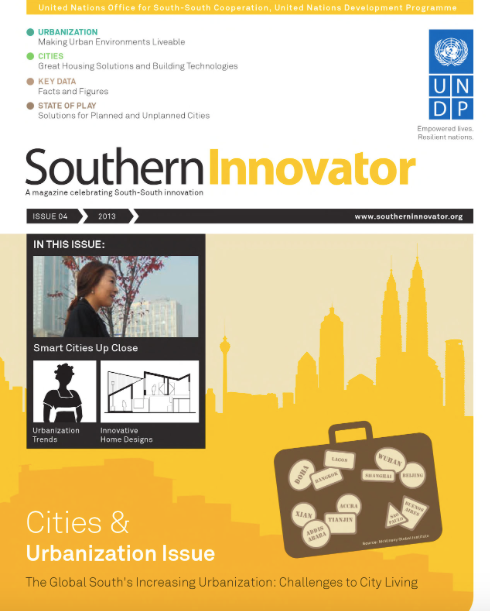
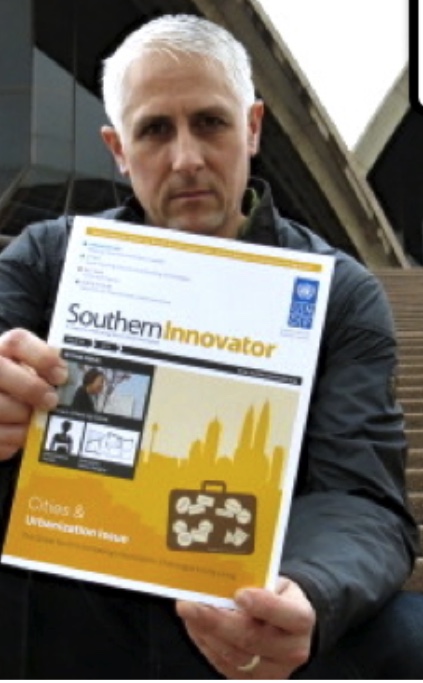
    7) Southern Innovator Magazine Issue 4: Cities and Urbanization. Website: http://www.scribd.com/doc/133622315/Southern-Innovator-Magazine-Issue-4-Cities-and-Urbanization

    Southern Innovator logo

    London Edit

    31 July 2013

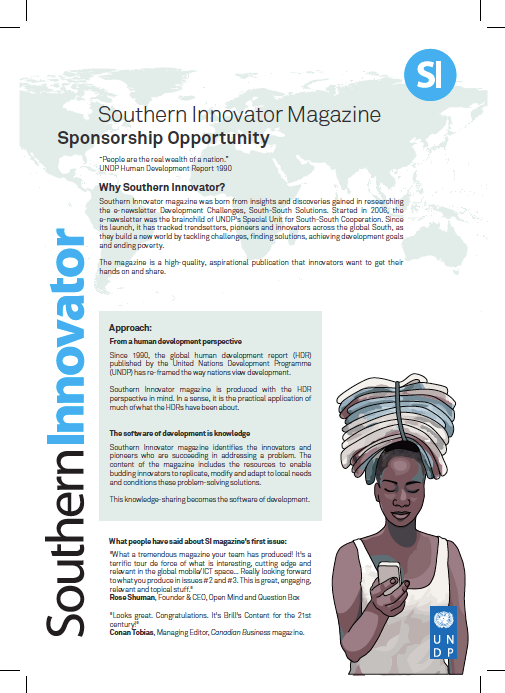
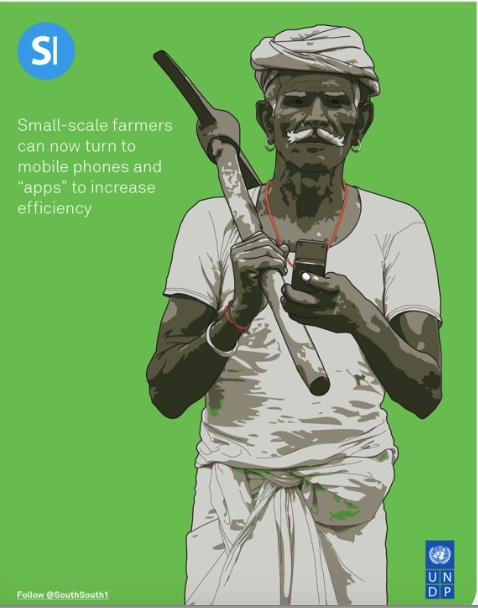
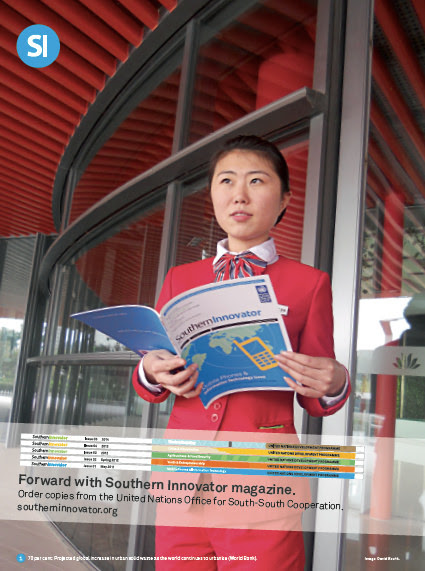
    Development Challenges, South-South Solutions was launched as an e-newsletter in 2006 by UNDP’s South-South Cooperation Unit (now the United Nations Office for South-South Cooperation) based in New York, USA. It led on profiling the rise of the global South as an economic powerhouse and was one of the first regular publications to champion the global South’s innovators, entrepreneurs, and pioneers. It tracked the key trends that are now so profoundly reshaping how development is seen and done. This includes the rapid take-up of mobile phones and information technology in the global South (as profiled in the first issue of magazine Southern Innovator), the move to becoming a majority urban world, a growing global innovator culture, and the plethora of solutions being developed in the global South to tackle its problems and improve living conditions and boost human development. The success of the e-newsletter led to the launch of the magazine Southern Innovator. 

    Creative Commons License

    This work is licensed under a
    Creative Commons Attribution-Noncommercial-No Derivative Works 3.0 License.

    ORCID iD: https://orcid.org/0000-0001-5311-1052.

    © David South Consulting 2023

  • Lagos Traffic Crunch Gets a New Solution

    Lagos Traffic Crunch Gets a New Solution

    By David SouthDevelopment Challenges, South-South Solutions

    SOUTH-SOUTH CASE STUDY

    Around the world, traffic congestion is often accepted as the price paid for rapid development and a dynamic economy. But as anyone who lives in a large city knows, there comes a tipping point where the congestion begins to harm economic activity by wasting people’s time in lengthy and aggravating commuting, and leaving commuters frazzled and burned out by the whole experience.

    According to the World Business Council for Sustainable Development, 95 per cent of congestion growth in the coming years will be in developing countries. Even in developed countries like the United States, in 2000, the average driver experienced 27 hours of delays (up seven hours from 1980) (MIT Press). This balloons to 136 hours in Los Angeles.

    Developing countries are seeing vehicle numbers rise by between 10 and 30 per cent per year (World Bank). In economic hotspots, growth is even faster.

    Lagos, Nigeria, the throbbing business hub of West Africa’s most populous nation, has a network of over 2,700 km of roads with a vehicle density of 740 vehicles per kilometre (E.I. Bello). All those cars consume over 85 per cent of the petroleum products imported into the country – a costly expense for a country that actually imports oil. All this driving is necessary because the city has no rail or sea mass transit system and all movements of people and goods are by road.

    Nigeria suffers from the irony of being a country that makes 95 per cent of its export earnings and 80 per cent of its revenue from oil, yet has to import most of its fuel because its refineries are constantly breaking down.

    The overwhelming majority of mega-cities are now located in developing countries, including sprawling conurbations such as São Paulo, Brazil (18.8 million inhabitants in 2007), Delhi, India (15.9 million), and Manila, Philippines (11.1 million). By 2015 Lagos will have 12.8 million inhabitants and by 2025, it is estimated it will have 16.8 million citizens.

    That will be a lot of cars and frustrated people trying to get around.

    One project trying to alleviate the pain of a daily commute in the city is called Traffic (Traffic.com.ng). The computer application, or ‘app’, has a live feed of traffic on its homepage, collecting information from a wide variety of sources: the web, mobile phones and SMS (short message service) text messages sent in by mobile telephone. The service is also looking to extract information from microblogging site Twitter (twitter.com).

    The service says it aims to “reduce stress on Lagos road by providing up-to-the-minute traffic status in the state.”

    It uses the powerful concept of ‘crowdsourcing’, in which a large group of people contributes to solve a problem by combining the technological power of mobile phones and the Internet. These two technologies mean it is possible to solve problems in real time and draw on a very large group of people spread out over a wide geographical area.

    So, how does it work? A user can go to the homepage and click “View Traffic Report From” and see live data streaming in. If the user wants to see traffic conditions in a particular area, they type in the road and area in a box on the page and click to see the report.

    Those who are stuck in a traffic jam and want to alert others can send an SMS message with the keywords to 07026702053.

    The Traffic app came under scrutiny by the anonymous blogger Cherchez la Curl, whose blog is about “celebrating African women and natural hair”: “It’s no Einstein-worthy revelation to say that solving Lagos’ traffic problem (and, more generally, improving Nigeria’s poor transportation network) is one of the keys to sustaining growth and economic development in Nigeria,” the blog said.

    The blog’s author found the service was still in its early days: “While the idea is a fantastic application of modern technology to developing Africa, the only problem I see is that it seems like no-one is sending through traffic alerts! On a recent visit to the site, the alert stream was empty of alerts save for a few tweets. It’s a shame as this service would be extremely handy as a counterpoint/band-aid whilst government sorts out the root cause of the traffic.”

    It sounds like it is still early days for the Traffic app and Lagos residents will be its harshest critics.

    Published: January 2012

    Resources

    1) LagosMet.com: An Internet bulletin board offering rolling updates on Lagos traffic and security reports. Users can also post their reports. Website: http://lagosmet.com

    2) eNowNow: A website offering live updates on Lagos traffic congestion. Website: http://traffic.enownow.com

    3) SENSEable City: A project at the Massachusetts Institute of Technology’s SENSEable City Laboratory to use the new generation of sensors and hand-held electronics to change how cities are understood and navigated. This includes creating real-time maps of cities that can then be used to help with avoiding traffic congestion and other problems. Website: http://senseable.mit.edu

    4) Mobility 2001: World Mobility at the End of the Twentieth Century and its Sustainability published by the World Business Council for Sustainable Development. Website: http://www.wbcsd.org

    5) Lagos Traffic Crowdmap: A mix of user-contributed reports on the traffic conditions in Lagos. Website: https://lagostraffic.crowdmap.com/main

    6) A study of Urban Traffic Management – A Case Study of Lagos State Traffic Management Authority by E. I, Bello et al., 2009. Website: http://www.scientific.net/AMR.62-64.599

    7) Cities for All: An interview on book seeking to find solutions to the congested cities of the South. Website: http://globalurbanist.com/2010/08/24/cities-for-all-shows-how-the-worlds-poor-are-building-tiesacross-the-global-south

    Development Challenges, South-South Solutions was launched as an e-newsletter in 2006 by UNDP’s South-South Cooperation Unit (now the United Nations Office for South-South Cooperation) based in New York, USA. It led on profiling the rise of the global South as an economic powerhouse and was one of the first regular publications to champion the global South’s innovators, entrepreneurs, and pioneers. It tracked the key trends that are now so profoundly reshaping how development is seen and done. This includes the rapid take-up of mobile phones and information technology in the global South (as profiled in the first issue of magazine Southern Innovator), the move to becoming a majority urban world, a growing global innovator culture, and the plethora of solutions being developed in the global South to tackle its problems and improve living conditions and boost human development. The success of the e-newsletter led to the launch of the magazine Southern Innovator. 
    Creative Commons License

    This work is licensed under a
    Creative Commons Attribution-Noncommercial-No Derivative Works 3.0 License.

    ORCID iD: https://orcid.org/0000-0001-5311-1052.

    © David South Consulting 2023

  • Free Magazine Boosts Income for Rickshaw Drivers

    Free Magazine Boosts Income for Rickshaw Drivers

    By David SouthDevelopment Challenges, South-South Solutions

    SOUTH-SOUTH CASE STUDY

    In the bustling, congested cities of Asia, rickshaws and auto-rickshaws are common forms of transport. Smaller, cheaper and more nimble than cars, they play a key role in the transit infrastructure, helping to get people to work and to get around.

    According to a report by the World Resources Institute (wri.org) and EMBARQ – a global network of experts on sustainable transport solutions – India’s auto rickshaws are “an increasingly important part of urban transport in cities.”

    The report estimates the number of auto rickshaws at between 15,000 and 30,000 in medium-sized cities and over 50,000 in large cities. The report found they make up between 10 and 20 per cent of daily motorized road transport trips for people in Bangalore, Mumbai, Pune and Rajkot.

    And it’s not just the economic role played in transporting people: auto rickshaws are made in India and their production there doubled between 2003 and 2010, making them a source of manufacturing jobs too.

    As India’s cities continue to grow – estimates forecast urban populations surging from 340 million in 2008 to 590 million by 2030 – auto rickshaws could have a bright future as they remain an affordable and safe transport solution.

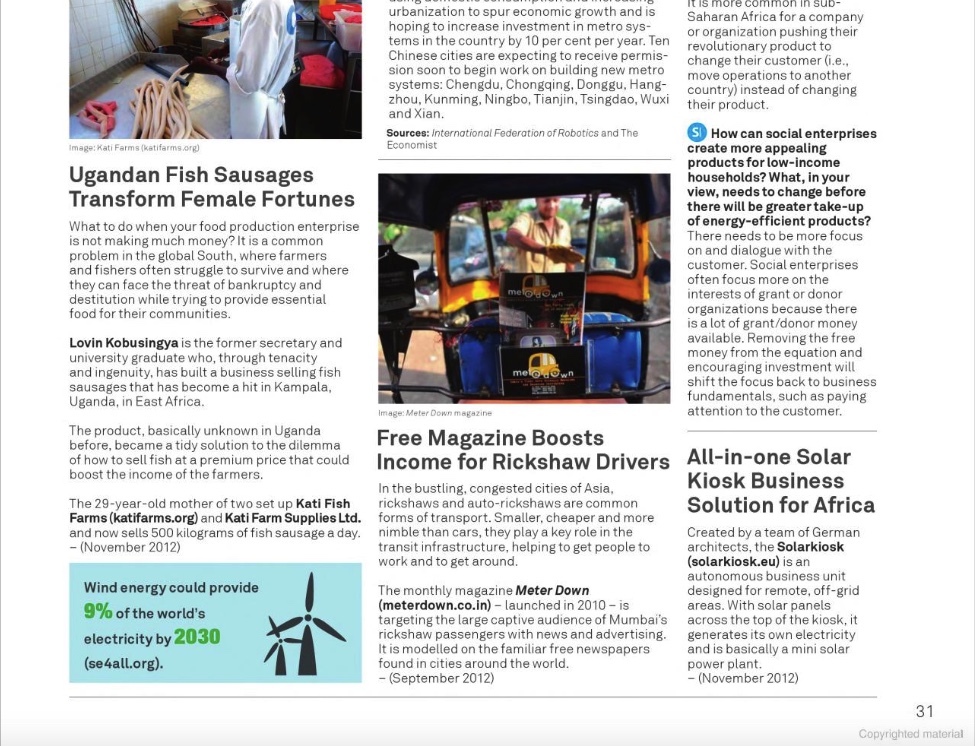
    The monthly magazine Meter Down (http://meterdown.co.in/) – launched in 2010 – is targeting the large captive audience of Mumbai’s rickshaw passengers with news and advertising. It is modelled on the familiar free newspapers found in cities around the world. Usually, these newspapers are distributed at subway and metro stations or in metal boxes at bus stops. Meter Down takes a different twist on this concept, distributing the publication directly to rickshaw passengers.

    Mumbai is a crowded and very busy Indian city with an estimated 14 million people. Many residents spend a lot of time commuting – and a lot of time stuck in traffic jams. They need something to occupy them and to keep them informed about the news. This also presents a significant opportunity for businesses to communicate messages and advertising products and services.

    Founded by three university graduates, Meter Down is trying to reach young professionals with a bit of money who can afford to ride to work in auto rickshaws.

    It is distributed through 7,000 auto rickshaws in Mumbai, according to The Guardian newspaper, and is also being distributed in Pune and Ahmedabad.

    The clever bit is the incentive for the drivers to carry the magazine: they receive 35 to 40 per cent of the profit from advertising sales.

    This is added to the 400 to 500 rupees they make in a normal shift, according to the Mumbai Autorickshawmen’s Union.

    But isn’t it a challenge to read a printed publication while bouncing along the road? The publishers came up with a solution: no story is to be longer than 300 words and the magazine has many large-size photographs to make it visually appealing and easy on the eye. Then there is the issue of passengers leaving with a copy of the magazine, denying the next passenger their read. The solution they came up for this is to tie the magazine to the rickshaw.

    One of the biggest problems for any new start-up publication is how to scale up and reach more readers. Meter Down cleverly has the mechanism to scale built into its business model: “The market for this is as big as the total number of auto-rickshaws in each city,” Dedhia told The Guardian. “We have successfully scaled the model and tweak it as per different specific needs. Since auto-rickshaws are present in every part of the country, we can expand the network everywhere.”

    Meter Down’s founders estimate that each rickshaw makes 90 to 95 trips every day. They have calculated this leads to a potential readership of 600,000 people. To increase revenue sources, the magazine also sells advertising space on the back and inside of the rickshaws.

    For people in wealthier countries, rickshaws may seem like a rough way to get to work, but they are actually, for Indians, the more expensive option. A three-mile ride in Mumbai costs 68 rupees (US $1.27), according to The Guardian, which is 10 times the cost of a second-class train ticket.

    For Meter Down, this means targeting the magazine and the ads at a market of readers with money and a willingness to buy products and services. It looks like things could be on the up for Meter Down!

    Published: September 2012

    Resources

    1) Sustainable Urban Transport in India: Role of the Auto-Rickshaw Sector.
    Website: http://www.embarq.org/en/sustainable-urban-transport-india-role-auto-rickshaw-sector 

    2) A fleet of auto rickshaws for sale from Bajaj. Website: http://www.bajajauto.com/commercial_vehicle.asp

    Development Challenges, South-South Solutions was launched as an e-newsletter in 2006 by UNDP’s South-South Cooperation Unit (now the United Nations Office for South-South Cooperation) based in New York, USA. It led on profiling the rise of the global South as an economic powerhouse and was one of the first regular publications to champion the global South’s innovators, entrepreneurs, and pioneers. It tracked the key trends that are now so profoundly reshaping how development is seen and done. This includes the rapid take-up of mobile phones and information technology in the global South (as profiled in the first issue of magazine Southern Innovator), the move to becoming a majority urban world, a growing global innovator culture, and the plethora of solutions being developed in the global South to tackle its problems and improve living conditions and boost human development. The success of the e-newsletter led to the launch of the magazine Southern Innovator. 
    Creative Commons License

    This work is licensed under a
    Creative Commons Attribution-Noncommercial-No Derivative Works 3.0 License.

    ORCID iD: https://orcid.org/0000-0001-5311-1052.

    © David South Consulting 2023

  • Rickshaw Drivers Prosper with New Services

    Rickshaw Drivers Prosper with New Services

    By David SouthDevelopment Challenges, South-South Solutions

    SOUTH-SOUTH CASE STUDY

    The rickshaw is the world’s oldest form of wheeled transportation and forms a significant part of India’s transport infrastructure. In large cities across Asia, 1 million three-wheeled auto-rickshaws form an important means of daily transportation and a vital source of income for their drivers. There are 8 million cycle rickshaws on the streets of India, the government says. They perform many tasks: as taxis, as couriers, as goods movers. And the Indian government promotes cycle rickshaws as a non-polluting alternative.

    But rickshaw drivers in India struggle with a bad image despite being a critical component of the transport infrastructure. They work 12 to 18 hour days, are paid poorly, and are subject to frequent abuse from passengers and other drivers in the crowded and stressful streets.

    Many of the men working as rickshaw drivers have left behind families in villages. Because their main home is elsewhere, many just eat, sleep and live next to the roadside.

    An innovative company is taking this important service into the 21st century, and in turn boosting income and benefits for the drivers and restoring their dignity. Based in Delhi, Sammaan (www.sammaan.org), meaning dignity, has developed a sophisticated business model that offers a wide range of services to rickshaw passengers – drinks for sale, mobile phone chargers, courier collections, music, magazines/newspapers, first aid and outdoor advertising and marketing – along with professional treatment of the drivers, providing them with a uniform, identity card, bank accounts, profit sharing and insurance. The drivers pay a small maintenance fee of 10 rupees a day (US 20 cents) for renting the rickshaws. It is common in the rickshaw industry in India for drivers to rent their vehicles on a daily basis – 95 percent do so.

    Drivers get the full fare from a ride, while they share the profits from the sales of goods with Sammaan (http://uk.youtube.com/watch?v=yUuP16fyTjM).

    Sammaan’s founder, 27-year-old Irfan Alam, from the Indian state of Bihar, had the inspiration for his business idea when he was thirsty and riding in a rickshaw. He knew the rickshaw driver made very little money after he paid his rent for the rickshaw. And so he thought about how drivers could increase their income. Why couldn’t they sell drinks, or newspapers or mobile phone cards, he thought?

    As well, since they travel more than 6 miles a day on average, why not deliver things and host advertisements on the rickshaws?

    Sammaan’s idea is to fully modernize the rickshaw business: an important goal considering it makes up 30 percent of urban transport in India. By turning rickshaws into mobile advertising and marketing vehicles, income is substantially increased, while offering services builds loyalty from passengers.

    In order to improve the quality of life for drivers, Sammaan also offers free evening classes for the drivers and their children.

    Sammaan’s rickshaws are custom designed to allow for ample space to display the paid-for advertisements. This has proved a highly competitive way to do outdoor advertisements: it is 90 percent cheaper than advertising billboards and other campaigns. The fact the rickshaws go everywhere – from urban back streets to rural areas – makes it an effective way to reach all corners of India.

    The rickshaws for the passengers are no more expensive than rickshaws with no services. And passengers are even covered by insurance if there is an accident.

    Sammaan currently has hundreds of rickshaws running in Noida, Ghaziabad , Patna , Agra , Meerut , Gurgaon and Chandigarh .

    The company also is planning to offer phone services in the rickshaws and the ability to pay utility bills while riding inside.

    “We are also in advanced talks with Zandu Pharmaceuticals, Coca Cola and Dabur, and are hopeful of getting advertising contracts from them,” Alam told The Economist magazine. Sammaan expects to make Rs 10,000 to 15,000 (US $204 to US $307) a year from a single rickshaw.
    Alam is part of a new breed in India: he is not from an established business family, but is nonetheless well educated. Many educated Indians are turning to entrepreneurship instead of becoming a corporate drone in a big company. This is being called a revolution in middle-class aspirations.

    India has long-standing entrepreneurial traditions: merchant community the Marwari baniyas (http://en.wikipedia.org/wiki/Marwaris) are famed for their business acumen. But the new entrepreneurs have different aspirations and inspirations. They look to technology pioneers like Infosys (http://www.infosys.com/) and hire people based on merit and professionalism, not family connections.

    The hot areas for this new breed of entrepreneur are technology, entertainment, human resources and education.

    Alam’s rickshaws are made out of fiberglass for tourist towns with paved roads, and a rugged version out of iron for places with poor road conditions.

    Another initiative to modernize the rickshaw business has come from India’s Centre for Scientific and Industrial Research (CSIR) (http://www.csir.res.in/), which has developed a state-of-the-art, solar powered version of the humble cycle-rickshaw.

    The “soleckshaw” is a motorized cycle rickshaw that can be pedalled normally or run on a 36-volt solar battery.

    The makeover includes FM radios and power points for charging mobile phones during rides.

    The “soleckshaw,” which has a top speed of 15 kilometres (9.3 miles) per hour, has a sturdier frame and foam seats for up to three people.

    The fully-charged solar battery will power the rickshaw for 50 to 70 kilometres (30 to 42 miles). Used batteries can be deposited at a centralized solar-powered charging station and replaced for a nominal fee.

    Published: January 2009

    Resources

    • India’s National Entrepreneurship Network (NEN) promotes the spirit of enterprise on the country’s campuses and has a contest to pick the top 30 Indian hot start-ups. Website: http://www.nenonline.org/
    • Indian venture capital firm Helion Ventures invests in start-ups. Website: www.helionvc.com
    • TATA NEN Hottest Startups — India’s first ever people’s choice awards. Hottest Startups will identify, showcase and support the highest-potential young companies in India. Websitehttp://www.hotteststartups.in/http://www.hotteststartups.in/shortlistedStartupsHome.do?        method=fetch&businessFn=shortlistedStartupsHome
    • Tukshop is a website selling auto rickshaws and tuk-tuks. Website: http://www.tukshop.biz/
    • A wide range of auto rickshaws for sale. Website: http://www.auto-rickshaw.com/
    • The Hybrid Tuk Tuk Battle is a competition to come up with less polluting auto rickshaws, clean up the air in Asian cities, and improve the economic conditions for auto rickshaw drivers. Website: http://hybridtuktuk.com/

    Citations:

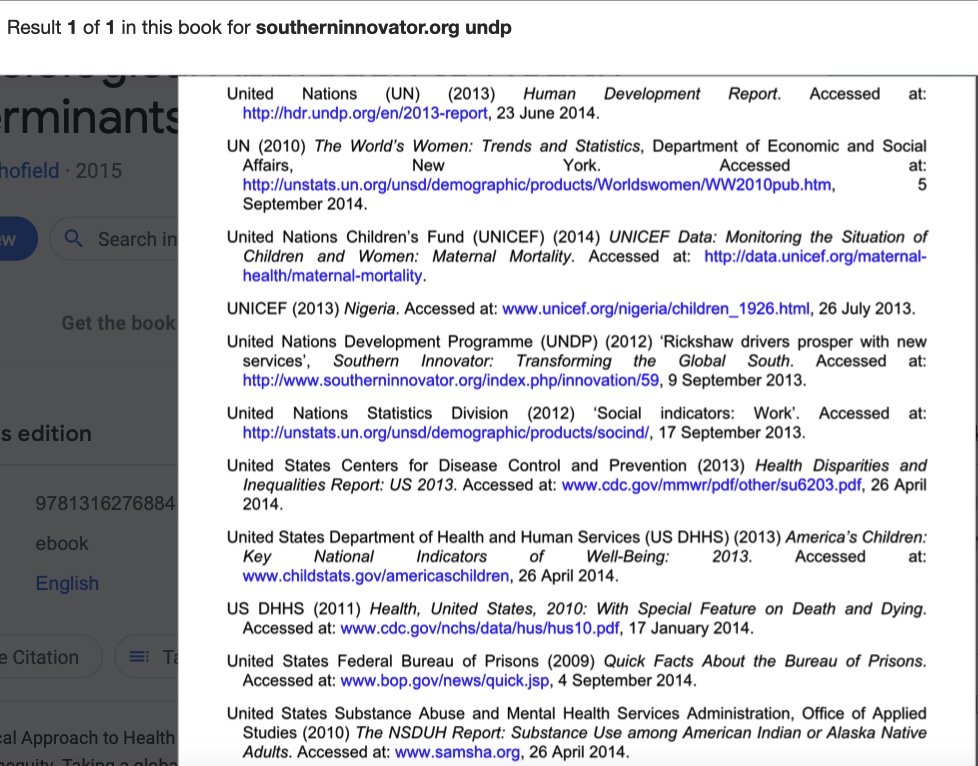
    As cited in A Sociological Approach to Health Determinants by Toni Schofield (2015).

    https://davidsouthconsulting.org/2022/11/21/asia/

    https://davidsouthconsulting.org/2022/09/29/cheap-indian-tablet-seeks-to-bridge-digital-divide/

    https://davidsouthconsulting.org/2022/02/17/digital-mapping-to-put-slums-on-the-map/

    https://davidsouthconsulting.org/2022/10/20/the-e-reader-battle-reaches-india/

    https://davidsouthconsulting.org/2022/10/09/entrepreneurs-use-mobiles-and-it-to-tackle-indian-traffic-gridlock/

    https://davidsouthconsulting.org/2022/10/12/free-magazine-boosts-income-for-rickshaw-drivers/

    https://davidsouthconsulting.org/2022/06/10/illiterate-get-internet-at-touch-of-a-button/

    https://davidsouthconsulting.org/2022/09/27/india-2-0-can-the-country-make-the-move-to-the-next-level/

    https://davidsouthconsulting.org/2022/10/25/indian-city-slum-areas-become-newly-desirable-places-to-live/

    https://davidsouthconsulting.org/2021/03/04/indian-id-project-is-foundation-for-future-economic-progress/

    https://davidsouthconsulting.org/2022/06/15/indian-mobile-phone-application-innovators-empower-citizens/

    https://davidsouthconsulting.org/2022/11/01/indian-newspapers-thrive-with-economy/

    https://davidsouthconsulting.org/2022/10/06/indian-solar-power-pack-powers-villages/

    https://davidsouthconsulting.org/2022/10/18/indians-fighting-inflation-with-technology/

    https://davidsouthconsulting.org/2022/06/10/info-ladies-and-question-boxes-reaching-out-to-the-poor/

    https://davidsouthconsulting.org/2022/03/29/model-city-to-test-the-new-urbanism-concept-in-india/

    https://davidsouthconsulting.org/2022/10/09/a-new-mobile-phone-aimed-at-the-poor/

    https://davidsouthconsulting.org/2021/03/31/new-weapon-against-crime-in-the-south/

    Development Challenges, South-South Solutions was launched as an e-newsletter in 2006 by UNDP’s South-South Cooperation Unit (now the United Nations Office for South-South Cooperation) based in New York, USA. It led on profiling the rise of the global South as an economic powerhouse and was one of the first regular publications to champion the global South’s innovators, entrepreneurs, and pioneers. It tracked the key trends that are now so profoundly reshaping how development is seen and done. This includes the rapid take-up of mobile phones and information technology in the global South (as profiled in the first issue of magazine Southern Innovator), the move to becoming a majority urban world, a growing global innovator culture, and the plethora of solutions being developed in the global South to tackle its problems and improve living conditions and boost human development. The success of the e-newsletter led to the launch of the magazine Southern Innovator. 
    Creative Commons License

    This work is licensed under a
    Creative Commons Attribution-Noncommercial-No Derivative Works 3.0 License.

    ORCID iD: https://orcid.org/0000-0001-5311-1052.

    © David South Consulting 2023