Tag: SDG11

  • Brewing Prosperity Creates Good Jobs

    Brewing Prosperity Creates Good Jobs

    By David SouthDevelopment Challenges, South-South Solutions

    SOUTH-SOUTH CASE STUDY

    In the Democratic Republic of Congo – home to the world’s largest United Nations peacekeeping mission and decades of bloody civil war – a brewery has not only survived, it has thrived to become a popular brand throughout central Africa. By being a success, the Brasimba brewery has brought prosperity and high-quality jobs to Congo’s second largest city, Lubumbashi (http://en.wikipedia.org/wiki/Lubumbashi), and proven that a modern business can do well there despite the obstacles.

    The Brasimba brewery has an ultra-modern factory (http://www.viddler.com/explore/kaysha/videos/298/) complete with high-tech laboratories to constantly test the quality of the beer. It employs 700 people – most of whom are Congolese – and produces 250,000 bottles of Simba beer every day, according to Monocle magazine. The company’s beer brands are Simba Biere du Lion and Tembo Biere and its slogan is a proud Notre Biere (Our Beer).

    Lubumbashi is a city described by the BBC as without “child beggars, without potholes and where there are no festering mounds of rubbish.”

    A study of the economic impact of breweries in Uganda and Honduras found that more than 100 local jobs, from farmers to truck drivers, depended on every person employed by a brewery (http://www.inclusivebusiness.org/2009/10/sabmiller-impact-assessment.html). Markets across the South are seen as growth areas for beer companies: China’s beer consumers now outnumber those in the U.S. By 2003, world sales of beer reached 148 billion hectolitres (Euromonitor). Overall, it is forecast that global beer consumption will rise by 3.5 percent by 2015, mostly in the South.

    Apart from creating steady employment, breweries also help to improve the development of the advertising and marketing businesses of a community as they promote their various brands, and they support local activities like sport with team sponsorship. They also offer a local example of how to run a modern beverage business, with mechanized production, distribution systems and laboratories to ensure hygiene and quality standards are maintained.

    Brasimba has been operating in Lubumbashi for eight decades, through the twists and turns of the country’s history. The city has prospered from its copper mines and wisely used that wealth to improve the city’s general prosperity.

    The brewery has successfully become a regional favourite, producing beer that is drunk not only in the surrounding Katanga province, but also in Zimbabwe and Zambia. It’s an impressive accomplishment for a company operating in such a turbulent environment. Distribution of the beer by truck is not easy, with the trip taking between six days and two weeks depending on the weather and the condition of the roads.

    And the beer is not cheap, at around US $1.48 for a big bottle — a sure sign there is money to be made.

    The healthy economic environment has also spawned a beer war with rivals Bralima, owned by the multinational Heineken. With five breweries in Congo and its head office in the capital Kinshasa, Heineken claims the lessons it has learned in Congo are helping it to change its marketing and business strategies far away in the United States.

    It recently transferred its commercial director of Congo operations to head up operations in the United States. Heineken Chief Executive Officer Jean-Francois van Boxmeer told the Bloomberg news agency that working in Africa was “certainly worth three times Harvard Business School.”

    Heineken’s market share doubled in the Democratic Republic of Congo in just four years and Africa has become a significant market for the brewer.

    Published: December 2009

    Resources

    • Small businesses looking to develop their brand can find plenty of free advice and resources here: Website: http://www.brandingstrategyinsider.com
    • A Brandchannel: The world’s only online exchange about branding, packed with resources, debates and contacts to help businesses intelligently build their brand. Website: http://www.brandchannel.com
    • Just Food is a web portal packed with the latest news on the global food industry and packed with events and special briefings to fill entrepreneurs in on the difficult issues and constantly shifting market demands. Website: http://www.just-food.com

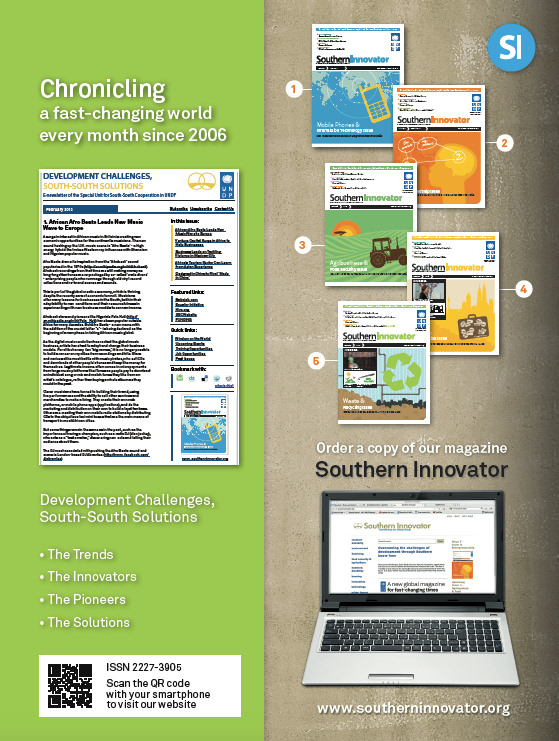
    Development Challenges, South-South Solutions was launched as an e-newsletter in 2006 by UNDP’s South-South Cooperation Unit (now the United Nations Office for South-South Cooperation) based in New York, USA. It led on profiling the rise of the global South as an economic powerhouse and was one of the first regular publications to champion the global South’s innovators, entrepreneurs, and pioneers. It tracked the key trends that are now so profoundly reshaping how development is seen and done. This includes the rapid take-up of mobile phones and information technology in the global South (as profiled in the first issue of magazine Southern Innovator), the move to becoming a majority urban world, a growing global innovator culture, and the plethora of solutions being developed in the global South to tackle its problems and improve living conditions and boost human development. The success of the e-newsletter led to the launch of the magazine Southern Innovator. 

    Creative Commons License

    This work is licensed under a
    Creative Commons Attribution-Noncommercial-No Derivative Works 3.0 License.

    ORCID iD: https://orcid.org/0000-0001-5311-1052.

    © David South Consulting 2023

  • Chinese Building Solution for Rapidly Urbanizing Global South

    Chinese Building Solution for Rapidly Urbanizing Global South

    By David SouthDevelopment Challenges, South-South Solutions

    SOUTH-SOUTH CASE STUDY

    The global South is currently experiencing the biggest surge in urban population ever seen in human history. This transformation from urban to rural is happening in many different ways across the global South. Some countries have highly detailed plans and are building new cities from scratch, while other countries feel overwhelmed by their booming urban populations.

    By 2025, it is estimated the developing world could become home to 37 megacities with more than 10 million residents (http://en.wikipedia.org/wiki/Megacity) (The Guardian). Sixty years ago there were just two megacities: New York and Tokyo. Today, there are between 21 and 23, and the UN is forecasting that by 2025 Asia will have nine new megacities. By 2025, the majority of the world’s megacities will be in the global South.

    But how will these cities be built? How will they use resources well and ensure the rapidly rising new buildings are safe and healthy?

    A Chinese innovator and Internet sensation has developed a way to rapidly build high-density, high-rise structures that are also safe and meet strict earthquake-proofing standards. Building upwards is an efficient way to get more use out of space and to free up land for things like parks.

    Just as the first megacities such as New York began building skyscrapers a century ago, going upwards will be the solution many of the new megacities will choose as they feel the pressing twin demands of rising populations and financial restraints.

    Based in Changsha, China (http://en.wikipedia.org/wiki/Changsha), the BROAD Group
    (http://www.broad.com/) (http://www.broad.com:8089/english/) has become an Internet sensation for posting videos of it rapidly building skyscrapers. It does this to show off its innovative technologies, which have significantly reduced the time it takes to build high-rise buildings.

    The BROAD Group calls itself “an enterprise based on the vision of unique technologies and the philosophy of preserving life.”

    The company is a pioneer in making non-electric air conditioning equipment, energy systems, and sustainable building technology.

    The company has come a long way since it was started in 1988 with just US $3,000. By 1995, it had shed its debts and loans. It sees its mission as confronting the two major crises facing the world today: atmospheric pollution and global warming. The company hopes to evolve into a social enterprise.

    BROAD calls itself a world leader in making central air conditioning powered by natural gas and waste heat (http://en.wikipedia.org/wiki/Broad_Group). The company is currently exporting its systems to more than 60 countries and was an official supplier to the 2010 Shanghai Expo.

    BROAD has recently been expanding its product range and moving into constructing sustainable buildings. In particular it is developing an expertise in rapid construction techniques. This is important in the modern world as cities across the global South experience population growth and the pressing need to house people and create workplaces efficiently. BROAD is proud of the 15-storey hotel in Dongting Lake in Hunan Province it built in just six days, which became a hit on YouTube (http://www.youtube.com/watch?v=sjGhHl-W8Wg). After this achievement, BROAD constructed a 30-storey hotel in 15 days.

    Part of the BROAD Group, Broad Sustainable Building (BSB) claims to make the “World’s first factory-made building.” BROAD says its buildings are sustainable because they efficiently use recycled construction materials, rely on materials free of formaldehyde, lead, radiation and asbestos and avoid “construction sewage” dust or waste.

    BROAD was provoked into making sustainable buildings after the Wenchuan Earthquake in 2008 (http://quake.mit.edu/~changli/wenchuan.html). A year after the earthquake, 300 researchers from BROAD developed an earthquake-resistant building technology.

    The factory-made building works like this: a “main board” is prepared with a floor and ceiling, ventilation, water supply and drainage, electricity and lighting. This is then placed on a truck and taken to the building site. All the workers need to do on site is assemble the building by screwing in the bolts and finishing it with the painting and other decorating. This makes the time spent assembling the building on site, according to BROAD, just 7 per cent of the total construction hours. This means 93 per cent of the building is prefabricated in a factory compared to an industry norm of 40 per cent.

    BROAD’s latest project and biggest challenge is to build Sky City One (http://skycityone.wordpress.com/) – the world’s tallest tower at 220 floors and 838 metres – in Changsha in just 90 days. A mix of residential, commercial and retail space, it will allow between 70,000 and 120,000 people to work and live. The start date could be November 2012 and the building completed by early 2013.

    The finished building will be 10 metres taller than the current tallest tower, the Burj Khalifa (http://www.burjkhalifa.ae/) in Dubai.

    Published: October 2012

    Resources

    1) 20th Century World Architecture: The Phaidon Atlas by The Phaidon Editors, Publisher: Phaidon. Focusing on 750 of the most outstanding works built between 1900 and 1999, the book features every imaginable building type. Website: http://uk.phaidon.com/store/ 

    2) Megacities Foundation: The Megacities initiative originates from the awareness of the future role of cities as the dominant type of settlement for humanity. Cities will play this role not just as a matter of fact but out of necessity as the only way of housing the world’s increasing population. Website: http://megacities.nl/ 

    3) Andrew Marr’s Megacities: A BBC series exploring the rise of the megacities and what life will be like for their residents. Website: http://www.bbc.co.uk/programmes/b011ql6k 

    4) The Rise of Megacities Interactive: An online resource on the world’s rising megacities. Website: http://www.guardian.co.uk/global-development/interactive/2012/oct/04/rise-of-megacities-interactive

    https://davidsouthconsulting.org/2022/10/26/african-trade-hub-in-china-brings-mutual-profits-2/

    https://davidsouthconsulting.org/2021/12/20/better-by-design-in-china/

    https://davidsouthconsulting.org/2022/10/20/china-consumer-market-asian-perspective-helps/

    https://davidsouthconsulting.org/2020/04/25/china-looking-to-lead-on-robot-innovation/

    https://davidsouthconsulting.org/2020/04/25/china-pushing-frontiers-of-medical-research/

    https://davidsouthconsulting.org/2020/12/10/china-sets-sights-on-dominating-global-smartphone-market/

    https://davidsouthconsulting.org/2022/10/04/chinas-booming-wine-market-can-boost-south/

    https://davidsouthconsulting.org/2020/04/29/chinas-outsourced-airliner-development-model/

    https://davidsouthconsulting.org/2021/01/25/creating-green-fashion-in-china/

    https://davidsouthconsulting.org/2021/01/26/designed-in-china-to-rival-made-in-china/

    https://davidsouthconsulting.org/2021/07/19/global-south-trade-boosted-with-increasing-china-africa-trade-in-2013/

    https://davidsouthconsulting.org/2021/02/12/rammed-earth-houses-china-shows-how-to-improve-and-respect-traditional-homes/

    https://davidsouthconsulting.org/2022/10/26/tackling-chinas-air-pollution-crisis-an-innovative-solution/

    https://davidsouthconsulting.org/2020/04/17/virtual-supermarket-shopping-takes-off-in-china/

    Development Challenges, South-South Solutions was launched as an e-newsletter in 2006 by UNDP’s South-South Cooperation Unit (now the United Nations Office for South-South Cooperation) based in New York, USA. It led on profiling the rise of the global South as an economic powerhouse and was one of the first regular publications to champion the global South’s innovators, entrepreneurs, and pioneers. It tracked the key trends that are now so profoundly reshaping how development is seen and done. This includes the rapid take-up of mobile phones and information technology in the global South (as profiled in the first issue of magazine Southern Innovator), the move to becoming a majority urban world, a growing global innovator culture, and the plethora of solutions being developed in the global South to tackle its problems and improve living conditions and boost human development. The success of the e-newsletter led to the launch of the magazine Southern Innovator. 

    Creative Commons License

    This work is licensed under a
    Creative Commons Attribution-Noncommercial-No Derivative Works 3.0 License.

    ORCID iD: https://orcid.org/0000-0001-5311-1052.

    © David South Consulting 2023

  • Indian Initiatives to Make Travel Safer for Women

    Indian Initiatives to Make Travel Safer for Women

    By David SouthDevelopment Challenges, South-South Solutions

    SOUTH-SOUTH CASE STUDY

    Shocking assaults on women traveling in India have galvanized innovators to find solutions. One solution that is proving successful is to establish specialist taxi services for women. As a happy additional benefit, these taxi innovators are transforming the taxi experience, introducing more ethical practices such as honest fares, professional and safe driving habits and clean, hygienic and comfortable taxis.

    With sexual harassment levels high and several shocking assaults and rapes of women in Indian cities grabbing global media attention, Indian women are now being offered a variety of women-driver-only taxi services to ensure they get to work and home again safely.

    As well as offering their passengers security, these companies are also redefining the taxi experience with innovation. As travelers know, the taxi experience in many cities can be frustrating, fraught with scams, rip-offs, disputes over fares, unhygienic taxi interiors and poor driving skills. These pioneering women-only taxi companies are trying to show there is another way: that taxis can be clean, meters honest and driving safe and sound.

    Security for women has come into the media spotlight in India after a series of high-profile attacks and sexual assaults. The country is undergoing major economic and social change as it modernizes and urbanizes. Women are seeing their incomes and their role in the economy increase.

    This brings both opportunities and risks. Women who would have only lived and worked in a small geographical area, and generally associated only with their family or a small village, are now mobile and in contact with the busy urban environments of megacities awash with strangers.

    One woman is raped every 20 minutes in India, according to the National Crime Records Bureau. But police estimate only four out of 10 rapes are reported, largely due to victims’ fear of being shamed by their families and communities. At the beginning of March 2013, a campaign to raise awareness on women’s safety was launched in Delhi to chime with International Women’s Day. The UN also confirmed in March 2013 a global strategy to combat violence against women (http://www.un.org/womenwatch/daw/csw/57sess.htm).

    One champion of safer transport for women in India is Revathi Roy, a rally car driver and entrepreneur. She started a women-only taxi company in Mumbai called Forsche in 2007 out of raw economic need, and to solve a problem.

    “I am a very fussy passenger and I would get upset that the seat was not comfortable, or the driver was driving too rashly for my liking,” Roy told BBC News.

    “I would also find it irritating that some drivers would stare at me from their rear-view mirror and one day, I just decided I had had enough.”

    Forsche – pronounced “for she” – a play on the German car maker Porsche’s name – was one of the pioneers in bringing all-women taxi services to India. Their drivers’ uniform came in pink and purple with a purple scarf worn around the neck.

    However, Roy parted ways with her previous business partner and set up Viira Cabs (viiracabs.com/) in 2011. Viira means ‘courageous woman’ according to Roy.

    Roy hopes passengers from young girls to senior citizens will feel safer and more confident knowing a woman is the driver.

    “The attitude of Indian mothers is changing,” she said. “Now they know their daughters go out and drink. They realize they may as well keep them safe by putting them in the hands of a woman who at all times is playing the role of a mother or a sister.  A man can’t be a woman. And just because a woman is sitting at the wheel she doesn’t become a man.”

    The company has 20 taxis and 25 drivers. It uses a fleet of Maruti Eecos (http://marutisuzukieeco.in/), a mini van made by Suzuki capable of carrying four adult passengers and their luggage. Viira also seeks to improve driving standards on Mumbai’s roads by setting a good example with safe, defensive driving techniques.

    A pioneer of female taxi drivers in India, Roy is now the Mentor and Chief Driving Officer for Viira Cabs. According to the company’s website, she is looking to train thousands of women to be able to make their livelihood as a taxi driver.

    “Driving is still very male dominated and in Mumbai where most people travel by public transport, there are very few women with driving licenses,” she explained.

    “Viira is a very powerful platform for poor, urban women who are now able to earn up to Rs 12,000 a month (US $222),” Roy told CNN.

    Viira’s drivers wear a professional uniform of a peaked cap, white short sleeved shirt with blue trim, and a plastic identification badge on a blue lanyard. This makes it clear from the start to passengers who is driving them.

    The service runs 24 hours a day, seven day a week, and journeys are dispatched from the company’s call centre. To keep the service safe as can be, all vehicles are monitored by GPS (global positioning system) and a panic alert system. The drivers receive self-defence and defensive-driving training so they can elude any dangers while on the road. They also know how to handle roadside emergencies and are backed up by 24/7 support from the call centre.

    The taxis follow the standard charges set down by the Mumbai region. By using mini-vans, passengers are able to enjoy a comfortable and roomy ride in air conditioned comfort – a big plus in a hot country. The vans run on CNG (compressed natural gas) (http://en.wikipedia.org/wiki/Compressed_natural_gas), reducing pollution.

    To add even more value to the journey experience, the taxis feature live television and Internet web surfing using something called Tabbie TM (Tablet in a Cab), a 10-inch-wide computer tablet.

    In addition to the taxi service, the Viira Motor Training School offers driver training to women with low incomes. Its 12-week program covers all the main areas of taxi-driving skills – driving theory, mechanics, customer service, health and safety and self-defence – but also goes to the next level and gives the students training on a vehicle-driving simulator donated by the Suzuki company.

    Roy said she hopes to expand the business from Mumbai to smaller urban areas “where Indian women are most starved of opportunities.”

    Long-term, she wants to become “India’s premier chauffeur and fleet service.”

    Roy’s success with these companies led to the founding of the social enterprise Sakh Consulting Wings (http://sakhaconsultingwings.com/about-us.php) to support establishing similar services in other Indian cities.

    Sakha Consulting Wings is partnered with the Azad Foundation to promote taxi driving as a viable career for women from poor backgrounds.

    Super Cabz in Delhi (http://www.supercabz.com/women-friendly-cab-service-delhi-ncr.php) is another service aimed at women. It has innovations such as panic buttons in the back seats of the cabs and mobilizers to allow the central call centre to shut the cab’s engine down in an emergency. There is also a GPS monitoring and tracking system to keep tabs on the cabs as they go about the city.

    Published: May 2013

    Resources

    1) South Africa’s Cabs for Women. Website: cabsforwomen.co.za/

    2) India Taxi Auto Fare: “A unique service that calculates your taxi fare and auto fares; before you start your travel! You also get an exact, to the scale Google Map that shows your route. Further, you can also change the default route to avoid traffic, plan for some shopping on the way or just pick up your date!” Website: http://www.taxiautofare.com/Default.aspx

    3) Merar: Merar was launched with the idea to create the best platform for investment providers and seekers from emerging markets. It has grown to become one of the largest online meeting places bringing together investors, entrepreneurs and investment intermediaries globally. Website: merar.com/

    4) Lavasa Womens Drive: Helps champion skilled women drivers in India. Website: http://www.lavasawomensdrive.com/selectcity1.html

    5) PeopleNet TABLET™: A powerful in-cab personal computer with a touch screen, stylus and screen keyboard. Website: peoplenetonline.com/tablet

    https://davidsouthconsulting.org/2022/11/22/bio-ethanol-from-sturdy-and-once-unwanted-indian-plant/

    https://davidsouthconsulting.org/2022/09/29/cheap-indian-tablet-seeks-to-bridge-digital-divide/

    https://davidsouthconsulting.org/2022/10/09/entrepreneurs-use-mobiles-and-it-to-tackle-indian-traffic-gridlock/

    https://davidsouthconsulting.org/2021/08/29/indian-business-model-makes-green-energy-affordable/

    https://davidsouthconsulting.org/2022/10/25/indian-city-slum-areas-become-newly-desirable-places-to-live/

    https://davidsouthconsulting.org/2021/08/28/indian-entrepreneur-brings-dignity-to-poor-women/

    https://davidsouthconsulting.org/2021/03/04/indian-id-project-is-foundation-for-future-economic-progress/

    https://davidsouthconsulting.org/2022/06/15/indian-mobile-phone-application-innovators-empower-citizens/

    https://davidsouthconsulting.org/2022/11/01/indian-newspapers-thrive-with-economy/

    https://davidsouthconsulting.org/2022/10/06/indian-solar-economy-brings-new-vocation-for-women/

    https://davidsouthconsulting.org/2022/10/06/indian-solar-power-pack-powers-villages/

    https://davidsouthconsulting.org/2022/10/25/indian-toilet-pioneer-champions-good-ideas/

    https://davidsouthconsulting.org/2022/10/18/indians-fighting-inflation-with-technology/

    https://davidsouthconsulting.org/2020/12/04/model-indian-villages-to-keep-rural-relevant/

    Southern Innovator logo

    London Edit

    31 July 2013

    Development Challenges, South-South Solutions was launched as an e-newsletter in 2006 by UNDP’s South-South Cooperation Unit (now the United Nations Office for South-South Cooperation) based in New York, USA. It led on profiling the rise of the global South as an economic powerhouse and was one of the first regular publications to champion the global South’s innovators, entrepreneurs, and pioneers. It tracked the key trends that are now so profoundly reshaping how development is seen and done. This includes the rapid take-up of mobile phones and information technology in the global South (as profiled in the first issue of magazine Southern Innovator), the move to becoming a majority urban world, a growing global innovator culture, and the plethora of solutions being developed in the global South to tackle its problems and improve living conditions and boost human development. The success of the e-newsletter led to the launch of the magazine Southern Innovator. 

    https://davidsouthconsulting.org/2021/03/05/southern-innovator-issue-1/

    Creative Commons License

    This work is licensed under a
    Creative Commons Attribution-Noncommercial-No Derivative Works 3.0 License.

    ORCID iD: https://orcid.org/0000-0001-5311-1052.

    © David South Consulting 2023

  • East Africa to get its First Dedicated Technology City

    East Africa to get its First Dedicated Technology City

    By David SouthDevelopment Challenges, South-South Solutions

    SOUTH-SOUTH CASE STUDY

    An ambitious scheme is underway to create a vast technology city on the outskirts of Nairobi, Kenya.

    With information technology proliferating across Africa after decades of stagnation and underinvestment, a host of exciting new technologies have had to exist within structures not built for the 21st century.

    One attempt to change things is Konza Technology City (konzacity.co.ke), an ambitious project that aims to build the infrastructure to host the companies of the 21st century for Kenya and East Africa. Konza Technology City joins a growing network of technology cities and parks across the global South. If the links between these centres of technological innovation and smart thinking can be strengthened, they have the potential to contribute to exceptional gains in human development.

    Konza Technology City will be built on 5,000 acres (2,023 hectares) of land 60 kilometres south of Kenya’s capital, Nairobi.

    The lead agency on the US $10 billion project is the Ministry of Information and Communication (http://www.information.go.ke/). The Kenyan government is seeking partners and investors to help with funding the project, whose components include a business process outsourcing (BPO) (http://en.wikipedia.org/wiki/Business_process_outsourcing) zone – where specific business functions are contracted to third party providers. There is also a financial district and a commercial district with office space.

    This will be combined with the other side of Konza: hotels, hospitals, a sports stadium and other support services necessary to support a city. The idea is to develop the site over a period of 20 years, with the BPO and IT Educational and Science Park taking up 23 per cent of the site.

    Kenya plans to expand its business process outsourcing sector and has been hosting conferences in Europe to gather the best advice. The sector has experienced double-digit growth in the past three years, rising on the increasing capacity brought by new undersea cables like TEAMs, Seacom and EASSy.

    The idea is to put in place the building blocks of a 21st century Kenya and to become the leading hub for the whole of East Africa. Kenya has an ambitious plan to become a middle-income country by 2030 (http://www.vision2030.go.ke/).

    There is scepticism about large projects in Kenya, with some fearing they will be abandoned before they are finished. But it does seem this project has galvanized a wide community of support. According to IT Web’s (http://www.itweb.co.za/) Ken Macharia, opponents of the project make various arguments. People in the information and communication technologies sector would like to see greater local capacity in place before such massive investment in buildings goes ahead. Others oppose the idea of having a planned city and would like to see things evolve organically. Still others question the government’s capacity to undertake such an ambitious scheme.

    According to Macharia, the ‘if you build it, they will come’ argument is winning the day. The scope and ambition of the project has both excited many players within and outside government and focused their efforts.

    Macharia even believes the public sector is way ahead of the private sector.

    “The government is light years ahead in terms of the vision and drive of developing the ICT sector in the country, while the private sector is trying to catch up,” he said.

    Kenya will become the first country in the region to build a technology city. It can look to China for some examples. One is Shenzhen City and its Science and Technology Park (http://www.ship.gov.cn/en/index.asp?bianhao=20). Or Cairo, Egypt’s Smart Village (http://www.smart-villages.com/).

    Macharia also says the focus solely on technology is missing the bigger impact Konza can have.

    “The city’s concept has financial, educational, commercial and industrial implications, which have not been sold as aggressively as the tech aspect has. Perhaps the better name for the proposed city would be Konza Special Economic Zone, where the key pillars mutually benefit from each other’s presence. Technology, after all, is a means to an end, not the end itself.”

    The timing for a place like Konza City is excellent: undersea cables are being placed around and to Africa. The continent was notorious for being the most underserved continent on the planet and is in a furious transition from this information technology wasteland to a potential oasis of prosperity.

    The undersea cable projects are promising a bandwidth explosion for the continent of Africa. The WACS cable (http://wacscable.com/index.jsp) is being put in place to link South Africa and Britain, and is due to be completed in 2012. It runs up the West Coast of Africa and will become the first direct connection to the undersea cable network for Namibia, the Congo and Togo.

    It will increase South Africa’s bandwidth by an estimated 23 per cent.

    Various technology investors, including the search engine giant Google, are also planning to build an undersea cable linking the so-called BRICS countries by 2014 – Brazil, Russia, India, China and South Africa. The cable will also link them all to the United States. The technology group i3 Africa is leading the project (http://www.i3-mea.com/africa/), which should open up 21 additional African countries to the world’s undersea cable network.

    Konza Technology City could make Kenya a significant beneficiary of all this new connectivity and bandwidth.

    Published: July 2012

    Resources

    1) Center for Innovation Testing and Evaluation: CITE will represent a 20th century American city with a population of approximately 35,000 people and be built on roughly 15 square miles. CITE’s test city will be unpopulated. CITE will be a catalyst for the acceleration of research into applied, market-ready products by providing “end to end” testing and evaluation of emerging technologies and innovations from the world’s public laboratories, universities and the private sector. Website: http://www.cite-city.com/index.php

    2) Dubai Internet City: Since its official opening in 2000, Dubai Internet City (DIC) has grown to become the Middle East and North Africa’s largest Information and Communication Technology (ICT) Business Park, hosting both global and regional companies. Website: http://www.dubaiinternetcity.com/

    3) Songdo International Business District (IBD) officially opened on August 7, 2009 as a designated Free Economic Zone and the first new sustainable city in the world designed to be an international business district. With its strategic location just 15 minutes driving time from Incheon International Airport and 3 ½ hours flying time to 1/3 of the world’s population and regional markets such as China, Russia and Japan, Songdo IBD will position South Korea as the commercial epicenter of Northeast Asia. Website: http://www.songdo.com/

    4) Nasrec Smart City: South Africa’s own ‘smart city’ is in development. Website: http://www.businessday.co.za/articles/Content.aspx?id=168466

    Development Challenges, South-South Solutions was launched as an e-newsletter in 2006 by UNDP’s South-South Cooperation Unit (now the United Nations Office for South-South Cooperation) based in New York, USA. It led on profiling the rise of the global South as an economic powerhouse and was one of the first regular publications to champion the global South’s innovators, entrepreneurs, and pioneers. It tracked the key trends that are now so profoundly reshaping how development is seen and done. This includes the rapid take-up of mobile phones and information technology in the global South (as profiled in the first issue of magazine Southern Innovator), the move to becoming a majority urban world, a growing global innovator culture, and the plethora of solutions being developed in the global South to tackle its problems and improve living conditions and boost human development. The success of the e-newsletter led to the launch of the magazine Southern Innovator. 

    Creative Commons License

    This work is licensed under a
    Creative Commons Attribution-Noncommercial-No Derivative Works 3.0 License.

    ORCID iD: https://orcid.org/0000-0001-5311-1052.

    © David South Consulting 2023