As of 2007, the world became a majority urban place. The largest movements of people in human history are occurring right now, as vast populations relocate to urban and semi-urban areas in pursuit of a better quality of life, or because life has become intolerable where they currently live.
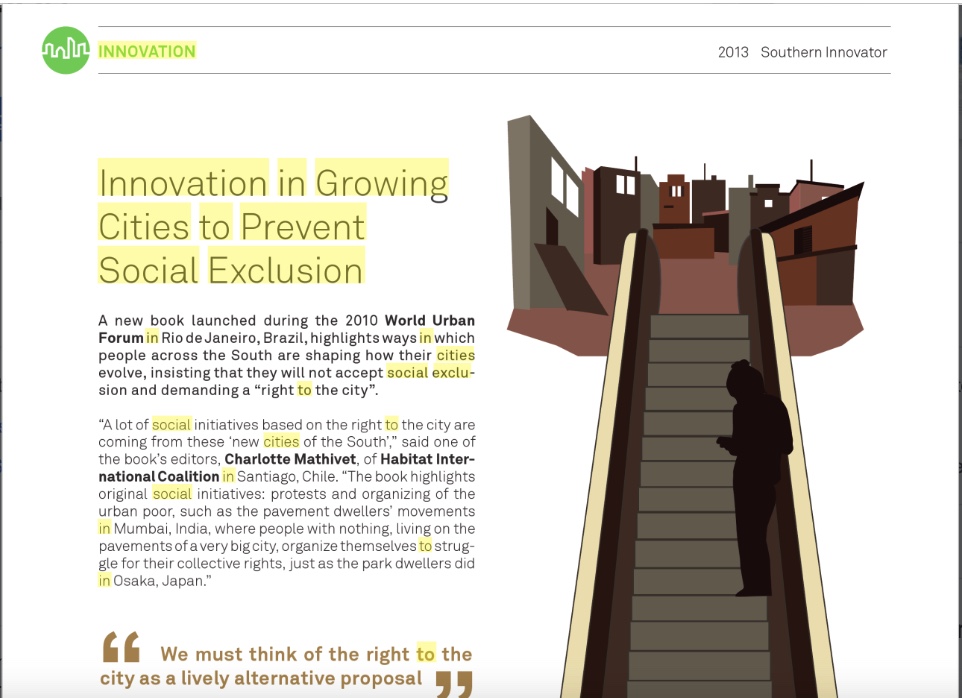
A new book launched during this year’s World Urban Forum in Rio de Janeiro, Brazil highlights ways in which people across the South are shaping how their cities evolve, insisting that they will not accept social exclusion and demanding a “right to the city.”
“A lot of social initiatives based on the right to the city are coming from these ‘new cities of the South,’ said one of the book’s editors, Charlotte Mathivet of Habitat International Coalition in Santiago, Chile. “The book highlights original social initiatives: protests and organizing of the urban poor, such as the pavement dwellers’ movements in Mumbai, India where people with nothing, living on the pavements of a very big city, organize themselves to struggle for their collective rights, just as the park dwellers did in Osaka, Japan.”
The book’s chapters span an eclectic mix of topics, from democracy in the world’s future cities to experiences in Africa’s cities, to how the 2008 Beijing Olympics affected the metropolis, to ways of involving children in urban planning.
One innovative case study included in the book is the children’s workshops in Santiago, Chile, which aim to make a more child-friendly city by including children in the planning process.
One example of the success of a child-friendly approach has been the work of the former mayor of Bogotá, Colombia, Enrique Peñalosa (http://www.pps.org/epenalosa-2/) . As mayor of the city of over 6.6 million people from 1998 to 2001, he put children to the fore in planning.
“In Bogotá, our goal was to make a city for all the children,” he told Yes! magazine. “The measure of a good city is one where a child on a tricycle or bicycle can safely go anywhere. If a city is good for children, it will be good for everybody else. Over the last 80 years we have been making cities much more for cars’ mobility than for children’s happiness.”
His term in office saw the establishment or refurbishing of 1,200 parks and playgrounds, the building of three large and 10 neighbourhood libraries and the opening of 100 nurseries for children under five. He also oversaw the creation of 300 kilometres of bike lanes, the largest such network in the developing world, created the world’s longest pedestrian street, at 17 kilometres, and turned land earmarked for an eight-lane highway into a 45 kilometre green belt path.
Cities for All’s publisher, Habitat International Coalition (HIC) (www.hic-net.org) , says it focuses on the link between “human habitat, human rights, and dignity, together with people’s demands, capabilities, and aspirations for freedom and solidarity.”
The group works towards the creation of a theoretical and practical framework for what it calls a “right to the city.”
The cities of Africa and Asia are growing by a million people a week. If current trends continue, megacities and sprawling slums will be the hallmarks of this majority urban world. Currently in sub-Saharan Africa, 72 percent of the population lives in slum conditions. And by 2015, there will be 332 million slum-dwellers in Africa, with slums growing at twice the speed of cities.
“The consequences have produced a deeper gap between the city and countryside and also within the city between the rich and poor,” said Mathivet.
“We must think of the right to the city as a lively alternative proposal,” Mathivet said, “a banner under which social movements, academics, and social organizations are struggling against the perverse effects of neo-liberalism in cities such as the privatization of land, public spaces and services, land speculation, gentrification, forced evictions, segregation, and exclusion.”
Published: July 2010
Resources
1) Model Village India: Drawing on self-organizing methods used in India since 1200 BC, the Model Village India is based around India’s democratic system of Panchayats: a village assembly of people stemming back to pre-colonial times. Website: www.modelvillageindia.org.in
2) More Urban, Less Poor: The first textbook to explore urban development and management and challenge the notion unplanned shanty towns without basic services are the inevitable consequence of urbanization. Website:www.earthscan.co.uk
3) Building and Social Housing Foundation: The Building and Social Housing Foundation (BSHF) is an independent research organisation that promotes sustainable development and innovation in housing through collaborative research and knowledge transfer. Website: http://www.bshf.org
Development Challenges, South-South Solutions was launched as an e-newsletter in 2006 by UNDP’s South-South Cooperation Unit (now the United Nations Office for South-South Cooperation) based in New York, USA. It led on profiling the rise of the global South as an economic powerhouse and was one of the first regular publications to champion the global South’s innovators, entrepreneurs, and pioneers. It tracked the key trends that are now so profoundly reshaping how development is seen and done. This includes the rapid take-up of mobile phones and information technology in the global South (as profiled in the first issue of magazine Southern Innovator), the move to becoming a majority urban world, a growing global innovator culture, and the plethora of solutions being developed in the global South to tackle its problems and improve living conditions and boost human development. The success of the e-newsletter led to the launch of the magazine Southern Innovator.
“Cities for All, recently published by Habitat International Coalition, draws together thinkers and innovators in a compilation of case studies addressing the challenges of inclusive cities in the global South. The book seeks to articulate experiences of South-South cooperation and enhance the links between different regions. David South interviews the co-editor, Charlotte Mathivet.”
The future is arriving in the South even faster than many think: so-called “cyber cities” are being created to become this century’s new Silicon Valleys. Well-known ‘cyber cities’ like India’s Hyderabad and Bangalore have been joined by many other cities across the global South. But two places are set to make big waves with their ambition and drive in 2008: Mauritius and China.
Mauritius, an island in the Indian Ocean strategically close to Africa, better known for tourism and luxury hotels, wants to become the world’s “cyber island”. Armed with the first 3G network in Africa (the third generation of mobile phone technology – offering high-speed internet access and video telephony), Mauritius is moving fast to make good on this advantage. And it is even moving to the next level of mobile-phone speed, something called High-speed Download Packet Access (HSDPA) – allowing even greater quantities of information to be exchanged.
Mauritius joins a select few countries, including Japan and South Korea, at the forefront of access to 3G. Wireless – or wi-fi – computer access is available in three-quarters of the island.
Outside the capital of Port Louis, former sugar cane plantations are being turned into a “cyber city”. The centrepiece of the development is the 12-story Cyber Tower, home to young technology start-ups. The country is also investing heavily in education from primary school to university, to make sure the country’s 1.2 million people are cyber-ready.
Computer novices in remote villages are being visited by a Cyber Caravan with a classroom teaching housewives, children, the unemployed and the disabled basic computing and world processing.
Mauritius built its wealth on tourism, sugar plantations and textile manufacturing. But it is worried that trading arrangements that helped the sugar and textile industries to flourish, will be taken away. So it is focusing on the future: it sees itself as the world centre for disaster recovery computing services for the world’s companies in event of a disaster in their own country that destroys computer networks.
In China, its largest Cyber Park is under construction in Wujin New and High-tech Development Zone of Changzhou. It will be a technology incubator, a research and development centre, and a place for small and medium-sized enterprises to innovate.
What is truly making people stop and think is another far-reaching project: the Beijing Cyber Recreation District (CRD) – China’s most ambitious digital media industry development: a virtual worlds’ initiative with digital media academies and company incubators. It is spread over 100 square kilometres, creating the world’s largest virtual world development. It is already home to more than 200 game and multimedia content producers in western Beijing.
The CRD says its goal is “to create a virtual economy providing infrastructure and platforms through which any business – not just those based in China – can come in and sell their real-world products and services. While a concerted effort will be placed on bringing Chinese businesses and consumers in, the effort is worldwide and open to businesses and consumers from any country.”
The idea is to create a vast virtual economy for commerce where manufacturers can directly connect with billions of customers – bypassing middlemen.
It claims it will be “the world’s one-stop shop for customers and producers.” It will host billions of avatars – or virtual people – surpassing the capability of the very popular Second Life virtual world game’s 40,000.
Published: January 2008
Resources
The Atlas of Ideas is an 18-month study of science and innovation in China, India and Republic of Korea Korea, with a special focus on new opportunities for collaboration with Europe. It is a comprehensive account of the rising tide of Asian innovation. Special reports on China, India and Korea, introducing innovation policy and trends in these countries can be downloaded for free.
The Cyber Cities Reader: the first book to bring together a vast range of debates and examples of ICT-based city changes.
Development Challenges, South-South Solutions was launched as an e-newsletter in 2006 by UNDP’s South-South Cooperation Unit (now the United Nations Office for South-South Cooperation) based in New York, USA. It led on profiling the rise of the global South as an economic powerhouse and was one of the first regular publications to champion the global South’s innovators, entrepreneurs, and pioneers. It tracked the key trends that are now so profoundly reshaping how development is seen and done. This includes the rapid take-up of mobile phones and information technology in the global South (as profiled in the first issue of magazine Southern Innovator), the move to becoming a majority urban world, a growing global innovator culture, and the plethora of solutions being developed in the global South to tackle its problems and improve living conditions and boost human development. The success of the e-newsletter led to the launch of the magazine Southern Innovator.
We were able to identify numerous trends that were at the time being overlooked or under-reported; trends that could radically re-shape international development. This included the rapid rise ofmobile phonesin the global South and their powerful impact on economic development, the rush to cities and urban areas that was turning the world into a majority urban place, and the shift to greater South-South trade, investment and contact. Whereas the past involved people always looking North for inspiration, capital and business and trade relationships, this was shifting to South-South arrangements. And there were plenty of inspirational, modern, 21st century examples of economic, social and human development achievements across the global South to report on. By consistently tracking and chronicling a quiet revolution underway in the global South, the e-newsletter was able to draw attention to a rising 21st-century global innovator culture being shaped by the use of mobile phones and information technologies. Few at the time had grasped how much this was going to reshape the international development paradigm.
To start, the e-newsletterDevelopment Challenges, South-South Solutions(begun in 2006), was used to gather together as many stories, data, trends, and contacts as possible and get this message to as wide a group as possible. Luckily, this coincided with the very moment whole swathes of the global South were coming online, either through connecting with mobile phones or through the Internet. Quickly, it became clear there was not a lack of inspiring stories and innovations and solutions to share, but a lack of resources to communicate them. One solution was to utilise a new publishing tool that emerged in 2007: crowd-powered news services. It became a great way to bypass the stranglehold on news and information held by traditional media. Read more on this here:http://www.scribd.com/doc/251968773/Southern-Innovator-Summary-of-Impact-2011-to-2012
In particular, the e-newsletter caught the eye of those looking for inspiration in the wake of the 2007/2008 global economic crisis:
“Great economic and business reporting! Very helpful for us.” Africa Renewal, Africa Section, Strategic Communications Division, United Nations Department of Public Information
“I just went over your June newsletter. It’s very well done and far reaching. Congratulations!” Violette Ruppanner, Director, 3D -> Trade – Human Rights – Equitable Economy, Geneva, Switzerland
“Just to let you know I enjoyed the newsletter a lot – it was interesting to learn about things going on that I would never otherwise find out about, and also the listing of future conferences and events proved very useful.” Ian Sanderson, Deloitte, Geneva, Switzerland
“Congratulations on another great newsletter that’s packed with fascinating information! I really enjoy getting it each month.” Whitney Harrelson, Making Cents, Washington D.C.
2008: Development work begins on the concept for a book on innovation in the global South. Attend an Africa trade-focused meeting in Switzerland just as the global crisis breaks. Witness attendees dash from the event as they get frantic calls from London and New York. Undertake Cuba study tour with the BSHF.
2009: The book concept becomes a magazine. Attend the UN Conference on the Social and Political Dimensions of the Global Crisis: Implications for Developing Countries in Geneva, Switzerland.
2010: Begin working with graphic designer and illustrator Solveig Rolfsdottir and graphic designer Eva Hronn Gudnadottir in Reykjavik, Iceland on the initial concepts for what would become Southern Innovator. The working title for the new magazine is Creative Sparks.
2014: The fifth issue ofSouthern Innovatoris launched at the Global South-South Development Expo (GSSD Expo) in Washington, D.C.. Southern Innovator has always tried to inspire others to take action and this has turned out to be the case.
“Beautiful, inspiring magazine from UNDP on South-South innovation. Heart is pumping adrenaline and admiration just reading it”
Once blazing a lonely trail, there are now many places to find stories on global South innovation (The Guardian, SciDev, Devex, Business Fights Poverty, Zunia etc.). Mainstream media have also woken up to the energy and change sweeping across the global South, disrupting its regular diet of negative news stories focused around war, disasters and failure (unfortunately, still the majority of what most people see on their TV).
“I liked your latest Southern innovator! Always inspiring.”
“Btw, I really enjoyed reading them, impressive work & a great resource. Looking forward to Issue 6. My best wishes to you & your team at SI.”
“The magazine looks fantastic, great content and a beautiful design!”
Most importantly, it is the young who have told us they ‘get’ Southern Innovator. It portrays a world they know – comfortable with new technologies, looking to solve problems, open to doing things in new ways. And it is that audience that excites us the most: the youth of the global South (Africa’s young population will be a huge contributor to the world’s working-age workforce by 2050): they are shaping the new world we live in and seeking a role in it.
On Twitter, comments included: From @CapacityPlus Nice job RT @ActevisCGroup: RT @UNDP: Great looking informative @SouthSouth1 mag on South-South Innovation; @UNDP Great looking informative @SouthSouth1 mag on South-South Innovation; @JeannineLemaire Graphically beautiful & informative @UNDP Southern Innovator mag on South-South Innov.
The phases of this project have been compiled in two e-books and published online here:
2015: In September 2015 (http://www.bbc.co.uk/news/world-asia-china-34372188), China’s President Xi Jinping announced China would spend US $2 billion on South-South cooperation initiatives. This has been called “a ‘game changer’ in international relations”(http://www.ipsnews.net/2015/11/opinion-chinas-new-south-south-funds-a-global-game-changer/).President Xi also said of South-South cooperation, it is: “a great pioneering measure uniting the developing nations together for self-improvement, is featured by equality, mutual trust, mutual benefit, win-win result, solidarity and mutual assistance and can help developing nations pave a new path for development and prosperity.”
The Southern origins of sustainable development goals: Ideas, actors, aspirations by Sakiko Fukuda-Parr and Bhumika Muchhala (SDG Resource Centre).United Nations General Assembly: Sixty-ninth session, Item 24 (b) of the provisional agenda, Operational activities for development: South-South cooperation for development, 17 July 2014.The research informing Southern Innovator Magazine played a part in the formulation of the UN’s post-2015 development agenda, including the Sustainable Development Goals (SDGs).










 David South Consulting
You must be logged in to post a comment.