Tag: SDG1

  • Business as a Tool to Do Good

    Business as a Tool to Do Good

    By David SouthDevelopment Challenges, South-South Solutions

    SOUTH-SOUTH CASE STUDY

    The United States’ fast-paced and highly inventive technology sector is re-shaping philanthropy and proving it is possible to do good and make money at the same time. The approach taken by these philanthropists is flavoured by their experiences in the cut-throat world of technology, where innovation is a necessity and where re-invention and risk are de rigeur. They share many of these qualities, counter intuitively, with millions of the world’s poor as they struggle day in and day out to survive and get ahead.

    Differing from the Fairtrade movement – whose origins are in NGOs seeking guaranteed fair price for goods – so-called ‘venture philanthropists’ and ‘social entrepreneurs’ focus more on profit and growth. They draw their inspiration from the online networks that have rocked the business world in the past few years, and look to apply a model of constant innovation.

    The past ten years have seen non-profits more and more adopt the language and methods of business. For ‘venture philanthropists’ and ‘social entrepreneurs’, business is the tool to do good. By breaking out of the narrow view of philanthropy as about giving away money, it becomes possible to see the connections between doing good and making good money, venture philanthropists argue. And as more people think this way, more tools are emerging to make it easier and easier to do.

    The highly successful online auction house Ebay’s founders Jeff Skoll and Pierre Omidyar are part of a wave of new thinking from California’s high-tech Silicon Valley that is shaping the way huge sums of private capital get invested in social change.

    ‘Venture philanthropists’ focus on a small portfolio of grantees that make the most of the investment. By giving them large, long commitments, including money for infrastructure such as staff and computers, they don’t spend all their time fundraising. And unlike traditional philanthropists, they get in their offices and work with them like partners instead of waiting for annual reports, and they hold the grantees to quantifiable goals.

    The success of Nobel Prize winner Mohammed Yunus and his microcredit bank, Grameen, has spawned an even more ambitious venture. The Omidyar Network – led by billionaire Omidyar – calculated it would take between US $50 and US $60 billion to provide micro-lending services to the entire world’s poor. The Network is currently putting together the financing to launch this new micro-lending facility across the world. According to Omidyar, private capital is functionally limitless. Look at it that way, he said recently to the Los Angeles Times, and “$60 billion is nothing.”

    Billing itself as a nonprofit venture capital firm, the Acumen Fund uses the principles of design to solve the problems of the poor. Just as the Procter & Gambles (PG) and Motorolas (MOT) of the corporate world conduct extensive ethnographic research on consumers, Acumen finances companies that create systems from the bottom up. “Start with the individuals,” said founder Jacqueline Novogratz. “Build systems from their perspective. Really pay attention, and then see if they can scale.”

    Under Novogratz’s leadership, the New York-based fund manages $20 million in investments in companies that fall within three portfolios: health, water, and housing. It’s not a lot of money compared with any of the traditional venture funds in Silicon Valley. But Acumen’s goal is not to launch initial public offerings. Rather, Novogratz and her team are building prototypes for new business models that measure returns in social benefits as well as monetary rewards.

    “We are betting on entrepreneurs, we look for a strong management team,” said Brian Trelstad, Chief Investment Officer of the Acumen Fund. “We currently have US $20 million in investments in six countries. We hope to take that to US $100 million in the next five years. We are beginning to see a really rich pipeline developing in our investment countries and more high quality investment opportunities coming our way. We are looking for people who are passionate about their approach and who continue to build their business from the perspective of the people in need.”

    Larry Page and Sergey Brin, the founders of the successful search engine Google, started their philanthropic wing, Google.org, following Ebay’s example. They endowed Google.org with stock now worth about US $1 billion. Then they followed Omidyar’s example and set themselves up as a for-profit network.

    “In the old American business model, the relationships between a firm and its investors, bank, suppliers and customers tended to be very arm’s length,” says Annalee Saxenian, dean of UC Berkeley’s School of Information. “You would make a deal and report back after some specified period of time. The new business model is much more engaged. Everyone learns from one another, and there is a continuous flow of information. The firms are more specialized, but they see each other as collaborators.”

    The approach, just like in the pell mell pace of the computer industry, is relentless. Just as computer software and hardware manufacturers follow a constant improvement and innovation cycle, so can social entrepreneurs.

    Published: March 2007

    Resources

    • The Skoll Centre for Social Entrepreneurship at Oxford’s Said Business School, hosts the Skoll World Forum every year to promote entrepreneurial solutions to social problems.
    • Ashoka: Ashoka is the global association of the world’s leading social entrepreneurs. It identifies and invests in leading social entrepreneurs with innovative and practical ideas at the launch stage. They then receive a living stipend for three years to focus on their ideas.
    • Social Ventures Partners: While only focused on the Seattle, USA area, SVP offers a model that can be applied throughout the global South. The vision of the founders was to build a philanthropic organization using a venture capital model, where partners actively nurture their financial investments with guidance and resources.
    • Generation Investment Management: Started in 2004 with former US vice president Al Gore, they only focus on investments that are long-term, sustainable and that they really believe in.
    • Omidyar Network: Started by Ebay’s founders, it funds for-profits and non-profits who promote equal access to information, tools and opportunities, and encourage shared interests and a sense of ownership among participants.
    • Skoll Foundation: The mission of the Foundation is to seek out social entrepreneurs who are already implementing successful programs on a small scale, and then through three-year awards, support the continuation, replication or extension of the program. Issues funded are: tolerance and human rights, health, environmental sustainability, economic and social equity, institutional responsibility, and personal security.
    • SV2: Silicon Valley Social Venture Fund: A partnership of successful technology entrepreneurs, it pools funds to support social entrepreneurs by giving money and giving time – venture philanthropy.
    • Google.org: It uses the talent, technology and financial resources of the successful search engine to tackle global poverty.
    • Acumen Fund: A non-profit venture fund that invests in market-based solutions to global poverty. The Fund supports entrepreneurial approaches to developing affordable goods and services for the 4 billion people in the world who live on less than $4 a day.
    • TechnoServe: Helps budding entrepreneurs turn good business ideas into thriving enterprises. With funding from the Google Foundation, they are launching a Business Plan Competition and an Entrepreneurship Development Program in Ghana.

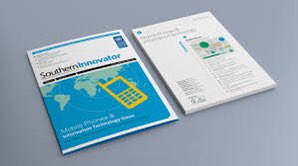
    Development Challenges, South-South Solutions was launched as an e-newsletter in 2006 by UNDP’s South-South Cooperation Unit (now the United Nations Office for South-South Cooperation) based in New York, USA. It led on profiling the rise of the global South as an economic powerhouse and was one of the first regular publications to champion the global South’s innovators, entrepreneurs, and pioneers. It tracked the key trends that are now so profoundly reshaping how development is seen and done. This includes the rapid take-up of mobile phones and information technology in the global South (as profiled in the first issue of magazine Southern Innovator), the move to becoming a majority urban world, a growing global innovator culture, and the plethora of solutions being developed in the global South to tackle its problems and improve living conditions and boost human development. The success of the e-newsletter led to the launch of the magazine Southern Innovator. 

    Creative Commons License

    This work is licensed under a
    Creative Commons Attribution-Noncommercial-No Derivative Works 3.0 License.

    ORCID iD: https://orcid.org/0000-0001-5311-1052.

    © David South Consulting 2023

  • Creative and Inventive Ways to Aid the Global Poor

    Creative and Inventive Ways to Aid the Global Poor

    By David SouthDevelopment Challenges, South-South Solutions

    SOUTH-SOUTH CASE STUDY

    As the saying goes, “necessity is the mother of invention”. Poverty can be a major spur to invention, and invention a route out of poverty – but only if the poor in the developing world can get the recognition, capital and support for navigating the legal and bureaucratic hurdles that will inevitably stand in their way. Thankfully many new initiatives acknowledge this.

    Contrary to popular perception, the poor do have buying power, as has been documented by Massachusetts Institute of Technology (MIT) professors Abhijit Banerjee and Esther Duflo in their paper “The Economic Lives of the Poor”. Surveying 13 countries, they found those living on less than a dollar a day, the very poor, actually spent 1/3 of their household income on things other than food, including tobacco, alcohol, weddings, funerals, religious festivals, radios and TVs. The researchers also found that the poor increasingly used their spending power to seek out private sector options when the public sector failed to provide adequate services. As awareness of global poverty has grown in the past decade, a new wave of scientists, inventors and entrepreneurs has started to apply their considerable brain power to tackling the everyday problems of the poor.

    Afrigadget, a website celebrating African ingenuity and inventions, serves as a goldmine for small-scale entrepreneurs looking for inspiration. All the inventions on the website share something in common: they are grassroots, homemade and handmade solutions to everyday problems of the poor. Examples of inventions profiled on the website include multi-machines, basically a 3-in-1 machine used as a metal lathe, mill and drill press, all built by hand from old car engine parts; a US $100 bicycle motor that gets 50 kilometres per liter made in Kisumu, Kenya; hand-made African wire toys; do-it-yourself telephone handsets which are then used to run roadside phone booths as a small business; and Malawian homemade windmills used to generate electricity for both home use and as a business to recharge mobile phone and radio batteries.

    Another African invention tackles the urgent need for inexpensive or free common toilets that are self-financing. In the Kibera slum of Nairobi, Kenya, where 60 percent of the city’s inhabitants live, the lack of decent toilet facilities has led to the widespread use of so-called “flying toilets”, plastic bags filled with excrement and then flung as far away as possible. The resulting build-up turns the streets into a foul-smelling sludge in the rainy season and causes disease outbreaks like diarrhoea and typhoid fever. Up to now, conventional attempts to provide communal toilets have failed to resolve the problem, because they charge too much to use. But an innovative solution has been developed: bio-latrines that capture the methane gas produced by the toilets for sale as gas for cooking, heating and lighting, and the sludge for fertilizer. A joint initiative between a Kenyan company, Globology Limited, and the NGOs Umande Trustand Ushirika Roho Safi Laini Saba, it is partly funded by the Swedish International Development Agency (SIDA). The toilets are used by 500 people a day and are self-financing from the profits made by the sale of the gas and fertilizer.

    In India, social entrepreneurs have stepped in to help the rural poor navigate the Indian government bureaucracy. Drishtee, an internet service provider – offers a fast-track to government services used by the poor in rural villages through its e-government services information kiosk. Using a franchise model, it has branches spread out through 160 locations in the country and serves 1.5 million people. Drishtee’s niche is that it saves the poor the exhausting and draining time and long travel normally required to access any government services. Drishtee’s “ask a government employee” service brings government to the poorest people.

    Operating out of New Zealand and South Africa, Ecologics is an engineering company focused on developing appropriate technologies for sustainable livelihoods in developing countries. All their inventions are built around the principles of low maintenance and costs, and ease of use. Its African operations are based in South Africa and run under the Black Economic Empowerment (BEE) scheme. It builds step powered pumps, the Step Action Water Pump which works just like a gym step exercise machine and is a highly efficient way to power the pump – for small scale mining and agricultural irrigation. The pumps can deliver 5,000 to 6,000 litres of water per hour, weigh just 11 kilograms, and have been field tested in Fiji, Lesotho and South Africa.

    Published: April 2007

    Resources

    • NextBillion.net: Hosted by the World Resources Institute, it identifies sustainable business models that address the needs of the world’s poorest citizens.
    • A paper on social lending via the web: PDF version
    • African Inventors Museum: The International African Inventors Museum promotes positive images and self-esteem in children and adults and teaches people of all nationalities about the contributions that Africans throughout the world have given to society.
    • AU-WIPO Prize: The AU-WIPO is an initiative of the Africa Union Commission and the World Intellectual Property Organization. It is a leading continental award in Africa honoring the scientists and technologists whose efforts are towards addressing critical problems in Africa and the attainment of the Millennium Development Goals.
    United Nations e-newsletter Development Challenges, South-South Solutions visited the Berlin, Germany headquarters of start-up betterplace.org in 2009. It was the dawn of the Berlin digital tech boom.

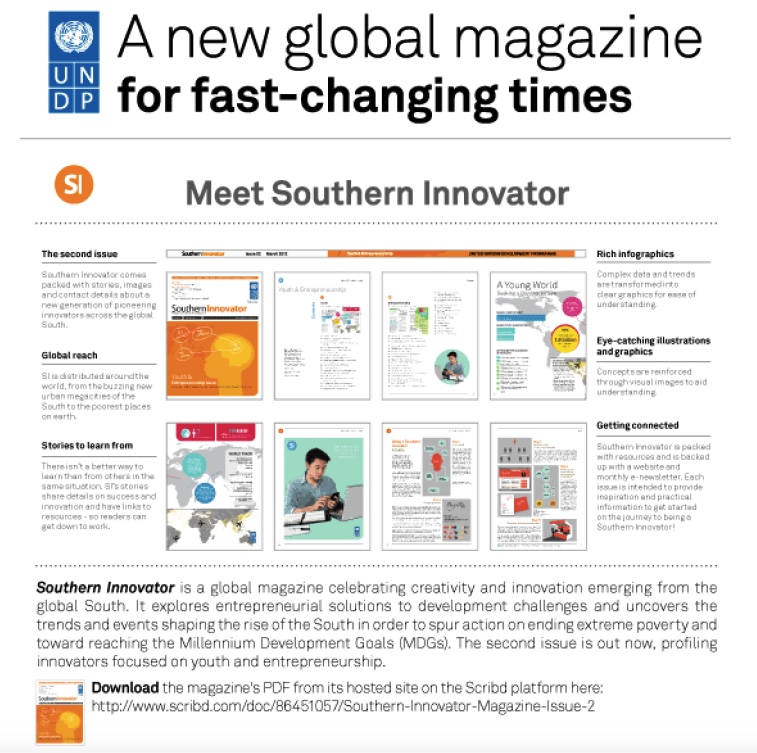
    Development Challenges, South-South Solutions was launched as an e-newsletter in 2006 by UNDP’s South-South Cooperation Unit (now the United Nations Office for South-South Cooperation) based in New York, USA. It led on profiling the rise of the global South as an economic powerhouse and was one of the first regular publications to champion the global South’s innovators, entrepreneurs, and pioneers. It tracked the key trends that are now so profoundly reshaping how development is seen and done. This includes the rapid take-up of mobile phones and information technology in the global South (as profiled in the first issue of magazine Southern Innovator), the move to becoming a majority urban world, a growing global innovator culture, and the plethora of solutions being developed in the global South to tackle its problems and improve living conditions and boost human development. The success of the e-newsletter led to the launch of the magazine Southern Innovator. 
    Creative Commons License

    This work is licensed under a
    Creative Commons Attribution-Noncommercial-No Derivative Works 3.0 License.

    ORCID iD: https://orcid.org/0000-0001-5311-1052.

    © David South Consulting 2023

  • Pakistan Simplifies Job-matching Services

    Pakistan Simplifies Job-matching Services

    By David SouthDevelopment Challenges, South-South Solutions

    SOUTH-SOUTH CASE STUDY

    An innovative job-matching service from Pakistan is trying to bring together people who normally live separate lives. It is eliminating the middlemen who gouge both employers and employees for job-seeking fees and opening up a new world of opportunities for the poor.

    Connecting employees and employers is a problem being compounded in countries all over the world by the global economic crisis, as people retrench to their own communities and stick with known and trusted contacts. While this is a natural response to crisis, it is highly damaging to economies and social mobility.

    Pakistan (http://www.tourism.gov.pk) has had to contend with multiple challenges in the last few years. It has been hard hit during the global economic crisis. It is also experiencing stress from the ongoing conflict resulting from terrorism and the nearby war in Afghanistan. And 2010’s floods devastated large swathes of the country’s crops.

    As the World Bank noted in its Pakistan Economic Update June 2011, “Pakistan continues to face significant political challenges in achieving durable development. The domestic security situation as a result of (the) campaign against terrorism is a direct and indirect tax on the costs of economic activity and the achievement of the kinds of social stability required to promote a supportive environment for businesses.”

    The World Bank estimates that 30 percent of the population lives below the poverty line, although Pakistan’s finance ministry has recently estimated it to be 43 percent.

    “Due to the global financial crisis, many businesses in Pakistan either scaled down their operations or had to close down,” said Asim Fayaz, one of the people behind Pakistan Urban Link and Support, or PULS (http://www.puls.pk).

    “As a result, the income of the informal sector was also affected because many of them became unemployed. In turn, the supply surplus meant the job market became more competitive, further affecting their income growth.”

    Job-hunting is time-consuming for everyone involved in any country, worse still during an economic downturn. The hunt for a job or for the right employee is part and parcel of a dynamic economy. The more dynamic and fast-evolving an economy, the more employees will move around looking for the best deal and the more employers will need to seek out people with the latest skills and best attitudes to stay competitive. A fluid labour market is a good thing if a country wants to be competitive.

    PULS bills itself as a “Telecommunications Software Platform for Job Search and Networking between the Working Poor and Educated Elite of Pakistan” (http://www.puls.pk). It was a semi-finalist in the 2011 Dell Social Innovation Competition (http://www.dellsocialinnovationcompetition.com/ideaView?id=08780000000DaC6AAK).

    “Conventionally, the informal sector workforce has found employment primarily through personal connections,” explains Fayaz. “In cases where that doesn’t work, they approach employment agencies and get enlisted. These employment agencies, behaving as middle men, charge both the employer and the employee upon making a connection. PULS removes the need for the middle man. Employees sign up on this platform themselves. Employers will only be charged a very small amount if they wish to contact a listed employee. If the employee is actually hired, PULS does not find out about the transaction and does not make anything off it.”

    As an e-marketplace accessible through SMS and Web, PULS matches the working poor to the educated elite of Pakistan. It is hoped it will boost the creation of jobs in Pakistan and help in raising incomes. PULS defines working poor as skilled but undereducated domestic workers (cooks, drivers, guards, gardeners, tailors, etc.), independent laborers and self-employed craftspeople.

    Pakistan has a population of over 169 million (World Bank, 2009). Of that, PULS estimates there are 20 million people who are literate and have access to mobile phones but not the Internet.

    Then there is the elite, defined as educated employers and formal-sector professionals. They live in extended family households and employ one or more domestic workers. Of this elite group, around 10 million are regular Internet users.

    The much larger group of working poor have little access to the resources found on the Internet or in employment databases. Because of this, most turn to word-of-mouth and informal connections to the elite for new jobs and upward mobility.

    These groups have traditionally failed to meet. The educated elite, with their access to online search-engines and classifieds, only ever see other people engaged with the formal employment sector. Those in the informal sector are left out of the loop in accessing these better quality jobs with better pay.

    Fayaz says PULS enables jobseekers to “get access to more employment opportunities outside their network.”

    “They will be able to contact those potential employers directly without going through a middle man,” he said. “Most importantly, this service will be free for employees.”

    He says the platform could potentially be used for other transactions, such as buying and selling cars, electronics and other equipment.

    PULS has built a multi-use, “mobile-to-web software platform explicitly designed for semi-literate mobile phone users and fully literate Web users.”

    The first version, PULS 1.0, has an SMS (short message service) interface in the Urdu language and enables domestic employees to register, create a profile, and communicate with employers. All an employer has to do is pull up the PULS 1.0 website. The employer creates a profile as well, searches for potential employees, and sends SMS messages to employees through an anonymous gateway.

    “In addition to employer-to-employee broadcasting, PULS will also (eventually) provide the informal sector a simple means to self-promote and broadcast custom messages back to employers,” Fayaz said. “Presumably PULS will eventually offer a multi-use tool for advertising, networking, job search, and even financial transactions, all via SMS-to-Web.”

    PULS is a non-profit entity developed by a team from The Fletcher School, Tufts University in the United States (http://fletcher.tufts.edu) and aims to be financially sustainable as it grows and the service stays affordable for its users. Employees can use the system for free as long as they pay standard SMS charges, while employers must buy credits. To get things started, employers are given 1,000 credits for free. PULS is also offering premium services such as mass-communication surveys, market research, and advertising.

    Developing the technology didn’t prove difficult in Pakistan, Fayaz says.

    “We have a large of pool of skilled workers equipped to develop such platforms, very high cellular penetration and one of the lowest SMS rates in the world!”

    Fayaz advocates taking an organic approach to developing a new technology like PULS.

    “Setting up the technology is just one part of the picture,” he said. “You should identify a problem, look at how it’s currently being addressed, see how you can improve, research on how it’s being addressed in similar circumstances elsewhere (in our case, India works best), design your solution with just the main use cases addressed, and aggressively roll out.

    “You should remember that you have to make revenue at some point but don’t let it be a hurdle in the short term. Don’t jump back to the drawing board if the first few people find your service hard to use. Also, you may want it to look fancier than Facebook but remember, they also took time getting there!”

    Published: August 2011

    Resources

    1) Dell Social Innovation Competition: The competition is looking for students with the most innovative ideas to solve a social or environmental problem anywhere in the world and the first prize is US $50,000. Website: http://www.dellsocialinnovationcompetition.com/

    2) Taka Taka Solutions: TakaTaka Solutions is a social enterprise that collects and recycles waste. It aims to bring about social and environmental change through a commercially viable business approach in Kenya. Website: http://www.facebook.com/pages/TakaTaka-Solutions/101240103296048

    Development Challenges, South-South Solutions was launched as an e-newsletter in 2006 by UNDP’s South-South Cooperation Unit (now the United Nations Office for South-South Cooperation) based in New York, USA. It led on profiling the rise of the global South as an economic powerhouse and was one of the first regular publications to champion the global South’s innovators, entrepreneurs, and pioneers. It tracked the key trends that are now so profoundly reshaping how development is seen and done. This includes the rapid take-up of mobile phones and information technology in the global South (as profiled in the first issue of magazine Southern Innovator), the move to becoming a majority urban world, a growing global innovator culture, and the plethora of solutions being developed in the global South to tackle its problems and improve living conditions and boost human development. The success of the e-newsletter led to the launch of the magazine Southern Innovator. 

    Creative Commons License

    This work is licensed under a
    Creative Commons Attribution-Noncommercial-No Derivative Works 3.0 License.

    ORCID iD: https://orcid.org/0000-0001-5311-1052.

    © David South Consulting 2022

  • Flurry of Anti-poverty Innovations

    Flurry of Anti-poverty Innovations

    By David SouthDevelopment Challenges, South-South Solutions

    SOUTH-SOUTH CASE STUDY

    Innovation is key to transforming the lives of the world’s four billion poor. And it is at the core of much of the new thinking these days. While the world’s poor can’t rely on political developments, or wider macro-economic events to go their way, they can harness the power of invention, innovation and self-reliance to make big changes in the quality of their lives and increase income – and so can those who want to help them. New York Times journalist and author Thomas Friedman put it like this: “Africa needs many things, but most of all it needs capitalists who can start and run legal companies. More Bill Gateses, fewer foundations. People grow out of poverty when they create small businesses that employ their neighbours. Nothing else lasts.”

    In the 1940s, Austrian economist Joseph Schumpeter wrote that “the function of entrepreneurs is to reform or revolutionise the pattern of production.” Schumpeter’s definition remains at the core of an entrepreneurial approach that focuses on innovation and enterprise as a means of addressing social needs. “Social innovators” are pragmatic and embrace innovation to tackle social problems through both for-profit and non-profit models.

    International Development Enterprises India (IDEI) is a non-profit that uses product invention to transform the lives of the poor and tackle hunger and malnutrition. Its approach is to take existing technologies and adapt them, reducing costs and improving effectiveness. By constantly evolving the design, they can focus in on making it cheap and relevant.

    One innovation is the Treadle Pump: a foot operated, water pump for small plots of land. It enables crops to be grown in winter and summer – no need to rely on rain. And since women are key to farm life, it is physically easy for women to use. So far more than 350,000 small farms are using it. It has been calculated the pump increases household incomes by a minimum of US $100/year.

    Another of their innovations is the Affordable Drip Irrigation Technology Intervention. While drip irrigation systems have been for sale in India for the past 15 years, they were not relevant or affordable for small and marginal farms. IDEI adapted these technologies during trials from 1997 to 2000. Existing technologies suffer from two drawbacks: they are complicated to maintain and they are expensive to buy. A big challenge was demystifying the idea that crop irrigation methods were for only the big orchards. The irrigation systems are sold as kits and are scalable so that farmers can expand their systems if they want. IDEI has sold over 85,000 of the various irrigation kits.

    Both inventions are designed to mimic traditional technologies and are inexpensive, thus maximising take-up by small farmers, who can recover the cost within one season of crops.

    They not only do the research and development and product design and manufacturing, but also set up the vertically integrated marketing and sales network and make it viable for the private sector to step up and sell the kits.

    Paul Polak, the founder of the global International Development Enterprises, believes progress is only possible if products are sold at a fair market price. “When you give things away, you lack discipline in how you design them because you don’t have to get feedback from the customer,” he said.

    In the village of Otse, Botswana in southern Africa, the Godisa Technologies Trust has brought affordable solar-powered hearing aids to the poor. Most of the employees are deaf, and as a non-profit social enterprise, its battery chargers – and its branded Solar Aid digital behind-the-ear (BTE) hearing aid – are all for use in developing countries. It is estimated over 600 million people suffer from some form of hearing impairment. According to the World Health Organization, 278 million people in the world are affected by moderate hearing loss. Yet the global production of hearing aids does not come anywhere close to meeting the need.

    The Solar Aid needs only six to eight hours of sunlight to recharge for a full week. And it is fully compliant with WHO guidelines. Conventional hearing aids and batteries are very expensive and often not locally available. Solar Aid batteries can take 400 charges before being replaced.

    The Solar Aid hearing aid was developed through field testing, funds were raised for further design improvements, and it went on to win several awards. But it initially failed to earn back its production costs and so the Godisa Technologies Trust was established to sweat the details on making it sustainable. It was developed in partnership with the Botswana Technology Centre,

    “I want to help other deaf people to have access to education training and employment. I would like to use my skills and opportunities to help other deaf people achieve their goals,” said one of Godisa’s technicians, Sarah Phiri. So successful are these hearing aids, there is interest around the world, including in Canada.

    Adequate street lighting has been proven to cut down muggings and improve public safety, reduce traffic accidents, and boost business confidence in neighbourhoods because people feel safe going there. StarSight’s street lamps combine solar-powered street lighting and internet access in a wireless configuration, freeing up the lighting poles from needing to access the main power and telephone grids. Each one contains VoIP, wi-fi broadband, CCTV and are being rolled out in Istanbul.

    StarSight street lamp poles, designed in Turkey, are also being rolled out in Martinique, Republic of Congo, Cameroon, and Cote d-Ivoire. StarSight’s goal is to install 70,000 street lamps by 2011. Malaysia and Indonesia are next.

    d.light design is a social enterprise targeting the 1.6 billion people who rely on kerosene oil to light their lanterns, or use candles. There is an ambitious goal behind this business: they want to replace all the kerosene lanterns in the world with their lights within the next ten years. They use light emitting diode (LED) technology and are about commercializing light and power solutions for families living without electricity in emerging markets.

    Better lighting has many benefits, including helping children and adults to study and learn during dark hours. Importantly, it will make the air inside dwellings cleaner and the environment safer without the risk of fire. Indoor air pollution is one of the biggest killers of children under five in India. UNDP has found that families with improved lighting see a 30 per cent increase in their income because they can keep doing things at night.

    On high beam, the lights last five hours; on low beam, they last for 200 hours without a charge. It can be re-charged by solar panels or by normal electric outlet. They promise consumers can expect to save $150 over five years. They have received additional support from the Acumen Fund to enter the peri-urban and, later, the rural market in India.

    Published: December 2007

    Resources

    • Rockefeller Foundation Innovation for Development Initiative: It will “spur the development of solutions to the challenges facing poor or vulnerable people around the world.”
      Team leader: Maria Blair, email: Innovation_dev@rockfound.org
    • Pratt Design Incubator for Sustainable Innovation: It brings together the entrepreneurial talents of designers, artists and architects with one goal: to link the social entrepreneur with the business of design. Budding social entrepreneurs get start-up support, design help and connection to mentors.
    • E and Co: An investor providing seed funding to energy entrepreneurs in developing countries.
    • SEAF (Small Enterprise Assistance Fund): A global investment firm focused on helping small companies and entrepreneurs in emerging markets, and those underserved by traditional sources of capital.
    • Microplace: An online marketplace to connect retail investors (anybody looking to invest US $100 or more) with microfinance organisations looking for funds.

    https://davidsouthconsulting.org/2022/02/17/african-digital-laser-breakthrough-promises-future-innovation/

    https://davidsouthconsulting.org/2022/10/05/african-innovation-eco-system-taking-shape/

    https://davidsouthconsulting.org/2021/05/18/african-innovation-helps-make-banking-transactions-safer/

    https://davidsouthconsulting.org/2022/10/10/bringing-the-invention-and-innovation-mindset-to-young-kenyans/

    https://davidsouthconsulting.org/2020/04/25/china-looking-to-lead-on-robot-innovation/

    https://davidsouthconsulting.org/2021/03/24/frugal-innovation-trend-meets-global-souths-innovation-culture/

    https://davidsouthconsulting.org/2022/11/16/housing-innovation-in-souths-urban-areas/

    https://davidsouthconsulting.org/2017/10/18/innovation-agenda-and-timeline-2007-2015/

    https://davidsouthconsulting.org/2022/11/11/innovation-cairos-green-technology-pioneers/

    https://davidsouthconsulting.org/2020/12/14/innovation-in-growing-cities-to-prevent-social-exclusion/

    https://davidsouthconsulting.org/2022/04/28/innovation-in-the-slums-can-bring-peace-and-prosperity/

    https://davidsouthconsulting.org/2020/04/27/innovation-from-the-global-south/

    https://davidsouthconsulting.org/2021/03/04/innovation-villages-tackling-mdgs/

    https://davidsouthconsulting.org/2021/10/22/innovations-in-green-economy-top-three-agenda/

    https://davidsouthconsulting.org/2022/10/27/kenyan-mobile-phone-innovations/

    https://davidsouthconsulting.org/2021/03/02/new-3d-technology-makes-innovation-breakthrough-and-puts-mind-over-matter/

    https://davidsouthconsulting.org/2022/10/09/next-generation-of-innovation-for-the-grassroots/

    https://davidsouthconsulting.org/2022/04/08/technological-innovation-alive-in-brazil/

    Development Challenges, South-South Solutions was launched as an e-newsletter in 2006 by UNDP’s South-South Cooperation Unit (now the United Nations Office for South-South Cooperation) based in New York, USA. It led on profiling the rise of the global South as an economic powerhouse and was one of the first regular publications to champion the global South’s innovators, entrepreneurs, and pioneers. It tracked the key trends that are now so profoundly reshaping how development is seen and done. This includes the rapid take-up of mobile phones and information technology in the global South (as profiled in the first issue of magazine Southern Innovator), the move to becoming a majority urban world, a growing global innovator culture, and the plethora of solutions being developed in the global South to tackle its problems and improve living conditions and boost human development. The success of the e-newsletter led to the launch of the magazine Southern Innovator. 

    https://davidsouthconsulting.org/2022/11/01/southern-innovator-magazine-2010-2014/

    Creative Commons License

    This work is licensed under a
    Creative Commons Attribution-Noncommercial-No Derivative Works 3.0 License.

    ORCID iD: https://orcid.org/0000-0001-5311-1052.

    © David South Consulting 2023